
Thailand Electric Three-wheeler Market Size & Share Growth Forecast Report (2026-2035)
Industry Insight by Vehicle Type (Passenger Carrier, Load Carrier), by Battery Type (Lithium-ion Battery, Lead-acid Battery), by Power Output (Up to 1000W, 1001W–1500W, Above 1500W), by End Use (Passenger Transportation, Goods Transportation)
| Status : Published | Published On : Jul, 2026 | Report Code : VRAT9674 | Industry : Automotive & Transportation | Available Format :

|
Page : 143 |
Thailand Electric Three-wheeler Market Overview
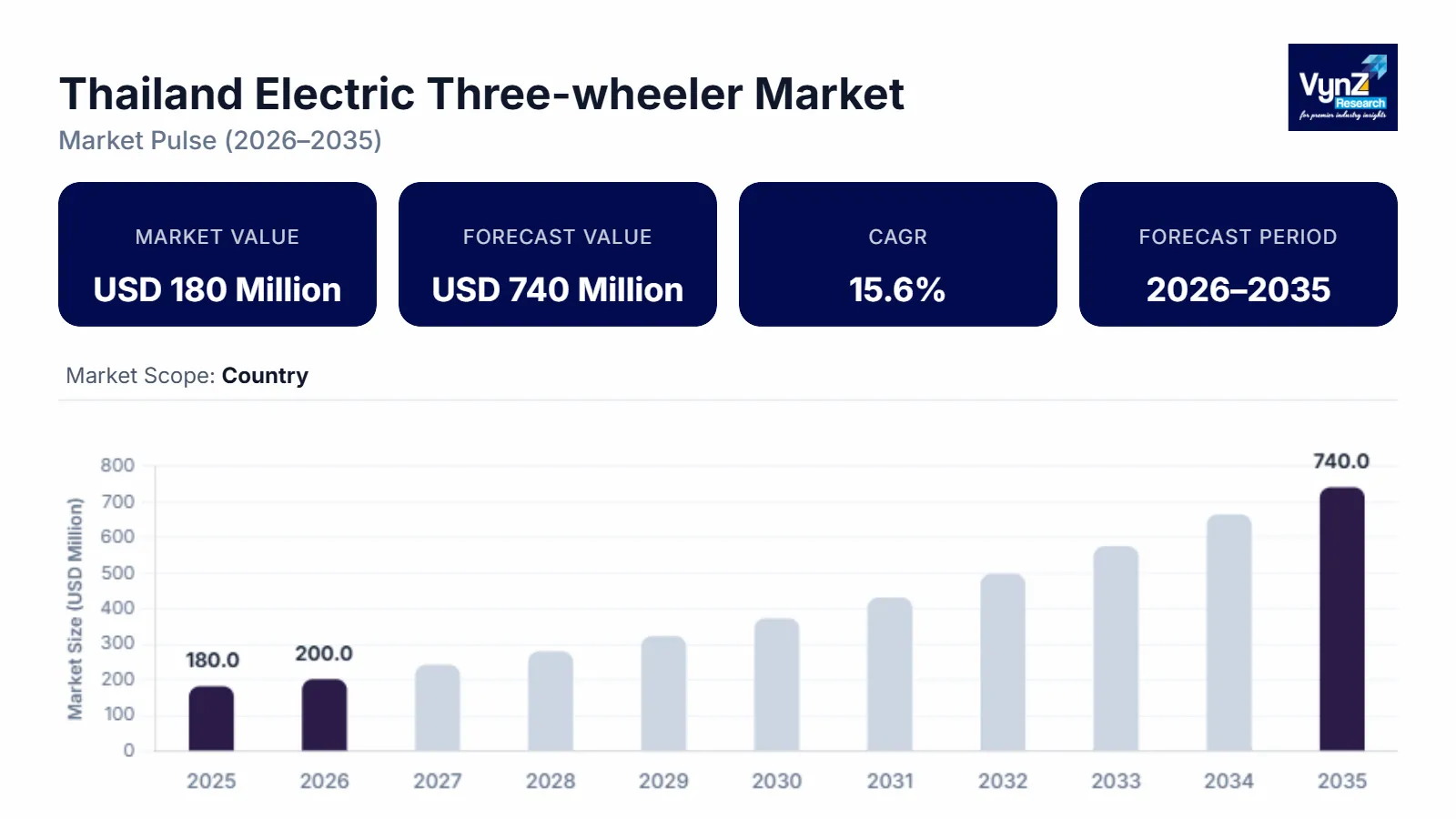
The Thailand electric three-wheeler market size was estimated at USD 180 million in 2025 and is expected to reach around USD 200 million in 2026, rising to roughly USD 740 million by 2035, growing at approximately 15.6% CAGR from 2026 to 2035.
Research Highlights
- Passenger carriers led the pack in 2025, holding 61.4% share as urban mobility needs climbed.
- Lithium-ion took the largest slice of the battery segment at 72.1%, thanks to its efficiency edge over older chemistries.
- The 1001W–1500W power band was the sweet spot for buyers, accounting for 47.8% share on the strength of its performance-to-cost balance.
- Goods transportation looks set to outpace the rest of the market, with a projected 16.5% CAGR as ecommerce volumes keep climbing.
- Bangkok alone brought in 34.2% of total market share in 2025, helped along by faster-than-average EV infrastructure buildout.
A few forces are pushing this market forward at once. Government backing for electric mobility has picked up, urban buyers want cheaper last-mile options, and domestic EV manufacturing is pulling in fresh investment. Together, these are nudging more operators toward battery-powered three-wheelers. Logistics companies, urban transport providers, and small business owners are driving a lot of this uptake, helped by incentives tied to Thailand's National Electric Vehicle Policy. EGAT's ongoing charging-infrastructure rollout is also making it easier for adoption to take hold in Bangkok, Chonburi, and Chiang Mai specifically. On top of that, the Thailand Board of Investment has kept its policy support flowing, and the Ministry of Energy's longer-term decarbonization push is bringing in investment that's likely to keep compounding through the rest of the decade.
Thailand Electric Three-wheeler Market Dynamics
Market Trends
Electric mobility adoption, battery technology, and fleet electrification are all moving at once in Thailand's three-wheeler space, and the shifts are starting to show. Lithium-ion is the clearest example. Manufacturers are leaning into it because it gives buyers more range, better efficiency, and lower running costs than older battery types. The Thailand Board of Investment has kept incentives flowing for EV production, and that's pushing more manufacturers to build out local assembly lines and component supply rather than import everything.
Charging infrastructure is the other big trend. EGAT has been building out its public charging network as part of the national EV roadmap, and the National Electric Vehicle Policy Committee is pushing adoption from the policy side too. With that backbone in place, manufacturers have more room to experiment. Connected vehicle features and fleet-management add-ons are starting to show up as competitive differentiators rather than nice-to-haves.
Growth Drivers
Thailand's broader shift away from combustion-engine transport is the main engine behind this market's growth, and it's showing up across passenger mobility, urban logistics, and delivery fleets alike. Manufacturing capacity, charging networks, and battery production have all pulled in fresh investment, and that's compounding the expansion. BOI's investment incentives remain a draw for both domestic players and manufacturers looking to enter from abroad.
Decarbonization policy is doing real work here too. Fleet operators are watching both their operating costs and their compliance obligations, and electric three-wheelers increasingly check both boxes. That is why demand looks set to hold up through the forecast period. The Ministry of Energy and EGAT are backing this shift from two angles: policy on one side, charging infrastructure on the other.
Market Restraints / Challenges
The growth story isn't without challenges. Vehicle and battery prices are still steep upfront, and that's keeping smaller transport operators and cost-sensitive buyers on the sidelines even with subsidies in place. BOI has flagged that localizing battery production further is key to bringing costs down over the long run.
There's also a supply-chain problem underneath all this. Battery cells and key electronic components are still largely imported. That dependence raises production costs and leaves manufacturers exposed when global supply chains hit turbulence. The Ministry of Industry is pushing for more localized EV component manufacturing specifically to close this gap and build resilience into the supply chain.
Market Opportunities
Last-mile commercial mobility is where the biggest opening sits right now, fueled by ecommerce growth, urban delivery demand, and a broader push toward sustainable transport. Manufacturers that can deliver three-wheelers that are affordable, durable, and connected are in a strong position to win business from logistics firms, retailers, and urban transport operators. BOI's long-term incentive programs are specifically geared toward pulling in next-generation EV manufacturing to serve this demand.
Battery manufacturing and smart charging make up the second major opportunity. As investment flows into better energy solutions, there's room for higher-value products and longer-term partnerships across the industry. Battery management systems, connected fleet platforms, and smarter charging tech are all expected to push operational efficiency up and make adoption easier for end users. EGAT and the National Electric Vehicle Policy Committee continue backing this through national electrification programs and infrastructure investment.
Thailand Electric Three-wheeler Market Report Coverage
|
Report Metric |
Details |
|
Historical Period |
2020 - 2024 |
|
Base Year Considered |
2025 |
|
Forecast Period |
2026 - 2035 |
|
Market Size in 2025 |
USD 180 Million |
|
Revenue Forecast in 2035 |
USD 740 Million |
|
Growth Rate |
15.6% |
|
Segments Covered in the Report |
Vehicle Type, Battery Type, Power Output, End Use |
|
Report Scope |
Market Trends, Drivers, and Restraints; Revenue Estimation and Forecast; Segmentation Analysis; Companies’ Strategic Developments; Market Share Analysis of Key Players; Company Profiling |
|
Regions Covered in the Report |
Bangkok, Eastern Thailand, Northern Thailand, Rest of Thailand |
|
Key Companies |
Altigreen Propulsion Labs, Atul Auto Limited, Euler Motors, Jiangsu Kingbon Vehicle Co., Ltd., Mahindra Electric Mobility Limited, Piaggio Vehicles Pvt. Ltd., Saera Electric Auto Pvt. Ltd., Terra Motors Corporation, TVS Motor Company, YC Electric Vehicle Co., Ltd. |
|
Customization |
Available upon request |
Thailand Electric Three-wheeler Market Segmentation
By Vehicle Type
Passenger carriers dominate this market, holding roughly 61.4% share in 2025 and set to grow at a 15.2% CAGR through 2035. A lot of that comes down to Thailand's cities needing more affordable public transport options and a steady wave of traditional tuk-tuks getting swapped out for electric versions. The Department of Land Transport and the National Electric Vehicle Policy Committee have both leaned into this shift, using registration reforms and electrification initiatives to make cleaner urban transport easier to adopt.
Load carriers are the ones to watch on growth as they're projected to expand faster than any other vehicle segment at 16.3% CAGR. Ecommerce deliveries, retail distribution, and last-mile logistics across industrial and urban hubs are the main drivers here. Government-backed fleet electrification programs, paired with BOI's investment incentives, are giving logistics operators a real reason to switch over faster and run more efficiently while they're at it.
By Battery Type
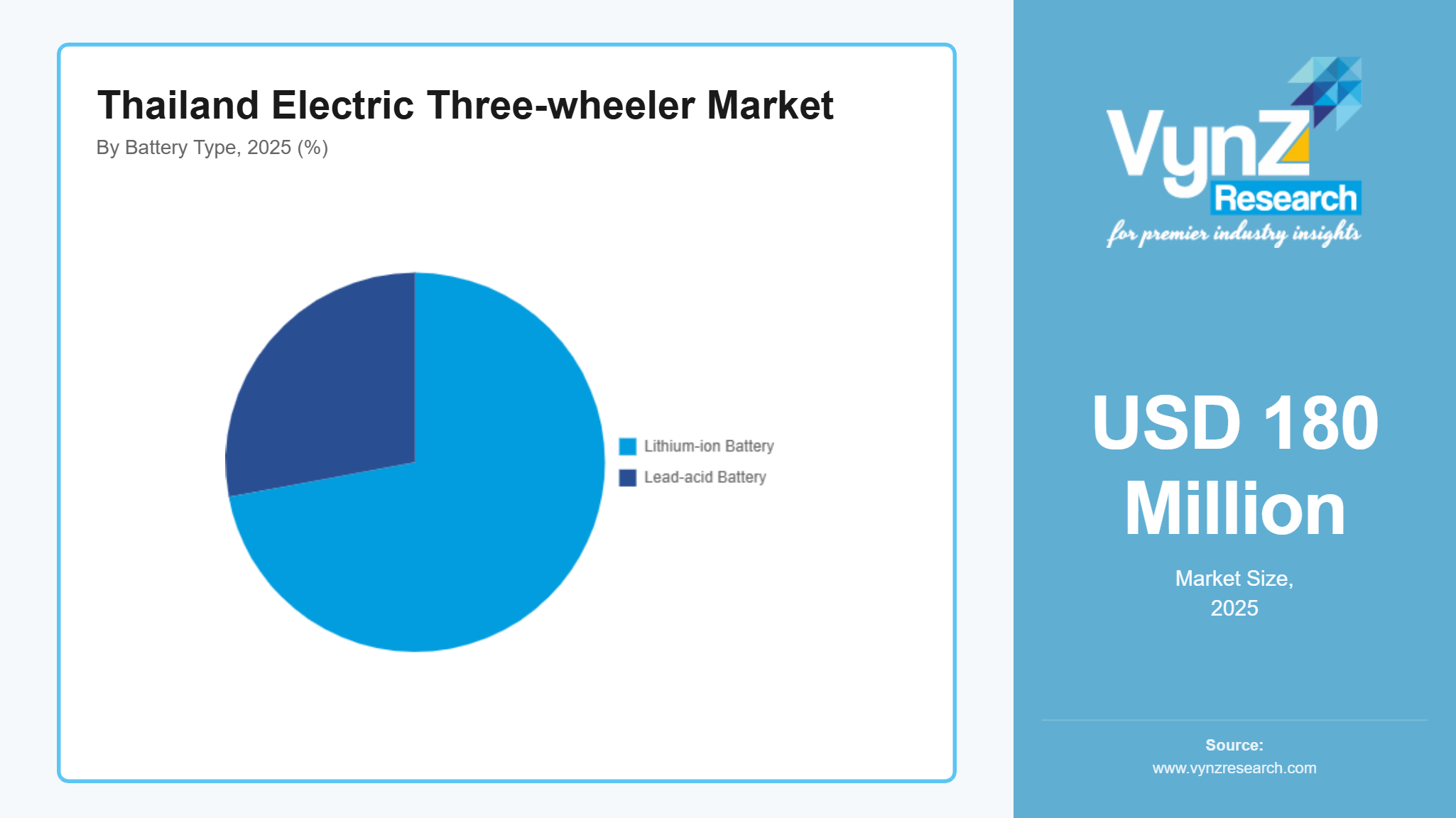
Lithium-ion holds a commanding 72.1% share of the battery segment in 2025, and it's on track for a 16.0% CAGR through 2035. The influencing factors are better energy density, longer service life, quicker charging, and prices that keep coming down. All of these make it an easy choice for commercial operators. BOI and the Ministry of Industry are both backing domestic battery manufacturing and energy-storage investment to keep that momentum going.
Lead-acid grows at 13.1% CAGR since fleet operators are increasingly choosing longer battery life and better efficiency over a lower sticker price. The National Electric Vehicle Policy Committee's continued push for advanced battery tech is likely to speed up the shift toward lithium-based options over the next decade.
By Power Output
The 1001W–1500W bracket is the market's sweet spot, capturing about 47.8% of revenue in 2025 and growing at 15.5% CAGR. It works well because it balances performance with efficiency and suits both passenger and light commercial use without forcing a trade-off. The Department of Land Transport has supported wider adoption here through updated regulations and vehicle certification frameworks.
Above 1500W is where the fastest growth is happening, though, at an estimated 16.6% CAGR. Fleet operators handling heavier payloads and longer routes are the ones pushing this segment forward while commercial logistics work simply demands more power and range. BOI-backed investment in high-performance drivetrains is expected to keep strengthening this category going forward.
By End Use
Passenger transportation leads on revenue, accounting for 64.3% of the market in 2025 and growing at 15.1% CAGR through 2035. Urban commuting and tourism are the two biggest contributors, alongside the ongoing replacement of older three-wheelers with electric versions. The Tourism Authority of Thailand and the Department of Land Transport have both encouraged this shift, particularly across major tourism destinations and metro areas.
Goods transportation is the fastest-growing use case, projected at 16.5% CAGR. Ecommerce and food delivery are driving most of this demand, since electric cargo vehicles offer a clear edge on operating costs and emissions compared to conventional options. BOI's investment incentives and the National Electric Vehicle Policy Committee's electrification push are both working to accelerate fleet conversion across the country.
Regional Insights
Bangkok
Bangkok leads the pack with roughly 34.2% of the national market in 2025, and it's on track for a 15.8% CAGR through 2035. Dense urban population, growing commercial transport needs, and a real appetite for sustainable mobility are behind that lead. Passenger transport, tourism, and urban logistics are all pulling their weight here. The Department of Land Transport and the Bangkok Metropolitan Administration have leaned into cleaner transport through electric mobility initiatives and emission-reduction programs, and that's translating into real adoption on the ground. Ride-hailing operators and commercial fleet owners are increasingly betting on electric three-wheelers, helped along by government incentives and EGAT's continued buildout of public charging stations across the capital is making that bet easier to place.
Eastern Thailand
Eastern Thailand holds about 24.5% share and is set to outpace Bangkok on growth, at an estimated 16.2% CAGR. Chonburi, Rayong, and the surrounding provinces are where most of the action is, driven by industrial expansion, logistics activity, and a steady stream of EV manufacturing investment. BOI's incentives continue to pull manufacturers into the region, while the Eastern Economic Corridor Office is building out the infrastructure needed to support advanced automotive production at scale.
Northern Thailand
Northern Thailand accounts for around 18.3% of the market, growing at an estimated 15.1% CAGR through 2035. Tourism is a big part of the story here and rising urban transport needs and growing environmental awareness are keeping demand steady across Chiang Mai and nearby provinces. The Tourism Authority of Thailand and the Department of Land Transport have both pushed environmentally friendly transport options, which is helping electric three-wheelers gain ground in a region that's traditionally been slower to electrify.
Rest of Thailand
The remaining regions together make up about 23.0% of the market, expanding at roughly 15.4% CAGR. Secondary cities and rural provinces are where this growth is concentrated, as affordable passenger mobility and last-mile goods transport become more of a priority outside the major metros. The Ministry of Energy, the Department of Land Transport, and BOI are all working different angles like charging infrastructure, investment incentives, and manufacturing support to bring EV adoption further into these markets.
Competitive Landscape / Company Insights
Competition in Thailand's electric three-wheeler space sits at a moderate level right now, with both domestic and international players jockeying for position through product innovation, battery upgrades, localization efforts, and strategic tie-ups. R&D spend, production capacity, and next-gen mobility solutions are where most companies are putting their money, largely to keep pace with shifting regulations and buyer expectations. BOI's investment promotion programs and the National Electric Vehicle Policy Committee's development initiatives are keeping the pressure on, pushing manufacturers to compete harder on both technology and scale.
Mini Profiles
Altigreen Propulsion Labs has built its reputation around electric commercial mobility, backed by solid battery tech and research chops, and it's been growing its footprint through partnerships with fleet operators.
Euler Motors plays in the commercial EV space with a focus on high-performance cargo three-wheelers, connected-vehicle features, and fleet solutions built for urban logistics and last-mile delivery work.
Jiangsu Kingbon Vehicle Co Ltd brings scale to the table — large manufacturing capacity, a diversified EV lineup, and export reach that extends its three-wheeler business into international markets.
Piaggio Vehicles Pvt. Ltd. covers both passenger and cargo electric three-wheelers, leaning on an established dealer network, strong brand equity, and steady investment in product development.
Terra Motors Corporation has carved out a niche through strategic partnerships and regional manufacturing, using advanced battery tech to build a stronger foothold across emerging Asian EV markets.
Key Players
- Altigreen
- Propulsion Labs
- Atul Auto Limited
- Euler Motors
- Jiangsu
- Kingbon
- Vehicle Co Ltd
- Mahindra Electric Mobility Limited
- Piaggio Vehicles Pvt. Ltd
- Saera Electric Auto Pvt. Ltd
- Terra Motors Corporation
- TVS Motor Company
- YC Electric Vehicle Co Ltd
Recent Developments
Atul Auto Limited rolled out upgraded electric three-wheeler models in January 2025, adding better battery efficiency and higher payload capacity for commercial buyers — a move that broadened its EV lineup and tapped into rising demand for both passenger and cargo transport.
TVS Motor Company signed a Joint Development Agreement with Hyundai Motor in April 2026 to build and commercialize next-generation electric three-wheelers together, with an eye on purpose-built last-mile solutions and future export markets.
Mahindra Electric Mobility Limited kept building on its market position through March 2026, backed by steady sales growth and wider commercial fleet deployment as demand for both cargo and passenger electric vehicles kept climbing.
Saera Electric Auto Pvt. Ltd. pushed its Mayuri electric three-wheeler lineup further in April 2026, holding its ground against growing competition from established automakers while staying focused on affordable options for both passenger and cargo use.
YC Electric Vehicle Co Ltd widened availability of its passenger and cargo models across key domestic markets in March 2026, continuing to grow its dealer network while keeping pricing competitive for commercial fleet buyers.
Thailand Electric Three-wheeler Market Coverage
Vehicle Type Insight and Forecast 2026 - 2035
- Passenger Carrier
- Load Carrier
Battery Type Insight and Forecast 2026 - 2035
- Lithium-ion Battery
- Lead-acid Battery
Power Output Insight and Forecast 2026 - 2035
- Up to 1000W
- 1001W–1500W
- Above 1500W
End Use Insight and Forecast 2026 - 2035
- Passenger Transportation
- Goods Transportation
Thailand Electric Three-wheeler Market by Region
- Bangkok
- By Vehicle Type
- By Battery Type
- By Power Output
- By End Use
- Eastern Thailand
- By Vehicle Type
- By Battery Type
- By Power Output
- By End Use
- Northern Thailand
- By Vehicle Type
- By Battery Type
- By Power Output
- By End Use
- Rest of Thailand
- By Vehicle Type
- By Battery Type
- By Power Output
- By End Use
Table of Contents for Thailand Electric Three-wheeler Market Report
1. Research Overview
1.1. The Report Offers
1.2. Market Coverage
1.2.1. By
Vehicle Type
1.2.2. By
Battery Type
1.2.3. By
Power Output
1.2.4. By
End Use
1.3. Research Phases
1.4. Limitations
1.5. Market Methodology
1.5.1. Data Sources
1.5.1.1.
Primary Research
1.5.1.2.
Secondary Research
1.5.2. Methodology
1.5.2.1.
Data Exploration
1.5.2.2.
Forecast Parameters
1.5.2.3.
Data Validation
1.5.2.4.
Assumptions
1.5.3. Study Period & Data Reporting Unit
2. Executive Summary
3. Industry Overview
3.1. Industry Dynamics
3.1.1. Market Growth Drivers
3.1.2. Market Restraints
3.1.3. Key Market Trends
3.1.4. Major Opportunities
3.2. Industry Ecosystem
3.2.1. Porter’s Five Forces Analysis
3.2.2. Recent Development Analysis
3.2.3. Value Chain Analysis
3.3. Competitive Insight
3.3.1. Competitive Position of Industry
Players
3.3.2. Market Attractive Analysis
3.3.3. Market Share Analysis
4. Thailand Market Estimate and Forecast
4.1. Thailand Market Overview
4.2. Thailand Market Estimate and Forecast to 2035
5. Market Segmentation Estimate and Forecast
5.1. By Vehicle Type
5.1.1. Passenger Carrier
5.1.1.1. Market Definition
5.1.1.2. Market Estimation and Forecast to 2035
5.1.2. Load Carrier
5.1.2.1. Market Definition
5.1.2.2. Market Estimation and Forecast to 2035
5.2. By Battery Type
5.2.1. Lithium-ion Battery
5.2.1.1. Market Definition
5.2.1.2. Market Estimation and Forecast to 2035
5.2.2. Lead-acid Battery
5.2.2.1. Market Definition
5.2.2.2. Market Estimation and Forecast to 2035
5.3. By Power Output
5.3.1. Up to 1000W
5.3.1.1. Market Definition
5.3.1.2. Market Estimation and Forecast to 2035
5.3.2. 1001W–1500W
5.3.2.1. Market Definition
5.3.2.2. Market Estimation and Forecast to 2035
5.3.3. Above 1500W
5.3.3.1. Market Definition
5.3.3.2. Market Estimation and Forecast to 2035
5.4. By End Use
5.4.1. Passenger Transportation
5.4.1.1. Market Definition
5.4.1.2. Market Estimation and Forecast to 2035
5.4.2. Goods Transportation
5.4.2.1. Market Definition
5.4.2.2. Market Estimation and Forecast to 2035
6. Bangkok Market Estimate and Forecast
6.1. By
Vehicle Type
6.2. By
Battery Type
6.3. By
Power Output
6.4. By
End Use
7. Eastern Thailand Market Estimate and Forecast
7.1. By
Vehicle Type
7.2. By
Battery Type
7.3. By
Power Output
7.4. By
End Use
8. Northern Thailand Market Estimate and Forecast
8.1. By
Vehicle Type
8.2. By
Battery Type
8.3. By
Power Output
8.4. By
End Use
9. Rest of Thailand Market Estimate and Forecast
9.1. By
Vehicle Type
9.2. By
Battery Type
9.3. By
Power Output
9.4. By
End Use
10. Company Profiles
10.1.
Altigreen Propulsion Labs
10.1.1.
Snapshot
10.1.2.
Overview
10.1.3.
Offerings
10.1.4.
Financial
Insight
10.1.5.
Recent
Developments
10.2.
Atul Auto Limited
10.2.1.
Snapshot
10.2.2.
Overview
10.2.3.
Offerings
10.2.4.
Financial
Insight
10.2.5.
Recent
Developments
10.3.
Euler Motors
10.3.1.
Snapshot
10.3.2.
Overview
10.3.3.
Offerings
10.3.4.
Financial
Insight
10.3.5.
Recent
Developments
10.4.
Jiangsu Kingbon Vehicle Co., Ltd.
10.4.1.
Snapshot
10.4.2.
Overview
10.4.3.
Offerings
10.4.4.
Financial
Insight
10.4.5.
Recent
Developments
10.5.
Mahindra Electric Mobility Limited
10.5.1.
Snapshot
10.5.2.
Overview
10.5.3.
Offerings
10.5.4.
Financial
Insight
10.5.5.
Recent
Developments
10.6.
Piaggio Vehicles Pvt. Ltd.
10.6.1.
Snapshot
10.6.2.
Overview
10.6.3.
Offerings
10.6.4.
Financial
Insight
10.6.5.
Recent
Developments
10.7.
Saera Electric Auto Pvt. Ltd.
10.7.1.
Snapshot
10.7.2.
Overview
10.7.3.
Offerings
10.7.4.
Financial
Insight
10.7.5.
Recent
Developments
10.8.
Terra Motors Corporation
10.8.1.
Snapshot
10.8.2.
Overview
10.8.3.
Offerings
10.8.4.
Financial
Insight
10.8.5.
Recent
Developments
10.9.
TVS Motor Company
10.9.1.
Snapshot
10.9.2.
Overview
10.9.3.
Offerings
10.9.4.
Financial
Insight
10.9.5.
Recent
Developments
10.10.
YC Electric Vehicle Co., Ltd.
10.10.1.
Snapshot
10.10.2.
Overview
10.10.3.
Offerings
10.10.4.
Financial
Insight
10.10.5.
Recent
Developments
11. Appendix
11.1. Exchange Rates
11.2. Abbreviations
Note: Financial insight and recent developments of different companies are subject to the availability of information in the secondary domain.
Frequently Asked Questions
Purchase Options
Latest Report
Research Methodology
- Desk Research / Pilot Interviews
- Build Market Size Model
- Research and Analysis
- Final Deliverable
Connect With Our Sales Team
- Toll-Free: +1-888-253-3960
- Phone: +91 9960 288 381
- Email: enquiry@vynzresearch.com
Thailand Electric Three-wheeler Market