
Cosmetic Pigments Market Size & Share Growth Forecast Report (2026-2035)
Industry Insight by Composition (Inorganic Pigments, Organic Pigments), by Product Type (Special Effect Pigments, Surface Treated Pigments, Nano Pigments, Natural Colorants), by Application (Facial Makeup, Eye Makeup, Lip Products, Nail Products, Hair Color Products, Special Effect and Special Purpose Products, Other Applications), by End Use (Decorative Cosmetics, Skin Care, Hair Care, Toiletries)
| Status : Published | Published On : Sep, 2026 | Report Code : VRCH2143 | Industry : Chemicals & Materials | Available Format :

|
Page : 146 |
Cosmetic Pigments Market Overview
The cosmetic pigments market size was estimated at about USD 1.15 billion in 2025 and is expected to reach around USD 1.24 billion in 2026, rising up to roughly USD 2.63 billion in 2035, growing at approximately 8.7% CAGR from 2026 to 2035.
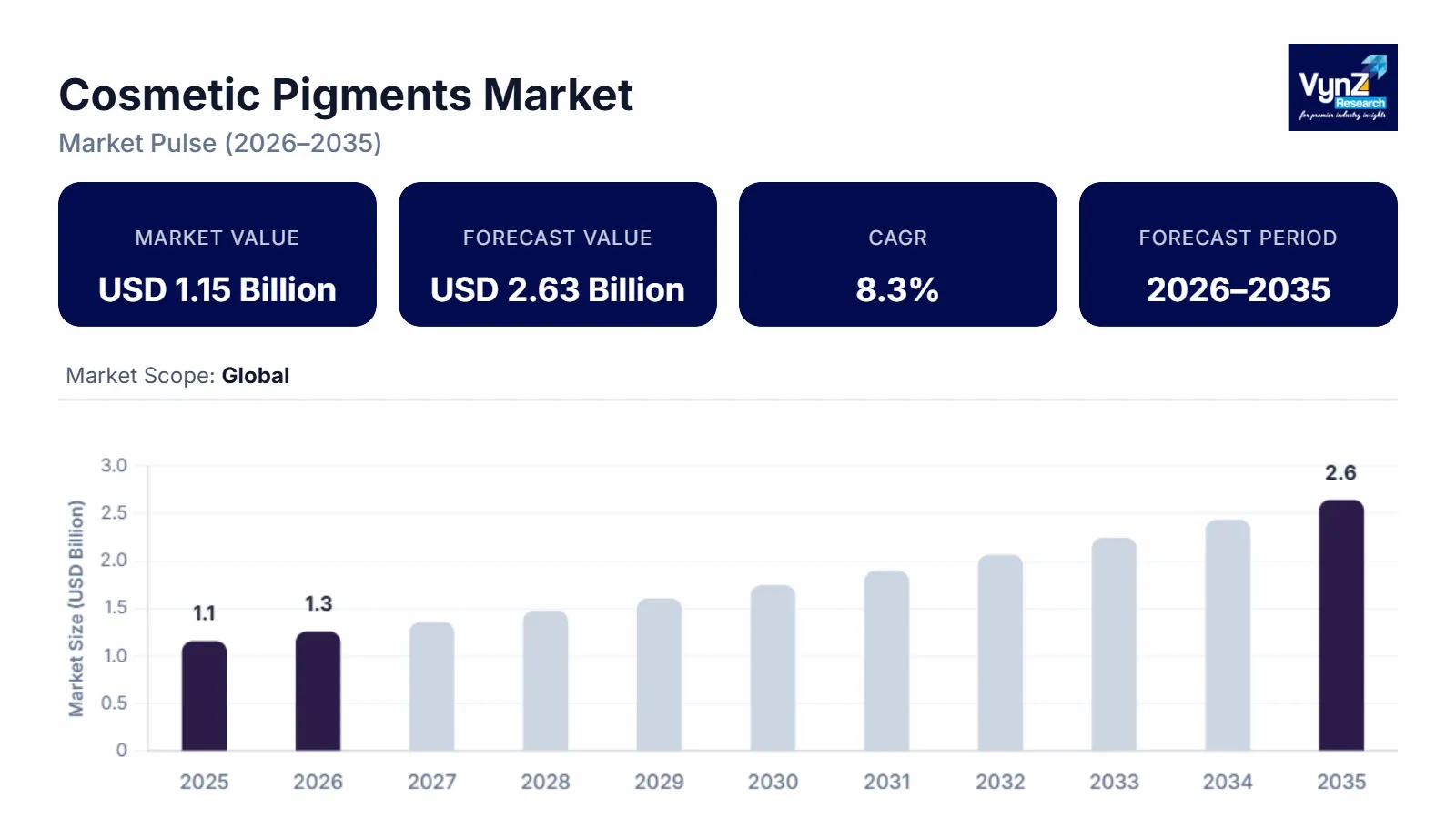
The market is driven by the increased consumption of color cosmetics, the growing demand for inclusive complexion shades, and the continuous innovation in the sector for effect, surface treated and natural color systems. Facial makeup remains a primary application area, while inorganic pigments hold a substantial position due to their opacity, stability and formulation reliability. Specialist market studies also highlight Asia Pacific as a major regional growth engine, supported by the expanding cosmetics manufacturing and rising beauty consumption across China, India, Japan and South Korea.
Market growth is driven by increased color cosmetics consumption, premiumization, broader shade development and continued demand for pigments that deliver stable color, opacity and distinctive optical effects. The U.S. Food and Drug Administration requires cosmetic color additives to be approved for their intended uses and applies additional certification requirements to certain colors, creating continued demand for documented and compliant pigment systems. In India, the Central Drugs Standard Control Organization and Bureau of Indian Standards regulate permitted cosmetic colorants through the Cosmetics Rules and relevant Indian Standards, while ECHA maintains the European Union list of permitted cosmetic colorants. These regulatory frameworks support quality-focused procurement across major production markets.
Research Methodology
VynZ Research assessed the market through secondary research across industry publications, regulatory databases, company disclosures, technical literature and publicly available government information, followed by comparative validation of market estimates and segment trends. The VynZ Research team reviewed pigment composition, product technology, cosmetic applications, end use patterns, regional demand and competitive developments to establish a consistent 2025 base and 2026 to 2035 forecast. Regulatory evidence from the U.S. Food and Drug Administration, European Chemicals Agency, Central Drugs Standard Control Organization and Bureau of Indian Standards were considered where relevant to colorant approval, purity, permitted use and safety requirements.
Research Highlights
- Inorganic pigments accounted for an estimated 70.2% of market revenue in 2025, supported by strong opacity, light stability and widespread use in complexion products.
- Facial makeup represented approximately 35.2% of application demand in 2025, reflecting continued consumption of foundations, concealers, blushes and complexion correcting products.
- Decorative cosmetics estimated to account for approximately 61.8% of revenue in 2025 because pigments are central to face, eye, lip and nail formulations.
- Organic pigments represent the smaller share but are expected to expand at approximately 9.6% CAGR through 2035. North America accounted for an estimated 22% of the global market in 2025, owing to a mature cosmetics industry.
Cosmetic Pigments Market Dynamics
Market Trends
The cosmetic pigments market is moving towards high performance pigments with enhanced chroma, dispersion, formulation stability and unique optical effects. This is driven by demand for inclusive complexion development, hybrid makeup and skincare products, vegan formulations and greater interest in traceable materials. A further trend driving the market is the emphasis on natural origins, regulation documentation and responsible sourcing. This is supported by regulation, which defines the permitted additives that can be used in cosmetics and their applications. For example, the FDA defines permitted cosmetic color additives, while ECHA provides an extensive list of permitted colorants under Annex IV of the European Cosmetics Regulation.
Growth Drivers
The growth of the market is driven by increased use of facial makeup, eye cosmetics, lip products and multifunctional beauty products and increased use of natural, vegan and high purity color systems. Another driver for the market is the increased consumer and brand interest in the transparency of ingredients, sourcing and formulation safety, which is stimulating suppliers to develop products with improved traceability and regulatory documentation. The FDA requires color additives used for cosmetics in the United States to meet approval and use requirements. Similarly, India's Cosmetics Rules restrict the cosmetic formulation to particular dyes, colors and pigments that have been specified and define impurity limits for permitted synthetic and natural organic colors. This supports the adoption of controlled pigment grades and stimulates supply of technically documented products.
Market Restraints / Challenges
Despite the growth drivers, the market has regulatory complexity, raw material cost pressures and a technical challenge in achieving consistent performance from different formulation systems. Cosmetic pigments need to meet requirements relating to purity, color index identification, permitted application, particle characteristics and potential impurities. In the United States, the FDA highlights that violations of color additive regulations can lead to import detention and requires approved uses, specifications and restrictions to be followed. In Europe, colorants can have specific conditions applicable to product type, body area, purity and exposure, which adds complexity for suppliers supplying international markets. The complexity of the supply chain is another key challenge, as the production of pigments requires specialized materials, controlled processing and adherence to consistent quality specifications.
Market Opportunities
The market has opportunities around inclusive complexion products, natural colorants, surface treated pigments and multifunctional formulations that combine color with skincare attributes. The demand for a greater range of shades is driving manufacturers to develop combinations that offer enhanced skin tone matching, reduced whitening and natural optical effects. An opportunity for special effects is also available, as pearlescent, metallic, iridescent and high sparkle pigments are being used to differentiate more premium and trend driven products.
Global Cosmetic Pigments Market Report Coverage
|
Report Metric |
Details |
|
Historical Period |
2020 - 2024 |
|
Base Year Considered |
2025 |
|
Forecast Period |
2026 - 2035 |
|
Market Size in 2025 |
USD 1.15 Billion |
|
Revenue Forecast in 2035 |
USD 2.63 Billion |
|
Growth Rate |
8.7% |
|
Segments Covered in the Report |
Composition, Product Type, Application, End Use |
|
Report Scope |
Market Trends, Drivers, and Restraints; Revenue Estimation and Forecast; Segmentation Analysis; Companies’ Strategic Developments; Market Share Analysis of Key Players; Company Profiling |
|
Regions Covered in the Report |
North America, Europe, Asia Pacific, Rest of the World |
|
Key Companies |
ALTANA AG, BASF SE, Clariant AG, DIC Corporation, Fujian Kuncai Material Technology, Merck KGaA, Sensient Technologies, Sudarshan Chemical Industries, Sun Chemical, Venator Materials |
|
Customization |
Available upon request |
Cosmetic Pigments Market Segmentation
By Composition
Inorganic pigments accounting for an estimated 70.2% of revenue in 2025. Their position is supported by strong opacity, light and heat stability, dispersion performance and established use in foundations, concealers, eye makeup and other complexion products.
Organic pigments represent the smaller share but are expected to expand at approximately 9.6% CAGR through 2035, making them one of the faster growing composition categories. Their higher chroma, transparency and broader shade possibilities support applications requiring vivid reds, pinks, oranges and other strong colors.
By Product Type
Special effect pigments represented an estimated 34.7% share in 2025. Pearlescent, metallic, iridescent and high sparkle pigments are gaining importance as cosmetic brands seek stronger visual differentiation, while improved coating technologies support more consistent optical effects.
Nano pigments are estimated to expand at approximately 8.8% CAGR through 2035 as formulators seek improved color intensity, transparency and smoother application in selected premium formulations.
By Application
Facial makeup accounted for an estimated 35.2% of revenue in 2025, because foundations, concealers, blushes, primers and tone correcting products require stable color, controlled opacity and increasingly precise shade matching.
Hair color products are estimated to grow at approximately 7.5% CAGR through 2035, supported by continuing consumer interest in hair coloring and development of more specialized shades.
By End Use
Decorative cosmetics estimated to account for approximately 61.8% of revenue in 2025. The category remains dominant because pigments are central to face, eye, lip and nail formulations, where shade, coverage and optical effects directly influence product performance.
Skin care applications are estimated to grow at approximately 9.1% CAGR as tinted moisturizers, tone correcting products, hybrid makeup and sun care formats increasingly incorporate color effects.
Regional Insights
North America
North America accounted for an estimated 22% of the global market in 2025, supported by a mature cosmetics industry, high demand for premium beauty products and strong formulation capabilities in the United States. The region is estimated to grow at approximately 7.9% CAGR through 2035 as manufacturers increase use of high purity, natural and effect pigments in color cosmetics. U.S. FDA requirements for approved color additives, permitted uses, specifications and certification continue to influence supplier selection and technical documentation. The country's established e-commerce ecosystem and strong presence of independent beauty brands also support demand for differentiated pigment systems and inclusive complexion products.
Europe
Europe represented approximately 28% of global revenue in 2025 and is expected to grow at around 7.4% CAGR through 2035. Germany, France, Italy and the United Kingdom remain important markets because of established cosmetics manufacturing, premium beauty consumption and strong formulation expertise. European demand is increasingly influenced by sustainability, traceability and ingredient compliance, with ECHA maintaining the permitted cosmetic colorant list under Annex IV of the Cosmetics Regulation. The regulatory environment encourages suppliers to provide detailed technical information and verified pigment specifications, while premium cosmetics and natural ingredient positioning continue to support demand for advanced color systems.
Asia Pacific
Asia Pacific held an estimated 42% of the global market in 2025, making it the largest regional market, and is projected to register approximately 9.8% CAGR through 2035. China, Japan, South Korea and India provide a combination of cosmetics manufacturing capacity, expanding consumer demand and rapidly evolving beauty preferences. Increasing demand for premium cosmetics, natural ingredients, multifunctional products and innovative color effects is supporting pigment consumption across the region.
Rest of the World
Rest of the World contributed the remaining estimated 8% of global revenue in 2025, comprising Latin America, the Middle East and Africa, and is expected to grow at approximately 8.3% CAGR through 2035. Brazil remains an important Latin American market because of its established beauty industry, while the Middle East offers opportunities in premium, luxury and high-performance cosmetics. Africa provides long-term potential through urbanization, expanding retail access and increasing demand for products designed for diverse skin tones.
Competitive Landscape / Company Insights
The market is moderately competitive, with global pigment manufacturers and specialized color suppliers competing through product breadth, technical support, regulatory capability and formulation innovation. Companies are expanding portfolios covering organic, inorganic, natural and effect pigments while developing products for clean beauty, vegan formulations and inclusive complexion ranges. Recent product activity from Sun Chemical, DIC and other suppliers indicates continued investment in high chroma, pearlescent and natural color technologies. Regulatory expertise is also becoming an important competitive factor as manufacturers serve markets with different permitted colorant lists and purity requirements.
Mini Profiles
ALTANA AG through its ECKART division supplies metallic and pearlescent effect pigments used in cosmetics alongside coatings and other industries, with emphasis on specialized optical effects and application support.
BASF SE maintains a broad personal care ingredients portfolio and supports cosmetic formulation development through science-based ingredients, formulation concepts and technical services across major beauty markets.
Clariant AG develops specialty ingredients and formulation solutions for personal care manufacturers, with its broader specialty chemicals capabilities supporting performance, sustainability and formulation requirements.
DIC Corporation offers organic, inorganic, pearlescent and natural cosmetic pigments for makeup, skin care, hair care, sun care and oral care, supported by a broad product portfolio.
Merck KGaA has established capabilities in effect pigments, functional fillers and cosmetic materials, supporting visual effects and formulation performance across beauty applications.
Key Players
- ALTANA AG
- BASF SE
- Clariant AG
- DIC Corporation
- Fujian Kuncai Material Technology Co., Ltd.
- Merck KGaA
- Sensient Technologies Corporation
- Sudarshan Chemical Industries Limited
- Sun Chemical Corporation
- Venator Materials PLC
Recent Developments
Sun Chemical expanded its Chione Electric portfolio with new high chroma effect pigments for cosmetics, including Amber, following the introduction of Scarlet and Sienna. The products are designed for vivid, vegan and carmine-free beauty formulations and extend the company's effect pigment offering.
BASF expanded its personal care innovation portfolio with new formulation technologies and ingredient concepts focused on responsible formulation, skin care performance and evolving consumer expectations. Its 2026 activities also included new personal care launches and formulation concepts presented at major industry events.
Sensient Beauty presented new ingredient launches and formulation technologies at in-cosmetics Global, highlighting solutions where color, texture and care converge. The company continues to position sustainable, high-performance formulation technologies for the evolving beauty industry.
Sudarshan Chemical Industries continued expanding its cosmetics and personal care pigment portfolio across inorganic pigments, effect pigments, pigment preparations and dyes. Its product range emphasizes regulatory compliance, purity and suitability across rinse-off and leave-on applications.
Clariant continued developing specialty personal care solutions around formulation performance and sustainability, reflecting the industry's movement toward ingredients and materials that combine technical performance with improved environmental characteristics.
Global Cosmetic Pigments Market Coverage
Composition Insight and Forecast 2026 - 2035
- Inorganic Pigments
- Organic Pigments
Product Type Insight and Forecast 2026 - 2035
- Special Effect Pigments
- Surface Treated Pigments
- Nano Pigments
- Natural Colorants
Application Insight and Forecast 2026 - 2035
- Facial Makeup
- Eye Makeup
- Lip Products
- Nail Products
- Hair Color Products
- Special Effect and Special Purpose Products
- Other Applications
End Use Insight and Forecast 2026 - 2035
- Decorative Cosmetics
- Skin Care
- Hair Care
- Toiletries
Global Cosmetic Pigments Market by Region
- North America
- By Composition
- By Product Type
- By Application
- By End Use
- By Country - U.S., Canada, Mexico
- Europe
- By Composition
- By Product Type
- By Application
- By End Use
- By Country - Germany, U.K., France, Italy, Spain, Russia, Rest of Europe
- Asia-Pacific (APAC)
- By Composition
- By Product Type
- By Application
- By End Use
- By Country - China, Japan, India, South Korea, Vietnam, Thailand, Malaysia, Rest of Asia-Pacific
- Rest of the World (RoW)
- By Composition
- By Product Type
- By Application
- By End Use
- By Country - Brazil, Saudi Arabia, South Africa, U.A.E., Other Countries
Table of Contents for Cosmetic Pigments Market Report
1. Research Overview
1.1. The Report Offers
1.2. Market Coverage
1.2.1. By
Composition
1.2.2. By
Product Type
1.2.3. By
Application
1.2.4. By
End Use
1.3. Research Phases
1.4. Limitations
1.5. Market Methodology
1.5.1. Data Sources
1.5.1.1.
Primary Research
1.5.1.2.
Secondary Research
1.5.2. Methodology
1.5.2.1.
Data Exploration
1.5.2.2.
Forecast Parameters
1.5.2.3.
Data Validation
1.5.2.4.
Assumptions
1.5.3. Study Period & Data Reporting Unit
2. Executive Summary
3. Industry Overview
3.1. Industry Dynamics
3.1.1. Market Growth Drivers
3.1.2. Market Restraints
3.1.3. Key Market Trends
3.1.4. Major Opportunities
3.2. Industry Ecosystem
3.2.1. Porter’s Five Forces Analysis
3.2.2. Recent Development Analysis
3.2.3. Value Chain Analysis
3.3. Competitive Insight
3.3.1. Competitive Position of Industry
Players
3.3.2. Market Attractive Analysis
3.3.3. Market Share Analysis
4. Global Market Estimate and Forecast
4.1. Global Market Overview
4.2. Global Market Estimate and Forecast to 2035
5. Market Segmentation Estimate and Forecast
5.1. By Composition
5.1.1. Inorganic Pigments
5.1.1.1. Market Definition
5.1.1.2. Market Estimation and Forecast to 2035
5.1.2. Organic Pigments
5.1.2.1. Market Definition
5.1.2.2. Market Estimation and Forecast to 2035
5.2. By Product Type
5.2.1. Special Effect Pigments
5.2.1.1. Market Definition
5.2.1.2. Market Estimation and Forecast to 2035
5.2.2. Surface Treated Pigments
5.2.2.1. Market Definition
5.2.2.2. Market Estimation and Forecast to 2035
5.2.3. Nano Pigments
5.2.3.1. Market Definition
5.2.3.2. Market Estimation and Forecast to 2035
5.2.4. Natural Colorants
5.2.4.1. Market Definition
5.2.4.2. Market Estimation and Forecast to 2035
5.3. By Application
5.3.1. Facial Makeup
5.3.1.1. Market Definition
5.3.1.2. Market Estimation and Forecast to 2035
5.3.2. Eye Makeup
5.3.2.1. Market Definition
5.3.2.2. Market Estimation and Forecast to 2035
5.3.3. Lip Products
5.3.3.1. Market Definition
5.3.3.2. Market Estimation and Forecast to 2035
5.3.4. Nail Products
5.3.4.1. Market Definition
5.3.4.2. Market Estimation and Forecast to 2035
5.3.5. Hair Color Products
5.3.5.1. Market Definition
5.3.5.2. Market Estimation and Forecast to 2035
5.3.6. Special Effect and Special Purpose Products
5.3.6.1. Market Definition
5.3.6.2. Market Estimation and Forecast to 2035
5.3.7. Other Applications
5.3.7.1. Market Definition
5.3.7.2. Market Estimation and Forecast to 2035
5.4. By End Use
5.4.1. Decorative Cosmetics
5.4.1.1. Market Definition
5.4.1.2. Market Estimation and Forecast to 2035
5.4.2. Skin Care
5.4.2.1. Market Definition
5.4.2.2. Market Estimation and Forecast to 2035
5.4.3. Hair Care
5.4.3.1. Market Definition
5.4.3.2. Market Estimation and Forecast to 2035
5.4.4. Toiletries
5.4.4.1. Market Definition
5.4.4.2. Market Estimation and Forecast to 2035
6. North America Market Estimate and Forecast
6.1. By
Composition
6.2. By
Product Type
6.3. By
Application
6.4. By
End Use
6.4.1.
U.S. Market Estimate and Forecast
6.4.2.
Canada Market Estimate and Forecast
6.4.3.
Mexico Market Estimate and Forecast
7. Europe Market Estimate and Forecast
7.1. By
Composition
7.2. By
Product Type
7.3. By
Application
7.4. By
End Use
7.4.1.
Germany Market Estimate and Forecast
7.4.2.
France Market Estimate and Forecast
7.4.3.
U.K. Market Estimate and Forecast
7.4.4.
Italy Market Estimate and Forecast
7.4.5.
Spain Market Estimate and Forecast
7.4.6.
Russia Market Estimate and Forecast
7.4.7.
Rest of Europe Market Estimate and Forecast
8. Asia-Pacific (APAC) Market Estimate and Forecast
8.1. By
Composition
8.2. By
Product Type
8.3. By
Application
8.4. By
End Use
8.4.1.
China Market Estimate and Forecast
8.4.2.
Japan Market Estimate and Forecast
8.4.3.
India Market Estimate and Forecast
8.4.4.
South Korea Market Estimate and Forecast
8.4.5.
Rest of Asia-Pacific Market Estimate and Forecast
9. Rest of the World (RoW) Market Estimate and Forecast
9.1. By
Composition
9.2. By
Product Type
9.3. By
Application
9.4. By
End Use
9.4.1.
Brazil Market Estimate and Forecast
9.4.2.
Saudi Arabia Market Estimate and Forecast
9.4.3.
South Africa Market Estimate and Forecast
9.4.4.
U.A.E. Market Estimate and Forecast
9.4.5.
Other Countries Market Estimate and Forecast
10. Company Profiles
10.1.
ALTANA AG
10.1.1.
Snapshot
10.1.2.
Overview
10.1.3.
Offerings
10.1.4.
Financial
Insight
10.1.5.
Recent
Developments
10.2.
BASF SE
10.2.1.
Snapshot
10.2.2.
Overview
10.2.3.
Offerings
10.2.4.
Financial
Insight
10.2.5.
Recent
Developments
10.3.
Clariant AG
10.3.1.
Snapshot
10.3.2.
Overview
10.3.3.
Offerings
10.3.4.
Financial
Insight
10.3.5.
Recent
Developments
10.4.
DIC Corporation
10.4.1.
Snapshot
10.4.2.
Overview
10.4.3.
Offerings
10.4.4.
Financial
Insight
10.4.5.
Recent
Developments
10.5.
Fujian Kuncai Material Technology Co., Ltd.
10.5.1.
Snapshot
10.5.2.
Overview
10.5.3.
Offerings
10.5.4.
Financial
Insight
10.5.5.
Recent
Developments
10.6.
Merck KGaA
10.6.1.
Snapshot
10.6.2.
Overview
10.6.3.
Offerings
10.6.4.
Financial
Insight
10.6.5.
Recent
Developments
10.7.
Sensient Technologies Corporation
10.7.1.
Snapshot
10.7.2.
Overview
10.7.3.
Offerings
10.7.4.
Financial
Insight
10.7.5.
Recent
Developments
10.8.
Sudarshan Chemical Industries Limited
10.8.1.
Snapshot
10.8.2.
Overview
10.8.3.
Offerings
10.8.4.
Financial
Insight
10.8.5.
Recent
Developments
10.9.
Sun Chemical Corporation
10.9.1.
Snapshot
10.9.2.
Overview
10.9.3.
Offerings
10.9.4.
Financial
Insight
10.9.5.
Recent
Developments
10.10.
Venator Materials PLC
10.10.1.
Snapshot
10.10.2.
Overview
10.10.3.
Offerings
10.10.4.
Financial
Insight
10.10.5.
Recent
Developments
11. Appendix
11.1. Exchange Rates
11.2. Abbreviations
Note: Financial insight and recent developments of different companies are subject to the availability of information in the secondary domain.
Frequently Asked Questions
Purchase Options
Latest Report
Research Methodology
- Desk Research / Pilot Interviews
- Build Market Size Model
- Research and Analysis
- Final Deliverable
Connect With Our Sales Team
- Toll-Free: +1-888-253-3960
- Phone: +91 9960 288 381
- Email: enquiry@vynzresearch.com
Cosmetic Pigments Market