
Baby Shampoo Market Size & Share Growth Forecast Report (2026-2035)
Industry Insight by Product Type (Baby shampoo, Baby conditioner), by Category (Conventional and synthetic, Natural and organic), by Distribution Channel (Supermarkets and hypermarkets, Convenience stores, Pharmacies and drug stores, Online retail stores)
| Status : Published | Published On : Oct, 2026 | Report Code : VRCG7063 | Industry : Consumer Goods | Available Format :

|
Page : 156 |
Baby Shampoo Market Overview
The global baby shampoo market size was estimated at USD 6.25 billion in 2025 and USD 6.67 billion in 2026, with a forecast to reach nearly USD 9.61 billion in 2035, with a CAGR of 4.27% from 2026 to 2035.
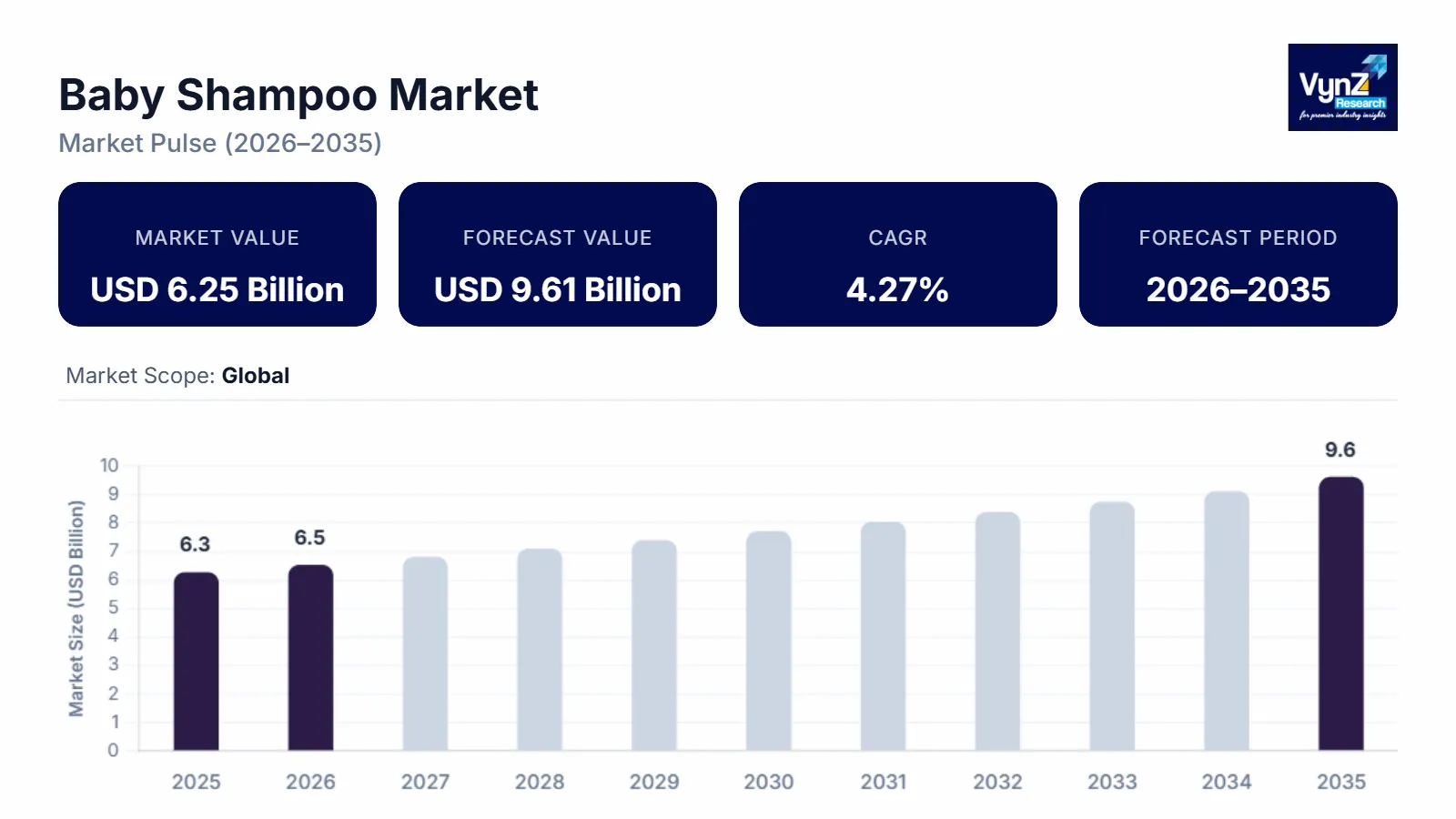
Market growth is supported by demand for mild and hypoallergenic formulations, premium infant care products, and expanding online retail. Ingredient transparency, dermatologist-tested products, and convenient multifunctional cleansers are increasingly important differentiators. However, birth-rate declines in several mature markets, cost volatility, and price competition may constrain volume growth.
Market expansion is also driven by ingredient-conscious purchasing, premiumization, and e-commerce adoption. The U.S. Food and Drug Administration (FDA) requires responsible persons to maintain adequate safety substantiation for cosmetic products under the Modernization of Cosmetics Regulation Act (MoCRA), reinforcing the importance of product safety documentation and compliant claims. India's Office of the Registrar General and Census Commissioner also provides official birth-registration and fertility statistics useful for assessing long-term infant-care demand.
Research Methodology
The report synthesizes secondary research from reliable market research publications, company announcements, and government-backed sources. Market estimates and segment shares are attributed to their respective publishers. Government sources are used to assess demographic conditions and regulatory requirements rather than to substantiate commercial market valuations. The analysis covers market sizing, product formulation, distribution channels, regional demand, competition, and recent company developments. Forecast extensions beyond a source's published period are identified as extrapolations.
Research Highlights
- Baby shampoo accounted for 62.56% in 2025, reflecting its essential role in routine infant hygiene and frequent household replenishment.
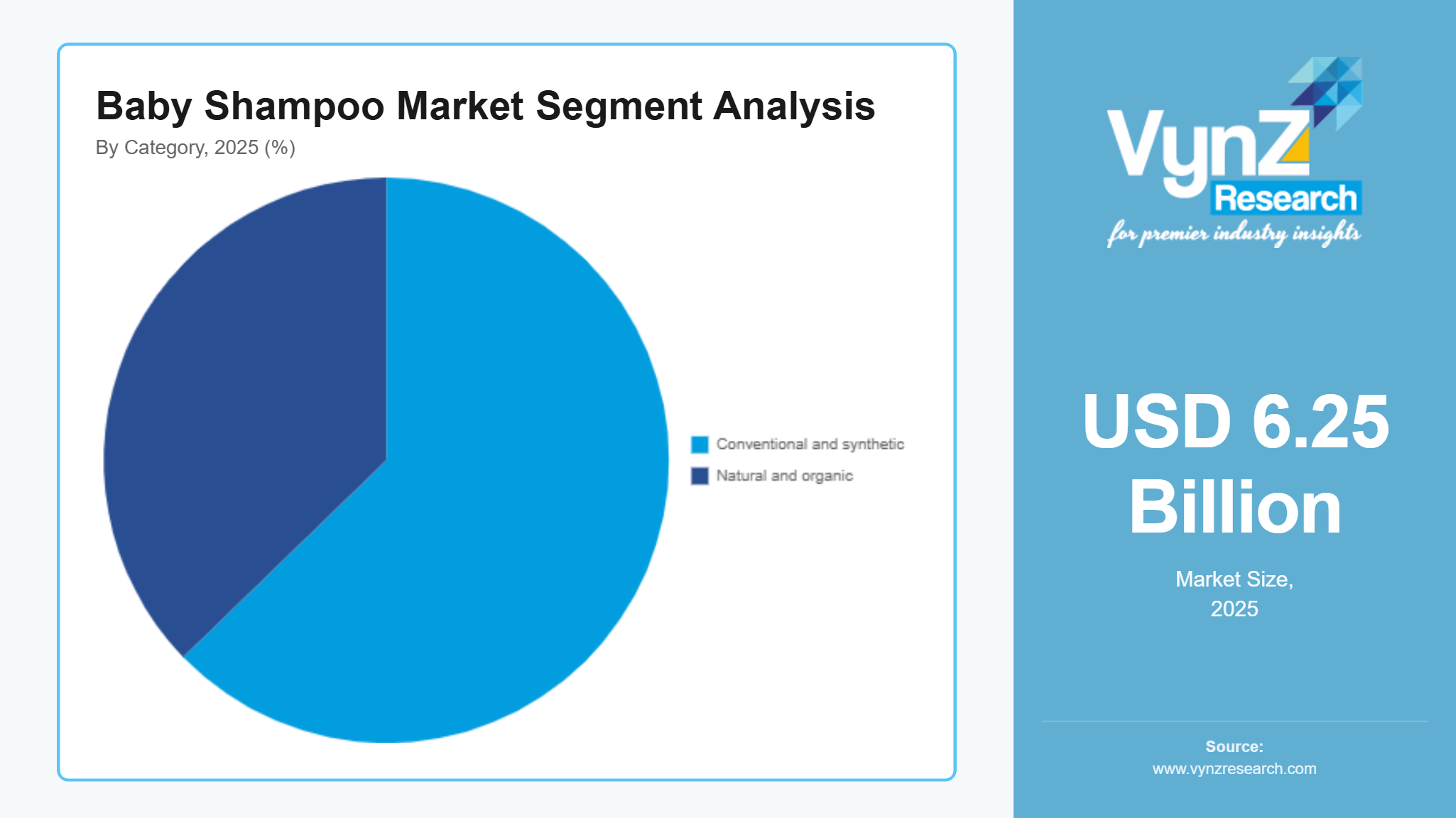
- Conventional and synthetic products held 62.75% in 2025, supported by established brands, broad retail availability, and affordable pricing.
- Supermarkets and hypermarkets captured 48.77% in 2025, benefiting from product accessibility and in-store price comparisons.
- Online retail is projected to grow at a 6.89% CAGR during 2026 to 2035, supported by convenient replenishment, product comparisons, and wider assortment availability.
- Asia Pacific represented 39.6% in 2025 supported by its large consumer base and increasing demand for specialized infant care.
Baby Shampoo Market Dynamics
Market Trends
The industry is shifting toward hypoallergenic, tear-free, fragrance-free, and naturally positioned formulations. Parents increasingly review ingredients and seek dermatologist-tested products designed for sensitive infant skin. Another important trend is the growth of multifunctional products and online replenishment. Shampoo-and-body-wash combinations, refill formats, and digital subscriptions offer convenience while helping brands encourage repeat purchases. The FDA's safety-substantiation requirements also make documented product testing and substantiated claims important for manufacturers selling in the U.S.
Growth Drivers
Demand for specialized infant hygiene products supports recurring purchases across household income groups. Awareness of infant skin sensitivity is encouraging consumers to choose products marketed around mild cleansing, moisture retention, and transparent ingredients. These preferences create opportunities for both established mass-market brands and premium specialist manufacturers. E-commerce and premiumization are additional growth drivers. Online platforms widen product access, simplify replenishment, and allow parents to compare ingredients and product attributes.
Market Restraints / Challenges
Declining birth rates in mature economies can limit the number of potential consumers. The demographic pressure encourages companies to focus on premium products and spending per child rather than relying exclusively on volume growth. Manufacturers also face raw-material and packaging cost volatility, private-label competition, and compliance costs. The FDA requires appropriate safety substantiation and compliant labeling, while cosmetic claims must be supported by suitable evidence. These requirements can increase product-development, documentation, and quality-control costs.
Market Opportunities
Natural and organic formulations offer an opportunity for brands able to provide transparent ingredient information and substantiated product claims. A second opportunity lies in digital retail and specialized products for toddlers and children with specific hair-care needs. Online stores, subscription services, and multifunctional products can improve convenience and customer retention. Manufacturers can strengthen differentiation through documented safety evidence, responsible packaging, and clear communication of product benefits.
Global Baby Shampoo Market Report Coverage
|
Report Metric |
Details |
|
Historical Period |
2020 - 2024 |
|
Base Year Considered |
2025 |
|
Forecast Period |
2026 - 2035 |
|
Market Size in 2025 |
USD 6.25 Billion |
|
Revenue Forecast in 2035 |
USD 9.61 Billion |
|
Growth Rate |
4.27% |
|
Segments Covered in the Report |
Product Type, Category, Distribution Channel |
|
Report Scope |
Market Trends, Drivers, and Restraints; Revenue Estimation and Forecast; Segmentation Analysis; Companies’ Strategic Developments; Market Share Analysis of Key Players; Company Profiling |
|
Regions Covered in the Report |
North America, Europe, Asia-Pacific, South America, Middle East & Africa |
|
Key Companies |
Artsana, Beiersdorf, Himalaya Wellness, Kenvue, Kimberly-Clark, Laboratoires Expanscience, Pigeon, Procter & Gamble, The Honest Company, Unilever |
|
Customization |
Available upon request |
Baby Shampoo Market Segmentation
By Product Type
Baby shampoo held the largest share, accounting for 62.56% in 2025, as routine cleansing, repeat purchasing, and widespread availability support demand across income groups.
Baby conditioner is projected to register a 4.97% CAGR during 2026 to 2035. Growth is supported by greater interest in hair manageability, moisturizing benefits, and products designed for fine or easily tangled hair.
By Category
Conventional and synthetic products held 62.75% in 2025, supported by affordable pricing, established consumer familiarity, and broad distribution.
Natural and organic formulations are projected to grow at a 6.45% CAGR during 2026 to 2035. Demand is supported by parental interest in ingredient transparency and products positioned without selected synthetic ingredients.
By Distribution Channel
Supermarkets and hypermarkets accounted for 48.77% in 2025, benefiting from convenient household shopping, immediate product availability, and opportunities to compare prices.
Online retail stores are forecast to grow at a 6.89% CAGR during 2026 to 2035. Product comparisons, customer reviews, broad assortments, and home delivery can encourage repeat purchases.
Regional Insights
Asia Pacific
Asia Pacific accounted for 39.6% of the global baby shampoo and conditioner market in 2025, supported by demand from China, India, Indonesia, and other Southeast Asian markets. A large consumer base, increasing adoption of branded infant-care products, and expanding online retail support regional sales. China's National Bureau of Statistics reported 7.92 million births in 2025, providing important demographic context for demand.
North America
North America represented 24.8% of the global market in 2025 and is projected to grow at a 4.6% CAGR from 2026 to 2035. The United States accounts for most regional demand, supported by premium infant-care products, established retail networks, and demand for hypoallergenic formulations. However, demographic pressures and private-label competition may limit volume growth.
Europe
Europe held 22.3% of the global market in 2025 and is forecast to expand at a 4.2% CAGR from 2026 to 2035. Demand is supported by established pharmacy channels and consumer interest in dermatologically tested, natural, and sensitive-skin products. Eurostat reported an EU fertility rate of 1.34 live births per woman in 2024, highlighting demographic constraints on long-term unit demand.
South America
South America accounted for 7.6% of the global market in 2025 and is projected to grow at a 5.8% CAGR from 2026 to 2035. Brazil is a key market, with demand supported by supermarket and pharmacy distribution and increasing access to branded infant-care products. Affordable formulations are important for mass-market penetration, while premium products offer opportunities in higher-income consumer segments.
Middle East & Africa
The Middle East & Africa region represented 5.7% of the global market in 2025 and is forecast to record the fastest regional growth, at a 6.8% CAGR from 2026 to 2035. Growth is supported by expanding access to branded baby-care products, demand for premium imported formulations, and opportunities in markets such as Saudi Arabia and the UAE. Affordability and distribution infrastructure remain important considerations across emerging markets.
Competitive Landscape / Company Insights
The baby shampoo and conditioner market is moderately competitive, with global and regional companies competing through product innovation, brand trust, pricing, and distribution. Major players emphasize gentle formulations, ingredient transparency, dermatological testing, and products tailored to different age groups. Online retail and premium natural formulations offer additional routes to differentiation. Regulatory requirements also increase the importance of product safety documentation and substantiated claims. The FDA's MoCRA framework is a relevant compliance reference for companies marketing cosmetics in the United States.
Mini Profiles
Artsana S.p.A. offers baby-care products through its Chicco brand, emphasizing infant needs, product accessibility, and established international distribution.
Beiersdorf AG competes through skincare expertise and established consumer brands, with product quality and skin compatibility central to its positioning.
Himalaya Wellness offers herbal and naturally positioned baby-care products, targeting parents seeking plant-based ingredients and accessible pricing.
Pigeon Corporation specializes in infant and childcare products, using baby-care expertise and product innovation to support international expansion.
Unilever PLC leverages global consumer-brand capabilities, extensive distribution, and product development to compete across personal-care markets.
Key Players
- Artsana S.p.A.
- Beiersdorf AG
- Himalaya Wellness
- Kenvue Inc.
- Kimberly-Clark Corporation
- Laboratoires Expanscience
- Pigeon Corporation
- Procter & Gamble
- The Honest Company
- Unilever PLC
Recent Developments
Kenvue Inc. refreshed its U.S. shampoo formulas in 2026 with vitamin B5 and hypoallergenic positioning. The updated packaging was reported to contain 50% recycled plastic.
Kimberly-Clark Corporation introduced its Big Dreams diapers and wipes collection through Amazon's stores in 2026. The launch expands its baby-care portfolio, although it is not a baby shampoo launch.
Procter & Gamble reported that e-commerce represented 19% of fiscal 2025 sales and grew 12%. This demonstrates the growing importance of digital commerce across its consumer-products portfolio, including personal-care categories.
The Honest Company introduced a Disney-themed baby personal-care collection in 2025, including shampoo and body-wash products. The collaboration combined established character licensing with the company's existing product formulations and packaging strategy.
Global Baby Shampoo Market Coverage
Product Type Insight and Forecast 2026 - 2035
- Baby shampoo
- Baby conditioner
Category Insight and Forecast 2026 - 2035
- Conventional and synthetic
- Natural and organic
Distribution Channel Insight and Forecast 2026 - 2035
- Supermarkets and hypermarkets
- Convenience stores
- Pharmacies and drug stores
- Online retail stores
Global Baby Shampoo Market by Region
- North America
- By Product Type
- By Category
- By Distribution Channel
- By Country - U.S., Canada, Mexico
- Europe
- By Product Type
- By Category
- By Distribution Channel
- By Country - Germany, U.K., France, Italy, Spain, Russia, Rest of Europe
- Asia-Pacific (APAC)
- By Product Type
- By Category
- By Distribution Channel
- By Country - China, Japan, India, South Korea, Vietnam, Thailand, Malaysia, Rest of Asia-Pacific
- Rest of the World (RoW)
- By Product Type
- By Category
- By Distribution Channel
- By Country - Brazil, Saudi Arabia, South Africa, U.A.E., Other Countries
Table of Contents for Baby Shampoo Market Report
1. Research Overview
1.1. The Report Offers
1.2. Market Coverage
1.2.1. By
Product Type
1.2.2. By
Category
1.2.3. By
Distribution Channel
1.3. Research Phases
1.4. Limitations
1.5. Market Methodology
1.5.1. Data Sources
1.5.1.1.
Primary Research
1.5.1.2.
Secondary Research
1.5.2. Methodology
1.5.2.1.
Data Exploration
1.5.2.2.
Forecast Parameters
1.5.2.3.
Data Validation
1.5.2.4.
Assumptions
1.5.3. Study Period & Data Reporting Unit
2. Executive Summary
3. Industry Overview
3.1. Industry Dynamics
3.1.1. Market Growth Drivers
3.1.2. Market Restraints
3.1.3. Key Market Trends
3.1.4. Major Opportunities
3.2. Industry Ecosystem
3.2.1. Porter’s Five Forces Analysis
3.2.2. Recent Development Analysis
3.2.3. Value Chain Analysis
3.3. Competitive Insight
3.3.1. Competitive Position of Industry
Players
3.3.2. Market Attractive Analysis
3.3.3. Market Share Analysis
4. Global Market Estimate and Forecast
4.1. Global Market Overview
4.2. Global Market Estimate and Forecast to 2035
5. Market Segmentation Estimate and Forecast
5.1. By Product Type
5.1.1. Baby shampoo
5.1.1.1. Market Definition
5.1.1.2. Market Estimation and Forecast to 2035
5.1.2. Baby conditioner
5.1.2.1. Market Definition
5.1.2.2. Market Estimation and Forecast to 2035
5.2. By Category
5.2.1. Conventional and synthetic
5.2.1.1. Market Definition
5.2.1.2. Market Estimation and Forecast to 2035
5.2.2. Natural and organic
5.2.2.1. Market Definition
5.2.2.2. Market Estimation and Forecast to 2035
5.3. By Distribution Channel
5.3.1. Supermarkets and hypermarkets
5.3.1.1. Market Definition
5.3.1.2. Market Estimation and Forecast to 2035
5.3.2. Convenience stores
5.3.2.1. Market Definition
5.3.2.2. Market Estimation and Forecast to 2035
5.3.3. Pharmacies and drug stores
5.3.3.1. Market Definition
5.3.3.2. Market Estimation and Forecast to 2035
5.3.4. Online retail stores
5.3.4.1. Market Definition
5.3.4.2. Market Estimation and Forecast to 2035
6. North America Market Estimate and Forecast
6.1. By
Product Type
6.2. By
Category
6.3. By
Distribution Channel
6.3.1.
U.S. Market Estimate and Forecast
6.3.2.
Canada Market Estimate and Forecast
6.3.3.
Mexico Market Estimate and Forecast
7. Europe Market Estimate and Forecast
7.1. By
Product Type
7.2. By
Category
7.3. By
Distribution Channel
7.3.1.
Germany Market Estimate and Forecast
7.3.2.
France Market Estimate and Forecast
7.3.3.
U.K. Market Estimate and Forecast
7.3.4.
Italy Market Estimate and Forecast
7.3.5.
Spain Market Estimate and Forecast
7.3.6.
Russia Market Estimate and Forecast
7.3.7.
Rest of Europe Market Estimate and Forecast
8. Asia-Pacific (APAC) Market Estimate and Forecast
8.1. By
Product Type
8.2. By
Category
8.3. By
Distribution Channel
8.3.1.
China Market Estimate and Forecast
8.3.2.
Japan Market Estimate and Forecast
8.3.3.
India Market Estimate and Forecast
8.3.4.
South Korea Market Estimate and Forecast
8.3.5.
Rest of Asia-Pacific Market Estimate and Forecast
9. Rest of the World (RoW) Market Estimate and Forecast
9.1. By
Product Type
9.2. By
Category
9.3. By
Distribution Channel
9.3.1.
Brazil Market Estimate and Forecast
9.3.2.
Saudi Arabia Market Estimate and Forecast
9.3.3.
South Africa Market Estimate and Forecast
9.3.4.
U.A.E. Market Estimate and Forecast
9.3.5.
Other Countries Market Estimate and Forecast
10. Company Profiles
10.1.
Artsana S.p.A.
10.1.1.
Snapshot
10.1.2.
Overview
10.1.3.
Offerings
10.1.4.
Financial
Insight
10.1.5.
Recent
Developments
10.2.
Beiersdorf AG
10.2.1.
Snapshot
10.2.2.
Overview
10.2.3.
Offerings
10.2.4.
Financial
Insight
10.2.5.
Recent
Developments
10.3.
Himalaya Wellness
10.3.1.
Snapshot
10.3.2.
Overview
10.3.3.
Offerings
10.3.4.
Financial
Insight
10.3.5.
Recent
Developments
10.4.
Kenvue Inc.
10.4.1.
Snapshot
10.4.2.
Overview
10.4.3.
Offerings
10.4.4.
Financial
Insight
10.4.5.
Recent
Developments
10.5.
Kimberly-Clark Corporation
10.5.1.
Snapshot
10.5.2.
Overview
10.5.3.
Offerings
10.5.4.
Financial
Insight
10.5.5.
Recent
Developments
10.6.
Laboratoires Expanscience
10.6.1.
Snapshot
10.6.2.
Overview
10.6.3.
Offerings
10.6.4.
Financial
Insight
10.6.5.
Recent
Developments
10.7.
Pigeon Corporation
10.7.1.
Snapshot
10.7.2.
Overview
10.7.3.
Offerings
10.7.4.
Financial
Insight
10.7.5.
Recent
Developments
10.8.
Procter & Gamble
10.8.1.
Snapshot
10.8.2.
Overview
10.8.3.
Offerings
10.8.4.
Financial
Insight
10.8.5.
Recent
Developments
10.9.
The Honest Company
10.9.1.
Snapshot
10.9.2.
Overview
10.9.3.
Offerings
10.9.4.
Financial
Insight
10.9.5.
Recent
Developments
10.10.
Unilever PLC
10.10.1.
Snapshot
10.10.2.
Overview
10.10.3.
Offerings
10.10.4.
Financial
Insight
10.10.5.
Recent
Developments
11. Appendix
11.1. Exchange Rates
11.2. Abbreviations
Note: Financial insight and recent developments of different companies are subject to the availability of information in the secondary domain.
Frequently Asked Questions
Purchase Options
Latest Report
Research Methodology
- Desk Research / Pilot Interviews
- Build Market Size Model
- Research and Analysis
- Final Deliverable
Connect With Our Sales Team
- Toll-Free: +1-888-253-3960
- Phone: +91 9960 288 381
- Email: enquiry@vynzresearch.com
Baby Shampoo Market