
Edutainment Market Size & Share Growth Forecast Report (2026-2035)
Industry Insight by Product Type (Interactive, Non-Interactive, Hybrid, Explorative), by End-Use Age Group (Children, Teenagers, Young Adults, Adults), by Platform (Mobile Apps, PC / Console, Web-Based, AR / VR, TV / Streaming), by Region (North America, Europe, Asia Pacific, South America, Middle East & Africa)
| Status : Published | Published On : Sep, 2026 | Report Code : VRCG7057 | Industry : Consumer Goods | Available Format :

|
Page : 156 |
Edutainment Market Overview
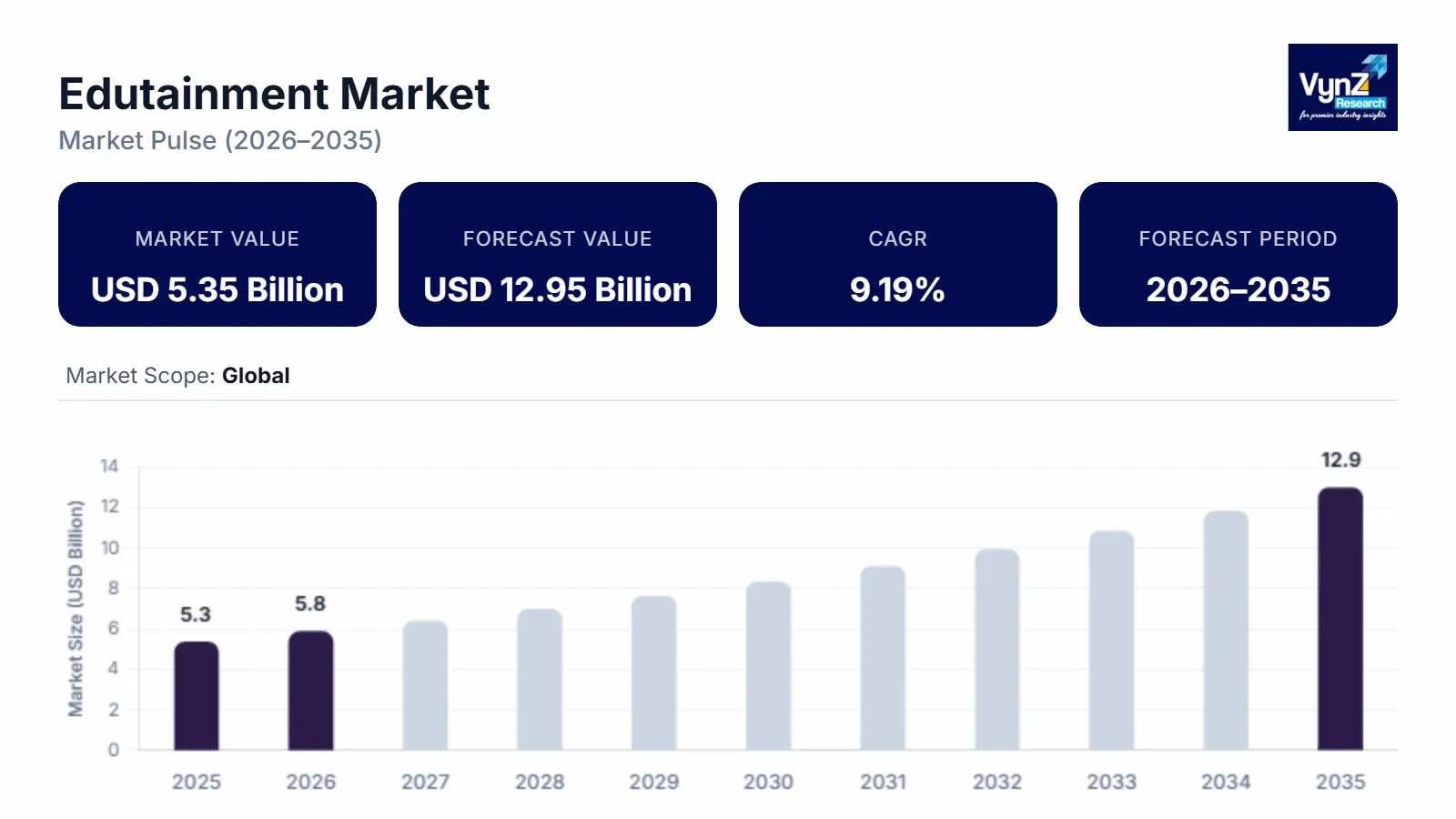
The global edutainment market was valued at approximately USD 5.35 billion in 2025 and is estimated to reach around USD 5.85 billion in 2026. Based on the reported 9.19% CAGR from 2026 to 2035, VynZ Research estimates the market could reach approximately USD 12.95 billion by 2035 if the same growth trajectory continues through the extended forecast period.
Edutainment is a genre that brings educational and entertaining features together in such ways as games, learning apps, simulations, digital platforms, immersive content, educational streaming, and physical experiences, among other tools and methods. The current trends and demands are met by gamification, cell phone applications and digital learning, experiences, AI, and augmented and virtual reality.
The market comprises of digital and physical products, platforms, applications, content, and experiences that seek to engage people in ways that make learning more entertaining or entertainment more enlightening. The products use games, simulations, narratives, challenges, interactive media, video, immersive, and experiential methods to help increase participation, engagement, and learning outcomes. The market offers interactive, non-interactive, hybrid, and exploratory products that can be delivered through mobile apps, computer/console, web-based, augmented and virtual reality, or TV/streaming platforms. The users are children, teenagers, young adults, and adults.
The market covers consumer learning, institutional education, home school, language learning, and Math, Science, Technology, Engineering, and Mathematics (STEM) learning, digital skills, corporate learning, games, and immersive learning experiences.
Research Methodology
VynZ Research gathers information from a range of external sources, including company reports, government publications, education agencies, technology organizations, industry databases, academic research, digital-learning publications, regulatory information, and other reliable resources. Primary research, where relevant, covers engagement with educational technology providers, content developers, educators, operators, distributors, institutional users, and industry specialists. These engagements enable the verification of adoption trends, consumer preferences, pricing models, platform demand, technology integration, and competitive developments. Secondary research provides an understanding of the market structure, technology trends, user adoption patterns, competitive environment, and regional developments.
Market estimates are derived from a combination of data triangulation, company-level analysis, segment assessment, adoption indicators, and historical growth patterns. Revenue is reviewed across various product types, age groups, platforms, and geographical markets to ensure consistency between segment and total market estimates. Forecast modelling considers digital-learning adoption, smartphone and internet penetration, gamification, educational spending, AR/VR adoption, AI integration, consumer behavior, institutional technology investment, and regional economic conditions. These variables are considered to estimate future demand across market segments.
The research team undertakes a process of market figures, CAGR calculations, segment shares, forecast values, company information, and regional estimates validation ahead of publication. Published values and research analytical estimates are differentiated where extended forecast or allocation is required.
Research Highlights
Interactive products accounted for 47.05% share in 2025, while hybrid products are projected to grow at 18.11% CAGR.
Children held 41.68% share in 2025 with young adults projected to grow at 13.81% CAGR.
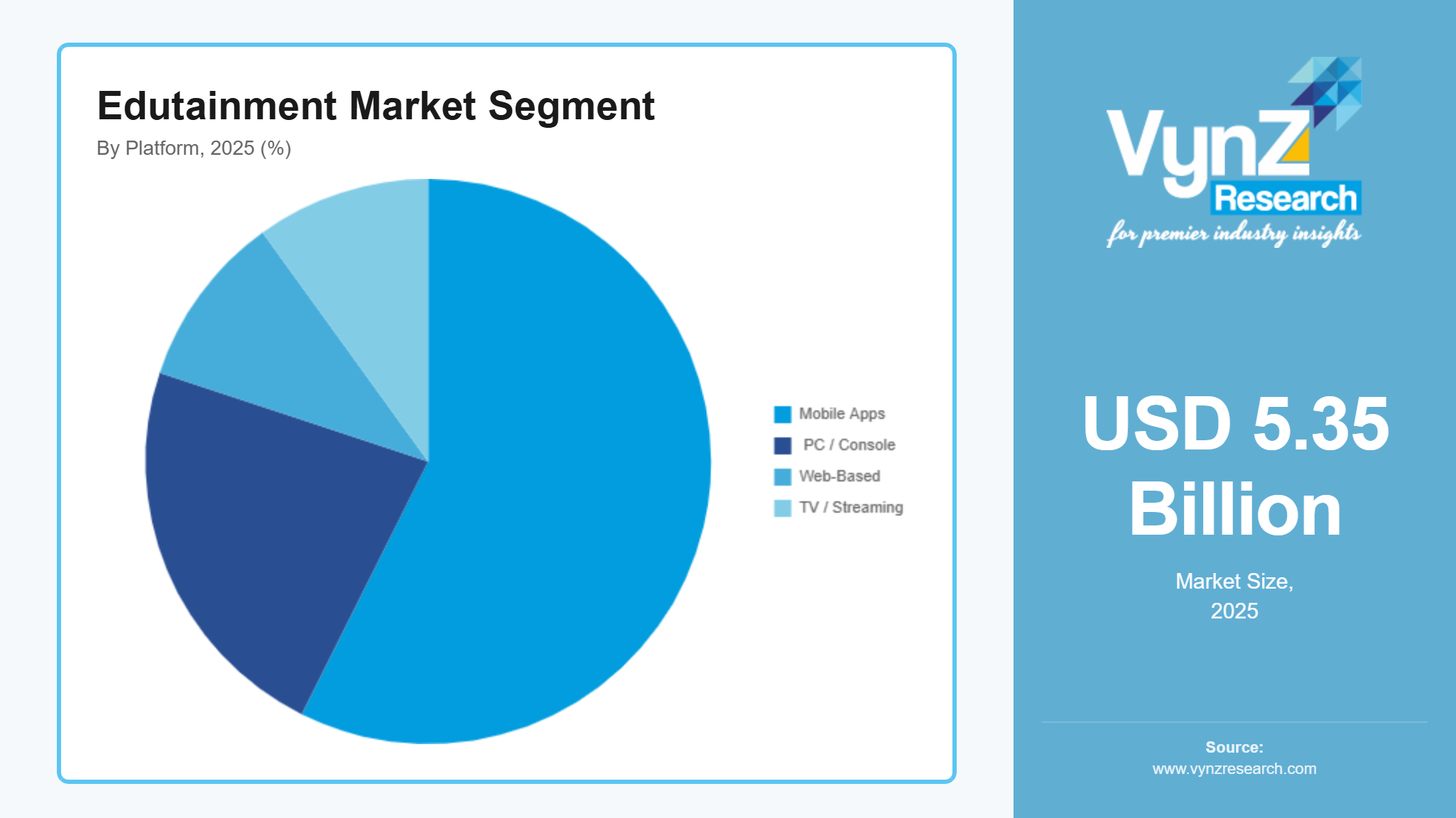
Mobile apps accounted for 57.62% share in 2025 and the AR/VR platforms are projected to grow at 25.39% CAGR.
Asia Pacific is projected to register approximately 10.21% CAGR.
North America led the global market with 33.10% share in 2025.
Edutainment Market Dynamics
Market Trends
Gamification features such as challenges, rewards, points, progress tracking, competitions, and narrative are used by Edutainment to increase engagement. Language learning, math, coding, science, professional development, and pre-school education genres are integrating gamification features into their learning content. Edutainment is embracing augmented and virtual reality innovations that facilitate the creation of simulated laboratory experiments, historical recreations, science, and virtual reality content. The AR/VR segment is projected to witness the highest Compound Annual Growth Rate (CAGR) of 25.39%, indicating the rising demand for immersive Edutainment. Mobile phones and tablets are gaining popularity as learning devices due to their convenience in learning at the comfort of one’s home or during short breaks from work or study. Mobile Edutainment witnessed the highest market value of 57.62% in 2025, indicating its significance in the Edutainment sector. Edutainment software and games are witnessing a rise in the adoption of artificial intelligence to facilitate learning and personalization. Edutainment companies are using AI to enhance the content recommendation system and personalize each learner’s experience based on individual learning patterns. Generative AI is being adopted to accelerate content localization and production by developers.
Growth Drivers
Parents, education professionals, and employers are demanding more immersive learning experiences instead of the conventional rote-learning method. Experiential Edutainment involves games, simulations, and challenges that facilitate learners’ comprehension of concepts and development of problem-solving skills. The Edutainment industry is witnessing a surge in demand for digital learning apps, games, simulations, and experiences. More people are accessing the internet and using digital devices to undertake online courses and certifications. The proliferation of smartphones and other connected devices is facilitating the expansion of Edutainment beyond traditional learning institutions. Parents are willing to spend more on engaging and entertaining educational content for their children. Additionally, they are assessing the value of language learning apps, coding tools, STEM activities, interactive games, and Edutainment services. The children’s Edutainment segment was valued at 41.68% in 2025. Edutainment producers are witnessing a rise in the demand for gamified learning modules as companies are embracing more interactive experiences to train their employees. Edutainment developers are creating immersive simulations, puzzles, games, and role-play activities to meet the demand for corporate training, workforce readiness, and onboarding initiatives. This trend presents a significant growth opportunity for young adult Edutainment.
Market Restraints / Challenges
Edutainment developers are forced to invest significantly in augmented and virtual reality hardware and content production. The adoption of advanced technologies such as AR and VR is limited due to the high capital investment required to acquire the necessary equipment. The rising adoption of digital content among children is a significant concern as it may affect their wellbeing. Parents, caregivers, policymakers, and professional bodies are raising alarms over the adverse effects of screen time on children’s health and development. They are questioning whether mobile apps, games, and online experiences are appropriate for early childhood development. Edutainment companies that target the children and young adult demographic have to invest in robust security features such as parental controls, data encryption, and advertisement filtering. Additionally, Edutainment producers have to comply with the existing parental control regulations and avoid the use of children’s data for commercial purposes. The Edutainment industry faces the challenge of fragmentation of the educational curriculum. Edutainment producers have to localize their content to meet the varying accreditation and licensing requirements of education authorities in different countries and regions.
Market Opportunities
Edutainment producers are witnessing rising demand for AR-based, VR-based, and immersive learning experiences in science, history, healthcare, and technical fields. The adoption of these experiences is projected to grow due to the decreasing cost of hardware and the proliferation of high-quality content. Edutainment companies are localizing their mobile and digital learning solutions to meet the rising demand in the Asia Pacific, Latin America, the Middle East, and Africa regions. These regions have a young population, and smartphones are becoming more affordable. Edutainment producers are leveraging artificial intelligence to recommend relevant content to different demographics based on their level of comprehension. Developers are adopting AI to enhance the learning process by adjusting the difficulty of the learning material. Additionally, generative AI is being used to facilitate localized content production. Edutainment is being used to enhance professional skills and competencies, as it offers a more engaging alternative to conventional corporate training methods. This segment appeals to a young audience and is projected to witness the highest CAGR of 13.81%.
Global Edutainment Market Report Coverage
|
Report Metric |
Details |
|
Historical Period |
2020 - 2024 |
|
Base Year Considered |
2025 |
|
Forecast Period |
2026 - 2035 |
|
Market Size in 2025 |
USD 5.35 Billion |
|
Revenue Forecast in 2035 |
USD 12.95 Billion |
|
Growth Rate |
9.19% |
|
Segments Covered in the Report |
Product Type, End-Use Age Group, Platform |
|
Report Scope |
Market Trends, Drivers, and Restraints; Revenue Estimation and Forecast; Segmentation Analysis; Companies’ Strategic Developments; Market Share Analysis of Key Players; Company Profiling |
|
Regions Covered in the Report |
North America, Europe, Asia Pacific, South America, Middle East & Africa |
|
Key Companies |
Duolingo, Inc., Kahoot!, Roblox Corporation, LEGO Education, Microsoft – Minecraft Education, Age of Learning, Prodigy Education, Labster, Sesame Workshop, KidZania |
|
Customization |
Available upon request |
Edutainment Market Segmentation
By Product Type
Interactive products dominated the edutainment market with 47.05% of the total share in 2025, driven by demand for games, simulations, quizzes, interactive learning applications and user-controlled educational experiences. Interactive products encourage engagement and offer real-time feedback, thus being suitable for children, students, language learners and skills development.
Hybrid products are poised to see the highest growth with a CAGR of 18.11% through 2031, enabled by the confluence of structured educational content with gaming, interactive exercises, digital tools and experiential activities. Hybrid products may appeal to both individual and institutional audiences, and cater to different learning strategies.
By End-use Age Group
Children comprised the largest share of the market with 41.68% of the total share in 2025, driven by parental investment in educational technology and institutional adoption in schools and childcare settings. Game-based learning, educational applications, interactive storytelling, STEM products and language-learning tools are preferred by young learners.
Young adults are expected to see the highest growth with a CAGR of 13.81% through 2031, fueled by a growing need for professional development, digital literacy, language learning, career training and gamified educational experiences. Corporate learning initiatives are also targeting this age group, expanding the addressable market.
By Platform
Mobile applications accounted for the largest share of the market with 57.62% of the total platform share in 2025, benefitting from the smartphone ecosystem, flexibility of learning schedules and the freemium and subscription business models of apps. Mobile applications offer short learning sessions and accessibility from virtually anywhere.
AR/VR platforms are forecasted to see the highest growth with a CAGR of 25.39% through 2031, stimulated by the rise in immersive simulations, virtual laboratories, interactive explorations and experiential education. The advancement of devices and immersive content creation is set to expand the scope across schools, training and consumer learning.
Regional Insights
North America
North America was the largest region by share for the edutainment market with 33.10% in 2025 and a well-established ecosystem of educational gaming, language-learning, interactive content, and immersive technology companies. The region was fueled by advanced educational technology infrastructures, high digital-device penetrations, significant consumer spend on education, and robust corporate training budgets.
Europe
Europe accounted for approximately 27% of the global market in the normalized 2025 regional assessment. The region was supported by strong educational systems, digital-learning adoption, interactive museum experiences, multilingual educational content, and institutional use of technology. Data privacy requirements and educational validation standards also influenced platform development and purchasing decisions.
Asia Pacific
Asia Pacific accounted for approximately 29% of the market in the normalized 2025 regional assessment and was the fastest-growing major region. The market was projected to expand at approximately 10.21% CAGR and supported by government digitization programs, large student populations, rising smartphone adoption, and mobile-first learning behaviors.
South America
South America represented an estimated 5.30% of the global market in the VynZ Research normalized 2025 regional assessment. Growth opportunities were supported by expanding digital education, increasing smartphone access, and stronger availability of localized Spanish and Portuguese educational content. Regional developers were also creating learning products aligned with local educational requirements.
Middle East & Africa
Middle East & Africa accounted for a total of approximately 5.60% of the global market in 2025. Growing government spending on education and better connectivity and digital skills are factors that create opportunities in the region, despite an uneven playing field and high levels of infrastructure investment.
Competitive Landscape / Company Insights
The edutainment market is fragmented in education technology companies, gaming platforms, content developers, digital-learning providers, entertainment companies, and experiential learning operators. Competition is intense as firms focus on engagement, content quality, personalization, gamification, mobile access, artificial intelligence, immersive technologies, and educational outcomes. Firms are expanding by introducing new learning formats, partnerships, acquisitions, aligned curriculum content, and integrating entertainment intellectual property. Safety, privacy, localization, and multi-platform access are also key differentiators.
Mini Profiles
Duolingo combines gamification, adaptive learning, and mobile accessibility across language, mathematics, music, and chess, while increasingly using AI to accelerate educational-content development.
Kahoot! provides game-based learning and engagement tools for classrooms, homes, and workplaces, combining quizzes, interactive content, AI-assisted creation, and curriculum-aligned learning experiences.
Roblox supports learning through interactive virtual experiences, game creation, STEM activities, digital citizenship, and its Learning Hub, connecting educational content with user-generated immersive environments.
LEGO Education combines physical construction with structured learning activities, supporting hands-on STEM education, problem-solving, creativity, collaboration, and classroom-based experiential learning.
Microsoft Minecraft Education uses game-based virtual environments for coding, STEM, digital citizenship, collaboration, AI education, and project-based learning across schools and educational programs worldwide.
Key Players
- Duolingo, Inc.
- Kahoot!
- Roblox Corporation
- LEGO Education
- Microsoft – Minecraft Education
- Age of Learning
- Prodigy Education
- Labster
- Sesame Workshop
- KidZania
Recent Developments
Kahoot! announced new classroom experiences including device-free game modes, Kahootopia! Assignments, curriculum-aligned content, and a ChatGPT application. The company stated that more than 10 million educators now use its platform worldwide.
Duolingo acquired London-based animation and motion-design studio Animade. The acquisition strengthens Duolingo's internal motion-design capabilities and supports its strategy of making digital learning experiences more engaging and interactive.
Roblox completed its Play to Learn competition in Saudi Arabia. More than 700,000 students submitted over 155,000 games, while the Roblox Learning Hub had recorded more than 64 million visits since its July 2025 launch.
Microsoft highlighted an education program in Indonesia where students used Minecraft Education to develop AI-driven virtual simulations addressing real-world challenges, including post-disaster infrastructure assessment and reconstruction.
Global Edutainment Market Coverage
Product Type Insight and Forecast 2026 - 2035
- Interactive
- Non-Interactive
- Hybrid
- Explorative
End-Use Age Group Insight and Forecast 2026 - 2035
- Children
- Teenagers
- Young Adults
- Adults
Platform Insight and Forecast 2026 - 2035
- Mobile Apps
- PC / Console
- Web-Based
- AR / VR
- TV / Streaming
Region Insight and Forecast 2026 - 2035
- North America
- Europe
- Asia Pacific
- South America
- Middle East & Africa
Global Edutainment Market by Region
- North America
- By Product Type
- By End-Use Age Group
- By Platform
- By Region
- By Country - U.S., Canada, Mexico
- Europe
- By Product Type
- By End-Use Age Group
- By Platform
- By Region
- By Country - Germany, U.K., France, Italy, Spain, Russia, Rest of Europe
- Asia-Pacific (APAC)
- By Product Type
- By End-Use Age Group
- By Platform
- By Region
- By Country - China, Japan, India, South Korea, Vietnam, Thailand, Malaysia, Rest of Asia-Pacific
- Rest of the World (RoW)
- By Product Type
- By End-Use Age Group
- By Platform
- By Region
- By Country - Brazil, Saudi Arabia, South Africa, U.A.E., Other Countries
Table of Contents for Edutainment Market Report
1. Research Overview
1.1. The Report Offers
1.2. Market Coverage
1.2.1. By
Product Type
1.2.2. By
End-Use Age Group
1.2.3. By
Platform
1.2.4. By
Region
1.3. Research Phases
1.4. Limitations
1.5. Market Methodology
1.5.1. Data Sources
1.5.1.1.
Primary Research
1.5.1.2.
Secondary Research
1.5.2. Methodology
1.5.2.1.
Data Exploration
1.5.2.2.
Forecast Parameters
1.5.2.3.
Data Validation
1.5.2.4.
Assumptions
1.5.3. Study Period & Data Reporting Unit
2. Executive Summary
3. Industry Overview
3.1. Industry Dynamics
3.1.1. Market Growth Drivers
3.1.2. Market Restraints
3.1.3. Key Market Trends
3.1.4. Major Opportunities
3.2. Industry Ecosystem
3.2.1. Porter’s Five Forces Analysis
3.2.2. Recent Development Analysis
3.2.3. Value Chain Analysis
3.3. Competitive Insight
3.3.1. Competitive Position of Industry
Players
3.3.2. Market Attractive Analysis
3.3.3. Market Share Analysis
4. Global Market Estimate and Forecast
4.1. Global Market Overview
4.2. Global Market Estimate and Forecast to 2035
5. Market Segmentation Estimate and Forecast
5.1. By Product Type
5.1.1. Interactive
5.1.1.1. Market Definition
5.1.1.2. Market Estimation and Forecast to 2035
5.1.2. Non-Interactive
5.1.2.1. Market Definition
5.1.2.2. Market Estimation and Forecast to 2035
5.1.3. Hybrid
5.1.3.1. Market Definition
5.1.3.2. Market Estimation and Forecast to 2035
5.1.4. Explorative
5.1.4.1. Market Definition
5.1.4.2. Market Estimation and Forecast to 2035
5.2. By End-Use Age Group
5.2.1. Children
5.2.1.1. Market Definition
5.2.1.2. Market Estimation and Forecast to 2035
5.2.2. Teenagers
5.2.2.1. Market Definition
5.2.2.2. Market Estimation and Forecast to 2035
5.2.3. Young Adults
5.2.3.1. Market Definition
5.2.3.2. Market Estimation and Forecast to 2035
5.2.4. Adults
5.2.4.1. Market Definition
5.2.4.2. Market Estimation and Forecast to 2035
5.3. By Platform
5.3.1. Mobile Apps
5.3.1.1. Market Definition
5.3.1.2. Market Estimation and Forecast to 2035
5.3.2. PC / Console
5.3.2.1. Market Definition
5.3.2.2. Market Estimation and Forecast to 2035
5.3.3. Web-Based
5.3.3.1. Market Definition
5.3.3.2. Market Estimation and Forecast to 2035
5.3.4. AR / VR
5.3.4.1. Market Definition
5.3.4.2. Market Estimation and Forecast to 2035
5.3.5. TV / Streaming
5.3.5.1. Market Definition
5.3.5.2. Market Estimation and Forecast to 2035
5.4. By Region
5.4.1. North America
5.4.1.1. Market Definition
5.4.1.2. Market Estimation and Forecast to 2035
5.4.2. Europe
5.4.2.1. Market Definition
5.4.2.2. Market Estimation and Forecast to 2035
5.4.3. Asia Pacific
5.4.3.1. Market Definition
5.4.3.2. Market Estimation and Forecast to 2035
5.4.4. South America
5.4.4.1. Market Definition
5.4.4.2. Market Estimation and Forecast to 2035
5.4.5. Middle East & Africa
5.4.5.1. Market Definition
5.4.5.2. Market Estimation and Forecast to 2035
6. North America Market Estimate and Forecast
6.1. By
Product Type
6.2. By
End-Use Age Group
6.3. By
Platform
6.4. By
Region
6.4.1.
U.S. Market Estimate and Forecast
6.4.2.
Canada Market Estimate and Forecast
6.4.3.
Mexico Market Estimate and Forecast
7. Europe Market Estimate and Forecast
7.1. By
Product Type
7.2. By
End-Use Age Group
7.3. By
Platform
7.4. By
Region
7.4.1.
Germany Market Estimate and Forecast
7.4.2.
France Market Estimate and Forecast
7.4.3.
U.K. Market Estimate and Forecast
7.4.4.
Italy Market Estimate and Forecast
7.4.5.
Spain Market Estimate and Forecast
7.4.6.
Russia Market Estimate and Forecast
7.4.7.
Rest of Europe Market Estimate and Forecast
8. Asia-Pacific (APAC) Market Estimate and Forecast
8.1. By
Product Type
8.2. By
End-Use Age Group
8.3. By
Platform
8.4. By
Region
8.4.1.
China Market Estimate and Forecast
8.4.2.
Japan Market Estimate and Forecast
8.4.3.
India Market Estimate and Forecast
8.4.4.
South Korea Market Estimate and Forecast
8.4.5.
Rest of Asia-Pacific Market Estimate and Forecast
9. Rest of the World (RoW) Market Estimate and Forecast
9.1. By
Product Type
9.2. By
End-Use Age Group
9.3. By
Platform
9.4. By
Region
9.4.1.
Brazil Market Estimate and Forecast
9.4.2.
Saudi Arabia Market Estimate and Forecast
9.4.3.
South Africa Market Estimate and Forecast
9.4.4.
U.A.E. Market Estimate and Forecast
9.4.5.
Other Countries Market Estimate and Forecast
10. Company Profiles
10.1.
Duolingo, Inc.
10.1.1.
Snapshot
10.1.2.
Overview
10.1.3.
Offerings
10.1.4.
Financial
Insight
10.1.5.
Recent
Developments
10.2.
Kahoot!
10.2.1.
Snapshot
10.2.2.
Overview
10.2.3.
Offerings
10.2.4.
Financial
Insight
10.2.5.
Recent
Developments
10.3.
Roblox Corporation
10.3.1.
Snapshot
10.3.2.
Overview
10.3.3.
Offerings
10.3.4.
Financial
Insight
10.3.5.
Recent
Developments
10.4.
LEGO Education
10.4.1.
Snapshot
10.4.2.
Overview
10.4.3.
Offerings
10.4.4.
Financial
Insight
10.4.5.
Recent
Developments
10.5.
Microsoft – Minecraft Education
10.5.1.
Snapshot
10.5.2.
Overview
10.5.3.
Offerings
10.5.4.
Financial
Insight
10.5.5.
Recent
Developments
10.6.
Age of Learning
10.6.1.
Snapshot
10.6.2.
Overview
10.6.3.
Offerings
10.6.4.
Financial
Insight
10.6.5.
Recent
Developments
10.7.
Prodigy Education
10.7.1.
Snapshot
10.7.2.
Overview
10.7.3.
Offerings
10.7.4.
Financial
Insight
10.7.5.
Recent
Developments
10.8.
Labster
10.8.1.
Snapshot
10.8.2.
Overview
10.8.3.
Offerings
10.8.4.
Financial
Insight
10.8.5.
Recent
Developments
10.9.
Sesame Workshop
10.9.1.
Snapshot
10.9.2.
Overview
10.9.3.
Offerings
10.9.4.
Financial
Insight
10.9.5.
Recent
Developments
10.10.
KidZania
10.10.1.
Snapshot
10.10.2.
Overview
10.10.3.
Offerings
10.10.4.
Financial
Insight
10.10.5.
Recent
Developments
11. Appendix
11.1. Exchange Rates
11.2. Abbreviations
Note: Financial insight and recent developments of different companies are subject to the availability of information in the secondary domain.
Frequently Asked Questions
Purchase Options
Latest Report
Research Methodology
- Desk Research / Pilot Interviews
- Build Market Size Model
- Research and Analysis
- Final Deliverable
Connect With Our Sales Team
- Toll-Free: +1-888-253-3960
- Phone: +91 9960 288 381
- Email: enquiry@vynzresearch.com
Edutainment Market