
| About This Report | Status : Published | Published On : Feb, 2024 | Report Code : VRAD12022 | Industry : Aerospace and Defense | Available Format :
|
Page : 195 |
Global Active Protection System Market is projected to grow from USD 4.2 billion in 2023 to USD 5.7 billion by 2030 with a CAGR of 5.5% from 2025 to 2030.
Active Protection System (APS) is a type of defense system designed to protect military vehicles, such as tanks and armored vehicles, against arriving threats, including anti-tank missiles, rockets, and artillery shells. APS systems use a variety of techniques to detect and intercept incoming threats, such as radar, electro-optical sensors, and acoustic sensors. This system consists of three major components such as a sensor system, a processing system and a countermeasure system.
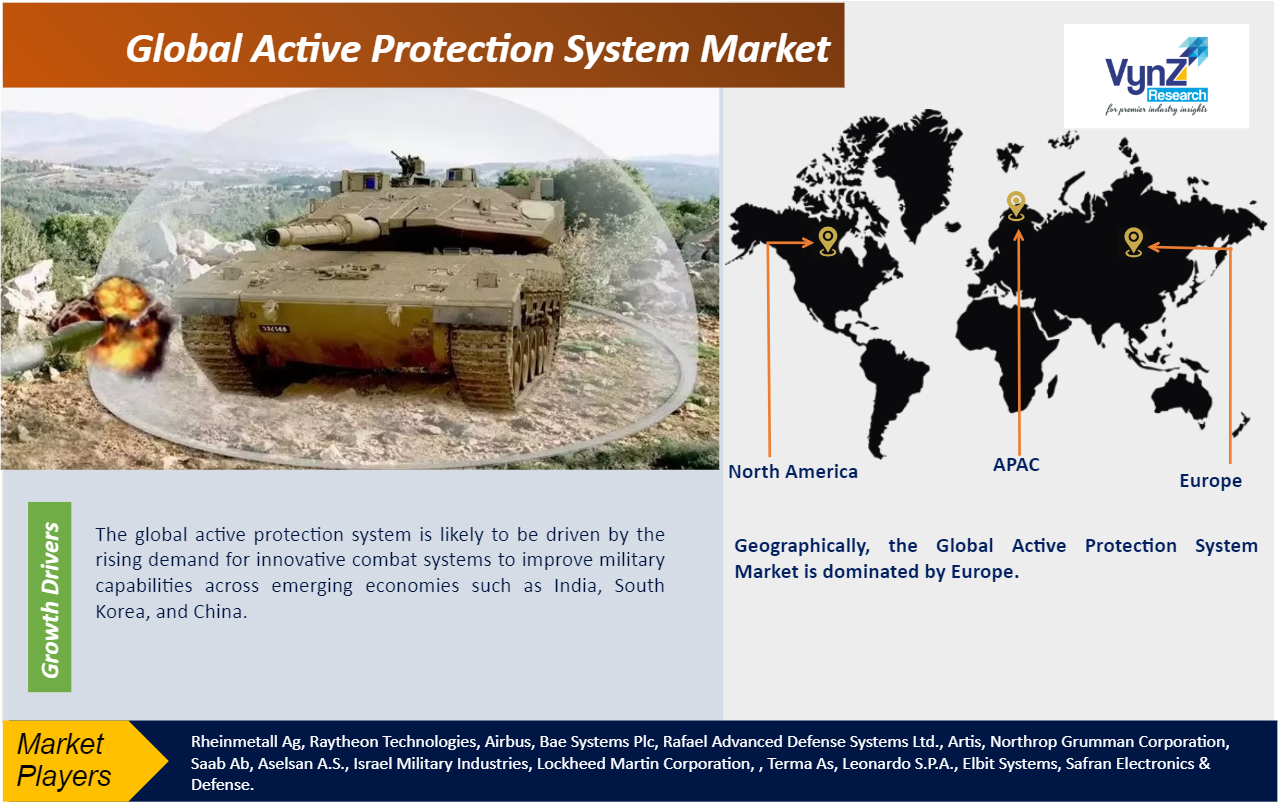
APS systems are made to make military vehicles more combat-survivable by identifying and removing threats before they may destroy the vehicle. Anti-tank missiles and other guided weapons play a vital role in modern warfare as they are deployed. A vehicle’s weight is the main obstruction in its mobility and speed in conventional passive armor systems, whereas in active protection systems the vehicle’s performance is not compromised as it is typically lighter and more compact. To improve the effectiveness, active protection systems are rapidly evolving with new and advanced technologies.
Market Segmentation
Insight by Kill System Type
The Active Protection System Market is segmented by kill system type, such as soft kill system, hard kill system and reactive armor. The soft kill systems dominated the market over the forecast period owing to their cost-effectiveness and greater relevance to military capabilities such as intelligence, surveillance, and investigation.
Insight by Platform
Based on platform, The Active Protection System Market is segregated ground, airborne and marine. Ground segment is anticipated to grow at the highest CAGR during the forecast period. Militaries around the world are concentrating on combating improvised explosive devices (IEDs). To secure the platform totally, active protection systems can be used with anti-IED technologies, such as double V-hulls, IED jammers, and others. These systems can be fitted with a variety of sensors, radars, decoys, chaffs, and weapon mountings, which makes them important for a wide range of land combat platforms around the world as they are scalable, dependable, and versatile.
Insight by End-user type
On the basis of its uses the Active Protection System Market is bifurcated into defense and homeland security. Defense segment dominated the market in terms of value in the active protection market as these systems are widely used to provide safety to armored fighting vehicles from enemy fire.
|
Report Metric |
Details |
|
Historical Period |
2020 - 2024 |
|
Base Year Considered |
2025 |
|
Forecast Period |
2026 - 2035 |
|
Market Size in 2025 |
U.S.D. 4.2 Billion |
|
Revenue Forecast in 2035 |
U.S.D. 5.7 Billion |
|
Growth Rate |
5.5% |
|
Segments Covered in the Report |
By kill system type, by platform and by End-user type |
|
Report Scope |
Market Trends, Drivers, and Restraints; Revenue Estimation and Forecast; Segmentation Analysis; Impact of COVID-19; Companies’ Strategic Developments; Market Share Analysis of Key Players; Company Profiling |
|
Regions Covered in the Report |
North America, Europe, Asia-Pacific, South America, Middle East And Africa |
Industry Dynamics
Growth Drivers
The global active protection system is likely to be driven by the rising demand for innovative combat systems to improve military capabilities across emerging economies such as India, South Korea, and China. Furthermore, rising demand for the building of a secure network against cyber-attacks, continued research and development efforts, considerable government and non-government organization investment, and favorable economic conditions are also driving the growth of the active protection market. Military spending among both developing and developed countries is rising, ultimately expanding the active protection systems market.
Restraints
Demand for defense products and APS-related services had a major impact as the European Union's reduced defense budget. Due to the national lockdown, reduction in defense spending and the suspension of APS production, the defense sector is facing serious challenges. Utilizing this kind of technology, military vehicles can better defend themselves. With the replacement of conventional equipment with an advanced active protection system in various armored vehicles, light-protected vehicles and light tanks that require maintenance costs, are hampering the industry growth. In addition, military aircraft have active defenses such as radar systems to track and identify threats which require a huge investment from R&D that can restrain the growth of the active protection system market.
Geographic Overview
North America
Europe
Asia Pacific (APAC)
South America
Middle East and Africa
Geographically, the global Active Protection System Market is dominated by Europe. The European region has a well-established defense procurement system, which enables countries to acquire the latest and most advanced APS systems. The European defense industry has been investing heavily in research and development for Active Protection Systems, leading to the development of technologically advanced systems. European companies like Rafael Advanced Defense Systems, Saab AB, and Rheinmetall AG are leading players in the APS market, offering a range of advanced systems to customers worldwide. The high demand for APS systems has boosted European companies to invest more in the development of these systems.
Key Players Covered in the Report
The Active Protection System market key players include Rheinmetall Ag, Raytheon Technologies, Airbus, Bae Systems Plc, Rafael Advanced Defense Systems Ltd., Artis, Northrop Grumman Corporation, Saab Ab, Aselsan A.S., Israel Military Industries, Lockheed Martin Corporation, , Terma As, Leonardo S.P.A., Elbit Systems, Safran Electronics & Defense.
Recent developments by Key Players
Raytheon, an RTX business, in support of the U.S. Army, completed a live-fire engagement using the advanced, 360-degree Lower Tier Air and Missile Defense Sensor, known as LTAMDS. This milestone is the latest event in a series of ongoing development tests for the radar which will culminate with an operational capability level by the end of the year. The test consisted of a cruise missile surrogate flying a representative threat trajectory. The target was acquired and tracked by LTAMDS, its track data was passed to the Integrated Battle Command System for launch command, and LTAMDS guided a PAC-3 missile to intercept.
Elbit Systems Ltd. Is awarded a contract worth $109 million to supply BAE Systems Hägglunds (Sweden) with the Iron Fist Active Protection System (APS) for its CV90 platform, for a European customer. The Iron Fist APS is characterized by low volume, weight, and power requirements. The system provides armored platforms with 360-degree protection from a wide variety of anti-armor threats, such as rocket-propelled grenades (RPG) and up to KE tank rounds in both open terrain and urban environments. The APS sensor combines the dual technologies of search-and-track radar and infra-red cameras with data fusion algorithms, allowing for rapid, reliable, and accurate threat detection, identification, and tracking. The system destroys threats by launching an explosive charge toward the incoming threat’s vicinity and exploding it to create a shock wave that deflects the threat at a safe distance from the protected platform.
The global Active Protection System Market report offers a comprehensive market segmentation analysis along with estimation for the forecast period 2025–2030.
Segments Covered in the Report
By Kill System Type
Soft Kill System
Hard Kill System
Reactive Armor
By Platform
Ground
Airborne
Marine
By Enduser type
Defence
Homeland Securities
Region Covered in the Report
North America
U.S.
Canada
Mexico
Europe
Germany
U.K.
France
Italy
Spain
Russia
Rest of Europe
Asia-Pacific (APAC)
China
Japan
South Korea
India
Australia
Rest of APAC
South America
Brazil
Argentina
Rest of South America
Middle East and Africa
Turkey
UAE
Saudi Arabia
South Africa
Rest of MEA
Primary Research Interviews Breakdown
%20System%20Market.png)
1. Research Overview
1.1. The Report Offers
1.2. Market Coverage
1.2.1. By Kill System Type
1.2.2. By Platform
1.2.3. By End User Type
1.2.5. By Region
1.3. Research Phases
1.4. Limitations
1.5. Market Methodology
1.5.1. Data Sources
1.5.1.1. Primary Research
1.5.1.2. Secondary Research
1.5.2. Methodology
1.5.2.1. Data Exploration
1.5.2.2. Forecast Parameters
1.5.2.3. Data Validation
1.5.2.4. Assumptions
1.5.3. Study Period & Data Reporting Unit
2. Executive Summary
3. Industry Overview
3.1. Industry Dynamics
3.1.1. Market Growth Drivers
3.1.2. Market Restraints
3.1.3. Key Market Trends
3.1.4. Major Opportunities
3.2. Industry Ecosystem
3.2.1. Porter’s Five Forces Analysis
3.2.2. Recent Development Analysis
3.2.3. Value Chain Analysis
3.3. Competitive Insight
3.3.1. Competitive Position of Industry Players
3.3.2. Market Attractive Analysis
3.3.3. Market Share Analysis
4. Global Market Estimate and Forecast
4.1. Global Market Overview
4.2. Global Market Estimate and Forecast to 2030
5. Market Segmentation Estimate and Forecast
5.1. By Kill System Type
5.1.1. Soft Kill System
5.1.1.1. Market Definition
5.1.1.2. Market Estimation and Forecast to 2030
5.1.2. Hard Kill System
5.1.2.1. Market Definition
5.1.2.2. Market Estimation and Forecast to 2030
5.1.3. Reactive Armor
5.1.3.1. Market Definition
5.1.3.2. Market Estimation and Forecast to 2030
5.2. By Platform
5.2.1. Ground
5.2.1.1. Market Definition
5.2.1.2. Market Estimation and Forecast to 2030
5.2.2. Airborne
5.2.2.1. Market Definition
5.2.2.2. Market Estimation and Forecast to 2030
5.2.3. Marine
5.2.3.1. Market Definition
5.2.3.2. Market Estimation and Forecast to 2030
5.3 By End User Type
5.3.1. Defence
5.3.1.1. Market Definition
5.3.1.2. Market Estimation and Forecast to 2030
5.3.2. Homeland Securities
5.3.2.1. Market Definition
5.3.2.2. Market Estimation and Forecast to 2030
6. North America Market Estimate and Forecast
6.1. By Kill System Type
6.2. By Platform
6.3. By End User Type
6.4.1. U.S. Market Estimate and Forecast
6.4.2. Canada Market Estimate and Forecast
6.4.3. Mexico Market Estimate and Forecast
7. Europe Market Estimate and Forecast
7.1. By Kill System Type
7.2. By Platform
7.3. By End User Type
7.4.1. Germany Market Estimate and Forecast
7.4.2. France Market Estimate and Forecast
7.4.3. U.K. Market Estimate and Forecast
7.4.4. Italy Market Estimate and Forecast
7.4.5. Spain Market Estimate and Forecast
7.4.6. Rest of Europe Market Estimate and Forecast
8. Asia-Pacific Market Estimate and Forecast
8.1. By Kill System Type
8.2. By Platform
8.3. By End User Type
8.4. By Country – China, Japan, India, South Korea, and Rest of Asia-Pacific
8.4.1. China Market Estimate and Forecast
8.4.2. Japan Market Estimate and Forecast
8.4.3. India Market Estimate and Forecast
8.4.4. South Korea Market Estimate and Forecast
8.4.5. Singapore Market Estimate and Forecast
8.4.6. Rest of Asia-Pacific Market Estimate and Forecast
9. Rest of the World (RoW) Market Estimate and Forecast
9.1. By Kill System Type
9.2. By Platform
9.3. By End User Type
9.4. By Country – Brazil, Saudi Arabia, South Africa, U.A.E., and Other Countries
9.4.1. Brazil Market Estimate and Forecast
9.4.2. Saudi Arabia Market Estimate and Forecast
9.4.3. South Africa Market Estimate and Forecast
9.4.4. Other Countries Market Estimate and Forecast
10. Company Profiles
10.1. Rheinmetall Ag
10.1.1. Snapshot
10.1.2. Overview
10.1.3. Offerings
10.1.4. Financial Insight
10.1.5. Recent Developments
10.2. Raytheon Technologies
10.2.1. Snapshot
10.2.2. Overview
10.2.3. Offerings
10.2.4. Financial Insight
10.2.5. Recent Developments
10.3. Airbus, Bae Systems Plc
10.3.1. Snapshot
10.3.2. Overview
10.3.3. Offerings
10.3.4. Financial Insight
10.3.5. Recent Developments
10.4. Rafael Advanced Defense Systems Ltd.
10.4.1. Snapshot
10.4.2. Overview
10.4.3. Offerings
10.4.4. Financial Insight
10.4.5. Recent Developments
10.5. Artis
10.5.1. Snapshot
10.5.2. Overview
10.5.3. Offerings
10.5.4. Financial Insight
10.5.5. Recent Developments
10.6. Northrop Grumman Corporation
10.6.1. Snapshot
10.6.2. Overview
10.6.3. Offerings
10.6.4. Financial Insight
10.6.5. Recent Developments
10.7. Saab Ab
10.7.1. Snapshot
10.7.2. Overview
10.7.3. Offerings
10.7.4. Financial Insight
10.7.5. Recent Developments
10.8. Aselsan A.S.
10.8.1. Snapshot
10.8.2. Overview
10.8.3. Offerings
10.8.4. Financial Insight
10.8.5. Recent Developments
10.9. Israel Military Industries
10.9.1. Snapshot
10.9.2. Overview
10.9.3. Offerings
10.9.4. Financial Insight
10.9.5. Recent Developments
10.10. Lockheed Martin Corporation,
10.10.1. Snapshot
10.10.2. Overview
10.10.3. Offerings
10.10.4. Financial Insight
10.11. Terma As
10.11.1. Snapshot
10.11.2. Overview
10.11.3. Offerings
10.11.4. Financial Insight
10.12. Leonardo S.P.A.
10.12.1. Snapshot
10.12.2. Overview
10.12.3. Offerings
10.12.4. Financial Insight
10.13. Elbit Systems
10.13.1. Snapshot
10.13.2. Overview
10.13.3. Offerings
10.13.4. Financial Insight
10.14. Safran Electronics & Defense
10.14.1. Snapshot
10.14.2. Overview
10.14.3. Offerings
10.14.4. Financial Insight
11. Appendix
11.1. Exchange Rates
11.2. Abbreviations
Note: Financial insight and recent developments of different companies are subject to the availability of information in the secondary domain.
List of Tables
Table 1 Applications
Table 2 Study Periods
Table 3 Data Reporting Unit
Table 4 Global Automated Material Handling Market Size, By Kill System Type, 2018 – 2023 (USD Billion)
Table 5 Global Automated Material Handling Market Size, By Kill System Type, 2025 – 2030 (USD Billion)
Table 6 Global Automated Material Handling Market Size, By Platform, 2018 – 2023 (USD Billion)
Table 7 Global Automated Material Handling Market Size, By Platform, 2025 – 2030 (USD Billion)
Table 8 Global Automated Material Handling Market Size, By End User Type, 2018 – 2023 (USD Billion)
Table 9 Global Automated Material Handling Market Size, By End User Type, 2025 – 2030 (USD Billion)
Table 10 Global Automated Material Handling Market Size, by Region, 2018 – 2023 (USD Billion)
Table 11 Global Automated Material Handling Market Size, by Region, 2025 – 2030 (USD Billion)
Table 12 North America Automated Material Handling Market Size, By Kill System Type, 2018 – 2023 (USD Billion)
Table 13 North America Automated Material Handling Market Size, By Kill System Type, 2025 – 2030 (USD Billion)
Table 14 North America Automated Material Handling Market Size, By Platform, 2018 – 2023 (USD Billion)
Table 15 North America Automated Material Handling Market Size, By Platform, 2025 – 2030 (USD Billion)
Table 16 North America Automated Material Handling Market Size, By End User Type, 2018 – 2023 (USD Billion)
Table 17 North America Automated Material Handling Market Size, By End User Type, 2025 – 2030 (USD Billion)
Table 18 North America Automated Material Handling Market Size, by Country, 2018 – 2023 (USD Billion)
Table 19 North America Automated Material Handling Market Size, by Country, 2025 – 2030 (USD Billion)
Table 20 Europe Automated Material Handling Market Size, By Kill System Type, 2018 – 2023 (USD Billion)
Table 21 Europe Automated Material Handling Market Size, By Kill System Type, 2025 – 2030 (USD Billion)
Table 22 Europe Automated Material Handling Market Size, By Platform, 2018 – 2023 (USD Billion)
Table 23 Europe Automated Material Handling Market Size, By Platform, 2025 – 2030 (USD Billion)
Table 24 Europe Automated Material Handling Market Size, By End User Type, 2018 – 2023 (USD Billion)
Table 25 Europe Automated Material Handling Market Size, By End User Type, 2025 – 2030 (USD Billion)
Table 26 Europe Automated Material Handling Market Size, by Country, 2018 – 2023 (USD Billion)
Table 27 Europe Automated Material Handling Market Size, by Country, 2025 – 2030 (USD Billion)
Table 28 Asia-Pacific Automated Material Handling Market Size, By Kill System Type, 2018 – 2023 (USD Billion)
Table 29 Asia-Pacific Automated Material Handling Market Size, By Kill System Type, 2025 – 2030 (USD Billion)
Table 30 Asia-Pacific Automated Material Handling Market Size, By Platform, 2018 – 2023 (USD Billion)
Table 31 Asia-Pacific Automated Material Handling Market Size, By Platform, 2025 – 2030 (USD Billion)
Table 32 Asia-Pacific Automated Material Handling Market Size, By End User Type, 2018 – 2023 (USD Billion)
Table 33 Asia-Pacific Automated Material Handling Market Size, By End User Type, 2025 – 2030 (USD Billion)
Table 34 Asia-Pacific Automated Material Handling Market Size, by Country, 2018 – 2023 (USD Billion)
Table 35 Asia-Pacific Automated Material Handling Market Size, by Country, 2025 – 2030 (USD Billion)
Table 36 RoW Automated Material Handling Market Size, By Kill System Type, 2018 – 2023 (USD Billion)
Table 37 RoW Automated Material Handling Market Size, By Kill System Type, 2025 – 2030 (USD Billion)
Table 38 RoW Automated Material Handling Market Size, By Platform, 2018 – 2023 (USD Billion)
Table 39 RoW Automated Material Handling Market Size, By Platform, 2025 – 2030 (USD Billion)
Table 40 RoW Automated Material Handling Market Size, By End User Type, 2018 – 2023 (USD Billion)
Table 41 RoW Automated Material Handling Market Size, By End User Type, 2025 – 2030 (USD Billion)
Table 42 RoW Automated Material Handling Market Size, by Country, 2018 – 2023 (USD Billion)
Table 43 RoW Automated Material Handling Market Size, by Country, 2025 – 2030 (USD Billion)
Table 44 Snapshot – Rheinmetall Ag
Table 45 Snapshot – Raytheon Technologies
Table 46 Snapshot – Airbus, Bae Systems Plc
Table 47 Snapshot – Rafael Advanced Defense Systems Ltd.
Table 48 Snapshot – Artis
Table 49 Snapshot – Northrop Grumman Corporation
Table 50 Snapshot – Saab Ab
Table 51 Snapshot – Aselsan A.S.
Table 52 Snapshot – Israel Military Industries
Table 53 Snapshot – Lockheed Martin Corporation,
Table 54 Snapshot – Terma As
Table 55 Snapshot – Leonardo S.P.A.
Table 56 Snapshot – Elbit Systems
Table 57 Snapshot – Safran Electronics & Defense
List of Figures
Figure 1 Market Coverage
Figure 2 Research Phases
Figure 3 Secondary Product Types for Different Parameters
Figure 4 Methodology
Figure 5 Data Mining & Exploration
Figure 6 Data Triangulation
Figure 7 Assumptions for Market Estimation and Forecast
Figure 8 Market Synopsis
Figure 9 Global Automated Material Handling Market - Growth Drivers and Restraints
Figure 10 Competitive Benchmark
Figure 11 Global Automated Material Handling Market Highlight
Figure 12 Global Automated Material Handling Market Size, By Kill System Type, 2018 - 2030 (USD Billion)
Figure 13 Global Automated Material Handling Market Size, By Platform 2018 - 2030 (USD Billion)
Figure 14 Global Automated Material Handling Market Size, By End User Type 2018 - 2030 (USD Billion)
Figure 15 Global Automated Material Handling Market Size, by Region, 2018 - 2030 (USD Billion)
Figure 16 North America Automated Material Handling Market Highlight
Figure 17 North America Automated Material Handling Market Size, By Kill System Type, 2018 - 2030 (USD Billion)
Figure 18 North America Automated Material Handling Market Size, By Platform 2018 - 2030 (USD Billion)
Figure 19 North America Automated Material Handling Market Size, By End User Type 2018 - 2030 (USD Billion)
Figure 20 North America Automated Material Handling Market Size, by Country, 2018 - 2030 (USD Billion)
Figure 21 Europe Automated Material Handling Market Highlight
Figure 22 Europe Automated Material Handling Market Size, By Kill System Type, 2018 - 2030 (USD Billion)
Figure 23 Europe Automated Material Handling Market Size, By Platform 2018 - 2030 (USD Billion)
Figure 24 Europe Automated Material Handling Market Size, By End User Type 2018 - 2030 (USD Billion)
Figure 25 Europe Automated Material Handling Market Size, by Country, 2018 - 2030 (USD Billion)
Figure 26 Asia-Pacific Automated Material Handling Market Highlight
Figure 27 Asia-Pacific Automated Material Handling Market Size, By Kill System Type, 2018 - 2030 (USD Billion)
Figure 28 Asia-Pacific Automated Material Handling Market Size, By Platform 2018 - 2030 (USD Billion)
Figure 29 Asia-Pacific Automated Material Handling Market Size, By End User Type 2018 - 2030 (USD Billion)
Figure 30 Asia-Pacific Automated Material Handling Market Size, by Country, 2018 - 2030 (USD Billion)
Figure 31 RoW Automated Material Handling Market Highlight
Figure 32 RoW Automated Material Handling Market Size, By Kill System Type, 2018 - 2030 (USD Billion)
Figure 33 RoW Automated Material Handling Market Size, By Platform 2018 - 2030 (USD Billion)
Figure 34 RoW Automated Material Handling Market Size, By End User Type 2018 - 2030 (USD Billion)
Figure 35 RoW Automated Material Handling Market Size, by Country, 2018 - 2030 (USD Billion)
Active Protection System Market Coverage
By Kill System Type Insight and Forecast 2025-2030
By Platform Insight and Forecast 2025-2030
By End User Type Insight and Forecast 2025-2030
Geographical Segmentation
Active Protection System Market by Region
North America
Europe
Asia-Pacific (APAC)
Rest of the World (RoW)
About This Report
Purchase Options
Latest Report
Research Methodology
Connect With Our Sales Team
Active Protection System Market