India PVC Based Wall Paper Market Overview
The India PVC based wall paper market size was estimated at about USD 680 million in 2025 and is expected to reach around USD 740 million in 2026, rising to roughly USD 1980 million by 2035, growing at an estimated CAGR of 11.5% during the forecast period from 2026 to 2035.
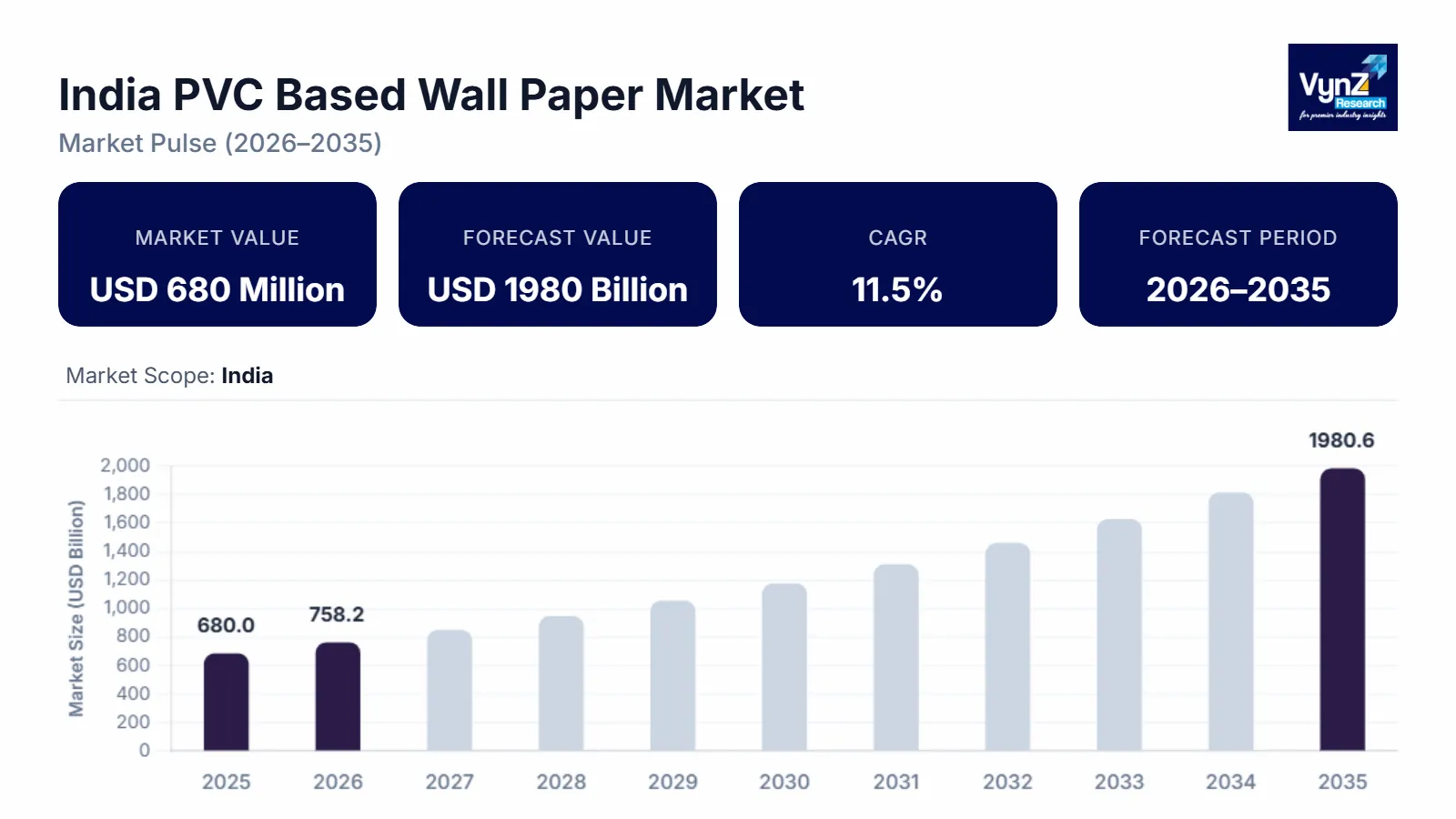
Research Highlights
- Solid vinyl held the largest share of approximately 46% in 2025, supported by superior durability and moisture resistance.
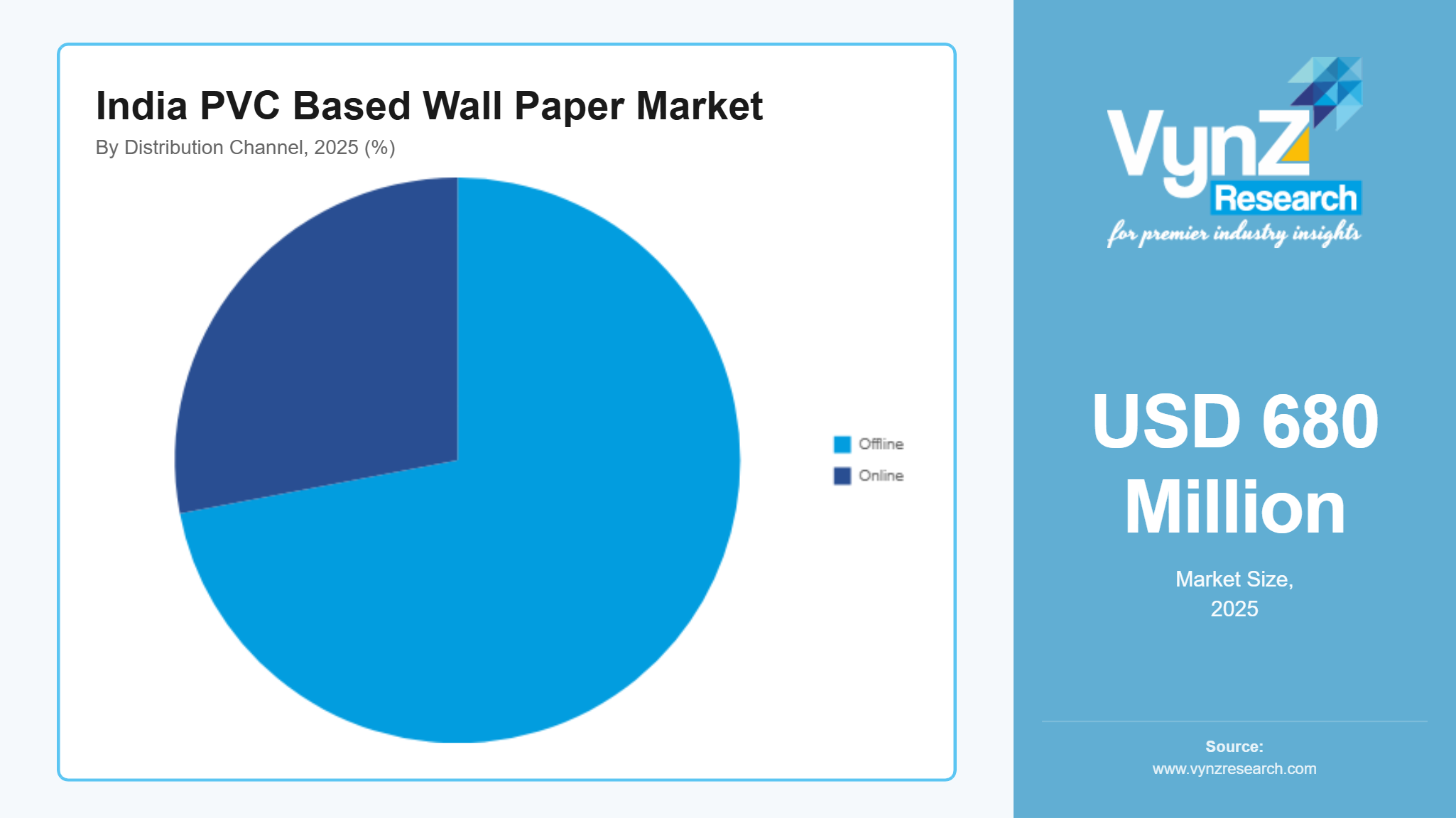
- Offline distribution accounted for nearly 72% of market revenue in 2025 due to strong preference for physical product evaluation and installation support.
- Residential applications captured around 64% of the market in 2025, driven by rising housing construction and renovation activities.
- Online distribution is projected to record the fastest growth at approximately 13.1% CAGR during 2026–2035, supported by expanding digital commerce adoption.
- North India accounted for nearly 29% of the market in 2025, supported by strong urban housing development and renovation demand.
The market expands largely due to increased residential renovation work, the quick growth of urban housing, and a higher consumer demand for the most cost-effective decorative wall solutions. Digitally printed and moisture resistant wall coverings are becoming more popular pushing the demand in apartments, commercial offices, hotels, and retail stores. The Ministry of Housing and Urban Affairs has revealed that through Pradhan Mantri Awas Yojana, millions of urban and rural housing units have been constructed and National Statistical Office data also show urban household expenditure on home improvement and furnishing is still on the rise. The Smart Cities Mission alongside ongoing smart city development projects and infrastructure investments keep pushing markets in major regions like Delhi NCR, Mumbai, Bengaluru, Hyderabad and Pune to grow.
India PVC Based Wall Paper Market Dynamics
Market Trends
The industry is witnessing changes in choice of interior decoration among consumers, how much they spend on renovations, and growing appetence of digitally printed and customized wall coverings for premium visuals, more design flexibility, and personal spaces. According to the National Statistical Office, urban household spending on furnishing and home improvement categories has increased with disposable incomes going up. Another trend picking up is the preference for low upkeep, tough interior materials, backed by sustainability related urban development initiatives under the Ministry of Housing and Urban Affairs and the Smart Cities Mission.
Growth Drivers
The market growth is mostly backed by ongoing residential construction increasing demand across apartments, independent housing developments, and urban redevelopment. The Ministry of Housing and Urban Affairs has pointed out continued momentum under the Pradhan Mantri Awas Yojana, which is helping expand housing at scale across many states. More spending in commercial infrastructure, hospitality facilities, retail projects and office spaces is also pushing the market forward. Data from the Department for Promotion of Industry and Internal Trade suggests that investment activity inside construction and real estate is still steady and that support longer term needs for decorative and cost-efficient interior finishing materials.
Market Restraints / Challenges
Even with all these positive growth signals, the market still has hurdles that could slow things down like fluctuations in PVC resin prices that hit production costs and profit margins making it tough for small and medium manufacturers who operate in price sensitive pockets. Dependency on imported specialty chemicals, decorative films and advanced printing materials create operational issues for suppliers. Trade statistics from the Ministry of Commerce and Industry point to continued reliance on imports for multiple value-added furnishing inputs that affects the market with freight price volatility, currency movements, and disruptions in global supply chains.
Market Opportunities
There are strong opportunities in the market in premium residential interiors due to rapid urbanization moves, higher disposable income and a growing taste for living spaces that look more attractive rather than merely functional. NITI Aayog and the National Statistical Office data shows India’s urban population and middle-income group are expanding, improving the demand for decorative interior products. Another major chance is in tier 2 and tier 3 cities where organized retail, ecommerce platforms and newer housing developments are improving access to these products. Ongoing infrastructure work under the Smart Cities Mission and different state level urban modernization initiatives are expected to open up new pathways for premium, more technologically advanced wall covering options.
India PVC Based Wall Paper Market Report Coverage
|
Report Metric
|
Details
|
|
Historical Period
|
2020 - 2024
|
|
Base Year Considered
|
2025
|
|
Forecast Period
|
2026 - 2035
|
|
Market Size in 2025
|
U.S.D. 680 Million
|
|
Revenue Forecast in 2035
|
U.S.D. 1980 Million
|
|
Growth Rate
|
11.5%
|
|
Segments Covered in the Report
|
By Type, By Application and By Distribution Channel
|
|
Report Scope
|
Market Trends, Drivers, and Restraints; Revenue Estimation and Forecast; Segmentation Analysis; Companies’ Strategic Developments; Market Share Analysis of Key Players; Company Profiling
|
|
Regions Covered in the Report
|
North India, East India, West and Central India, South India
|
India PVC Based Wall Paper Market Segmentation
By Type
Solid vinyl dominated with close to 46% share of the market in 2025 and is expected to grow at a CAGR of about 11.2% till 2035 due to its outstanding resilience, resistance to moisture, and convenience of cleaning, making it very popular both in residential and commercial remodeling. Higher urban housing construction and the increasing spending on interior finishing solutions have pushed demand for the segment in major urban areas.
The vinyl coated segment is predicted to grow at the highest rate of almost 12.3% throughout the forecast period. Changes in consumer behavior towards affordable decorative products and more availability of digitally printed designs are the main drivers for adoption of vinyl coated wall-paper. According to the Ministry of Housing and Urban Affairs, ongoing housing developments through urban infrastructure initiatives are creating requirements for cheaper wall decoration materials.
By Distribution Channel
Offline distribution held 72% market share approximately in 2025 and is expected to hold onto its leadership position throughout the forecast period due to higher demand in physical retail stores and interior furnishing specialty outlets mainly to meet the need to check the product, the possibility of side-by-side design comparison, and the availability of guidance on professional installation.
Online sale will probably increase at a high rate of about 13.1% CAGR during 2026 to 2035 due to the increase in internet penetration, development of logistics infrastructure and greater consumer faith in digital shopping platforms. Statistics from the Ministry of Electronics and Information Technology and DPIIT show that the trend towards online shopping is
By Application
The residential segment dominated the market in 2025 with a share of almost 64% and is expected to register a remarkable CAGR of 11.7% during the forecast period due to growing apartment construction, increasing home renovation expenditure, and changing consumer preferences for decorative interiors. Data from the National Statistical Office shows that household spending on furnishing and home improvement categories is increasing due to the growing demand for residential segment products.
Commercial applications will grow by around 12.0% over the forecast period largely fueled by the expansion of hospitality establishments, corporate offices, retail outlets, healthcare facilities, and educational institutions. Real estate investments and infrastructure projects receive support from DPIIT and Ministry of Commerce and Industry investment data, which keep on paving the way for the solutions based on decorative wall coverings.
Regional Insights
North India
North India contributed about 29% of the market in 2025, pushed mostly by strong residential construction, fast urban expansion and higher renovation spending across Delhi NCR, Chandigarh, Jaipur and Lucknow. As per the Ministry of Housing and Urban Affairs, a lot of smart city efforts and urban redevelopment projects are still keeping the construction pace up in the area.
West and Central India
West and Central India had an estimated 24% share in 2025 supported by active real estate work in Mumbai, Pune, Ahmedabad, Indore and Nagpur. The market is moving ahead because residential townships are growing, commercial infrastructure is getting built and more buyers are adopting modern interior finishing materials. DPIIT data also points to continued investment inflows into construction development and real estate activities which keeps demand for decorative building products alive. Organized home improvement retail is becoming more common and premium housing projects are increasing to push the growth in the region to about 11.8% CAGR over the forecast stretch.
South India
South India represented nearly 21% of the market in 2025, mainly from urbanization trends and growing needs from Bengaluru, Hyderabad, Chennai, and Kochi backed by expanding IT infrastructure, premium residential undertakings, hospitality investments and commercial office construction. The National Statistical Office suggests southern states show relatively higher urban consumption expenditure and that really supports demand for interior furnishing items. Ongoing investments in smart infrastructure, integrated townships and commercial modernization are creating demand for PVC based wall paper usage to help it growth at roughly 12.2% CAGR.
East India
East India held about 8% of the market in 2025 due to more urban housing development and infrastructure modernization across Kolkata, Bhubaneswar, Patna and Guwahati. Growth is fueled by consumers getting more aware of decorative interior products and more capital flowing into residential construction. The Ministry of Housing and Urban Affairs notes that several eastern cities are still benefitting from Smart Cities Mission investments and ongoing upgrades to urban infrastructure. The region should grow at nearly 11.0% CAGR during the forecast window. The remaining 18% market share is spread across other smaller regional markets and emerging urban hubs.
Competitive Landscape / Company Insights
The market is moderately competitive with the domestic manufacturers, importers, and international decorative surface solution providers focusing on product innovation, design diversification and distribution expansion. Companies are increasingly investing in digital printing technologies, premium product portfolios and organized retail partnerships to strengthen market positioning. According to the Department for Promotion of Industry and Internal Trade (DPIIT), continued investment activity within construction and interior furnishing sectors is creating opportunities for market participants. Supportive urban development initiatives led by the Ministry of Housing and Urban Affairs are further encouraging competitive expansion across major metropolitan and emerging urban markets.
Mini Profiles
Asian Paints Nilaya focuses on premium wall coverings and decorative interior solutions, supported by strong brand recognition, extensive dealer networks, and integrated home décor offerings across residential and commercial applications.
Excel Wall Interiors operates in customized and decorative wall covering segments, emphasizing design diversity, project-based solutions, and customer-specific requirements for residential, hospitality, and corporate interior environments.
Marshalls Wallcoverings specializes in premium wallpaper collections and interior décor products, supported by a well-established distribution presence, international design collaborations, and a strong reputation in luxury interiors.
Royale Touche focuses on high-end decorative surface solutions, emphasizing premium aesthetics, product innovation, and customization capabilities. The company serves luxury residential, hospitality, and commercial interior design projects.
Versalis leverages advanced material expertise and product development capabilities to support decorative surface applications. Strategic partnerships and innovation-driven solutions contribute to its presence within the broader wall covering value chain.
Key Players
- Asian Paints Nilaya
- Excel Wall Interiors
- Evershine Walls
- Marshalls Wallcoverings
- Maruti Interior Products
- Nilaya by Asian Paints
- Royale Touche
- Spectrum Interior Solutions
- Versalis
- Wallpaper World
Recent Developments
In April 2025, Wallpaper World expanded its premium wall décor portfolio to address rising demand for customized and digitally printed wall coverings across urban residential projects. The development aligned with growing consumer preference for personalized interior solutions and modern design themes observed across the Indian décor sector.
In August 2025, Maruti Interior Products strengthened its distribution network across western and southern India to improve product availability for dealers and interior contractors. The initiative supported increasing demand from residential renovation and commercial refurbishment projects.
In September 2025, Spectrum Interior Solutions introduced new contemporary wall covering collections focused on texture-rich finishes and modern design aesthetics. The launch was aimed at strengthening the company's presence within premium residential and hospitality interior applications.
In November 2025, Evershine Walls expanded its decorative wall solutions portfolio with an emphasis on durable and low-maintenance PVC based products. The company focused on addressing growing demand from urban housing developments and commercial interior projects.
In January 2026, Versalis continued advancing specialty material solutions supporting decorative surface and wall covering applications. The development reflected increasing industry focus on product performance, durability, and sustainable material innovation within the interior décor market.