
Rubber Process Oil Market Size & Share Growth Forecast Report (2026-2035)
Industry Insight by viscosity, medium viscosity grades are estimated to hold approximately 45.4% of revenue in 2025, reflecting their suitability across multiple rubber formulations and processing conditions. (Industrial applications are projected to grow at approximately 4% CAGR through 2035., Apar Industries Ltd., Chevron Corporation, Exxon Mobil Corporation, Gandhar Oil Refinery India Limited, H&R Group GmbH, Indian Oil Corporation Limited, Nynas AB, ORGKHIM Biochemical Holding, Shell plc), by Type (Aromatic, Paraffinic, Naphthenic, Treated Distillate Aromatic Extract, Distillate Aromatic Extract, Mild Extracted Solvate, Residual Aromatic Extract, Treated Residual Aromatic Extract), by Viscosity (Low viscosity, Medium viscosity, High viscosity), by Application (Tires, Industrial rubber products, Oil extended polymers, Thermoplastic elastomers, Other applications), by End Use (Automotive, Industrial, Consumer goods and footwear, Other end uses)
| Status : Published | Published On : Sep, 2026 | Report Code : VRCH2146 | Industry : Chemicals & Materials | Available Format :

|
Page : 143 |
Rubber Process Oil Market Overview
The global rubber process oil market was estimated at USD 3.07 billion in 2025, reached approximately USD 3.29 billion in 2026, and is projected to reach nearly USD 4.64 billion by 2035, reflecting an estimated 3.9% CAGR from 2026 to 2035.
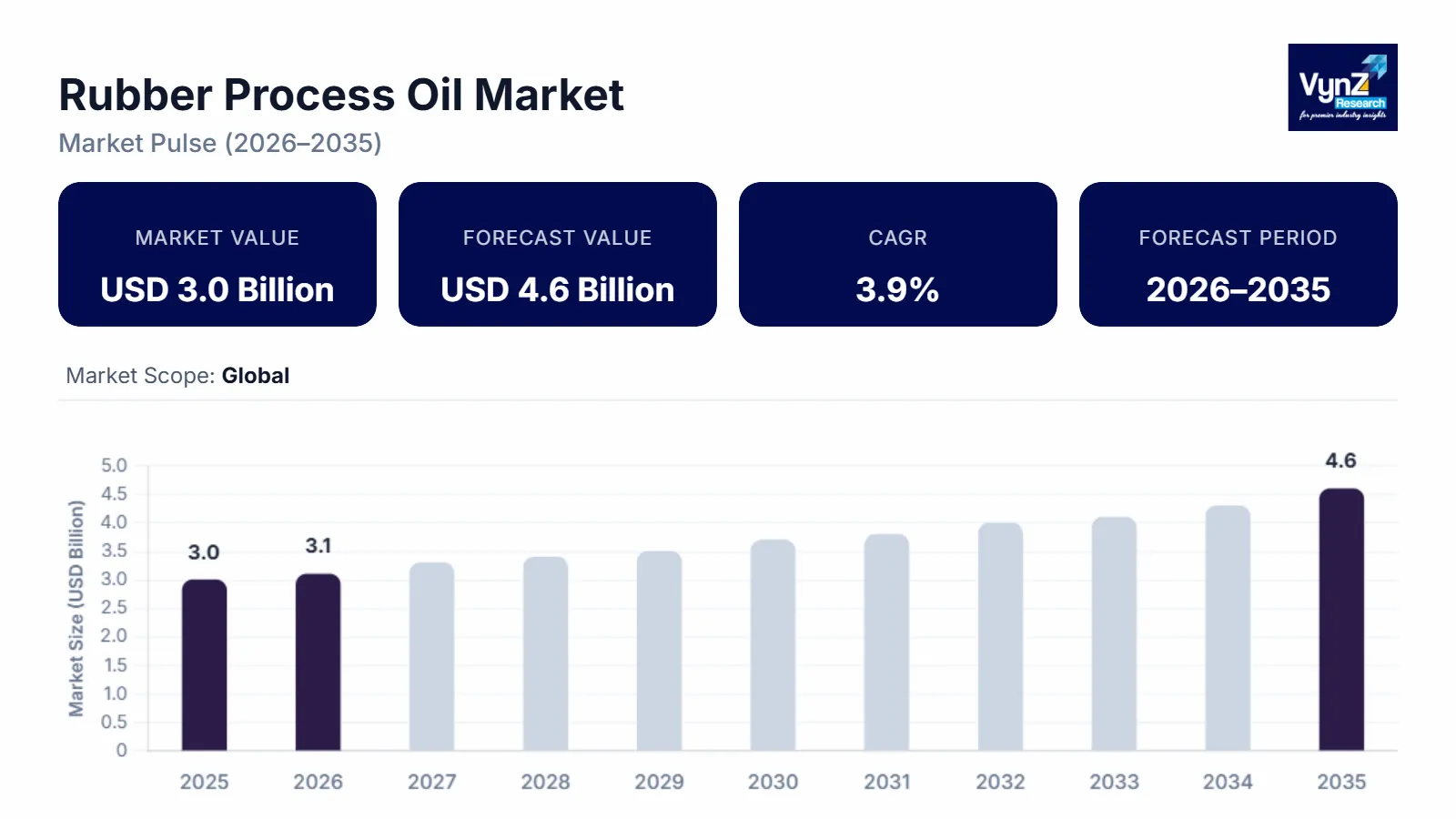
Market growth is driven by increasing tire production, growing synthetic rubber utilization, increasing high-performance tire demand and continual development of low aromatic process oils. The International Energy Agency reported that global electric car sales passed 20 million units in 2025, representing about one quarter of new car sales, while electric vehicle penetration is raising the demand for tires capable of withstanding higher vehicle weight, torque and durability. India's Rubber Board also reported that natural rubber production rose, supporting the wider rubber manufacturing ecosystem.
Research Methodology
VynZ Research employs a structured secondary research, primary validation and data triangulation approach to assess the global rubber process oil industry. The VynZ Research team reviews published market assessments, company disclosures, product portfolios, industry developments, regulatory information and downstream rubber industry indicators to establish market boundaries and forecast assumptions. The assessment covers product type, viscosity, application, end use and geographic demand, while differentiating rubber process oils from the wider process oil market. Analysis covers 2020 to 2024, with 2025 used as the base year and 2026 to 2035 considered the forecast period, while the market model combines published revenue and volume indicators with downstream demand factors, including tire manufacturing, automotive production, industrial rubber consumption and the adoption of low aromatic formulations.
Research Highlights
- By type, naphthenic oils are estimated to account for approximately 28.7% of global revenue in 2025, supported by broad compatibility with natural and synthetic rubber, low temperature flexibility and use across tires, technical rubber products and moldedcomponents.
- By application,tires are estimated to represent approximately 63.2% of market revenue in 2025,due to global tire production, replacement demand and increasing use of specialied rubber compounds.
- By viscosity, medium viscosity grades are estimated to hold approximately 45.4% of revenue in 2025, reflecting their suitability across multiple rubber formulations and processing conditions.
- Industrial applications are projected to grow at approximately 4% CAGR through 2035.
- Asia Pacific is estimated to account for approximately 44.7% of global revenue in 2025, supported by large tire manufacturing capacity, automotive production and industrial rubber consumption.
Rubber Process Oil Market Dynamics
Market Trends
The rubber process oil industry is witnessing a transition towards low aromatic, non carcinogenic and application specific formulations as tire and rubber manufacturers respond to environmental requirements and performance specifications. TDAE, MES, RAE and TRAE grades are seeing increased attention as they can satisfy the processing and compounding characteristics needed by modern rubber formulations while addressing restrictions associated with high aromatic oils. Current industry research identifies TDAE as a rapidly expanding product category while suppliers are seeking to develop grades that deliver processability, thermal stability and regulatory compliance. One other trend is higher performance rubber compounds for electric vehicles and specialized automotive applications.
Growth Drivers
The growth of the rubber process oil market is highly supported by tire manufacturing as the process oils enable improved compound processability, filler dispersion and flexibility and other formulation characteristics. Market research identifies tires as the dominant application while Asia Pacific represents the largest regional market given its extensive automotive and tire manufacturing base. Increasing demand for high performance and specialty rubber products is also driving consumption. The process oils are used in tires, industrial rubber products, oil extended polymers, thermoplastic elastomers which enable formulators to vary the processing behavior and finish characteristics of the finished product.
Market Restraints / Challenges
Despite the positive growth outlook for the rubber process oil market, it is subject to volatility in petroleum based feedstock prices as many conventional process oils are closely linked with the refinery stream and crude derived inputs. Changes in crude prices, refinery operating rates, transportation costs and regional supply conditions can influence production economics and procurement costs for rubber compound manufacturers. The challenge becomes more critical for smaller rubber processors who have limited ability to absorb raw material cost fluctuations or secure long term supply contracts. Regulatory requirements related to aromatic content and polycyclic aromatic hydrocarbons also influence product selection. This transition can require formulation changes, technical validation and customer approvals, increasing development time and qualification costs for the suppliers and rubber manufacturers.
Market Opportunities
The market presents significant opportunities in low aromatic and specialty rubber process oils, particularly as manufacturers seek products that fulfill regulatory compliance and stable processing and compound performance needs. Suppliers with hydrotreated, low PCA and specialty formulations can tap into the demand from tire manufacturers and technical rubber producers that require consistent product specifications. There is also opportunity in sustainable and lower carbon process oil formulations.
Global Rubber Process Oil Market Report Coverage
|
Report Metric |
Details |
|
Historical Period |
2020 - 2024 |
|
Base Year Considered |
2025 |
|
Forecast Period |
2026 - 2035 |
|
Market Size in 2025 |
USD 3.07 Billion |
|
Revenue Forecast in 2035 |
USD 4.64 Billion |
|
Growth Rate |
39% |
|
Segments Covered in the Report |
Type, Viscosity, Application, End Use |
|
Report Scope |
Market Trends, Drivers, and Restraints; Revenue Estimation and Forecast; Segmentation Analysis; Companies’ Strategic Developments; Market Share Analysis of Key Players; Company Profiling |
|
Regions Covered in the Report |
North America, Europe, Asia Pacific, Rest of the World |
|
Key Companies |
Apar Industries Ltd., Chevron Corporation, Exxon Mobil Corporation, Gandhar Oil Refinery India Limited, H&R Group GmbH, Indian Oil Corporation Limited, Nynas AB, ORGKHIM Biochemical Holding, Shell plc, Sinopec |
|
Customization |
Available upon request |
Rubber Process Oil Market Segmentation
By Type
Naphthenic oils are estimated to account for approximately 28.7% of global revenue in 2025, supported by their compatibility with natural and synthetic rubber, favorable low temperature characteristics and broad use in tires and industrial rubber products.
TDAE is projected to expand at approximately 4.3% CAGR through 2035, making it one of the faster developing specialty grades. Its adoption is linked with the continuing movement away from higher PAH formulations and demand for oils suitable for modern tire compounds.
By Viscosity
Medium viscosity grades are estimated to account for approximately 45.4% of revenue in 2025, due to their broad applicability across tire compounds, industrial rubber products and general rubber processing.
Low viscosity grades are estimated to represent approximately 30.1% of market revenue in 2025 and are projected to grow at approximately 4.0% CAGR through 2035. Demand is linked with applications where rapid incorporation, flow and processing efficiency are important, including selected polymer and rubber formulations.
By Application
Tires are estimated to account for approximately 63.2% of global revenue in 2025, supported by the large global tire manufacturing base and continuing replacement demand.
Industrial rubber products are estimated to account for approximately 19.8% of revenue in 2025 and are projected to grow at approximately 4.0% CAGR through 2035. Hoses, belts, seals, molded components and other technical products require process oils to support processing and finished product characteristics.
By End Use
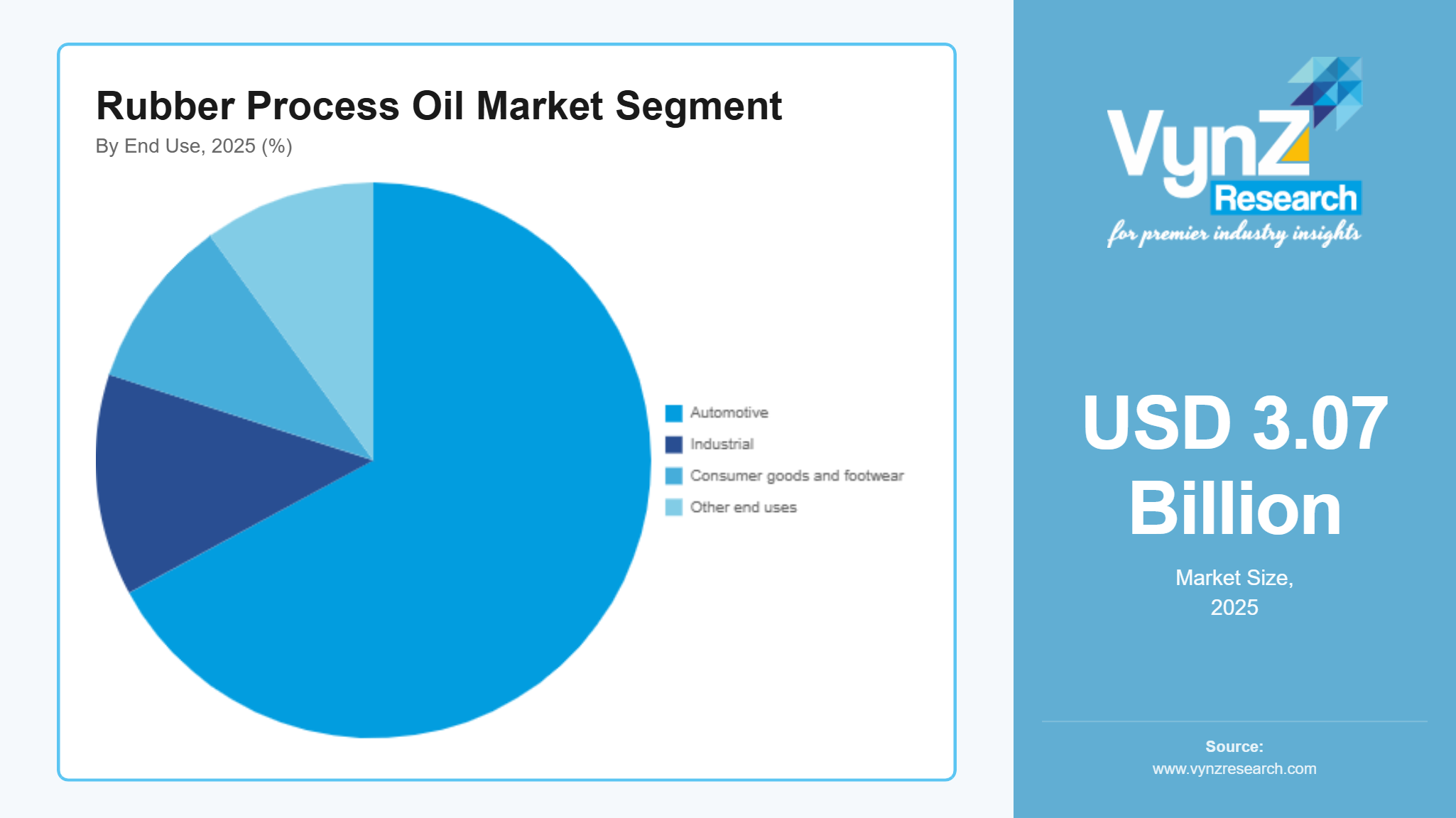
Automotive applications are estimated to account for approximately 67.1% of revenue in 2025, supported by tire manufacturing, seals, hoses, belts and other rubber components. The strong connection between automotive production and process oil consumption makes vehicle manufacturing and replacement tire demand important indicators for market development.
Industrial applications are estimated to account for approximately 18.7% of market revenue in 2025 and are projected to grow at approximately 4.0% CAGR through 2035. Demand is supported by industrial hoses, conveyor belts, seals, flooring materials and molded rubber components.
Regional Insights
North America
North America accounted for an estimated 18.9% of the market in 2025, supported by established automotive manufacturing, tire production and industrial rubber applications. The regional market is estimated to grow at approximately 3.0% CAGR from 2026 to 2035, reflecting mature downstream demand and established supply networks. Current regional research places the North American market at approximately USD 655.3 million in 2025 and identifies automotive and tire manufacturing as primary demand drivers.
Europe
Europe accounted for approximately 20.7% of market revenue in 2025 and is estimated to expand at approximately 3.6% CAGR through 2035. The region maintains significant demand for process oils because of its established automotive, tire and industrial manufacturing base, while regulatory requirements continue to encourage movement toward lower aromatic and more environmentally compatible grades.
Asia Pacific
Asia Pacific accounted for approximately 44.7% of global revenue in 2025, making it the largest regional market, and is estimated to record approximately 4.8% CAGR from 2026 to 2035. Current market research identifies the region as both the largest and fastest growing market, supported by extensive tire manufacturing, automotive production and industrial rubber consumption. China and India remain important demand centers, while Southeast Asian markets are supported by expanding automotive and manufacturing activity.
Rest of the World
The Rest of the World accounted for approximately 15.7% of revenue in 2025 and is estimated to grow at approximately 3.8% CAGR through 2035, supported by automotive production, tire replacement demand and industrial rubber consumption across Latin America, the Middle East and Africa. Market development varies considerably between individual countries because local refining capacity, tire manufacturing infrastructure and rubber processing activity influence demand.
Competitive Landscape / Company Insights
The global rubber process oil market remains competitive, with petroleum companies, specialty oil manufacturers and regional suppliers competing through product breadth, refining capability, technical support, geographic coverage and formulation consistency. Leading participants are developing low aromatic, low PCA and specialty grades while maintaining conventional naphthenic and paraffinic portfolios for established applications. Sinopec and Exxon Mobil are identified among the leading participants, while companies such as Nynas, H&R Group, Indian Oil, APAR and ORGKHIM strengthen competition through specialized products and regional distribution networks.
Mini Profiles
Apar Industries focuses on rubber process oils, including naphthenic, paraffinic and low PCA grades, supported by a diversified specialty oils portfolio and international distribution capabilities.
Chevron participates in the process oil market through its broader specialty petroleum portfolio, serving rubber, automotive and industrial applications across established regional markets.
Exxon Mobil supplies paraffinic process oils for EPDM and other rubber applications, including high viscosity grades designed for heat aging and demanding automotive components.
Nynas provides specialty oils for tire and rubber applications and is developing lower carbon solutions through its EVO concept and specialty oil portfolio.
ORGKHIM specializes in non carcinogenic and environmentally focused rubber process oils, with products designed for tire and rubber manufacturers across several international markets.
Key Players
- Apar Industries Ltd.
- Chevron Corporation
- Exxon Mobil Corporation
- Gandhar Oil Refinery India Limited
- H&R Group GmbH
- Indian Oil Corporation Limited
- Nynas AB
- ORGKHIM Biochemical Holding
- Shell plc
- Sinopec
Recent Developments
Nynas advanced its sustainability activities in 2025, including the introduction of its EVO concept for lower carbon specialty oil applications. The company also joined the United Nations Global Compact and advanced to a platinum EcoVadis sustainability rating during 2025.
Apar Industries corporate disclosures continued to identify rubber process oils as a dedicated specialty oils category, including POWEROIL SAPHIRE and paraffinic, naphthenic and low PCA formulations. Its 2024 to 2025 reporting also recorded continued specialty oil operations across domestic and export markets.
Thai Oil's reporting stated that its subsidiary developed a low PAH rubber process oil with optimized viscosity and polarity for the tire industry. Commercial sales began in 2025, supporting the company's move into higher value rubber processing applications.
GP Petroleums reported that it continued strengthening its position across process oils and related lubricant categories, supported by an expanding product portfolio and customized solutions. The company maintains rubber process oil production and exports products to more than 12 countries.
Global Rubber Process Oil Market Coverage
viscosity, medium viscosity grades are estimated to hold approximately 45.4% of revenue in 2025, reflecting their suitability across multiple rubber formulations and processing conditions. Insight and Forecast 2026 - 2035
- Industrial applications are projected to grow at approximately 4% CAGR through 2035.
- Apar Industries Ltd.
- Chevron Corporation
- Exxon Mobil Corporation
- Gandhar Oil Refinery India Limited
- H&R Group GmbH
- Indian Oil Corporation Limited
- Nynas AB
- ORGKHIM Biochemical Holding
- Shell plc
- Sinopec
Type Insight and Forecast 2026 - 2035
- Aromatic
- Paraffinic
- Naphthenic
- Treated Distillate Aromatic Extract
- Distillate Aromatic Extract
- Mild Extracted Solvate
- Residual Aromatic Extract
- Treated Residual Aromatic Extract
Viscosity Insight and Forecast 2026 - 2035
- Low viscosity
- Medium viscosity
- High viscosity
Application Insight and Forecast 2026 - 2035
- Tires
- Industrial rubber products
- Oil extended polymers
- Thermoplastic elastomers
- Other applications
End Use Insight and Forecast 2026 - 2035
- Automotive
- Industrial
- Consumer goods and footwear
- Other end uses
Global Rubber Process Oil Market by Region
- North America
- By viscosity, medium viscosity grades are estimated to hold approximately 45.4% of revenue in 2025, reflecting their suitability across multiple rubber formulations and processing conditions.
- By Type
- By Viscosity
- By Application
- By End Use
- By Country - U.S., Canada, Mexico
- Europe
- By viscosity, medium viscosity grades are estimated to hold approximately 45.4% of revenue in 2025, reflecting their suitability across multiple rubber formulations and processing conditions.
- By Type
- By Viscosity
- By Application
- By End Use
- By Country - Germany, U.K., France, Italy, Spain, Russia, Rest of Europe
- Asia-Pacific (APAC)
- By viscosity, medium viscosity grades are estimated to hold approximately 45.4% of revenue in 2025, reflecting their suitability across multiple rubber formulations and processing conditions.
- By Type
- By Viscosity
- By Application
- By End Use
- By Country - China, Japan, India, South Korea, Vietnam, Thailand, Malaysia, Rest of Asia-Pacific
- Rest of the World (RoW)
- By viscosity, medium viscosity grades are estimated to hold approximately 45.4% of revenue in 2025, reflecting their suitability across multiple rubber formulations and processing conditions.
- By Type
- By Viscosity
- By Application
- By End Use
- By Country - Brazil, Saudi Arabia, South Africa, U.A.E., Other Countries
Table of Contents for Rubber Process Oil Market Report
1. Research Overview
1.1. The Report Offers
1.2. Market Coverage
1.2.1. By
viscosity, medium viscosity grades are estimated to hold approximately 45.4% of revenue in 2025, reflecting their suitability across multiple rubber formulations and processing conditions.
1.2.2. By
Type
1.2.3. By
Viscosity
1.2.4. By
Application
1.2.5. By
End Use
1.3. Research Phases
1.4. Limitations
1.5. Market Methodology
1.5.1. Data Sources
1.5.1.1.
Primary Research
1.5.1.2.
Secondary Research
1.5.2. Methodology
1.5.2.1.
Data Exploration
1.5.2.2.
Forecast Parameters
1.5.2.3.
Data Validation
1.5.2.4.
Assumptions
1.5.3. Study Period & Data Reporting Unit
2. Executive Summary
3. Industry Overview
3.1. Industry Dynamics
3.1.1. Market Growth Drivers
3.1.2. Market Restraints
3.1.3. Key Market Trends
3.1.4. Major Opportunities
3.2. Industry Ecosystem
3.2.1. Porter’s Five Forces Analysis
3.2.2. Recent Development Analysis
3.2.3. Value Chain Analysis
3.3. Competitive Insight
3.3.1. Competitive Position of Industry
Players
3.3.2. Market Attractive Analysis
3.3.3. Market Share Analysis
4. Global Market Estimate and Forecast
4.1. Global Market Overview
4.2. Global Market Estimate and Forecast to 2035
5. Market Segmentation Estimate and Forecast
5.1. By viscosity, medium viscosity grades are estimated to hold approximately 45.4% of revenue in 2025, reflecting their suitability across multiple rubber formulations and processing conditions.
5.1.1. Industrial applications are projected to grow at approximately 4% CAGR through 2035.
5.1.1.1. Market Definition
5.1.1.2. Market Estimation and Forecast to 2035
5.1.2. Apar Industries Ltd.
5.1.2.1. Market Definition
5.1.2.2. Market Estimation and Forecast to 2035
5.1.3. Chevron Corporation
5.1.3.1. Market Definition
5.1.3.2. Market Estimation and Forecast to 2035
5.1.4. Exxon Mobil Corporation
5.1.4.1. Market Definition
5.1.4.2. Market Estimation and Forecast to 2035
5.1.5. Gandhar Oil Refinery India Limited
5.1.5.1. Market Definition
5.1.5.2. Market Estimation and Forecast to 2035
5.1.6. H&R Group GmbH
5.1.6.1. Market Definition
5.1.6.2. Market Estimation and Forecast to 2035
5.1.7. Indian Oil Corporation Limited
5.1.7.1. Market Definition
5.1.7.2. Market Estimation and Forecast to 2035
5.1.8. Nynas AB
5.1.8.1. Market Definition
5.1.8.2. Market Estimation and Forecast to 2035
5.1.9. ORGKHIM Biochemical Holding
5.1.9.1. Market Definition
5.1.9.2. Market Estimation and Forecast to 2035
5.1.10. Shell plc
5.1.10.1. Market Definition
5.1.10.2. Market Estimation and Forecast to 2035
5.1.11. Sinopec
5.1.11.1. Market Definition
5.1.11.2. Market Estimation and Forecast to 2035
5.2. By Type
5.2.1. Aromatic
5.2.1.1. Market Definition
5.2.1.2. Market Estimation and Forecast to 2035
5.2.2. Paraffinic
5.2.2.1. Market Definition
5.2.2.2. Market Estimation and Forecast to 2035
5.2.3. Naphthenic
5.2.3.1. Market Definition
5.2.3.2. Market Estimation and Forecast to 2035
5.2.4. Treated Distillate Aromatic Extract
5.2.4.1. Market Definition
5.2.4.2. Market Estimation and Forecast to 2035
5.2.5. Distillate Aromatic Extract
5.2.5.1. Market Definition
5.2.5.2. Market Estimation and Forecast to 2035
5.2.6. Mild Extracted Solvate
5.2.6.1. Market Definition
5.2.6.2. Market Estimation and Forecast to 2035
5.2.7. Residual Aromatic Extract
5.2.7.1. Market Definition
5.2.7.2. Market Estimation and Forecast to 2035
5.2.8. Treated Residual Aromatic Extract
5.2.8.1. Market Definition
5.2.8.2. Market Estimation and Forecast to 2035
5.3. By Viscosity
5.3.1. Low viscosity
5.3.1.1. Market Definition
5.3.1.2. Market Estimation and Forecast to 2035
5.3.2. Medium viscosity
5.3.2.1. Market Definition
5.3.2.2. Market Estimation and Forecast to 2035
5.3.3. High viscosity
5.3.3.1. Market Definition
5.3.3.2. Market Estimation and Forecast to 2035
5.4. By Application
5.4.1. Tires
5.4.1.1. Market Definition
5.4.1.2. Market Estimation and Forecast to 2035
5.4.2. Industrial rubber products
5.4.2.1. Market Definition
5.4.2.2. Market Estimation and Forecast to 2035
5.4.3. Oil extended polymers
5.4.3.1. Market Definition
5.4.3.2. Market Estimation and Forecast to 2035
5.4.4. Thermoplastic elastomers
5.4.4.1. Market Definition
5.4.4.2. Market Estimation and Forecast to 2035
5.4.5. Other applications
5.4.5.1. Market Definition
5.4.5.2. Market Estimation and Forecast to 2035
5.5. By End Use
5.5.1. Automotive
5.5.1.1. Market Definition
5.5.1.2. Market Estimation and Forecast to 2035
5.5.2. Industrial
5.5.2.1. Market Definition
5.5.2.2. Market Estimation and Forecast to 2035
5.5.3. Consumer goods and footwear
5.5.3.1. Market Definition
5.5.3.2. Market Estimation and Forecast to 2035
5.5.4. Other end uses
5.5.4.1. Market Definition
5.5.4.2. Market Estimation and Forecast to 2035
6. North America Market Estimate and Forecast
6.1. By
viscosity, medium viscosity grades are estimated to hold approximately 45.4% of revenue in 2025, reflecting their suitability across multiple rubber formulations and processing conditions.
6.2. By
Type
6.3. By
Viscosity
6.4. By
Application
6.5. By
End Use
6.5.1.
U.S. Market Estimate and Forecast
6.5.2.
Canada Market Estimate and Forecast
6.5.3.
Mexico Market Estimate and Forecast
7. Europe Market Estimate and Forecast
7.1. By
viscosity, medium viscosity grades are estimated to hold approximately 45.4% of revenue in 2025, reflecting their suitability across multiple rubber formulations and processing conditions.
7.2. By
Type
7.3. By
Viscosity
7.4. By
Application
7.5. By
End Use
7.5.1.
Germany Market Estimate and Forecast
7.5.2.
France Market Estimate and Forecast
7.5.3.
U.K. Market Estimate and Forecast
7.5.4.
Italy Market Estimate and Forecast
7.5.5.
Spain Market Estimate and Forecast
7.5.6.
Russia Market Estimate and Forecast
7.5.7.
Rest of Europe Market Estimate and Forecast
8. Asia-Pacific (APAC) Market Estimate and Forecast
8.1. By
viscosity, medium viscosity grades are estimated to hold approximately 45.4% of revenue in 2025, reflecting their suitability across multiple rubber formulations and processing conditions.
8.2. By
Type
8.3. By
Viscosity
8.4. By
Application
8.5. By
End Use
8.5.1.
China Market Estimate and Forecast
8.5.2.
Japan Market Estimate and Forecast
8.5.3.
India Market Estimate and Forecast
8.5.4.
South Korea Market Estimate and Forecast
8.5.5.
Rest of Asia-Pacific Market Estimate and Forecast
9. Rest of the World (RoW) Market Estimate and Forecast
9.1. By
viscosity, medium viscosity grades are estimated to hold approximately 45.4% of revenue in 2025, reflecting their suitability across multiple rubber formulations and processing conditions.
9.2. By
Type
9.3. By
Viscosity
9.4. By
Application
9.5. By
End Use
9.5.1.
Brazil Market Estimate and Forecast
9.5.2.
Saudi Arabia Market Estimate and Forecast
9.5.3.
South Africa Market Estimate and Forecast
9.5.4.
U.A.E. Market Estimate and Forecast
9.5.5.
Other Countries Market Estimate and Forecast
10. Company Profiles
10.1.
Apar Industries Ltd.
10.1.1.
Snapshot
10.1.2.
Overview
10.1.3.
Offerings
10.1.4.
Financial
Insight
10.1.5.
Recent
Developments
10.2.
Chevron Corporation
10.2.1.
Snapshot
10.2.2.
Overview
10.2.3.
Offerings
10.2.4.
Financial
Insight
10.2.5.
Recent
Developments
10.3.
Exxon Mobil Corporation
10.3.1.
Snapshot
10.3.2.
Overview
10.3.3.
Offerings
10.3.4.
Financial
Insight
10.3.5.
Recent
Developments
10.4.
Gandhar Oil Refinery India Limited
10.4.1.
Snapshot
10.4.2.
Overview
10.4.3.
Offerings
10.4.4.
Financial
Insight
10.4.5.
Recent
Developments
10.5.
H&R Group GmbH
10.5.1.
Snapshot
10.5.2.
Overview
10.5.3.
Offerings
10.5.4.
Financial
Insight
10.5.5.
Recent
Developments
10.6.
Indian Oil Corporation Limited
10.6.1.
Snapshot
10.6.2.
Overview
10.6.3.
Offerings
10.6.4.
Financial
Insight
10.6.5.
Recent
Developments
10.7.
Nynas AB
10.7.1.
Snapshot
10.7.2.
Overview
10.7.3.
Offerings
10.7.4.
Financial
Insight
10.7.5.
Recent
Developments
10.8.
ORGKHIM Biochemical Holding
10.8.1.
Snapshot
10.8.2.
Overview
10.8.3.
Offerings
10.8.4.
Financial
Insight
10.8.5.
Recent
Developments
10.9.
Shell plc
10.9.1.
Snapshot
10.9.2.
Overview
10.9.3.
Offerings
10.9.4.
Financial
Insight
10.9.5.
Recent
Developments
10.10.
Sinopec
10.10.1.
Snapshot
10.10.2.
Overview
10.10.3.
Offerings
10.10.4.
Financial
Insight
10.10.5.
Recent
Developments
11. Appendix
11.1. Exchange Rates
11.2. Abbreviations
Note: Financial insight and recent developments of different companies are subject to the availability of information in the secondary domain.
Frequently Asked Questions
Purchase Options
Latest Report
Research Methodology
- Desk Research / Pilot Interviews
- Build Market Size Model
- Research and Analysis
- Final Deliverable
Connect With Our Sales Team
- Toll-Free: +1-888-253-3960
- Phone: +91 9960 288 381
- Email: enquiry@vynzresearch.com
Rubber Process Oil Market