
Beer Glass Market Size & Share Growth Forecast Report (2026-2035)
Industry Insight by Product Type (Mugs, Pints, Pilsner Glasses, Weizen Glasses, Other Specialized Glassware), by Application (Commercial, Household), by Distribution Channel (Offline, Online), by End User (Pubs and Bars, Restaurants and Hotels, Breweries and Tasting Establishments, Household Consumers)
| Status : Published | Published On : Nov, 2026 | Report Code : VRCG7064 | Industry : Consumer Goods | Available Format :

|
Page : 134 |
Beer Glass Market Overview
The beer glass market size was estimated at approximately USD 440 million in 2025 and is expected to reach around USD 470 million in 2026, rising to roughly USD 700 million by 2035, growing at an estimated CAGR of 4.50% from 2026 to 2035.
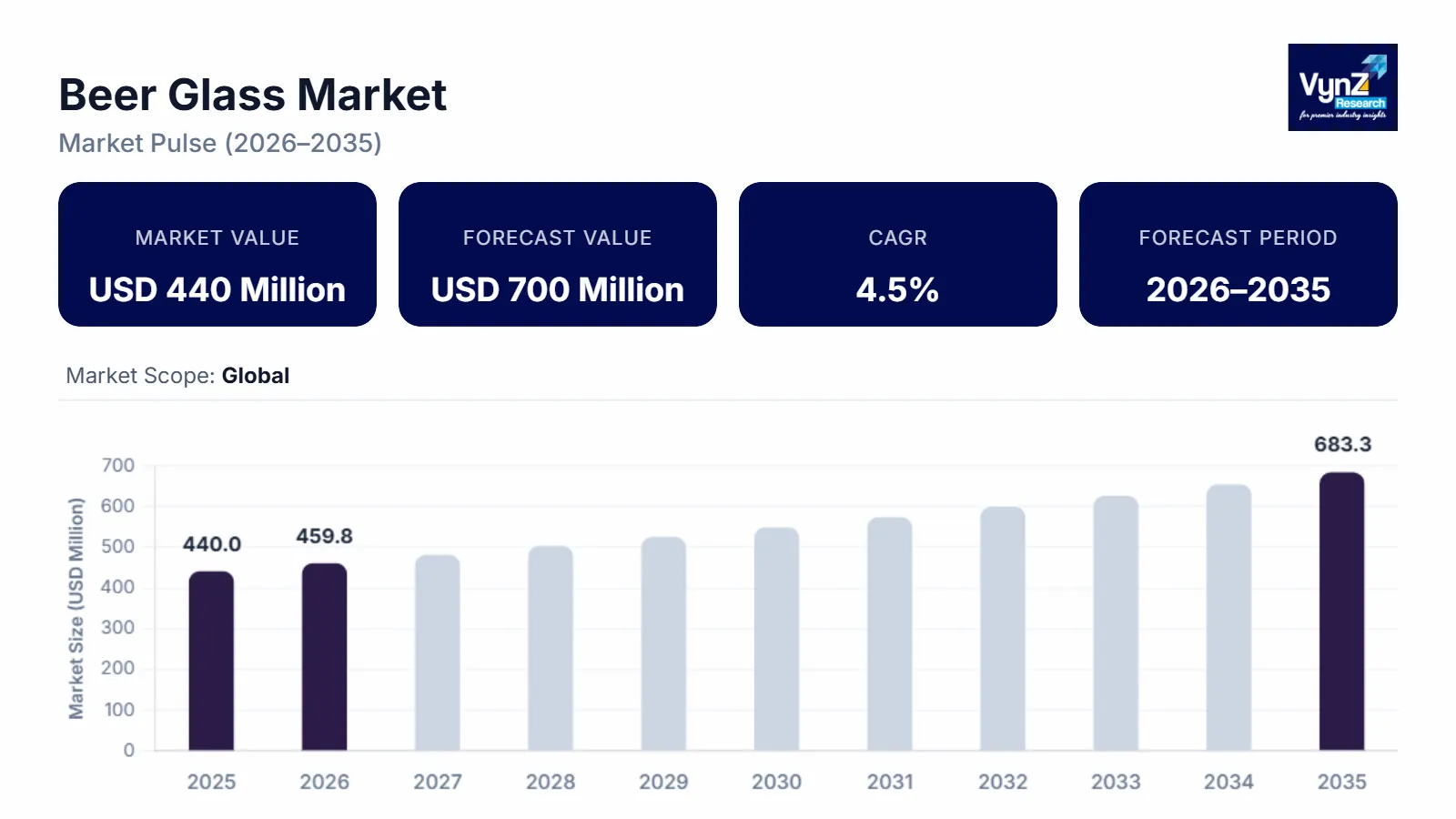
Market growth is driven by expanding hospitality activity, demand for premium beer presentation, and increasing preference for durable reusable drinkware, alongside product innovation in tempered, printed, and customised glassware. The USDA Economic Research Service reported that US foodservice sales reached USD 1.41 trillion in 2025, reflecting the scale of the restaurant and hospitality sector. In Europe, the European Commission’s Packaging and Packaging Waste Regulation strengthens the policy focus on recyclable and recoverable packaging, supporting wider attention to material efficiency and circularity across the packaging value chain.
Research Methodology
The VynZ Research team evaluated the beer glassware industry using published market research, product-level and application-level data, distribution channel trends, and regional demand indicators. It also considers official beer production and consumption statistics, hospitality-sector information, company annual reports, product launches, and capacity expansion announcements. Government-backed sources, including Eurostat and national statistical agencies, are used to assess the broader beer and hospitality industries, while market research publications provide the basis for market sizing, segmentation, and forecast estimates. The 2026–2035 market values are derived estimates based on the available industry benchmarks and stated forecast assumptions.
Research Highlights
- Pint glasses accounted for 34.1% of the product segment in 2025, supported by their widespread use in pubs, bars, and restaurants.
- Commercial applications held 62% of the revenue share in 2025, reflecting demand from bars, restaurants, hotels, and other hospitality establishments.
- Pubs and bars accounted for an estimated 38% share of end-user demand in 2025, supported by regular beer serving requirements, high customer turnover, and recurring glass replacement.
- Online distribution is projected to register a CAGR of 5.2%, supported by wider smartphone adoption and improved delivery of fragile glassware.
- Europe held 29.5% of the global market in 2025, due to a large consumer market and expanding hospitality activity.
Beer Glass Market Dynamics
Market Trends
The beer glass industry is witnessing notable changes in product design, material quality and consumer preferences, particularly with the growing popularity of craft beer and premium beverage presentation. One of the important trends shaping the market is the increasing demand for specialized glassware, including pilsner, weizen and tasting glasses, designed to improve aroma concentration, foam retention and visual presentation. Breweries and hospitality operators are also adopting customized glassware featuring distinctive shapes, logos and branding elements to strengthen customer engagement and differentiate their beverage offerings. Another emerging trend is the growing preference for durable, reusable and aesthetically differentiated glass products. Manufacturers are focusing on lightweight designs, improved glass strength, stackability and energy-efficient production processes to address the requirements of commercial buyers and environmentally conscious consumers.
Growth Drivers
The growth of the beer glass market is largely supported by increasing demand from pubs, bars, restaurants, hotels and breweries, where glassware remains an essential component of beverage serving and presentation. Expansion of hospitality infrastructure and rising consumer spending on dining and entertainment are generating replacement and procurement demand for commercial beer glasses. Additionally, increasing craft beer consumption and premiumization are encouraging buyers to adopt specialized glassware for different beer styles. Pint glasses, mugs, snifters and pilsner glasses are increasingly used to improve beverage presentation and create differentiated serving experiences. Breweries are also investing in branded merchandise and customized glassware for promotional campaigns, tasting events and customer engagement. The growing availability of glassware through online marketplaces and specialized retail platforms is further improving product accessibility for household consumers and smaller hospitality establishments.
Market Restraints / Challenges
Despite favorable growth prospects, the beer glass market faces challenges associated with breakage, transportation costs and fluctuations in raw material and energy prices. Glass manufacturing requires substantial thermal energy, while commercial beer glasses are frequently exposed to repeated washing, handling and transportation, increasing replacement requirements and operating expenses. These factors can affect purchasing decisions among smaller bars, restaurants and independent breweries, particularly where buyers prioritize low-cost alternatives such as plastic or polycarbonate drinkware. Furthermore, manufacturers face operational challenges related to furnace energy consumption, production efficiency and compliance with environmental requirements. Changes in energy prices and the cost of soda ash, silica sand and other production inputs can influence manufacturing margins. International suppliers must also manage packaging, shipping and inventory expenses because glass products are relatively fragile and require protective transportation arrangements. Increasing environmental scrutiny of manufacturing operations may require additional investment in energy-efficient furnaces, recycled material utilization and emissions management.
Market Opportunities
The market presents significant opportunities in customized and premium beer glassware, particularly as craft breweries, hospitality businesses and beverage brands seek distinctive serving products. Manufacturers offering logo printing, etched designs, specialized shapes and customized packaging can attract institutional buyers looking to strengthen brand visibility and customer engagement. Premium glassware collections also provide opportunities in household gifting, home entertaining and beer tasting activities, where consumers increasingly consider product design and beverage presentation alongside functional characteristics. Another important opportunity lies in manufacturing innovation and sustainable production, where improved furnace technologies, durable glass formulations and optimized product designs can reduce operational costs and environmental impact. The European Commission's packaging regulation is encouraging businesses to strengthen reuse and recycling practices, creating opportunities for manufacturers that prioritize product longevity and resource efficiency. Growing digital retail penetration is also enabling specialized glassware suppliers to reach smaller breweries, independent retailers and household customers through wider online distribution networks.
Global Beer Glass Market Report Coverage
|
Report Metric |
Details |
|
Historical Period |
2020 - 2024 |
|
Base Year Considered |
2025 |
|
Forecast Period |
2026 - 2035 |
|
Market Size in 2025 |
USD 440 Million |
|
Revenue Forecast in 2035 |
USD 700 Million |
|
Growth Rate |
4.5% |
|
Segments Covered in the Report |
Product Type, Application, Distribution Channel, End User |
|
Report Scope |
Market Trends, Drivers, and Restraints; Revenue Estimation and Forecast; Segmentation Analysis; Companies’ Strategic Developments; Market Share Analysis of Key Players; Company Profiling |
|
Regions Covered in the Report |
North America, Europe, Asia-Pacific, Rest of the World |
|
Key Companies |
Arc International, Bormioli Rocco, Cello World, Fiskars Group, Guangdong Garbo, Hamilton Housewares, Libbey, Lifetime Brands, Ocean Glass, Riedel |
|
Customization |
Available upon request |
Beer Glass Market Segmentation
By Product Type
The pint segment accounted for an estimated 34% share of product revenue in 2025, supported by its widespread acceptance across pubs, bars, restaurants and household settings. Its practical capacity, ease of handling and compatibility with different beer varieties make it a preferred product among commercial buyers.
The specialized pilsner and weizen glasses segment is projected to register a CAGR of approximately 4.40% from 2026 to 2035, supported by consistent commercial procurement and replacement requirements.
By Application
The commercial segment accounted for an estimated 62% share of the market in 2025, supported by high procurement from pubs, bars, restaurants, hotels, clubs and breweries.
The household segment is expected to grow at a comparatively faster CAGR of approximately 4.80% during 2026–2035, supported by increasing interest in home entertaining, craft beer consumption and premium drinkware collections.
By Distribution Channel
The offline segment accounted for an estimated 67% share in 2025, supported by established procurement relationships between manufacturers, wholesalers, hospitality distributors and retail outlets.
The online segment is projected to register a CAGR of approximately 5.20% from 2026 to 2035, making it the fastest-growing distribution channel. E-commerce platforms are improving access to specialized beer glasses, customized products and premium collections, particularly among household consumers and independent breweries.
By End User
Pubs and bars accounted for an estimated 38% share of end-user demand in 2025, supported by regular beer serving requirements, high customer turnover and recurring glass replacement.
Breweries and tasting establishments are projected to register a CAGR of approximately 5.10% during 2026–2035, supported by the expansion of craft beer offerings, tasting events and premium beverage experiences.
Regional Insights
North America
North America accounted for an estimated 24% share of the global beer glass market in 2025, supported by established hospitality infrastructure, widespread beer consumption and a strong commercial foodservice industry. The United States represents the largest contributor, followed by Canada and Mexico, where demand is generated by breweries, pubs, restaurants and household consumers. The expansion of foodservice establishments and growing interest in specialized beverage experiences are encouraging investments in commercial drinkware. Manufacturers are also focusing on durable glass products, customized branding and bulk supply arrangements to strengthen their relationships with hospitality operators and beverage companies.
Europe
Europe accounted for approximately 29.5% of the global beer glass market in 2025, making it the largest regional market. Germany, the United Kingdom, France, Italy and Spain represent important contributors, supported by established brewing traditions, premium beverage consumption and a developed hospitality sector. The European Commission's Packaging and Packaging Waste Regulation is encouraging businesses to improve packaging reuse, recyclability and waste management practices. The region's established glass manufacturing base and strong presence of specialized glassware companies are also supporting product innovation. Increasing demand for customized brewery glassware and premium hospitality tableware is expected to create additional opportunities for manufacturers across major European markets.
Asia Pacific
Asia Pacific accounted for an estimated 25.5% share of the global beer glass market in 2025 and is projected to remain the fastest-growing regional market. China, India, Japan, Australia and South Korea are important contributors, supported by expanding hospitality infrastructure, rising urban consumption and growing demand for specialized beverage products. The increasing presence of international breweries and domestic beverage manufacturers is also encouraging procurement of customized glassware for commercial serving and promotional activities. Government initiatives supporting manufacturing investment, domestic industrial capacity and tourism development are creating opportunities for regional glassware suppliers. India's Make in India initiative is encouraging domestic manufacturing and investment in consumer products, while growing foodservice and hospitality activity across China, India and Southeast Asia is supporting commercial demand. Manufacturers are also benefiting from expanding e-commerce networks, which improve access to premium and specialized glassware among household consumers and smaller hospitality businesses.
Rest of the World
The Rest of the World region accounted for an estimated 21% share of the global beer glass market in 2025, covering Latin America, the Middle East and Africa. Brazil, Argentina, South Africa, the UAE and Saudi Arabia represent important demand centres, supported by hospitality development, tourism activity and expanding commercial beverage services. Government-backed tourism development and hospitality infrastructure investments are creating additional opportunities for commercial glassware suppliers. Growing international hotel presence, restaurant expansion and premium dining concepts are encouraging demand for durable and visually differentiated drinkware. Import distributors and regional retailers continue to play an important role in supplying specialized products, while online purchasing platforms are improving the availability of customized and premium beer glassware.
Competitive Landscape / Company Insights
The beer glass market is moderately competitive, with global glassware manufacturers and regional suppliers focusing on product innovation, manufacturing efficiency, distribution expansion and customized designs. Major participants compete through product durability, glass clarity, pricing and specialized collections for hospitality and household customers. Companies are increasingly investing in energy-efficient manufacturing, premium product development and broader distribution networks. The growing demand for branded beer glasses and sustainable drinkware is also encouraging differentiation across commercial and retail purchasing channels.
Mini Profiles
Arc International manufactures glassware and tabletop products through an extensive international brand portfolio, serving household consumers and professional hospitality establishments.
Bormioli Rocco specializes in glassware and tableware products, emphasizing Italian design, manufacturing expertise and differentiated collections for household and commercial customers.
Guangdong Garbo supplies glassware and household tableware products through manufacturing and international distribution networks, serving wholesale and retail buyers.
Hamilton Housewares offers consumer household and kitchenware products, with distribution capabilities across Indian retail and domestic consumer markets.
Riedel specializes in premium glassware designed for beverage presentation, with particular emphasis on glass shape, aroma development and drinking experiences.
Key Players
- Arc International
- Bormioli
- Rocco
- Cello World
- Fiskars Group
- Guangdong Garbo
- Hamilton Housewares
- Libbey
- Lifetime Brands
- Ocean Glass
- Riedel
Recent Developments
Cello World commissioned a new glassware manufacturing facility in Rajasthan with an annual production capacity of approximately 20,000 tons. The facility is being operationalized in phases to strengthen domestic manufacturing capabilities and reduce dependence on imported glassware.
Fiskars Group continued investments in its Rogaška glass manufacturing facility in Slovenia, including improvements to production equipment and energy efficiency. Its 2025 investment activities included upgrades to tempering furnaces, with electric furnace replacements scheduled for completion in 2026 to reduce direct carbon emissions.
Lifetime Brands introduced the Mikasa Black Label premium tabletop collection, expanding its product portfolio across dinnerware, glassware and flatware. The collection strengthens its premium tabletop offering through European-inspired designs and differentiated product positioning.
Ocean Glass expanded its product portfolio through its 2025–2026 glassware catalogue, presenting collections designed for household and professional foodservice applications. Its product development activities include contemporary drinkware and barware designs that address changing hospitality and consumer preferences.
Global Beer Glass Market Coverage
Product Type Insight and Forecast 2026 - 2035
- Mugs
- Pints
- Pilsner Glasses
- Weizen Glasses
- Other Specialized Glassware
Application Insight and Forecast 2026 - 2035
- Commercial
- Household
Distribution Channel Insight and Forecast 2026 - 2035
- Offline
- Online
End User Insight and Forecast 2026 - 2035
- Pubs and Bars
- Restaurants and Hotels
- Breweries and Tasting Establishments
- Household Consumers
Global Beer Glass Market by Region
- North America
- By Product Type
- By Application
- By Distribution Channel
- By End User
- By Country - U.S., Canada, Mexico
- Europe
- By Product Type
- By Application
- By Distribution Channel
- By End User
- By Country - Germany, U.K., France, Italy, Spain, Russia, Rest of Europe
- Asia-Pacific (APAC)
- By Product Type
- By Application
- By Distribution Channel
- By End User
- By Country - China, Japan, India, South Korea, Vietnam, Thailand, Malaysia, Rest of Asia-Pacific
- Rest of the World (RoW)
- By Product Type
- By Application
- By Distribution Channel
- By End User
- By Country - Brazil, Saudi Arabia, South Africa, U.A.E., Other Countries
Table of Contents for Beer Glass Market Report
1. Research Overview
1.1. The Report Offers
1.2. Market Coverage
1.2.1. By
Product Type
1.2.2. By
Application
1.2.3. By
Distribution Channel
1.2.4. By
End User
1.3. Research Phases
1.4. Limitations
1.5. Market Methodology
1.5.1. Data Sources
1.5.1.1.
Primary Research
1.5.1.2.
Secondary Research
1.5.2. Methodology
1.5.2.1.
Data Exploration
1.5.2.2.
Forecast Parameters
1.5.2.3.
Data Validation
1.5.2.4.
Assumptions
1.5.3. Study Period & Data Reporting Unit
2. Executive Summary
3. Industry Overview
3.1. Industry Dynamics
3.1.1. Market Growth Drivers
3.1.2. Market Restraints
3.1.3. Key Market Trends
3.1.4. Major Opportunities
3.2. Industry Ecosystem
3.2.1. Porter’s Five Forces Analysis
3.2.2. Recent Development Analysis
3.2.3. Value Chain Analysis
3.3. Competitive Insight
3.3.1. Competitive Position of Industry
Players
3.3.2. Market Attractive Analysis
3.3.3. Market Share Analysis
4. Global Market Estimate and Forecast
4.1. Global Market Overview
4.2. Global Market Estimate and Forecast to 2035
5. Market Segmentation Estimate and Forecast
5.1. By Product Type
5.1.1. Mugs
5.1.1.1. Market Definition
5.1.1.2. Market Estimation and Forecast to 2035
5.1.2. Pints
5.1.2.1. Market Definition
5.1.2.2. Market Estimation and Forecast to 2035
5.1.3. Pilsner Glasses
5.1.3.1. Market Definition
5.1.3.2. Market Estimation and Forecast to 2035
5.1.4. Weizen Glasses
5.1.4.1. Market Definition
5.1.4.2. Market Estimation and Forecast to 2035
5.1.5. Other Specialized Glassware
5.1.5.1. Market Definition
5.1.5.2. Market Estimation and Forecast to 2035
5.2. By Application
5.2.1. Commercial
5.2.1.1. Market Definition
5.2.1.2. Market Estimation and Forecast to 2035
5.2.2. Household
5.2.2.1. Market Definition
5.2.2.2. Market Estimation and Forecast to 2035
5.3. By Distribution Channel
5.3.1. Offline
5.3.1.1. Market Definition
5.3.1.2. Market Estimation and Forecast to 2035
5.3.2. Online
5.3.2.1. Market Definition
5.3.2.2. Market Estimation and Forecast to 2035
5.4. By End User
5.4.1. Pubs and Bars
5.4.1.1. Market Definition
5.4.1.2. Market Estimation and Forecast to 2035
5.4.2. Restaurants and Hotels
5.4.2.1. Market Definition
5.4.2.2. Market Estimation and Forecast to 2035
5.4.3. Breweries and Tasting Establishments
5.4.3.1. Market Definition
5.4.3.2. Market Estimation and Forecast to 2035
5.4.4. Household Consumers
5.4.4.1. Market Definition
5.4.4.2. Market Estimation and Forecast to 2035
6. North America Market Estimate and Forecast
6.1. By
Product Type
6.2. By
Application
6.3. By
Distribution Channel
6.4. By
End User
6.4.1.
U.S. Market Estimate and Forecast
6.4.2.
Canada Market Estimate and Forecast
6.4.3.
Mexico Market Estimate and Forecast
7. Europe Market Estimate and Forecast
7.1. By
Product Type
7.2. By
Application
7.3. By
Distribution Channel
7.4. By
End User
7.4.1.
Germany Market Estimate and Forecast
7.4.2.
France Market Estimate and Forecast
7.4.3.
U.K. Market Estimate and Forecast
7.4.4.
Italy Market Estimate and Forecast
7.4.5.
Spain Market Estimate and Forecast
7.4.6.
Russia Market Estimate and Forecast
7.4.7.
Rest of Europe Market Estimate and Forecast
8. Asia-Pacific (APAC) Market Estimate and Forecast
8.1. By
Product Type
8.2. By
Application
8.3. By
Distribution Channel
8.4. By
End User
8.4.1.
China Market Estimate and Forecast
8.4.2.
Japan Market Estimate and Forecast
8.4.3.
India Market Estimate and Forecast
8.4.4.
South Korea Market Estimate and Forecast
8.4.5.
Rest of Asia-Pacific Market Estimate and Forecast
9. Rest of the World (RoW) Market Estimate and Forecast
9.1. By
Product Type
9.2. By
Application
9.3. By
Distribution Channel
9.4. By
End User
9.4.1.
Brazil Market Estimate and Forecast
9.4.2.
Saudi Arabia Market Estimate and Forecast
9.4.3.
South Africa Market Estimate and Forecast
9.4.4.
U.A.E. Market Estimate and Forecast
9.4.5.
Other Countries Market Estimate and Forecast
10. Company Profiles
10.1.
Arc International
10.1.1.
Snapshot
10.1.2.
Overview
10.1.3.
Offerings
10.1.4.
Financial
Insight
10.1.5.
Recent
Developments
10.2.
Bormioli Rocco
10.2.1.
Snapshot
10.2.2.
Overview
10.2.3.
Offerings
10.2.4.
Financial
Insight
10.2.5.
Recent
Developments
10.3.
Cello World
10.3.1.
Snapshot
10.3.2.
Overview
10.3.3.
Offerings
10.3.4.
Financial
Insight
10.3.5.
Recent
Developments
10.4.
Fiskars Group
10.4.1.
Snapshot
10.4.2.
Overview
10.4.3.
Offerings
10.4.4.
Financial
Insight
10.4.5.
Recent
Developments
10.5.
Guangdong Garbo
10.5.1.
Snapshot
10.5.2.
Overview
10.5.3.
Offerings
10.5.4.
Financial
Insight
10.5.5.
Recent
Developments
10.6.
Hamilton Housewares
10.6.1.
Snapshot
10.6.2.
Overview
10.6.3.
Offerings
10.6.4.
Financial
Insight
10.6.5.
Recent
Developments
10.7.
Libbey
10.7.1.
Snapshot
10.7.2.
Overview
10.7.3.
Offerings
10.7.4.
Financial
Insight
10.7.5.
Recent
Developments
10.8.
Lifetime Brands
10.8.1.
Snapshot
10.8.2.
Overview
10.8.3.
Offerings
10.8.4.
Financial
Insight
10.8.5.
Recent
Developments
10.9.
Ocean Glass
10.9.1.
Snapshot
10.9.2.
Overview
10.9.3.
Offerings
10.9.4.
Financial
Insight
10.9.5.
Recent
Developments
10.10.
Riedel
10.10.1.
Snapshot
10.10.2.
Overview
10.10.3.
Offerings
10.10.4.
Financial
Insight
10.10.5.
Recent
Developments
11. Appendix
11.1. Exchange Rates
11.2. Abbreviations
Note: Financial insight and recent developments of different companies are subject to the availability of information in the secondary domain.
Frequently Asked Questions
Purchase Options
Latest Report
Research Methodology
- Desk Research / Pilot Interviews
- Build Market Size Model
- Research and Analysis
- Final Deliverable
Connect With Our Sales Team
- Toll-Free: +1-888-253-3960
- Phone: +91 9960 288 381
- Email: enquiry@vynzresearch.com
Beer Glass Market