
DNA Sequencing Market Size & Share Growth Forecast Report (2026-2035)
Industry Insight by Product & Service (Consumables, Instruments, Services), by Technology (Next-Generation Sequencing, Third-Generation Sequencing), by Workflow (Pre-sequencing, Sequencing, Data Analysis), by Application (Oncology, Reproductive Health, Clinical Research, Agrigenomics, Forensics, Other Applications), by End Use (Academic Research, Clinical Research, Pharmaceutical & Biotechnology Companies, Hospitals & Clinics, Other End Users), by Region (North America, Europe, Asia Pacific, Latin America, Middle East & Africa)
| Status : Published | Published On : Sep, 2026 | Report Code : VRHC1351 | Industry : Healthcare | Available Format :

|
Page : 154 |
DNA Sequencing Market Overview
The global DNA sequencing market was valued at approximately USD 17.7 billion in 2025 and is estimated to reach around USD 21.4 billion in 2026. Based on the reported 22.6% CAGR from 2026 to 2035, the market is projected to reach approximately USD 138.89 billion by 2035 through the extended forecast period.
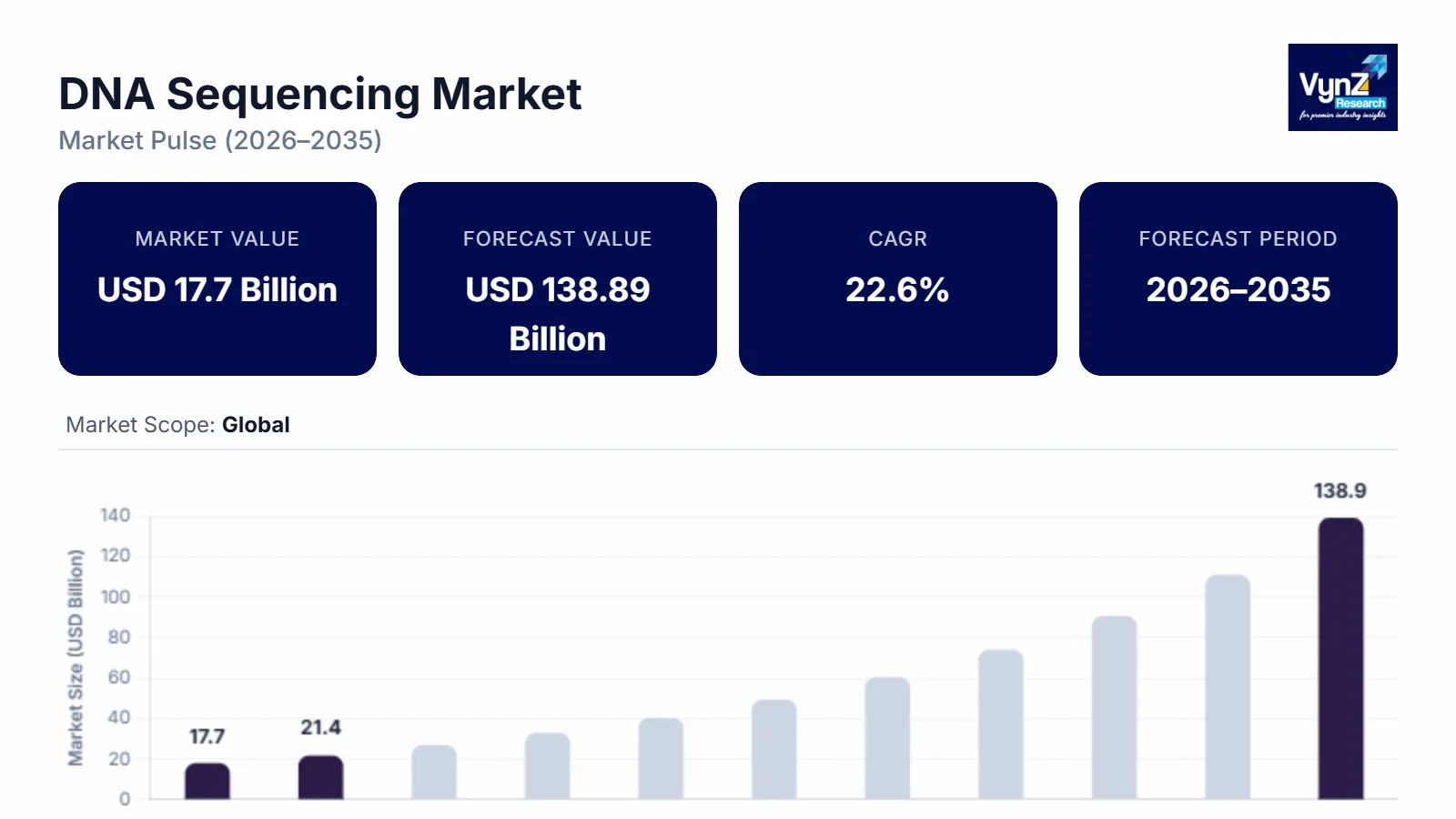
DNA sequencing demand is being driven by expanding genomic research, growing clinical applications, precision medicine, oncology testing, rare disease research, and continued advances in next-generation and long-read sequencing technologies.
The market is being driven by an increasing number of companies entering the clinical space as well as a growing emphasis on reproductive health, oncology, and consumer genetics. At the same time declining sequencing costs, higher throughput, improved accuracy, long-read capabilities, and advanced bioinformatics are expanding the addressable market.
The applications of DNA sequencing include academic research, clinical research, hospitals and clinics, pharmaceutical and biotechnology companies, consumer genomics, oncology, reproductive health, Agri genomics, forensics, and drug discovery. The market does not include other molecular diagnostic technologies that are used in the detection of diseases and do not require DNA sequencing.
Research Methodology
Primary research, wherever deemed relevant, includes discussions with industry participants, technology providers, lab professionals, researchers, distributors, and other stakeholders, to support the primary research, identify technology adoption trends, market dynamics, pricing trends, competitive landscape, and opportunities.
VynZ Research team utilizes secondary research to gather information from government, regulatory, scientific, company, industry, investor, and relevant market resources. Industry trends, technological advancements, company developments, application adoption and utilization, and regional developments are evaluated in order to understand the underlying market structure.
For market estimation and data modelling, we have utilized data triangulation, segmentation, analysis of historical trends, company-level analysis and evaluation of technology and application adoption to estimate the market size. The revenue estimates are then validated across product/service categories, technologies, application segments, processes, end-users, and regions to offer the most plausible market size estimation.
Forecasting analysis is made on the base year and forecast assumptions are built on factors such as genomic research investments, clinical relevance, sequencing costs, technology advancements, healthcare infrastructure, pharmaceutical and biotechnology developments, regulatory landscapes, and investment trends at the regional level to determine market potential. Historical trends and projected developments are used to estimate the market growth over the forecast period.
Validation of data is performed by comparing the results from various relevant sources and analyzing the relationship between the segment, region, and overall market trends.
Research Highlights
- Consumables held 48.7% of the market in 2025 due to higher demand while services recorded the fastest growth at 25.0% CAGR over 2026 to 2035.
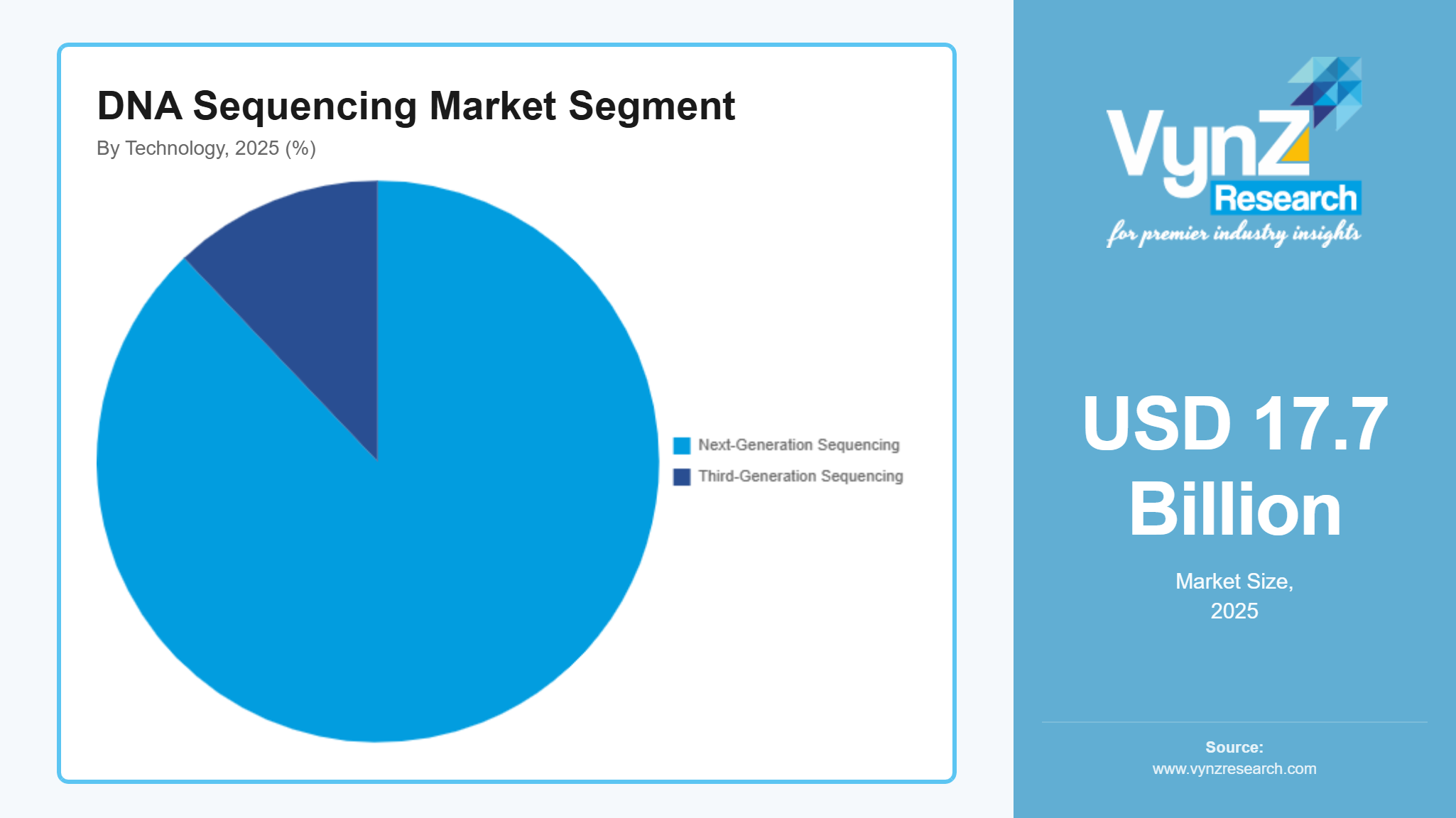
- Next-Generation Sequencing accounted for 87.9% of the market in 2025 because of higher adoption and application.
- Clinical research is projected to grow at 25.5% CAGR during the study period due to higher need in the healthcare sector.
- Data analysis is projected to grow at 25.8% CAGR during the forecast period owing to the growing demand.
- North America held 51.1% of the global market in 2025 supported by a strong infrastructure and growing demand.
DNA Sequencing Market Dynamics
Market Trends
Long-read sequencing is becoming an important technological direction due to its ability to overcome genomic regions that are challenging to characterize with conventional short-read approaches. Sequencing is generating great quantities of genomic data that require computational analysis, interpretation, and management. AI-assisted workflow enables researchers to manage complicated datasets, discover genomic patterns, and improve interpretation efficiency. The data analysis workflow generated approximately USD 2.56 billion in 2025 and is forecasted to grow at 25.8% CAGR from 2026 to 2033, representing the increasing commercial relevance of downstream sequencing analysis. Sequencing-as-a-service enables organizations to access cutting-edge platforms without massive capital expenditures on instruments and lab equipment. This approach is particularly relevant for small research organizations, biotech companies, clinical research groups, and academic institutions with sporadic sequencing needs.
Growth Drivers
The continued decline in sequencing costs is making genomic analysis more accessible to a larger number of research and clinical end users. This trend will drive increased adoption as labs look to sequence more samples and analyze larger population sets. Furthermore, cost reductions will spur interest in areas where sequencing was previously cost prohibitive. The growing emphasis on precision medicine is creating demand for genomic information that can provide insights into disease states and facilitate the identification of relevant biomarkers and mutations. Oncology is one such area that is driving sequencing as it supports biomarker discovery, tumor profiling, and treatment response analysis. Demand for sequencing is set to rise due to its increasing role in healthcare. Academia, pharma, biotech, and government agencies are continuing to invest significantly in genomics research and discovery. Large-scale population studies and genome projects fuel the need for high-throughput sequencing platforms as well as significant consumption of sequencing-related consumables and services. This trend is expected to support sequencing technology sales and consumption for years to come.
Market Restraints / Challenges
The need for enhanced equipment, implementation in existing infrastructures, professional staff, storage of data, and powerful computers to analyze the data can be a burden to many governments and organizations, especially in developing countries. Proficiency in molecular biology, laboratory skills, analytics, bioinformatics, and statistics are necessary for sequencing programs. The absence of personnel with such skills reduces the adoption rate of genome sequencing programs.
Market Opportunities
Players offering clinically validated workflows can benefit as sequencing moves away from a niche research-centric activity to a broader healthcare space. Long-read sequencing is expected to witness increased adoption in the fields of oncology, rare diseases, and reproductive health. With better precision and accuracy, the technology is being increasingly utilized for variant discovery, including copy number variations, structural variants, and repeat expansions. Players in the long-read sequencing space stand to gain from the adoption of the technology in other applications, in addition to oncology. A growing number of governments, research entities, hospitals, and biotechnology companies in emerging markets are willing to invest in and adopt genomic sequencing and related technologies. The sequencing market is witnessing heightened investment in the Asia Pacific, Latin America, Middle East, and Africa regions. With cheaper sequencing platforms, services, and cloud-based analysis tools, there is potential for market growth.
Global DNA Sequencing Market Report Coverage
|
Report Metric |
Details |
|
Historical Period |
2020 - 2024 |
|
Base Year Considered |
2025 |
|
Forecast Period |
2026 - 2035 |
|
Market Size in 2025 |
USD 17.7 Billion |
|
Revenue Forecast in 2035 |
USD 138.89 Billion |
|
Growth Rate |
22.6% |
|
Segments Covered in the Report |
Product & Service, Technology, Workflow, Application, End Use |
|
Report Scope |
Market Trends, Drivers, and Restraints; Revenue Estimation and Forecast; Segmentation Analysis; Companies’ Strategic Developments; Market Share Analysis of Key Players; Company Profiling |
|
Regions Covered in the Report |
North America, Europe, Asia Pacific, Latin America, Middle East & Africa |
|
Key Companies |
Illumina, Inc., Thermo Fisher Scientific Inc., F. Hoffmann-La Roche Ltd., QIAGEN N.V., Agilent Technologies, Inc., Pacific Biosciences of California, Inc. (PacBio), Oxford Nanopore Technologies plc, BGI, Bio-Rad Laboratories, Inc., Eurofins Scientific SE |
|
Customization |
Available upon request |
DNA Sequencing Market Segmentation
By Product & Service
Consumables retained the largest share of the DNA sequencing market with 48.7% in 2025, as they are integral to meeting the demand for sequencing reagents, kits, library-preparation materials, and other laboratory supplies, which are essential for supporting repeated DNA sequencing workflows. High sequencing volumes from research and clinical laboratories create continuous consumables demand, and this is a significant source of revenue.
Services are expected to see the fastest growth with a CAGR of 25.0% from 2026 to 2033, as companies look to outsource to gain access to advanced sequencing capabilities without having to acquire and maintain expensive sequencing infrastructure.
By Technology
Next-generation sequencing dominated the DNA sequencing market with 87.9% in 2025, as it has become established in high-throughput genomic research, clinical investigation, oncology, reproductive health, and other fields. Its combination of scale, throughput, and application coverage supports its dominant position.
Third-generation sequencing is expected to see the fastest growth with a CAGR of 26.3% from 2026 to 2033, as there is growing interest in long-read sequencing, structural-variant detection, complex genomic regions, and more comprehensive genome characterization.
By Workflow
Sequencing dominated the DNA sequencing workflow with 57.2% in 2025, as the core sequencing stage is the principal activity that drives the acquisition of genomic sequence data. Continued expansion of high-throughput sequencing applications supports demand for sequencing instruments, reagents, and processes.
Data analysis is expected to see the fastest growth with a CAGR of 25.8% from 2026 to 2033, as rising sequencing volumes and the need to process, interpret, store, and extract insights from complex genomic datasets will drive this segment. AI, cloud computing, and advanced bioinformatics are expected to bolster this segment.
By Application
Oncology dominated the DNA sequencing market with 24.9% in 2025, as increasing use of genomic analysis in cancer research, biomarker identification, molecular profiling, and precision medicine promotes this segment. The expanding role of genomic information in cancer research and treatment development supports demand.
Consumer genomics is expected to see the fastest growth with a CAGR of 25.7% from 2026 to 2033, as consumer interest in genetic information, ancestry, inherited traits, and genomic insights grows. Increasing availability of sequencing-based testing is generating additional demand outside traditional research and clinical settings.
By End Use
Academic research dominated the DNA sequencing market with 50.7% in 2025, as extensive use of sequencing for genomics, molecular biology, disease, population, and basic biological research promotes this segment. Universities are important users of sequencing platforms, reagents, and analytical services.
Clinical research is expected to see the fastest growth with a CAGR of 25.5% from 2026 to 2033 as increasing investigation of genomic biomarkers, rare diseases, oncology, reproductive health, and precision medicine promotes this segment. Expanding clinical evidence is promoting wider use of sequencing in translational research.
Regional Insights
North America
North America controlled the largest share of the global DNA sequencing market with 51.1% in 2025 due to sophisticated genomic research infrastructure, high healthcare and research expenditures, strong pharmaceutical and biotechnology sectors, and presence of key sequencing companies. Moreover, the U.S. dominates the regional DNA sequencing landscape.
Europe
Europe controlled approximately 24.9% of the global DNA sequencing market in 2025, supported by established research infrastructure, genomic medicine initiatives, pharmaceutical research, and clinical sequencing adoptions. Germany, the U.K., France, and other European countries are important contributors to the regional DNA sequencing market.
Asia Pacific
Asia Pacific controlled approximately 17.7% of the global DNA sequencing market in 2025 based on the regional revenue reported for the year, making it one of the most attractive markets for DNA sequencing technologies. Moreover, the region is expected to grow the fastest with a projected 26.5% CAGR from 2026 to 2033. Increasing genomics investments, expanding healthcare systems, research activity, and DNA sequencing adoptions in China, India, and other Asian countries are key drivers for the regional market.
Latin America
Latin America controlled approximately 4.4% of the global DNA sequencing market in 2025 based on the reported regional revenue and rounded regional allocation. A growing number of research initiatives, healthcare modernization and genomic medicine adoptions, and DNA sequencing technologies are creating market opportunities across Latin American countries such as Brazil, Mexico, Argentina, and others. Moreover, the regional DNA sequencing market is expected to grow at the 18.4% CAGR from 2026 to 2033.
Middle East & Africa
Middle East & Africa controlled approximately 1.9% of the global DNA sequencing market in 2025, supported by increasing healthcare and genomic medicine investments and sequencing technology adoptions. Notably, Saudi Arabia emerges as a critical regional growth market for DNA sequencing technologies but broader Middle East and African countries are projected to grow at the 15.7% CAGR from 2026 to 2033.
Competitive Landscape / Company Insights
The DNA sequencing market is highly competitive, as sequencing-platform providers engage in a competition through instrument performance, throughput, accuracy, consumable ecosystems, software, service capabilities, and clinical expansion. Companies are investing in next-generation and long-read technologies while developing integrated workflows for genomics, oncology, reproductive health, drug discovery, and research. Partnerships, clinical collaborations, regulatory approvals, lower sequencing costs, and improved bioinformatics are becoming important competitive factors. The market also includes specialized sequencing service providers and regional companies that support expanding genomic research and clinical testing demand.
Mini Profiles
Illumina develops sequencing platforms for research and clinical applications, strengthening its position through high-throughput technologies, genomic data solutions, and AI-supported applications.
Thermo Fisher provides sequencing instruments, consumables, and molecular biology solutions, serving academic, clinical, pharmaceutical, and biotechnology laboratories across diverse genomic workflows.
Roche combines diagnostics, pharmaceuticals, and molecular technologies, supporting sequencing applications in precision medicine, oncology, clinical research, and genomic disease characterization.
QIAGEN provides sample preparation, molecular testing, bioinformatics, and genomic solutions, supporting sequencing workflows across research, pharmaceutical development, and clinical applications.
Agilent offers genomic analysis instruments, reagents, and laboratory solutions, supporting sequencing-related research and molecular workflows across academic, clinical, and pharmaceutical settings.
Key Players
- Illumina, Inc.
- Thermo Fisher Scientific Inc.
- F. Hoffmann-La Roche Ltd.
- QIAGEN N.V.
- Agilent Technologies, Inc.
- Pacific Biosciences of California, Inc. (PacBio)
- Oxford Nanopore Technologies plc
- BGI
- Bio-Rad Laboratories, Inc.
- Eurofins Scientific SE
Recent Developments
Illumina introduced its Billion Cell Atlas in January 2026 to support AI-driven drug discovery, genetic target validation, and biological research. The initiative was launched with major pharmaceutical participants and forms part of a broader effort to combine genomic data, genetic perturbation, and AI.
PacBio announced that Berry Genomics received NMPA Class III medical-device registration for the Sequel II CNDx system in China. The approval supports clinical long-read sequencing applications, initially including thalassemia, and represents an important expansion of long-read sequencing into regulated clinical testing.
Thermo Fisher expanded genomic research capabilities through new laboratory and molecular analysis solutions, supporting sequencing, oncology, and precision medicine applications.
QIAGEN showcased new oncology workflow solutions connecting sample preparation, genomic profiling, multiomics, and data interpretation.
Global DNA Sequencing Market Coverage
Product & Service Insight and Forecast 2026 - 2035
- Consumables
- Instruments
- Services
Technology Insight and Forecast 2026 - 2035
- Next-Generation Sequencing
- Third-Generation Sequencing
Workflow Insight and Forecast 2026 - 2035
- Pre-sequencing
- Sequencing
- Data Analysis
Application Insight and Forecast 2026 - 2035
- Oncology
- Reproductive Health
- Clinical Research
- Agrigenomics
- Forensics
- Other Applications
End Use Insight and Forecast 2026 - 2035
- Academic Research
- Clinical Research
- Pharmaceutical & Biotechnology Companies
- Hospitals & Clinics
- Other End Users
Region Insight and Forecast 2026 - 2035
- North America
- Europe
- Asia Pacific
- Latin America
- Middle East & Africa
Global DNA Sequencing Market by Region
- North America
- By Product & Service
- By Technology
- By Workflow
- By Application
- By End Use
- By Region
- By Country - U.S., Canada, Mexico
- Europe
- By Product & Service
- By Technology
- By Workflow
- By Application
- By End Use
- By Region
- By Country - Germany, U.K., France, Italy, Spain, Russia, Rest of Europe
- Asia-Pacific (APAC)
- By Product & Service
- By Technology
- By Workflow
- By Application
- By End Use
- By Region
- By Country - China, Japan, India, South Korea, Vietnam, Thailand, Malaysia, Rest of Asia-Pacific
- Rest of the World (RoW)
- By Product & Service
- By Technology
- By Workflow
- By Application
- By End Use
- By Region
- By Country - Brazil, Saudi Arabia, South Africa, U.A.E., Other Countries
Table of Contents for DNA Sequencing Market Report
1. Research Overview
1.1. The Report Offers
1.2. Market Coverage
1.2.1. By
Product & Service
1.2.2. By
Technology
1.2.3. By
Workflow
1.2.4. By
Application
1.2.5. By
End Use
1.2.6. By
Region
1.3. Research Phases
1.4. Limitations
1.5. Market Methodology
1.5.1. Data Sources
1.5.1.1.
Primary Research
1.5.1.2.
Secondary Research
1.5.2. Methodology
1.5.2.1.
Data Exploration
1.5.2.2.
Forecast Parameters
1.5.2.3.
Data Validation
1.5.2.4.
Assumptions
1.5.3. Study Period & Data Reporting Unit
2. Executive Summary
3. Industry Overview
3.1. Industry Dynamics
3.1.1. Market Growth Drivers
3.1.2. Market Restraints
3.1.3. Key Market Trends
3.1.4. Major Opportunities
3.2. Industry Ecosystem
3.2.1. Porter’s Five Forces Analysis
3.2.2. Recent Development Analysis
3.2.3. Value Chain Analysis
3.3. Competitive Insight
3.3.1. Competitive Position of Industry
Players
3.3.2. Market Attractive Analysis
3.3.3. Market Share Analysis
4. Global Market Estimate and Forecast
4.1. Global Market Overview
4.2. Global Market Estimate and Forecast to 2035
5. Market Segmentation Estimate and Forecast
5.1. By Product & Service
5.1.1. Consumables
5.1.1.1. Market Definition
5.1.1.2. Market Estimation and Forecast to 2035
5.1.2. Instruments
5.1.2.1. Market Definition
5.1.2.2. Market Estimation and Forecast to 2035
5.1.3. Services
5.1.3.1. Market Definition
5.1.3.2. Market Estimation and Forecast to 2035
5.2. By Technology
5.2.1. Next-Generation Sequencing
5.2.1.1. Market Definition
5.2.1.2. Market Estimation and Forecast to 2035
5.2.2. Third-Generation Sequencing
5.2.2.1. Market Definition
5.2.2.2. Market Estimation and Forecast to 2035
5.3. By Workflow
5.3.1. Pre-sequencing
5.3.1.1. Market Definition
5.3.1.2. Market Estimation and Forecast to 2035
5.3.2. Sequencing
5.3.2.1. Market Definition
5.3.2.2. Market Estimation and Forecast to 2035
5.3.3. Data Analysis
5.3.3.1. Market Definition
5.3.3.2. Market Estimation and Forecast to 2035
5.4. By Application
5.4.1. Oncology
5.4.1.1. Market Definition
5.4.1.2. Market Estimation and Forecast to 2035
5.4.2. Reproductive Health
5.4.2.1. Market Definition
5.4.2.2. Market Estimation and Forecast to 2035
5.4.3. Clinical Research
5.4.3.1. Market Definition
5.4.3.2. Market Estimation and Forecast to 2035
5.4.4. Agrigenomics
5.4.4.1. Market Definition
5.4.4.2. Market Estimation and Forecast to 2035
5.4.5. Forensics
5.4.5.1. Market Definition
5.4.5.2. Market Estimation and Forecast to 2035
5.4.6. Other Applications
5.4.6.1. Market Definition
5.4.6.2. Market Estimation and Forecast to 2035
5.5. By End Use
5.5.1. Academic Research
5.5.1.1. Market Definition
5.5.1.2. Market Estimation and Forecast to 2035
5.5.2. Clinical Research
5.5.2.1. Market Definition
5.5.2.2. Market Estimation and Forecast to 2035
5.5.3. Pharmaceutical & Biotechnology Companies
5.5.3.1. Market Definition
5.5.3.2. Market Estimation and Forecast to 2035
5.5.4. Hospitals & Clinics
5.5.4.1. Market Definition
5.5.4.2. Market Estimation and Forecast to 2035
5.5.5. Other End Users
5.5.5.1. Market Definition
5.5.5.2. Market Estimation and Forecast to 2035
5.6. By Region
5.6.1. North America
5.6.1.1. Market Definition
5.6.1.2. Market Estimation and Forecast to 2035
5.6.2. Europe
5.6.2.1. Market Definition
5.6.2.2. Market Estimation and Forecast to 2035
5.6.3. Asia Pacific
5.6.3.1. Market Definition
5.6.3.2. Market Estimation and Forecast to 2035
5.6.4. Latin America
5.6.4.1. Market Definition
5.6.4.2. Market Estimation and Forecast to 2035
5.6.5. Middle East & Africa
5.6.5.1. Market Definition
5.6.5.2. Market Estimation and Forecast to 2035
6. North America Market Estimate and Forecast
6.1. By
Product & Service
6.2. By
Technology
6.3. By
Workflow
6.4. By
Application
6.5. By
End Use
6.6. By
Region
6.6.1.
U.S. Market Estimate and Forecast
6.6.2.
Canada Market Estimate and Forecast
6.6.3.
Mexico Market Estimate and Forecast
7. Europe Market Estimate and Forecast
7.1. By
Product & Service
7.2. By
Technology
7.3. By
Workflow
7.4. By
Application
7.5. By
End Use
7.6. By
Region
7.6.1.
Germany Market Estimate and Forecast
7.6.2.
France Market Estimate and Forecast
7.6.3.
U.K. Market Estimate and Forecast
7.6.4.
Italy Market Estimate and Forecast
7.6.5.
Spain Market Estimate and Forecast
7.6.6.
Russia Market Estimate and Forecast
7.6.7.
Rest of Europe Market Estimate and Forecast
8. Asia-Pacific (APAC) Market Estimate and Forecast
8.1. By
Product & Service
8.2. By
Technology
8.3. By
Workflow
8.4. By
Application
8.5. By
End Use
8.6. By
Region
8.6.1.
China Market Estimate and Forecast
8.6.2.
Japan Market Estimate and Forecast
8.6.3.
India Market Estimate and Forecast
8.6.4.
South Korea Market Estimate and Forecast
8.6.5.
Rest of Asia-Pacific Market Estimate and Forecast
9. Rest of the World (RoW) Market Estimate and Forecast
9.1. By
Product & Service
9.2. By
Technology
9.3. By
Workflow
9.4. By
Application
9.5. By
End Use
9.6. By
Region
9.6.1.
Brazil Market Estimate and Forecast
9.6.2.
Saudi Arabia Market Estimate and Forecast
9.6.3.
South Africa Market Estimate and Forecast
9.6.4.
U.A.E. Market Estimate and Forecast
9.6.5.
Other Countries Market Estimate and Forecast
10. Company Profiles
10.1.
Illumina, Inc.
10.1.1.
Snapshot
10.1.2.
Overview
10.1.3.
Offerings
10.1.4.
Financial
Insight
10.1.5.
Recent
Developments
10.2.
Thermo Fisher Scientific Inc.
10.2.1.
Snapshot
10.2.2.
Overview
10.2.3.
Offerings
10.2.4.
Financial
Insight
10.2.5.
Recent
Developments
10.3.
F. Hoffmann-La Roche Ltd.
10.3.1.
Snapshot
10.3.2.
Overview
10.3.3.
Offerings
10.3.4.
Financial
Insight
10.3.5.
Recent
Developments
10.4.
QIAGEN N.V.
10.4.1.
Snapshot
10.4.2.
Overview
10.4.3.
Offerings
10.4.4.
Financial
Insight
10.4.5.
Recent
Developments
10.5.
Agilent Technologies, Inc.
10.5.1.
Snapshot
10.5.2.
Overview
10.5.3.
Offerings
10.5.4.
Financial
Insight
10.5.5.
Recent
Developments
10.6.
Pacific Biosciences of California, Inc. (PacBio)
10.6.1.
Snapshot
10.6.2.
Overview
10.6.3.
Offerings
10.6.4.
Financial
Insight
10.6.5.
Recent
Developments
10.7.
Oxford Nanopore Technologies plc
10.7.1.
Snapshot
10.7.2.
Overview
10.7.3.
Offerings
10.7.4.
Financial
Insight
10.7.5.
Recent
Developments
10.8.
BGI
10.8.1.
Snapshot
10.8.2.
Overview
10.8.3.
Offerings
10.8.4.
Financial
Insight
10.8.5.
Recent
Developments
10.9.
Bio-Rad Laboratories, Inc.
10.9.1.
Snapshot
10.9.2.
Overview
10.9.3.
Offerings
10.9.4.
Financial
Insight
10.9.5.
Recent
Developments
10.10.
Eurofins Scientific SE
10.10.1.
Snapshot
10.10.2.
Overview
10.10.3.
Offerings
10.10.4.
Financial
Insight
10.10.5.
Recent
Developments
11. Appendix
11.1. Exchange Rates
11.2. Abbreviations
Note: Financial insight and recent developments of different companies are subject to the availability of information in the secondary domain.
Frequently Asked Questions
Purchase Options
Latest Report
Research Methodology
- Desk Research / Pilot Interviews
- Build Market Size Model
- Research and Analysis
- Final Deliverable
Connect With Our Sales Team
- Toll-Free: +1-888-253-3960
- Phone: +91 9960 288 381
- Email: enquiry@vynzresearch.com
DNA Sequencing Market