
Pharmacokinetics Services Market Size & Share - Growth Forecast Report (2026-2035)
Industry Insight by study phase, preclinical services accounted for approximately 35% of the market in 2025, reflecting the need to establish exposure, dose-response relationships, and drug-disposition characteristics before progression into human studies. (Aragen Life Sciences Ltd, Charles River Laboratories International Inc, Certara Inc, Evotec SE, Eurofins Scientific SE, Frontage Laboratories Inc, ICON plc, Parexel International Corporation, SGS Société Générale de Surveillance SA, Thermo Fisher Scientific Inc), by Service Type (Preclinical PK Services, Clinical PK Services, Bioanalytical Services, Consulting & Modeling Services, Regulatory Support Services), by Drug Type (Small Molecules, Large Molecules), by Study Phase (Discovery, Preclinical, Clinical Phase I–III, Post-Approval & Lifecycle Management), by End User (Pharmaceutical & Biotechnology Companies, Contract Research Organizations, Academic & Government Research Institutes, Other End Users)
| Status : Published | Published On : Oct, 2026 | Report Code : VRHC1353 | Industry : Healthcare | Available Format :

|
Page : 144 |
Pharmacokinetics Services Market Overview
The pharmacokinetics services market size was estimated at about USD 2.03 billion in 2025 and is expected to reach around USD 2.18 billion in 2026, rising up to roughly USD 4.34 billion by 2035, growing at approximately 8.2% CAGR from 2026 to 2035.
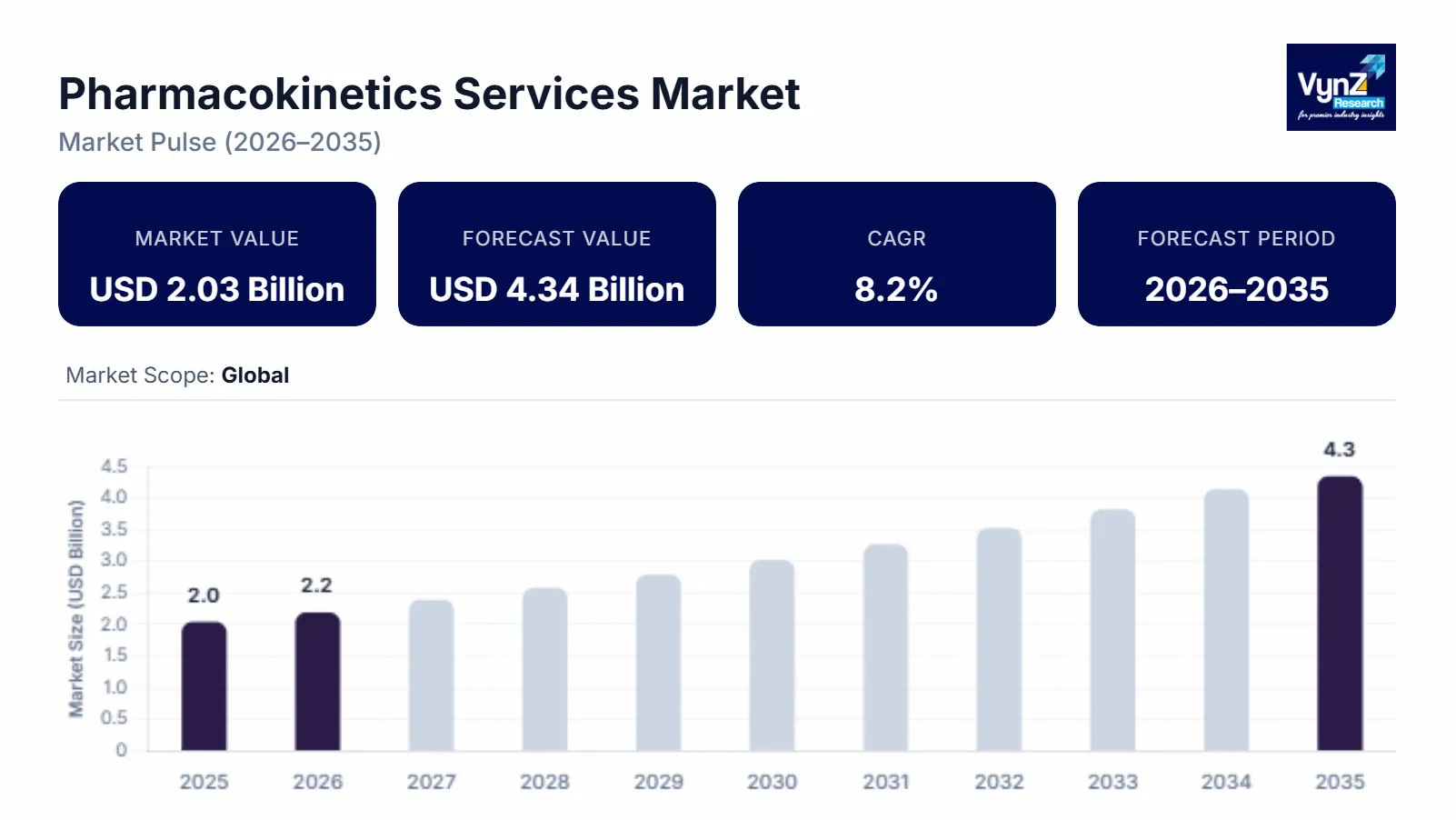
The market size is growing as the pharmaceutical and biotech industries adopt pharmacokinetic evaluation, bioanalysis, pharmacokinetic/pharmacodynamic modelling and related drug-disposition studies across preclinical and clinical development. Rising investment in biologics, complex therapeutic modalities, personalized medicine and model-informed drug development is driving the demand for specialized services to characterize drug exposure, optimize dosing, and support regulatory submissions. The increased outsourcing of specialized laboratory and quantitative pharmacology activities to contract research organizations is also expanding the potential service base.
Research Methodology
The research methodology employed by the VynZ Research team encompasses secondary research, company disclosures, regulatory publications, scientific literature, industry databases, market intelligence, and segment-level analysis to understand the global pharmacokinetics services industry. Market estimates were derived using data triangulation across service types, drug types, development stages, end users, and geographic markets, with subsequent validation of historical trends and growth assumptions. The forecasting process takes into account pharmaceutical R&D expenditure, clinical trial activity, biologics development, outsourcing trends, regulatory requirements, laboratory technology adoption, and the increasing use of pharmacometric and model-informed approaches. VynZ Research also assesses regional demand conditions and competitive service capabilities to provide a consistent global market outlook.
Research Highlights
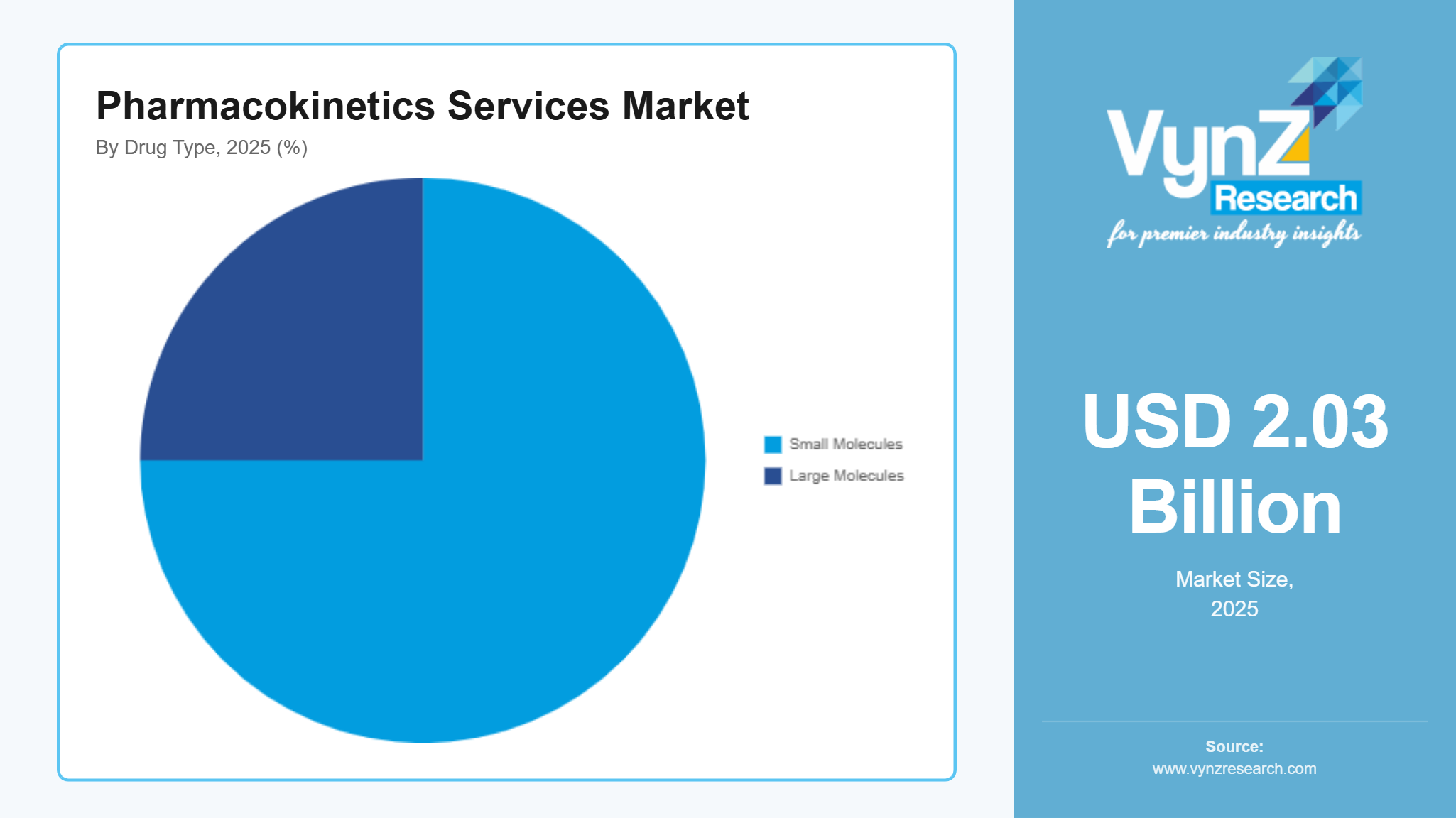
By drug type, small molecules accounted for approximately 75% of the market in 2025, supported by their extensive representation across pharmaceutical development pipelines and the continuing requirement for absorption, distribution, metabolism, excretion, bioavailability, and exposure characterization during development.
By service type, bioanalytical services represented about 42% of the market in 2025, as validated concentration measurement remains fundamental to pharmacokinetic evaluation across preclinical studies, clinical trials, and regulatory programs.
By study phase, preclinical services accounted for approximately 35% of the market in 2025, reflecting the need to establish exposure, dose-response relationships, and drug-disposition characteristics before progression into human studies.
PK/PD modelling and simulation is projected to expand at approximately 9.4% CAGR from 2026 to 2035, supported by wider adoption of model-informed drug development, population pharmacokinetics, physiologically based pharmacokinetic approaches, and data-driven dosing strategies.
North America accounted for approximately 37.5% of the global market in 2025, due to its large pharmaceutical and biotechnology base, established CRO ecosystem, substantial R&D expenditure, advanced analytical infrastructure, and mature regulatory environment.
Pharmacokinetics Services Market Dynamics
Market Trends
One of the most significant trends in the industry is the growing use of pharmacokinetic and pharmacodynamic modelling in drug development. Pharmaceutical companies are looking to move beyond traditional concentration measurements and take advantage of population PK, physiologically based pharmacokinetic modelling, exposure-response assessment, and model-informed drug development to refine dose selection and reduce development uncertainty. Digital platforms and computational tools are enabling service providers to handle larger data sets and more complex simulations across populations. These trends are especially pertinent for biologics, rare-disease therapies, oncology treatments, and other programs where limited clinical data can hinder trial-and-error approaches.
Growth Drivers
The increasing pharmaceutical and biotechnology R&D pipeline is a key driver for pharmacokinetics services demand due to the need to systematically evaluate exposure and disposition before and during clinical development. The rising number of biologics, biosimilars, targeted therapies, and advanced therapeutic candidates is also contributing to increased complexity in pharmacokinetic studies.
These programs often require specialized analytical methods, immunogenicity assessment, population modelling, and exposure-response analysis that may not be available internally at smaller and mid-sized drug developers. The expansion of outsourced research, therefore, enables sponsors to access specialized infrastructure while being able to control fixed laboratory and personnel costs.
Market Restraints / Challenges
High technical and regulatory requirements can limit market expansion because pharmacokinetic studies require specialized analytical instruments, validated methodologies, qualified personnel, controlled sample handling, and extensive quality systems. Establishing and maintaining such capabilities requires significant resources, while analytical methods may need to be adapted for different molecules, biological matrices, and therapeutic modalities. Smaller service providers, therefore, may face challenges competing with larger organizations that can spread infrastructure and compliance costs across a wider range of services.
Market Opportunities
The increasing use of model-informed drug development creates opportunities for pharmacokinetics service providers due to the ability to integrate population PK, PBPK, pharmacometric modelling, exposure-response analysis, and dosing simulations to complement conventional bioanalytical services. The growing recognition of modelling and simulation by regulators is also creating opportunities for providers that can link laboratory measurements to mechanistic and statistical models, particularly for first-in-human dosing, drug-drug interaction evaluation, special populations, and formulation decisions.
Global Pharmacokinetics Services Market Report Coverage
|
Report Metric |
Details |
|
Historical Period |
2020 - 2024 |
|
Base Year Considered |
2025 |
|
Forecast Period |
2026 - 2035 |
|
Market Size in 2025 |
USD 2.03 Billion |
|
Revenue Forecast in 2035 |
USD 4.34 Billion |
|
Growth Rate |
8.2% |
|
Segments Covered in the Report |
Service Type, Drug Type, Study Phase, End User |
|
Report Scope |
Market Trends, Drivers, and Restraints; Revenue Estimation and Forecast; Segmentation Analysis; Companies’ Strategic Developments; Market Share Analysis of Key Players; Company Profiling |
|
Regions Covered in the Report |
North America, Europe, Asia Pacific, Rest of the World |
|
Key Companies |
Aragen Life Sciences Ltd, Charles River Laboratories International Inc, Certara Inc, Evotec SE, Eurofins Scientific SE, Frontage Laboratories Inc, ICON plc, Parexel International Corporation, SGS Société Générale de Surveillance SA, Thermo Fisher Scientific Inc |
|
Customization |
Available upon request |
Pharmacokinetics Services Market Segmentation
By Service Type
Bioanalytical services accounted for approximately 42% of the market in 2025, representing the largest service category because quantitative measurement of drug concentrations forms the foundation for pharmacokinetic assessment across development stages. The demand is supported by increasing requirements for validated analytical methods, sample analysis, assay development, method validation, immunogenicity testing, and biomarker evaluation.
PK/PD modelling and simulation is expected to expand at approximately 9.4% CAGR from 2026 to 2035, due to greater use of computational approaches to optimize dosing and reduce unnecessary clinical experimentation.
By Drug Type
Small molecules held approximately 75% of the market in 2025, reflecting their broad representation across pharmaceutical pipelines and the established need for pharmacokinetic characterization throughout discovery, preclinical testing, clinical development, and lifecycle management.
Large-molecule pharmacokinetics services are projected to grow at approximately 9.6% CAGR from 2026 to 2035, exceeding the overall market rate as biologics pipelines expand.
By Study Phase
Preclinical studies represented approximately 35% of the market in 2025, owing to the need to characterize exposure, dose proportionality, drug disposition, and toxicokinetic relationships before candidates enter human trials.
Post-approval & lifecycle management services are expected to grow at approximately 9.5% CAGR from 2026 to 2035, supported by increasing use of population PK, real-world evidence integration, formulation changes, and additional regulatory requirements throughout a product's commercial life.
By End User
Pharmaceutical & biotechnology companies accounted for approximately 52% of the market in 2025, as these organizations maintain extensive development pipelines requiring pharmacokinetic evaluation across discovery, preclinical, clinical, and lifecycle stages.
The Contract research organizations segment is projected to grow at approximately 9.7% CAGR from 2026 to 2035, supported by increasing outsourcing, demand for faster development timelines, and the need to control fixed research infrastructure costs.
Regional Insights
North America
North America accounted for approximately 37.5% of the global pharmacokinetics services market in 2025, making it the leading regional market. The region benefits from a large concentration of pharmaceutical and biotechnology companies, substantial drug-development expenditure, established CRO networks, advanced bioanalytical laboratories, and mature regulatory infrastructure. The United States represents the primary contributor because of its extensive clinical development activity and strong demand for quantitative pharmacology, bioanalysis, and pharmacometric services. Regulatory guidance concerning population pharmacokinetics and human bioavailability further supports the use of structured PK evidence throughout development and regulatory submissions.
Europe
Europe accounted for approximately 27% of the global market in 2025, supported by a strong pharmaceutical industry, established clinical research infrastructure, and extensive demand for outsourced development services. Major European pharmaceutical markets maintain significant investment in innovative medicines, biologics, and specialty therapies, creating sustained requirements for preclinical PK, clinical pharmacology, bioanalysis, and modelling. The region's established regulatory framework also encourages the generation of high-quality pharmacokinetic evidence for clinical development and marketing applications.
Asia Pacific
Asia Pacific accounted for approximately 24% of the global market in 2025 and is expected to record the fastest regional expansion through 2035. The region benefits from increasing pharmaceutical R&D investment, expanding clinical trial activity, growing CRO infrastructure, and comparatively competitive research costs. India and China are strengthening their positions in outsourced pharmaceutical research, while Japan and South Korea provide mature pharmaceutical and biotechnology ecosystems with increasing demand for advanced analytical and quantitative pharmacology services.
Rest of the World
Rest of the World accounted for approximately 11.5% of the market in 2025, covering Latin America, the Middle East, and Africa. Demand in these markets is comparatively smaller but is supported by increasing pharmaceutical access, expanding clinical research activity, and gradual development of local healthcare and research infrastructure. Latin American countries are attracting clinical development programs because of growing patient populations and increasing participation in multinational trials, while selected Middle Eastern markets are investing in healthcare research and biotechnology initiatives.
Competitive Landscape / Company Insights
The competitive landscape is characterized by a combination of global contract research organizations, specialized bioanalytical laboratories, quantitative pharmacology providers, and technology-driven modelling companies. Competition increasingly depends on the ability to combine validated bioanalytical testing with pharmacokinetic modelling, clinical pharmacology, toxicokinetics, and regulatory support. Providers are expanding laboratory infrastructure, strengthening large-molecule capabilities, and adopting advanced computational tools to address increasingly complex development programs. Strategic collaborations, integrated service offerings, geographic expansion, and investment in model-informed drug development are expected to remain important competitive strategies as sponsors seek shorter development timelines and more coordinated outsourcing.
Mini Profiles
Aragen Life Sciences Ltd provides integrated pharmaceutical research and development services spanning nonclinical safety, toxicokinetics, analytical and bioanalytical testing, and clinical bioanalysis, supporting pharmacokinetic requirements across multiple stages of drug development.
Charles River Laboratories International, Inc. provides nonclinical development and laboratory services covering pharmacokinetics, bioanalysis, toxicology, and related research activities, supporting pharmaceutical and biotechnology companies from discovery through development.
Certara, Inc specializes in model-informed drug development, biosimulation, pharmacometrics, population pharmacokinetics, and physiologically based pharmacokinetic modelling, helping sponsors apply quantitative approaches to development and regulatory decisions.
Eurofins Scientific SE provides bioanalytical, ADME, pharmacokinetic, clinical, and laboratory services supporting small-molecule and biologics development, with integrated capabilities across discovery, clinical research, and regulatory programs.
Evotec SE provides integrated drug discovery and development capabilities, including pharmacology, bioanalysis, translational research, and related services that support the characterization and progression of pharmaceutical candidates.
Key Players
- Aragen
- Life Sciences Ltd
- Charles River Laboratories International Inc
- Certara Inc
- Evotec SE
- Eurofins Scientific SE
- Frontage Laboratories Inc
- ICON plc
- Parexel International Corporation
- SGS Société Générale de Surveillance SA
- Thermo
- Fisher Scientific Inc
Recent Developments
Certara Inc expanded its Simcyp Simulator through a new version designed to strengthen physiologically based pharmacokinetic modelling and regulatory submission workflows. The company also highlighted the use of PBPK modelling to support regulatory decisions and reduce the need for certain clinical pharmacology studies.
Eurofins Scientific SE strengthened its integrated biologics development capabilities by combining clinical, bioanalytical, pharmacokinetic, immunogenicity, and biologics testing expertise. The expanded approach is intended to support biopharmaceutical programs requiring coordinated services across development stages.
Charles River Laboratories International Inc highlighted changing requirements in bioanalytical strategy as sponsors increasingly seek earlier scientific interpretation, stronger regulatory readiness, and faster development decisions. The company continues to position bioanalysis as an integrated component of clinical development rather than a standalone testing activity.
Aragen Life Sciences Ltd continued expanding its integrated pharmaceutical development capabilities, including clinical bioanalysis and pharmacokinetic testing using LC-MS/MS and ligand-binding approaches. Its broader analytical and bioanalytical infrastructure supports programs spanning discovery, preclinical development, and clinical research.
Thermo Fisher Scientific Inc continued strengthening its clinical research and laboratory service capabilities to support the growing requirements of biopharmaceutical development. Its expanding laboratory infrastructure supports increasing demand for regulated bioanalytical and clinical research activities associated with complex therapeutic programs.
Global Pharmacokinetics Services Market Coverage
study phase, preclinical services accounted for approximately 35% of the market in 2025, reflecting the need to establish exposure, dose-response relationships, and drug-disposition characteristics before progression into human studies. Insight and Forecast 2026 - 2035
- Aragen Life Sciences Ltd
- Charles River Laboratories International Inc
- Certara Inc
- Evotec SE
- Eurofins Scientific SE
- Frontage Laboratories Inc
- ICON plc
- Parexel International Corporation
- SGS Société Générale de Surveillance SA
- Thermo Fisher Scientific Inc
Service Type Insight and Forecast 2026 - 2035
- Preclinical PK Services
- Clinical PK Services
- Bioanalytical Services
- Consulting & Modeling Services
- Regulatory Support Services
Drug Type Insight and Forecast 2026 - 2035
- Small Molecules
- Large Molecules
Study Phase Insight and Forecast 2026 - 2035
- Discovery
- Preclinical
- Clinical Phase I–III
- Post-Approval & Lifecycle Management
End User Insight and Forecast 2026 - 2035
- Pharmaceutical & Biotechnology Companies
- Contract Research Organizations
- Academic & Government Research Institutes
- Other End Users
Global Pharmacokinetics Services Market by Region
- North America
- By study phase, preclinical services accounted for approximately 35% of the market in 2025, reflecting the need to establish exposure, dose-response relationships, and drug-disposition characteristics before progression into human studies.
- By Service Type
- By Drug Type
- By Study Phase
- By End User
- By Country - U.S., Canada, Mexico
- Europe
- By study phase, preclinical services accounted for approximately 35% of the market in 2025, reflecting the need to establish exposure, dose-response relationships, and drug-disposition characteristics before progression into human studies.
- By Service Type
- By Drug Type
- By Study Phase
- By End User
- By Country - Germany, U.K., France, Italy, Spain, Russia, Rest of Europe
- Asia-Pacific (APAC)
- By study phase, preclinical services accounted for approximately 35% of the market in 2025, reflecting the need to establish exposure, dose-response relationships, and drug-disposition characteristics before progression into human studies.
- By Service Type
- By Drug Type
- By Study Phase
- By End User
- By Country - China, Japan, India, South Korea, Vietnam, Thailand, Malaysia, Rest of Asia-Pacific
- Rest of the World (RoW)
- By study phase, preclinical services accounted for approximately 35% of the market in 2025, reflecting the need to establish exposure, dose-response relationships, and drug-disposition characteristics before progression into human studies.
- By Service Type
- By Drug Type
- By Study Phase
- By End User
- By Country - Brazil, Saudi Arabia, South Africa, U.A.E., Other Countries
Table of Contents for Pharmacokinetics Services Market Report
1. Research Overview
1.1. The Report Offers
1.2. Market Coverage
1.2.1. By
study phase, preclinical services accounted for approximately 35% of the market in 2025, reflecting the need to establish exposure, dose-response relationships, and drug-disposition characteristics before progression into human studies.
1.2.2. By
Service Type
1.2.3. By
Drug Type
1.2.4. By
Study Phase
1.2.5. By
End User
1.3. Research Phases
1.4. Limitations
1.5. Market Methodology
1.5.1. Data Sources
1.5.1.1.
Primary Research
1.5.1.2.
Secondary Research
1.5.2. Methodology
1.5.2.1.
Data Exploration
1.5.2.2.
Forecast Parameters
1.5.2.3.
Data Validation
1.5.2.4.
Assumptions
1.5.3. Study Period & Data Reporting Unit
2. Executive Summary
3. Industry Overview
3.1. Industry Dynamics
3.1.1. Market Growth Drivers
3.1.2. Market Restraints
3.1.3. Key Market Trends
3.1.4. Major Opportunities
3.2. Industry Ecosystem
3.2.1. Porter’s Five Forces Analysis
3.2.2. Recent Development Analysis
3.2.3. Value Chain Analysis
3.3. Competitive Insight
3.3.1. Competitive Position of Industry
Players
3.3.2. Market Attractive Analysis
3.3.3. Market Share Analysis
4. Global Market Estimate and Forecast
4.1. Global Market Overview
4.2. Global Market Estimate and Forecast to 2035
5. Market Segmentation Estimate and Forecast
5.1. By study phase, preclinical services accounted for approximately 35% of the market in 2025, reflecting the need to establish exposure, dose-response relationships, and drug-disposition characteristics before progression into human studies.
5.1.1. Aragen Life Sciences Ltd
5.1.1.1. Market Definition
5.1.1.2. Market Estimation and Forecast to 2035
5.1.2. Charles River Laboratories International Inc
5.1.2.1. Market Definition
5.1.2.2. Market Estimation and Forecast to 2035
5.1.3. Certara Inc
5.1.3.1. Market Definition
5.1.3.2. Market Estimation and Forecast to 2035
5.1.4. Evotec SE
5.1.4.1. Market Definition
5.1.4.2. Market Estimation and Forecast to 2035
5.1.5. Eurofins Scientific SE
5.1.5.1. Market Definition
5.1.5.2. Market Estimation and Forecast to 2035
5.1.6. Frontage Laboratories Inc
5.1.6.1. Market Definition
5.1.6.2. Market Estimation and Forecast to 2035
5.1.7. ICON plc
5.1.7.1. Market Definition
5.1.7.2. Market Estimation and Forecast to 2035
5.1.8. Parexel International Corporation
5.1.8.1. Market Definition
5.1.8.2. Market Estimation and Forecast to 2035
5.1.9. SGS Société Générale de Surveillance SA
5.1.9.1. Market Definition
5.1.9.2. Market Estimation and Forecast to 2035
5.1.10. Thermo Fisher Scientific Inc
5.1.10.1. Market Definition
5.1.10.2. Market Estimation and Forecast to 2035
5.2. By Service Type
5.2.1. Preclinical PK Services
5.2.1.1. Market Definition
5.2.1.2. Market Estimation and Forecast to 2035
5.2.2. Clinical PK Services
5.2.2.1. Market Definition
5.2.2.2. Market Estimation and Forecast to 2035
5.2.3. Bioanalytical Services
5.2.3.1. Market Definition
5.2.3.2. Market Estimation and Forecast to 2035
5.2.4. Consulting & Modeling Services
5.2.4.1. Market Definition
5.2.4.2. Market Estimation and Forecast to 2035
5.2.5. Regulatory Support Services
5.2.5.1. Market Definition
5.2.5.2. Market Estimation and Forecast to 2035
5.3. By Drug Type
5.3.1. Small Molecules
5.3.1.1. Market Definition
5.3.1.2. Market Estimation and Forecast to 2035
5.3.2. Large Molecules
5.3.2.1. Market Definition
5.3.2.2. Market Estimation and Forecast to 2035
5.4. By Study Phase
5.4.1. Discovery
5.4.1.1. Market Definition
5.4.1.2. Market Estimation and Forecast to 2035
5.4.2. Preclinical
5.4.2.1. Market Definition
5.4.2.2. Market Estimation and Forecast to 2035
5.4.3. Clinical Phase I–III
5.4.3.1. Market Definition
5.4.3.2. Market Estimation and Forecast to 2035
5.4.4. Post-Approval & Lifecycle Management
5.4.4.1. Market Definition
5.4.4.2. Market Estimation and Forecast to 2035
5.5. By End User
5.5.1. Pharmaceutical & Biotechnology Companies
5.5.1.1. Market Definition
5.5.1.2. Market Estimation and Forecast to 2035
5.5.2. Contract Research Organizations
5.5.2.1. Market Definition
5.5.2.2. Market Estimation and Forecast to 2035
5.5.3. Academic & Government Research Institutes
5.5.3.1. Market Definition
5.5.3.2. Market Estimation and Forecast to 2035
5.5.4. Other End Users
5.5.4.1. Market Definition
5.5.4.2. Market Estimation and Forecast to 2035
6. North America Market Estimate and Forecast
6.1. By
study phase, preclinical services accounted for approximately 35% of the market in 2025, reflecting the need to establish exposure, dose-response relationships, and drug-disposition characteristics before progression into human studies.
6.2. By
Service Type
6.3. By
Drug Type
6.4. By
Study Phase
6.5. By
End User
6.5.1.
U.S. Market Estimate and Forecast
6.5.2.
Canada Market Estimate and Forecast
6.5.3.
Mexico Market Estimate and Forecast
7. Europe Market Estimate and Forecast
7.1. By
study phase, preclinical services accounted for approximately 35% of the market in 2025, reflecting the need to establish exposure, dose-response relationships, and drug-disposition characteristics before progression into human studies.
7.2. By
Service Type
7.3. By
Drug Type
7.4. By
Study Phase
7.5. By
End User
7.5.1.
Germany Market Estimate and Forecast
7.5.2.
France Market Estimate and Forecast
7.5.3.
U.K. Market Estimate and Forecast
7.5.4.
Italy Market Estimate and Forecast
7.5.5.
Spain Market Estimate and Forecast
7.5.6.
Russia Market Estimate and Forecast
7.5.7.
Rest of Europe Market Estimate and Forecast
8. Asia-Pacific (APAC) Market Estimate and Forecast
8.1. By
study phase, preclinical services accounted for approximately 35% of the market in 2025, reflecting the need to establish exposure, dose-response relationships, and drug-disposition characteristics before progression into human studies.
8.2. By
Service Type
8.3. By
Drug Type
8.4. By
Study Phase
8.5. By
End User
8.5.1.
China Market Estimate and Forecast
8.5.2.
Japan Market Estimate and Forecast
8.5.3.
India Market Estimate and Forecast
8.5.4.
South Korea Market Estimate and Forecast
8.5.5.
Rest of Asia-Pacific Market Estimate and Forecast
9. Rest of the World (RoW) Market Estimate and Forecast
9.1. By
study phase, preclinical services accounted for approximately 35% of the market in 2025, reflecting the need to establish exposure, dose-response relationships, and drug-disposition characteristics before progression into human studies.
9.2. By
Service Type
9.3. By
Drug Type
9.4. By
Study Phase
9.5. By
End User
9.5.1.
Brazil Market Estimate and Forecast
9.5.2.
Saudi Arabia Market Estimate and Forecast
9.5.3.
South Africa Market Estimate and Forecast
9.5.4.
U.A.E. Market Estimate and Forecast
9.5.5.
Other Countries Market Estimate and Forecast
10. Company Profiles
10.1.
Aragen Life Sciences Ltd
10.1.1.
Snapshot
10.1.2.
Overview
10.1.3.
Offerings
10.1.4.
Financial
Insight
10.1.5.
Recent
Developments
10.2.
Charles River Laboratories International Inc
10.2.1.
Snapshot
10.2.2.
Overview
10.2.3.
Offerings
10.2.4.
Financial
Insight
10.2.5.
Recent
Developments
10.3.
Certara Inc
10.3.1.
Snapshot
10.3.2.
Overview
10.3.3.
Offerings
10.3.4.
Financial
Insight
10.3.5.
Recent
Developments
10.4.
Evotec SE
10.4.1.
Snapshot
10.4.2.
Overview
10.4.3.
Offerings
10.4.4.
Financial
Insight
10.4.5.
Recent
Developments
10.5.
Eurofins Scientific SE
10.5.1.
Snapshot
10.5.2.
Overview
10.5.3.
Offerings
10.5.4.
Financial
Insight
10.5.5.
Recent
Developments
10.6.
Frontage Laboratories Inc
10.6.1.
Snapshot
10.6.2.
Overview
10.6.3.
Offerings
10.6.4.
Financial
Insight
10.6.5.
Recent
Developments
10.7.
ICON plc
10.7.1.
Snapshot
10.7.2.
Overview
10.7.3.
Offerings
10.7.4.
Financial
Insight
10.7.5.
Recent
Developments
10.8.
Parexel International Corporation
10.8.1.
Snapshot
10.8.2.
Overview
10.8.3.
Offerings
10.8.4.
Financial
Insight
10.8.5.
Recent
Developments
10.9.
SGS Société Générale de Surveillance SA
10.9.1.
Snapshot
10.9.2.
Overview
10.9.3.
Offerings
10.9.4.
Financial
Insight
10.9.5.
Recent
Developments
10.10.
Thermo Fisher Scientific Inc
10.10.1.
Snapshot
10.10.2.
Overview
10.10.3.
Offerings
10.10.4.
Financial
Insight
10.10.5.
Recent
Developments
11. Appendix
11.1. Exchange Rates
11.2. Abbreviations
Note: Financial insight and recent developments of different companies are subject to the availability of information in the secondary domain.
Purchase Options
Latest Report
Research Methodology
- Desk Research / Pilot Interviews
- Build Market Size Model
- Research and Analysis
- Final Deliverable
Connect With Our Sales Team
- Toll-Free: +1-888-253-3960
- Phone: +91 9960 288 381
- Email: enquiry@vynzresearch.com
Pharmacokinetics Services Market