
5G Market Size & Share Growth Forecast Report (2026-2035)
Industry Insight by Component (Hardware, Software, Services), by Network Architecture (Non-standalone, Standalone), by Communication Infrastructure (Macro cells, Small cells), by End User (Telecom operators, Enterprises, Consumer-facing connectivity providers, Government and public-sector organisations, Other end users)
| Status : Published | Published On : Oct, 2026 | Report Code : VRICT5251 | Industry : ICT & Media | Available Format : | Page : 165 |
5G Market Overview
The global 5G market was estimated at USD 128.20 billion in 2025 and is projected to reach USD 149.40 billion in 2026, rising to approximately USD 538 billion by 2035, at an estimated CAGR of 15.30% from 2026 to 2035.
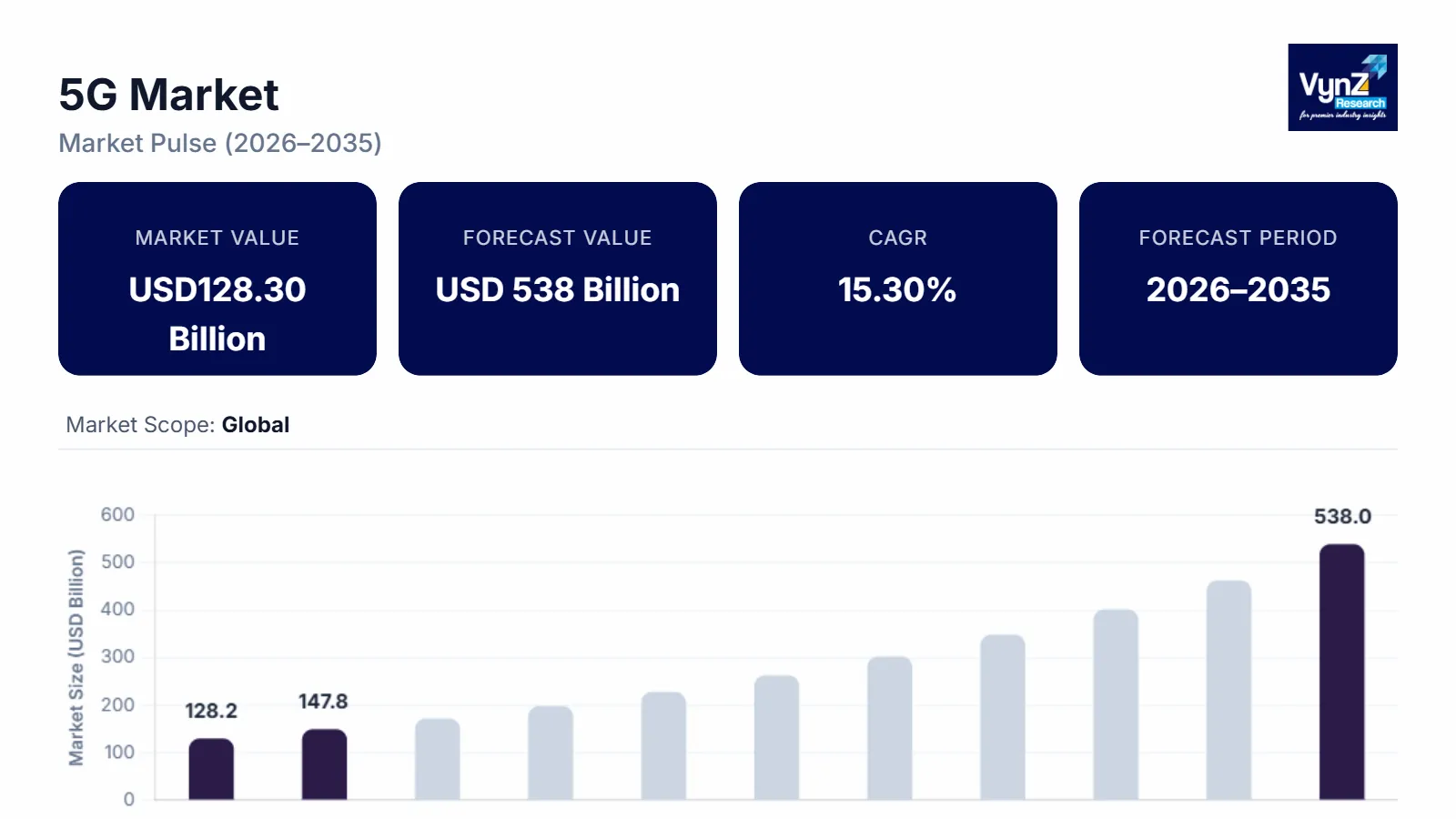
These estimates use the global 5G network market as the working scope, covering network infrastructure, core systems, software and associated services rather than the entire economic value of 5G-enabled devices and applications. Market growth is driven by increasing mobile data consumption, network modernization and enterprise digitalization, alongside the adoption of fixed wireless access, private 5G and automated industrial systems. According to the ITU's Facts and Figures 2025, 5G networks covered approximately 55% of the global population, while 5G subscriptions represented around 36% of mobile broadband subscriptions. These indicators highlight the continuing expansion of 5G connectivity, although significant differences in network availability and affordability remain across income groups and geographical markets.
Research Methodology
VynZ Research applies a structured research methodology combining secondary research, market assessment and forecast modelling to evaluate the global 5G market. The VynZ Research team reviews telecom operator disclosures, equipment manufacturer announcements, regulatory publications, spectrum policies and publicly available industry statistics. Government-backed information from the International Telecommunication Union (ITU), the US Federal Communications Commission (FCC), and relevant national telecommunications authorities helps assess network availability, infrastructure deployment and connectivity adoption. Market estimates are developed by comparing available industry forecasts, reviewing the scope of reported revenues and applying consistent annual growth calculations. Segment and regional estimates are then assessed for internal consistency, with assumptions reviewed against technology adoption and investment trends.
Research Highlights
- Hardware accounted for approximately 58% of market revenue in 2025, reflecting spending on radio equipment, antennas and supporting network infrastructure.
- Non-standalone architecture represented about 65% of the market in 2025 because it enables operators to introduce 5G radio capabilities with their existing 4G core infrastructure.
- Telecom operators held nearly 62% of market demand in 2025, being the principal purchasers of network infrastructure, spectrum-related capabilities and network management systems.
- The standalone 5G segment recorded a CAGR of nearly 19.20% from 2026 to 2035, supported by network slicing, private connectivity and more advanced enterprise requirements.
- Asia Pacific accounted for an estimated 42.30% of global market revenue in 2025, due to large subscriber bases.
5G Market Dynamics
Market Trends
The 5G industry is increasingly shifting from basic coverage expansion toward standalone architecture, software-defined networks and more efficient use of spectrum. Network operators are investing in automation, virtualised radio access networks and advanced core systems to improve capacity, service reliability and operational efficiency. These developments are creating opportunities for equipment suppliers and software providers that support flexible network deployment. Another important trend is the integration of artificial intelligence into network management and the development of 5G Advanced capabilities.
Growth Drivers
The growth of the 5G market is largely supported by rising mobile data demand and continued investment in telecommunications infrastructure. Higher usage of video streaming, cloud applications and connected devices is encouraging operators to increase network capacity and improve coverage. Such deployment activity illustrates how public policy, spectrum availability and operator investment can accelerate infrastructure expansion. Enterprise adoption is another important driver, particularly in manufacturing, logistics, utilities and other operations requiring dependable wireless connectivity. The development of standalone architecture and network slicing may further strengthen demand by allowing operators to support different service requirements through a more flexible network.
Market Restraints / Challenges
Despite favourable growth prospects, the 5G market faces substantial capital expenditure requirements associated with spectrum acquisition, radio equipment, fibre backhaul, site installation and network maintenance. Operators in less densely populated areas may find it difficult to recover these costs because lower subscriber density can limit revenue per site. The ITU's 2025 connectivity assessment also identifies a persistent gap in network coverage between high-income and low-income countries, highlighting the financial and infrastructure barriers that can delay deployment in underserved markets. Equipment interoperability, energy consumption, spectrum availability and the limited commercial maturity of some advanced enterprise applications can also constrain adoption.
Market Opportunities
Private 5G networks and industrial connectivity present important opportunities for network equipment suppliers, telecom operators and systems integrators. Manufacturing facilities, ports, warehouses and utility operations can use dedicated wireless networks to connect equipment, monitor assets and support automated processes. As organisations evaluate digital transformation projects, suppliers that provide integrated connectivity, security, and network management services may benefit from demand for solutions tailored to specific operational requirements. A further opportunity lies in standalone networks, fixed wireless access and 5G advanced services. These technologies can improve network flexibility, extend broadband availability and support applications requiring higher capacity or more consistent performance.
Global 5G Market Report Coverage
|
Report Metric |
Details |
|
Historical Period |
2020 - 2024 |
|
Base Year Considered |
2025 |
|
Forecast Period |
2026 - 2035 |
|
Market Size in 2025 |
USD 128.20 Billion |
|
Revenue Forecast in 2035 |
USD 538 Billion |
|
Growth Rate |
15.30% |
|
Segments Covered in the Report |
Component, Network Architecture, Communication Infrastructure, End User |
|
Report Scope |
Market Trends, Drivers, and Restraints; Revenue Estimation and Forecast; Segmentation Analysis; Companies’ Strategic Developments; Market Share Analysis of Key Players; Company Profiling |
|
Regions Covered in the Report |
North America, Europe, Asia Pacific, Rest of the World |
|
Key Companies |
AT&T, Broadcom, Cisco, Ericsson, Huawei, Nokia, Qualcomm, Samsung, T-Mobile, Vodafone Idea |
|
Customization |
Available upon request |
5G Market Segmentation
By Component
Hardware is estimated to have accounted for approximately 58% of market revenue in 2025, supported by investment in radio access equipment, antennas, base stations and supporting transmission infrastructure.
Software is expected to grow at a CAGR of 17.40% from 2026 to 2035, supported by network management, traffic optimisation and service orchestration.
By Network Architecture
Non-standalone architecture is estimated to have represented approximately 65% of the market in 2025 because it enables operators to introduce 5G radio capabilities while continuing to use parts of their existing 4G core infrastructure.
Standalone architecture is projected to record stronger growth, with an estimated CAGR of 19.20% from 2026 to 2035. Unlike non-standalone deployment, standalone networks use a dedicated 5G core and provide a foundation for advanced capabilities such as network slicing, improved service control and specialised enterprise connectivity.
By Communication Infrastructure
Macro cells are estimated to have accounted for approximately 52% of infrastructure revenue in 2025, reflecting their role in delivering broad-area coverage across cities, transport corridors and suburban locations.
Small cells are expected to expand at a faster pace, with an estimated CAGR of 17.80% from 2026 to 2035, as operators address localised congestion and improve indoor coverage.
By End User
Telecom operators are estimated to have represented approximately 62% of market demand in 2025, as they remain the principal purchasers of network infrastructure, spectrum-related capabilities and network management systems.
Enterprise adoption is expected to register an estimated CAGR of 18.60% from 2026 to 2035, supported by demand for connected equipment, operational monitoring and reliable industrial communication.
Regional Insights
North America
North America is estimated to have accounted for approximately 26.40% of the global 5G market in 2025, supported by established telecommunications operators, substantial network investment and demand for high-capacity mobile connectivity. The United States remains an important market for network equipment, fixed wireless access and enterprise connectivity. The Federal Communications Commission's spectrum-management and broadband policies provide an important regulatory context for deployment, while private-sector investment continues to shape network modernisation. Demand is expected to be supported by standalone network development, enterprise digitalisation and ongoing upgrades to network capacity.
Europe
Europe is estimated to have represented approximately 22.10% of global market revenue in 2025, driven by operator investment, enterprise digitalisation and continuing improvements in mobile connectivity. The ITU reported that approximately 74% of Europe's population was covered by 5G in 2025, demonstrating the region's comparatively broad deployment while leaving room for further expansion. European demand is supported by industrial connectivity, transport applications and efforts to improve network efficiency. Investment decisions will continue to reflect spectrum policies, competition, infrastructure-sharing arrangements and the financial capacity of operators across individual countries.
Asia Pacific
Asia Pacific is estimated to have accounted for approximately 42.30% of global 5G market revenue in 2025, making it the largest regional market. China, India, Japan and South Korea contribute to demand through extensive mobile subscriber bases, telecommunications investment and the growing use of digital services. According to the ITU, approximately 70% of the region's population was covered by 5G in 2025. India's Department of Telecommunications also reported 4.69 lakh installed 5G base transceiver stations by February 2025, reflecting the scale of infrastructure deployment. Continued network expansion, enterprise digitalisation and growing fixed wireless access adoption are expected to support regional demand.
Rest of the World
The Rest of the World is estimated to have accounted for approximately 9.20% of the global 5G market in 2025, covering Latin America, the Middle East, Africa and other markets outside the three regions discussed above. Growth is supported by expanding mobile broadband demand, telecommunications investment and efforts to improve connectivity in underserved areas.
Competitive Landscape / Company Insights
The 5G market is highly competitive, with equipment manufacturers, semiconductor suppliers, telecommunications operators and network software providers competing across different parts of the value chain. Companies are focusing on radio access equipment, standalone core systems, virtualised infrastructure, energy efficiency and advanced connectivity solutions. Government telecommunications policies and international standards influence deployment requirements, while operator investment decisions shape supplier opportunities. The ITU's connectivity statistics highlight the continuing need for network expansion, although market participants face pressure to balance infrastructure spending with affordability and sustainable commercial returns.
Mini Profiles
AT&T provides mobile and broadband connectivity services and invests in network modernisation to support consumer demand, enterprise communication and wider 5G coverage across the United States.
Broadcom supplies semiconductor and infrastructure software solutions relevant to telecommunications networks, supporting connectivity, data processing and the wider digital infrastructure ecosystem.
Cisco provides networking, security and enterprise connectivity solutions that support organisations integrating wireless infrastructure with business applications, cloud systems and industrial networks.
Ericsson develops radio access network equipment, antennas, core-network solutions and network management technologies, serving telecommunications operators expanding and modernising 5G infrastructure.
Huawei supplies telecommunications equipment, including radio access, core-network and transmission systems, supporting network deployment, capacity upgrades and the development of advanced mobile connectivity.
Key Players
- AT&T
- Broadcom
- Cisco
- Ericsson
- Huawei
- Nokia
- Qualcomm
- Samsung
- T-Mobile
- Vodafone Idea
Recent Developments
Nokia has continued expanding its 5G network portfolio through operator agreements and developments in network automation, including work on standalone core systems and AI-supported radio access networks. These initiatives reflect growing demand for more efficient infrastructure and software-driven network management.
Qualcomm introduced its X105 5G Modem-RF platform, designed to support 5G Advanced capabilities and provide a foundation for future 6G development. The platform incorporates improvements in power efficiency, connectivity performance and support for non-terrestrial network communications.
Samsung expanded its work on virtualised radio access networks and fixed wireless access through a technical validation with Qualcomm, demonstrating 5G Power Class 1 capability. The development supports efforts to improve uplink performance and extend wireless broadband coverage in challenging signal environments.
T-Mobile announced a nationwide 5G Advanced milestone based on its standalone network architecture, highlighting the role of advanced network capabilities in supporting consumers, developers and enterprises. The development demonstrates the potential of network automation, improved throughput and lower-latency services.
Vodafone Idea expanded commercial 5G availability in Bengaluru using Samsung's network solutions, building on earlier service launches in Chandigarh and Patna. The deployment demonstrates how operator-vendor partnerships can support network expansion and the modernisation of existing mobile infrastructure in India.
Global 5G Market Coverage
Component Insight and Forecast 2026 - 2035
- Hardware
- Software
- Services
Network Architecture Insight and Forecast 2026 - 2035
- Non-standalone
- Standalone
Communication Infrastructure Insight and Forecast 2026 - 2035
- Macro cells
- Small cells
End User Insight and Forecast 2026 - 2035
- Telecom operators
- Enterprises
- Consumer-facing connectivity providers
- Government and public-sector organisations
- Other end users
Global 5G Market by Region
- North America
- By Component
- By Network Architecture
- By Communication Infrastructure
- By End User
- By Country - U.S., Canada, Mexico
- Europe
- By Component
- By Network Architecture
- By Communication Infrastructure
- By End User
- By Country - Germany, U.K., France, Italy, Spain, Russia, Rest of Europe
- Asia-Pacific (APAC)
- By Component
- By Network Architecture
- By Communication Infrastructure
- By End User
- By Country - China, Japan, India, South Korea, Vietnam, Thailand, Malaysia, Rest of Asia-Pacific
- Rest of the World (RoW)
- By Component
- By Network Architecture
- By Communication Infrastructure
- By End User
- By Country - Brazil, Saudi Arabia, South Africa, U.A.E., Other Countries
Table of Contents for 5G Market Report
1. Research Overview
1.1. The Report Offers
1.2. Market Coverage
1.2.1. By
Component
1.2.2. By
Network Architecture
1.2.3. By
Communication Infrastructure
1.2.4. By
End User
1.3. Research Phases
1.4. Limitations
1.5. Market Methodology
1.5.1. Data Sources
1.5.1.1.
Primary Research
1.5.1.2.
Secondary Research
1.5.2. Methodology
1.5.2.1.
Data Exploration
1.5.2.2.
Forecast Parameters
1.5.2.3.
Data Validation
1.5.2.4.
Assumptions
1.5.3. Study Period & Data Reporting Unit
2. Executive Summary
3. Industry Overview
3.1. Industry Dynamics
3.1.1. Market Growth Drivers
3.1.2. Market Restraints
3.1.3. Key Market Trends
3.1.4. Major Opportunities
3.2. Industry Ecosystem
3.2.1. Porter’s Five Forces Analysis
3.2.2. Recent Development Analysis
3.2.3. Value Chain Analysis
3.3. Competitive Insight
3.3.1. Competitive Position of Industry
Players
3.3.2. Market Attractive Analysis
3.3.3. Market Share Analysis
4. Global Market Estimate and Forecast
4.1. Global Market Overview
4.2. Global Market Estimate and Forecast to 2035
5. Market Segmentation Estimate and Forecast
5.1. By Component
5.1.1. Hardware
5.1.1.1. Market Definition
5.1.1.2. Market Estimation and Forecast to 2035
5.1.2. Software
5.1.2.1. Market Definition
5.1.2.2. Market Estimation and Forecast to 2035
5.1.3. Services
5.1.3.1. Market Definition
5.1.3.2. Market Estimation and Forecast to 2035
5.2. By Network Architecture
5.2.1. Non-standalone
5.2.1.1. Market Definition
5.2.1.2. Market Estimation and Forecast to 2035
5.2.2. Standalone
5.2.2.1. Market Definition
5.2.2.2. Market Estimation and Forecast to 2035
5.3. By Communication Infrastructure
5.3.1. Macro cells
5.3.1.1. Market Definition
5.3.1.2. Market Estimation and Forecast to 2035
5.3.2. Small cells
5.3.2.1. Market Definition
5.3.2.2. Market Estimation and Forecast to 2035
5.4. By End User
5.4.1. Telecom operators
5.4.1.1. Market Definition
5.4.1.2. Market Estimation and Forecast to 2035
5.4.2. Enterprises
5.4.2.1. Market Definition
5.4.2.2. Market Estimation and Forecast to 2035
5.4.3. Consumer-facing connectivity providers
5.4.3.1. Market Definition
5.4.3.2. Market Estimation and Forecast to 2035
5.4.4. Government and public-sector organisations
5.4.4.1. Market Definition
5.4.4.2. Market Estimation and Forecast to 2035
5.4.5. Other end users
5.4.5.1. Market Definition
5.4.5.2. Market Estimation and Forecast to 2035
6. North America Market Estimate and Forecast
6.1. By
Component
6.2. By
Network Architecture
6.3. By
Communication Infrastructure
6.4. By
End User
6.4.1.
U.S. Market Estimate and Forecast
6.4.2.
Canada Market Estimate and Forecast
6.4.3.
Mexico Market Estimate and Forecast
7. Europe Market Estimate and Forecast
7.1. By
Component
7.2. By
Network Architecture
7.3. By
Communication Infrastructure
7.4. By
End User
7.4.1.
Germany Market Estimate and Forecast
7.4.2.
France Market Estimate and Forecast
7.4.3.
U.K. Market Estimate and Forecast
7.4.4.
Italy Market Estimate and Forecast
7.4.5.
Spain Market Estimate and Forecast
7.4.6.
Russia Market Estimate and Forecast
7.4.7.
Rest of Europe Market Estimate and Forecast
8. Asia-Pacific (APAC) Market Estimate and Forecast
8.1. By
Component
8.2. By
Network Architecture
8.3. By
Communication Infrastructure
8.4. By
End User
8.4.1.
China Market Estimate and Forecast
8.4.2.
Japan Market Estimate and Forecast
8.4.3.
India Market Estimate and Forecast
8.4.4.
South Korea Market Estimate and Forecast
8.4.5.
Rest of Asia-Pacific Market Estimate and Forecast
9. Rest of the World (RoW) Market Estimate and Forecast
9.1. By
Component
9.2. By
Network Architecture
9.3. By
Communication Infrastructure
9.4. By
End User
9.4.1.
Brazil Market Estimate and Forecast
9.4.2.
Saudi Arabia Market Estimate and Forecast
9.4.3.
South Africa Market Estimate and Forecast
9.4.4.
U.A.E. Market Estimate and Forecast
9.4.5.
Other Countries Market Estimate and Forecast
10. Company Profiles
10.1.
AT&T
10.1.1.
Snapshot
10.1.2.
Overview
10.1.3.
Offerings
10.1.4.
Financial
Insight
10.1.5.
Recent
Developments
10.2.
Broadcom
10.2.1.
Snapshot
10.2.2.
Overview
10.2.3.
Offerings
10.2.4.
Financial
Insight
10.2.5.
Recent
Developments
10.3.
Cisco
10.3.1.
Snapshot
10.3.2.
Overview
10.3.3.
Offerings
10.3.4.
Financial
Insight
10.3.5.
Recent
Developments
10.4.
Ericsson
10.4.1.
Snapshot
10.4.2.
Overview
10.4.3.
Offerings
10.4.4.
Financial
Insight
10.4.5.
Recent
Developments
10.5.
Huawei
10.5.1.
Snapshot
10.5.2.
Overview
10.5.3.
Offerings
10.5.4.
Financial
Insight
10.5.5.
Recent
Developments
10.6.
Nokia
10.6.1.
Snapshot
10.6.2.
Overview
10.6.3.
Offerings
10.6.4.
Financial
Insight
10.6.5.
Recent
Developments
10.7.
Qualcomm
10.7.1.
Snapshot
10.7.2.
Overview
10.7.3.
Offerings
10.7.4.
Financial
Insight
10.7.5.
Recent
Developments
10.8.
Samsung
10.8.1.
Snapshot
10.8.2.
Overview
10.8.3.
Offerings
10.8.4.
Financial
Insight
10.8.5.
Recent
Developments
10.9.
T-Mobile
10.9.1.
Snapshot
10.9.2.
Overview
10.9.3.
Offerings
10.9.4.
Financial
Insight
10.9.5.
Recent
Developments
10.10.
Vodafone Idea
10.10.1.
Snapshot
10.10.2.
Overview
10.10.3.
Offerings
10.10.4.
Financial
Insight
10.10.5.
Recent
Developments
11. Appendix
11.1. Exchange Rates
11.2. Abbreviations
Note: Financial insight and recent developments of different companies are subject to the availability of information in the secondary domain.
Frequently Asked Questions
Purchase Options
Latest Report
Research Methodology
- Desk Research / Pilot Interviews
- Build Market Size Model
- Research and Analysis
- Final Deliverable
Connect With Our Sales Team
- Toll-Free: +1-888-253-3960
- Phone: +91 9960 288 381
- Email: enquiry@vynzresearch.com
5G Market