
Legal Online Dispute Resolution Market Size & Share Growth Forecast Report (2026-2035)
Industry Insight by Component (Software, Services, Platform Solutions), by Deployment Mode (Cloud Based, On Premises, Hybrid), by Organization Size (Large Enterprises, Medium Enterprises, Small Enterprises), by End User (Courts, Law Firms, Corporate Enterprises, Government Agencies, Arbitration and Mediation Centers)
| Status : Published | Published On : Jul, 2026 | Report Code : VRICT5240 | Industry : ICT & Media | Available Format :

|
Page : 160 |
Legal Online Dispute Resolution Market Overview
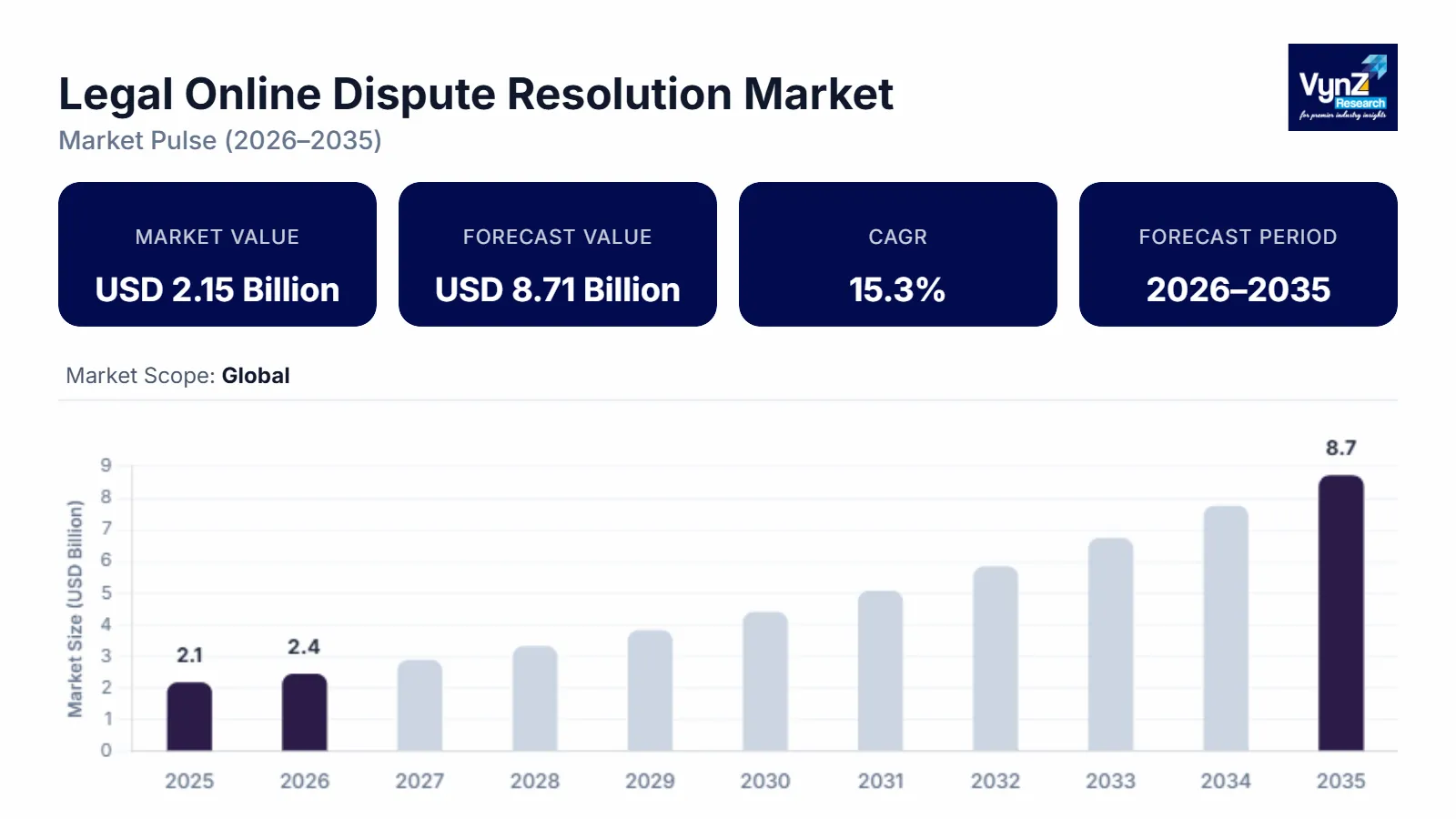
The legal online dispute resolution market size was estimated at approximately USD 2.15 billion in 2025 and is expected to reach around USD 2.42 billion in 2026, rising to roughly USD 8.71 billion by 2035, growing at approximately 15.3% CAGR from 2026 to 2035.
Research Highlights
- Software captured approximately 48% market share in 2025 supported by expanding AI enabled legal case management adoption.
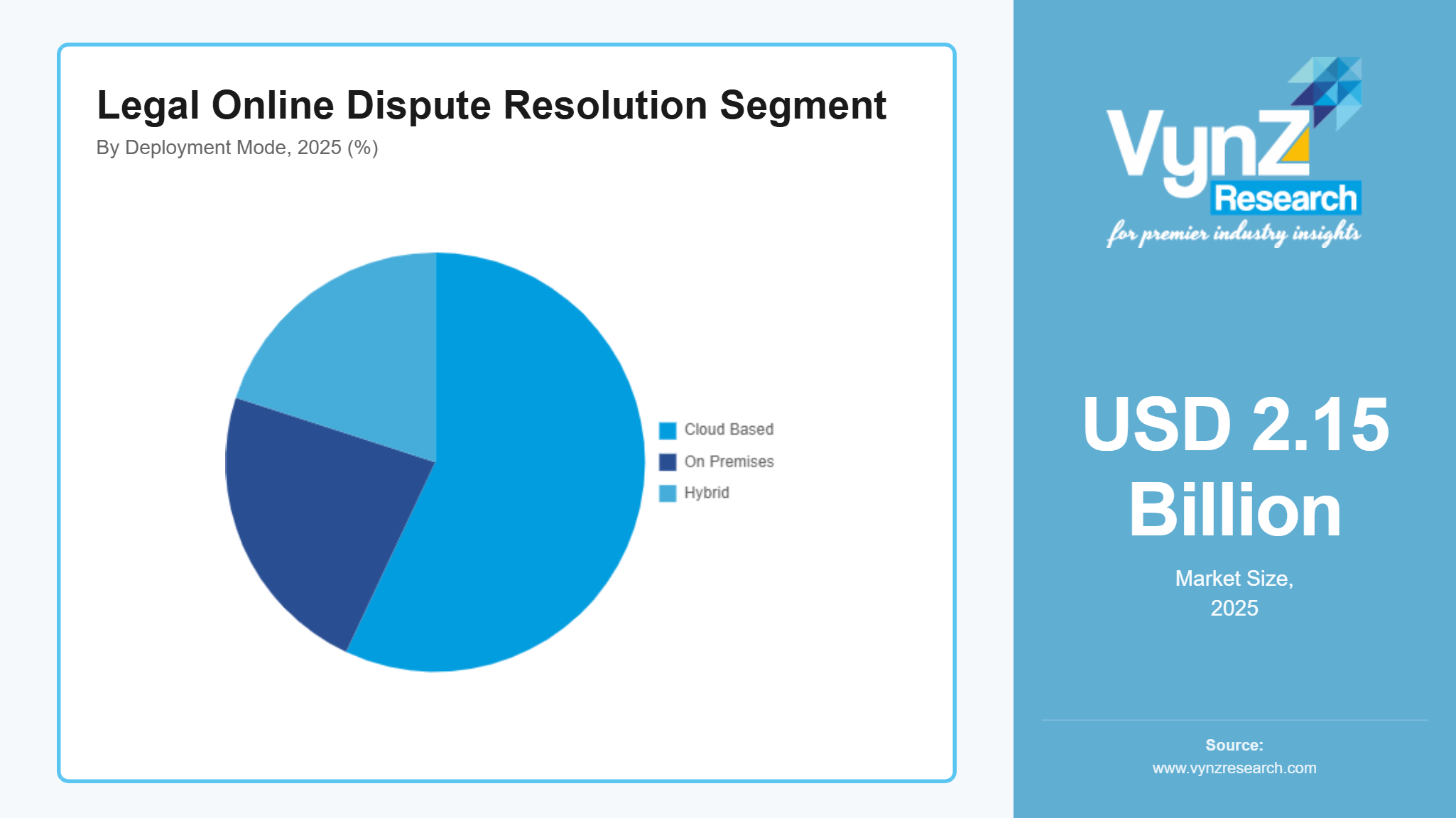
- Cloud based deployment accounted for approximately 57% share in 2025 due to scalable and secure digital justice infrastructure.
- Large enterprises represented approximately 54% market share in 2025 owing to significant investments in legal technology modernization.
- Services are projected to expand at approximately 16.2% CAGR supported by increasing implementation and cybersecurity consulting demand.
- North America held approximately 31% market share in 2025 due to advanced legal technology adoption and judicial digitalization initiatives.
Market growth is driven by increasing judicial digitalization, growing demand for cost effective dispute settlement and expanding adoption of cloud based legal technologies along with growing implementation of artificial intelligence enabled dispute resolution platforms. Increasing demand for faster conflict resolution among enterprises and consumers coupled with ongoing investments in digital justice initiatives by governments continues to support market expansion across major regions including North America, Europe, and Asia Pacific. The United Nations Commission on International Trade Law (UNCITRAL) continues to promote Online Dispute Resolution frameworks for cross border electronic commerce while the European Commission advances digital justice programs supporting wider adoption of online legal services.
Legal Online Dispute Resolution Market Dynamics
Market Trends
The market is witnessing notable shifts in digital legal services, artificial intelligence integration and cloud-based dispute management platforms. One of the leading trends is the growing adoption of AI assisted mediation and case management solutions reflecting increasing demand for faster case handling, lower administrative costs and improved accessibility. The European Commission's Digital Justice Strategy continues to encourage digital transformation across judicial systems, supporting broader implementation of online legal platforms. Another significant trend is the expansion of cross border online dispute resolution services supported by secure digital identity verification, electronic document management, and virtual hearings.
Growth Drivers
The growth of the market is primarily supported by increasing digital transformation across judicial systems and legal service providers. Courts, arbitration institutions and private legal organizations are investing in secure digital platforms that reduce case backlogs, improve procedural efficiency and lower litigation costs. Another important growth driver is the rapid increase in digital commerce and cross border business transactions requiring efficient dispute resolution mechanisms. Enterprises increasingly prioritize cost efficient, technology enabled legal solutions that minimize operational disruptions while maintaining regulatory compliance. The United Nations Commission on International Trade Law (UNCITRAL) supports international frameworks for Online Dispute Resolution that facilitate efficient settlement of commercial disputes across jurisdictions.
Market Restraints / Challenges
Despite favorable growth prospects, the market faces several operational and regulatory challenges. Variations in legal recognition of online dispute resolution outcomes, differing national regulations and inconsistent procedural standards continue to affect market expansion particularly for international commercial disputes. Another challenge involves cybersecurity risks, confidential data protection and digital identity verification across legal platforms. Dependence on secure digital infrastructure and evolving privacy regulations can increase implementation costs and delay platform deployment while regulatory requirements under frameworks promoted by the European Commission and national cybersecurity authorities require continuous investment in secure digital systems, creating additional compliance burdens for platform providers.
Market Opportunities
The market presents substantial opportunities through artificial intelligence through legal automation particularly for commercial arbitration, consumer protection, insurance claims, employment disputes and small value civil litigation. Providers offering scalable cloud-based dispute resolution platforms with multilingual capabilities are well positioned to capture increasing demand from courts, businesses, and legal service organizations. The European Commission continues supporting cross border digital justice projects that encourage wider implementation of secure online legal platforms. Another major opportunity lies in integrating advanced analytics, blockchain based evidence management, automated document review and secure digital identity technologies into dispute resolution workflows. Investments in digital public services and judicial modernization programs continue creating favorable conditions for technology providers.
Global Legal Online Dispute Resolution Market Report Coverage
|
Report Metric |
Details |
|
Historical Period |
2020 - 2024 |
|
Base Year Considered |
2025 |
|
Forecast Period |
2026 - 2035 |
|
Market Size in 2025 |
USD 2.15 Billion |
|
Revenue Forecast in 2035 |
USD 8.71 Billion |
|
Growth Rate |
15.3% |
|
Segments Covered in the Report |
Component, Deployment Mode, Organization Size, End User |
|
Report Scope |
Market Trends, Drivers, and Restraints; Revenue Estimation and Forecast; Segmentation Analysis; Companies’ Strategic Developments; Market Share Analysis of Key Players; Company Profiling |
|
Regions Covered in the Report |
North America, Europe, Asia Pacific, Rest of the World |
|
Key Companies |
eBay Inc., ICANN, JAMS, Modria, Newgen Software Technologies Limited, OpenText Corporation, Smartsettle, Tyler Technologies, Inc., Wevorce, Youstice |
|
Customization |
Available upon request |
Legal Online Dispute Resolution Market Segmentation
By Component
Software accounted for the largest market share of approximately 48% in 2025 and is expected to grow at an estimated 15.1% CAGR through 2035 supported by increasing deployment of AI based case management, automated document processing, secure communication modules and workflow automation across courts, arbitration centers and private legal firms.
Services are projected to register the fastest growth at approximately 16.2% CAGR during the forecast period as growing demand for consulting, platform integration, cybersecurity implementation, technical support and legal process outsourcing continues to strengthen this segment.
By Deployment Mode
Cloud based deployment held the largest market share of nearly 57% in 2025 and is anticipated to expand at approximately 15.5% CAGR through 2035 due to lower infrastructure costs, rapid implementation, scalable computing resources and improved accessibility for courts, businesses and consumers.
Hybrid deployment is expected to record the fastest growth at about 16.4% CAGR during the forecast period as organizations handling highly confidential legal information increasingly adopt hybrid environments that combine cloud flexibility with secure on premises data management. Growing emphasis on regulatory compliance, cybersecurity, and operational resilience continues supporting this segment.
By Organization Size
Large enterprises represented the highest market share of around 54% in 2025 and are projected to grow at nearly 15.0% CAGR throughout the forecast period supported by substantial investments in enterprise legal technology, regulatory compliance systems and international dispute management capabilities.
Small and medium enterprises are anticipated to witness the fastest expansion at around 16.1% CAGR through 2035 since affordable subscription based legal technology platforms and increasing awareness of online dispute resolution continue encouraging adoption among growing businesses.
By End User
Courts accounted for the largest revenue share of approximately 38% in 2025 and are expected to expand at nearly 15.2% CAGR through 2035 because government investments in judicial modernization, electronic filing systems, digital hearings and online case management continue driving adoption of online dispute resolution platforms.
Corporate enterprises are expected to register the fastest growth at approximately 16.3% CAGR during the forecast period as increasing cross border business transactions, contractual disputes, consumer complaints and commercial arbitration requirements continue accelerating adoption. Arbitration centers, government agencies, law firms, and other legal institutions also continue expanding investments in secure digital dispute resolution technologies.
Regional Insights
North America
North America accounted for about 31% of the market in 2025 and is expected to grow at almost 15% CAGR through 2035 benefited from mature legal technology ecosystems, high digital adoption across judicial institutions and increasing investments in artificial intelligence enabled legal platforms. Strong demand from the United States and Canada continues supporting market expansion. The National Institute of Standards and Technology (NIST) promotes secure digital infrastructure and cybersecurity standards while the U.S. Department of Justice continues supporting modernization of digital court services. Government backed digital justice initiatives combined with growing enterprise demand for efficient dispute management continue accelerating adoption of online dispute resolution platforms across commercial and public sector applications.
Europe
Europe represented around 25% of the global market in 2025 and is projected to expand at roughly 15.4% CAGR during the forecast period as increasing judicial digitalization, harmonized legal technology regulations and widespread adoption of electronic court systems continue supporting regional growth. The European Commission continues implementing digital justice initiatives that encourage secure online judicial services and cross border legal cooperation.
Asia Pacific
Asia Pacific accounted for almost 21% of the market in 2025 and is anticipated to register the fastest regional growth at about 16.1% CAGR through 2035 as expanding digital commerce, government backed judicial modernization and increasing legal technology investments across China, India, Japan, Singapore and Australia continue driving market demand. The United Nations Commission on International Trade Law (UNCITRAL) continues supporting internationally recognized online dispute resolution frameworks that facilitate cross border commercial dispute resolution throughout the region.
Rest of the World
The Rest of the World, including Latin America, the Middle East, and Africa, accounted for around 18% of the global market in 2025 and is expected to grow at about 15.6% CAGR through 2035. Governments continue investing in digital public services, judicial modernization and secure electronic governance platforms supporting wider adoption of online dispute resolution technologies. The remaining market is distributed across smaller economies not covered separately. The OECD continues promoting digital government transformation and technology enabled public services that strengthen legal accessibility.
Competitive Landscape / Company Insights
The market is moderately competitive with global technology providers and specialized legal technology companies focusing on artificial intelligence, secure cloud platforms and digital dispute resolution services. Companies continue investing in platform innovation, cybersecurity, strategic partnerships and geographic expansion to strengthen their competitive positions. The European Commission, UNCITRAL, and the OECD continue promoting digital justice, secure governance and internationally recognized online dispute resolution frameworks that support continued technological advancement across the industry.
Mini Profiles
ICANN focuses on domain name governance and digital policy frameworks, supported by global stakeholder collaboration, trusted internet governance expertise, and secure digital infrastructure that complements online dispute resolution ecosystems.
JAMS operates in premium alternative dispute resolution services, emphasizing high quality mediation, arbitration, virtual hearings, and technology enabled dispute resolution for commercial and international clients.
Modria leverages advanced online dispute resolution software, court integrations, and proven automation capabilities to expand digital justice services across courts, government agencies, and consumer dispute platforms.
OpenText Corporation focuses on enterprise information management and secure digital workflow solutions, supported by global technology infrastructure, strong cybersecurity capabilities, and extensive public sector partnerships.
Tyler Technologies, Inc. specializes in public sector software and court technology solutions, supported by integrated justice platforms, strong government relationships, and continuous investment in digital court modernization.
Key Players
- eBay Inc.
- ICANN
- JAMS
- Modria
- Newgen Software Technologies Limited
- OpenText Corporation
- Smartsettle
- Tyler Technologies, Inc.
- Wevorce
- Youstice
Recent Developments
In February 2026, Newgen Software Technologies Limited launched enhanced AI powered intelligent document processing capabilities for legal workflow automation and case management. The solution strengthened digital transformation across legal, judicial, and enterprise document management environments.
In May 2026, JAMS released its 2025 Resolution Report, highlighting a 16% increase in international dispute filings and continued growth in technology enabled ADR services. The report demonstrated rising adoption of digital dispute resolution across global commercial markets.
In February 2026, Smartsettle expanded its AI assisted negotiation capabilities to improve automated settlement recommendations and collaborative online mediation workflows. The enhancement strengthened digital dispute resolution efficiency for commercial and institutional users.
In January 2026, Wevorce expanded its digital family dispute resolution platform by enhancing virtual mediation and collaborative legal planning services. The company continued investing in technology driven solutions to improve accessibility and reduce resolution timelines.
In April 2026, Youstice enhanced its cross-border consumer dispute resolution platform with improved multilingual support and automated case management capabilities. The upgrade strengthened digital resolution services for international e commerce disputes.
Global Legal Online Dispute Resolution Market Coverage
Component Insight and Forecast 2026 - 2035
- Software
- Services
- Platform Solutions
Deployment Mode Insight and Forecast 2026 - 2035
- Cloud Based
- On Premises
- Hybrid
Organization Size Insight and Forecast 2026 - 2035
- Large Enterprises
- Medium Enterprises
- Small Enterprises
End User Insight and Forecast 2026 - 2035
- Courts
- Law Firms
- Corporate Enterprises
- Government Agencies
- Arbitration and Mediation Centers
Global Legal Online Dispute Resolution Market by Region
- North America
- By Component
- By Deployment Mode
- By Organization Size
- By End User
- By Country - U.S., Canada, Mexico
- Europe
- By Component
- By Deployment Mode
- By Organization Size
- By End User
- By Country - Germany, U.K., France, Italy, Spain, Russia, Rest of Europe
- Asia-Pacific (APAC)
- By Component
- By Deployment Mode
- By Organization Size
- By End User
- By Country - China, Japan, India, South Korea, Vietnam, Thailand, Malaysia, Rest of Asia-Pacific
- Rest of the World (RoW)
- By Component
- By Deployment Mode
- By Organization Size
- By End User
- By Country - Brazil, Saudi Arabia, South Africa, U.A.E., Other Countries
Table of Contents for Legal Online Dispute Resolution Market Report
1. Research Overview
1.1. The Report Offers
1.2. Market Coverage
1.2.1. By
Component
1.2.2. By
Deployment Mode
1.2.3. By
Organization Size
1.2.4. By
End User
1.3. Research Phases
1.4. Limitations
1.5. Market Methodology
1.5.1. Data Sources
1.5.1.1.
Primary Research
1.5.1.2.
Secondary Research
1.5.2. Methodology
1.5.2.1.
Data Exploration
1.5.2.2.
Forecast Parameters
1.5.2.3.
Data Validation
1.5.2.4.
Assumptions
1.5.3. Study Period & Data Reporting Unit
2. Executive Summary
3. Industry Overview
3.1. Industry Dynamics
3.1.1. Market Growth Drivers
3.1.2. Market Restraints
3.1.3. Key Market Trends
3.1.4. Major Opportunities
3.2. Industry Ecosystem
3.2.1. Porter’s Five Forces Analysis
3.2.2. Recent Development Analysis
3.2.3. Value Chain Analysis
3.3. Competitive Insight
3.3.1. Competitive Position of Industry
Players
3.3.2. Market Attractive Analysis
3.3.3. Market Share Analysis
4. Global Market Estimate and Forecast
4.1. Global Market Overview
4.2. Global Market Estimate and Forecast to 2035
5. Market Segmentation Estimate and Forecast
5.1. By Component
5.1.1. Software
5.1.1.1. Market Definition
5.1.1.2. Market Estimation and Forecast to 2035
5.1.2. Services
5.1.2.1. Market Definition
5.1.2.2. Market Estimation and Forecast to 2035
5.1.3. Platform Solutions
5.1.3.1. Market Definition
5.1.3.2. Market Estimation and Forecast to 2035
5.2. By Deployment Mode
5.2.1. Cloud Based
5.2.1.1. Market Definition
5.2.1.2. Market Estimation and Forecast to 2035
5.2.2. On Premises
5.2.2.1. Market Definition
5.2.2.2. Market Estimation and Forecast to 2035
5.2.3. Hybrid
5.2.3.1. Market Definition
5.2.3.2. Market Estimation and Forecast to 2035
5.3. By Organization Size
5.3.1. Large Enterprises
5.3.1.1. Market Definition
5.3.1.2. Market Estimation and Forecast to 2035
5.3.2. Medium Enterprises
5.3.2.1. Market Definition
5.3.2.2. Market Estimation and Forecast to 2035
5.3.3. Small Enterprises
5.3.3.1. Market Definition
5.3.3.2. Market Estimation and Forecast to 2035
5.4. By End User
5.4.1. Courts
5.4.1.1. Market Definition
5.4.1.2. Market Estimation and Forecast to 2035
5.4.2. Law Firms
5.4.2.1. Market Definition
5.4.2.2. Market Estimation and Forecast to 2035
5.4.3. Corporate Enterprises
5.4.3.1. Market Definition
5.4.3.2. Market Estimation and Forecast to 2035
5.4.4. Government Agencies
5.4.4.1. Market Definition
5.4.4.2. Market Estimation and Forecast to 2035
5.4.5. Arbitration and Mediation Centers
5.4.5.1. Market Definition
5.4.5.2. Market Estimation and Forecast to 2035
6. North America Market Estimate and Forecast
6.1. By
Component
6.2. By
Deployment Mode
6.3. By
Organization Size
6.4. By
End User
6.4.1.
U.S. Market Estimate and Forecast
6.4.2.
Canada Market Estimate and Forecast
6.4.3.
Mexico Market Estimate and Forecast
7. Europe Market Estimate and Forecast
7.1. By
Component
7.2. By
Deployment Mode
7.3. By
Organization Size
7.4. By
End User
7.4.1.
Germany Market Estimate and Forecast
7.4.2.
France Market Estimate and Forecast
7.4.3.
U.K. Market Estimate and Forecast
7.4.4.
Italy Market Estimate and Forecast
7.4.5.
Spain Market Estimate and Forecast
7.4.6.
Russia Market Estimate and Forecast
7.4.7.
Rest of Europe Market Estimate and Forecast
8. Asia-Pacific (APAC) Market Estimate and Forecast
8.1. By
Component
8.2. By
Deployment Mode
8.3. By
Organization Size
8.4. By
End User
8.4.1.
China Market Estimate and Forecast
8.4.2.
Japan Market Estimate and Forecast
8.4.3.
India Market Estimate and Forecast
8.4.4.
South Korea Market Estimate and Forecast
8.4.5.
Rest of Asia-Pacific Market Estimate and Forecast
9. Rest of the World (RoW) Market Estimate and Forecast
9.1. By
Component
9.2. By
Deployment Mode
9.3. By
Organization Size
9.4. By
End User
9.4.1.
Brazil Market Estimate and Forecast
9.4.2.
Saudi Arabia Market Estimate and Forecast
9.4.3.
South Africa Market Estimate and Forecast
9.4.4.
U.A.E. Market Estimate and Forecast
9.4.5.
Other Countries Market Estimate and Forecast
10. Company Profiles
10.1.
eBay Inc.
10.1.1.
Snapshot
10.1.2.
Overview
10.1.3.
Offerings
10.1.4.
Financial
Insight
10.1.5.
Recent
Developments
10.2.
ICANN
10.2.1.
Snapshot
10.2.2.
Overview
10.2.3.
Offerings
10.2.4.
Financial
Insight
10.2.5.
Recent
Developments
10.3.
JAMS
10.3.1.
Snapshot
10.3.2.
Overview
10.3.3.
Offerings
10.3.4.
Financial
Insight
10.3.5.
Recent
Developments
10.4.
Modria
10.4.1.
Snapshot
10.4.2.
Overview
10.4.3.
Offerings
10.4.4.
Financial
Insight
10.4.5.
Recent
Developments
10.5.
Newgen Software Technologies Limited
10.5.1.
Snapshot
10.5.2.
Overview
10.5.3.
Offerings
10.5.4.
Financial
Insight
10.5.5.
Recent
Developments
10.6.
OpenText Corporation
10.6.1.
Snapshot
10.6.2.
Overview
10.6.3.
Offerings
10.6.4.
Financial
Insight
10.6.5.
Recent
Developments
10.7.
Smartsettle
10.7.1.
Snapshot
10.7.2.
Overview
10.7.3.
Offerings
10.7.4.
Financial
Insight
10.7.5.
Recent
Developments
10.8.
Tyler Technologies, Inc.
10.8.1.
Snapshot
10.8.2.
Overview
10.8.3.
Offerings
10.8.4.
Financial
Insight
10.8.5.
Recent
Developments
10.9.
Wevorce
10.9.1.
Snapshot
10.9.2.
Overview
10.9.3.
Offerings
10.9.4.
Financial
Insight
10.9.5.
Recent
Developments
10.10.
Youstice
10.10.1.
Snapshot
10.10.2.
Overview
10.10.3.
Offerings
10.10.4.
Financial
Insight
10.10.5.
Recent
Developments
11. Appendix
11.1. Exchange Rates
11.2. Abbreviations
Note: Financial insight and recent developments of different companies are subject to the availability of information in the secondary domain.
Frequently Asked Questions
Purchase Options
Latest Report
Research Methodology
- Desk Research / Pilot Interviews
- Build Market Size Model
- Research and Analysis
- Final Deliverable
Connect With Our Sales Team
- Toll-Free: +1-888-253-3960
- Phone: +91 9960 288 381
- Email: enquiry@vynzresearch.com
Legal Online Dispute Resolution Market