
Humanoid Robots Market Size & Share Growth Forecast Report (2026-2035)
Industry Insight by Component (Hardware, Software, Services), by Motion Type (Biped, Wheel Drive), by Motion Control (Autonomous, Remote Controlled), by End User (Industrial, Healthcare, Education and Research, Retail, Hospitality, Defense and Security, Others)
| Status : Published | Published On : Jul, 2026 | Report Code : VRSME9221 | Industry : Semiconductor & Electronics | Available Format :

|
Page : 151 |
Humanoid Robots Market Overview
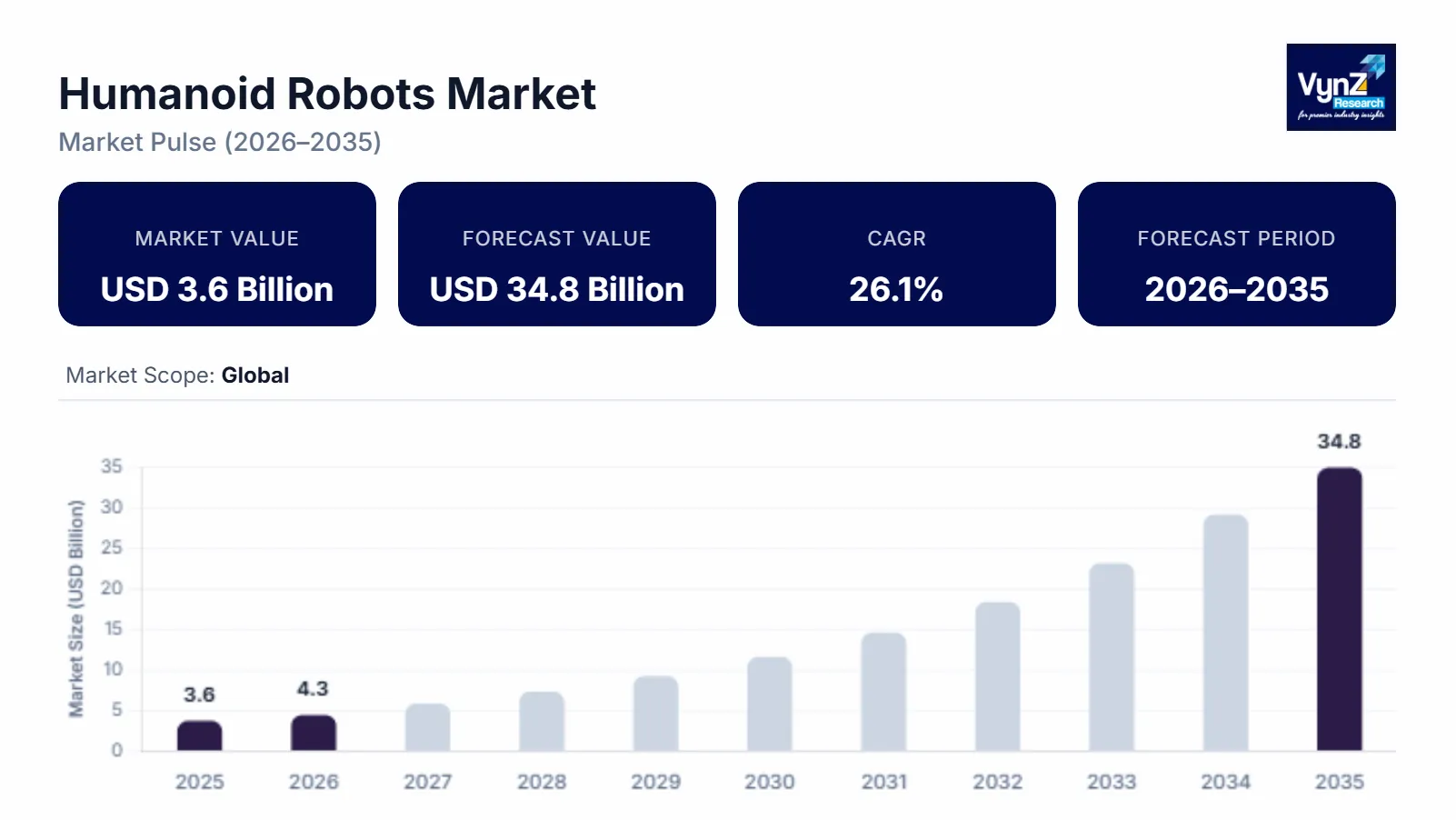
The humanoid robots market size was estimated at about USD 3.6 billion in 2025 and is expected to reach around USD 4.3 billion in 2026, rising to roughly USD 34.8 billion by 2035, growing at approximately 26.1% CAGR from 2026 to 2035.
Research Highlights
- Hardware accounted for 61% market sharedue toextensive demand for advanced robotic components.
- Biped humanoid robots captured 57% market share supported by growing deployment across industrial and healthcare applications.
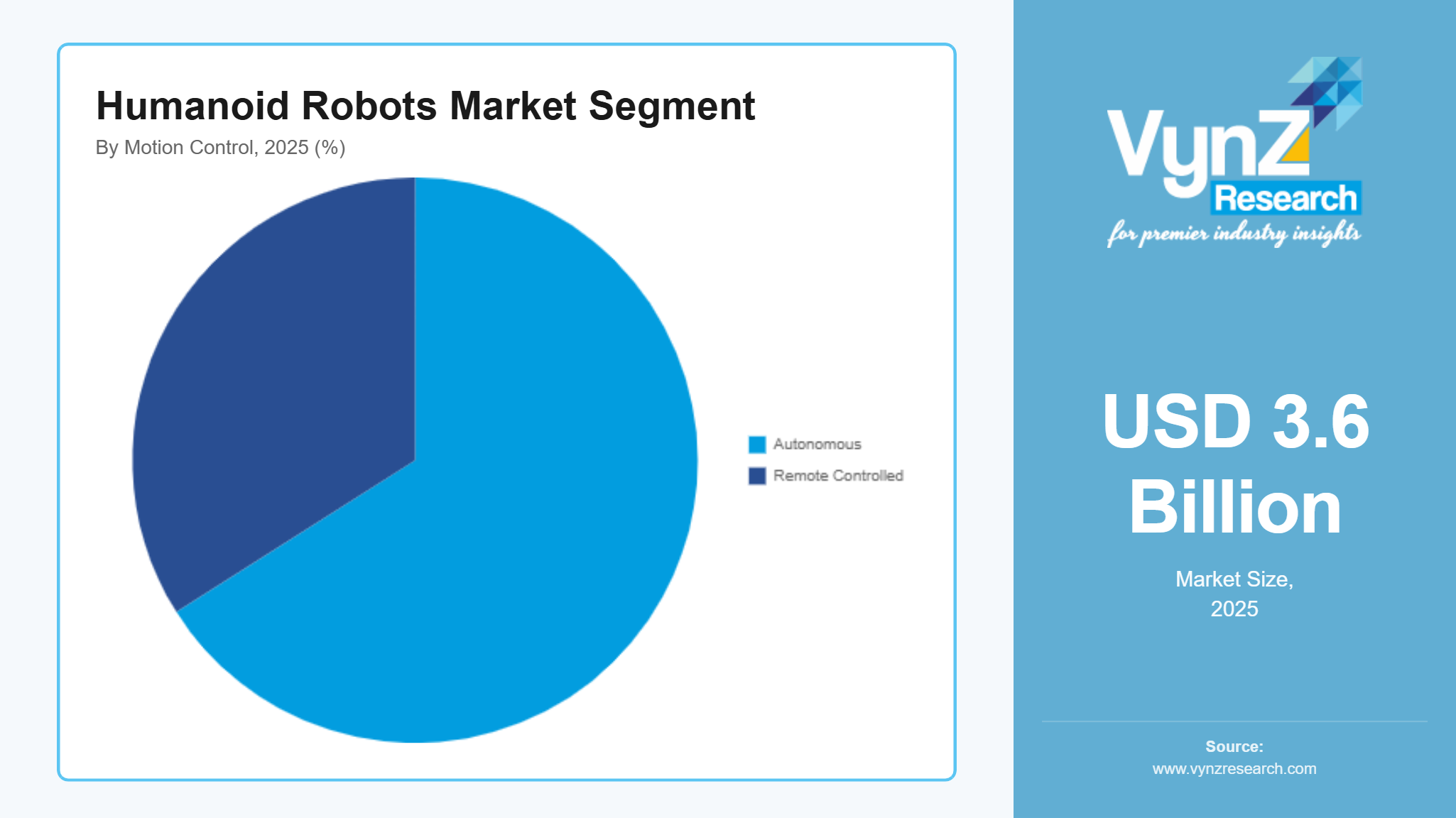
- Autonomous humanoid robots held 66% market share due to rapid advances in artificial intelligence technologies.
- Healthcare is projected to expand at 28.2% CAGR through 2035 due to increasing elderly care and hospital automation.
- North America accounted for 31% market share in 2025 supported by strong robotics research and automation investments.
Market growth is supported by rapid advancements in artificial intelligence, increasing automation across industrial and service sectors and growing investments in robotics research and development along with growing adoption of autonomous humanoid robots for healthcare, logistics, manufacturing and customer service applications. Increasing demand for intelligent human machine collaboration and ongoing investments in robotics innovation programs are further supporting market expansion across major regions including North America, Asia Pacific, and Europe. According to the International Federation of Robotics (IFR), global robot installations continue to increase as industries accelerate automation and digital transformation. In addition, the National Institute of Standards and Technology (NIST) continues to support robotics research, interoperability, and intelligent automation technologies, contributing to the advancement and commercialization of humanoid robotic systems.
Humanoid Robots Market Dynamics
Market Trends
The market is witnessing notable shifts in artificial intelligence integration, autonomous mobility and human machine collaboration across industrial and service environments. One of the key trends shaping the market is the development of AI enabled humanoid robots capable of performing complex and repetitive tasks, reflecting growing preference for operational efficiency, workforce optimization and adaptive automation. According to the International Federation of Robotics (IFR), global adoption of intelligent robots continues to accelerate as industries pursue higher productivity and flexible manufacturing. Another emerging trend is the integration of generative AI, advanced sensors and edge computing into humanoid robotic platforms due to rapid technological innovation and digital transformation.
Growth Drivers
The growth of the market is largely supported by increasing industrial automation which continues to generate consistent demand across manufacturing, logistics, healthcare and public service sectors. Increasing investments in smart factories, robotics infrastructure and digital manufacturing initiatives are further accelerating market expansion. Additionally, rapid advancements in artificial intelligence, machine vision and robotic control systems are playing a crucial role in boosting adoption. As enterprises prioritize operational efficiency, workplace safety and precision, demand for intelligent humanoid robotic platforms is expected to remain strong throughout the forecast period.
Market Restraints / Challenges
Despite favorable growth prospects, the market faces certain challenges that may limit its expansion. High development costs, expensive hardware components and complex system integration continue to affect profitability and commercial adoption particularly among small and medium sized enterprises. According to the National Institute of Standards and Technology (NIST), developing reliable and interoperable robotic systems remains a significant technical challenge requiring continued research and standardization. Furthermore, regulatory uncertainty and dependence on advanced semiconductor components pose operational challenges for manufacturers. Limited availability of specialized engineering talent and sophisticated electronic components can increase production costs and delay commercialization during periods of supply chain disruption.
Market Opportunities
The market presents significant opportunities in healthcare, elderly care and service robotics particularly driven by aging populations, labor shortages and rapid advancements in artificial intelligence. Companies offering highly autonomous, intelligent and application specific humanoid robots are well positioned to capture growing demand from hospitals, rehabilitation centers, manufacturing facilities and logistics providers. Another key opportunity lies in smart manufacturing and warehouse automation where increasing investments in intelligent robotic systems are creating avenues for long term productivity improvements and operational efficiency. Advancements in artificial intelligence, edge computing and collaborative robotics are also expected to improve robot performance and accelerate enterprise adoption.
Global Humanoid Robots Market Report Coverage
|
Report Metric |
Details |
|
Historical Period |
2020 - 2024 |
|
Base Year Considered |
2025 |
|
Forecast Period |
2026 - 2035 |
|
Market Size in 2025 |
USD 3.6 Billion |
|
Revenue Forecast in 2035 |
USD 34.8 Billion |
|
Growth Rate |
26.1% |
|
Segments Covered in the Report |
Component, Motion Type, Motion Control, End User |
|
Report Scope |
Market Trends, Drivers, and Restraints; Revenue Estimation and Forecast; Segmentation Analysis; Companies’ Strategic Developments; Market Share Analysis of Key Players; Company Profiling |
|
Regions Covered in the Report |
North America, Asia Pacific, Europe, Rest of the World |
|
Key Companies |
Agility Robotics, Apptronik, Boston Dynamics, Engineered Arts Ltd., Figure AI, Fourier Intelligence, Honda Motor Co., Ltd., Sanctuary AI, Tesla, Inc., UBTECH Robotics |
|
Customization |
Available upon request |
Humanoid Robots Market Segmentation
By Component
Hardware accounted for the largest market share of approximately 61% in 2025 and is projected to grow at an estimated 25.4% CAGR through 2035 supported by high demand for sensors, actuators, controllers, power systems and robotic joints that form the core architecture of humanoid robots. Increasing investments in advanced robotics manufacturing and intelligent automation continue to strengthen hardware demand.
Software is expected to register the fastest growth at around 28.6% CAGR during the forecast period due to rapid advances in artificial intelligence, machine learning, computer vision and autonomous navigation that are accelerating software adoption across service and industrial robotics. Growing emphasis on intelligent decision making and real time robotic control is further supporting segment expansion.
By Motion Type
Biped humanoid robots held the largest market share of approximately 57% in 2025 and are expected to expand at nearly 25.8% CAGR through 2035 due to increasing deployment in research laboratories, healthcare, hospitality and industrial environments where human like movement provides operational advantages.
Wheel drive humanoid robots are projected to witness the fastest growth at an estimated 27.1% CAGR during the forecast period because lower operational complexity, improved mobility efficiency and reduced deployment costs are encouraging adoption across logistics, warehousing and customer service applications.
By End User
Industrial applications accounted for the highest revenue share of approximately 41% in 2025 and are expected to expand at nearly 25.7% CAGR through 2035 since growing investments in smart manufacturing, factory automation and labor augmentation continue to strengthen demand for humanoid robots across production facilities worldwide.
Healthcare is expected to record the fastest growth at around 28.2% CAGR during the forecast period because growing demand for patient assistance, elderly care, rehabilitation support and hospital automation is driving broader adoption of humanoid robots across healthcare environments.
Regional Insights
North America
North America accounted for approximately 31% of the market in 2025 and is projected to expand at an estimated 25.8% CAGR through 2035 due to strong investments in artificial intelligence, robotics innovation and industrial automation across the United States and Canada. Demand from advanced manufacturing facilities, research institutions and technology companies continues to strengthen regional growth. Government initiatives supporting artificial intelligence development combined with increasing enterprise adoption of automation technologies are encouraging investments in humanoid robotics.
Asia Pacific
Asia Pacific represented approximately 28% of the global market in 2025 and is expected to register nearly 27.3% CAGR during the forecast period due to expanding industrial automation, favorable government policies and increasing robotics adoption across manufacturing, healthcare and logistics sectors in China, Japan, South Korea, and India. According to the International Federation of Robotics (IFR), Asia remains the world's largest market for industrial robot installations, supporting continued demand for advanced humanoid robotic technologies.
Europe
Europe accounted for approximately 19% of the market in 2025 and is anticipated to grow at around 25.2% CAGR through 2035 supported by smart manufacturing initiatives, research collaborations and increasing investments in Industry 4.0 technologies across Germany, France, Italy and the United Kingdom. The European Commission continues to promote robotics, artificial intelligence and digital innovation through research and industrial modernization programs creating long term opportunities for market participants.
Rest of the World
The Rest of the World, including Latin America, the Middle East, and Africa, accounted for approximately 22% of the market in 2025 and is projected to grow at nearly 26.8% CAGR through 2035 because expanding industrial infrastructure, increasing automation investments and growing awareness of intelligent robotics are supporting market development across emerging economies. According to the International Federation of Robotics (IFR), broader adoption of automation technologies continues to expand beyond mature markets as industries pursue higher productivity and operational efficiency.
Competitive Landscape / Company Insights
The market is highly competitive with global and regional companies focusing on artificial intelligence integration, robotic mobility, product innovation and geographic expansion to strengthen their market position. Manufacturers continue to invest in research and development, advanced software capabilities and strategic collaborations to accelerate commercialization of humanoid robots across multiple industries. The International Federation of Robotics (IFR) and the National Institute of Standards and Technology (NIST) continue to support advancements in robotics technologies, interoperability, and intelligent automation, encouraging sustained innovation across the market.
Mini Profiles
Agility Robotics focuses on autonomous humanoid robots for logistics and industrial automation, supported by advanced mobility technologies, strategic industry partnerships, and expanding commercial deployment capabilities.
Boston Dynamics operates in premium robotics segments, emphasizing advanced mobility, artificial intelligence, and high-performance robotic platforms for industrial, research, and commercial applications.
Engineered Arts Ltd. leverages innovative humanoid robot design, advanced human interaction technologies, and global customer collaborations to expand its presence across entertainment, education, and research markets.
Figure AI focuses on general purpose humanoid robots, supported by artificial intelligence integration, strategic technology partnerships, and continuous innovation for manufacturing and logistics automation.
Honda Motor Co Ltd. specializes in advanced humanoid robotics research, supported by strong engineering expertise, global brand recognition, and long-term investment in intelligent mobility technologies.
Key Players
- Agility Robotics
- Apptronik
- Boston Dynamics
- Engineered Arts Ltd.
- Figure AI
- Fourier Intelligence
- Honda Motor Co., Ltd.
- Sanctuary AI
- Tesla, Inc.
- UBTECH Robotics
Recent Developments
In January 2025, Apptronik secured USD 350 million in Series A funding to accelerate production of its Apollo humanoid robot. The investment supports commercial deployments across manufacturing, warehousing, healthcare, and logistics applications.
In June 2025, Fourier Intelligence expanded its collaboration with the NVIDIA robotics ecosystem to enhance embodied AI capabilities for next generation humanoid robots. The initiative strengthens AI driven motion control and intelligent human robot interaction.
In July 2025, Sanctuary AI advanced commercial deployment of its Phoenix humanoid robot through expanded pilot programs for industrial and service applications. The company continued enhancing dexterous manipulation capabilities for real world automation tasks.
In July 2026, Tesla Inc. continued expanding Optimus humanoid robot deployments across its manufacturing facilities to automate repetitive production tasks. The company also accelerated development of large scale production capabilities for future commercial adoption.
In July 2026, UBTECH Robotics unveiled a new AI powered humanoid robot designed for home environments with natural conversation and expressive interaction capabilities. The launch marked the company's strategic expansion beyond industrial automation into consumer robotics.
Global Humanoid Robots Market Coverage
Component Insight and Forecast 2026 - 2035
- Hardware
- Software
- Services
Motion Type Insight and Forecast 2026 - 2035
- Biped
- Wheel Drive
Motion Control Insight and Forecast 2026 - 2035
- Autonomous
- Remote Controlled
End User Insight and Forecast 2026 - 2035
- Industrial
- Healthcare
- Education and Research
- Retail
- Hospitality
- Defense and Security
- Others
Global Humanoid Robots Market by Region
- North America
- By Component
- By Motion Type
- By Motion Control
- By End User
- By Country - U.S., Canada, Mexico
- Europe
- By Component
- By Motion Type
- By Motion Control
- By End User
- By Country - Germany, U.K., France, Italy, Spain, Russia, Rest of Europe
- Asia-Pacific (APAC)
- By Component
- By Motion Type
- By Motion Control
- By End User
- By Country - China, Japan, India, South Korea, Vietnam, Thailand, Malaysia, Rest of Asia-Pacific
- Rest of the World (RoW)
- By Component
- By Motion Type
- By Motion Control
- By End User
- By Country - Brazil, Saudi Arabia, South Africa, U.A.E., Other Countries
Table of Contents for Humanoid Robots Market Report
1. Research Overview
1.1. The Report Offers
1.2. Market Coverage
1.2.1. By
Component
1.2.2. By
Motion Type
1.2.3. By
Motion Control
1.2.4. By
End User
1.3. Research Phases
1.4. Limitations
1.5. Market Methodology
1.5.1. Data Sources
1.5.1.1.
Primary Research
1.5.1.2.
Secondary Research
1.5.2. Methodology
1.5.2.1.
Data Exploration
1.5.2.2.
Forecast Parameters
1.5.2.3.
Data Validation
1.5.2.4.
Assumptions
1.5.3. Study Period & Data Reporting Unit
2. Executive Summary
3. Industry Overview
3.1. Industry Dynamics
3.1.1. Market Growth Drivers
3.1.2. Market Restraints
3.1.3. Key Market Trends
3.1.4. Major Opportunities
3.2. Industry Ecosystem
3.2.1. Porter’s Five Forces Analysis
3.2.2. Recent Development Analysis
3.2.3. Value Chain Analysis
3.3. Competitive Insight
3.3.1. Competitive Position of Industry
Players
3.3.2. Market Attractive Analysis
3.3.3. Market Share Analysis
4. Global Market Estimate and Forecast
4.1. Global Market Overview
4.2. Global Market Estimate and Forecast to 2035
5. Market Segmentation Estimate and Forecast
5.1. By Component
5.1.1. Hardware
5.1.1.1. Market Definition
5.1.1.2. Market Estimation and Forecast to 2035
5.1.2. Software
5.1.2.1. Market Definition
5.1.2.2. Market Estimation and Forecast to 2035
5.1.3. Services
5.1.3.1. Market Definition
5.1.3.2. Market Estimation and Forecast to 2035
5.2. By Motion Type
5.2.1. Biped
5.2.1.1. Market Definition
5.2.1.2. Market Estimation and Forecast to 2035
5.2.2. Wheel Drive
5.2.2.1. Market Definition
5.2.2.2. Market Estimation and Forecast to 2035
5.3. By Motion Control
5.3.1. Autonomous
5.3.1.1. Market Definition
5.3.1.2. Market Estimation and Forecast to 2035
5.3.2. Remote Controlled
5.3.2.1. Market Definition
5.3.2.2. Market Estimation and Forecast to 2035
5.4. By End User
5.4.1. Industrial
5.4.1.1. Market Definition
5.4.1.2. Market Estimation and Forecast to 2035
5.4.2. Healthcare
5.4.2.1. Market Definition
5.4.2.2. Market Estimation and Forecast to 2035
5.4.3. Education and Research
5.4.3.1. Market Definition
5.4.3.2. Market Estimation and Forecast to 2035
5.4.4. Retail
5.4.4.1. Market Definition
5.4.4.2. Market Estimation and Forecast to 2035
5.4.5. Hospitality
5.4.5.1. Market Definition
5.4.5.2. Market Estimation and Forecast to 2035
5.4.6. Defense and Security
5.4.6.1. Market Definition
5.4.6.2. Market Estimation and Forecast to 2035
5.4.7. Others
5.4.7.1. Market Definition
5.4.7.2. Market Estimation and Forecast to 2035
6. North America Market Estimate and Forecast
6.1. By
Component
6.2. By
Motion Type
6.3. By
Motion Control
6.4. By
End User
6.4.1.
U.S. Market Estimate and Forecast
6.4.2.
Canada Market Estimate and Forecast
6.4.3.
Mexico Market Estimate and Forecast
7. Europe Market Estimate and Forecast
7.1. By
Component
7.2. By
Motion Type
7.3. By
Motion Control
7.4. By
End User
7.4.1.
Germany Market Estimate and Forecast
7.4.2.
France Market Estimate and Forecast
7.4.3.
U.K. Market Estimate and Forecast
7.4.4.
Italy Market Estimate and Forecast
7.4.5.
Spain Market Estimate and Forecast
7.4.6.
Russia Market Estimate and Forecast
7.4.7.
Rest of Europe Market Estimate and Forecast
8. Asia-Pacific (APAC) Market Estimate and Forecast
8.1. By
Component
8.2. By
Motion Type
8.3. By
Motion Control
8.4. By
End User
8.4.1.
China Market Estimate and Forecast
8.4.2.
Japan Market Estimate and Forecast
8.4.3.
India Market Estimate and Forecast
8.4.4.
South Korea Market Estimate and Forecast
8.4.5.
Rest of Asia-Pacific Market Estimate and Forecast
9. Rest of the World (RoW) Market Estimate and Forecast
9.1. By
Component
9.2. By
Motion Type
9.3. By
Motion Control
9.4. By
End User
9.4.1.
Brazil Market Estimate and Forecast
9.4.2.
Saudi Arabia Market Estimate and Forecast
9.4.3.
South Africa Market Estimate and Forecast
9.4.4.
U.A.E. Market Estimate and Forecast
9.4.5.
Other Countries Market Estimate and Forecast
10. Company Profiles
10.1.
Agility Robotics
10.1.1.
Snapshot
10.1.2.
Overview
10.1.3.
Offerings
10.1.4.
Financial
Insight
10.1.5.
Recent
Developments
10.2.
Apptronik
10.2.1.
Snapshot
10.2.2.
Overview
10.2.3.
Offerings
10.2.4.
Financial
Insight
10.2.5.
Recent
Developments
10.3.
Boston Dynamics
10.3.1.
Snapshot
10.3.2.
Overview
10.3.3.
Offerings
10.3.4.
Financial
Insight
10.3.5.
Recent
Developments
10.4.
Engineered Arts Ltd.
10.4.1.
Snapshot
10.4.2.
Overview
10.4.3.
Offerings
10.4.4.
Financial
Insight
10.4.5.
Recent
Developments
10.5.
Figure AI
10.5.1.
Snapshot
10.5.2.
Overview
10.5.3.
Offerings
10.5.4.
Financial
Insight
10.5.5.
Recent
Developments
10.6.
Fourier Intelligence
10.6.1.
Snapshot
10.6.2.
Overview
10.6.3.
Offerings
10.6.4.
Financial
Insight
10.6.5.
Recent
Developments
10.7.
Honda Motor Co., Ltd.
10.7.1.
Snapshot
10.7.2.
Overview
10.7.3.
Offerings
10.7.4.
Financial
Insight
10.7.5.
Recent
Developments
10.8.
Sanctuary AI
10.8.1.
Snapshot
10.8.2.
Overview
10.8.3.
Offerings
10.8.4.
Financial
Insight
10.8.5.
Recent
Developments
10.9.
Tesla, Inc.
10.9.1.
Snapshot
10.9.2.
Overview
10.9.3.
Offerings
10.9.4.
Financial
Insight
10.9.5.
Recent
Developments
10.10.
UBTECH Robotics
10.10.1.
Snapshot
10.10.2.
Overview
10.10.3.
Offerings
10.10.4.
Financial
Insight
10.10.5.
Recent
Developments
11. Appendix
11.1. Exchange Rates
11.2. Abbreviations
Note: Financial insight and recent developments of different companies are subject to the availability of information in the secondary domain.
Frequently Asked Questions
Purchase Options
Latest Report
Research Methodology
- Desk Research / Pilot Interviews
- Build Market Size Model
- Research and Analysis
- Final Deliverable
Connect With Our Sales Team
- Toll-Free: +1-888-253-3960
- Phone: +91 9960 288 381
- Email: enquiry@vynzresearch.com
Humanoid Robots Market