
Optoelectronics Market Size & Share | Growth Forecast Report (2026-2035)
Industry Insight by Device Type (LED, Laser Diode, Image Sensors, Optocouplers, Photovoltaic Cells, Others), by Device Material (Gallium Nitride, Gallium Arsenide, Silicon Carbide, Indium Phosphide, Silicon and Others), by Application (Lighting and Display, Optical Communication and Li Fi, Sensing and Imaging, Power Conversion and Photovoltaics, Defense and Security), by End User Industry (Consumer Electronics, Automotive, Information Technology and Telecom, Healthcare and Life Sciences, Aerospace and Defense, Residential and Commercial, Industrial, Others)
| Status : Published | Published On : Oct, 2026 | Report Code : VRSME9225 | Industry : Semiconductor & Electronics | Available Format :

|
Page : 146 |
Optoelectronics Market Overview
The optoelectronics market size was estimated at about USD 45.52 billion in 2025 and is expected to reach around USD 48.32 billion in 2026, rising up to roughly USD 82.68 billion in 2035, growing at approximately 6.15% CAGR from 2026 to 2035.
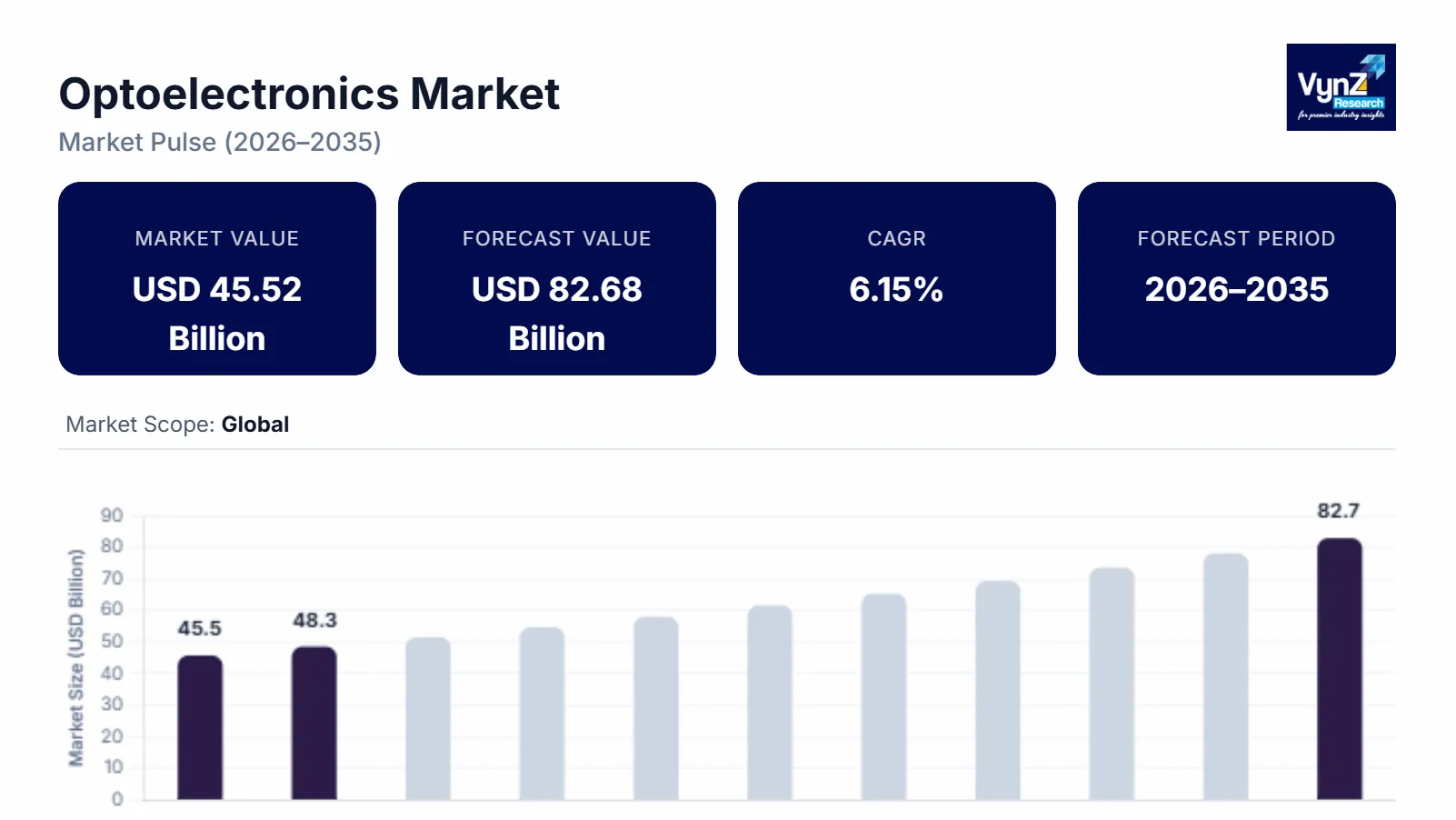
Market growth is being driven by rising demand for high-speed optical communication, advanced sensing, energy-efficient lighting and semiconductor integration, along with increasing adoption of photonic technologies in artificial intelligence infrastructure. Increasing demand from consumer electronics, automotive systems, industrial automation and telecommunications is helping to boost investment across major manufacturing centers. The Ministry of Electronics and Information Technology has been expanding its semiconductor support through the Semicon India Programme, including fiscal support for compound semiconductors, silicon photonics, sensors and advanced packaging, while the European Commission continues to support photonic integrated circuit development through semiconductor initiatives.
Research Methodology
VynZ Research evaluated the optoelectronics landscape by conducting secondary research on device technologies, semiconductor materials, applications, end user industries, regional manufacturing activity, technology investments and company developments. The VynZ Research team compared established market estimates, segment shares and growth indicators and then recalculated the market trajectory for the 2025 base year and 2035 forecast horizon. Government and institutional evidence from the Ministry of Electronics and Information Technology, U.S. Department of Energy, NIST and European Commission was incorporated to verify semiconductor manufacturing, photonic integration, energy efficiency and policy-related demand factors.
Research Highlights
LEDs represented an estimated 34% share in 2025, supported by broad adoption across lighting, displays, automotive systems and electronic equipment. Gallium nitride accounted for an estimated 41% share in 2025, driven by efficient high-frequencyoperation
.Consumer electronics represented an estimated 46% share in 2025, due tosmartphones, wearable devices, imaging systems and increasing semiconductor content per product Laser diodes are estimated to register approximately 6.9 % CAGR through the forecast period, for 3D sensing, optical interconnects and automotive LiDAR applications.
Asia Pacific accounted for an estimated 52% share in 2025, owing toconcentrated electronics manufacturing, semiconductor capacity, display production and government-backed technology investment.
Optoelectronics Market Dynamics
Market Trends
Within the optoelectronics industry there is a growing trend toward higher bandwidth, lower power consumption and increased optical integration into semiconductor architectures. Silicon photonics and co-packaged optics are two key trends within the optoelectronics industry that are being driven by the need for greater bandwidth and reduced power consumption within artificial intelligence (AI) and data centre infrastructure. Another trend is the use of compact optical sensing and imaging technologies across vehicles, industrial systems and healthcare equipment.
Growth Drivers
The growth of the optoelectronics market is primarily driven by the rapid growth of optical communication and AI infrastructure, which in turn drives demand for laser diodes, photodetectors, optical transceivers and photonic integrated technologies. Increasing investments in data centres and high-performance computing are accelerating the transition toward optical connectivity, while NIST research highlights energy consumption and bandwidth as important drivers for photonic integration in advanced computing systems. Additionally, demand for energy efficient lighting and advanced semiconductor devices is supporting adoption across commercial, industrial and infrastructure applications.
Market Restraints / Challenges
Despite favorable growth prospects, the optoelectronics market faces challenges associated with complex semiconductor manufacturing, high capital requirements and dependence on specialized materials. Compound semiconductor fabrication and photonic integration require advanced equipment, controlled manufacturing environments and specialized engineering capabilities, which can increase production costs and lengthen qualification cycles. Furthermore, supply chain dependency for materials such as indium phosphide and other compound semiconductor inputs can create operational risks for optical component manufacturers.
Market Opportunities
The market presents significant opportunities in silicon photonics, co-packaged optics, high-speed optical interconnects, and advanced sensing, particularly as artificial intelligence infrastructure requires higher bandwidth and improved power efficiency. Companies developing compact laser sources, photonic integrated circuits and high-density optical modules are positioned to benefit from increasing deployment of AI data centres and advanced computing systems. Another key opportunity lies in automotive sensing, industrial machine vision, medical imaging and energy-efficient lighting, where optical technologies are becoming more integrated with electronic control systems.
Global Optoelectronics Market Report Coverage
|
Report Metric |
Details |
|
Historical Period |
2020 - 2024 |
|
Base Year Considered |
2025 |
|
Forecast Period |
2026 - 2035 |
|
Market Size in 2025 |
USD 45.52 Billion |
|
Revenue Forecast in 2035 |
USD 82.68 Billion |
|
Growth Rate |
6.15% |
|
Segments Covered in the Report |
Device Type, Device Material, Application, End User Industry |
|
Report Scope |
Market Trends, Drivers, and Restraints; Revenue Estimation and Forecast; Segmentation Analysis; Companies’ Strategic Developments; Market Share Analysis of Key Players; Company Profiling |
|
Regions Covered in the Report |
North America, Europe, Asia Pacific, Rest of the World |
|
Key Companies |
ams OSRAM, Broadcom, Coherent, Hamamatsu Photonics, Intel, Lumentum, Nichia, Samsung Electronics, Sony, Vishay Intertechnology |
|
Customization |
Available upon request |
Optoelectronics Market Segmentation
By Device Type
LEDs accounted for the largest market share of approximately 34% in 2025, supported by broad application across lighting, displays, automotive systems and electronic equipment, while established manufacturing capacity and replacement demand continue to sustain high volume consumption.
Laser diodes are estimated to expand at approximately 6.9% CAGR from 2026 to 2035, driven by increasing deployment in optical communication, three-dimensional sensing, LiDAR and high-performance computing.
By Device Material
Gallium nitride accounted for the largest market share of approximately 41% in 2025, due to its suitability for efficient light emission, high-frequency operation and demanding semiconductor applications.
Silicon carbide is estimated to record approximately 7.5% CAGR from 2026 to 2035, making it one of the fastest-growing material categories, due to high thermal stability, efficient power handling and increasing deployment in advanced semiconductor systems.
By Application
Lighting and display accounted for the largest market share of approximately 37% in 2025, due to widespread LED deployment, commercial lighting replacement, display technologies and automotive illumination.
Optical communication and Li Fi are estimated to register approximately 5.7% CAGR from 2026 to 2035, driven by increasing bandwidth requirements, cloud computing, artificial intelligence infrastructure and expansion of high-speed data networks.
By End User Industry
Consumer electronics accounted for the largest market share of approximately 46% in 2025, supported by extensive integration of LEDs, image sensors, optical detectors and display technologies across smartphones, wearable devices, cameras and connected equipment.
Automotive is estimated to register approximately 6.2% CAGR from 2026 to 2035, because of increasing adoption of advanced driver assistance systems, vehicle cameras, LiDAR, cabin monitoring and intelligent lighting.
Regional Insights
North America
North America accounted for approximately 20% of the optoelectronics market in 2025, supported by advanced semiconductor infrastructure, AI data centre investment, optical networking and high-value photonic research. The United States remains a major centre for optical component development and advanced computing, while NIST research is focused on integrating photonics and electronics for high-bandwidth communication and computing. Lumentum’s planned 6-inch indium phosphide manufacturing facility in North Carolina further demonstrates the strategic movement toward domestic optical component production and supply chain resilience.
Europe
Europe represented approximately 15% of the market in 2025, supported by automotive manufacturing, industrial automation, healthcare technology and semiconductor research. The European Commission has identified photonics, semiconductor photonics and photonic integration as important technology areas within its digital and semiconductor initiatives, while European research programs are supporting optical interconnects, sensing and photonic integrated circuits. Automotive applications remain particularly relevant because advanced imaging and sensing technologies are increasingly integrated into safety and driver assistance systems.
Asia Pacific
Asia Pacific accounted for approximately 52% of the market in 2025, supported by its large electronics manufacturing base, semiconductor supply chain depth, display production and concentration of consumer electronics manufacturers. Government-supported semiconductor investments are reinforcing the region’s manufacturing advantage. India has approved semiconductor projects covering silicon carbide, advanced packaging and related semiconductor technologies, while China, Japan, South Korea and Taiwan continue to maintain substantial electronics and semiconductor capabilities.
Rest of the World
Rest of the World accounted for the remaining approximately 13% of the market in 2025, covering Latin America, the Middle East and Africa and other smaller markets not separately represented above. Growth is supported by telecommunications modernization, energy-efficient lighting, industrial digitization, security imaging and infrastructure development, while selected Middle Eastern markets are investing in smart city and advanced technology projects.
Competitive Landscape / Company Insights
The optoelectronics market is moderately to highly competitive, with global players competing through optical component innovation, semiconductor integration, manufacturing scale and strategic partnerships. Companies are increasing investment in high-speed optical connectivity, image sensing, LEDs, laser diodes and photonic integration to address AI infrastructure, automotive and industrial demand. Broadcom, Lumentum and Coherent are strengthening optical connectivity capabilities, while Sony, Samsung, Nichia, Hamamatsu Photonics and Vishay continue to expand specialized sensing, imaging and semiconductor portfolios.
Mini Profiles
ams OSRAM focuses on optical semiconductor technologies, LEDs and sensing solutions, with strong exposure to automotive lighting, consumer electronics and specialized optical applications.
Broadcom develops high speed optical connectivity technologies, including optical interconnects, lasers, DSPs and co packaged optics for AI and data center infrastructure.
Coherent provides lasers, optical components and photonic systems, with increasing emphasis on high density optical interconnects, VCSEL arrays and AI data center applications.
Hamamatsu Photonics specializes in photodetectors, imaging devices, light sources and optical components serving healthcare, scientific, industrial and measurement applications.
Intel develops silicon photonics and optical connectivity technologies designed to support high bandwidth data movement across data center and computing architectures.
Key Players
- ams OSRAM
- Broadcom
- Coherent
- Hamamatsu Photonics
- Intel
- Lumentum
- Nichia
- Samsung Electronics
- Sony
- Vishay Intertechnology
Recent Developments
Lumentum announced plans for a new U.S. manufacturing facility in North Carolina to produce advanced indium phosphide optical devices for AI data centers, strengthening domestic photonic manufacturing capacity. The facility is expected to support high power laser production and expand supply chain resilience for large scale AI infrastructure.
Nichia expanded its LED technology portfolio with high efficiency UV LED and advanced display lighting products, while continuing development focused on energy efficiency and environmental performance. Its sustainabLED initiative also introduced LED components incorporating recycled materials to support resource circulation.
Samsung Electronics expanded its image sensor portfolio with advanced mobile sensing technologies designed to improve light sensitivity, autofocus and image quality in compact smartphone camera systems. The developments reinforce the company's focus on high resolution optical sensing and smaller pixel architectures.
Sony introduced new automotive and industrial CMOS image sensor technologies targeting cabin monitoring, high dynamic range imaging and high speed inspection applications. The developments reflect increasing demand for advanced optical sensing in vehicle safety and industrial automation.
Vishay Intertechnology expanded its optoelectronics portfolio with a silicon PIN photodiode designed for compact biomedical applications, including wearable heart rate and blood oxygen monitoring. The device combines a small form factor with enhanced sensitivity for visible and infrared light detection.
Global Optoelectronics Market Coverage
Device Type Insight and Forecast 2026 - 2035
- LED
- Laser Diode
- Image Sensors
- Optocouplers
- Photovoltaic Cells
- Others
Device Material Insight and Forecast 2026 - 2035
- Gallium Nitride
- Gallium Arsenide
- Silicon Carbide
- Indium Phosphide
- Silicon and Others
Application Insight and Forecast 2026 - 2035
- Lighting and Display
- Optical Communication and Li Fi
- Sensing and Imaging
- Power Conversion and Photovoltaics
- Defense and Security
End User Industry Insight and Forecast 2026 - 2035
- Consumer Electronics
- Automotive
- Information Technology and Telecom
- Healthcare and Life Sciences
- Aerospace and Defense
- Residential and Commercial
- Industrial
- Others
Global Optoelectronics Market by Region
- North America
- By Device Type
- By Device Material
- By Application
- By End User Industry
- By Country - U.S., Canada, Mexico
- Europe
- By Device Type
- By Device Material
- By Application
- By End User Industry
- By Country - Germany, U.K., France, Italy, Spain, Russia, Rest of Europe
- Asia-Pacific (APAC)
- By Device Type
- By Device Material
- By Application
- By End User Industry
- By Country - China, Japan, India, South Korea, Vietnam, Thailand, Malaysia, Rest of Asia-Pacific
- Rest of the World (RoW)
- By Device Type
- By Device Material
- By Application
- By End User Industry
- By Country - Brazil, Saudi Arabia, South Africa, U.A.E., Other Countries
Table of Contents for Optoelectronics Market Report
1. Research Overview
1.1. The Report Offers
1.2. Market Coverage
1.2.1. By
Device Type
1.2.2. By
Device Material
1.2.3. By
Application
1.2.4. By
End User Industry
1.3. Research Phases
1.4. Limitations
1.5. Market Methodology
1.5.1. Data Sources
1.5.1.1.
Primary Research
1.5.1.2.
Secondary Research
1.5.2. Methodology
1.5.2.1.
Data Exploration
1.5.2.2.
Forecast Parameters
1.5.2.3.
Data Validation
1.5.2.4.
Assumptions
1.5.3. Study Period & Data Reporting Unit
2. Executive Summary
3. Industry Overview
3.1. Industry Dynamics
3.1.1. Market Growth Drivers
3.1.2. Market Restraints
3.1.3. Key Market Trends
3.1.4. Major Opportunities
3.2. Industry Ecosystem
3.2.1. Porter’s Five Forces Analysis
3.2.2. Recent Development Analysis
3.2.3. Value Chain Analysis
3.3. Competitive Insight
3.3.1. Competitive Position of Industry
Players
3.3.2. Market Attractive Analysis
3.3.3. Market Share Analysis
4. Global Market Estimate and Forecast
4.1. Global Market Overview
4.2. Global Market Estimate and Forecast to 2035
5. Market Segmentation Estimate and Forecast
5.1. By Device Type
5.1.1. LED
5.1.1.1. Market Definition
5.1.1.2. Market Estimation and Forecast to 2035
5.1.2. Laser Diode
5.1.2.1. Market Definition
5.1.2.2. Market Estimation and Forecast to 2035
5.1.3. Image Sensors
5.1.3.1. Market Definition
5.1.3.2. Market Estimation and Forecast to 2035
5.1.4. Optocouplers
5.1.4.1. Market Definition
5.1.4.2. Market Estimation and Forecast to 2035
5.1.5. Photovoltaic Cells
5.1.5.1. Market Definition
5.1.5.2. Market Estimation and Forecast to 2035
5.1.6. Others
5.1.6.1. Market Definition
5.1.6.2. Market Estimation and Forecast to 2035
5.2. By Device Material
5.2.1. Gallium Nitride
5.2.1.1. Market Definition
5.2.1.2. Market Estimation and Forecast to 2035
5.2.2. Gallium Arsenide
5.2.2.1. Market Definition
5.2.2.2. Market Estimation and Forecast to 2035
5.2.3. Silicon Carbide
5.2.3.1. Market Definition
5.2.3.2. Market Estimation and Forecast to 2035
5.2.4. Indium Phosphide
5.2.4.1. Market Definition
5.2.4.2. Market Estimation and Forecast to 2035
5.2.5. Silicon and Others
5.2.5.1. Market Definition
5.2.5.2. Market Estimation and Forecast to 2035
5.3. By Application
5.3.1. Lighting and Display
5.3.1.1. Market Definition
5.3.1.2. Market Estimation and Forecast to 2035
5.3.2. Optical Communication and Li Fi
5.3.2.1. Market Definition
5.3.2.2. Market Estimation and Forecast to 2035
5.3.3. Sensing and Imaging
5.3.3.1. Market Definition
5.3.3.2. Market Estimation and Forecast to 2035
5.3.4. Power Conversion and Photovoltaics
5.3.4.1. Market Definition
5.3.4.2. Market Estimation and Forecast to 2035
5.3.5. Defense and Security
5.3.5.1. Market Definition
5.3.5.2. Market Estimation and Forecast to 2035
5.4. By End User Industry
5.4.1. Consumer Electronics
5.4.1.1. Market Definition
5.4.1.2. Market Estimation and Forecast to 2035
5.4.2. Automotive
5.4.2.1. Market Definition
5.4.2.2. Market Estimation and Forecast to 2035
5.4.3. Information Technology and Telecom
5.4.3.1. Market Definition
5.4.3.2. Market Estimation and Forecast to 2035
5.4.4. Healthcare and Life Sciences
5.4.4.1. Market Definition
5.4.4.2. Market Estimation and Forecast to 2035
5.4.5. Aerospace and Defense
5.4.5.1. Market Definition
5.4.5.2. Market Estimation and Forecast to 2035
5.4.6. Residential and Commercial
5.4.6.1. Market Definition
5.4.6.2. Market Estimation and Forecast to 2035
5.4.7. Industrial
5.4.7.1. Market Definition
5.4.7.2. Market Estimation and Forecast to 2035
5.4.8. Others
5.4.8.1. Market Definition
5.4.8.2. Market Estimation and Forecast to 2035
6. North America Market Estimate and Forecast
6.1. By
Device Type
6.2. By
Device Material
6.3. By
Application
6.4. By
End User Industry
6.4.1.
U.S. Market Estimate and Forecast
6.4.2.
Canada Market Estimate and Forecast
6.4.3.
Mexico Market Estimate and Forecast
7. Europe Market Estimate and Forecast
7.1. By
Device Type
7.2. By
Device Material
7.3. By
Application
7.4. By
End User Industry
7.4.1.
Germany Market Estimate and Forecast
7.4.2.
France Market Estimate and Forecast
7.4.3.
U.K. Market Estimate and Forecast
7.4.4.
Italy Market Estimate and Forecast
7.4.5.
Spain Market Estimate and Forecast
7.4.6.
Russia Market Estimate and Forecast
7.4.7.
Rest of Europe Market Estimate and Forecast
8. Asia-Pacific (APAC) Market Estimate and Forecast
8.1. By
Device Type
8.2. By
Device Material
8.3. By
Application
8.4. By
End User Industry
8.4.1.
China Market Estimate and Forecast
8.4.2.
Japan Market Estimate and Forecast
8.4.3.
India Market Estimate and Forecast
8.4.4.
South Korea Market Estimate and Forecast
8.4.5.
Rest of Asia-Pacific Market Estimate and Forecast
9. Rest of the World (RoW) Market Estimate and Forecast
9.1. By
Device Type
9.2. By
Device Material
9.3. By
Application
9.4. By
End User Industry
9.4.1.
Brazil Market Estimate and Forecast
9.4.2.
Saudi Arabia Market Estimate and Forecast
9.4.3.
South Africa Market Estimate and Forecast
9.4.4.
U.A.E. Market Estimate and Forecast
9.4.5.
Other Countries Market Estimate and Forecast
10. Company Profiles
10.1.
ams OSRAM
10.1.1.
Snapshot
10.1.2.
Overview
10.1.3.
Offerings
10.1.4.
Financial
Insight
10.1.5.
Recent
Developments
10.2.
Broadcom
10.2.1.
Snapshot
10.2.2.
Overview
10.2.3.
Offerings
10.2.4.
Financial
Insight
10.2.5.
Recent
Developments
10.3.
Coherent
10.3.1.
Snapshot
10.3.2.
Overview
10.3.3.
Offerings
10.3.4.
Financial
Insight
10.3.5.
Recent
Developments
10.4.
Hamamatsu Photonics
10.4.1.
Snapshot
10.4.2.
Overview
10.4.3.
Offerings
10.4.4.
Financial
Insight
10.4.5.
Recent
Developments
10.5.
Intel
10.5.1.
Snapshot
10.5.2.
Overview
10.5.3.
Offerings
10.5.4.
Financial
Insight
10.5.5.
Recent
Developments
10.6.
Lumentum
10.6.1.
Snapshot
10.6.2.
Overview
10.6.3.
Offerings
10.6.4.
Financial
Insight
10.6.5.
Recent
Developments
10.7.
Nichia
10.7.1.
Snapshot
10.7.2.
Overview
10.7.3.
Offerings
10.7.4.
Financial
Insight
10.7.5.
Recent
Developments
10.8.
Samsung Electronics
10.8.1.
Snapshot
10.8.2.
Overview
10.8.3.
Offerings
10.8.4.
Financial
Insight
10.8.5.
Recent
Developments
10.9.
Sony
10.9.1.
Snapshot
10.9.2.
Overview
10.9.3.
Offerings
10.9.4.
Financial
Insight
10.9.5.
Recent
Developments
10.10.
Vishay Intertechnology
10.10.1.
Snapshot
10.10.2.
Overview
10.10.3.
Offerings
10.10.4.
Financial
Insight
10.10.5.
Recent
Developments
11. Appendix
11.1. Exchange Rates
11.2. Abbreviations
Note: Financial insight and recent developments of different companies are subject to the availability of information in the secondary domain.
Purchase Options
Latest Report
Research Methodology
- Desk Research / Pilot Interviews
- Build Market Size Model
- Research and Analysis
- Final Deliverable
Connect With Our Sales Team
- Toll-Free: +1-888-253-3960
- Phone: +91 9960 288 381
- Email: enquiry@vynzresearch.com
Optoelectronics Market