
North America Track and Trace Solutions Market Size & Share Growth Forecast Report (2026-2035)
Industry Insight by Component (Hardware, Software, Services), by Technology (Barcode, Radio Frequency Identification, Near Field Communication, Others), by Application (Serialization, Aggregation, Tracking, Tracing, and Reporting), by End User (Pharmaceutical Companies, Biotechnology Companies, Medical Device Manufacturers, Others)
| Status : Published | Published On : Jul, 2026 | Report Code : VRSME9223 | Industry : Semiconductor & Electronics | Available Format :

|
Page : 156 |
North America Track and Trace Solutions Market Overview
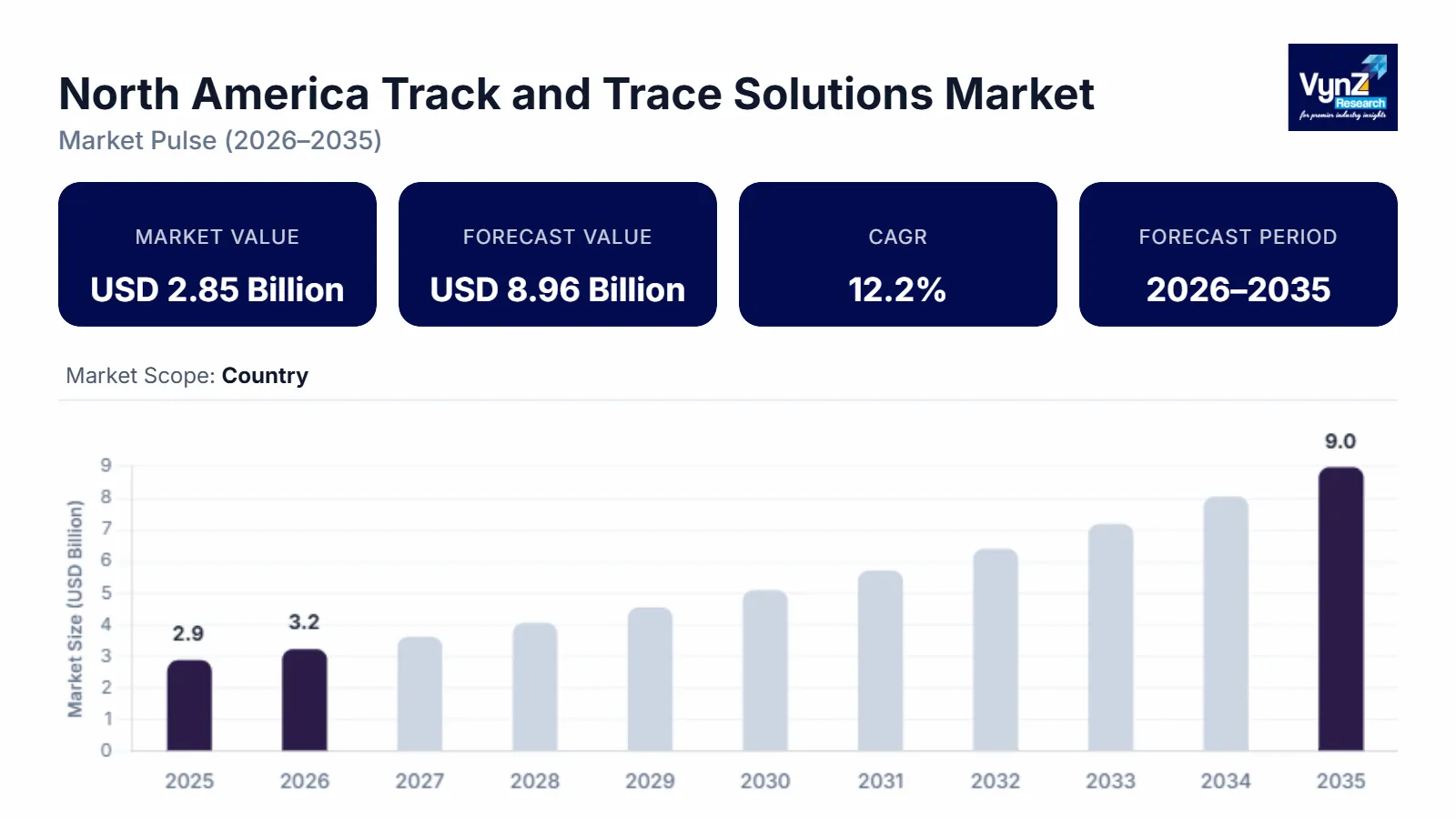
The North America track and trace solutions market size was estimated at about USD 2.85 billion in 2025 and is expected to reach around USD 3.18 billion in 2026, rising to roughly USD 8.96 billion by 2035, growing at approximately 12.2% CAGR from 2026 to 2035.
Research Highlights
- In 2025, the software segment held 45.6% market share supported by increasing cloud-based serialization platform adoption.
- Barcode technology captured 52.3% market share in 2025 due to widespread regulatory acceptance and cost efficiency.
- In 2025, serialization accounted for 48.7% market share owing to stringent pharmaceutical compliance requirements.
- Biotechnology companies are projected to grow at 13.2% CAGR supported by expanding biologics manufacturing and digital traceability.
- The United States held 67.4% market share in 2025 due to DSCSA compliance and advanced pharmaceutical manufacturing infrastructure.
Market growth is supported by stringent pharmaceutical serialization regulations, increasing adoption of digital supply chain technologies and growing concerns regarding counterfeit medicines along with expanding implementation of cloud-based traceability platforms. Growing investments in healthcare digitalization and regulatory compliance are further supporting market expansion across the United States, Canada, and Mexico. The U.S. Food and Drug Administration (FDA) continues to implement the Drug Supply Chain Security Act (DSCSA) to strengthen pharmaceutical traceability while Health Canada supports drug safety through national regulatory frameworks and digital compliance initiatives.
North America Track and Trace Solutions Market Dynamics
Market Trends
The industry is witnessing notable shifts in cloud-based serialization platforms, blockchain enabled traceability and artificial intelligence driven supply chain monitoring. One of the key trends shaping the market is the growing adoption of integrated software solutions that improve product authentication, inventory visibility and regulatory compliance across pharmaceutical supply chains. Another emerging trend is the increasing use of automated data capture technologies supported by digital transformation and stricter compliance requirements. The FDA continues to advance electronic interoperability requirements under the DSCSA while Health Canada promotes enhanced pharmaceutical safety and product traceability encouraging technology investments throughout the regional healthcare sector.
Growth Drivers
The growth of the market is supported by expanding pharmaceutical manufacturing and increasingly stringent regulatory requirements generating consistent demand across healthcare manufacturers, distributors and logistics providers. Increasing investments in digital healthcare infrastructure, automated packaging systems and supply chain visibility solutions are further accelerating market expansion. Additionally, increasing concerns regarding counterfeit medicines and product recalls are strengthening adoption of advanced serialization and aggregation technologies. The FDA continues to enforce the Drug Supply Chain Security Act to improve end to end pharmaceutical traceability while the U.S. Department of Health and Human Services (HHS) supports healthcare digitalization initiatives that reinforce secure product tracking.
Market Restraints / Challenges
Despite favorable growth prospects, the market faces certain challenges that may limit expansion. High implementation costs associated with serialization equipment, software integration and infrastructure upgrades continue to affect adoption particularly among small and medium sized manufacturers. Furthermore, interoperability challenges across multiple supply chain systems increase operational complexity and compliance costs.
Market Opportunities
The market presents significant opportunities in cloud-based track and trace platforms and advanced pharmaceutical supply chain analytics particularly supported by increasing digital transformation and demand for real time product visibility. Companies offering scalable serialization software, blockchain enabled authentication and automated compliance solutions are well positioned to capture growing demand across pharmaceutical and biotechnology industries. Another key opportunity lies in artificial intelligence enabled supply chain monitoring, where investments in predictive analytics and smart packaging technologies are improving operational efficiency and regulatory compliance.
North America Track and Trace Solutions Market Report Coverage
|
Report Metric |
Details |
|
Historical Period |
2020 - 2024 |
|
Base Year Considered |
2025 |
|
Forecast Period |
2026 - 2035 |
|
Market Size in 2025 |
USD 2.85 Billion |
|
Revenue Forecast in 2035 |
USD 8.96 Billion |
|
Growth Rate |
12.2% |
|
Segments Covered in the Report |
Component, Technology, Application, End User |
|
Report Scope |
Market Trends, Drivers, and Restraints; Revenue Estimation and Forecast; Segmentation Analysis; Companies’ Strategic Developments; Market Share Analysis of Key Players; Company Profiling |
|
Regions Covered in the Report |
United States, Canada, Mexico, Rest of North America |
|
Key Companies |
Antares Vision S.p.A., Axway Software SA, Korber AG, Markem-Imaje, Mettler Toledo International Inc., OPTEL Group, Robert Bosch GmbH, SATO Holdings Corporation, Siemens AG, Zebra Technologies Corporation |
|
Customization |
Available upon request |
North America Track and Trace Solutions Market Segmentation
By Component
The software segment accounted for the largest market share of approximately 45.6% in 2025 and is projected to expand at an estimated 12.0% CAGR through 2035 since growing demand for cloud-based serialization platforms, regulatory compliance management and real time supply chain visibility continues to support segment leadership.
The services segment is expected to register the fastest growth at approximately 13.1% CAGR due to increasing demand for system integration, validation, consulting and regulatory support services.
By Technology
The barcode segment represented the largest market share of nearly 52.3% in 2025 supported by its cost effectiveness, regulatory acceptance and widespread implementation across pharmaceutical manufacturing and distribution facilities.
The radio frequency identification segment is expected to witness the fastest expansion at an estimated 13.4% CAGR because of real time inventory visibility, automated asset tracking, and greater operational efficiency.
By Application
The serialization segment held the dominant position with an estimated 48.7% market share in 2025 reflecting increasing regulatory compliance requirements and broader implementation across pharmaceutical manufacturing facilities.
The aggregation segment is projected to register the fastest growth at approximately 12.8% CAGR owning to increasing demand for automated warehouse operations and integrated logistics management.
By End User
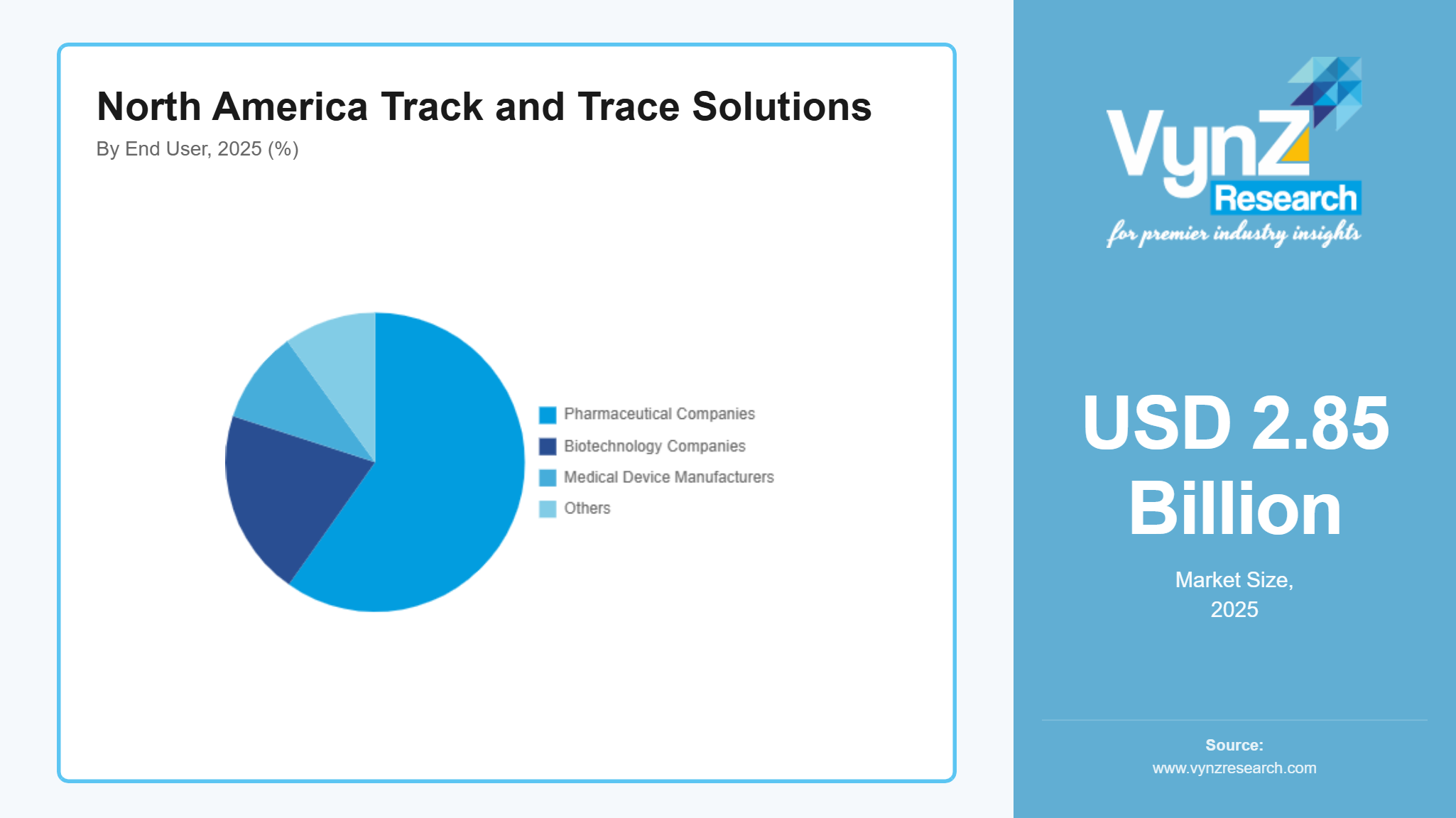
Pharmaceutical companies accounted for the largest market share of approximately 59.8% in 2025 supported by stringent regulatory compliance requirements, large scale production volumes and extensive implementation of serialization and traceability systems.
Biotechnology companies are expected to witness the fastest growth at an estimated 13.2% CAGR due to expanding biologics production, increasing investment in advanced therapies, and rising adoption of digital traceability solutions.
Regional Insights
United States
The United States accounted for approximately 67% of the market in 2025 supported by a well-established pharmaceutical manufacturing sector, advanced healthcare infrastructure and stringent drug traceability regulations. Major pharmaceutical hubs across New Jersey, California, Massachusetts, and North Carolina continue to drive technology adoption. The U.S. Food and Drug Administration (FDA) continues implementing the Drug Supply Chain Security Act (DSCSA) to strengthen end to end pharmaceutical traceability and electronic interoperability encouraging investments in serialization, aggregation and cloud-based tracking platforms.
Canada
Canada represented around 13% of the regional market in 2025 due to increasing pharmaceutical production, digital healthcare transformation and growing investments in supply chain transparency. The Health Canada regulatory framework continues to strengthen medicine safety, product authentication and pharmaceutical compliance encouraging broader adoption of track and trace technologies. Rising investment in cloud-based healthcare systems, automated packaging, and digital compliance solutions is projected to support growth during the forecast period.
Mexico
Mexico held nearly 7% of the market in 2025 supported by expanding pharmaceutical manufacturing, increasing exports and rising implementation of digital product authentication systems. The Federal Commission for the Protection against Sanitary Risks (COFEPRIS) continues strengthening pharmaceutical regulation and product safety encouraging manufacturers to modernize serialization and supply chain monitoring capabilities.
Rest of North America
The Rest of North America contributed nearly 13% of the regional market in 2025 supported by growing adoption of pharmaceutical traceability technologies, increasing regulatory alignment and expanding investments in healthcare digitalization. Demand for advanced serialization software, automated identification technologies and secure supply chain management continues to strengthen across smaller regional markets.
Competitive Landscape / Company Insights
The market is highly competitive with global and regional companies focusing on serialization technologies, cloud-based traceability platforms, artificial intelligence and strategic partnerships to strengthen their market presence. Companies continue investing in research and development, software innovation and regulatory compliance solutions to improve pharmaceutical supply chain security. The U.S. Food and Drug Administration (FDA) continues implementing the Drug Supply Chain Security Act, encouraging continuous technological advancement and digital interoperability across the regional healthcare industry.
Mini Profiles
Antares Vision S.p.A. focuses on pharmaceutical serialization and inspection solutions, supported by advanced digital traceability technologies and strong expertise in regulatory compliance.
Korber AG operates in integrated supply chain and serialization solutions, emphasizing automation, software innovation, and customized pharmaceutical packaging technologies.
Markem-Imaje leverages advanced coding, marking, and traceability technologies to strengthen pharmaceutical product identification and improve global supply chain visibility.
OPTEL Group specializes in end-to-end traceability platforms, supported by cloud-based software, intelligent inspection systems, and sustainable supply chain solutions.
Siemens AG delivers industrial automation and digital manufacturing technologies, supported by advanced software platforms and strong capabilities in smart pharmaceutical production systems.
Key Players
- Antares Vision S.p.A.
- Axway Software SA
- Korber AG
- Markem-Imaje
- Mettler Toledo International Inc.
- OPTEL Group
- Robert Bosch GmbH
- SATO Holdings Corporation
- Siemens AG
- Zebra Technologies Corporation
Recent Developments
In February 2025, Axway Software SA introduced enhanced data integration capabilities for pharmaceutical supply chains to improve secure information exchange and regulatory compliance. The update strengthened interoperability for organizations implementing advanced track and trace solutions.
In April 2025, Mettler Toledo International Inc. expanded its vision inspection and serialization portfolio with advanced digital inspection technologies for pharmaceutical packaging. The launch improved product verification accuracy and supported evolving regulatory requirements.
In June 2025, Robert Bosch GmbH enhanced its pharmaceutical packaging automation solutions by integrating intelligent inspection and digital traceability technologies. The development strengthened operational efficiency and end to end product visibility across manufacturing facilities.
In September 2025, SATO Holdings Corporation introduced upgraded RFID enabled identification and labeling solutions to improve pharmaceutical supply chain transparency and inventory accuracy. The innovation supported increasing demand for automated product tracking across healthcare industries.
In March 2026, Zebra Technologies Corporation expanded its healthcare tracking portfolio with advanced mobile data capture and real time asset visibility solutions. The development strengthened digital traceability and compliance across pharmaceutical and medical supply chains.
North America Track and Trace Solutions Market Coverage
Component Insight and Forecast 2026 - 2035
- Hardware
- Software
- Services
Technology Insight and Forecast 2026 - 2035
- Barcode
- Radio Frequency Identification
- Near Field Communication
- Others
Application Insight and Forecast 2026 - 2035
- Serialization
- Aggregation
- Tracking
- Tracing
- and Reporting
End User Insight and Forecast 2026 - 2035
- Pharmaceutical Companies
- Biotechnology Companies
- Medical Device Manufacturers
- Others
North America Track and Trace Solutions Market by Region
- U.S.
- By Component
- By Technology
- By Application
- By End User
- Canada
- By Component
- By Technology
- By Application
- By End User
- Mexico
- By Component
- By Technology
- By Application
- By End User
Table of Contents for North America Track and Trace Solutions Market Report
1. Research Overview
1.1. The Report Offers
1.2. Market Coverage
1.2.1. By
Component
1.2.2. By
Technology
1.2.3. By
Application
1.2.4. By
End User
1.3. Research Phases
1.4. Limitations
1.5. Market Methodology
1.5.1. Data Sources
1.5.1.1.
Primary Research
1.5.1.2.
Secondary Research
1.5.2. Methodology
1.5.2.1.
Data Exploration
1.5.2.2.
Forecast Parameters
1.5.2.3.
Data Validation
1.5.2.4.
Assumptions
1.5.3. Study Period & Data Reporting Unit
2. Executive Summary
3. Industry Overview
3.1. Industry Dynamics
3.1.1. Market Growth Drivers
3.1.2. Market Restraints
3.1.3. Key Market Trends
3.1.4. Major Opportunities
3.2. Industry Ecosystem
3.2.1. Porter’s Five Forces Analysis
3.2.2. Recent Development Analysis
3.2.3. Value Chain Analysis
3.3. Competitive Insight
3.3.1. Competitive Position of Industry
Players
3.3.2. Market Attractive Analysis
3.3.3. Market Share Analysis
4. North Market Estimate and Forecast
4.1. North Market Overview
4.2. North Market Estimate and Forecast to 2035
5. Market Segmentation Estimate and Forecast
5.1. By Component
5.1.1. Hardware
5.1.1.1. Market Definition
5.1.1.2. Market Estimation and Forecast to 2035
5.1.2. Software
5.1.2.1. Market Definition
5.1.2.2. Market Estimation and Forecast to 2035
5.1.3. Services
5.1.3.1. Market Definition
5.1.3.2. Market Estimation and Forecast to 2035
5.2. By Technology
5.2.1. Barcode
5.2.1.1. Market Definition
5.2.1.2. Market Estimation and Forecast to 2035
5.2.2. Radio Frequency Identification
5.2.2.1. Market Definition
5.2.2.2. Market Estimation and Forecast to 2035
5.2.3. Near Field Communication
5.2.3.1. Market Definition
5.2.3.2. Market Estimation and Forecast to 2035
5.2.4. Others
5.2.4.1. Market Definition
5.2.4.2. Market Estimation and Forecast to 2035
5.3. By Application
5.3.1. Serialization
5.3.1.1. Market Definition
5.3.1.2. Market Estimation and Forecast to 2035
5.3.2. Aggregation
5.3.2.1. Market Definition
5.3.2.2. Market Estimation and Forecast to 2035
5.3.3. Tracking
5.3.3.1. Market Definition
5.3.3.2. Market Estimation and Forecast to 2035
5.3.4. Tracing
5.3.4.1. Market Definition
5.3.4.2. Market Estimation and Forecast to 2035
5.3.5. and Reporting
5.3.5.1. Market Definition
5.3.5.2. Market Estimation and Forecast to 2035
5.4. By End User
5.4.1. Pharmaceutical Companies
5.4.1.1. Market Definition
5.4.1.2. Market Estimation and Forecast to 2035
5.4.2. Biotechnology Companies
5.4.2.1. Market Definition
5.4.2.2. Market Estimation and Forecast to 2035
5.4.3. Medical Device Manufacturers
5.4.3.1. Market Definition
5.4.3.2. Market Estimation and Forecast to 2035
5.4.4. Others
5.4.4.1. Market Definition
5.4.4.2. Market Estimation and Forecast to 2035
6. U.S. Market Estimate and Forecast
6.1. By
Component
6.2. By
Technology
6.3. By
Application
6.4. By
End User
7. Canada Market Estimate and Forecast
7.1. By
Component
7.2. By
Technology
7.3. By
Application
7.4. By
End User
8. Mexico Market Estimate and Forecast
8.1. By
Component
8.2. By
Technology
8.3. By
Application
8.4. By
End User
9. Company Profiles
9.1.
Antares Vision S.p.A.
9.1.1.
Snapshot
9.1.2.
Overview
9.1.3.
Offerings
9.1.4.
Financial
Insight
9.1.5.
Recent
Developments
9.2.
Away Software SA
9.2.1.
Snapshot
9.2.2.
Overview
9.2.3.
Offerings
9.2.4.
Financial
Insight
9.2.5.
Recent
Developments
9.3.
Korber AG
9.3.1.
Snapshot
9.3.2.
Overview
9.3.3.
Offerings
9.3.4.
Financial
Insight
9.3.5.
Recent
Developments
9.4.
Markem-Imaje
9.4.1.
Snapshot
9.4.2.
Overview
9.4.3.
Offerings
9.4.4.
Financial
Insight
9.4.5.
Recent
Developments
9.5.
Mettler Toledo International Inc.
9.5.1.
Snapshot
9.5.2.
Overview
9.5.3.
Offerings
9.5.4.
Financial
Insight
9.5.5.
Recent
Developments
9.6.
OPTEL Group
9.6.1.
Snapshot
9.6.2.
Overview
9.6.3.
Offerings
9.6.4.
Financial
Insight
9.6.5.
Recent
Developments
9.7.
Robert Bosch GmbH
9.7.1.
Snapshot
9.7.2.
Overview
9.7.3.
Offerings
9.7.4.
Financial
Insight
9.7.5.
Recent
Developments
9.8.
SATO Holdings Corporation
9.8.1.
Snapshot
9.8.2.
Overview
9.8.3.
Offerings
9.8.4.
Financial
Insight
9.8.5.
Recent
Developments
9.9.
Siemens AG
9.9.1.
Snapshot
9.9.2.
Overview
9.9.3.
Offerings
9.9.4.
Financial
Insight
9.9.5.
Recent
Developments
9.10.
Zebra Technologies Corporation
9.10.1.
Snapshot
9.10.2.
Overview
9.10.3.
Offerings
9.10.4.
Financial
Insight
9.10.5.
Recent
Developments
10. Appendix
10.1. Exchange Rates
10.2. Abbreviations
Note: Financial insight and recent developments of different companies are subject to the availability of information in the secondary domain.
Frequently Asked Questions
Purchase Options
Latest Report
Research Methodology
- Desk Research / Pilot Interviews
- Build Market Size Model
- Research and Analysis
- Final Deliverable
Connect With Our Sales Team
- Toll-Free: +1-888-253-3960
- Phone: +91 9960 288 381
- Email: enquiry@vynzresearch.com
North America Track and Trace Solutions Market