
U.S. E-Cigarette Market Size & Share Growth Forecast Report (2026-2035)
Industry Insight by Product Type (Disposable E-Cigarettes, Rechargeable E-Cigarettes, Modular Devices, Pod Systems), by Flavor Type (Tobacco, Menthol, Fruit, Other Flavors), by Distribution Channel (Specialty Vape Stores, Online Retail, Convenience Stores, Supermarkets and Hypermarkets), by End Use (Individual Consumers, Specialty Retailers, Healthcare Research Organizations, Commercial Institutions)
| Status : Published | Published On : Aug, 2026 | Report Code : VRSME9221 | Industry : Semiconductor & Electronics | Available Format :

|
Page : 134 |
U.S. E-Cigarette Market Overview
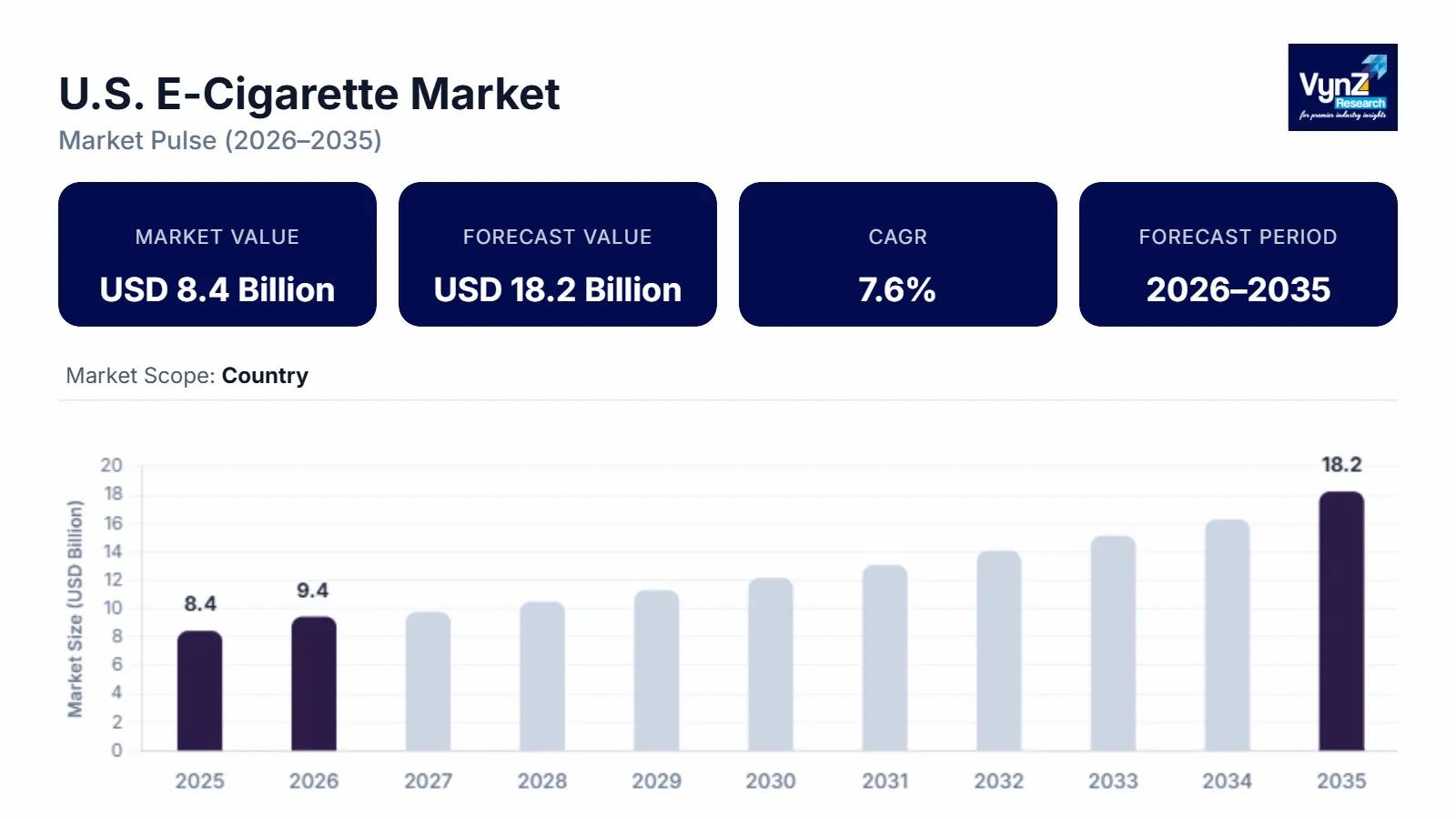
The U.S. e-cigarette market size was estimated at approximately USD 8.4 billion in 2025 and is expected to reach around USD 9.4 billion in 2026, rising to nearly USD 18.2 billion by 2035, growing at an estimated 7.6% CAGR during 2026 to 2035.
Research Highlights
- Pod systems held 39.8% market share in 2025 due to user convenience.
- Tobacco flavors captured 42.6% share in 2025 supported by adult smokers.
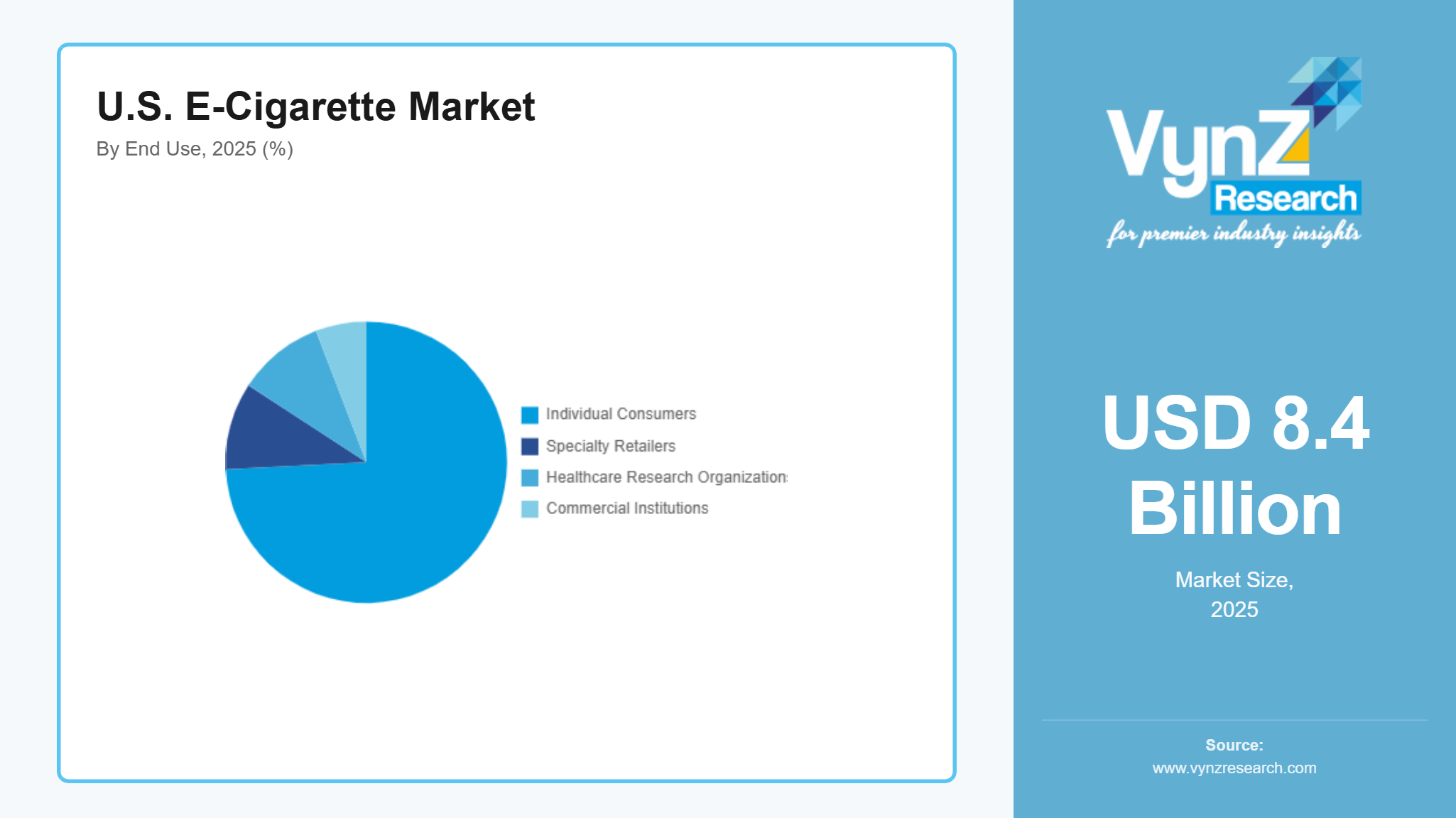
- Individual consumers accounted for 74.2% revenue share in 2025 owing to widespread adoption.
- Disposable e-cigarettes are projected at 8.9% CAGR during 2026–2035 because of convenience.
- Southern U.S. represented 30.6% market share in 2025 supported by retail expansion.
Market growth is attributed to a rising need for alternative smoke-free cigarettes, an expanding number of refillable and disposable vaping devices, and product development innovations, together with the rising popularity of closed pod systems and nicotine salt vaping products. In addition, the demand for nicotine-based consumption methods is rising, as well as FDA regulatory reviews, public health research, and consumer protection authorities in California, Texas, Florida, New York, and other regions.
The US Food and Drug Administration (FDA) still regulates Electronic Nicotine Delivery Systems via the Premarket Tobacco Product Application process. Moreover, the Center for Disease Control and Prevention (CDC) has been observing the US market dynamics, noting changes in consumer buying patterns and emerging product categories. Simultaneously, the National Institutes of Health (NIH) have been conducting extensive research into vaping health hazards.
U.S. E-Cigarette Market Dynamics
Market Trends
The U.S. E-Cigarette Market is projected to witness growth in the product portfolio, nicotine consumption, and purchase trends of the leading players during the forecast period. The closed pod vaping devices and disposable vaping products are gaining popularity among adult vapers and tobacco consumers due to shifting demand preferences. Vendors are focusing on developing innovative battery packs, leak-proof technology, and advanced vaporization features while considering the regulatory landscape. The recent emergence of nicotine salts and digital retailing platforms is anticipated to drive the demand for vaping products in the U.S. The shifting purchase trends and technological advancements are projected to encourage product developers to emphasize improved battery technology and rechargeable devices.
Growth Drivers
The market size is poised to grow steadily in the coming years due to the increasing need for reduced-risk combustible tobacco products and a consistent demand for alternative nicotine consumption methods. Consumers have been expressing growing interest in the health benefits of switching from combustible cigarettes to e-cigarettes, which has encouraged numerous manufacturers to enter the market space. In addition, the expanding product portfolio, growing retail presence, and rechargeable device adoption are projected to augment the growth of the U.S. E-Cigarette Market size. Adult consumers are prioritizing advanced and refillable electronic cigarettes with innovative features and greater customization. The CDC and NIH clinical research studies on vaping and nicotine trends are also expected to support the growth of the market.
Market Restraints / Challenges
The market growth is projected to face challenges in the near future due to the growing number of regulations on product sales, advertising, and ingredient usage. The product approval process by the FDA also poses a challenge to manufacturers due to the complex and time-consuming protocols. Moreover, the FDA, CDC, and NIH are emphasizing product safety and monitoring the usage trends and associated health concerns linked to ENDS products. The rising popularity of e-liquids and flavors among younger demographics is also a concern for regulatory authorities and has hindered market growth to a certain extent. The changing perspectives of consumers, product approval process, and shifting state-level regulations present substantial challenges for manufacturers. Apart from that, supply chain network disruptions and consumer behavior also impact the growth rate of the U.S. E-Cigarette Market size.
Market Opportunities
The market presents ample opportunities for manufacturers to develop next-generation vaping products. The rising need for improved closed-system vaping devices coupled with better battery technology and nicotine control can create growth opportunities for manufacturers. Companies focusing on developing reduced-risk ENDS products with FDA approval are likely to gain a competitive advantage in the market. Another lucrative opportunity for manufacturers is the growing need for rechargeable closed-system vaping devices and the development of new nicotine delivery technologies. Product developers can emphasize the extensive research and development (R&D) initiatives, improved production techniques, and compliance with the regulatory guidelines to promote long-term growth. The advancements in battery technology, rechargeable devices, and digital retail platforms are also anticipated to help manufacturers retain existing customers and attract new clients.
U.S. E-Cigarette Market Report Coverage
|
Report Metric |
Details |
|
Historical Period |
2020 - 2024 |
|
Base Year Considered |
2025 |
|
Forecast Period |
2026 - 2035 |
|
Market Size in 2025 |
USD 8.4 Billion |
|
Revenue Forecast in 2035 |
USD 18.2 Billion |
|
Growth Rate |
7.6% |
|
Segments Covered in the Report |
Product Type, Flavor Type, Distribution Channel, End Use |
|
Report Scope |
Market Trends, Drivers, and Restraints; Revenue Estimation and Forecast; Segmentation Analysis; Companies’ Strategic Developments; Market Share Analysis of Key Players; Company Profiling |
|
Regions Covered in the Report |
Southern U.S., Western U.S., Northeastern U.S., Other U.S. Regions |
|
Key Companies |
Altria Group, Inc., British American Tobacco plc, Geek Bar, Imperial Brands PLC, Japan Tobacco Inc., Juul Labs, Inc., NJOY LLC, Philip Morris International Inc., R.J. Reynolds Vapor Company, Shenzhen IVPS Technology Co., Ltd. (SMOK) |
|
Customization |
Available upon request |
U.S. E-Cigarette Market Segmentation
By Product Type
Pod systems dominated the market with a share of 39.8% in 2025. This segment is majorly driven by the product’s high usability, continuous supply of nicotine, small size, and inclination toward closed systems. The pod systems make use of nicotine salts and have seen an improvement in terms of battery capacity, thus witnessing demand from a large consumer base.
The disposable e-cigarettes segment is the most prominent segment in the market and is expected to witness a CAGR of 8.9% during the forecast period. The segment is majorly driven by the inclination of consumers toward convenient, ready-to-use products.
By Flavor Type
The tobacco segment comprised the largest share, with around 42.6% in 2025. This segment is anticipated to witness growth during the forecast period. This is majorly attributable to the high demand for tobacco flavored products from adult smokers switching from conventional smoking products.
The menthol segment is projected to witness a higher growth rate compared to the other segments. It is anticipated to witness a 7.9% CAGR during the forecast period. The segment is majorly driven by the demand for the products from adult consumers, along with product development and the purchasing pattern of the target population.
By Distribution Channel
The specialty vape stores segment dominated the market with a share of 37.5% in 2025. This segment offers a wide range of products and provides guidance to customers, thus gaining popularity over other channels.
The online retail segment is projected to witness the highest growth rate during the forecast period, with an expected CAGR of 8.3% during 2026-2035. The segment’s growth is majorly driven by the changing consumer buying behavior.
By End Use
The individual consumers segment had the largest market share of 74.2% in 2025. Individual consumers are highly inclined toward switching to smoke-free nicotine products. This has led to the segment’s demand being driven by the rising awareness about the benefits of using e-cigarettes.
The specialty retailers and commercial organizations segment is anticipated to witness a CAGR of 7.1% during the forecast period. The segment’s growth is majorly driven by the increasing product offerings and rising investment in the retail sector.
Regional Insights
Southern US
The Southern US accounted for around 30.6% of the US e-cigarette market in 2025. This region possesses a vast consumer base of adult individuals and an adequate distribution network to meet the demand. Moreover, the presence of convenience stores and specialty vape shops in Texas, Florida, Georgia, and North Carolina drives the market growth. Increasing consumer inclination toward smoke-free alternatives and the availability of rechargeable and disposable vaping devices contribute to the regional market growth. Moreover, government regulations and the introduction of new products and extended distribution networks promote the investment in developing and distributing approved products. Furthermore, the adoption of smoke-free alternatives among adult nicotine users is expected to drive the market growth in the forecast period.
Western US
The Western US contributed around 25.4% of the market in 2025. The western states such as California, Washington, Nevada, Arizona, and Utah are inclined toward alternative nicotine products. Moreover, the presence of well-established retail chains and extensive product development in the region accelerates the market growth. Additionally, rising investment in advanced vaping products and improved battery technology create growth opportunities for the market. The manufacturers are focusing on advanced and authorized products to comply with the federal regulations in the forecast period.
Northeastern US
The Northeastern US held around 20.1% of the market in 2025. The region consists of a robust retail network and immense population concentration that supports the demand for electronic cigarettes. Moreover, the adoption of vaping products is rising among the adult population in the states such as New York, Massachusetts, Pennsylvania, and New Jersey. The availability of authorized vape products and increased consumer awareness accelerates the market growth.
The remaining 23.9% is segmented among the Midwestern US, Mountain States, and other regions. These regions are expected to witness stable growth due to rising adoption among adult consumers and increasing retail penetration and comply with the federal government regulations.
Competitive Landscape / Company Insights
The market is intensely competitive and dominated by a number of global and local players that focus on product development, regulatory compliance, geographical reach, and next-generation nicotine delivery technology. The companies invest significantly in research and development, rechargeable platform development, battery technology, and branded product portfolios to strengthen their positions in the market. The market is also driven by regulatory bodies such as the US Food and Drug Administration (FDA) and others, while public health bodies such as the Centers for Disease Control and Prevention (CDC) and the National Institutes of Health (NIH) conduct extensive clinical studies and surveillance.
Mini Profiles
Altria Group, Inc. focuses on smoke free nicotine products and authorized vaping technologies, supported by strong distribution capabilities, regulatory expertise, and established brand recognition.
British American Tobacco plc operates across premium and mass market vaping segments, emphasizing product innovation, advanced nicotine delivery systems, and global research capabilities.
Geek Bar specializes in disposable electronic cigarette products, supported by extensive product development, international distribution, and consumer focused device innovation.
Imperial Brands PLC develops vaping products and next generation nicotine solutions, supported by established manufacturing expertise and expanding reduced risk product portfolios.
Japan Tobacco Inc. focuses on alternative nicotine technologies, supported by research driven innovation, international operations, and continuous investment in smoke free product development.
Key Players
- Altria Group, Inc.
- British American Tobacco plc
- Geek Bar
- Imperial Brands PLC
- Japan Tobacco Inc.
- Juul Labs, Inc.
- NJOY LLC
- Philip Morris International Inc.
- R.J. Reynolds Vapor Company
- Shenzhen IVPS Technology Co., Ltd. (SMOK)
Recent Developments
In January 2026, NJOY LLC expanded its authorized vaping product portfolio following continued investment in FDA compliant electronic nicotine delivery systems. The initiative strengthened its presence in the regulated U.S. vaping market.
In March 2026, Philip Morris International Inc. accelerated investments in smoke free product innovation and expanded commercialization of reduced risk nicotine technologies. The development aligned with the company's long term smoke free business strategy.
In February 2025, Juul Labs, Inc. continued strengthening its regulatory and scientific engagement programs while focusing on authorized product development and adult smoker transition initiatives. The company also expanded scientific evidence supporting its product portfolio.
In April 2025, R.J. Reynolds Vapor Company expanded distribution of its authorized vaping products across additional retail channels in the United States. The development supported growing adult consumer demand for regulated nicotine alternatives.
In May 2025, Shenzhen IVPS Technology Co., Ltd. (SMOK) introduced new rechargeable vaping devices featuring improved battery performance and enhanced user functionality. The launch supported increasing demand for technologically advanced vaping products in international markets.
U.S. E-Cigarette Market Coverage
Product Type Insight and Forecast 2026 - 2035
- Disposable E-Cigarettes
- Rechargeable E-Cigarettes
- Modular Devices
- Pod Systems
Flavor Type Insight and Forecast 2026 - 2035
- Tobacco
- Menthol
- Fruit
- Other Flavors
Distribution Channel Insight and Forecast 2026 - 2035
- Specialty Vape Stores
- Online Retail
- Convenience Stores
- Supermarkets and Hypermarkets
End Use Insight and Forecast 2026 - 2035
- Individual Consumers
- Specialty Retailers
- Healthcare Research Organizations
- Commercial Institutions
U.S. E-Cigarette Market by Region
- Southern U.S.
- By Product Type
- By Flavor Type
- By Distribution Channel
- By End Use
- Western U.S.
- By Product Type
- By Flavor Type
- By Distribution Channel
- By End Use
- Northeastern U.S.
- By Product Type
- By Flavor Type
- By Distribution Channel
- By End Use
- Other U.S. Regions
- By Product Type
- By Flavor Type
- By Distribution Channel
- By End Use
Table of Contents for U.S. E-Cigarette Market Report
1. Research Overview
1.1. The Report Offers
1.2. Market Coverage
1.2.1. By
Product Type
1.2.2. By
Flavor Type
1.2.3. By
Distribution Channel
1.2.4. By
End Use
1.3. Research Phases
1.4. Limitations
1.5. Market Methodology
1.5.1. Data Sources
1.5.1.1.
Primary Research
1.5.1.2.
Secondary Research
1.5.2. Methodology
1.5.2.1.
Data Exploration
1.5.2.2.
Forecast Parameters
1.5.2.3.
Data Validation
1.5.2.4.
Assumptions
1.5.3. Study Period & Data Reporting Unit
2. Executive Summary
3. Industry Overview
3.1. Industry Dynamics
3.1.1. Market Growth Drivers
3.1.2. Market Restraints
3.1.3. Key Market Trends
3.1.4. Major Opportunities
3.2. Industry Ecosystem
3.2.1. Porter’s Five Forces Analysis
3.2.2. Recent Development Analysis
3.2.3. Value Chain Analysis
3.3. Competitive Insight
3.3.1. Competitive Position of Industry
Players
3.3.2. Market Attractive Analysis
3.3.3. Market Share Analysis
4. U.S. Market Estimate and Forecast
4.1. U.S. Market Overview
4.2. U.S. Market Estimate and Forecast to 2035
5. Market Segmentation Estimate and Forecast
5.1. By Product Type
5.1.1. Disposable E-Cigarettes
5.1.1.1. Market Definition
5.1.1.2. Market Estimation and Forecast to 2035
5.1.2. Rechargeable E-Cigarettes
5.1.2.1. Market Definition
5.1.2.2. Market Estimation and Forecast to 2035
5.1.3. Modular Devices
5.1.3.1. Market Definition
5.1.3.2. Market Estimation and Forecast to 2035
5.1.4. Pod Systems
5.1.4.1. Market Definition
5.1.4.2. Market Estimation and Forecast to 2035
5.2. By Flavor Type
5.2.1. Tobacco
5.2.1.1. Market Definition
5.2.1.2. Market Estimation and Forecast to 2035
5.2.2. Menthol
5.2.2.1. Market Definition
5.2.2.2. Market Estimation and Forecast to 2035
5.2.3. Fruit
5.2.3.1. Market Definition
5.2.3.2. Market Estimation and Forecast to 2035
5.2.4. Other Flavors
5.2.4.1. Market Definition
5.2.4.2. Market Estimation and Forecast to 2035
5.3. By Distribution Channel
5.3.1. Specialty Vape Stores
5.3.1.1. Market Definition
5.3.1.2. Market Estimation and Forecast to 2035
5.3.2. Online Retail
5.3.2.1. Market Definition
5.3.2.2. Market Estimation and Forecast to 2035
5.3.3. Convenience Stores
5.3.3.1. Market Definition
5.3.3.2. Market Estimation and Forecast to 2035
5.3.4. Supermarkets and Hypermarkets
5.3.4.1. Market Definition
5.3.4.2. Market Estimation and Forecast to 2035
5.4. By End Use
5.4.1. Individual Consumers
5.4.1.1. Market Definition
5.4.1.2. Market Estimation and Forecast to 2035
5.4.2. Specialty Retailers
5.4.2.1. Market Definition
5.4.2.2. Market Estimation and Forecast to 2035
5.4.3. Healthcare Research Organizations
5.4.3.1. Market Definition
5.4.3.2. Market Estimation and Forecast to 2035
5.4.4. Commercial Institutions
5.4.4.1. Market Definition
5.4.4.2. Market Estimation and Forecast to 2035
6. Southern U.S. Market Estimate and Forecast
6.1. By
Product Type
6.2. By
Flavor Type
6.3. By
Distribution Channel
6.4. By
End Use
7. Western U.S. Market Estimate and Forecast
7.1. By
Product Type
7.2. By
Flavor Type
7.3. By
Distribution Channel
7.4. By
End Use
8. Northeastern U.S. Market Estimate and Forecast
8.1. By
Product Type
8.2. By
Flavor Type
8.3. By
Distribution Channel
8.4. By
End Use
9. Other U.S. Regions Market Estimate and Forecast
9.1. By
Product Type
9.2. By
Flavor Type
9.3. By
Distribution Channel
9.4. By
End Use
10. Company Profiles
10.1.
India-tourism-market
10.1.1.
Snapshot
10.1.2.
Overview
10.1.3.
Offerings
10.1.4.
Financial
Insight
10.1.5.
Recent
Developments
10.2.
Altria Group, Inc.
10.2.1.
Snapshot
10.2.2.
Overview
10.2.3.
Offerings
10.2.4.
Financial
Insight
10.2.5.
Recent
Developments
10.3.
British American Tobacco plc
10.3.1.
Snapshot
10.3.2.
Overview
10.3.3.
Offerings
10.3.4.
Financial
Insight
10.3.5.
Recent
Developments
10.4.
Geek Bar
10.4.1.
Snapshot
10.4.2.
Overview
10.4.3.
Offerings
10.4.4.
Financial
Insight
10.4.5.
Recent
Developments
10.5.
Imperial Brands PLC
10.5.1.
Snapshot
10.5.2.
Overview
10.5.3.
Offerings
10.5.4.
Financial
Insight
10.5.5.
Recent
Developments
10.6.
Japan Tobacco Inc.
10.6.1.
Snapshot
10.6.2.
Overview
10.6.3.
Offerings
10.6.4.
Financial
Insight
10.6.5.
Recent
Developments
10.7.
Juul Labs, Inc.
10.7.1.
Snapshot
10.7.2.
Overview
10.7.3.
Offerings
10.7.4.
Financial
Insight
10.7.5.
Recent
Developments
10.8.
NJOY LLC
10.8.1.
Snapshot
10.8.2.
Overview
10.8.3.
Offerings
10.8.4.
Financial
Insight
10.8.5.
Recent
Developments
10.9.
Philip Morris International Inc.
10.9.1.
Snapshot
10.9.2.
Overview
10.9.3.
Offerings
10.9.4.
Financial
Insight
10.9.5.
Recent
Developments
10.10.
R.J. Reynolds Vapor Company
10.10.1.
Snapshot
10.10.2.
Overview
10.10.3.
Offerings
10.10.4.
Financial
Insight
10.10.5.
Recent
Developments
11. Appendix
11.1. Exchange Rates
11.2. Abbreviations
Note: Financial insight and recent developments of different companies are subject to the availability of information in the secondary domain.
Frequently Asked Questions
Purchase Options
Latest Report
Research Methodology
- Desk Research / Pilot Interviews
- Build Market Size Model
- Research and Analysis
- Final Deliverable
Connect With Our Sales Team
- Toll-Free: +1-888-253-3960
- Phone: +91 9960 288 381
- Email: enquiry@vynzresearch.com
U.S. E-Cigarette Market