
Aircraft Conversion Market Size & Share Growth Forecast Report (2026-2035)
Industry Insight by Engine Type (Turbofan aircraft, Turboprop aircraft), by Conversion Type (OEM-configured freighters, Passenger-to-freighter conversions), by Payload Capacity (Standard-body aircraft, Medium-widebody aircraft, Large-widebody aircraft)
| Status : Published | Published On : Oct, 2026 | Report Code : VRAD12057 | Industry : Aerospace and Defense | Available Format :

|
Page : 156 |
Aircraft Conversion Market Overview
The Aircraft Conversion Market was estimated at approximately USD 7.40 billion in 2025 and is projected to reach around USD 7.85 billion in 2026, rising to nearly USD 13.60 billion by 2035, at a CAGR of approximately 6.30% from 2026 to 2035.
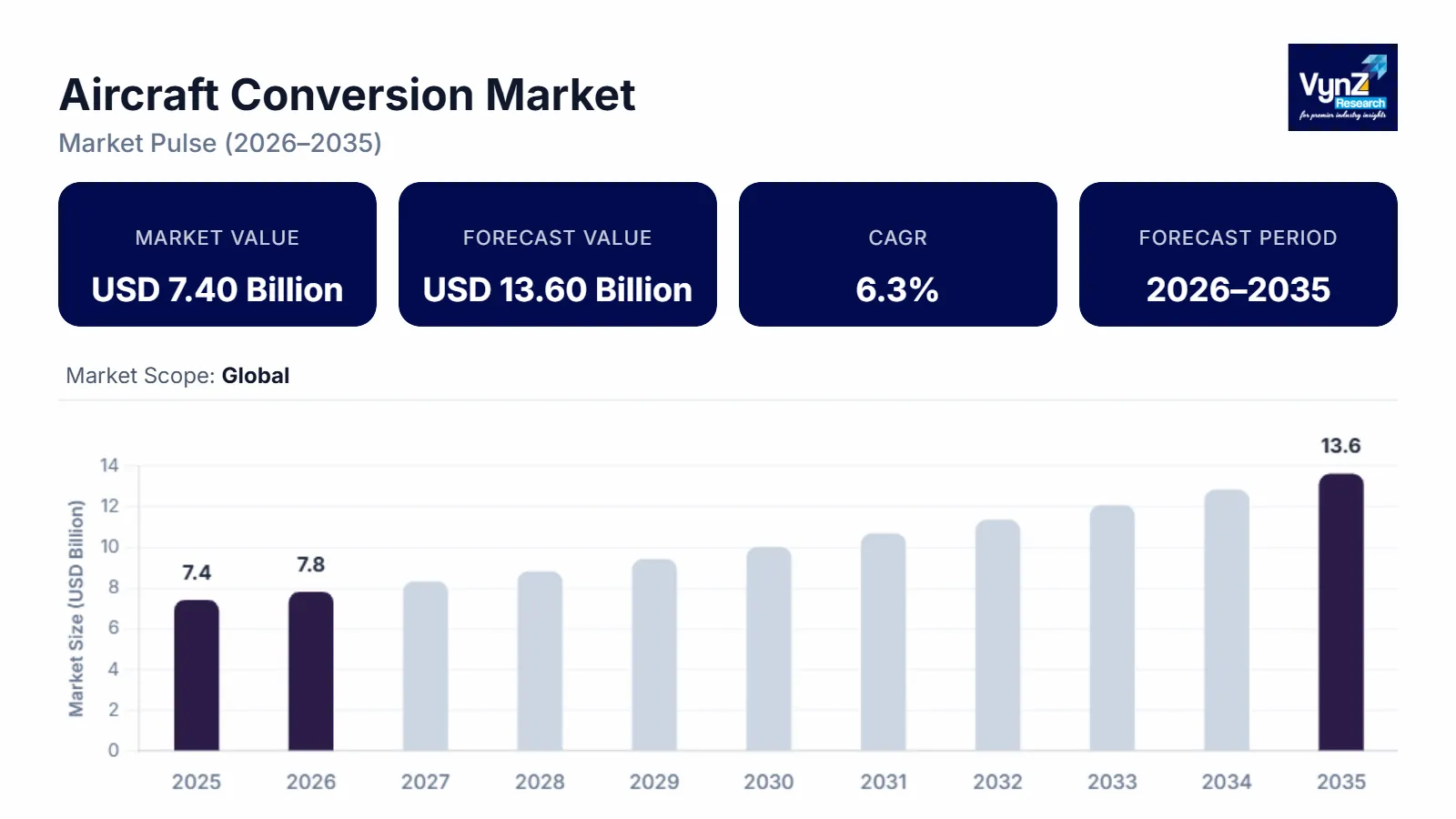
These figures are working estimates for the broader aircraft conversion industry, rather than a directly reported total, because published market studies often measure the narrower freighter aircraft market or passenger-to-freighter conversions separately. Demand is supported by air cargo expansion, the continued use of older aircraft, and the cost advantages of converting existing airframes instead of acquiring new aircraft. Boeing’s 2025 Commercial Market Outlook expects converted passenger aircraft to account for roughly two-thirds of freighter deliveries over its 20-year forecast period.
Research Methodology
The research uses secondary information from industry reports, company announcements, and official aviation sources. The VynZ Research team reviews aircraft conversion activity across passenger-to-freighter programmes, special-mission modifications, and other major aircraft reconfiguration services. Market estimates are developed by considering industry growth indicators, conversion demand, fleet replacement requirements, and regional air cargo trends. Sources include Boeing’s Commercial Market Outlook, the International Air Transport Association (IATA), the U.S. Federal Aviation Administration (FAA), and company announcements from established conversion providers. Since market definitions vary between reports, the figures presented are analytical estimates and should not be treated as audited industry totals.
Research Highlights
- OEM-configured freighters accounted for about 51.25% of the market in 2025 because they allow operators to repurpose suitable passenger aircraft to meet cargo requirements without relying entirely on factory-built freighters.
- Medium-widebody aircraft held nearly 41.21% in 2025 reflecting demand for aircraft that can carry substantial cargo volumes.
- Turbofan platforms accounted for 56.47% of the market in 2025 due to their use across many medium- and large-capacity freighters.
- Passenger-to-freighter conversions are projected to grow at a 5.95% CAGR through 2036 supported by air cargo requirements.
- Asia Pacific accounted for approximately 28% of projected market in 2025, supported by growing cargo demand and regional logistics activity.
Aircraft Conversion Market Dynamics
Market Trends
The aircraft conversion industry is moving toward larger passenger-to-freighter programs, specialized cargo configurations, and modifications that extend the useful life of existing aircraft. Operators are evaluating conversion options as they balance fleet costs, cargo demand, and aircraft availability. Another important trend is the development of conversion programs for newer aircraft models and larger widebody platforms. However, major structural changes require technical testing and regulatory approval. The U.S. Federal Aviation Administration’s Supplemental Type Certificate requirements establish the certification framework for significant aircraft design modifications, making engineering capability and compliance essential competitive factors.
Growth Drivers
Growth is supported by expanding air cargo demand, e-commerce shipments, and the need for additional freighter capacity. IATA reported that global air cargo demand increased by 3.4% in 2025, while international demand rose by 4.2%. These conditions encourage airlines, lessors, and cargo operators to assess conversion programs as part of their fleet planning. The availability of suitable used aircraft also supports market expansion, since conversion can provide an alternative to purchasing a new freighter. Boeing projects that approximately two-thirds of future freighter deliveries over its 2025–2044 outlook period will be converted passenger aircraft. This long-term expectation underlines the role of conversions in meeting replacement and fleet-growth requirements.
Market Restraints / Challenges
Despite favorable demand, aircraft conversion programs involve substantial engineering work, structural modifications, certification procedures, and aircraft downtime. The FAA requires applicants for major design changes to demonstrate compliance with applicable airworthiness requirements before an STC can be issued. These processes can lengthen program timelines and increase development costs, especially for new aircraft types or complex widebody conversions. The industry is also exposed to uncertainty in cargo demand, the availability and condition of used aircraft, specialist labor requirements, and the supply of conversion components. A program may become less attractive if the donor aircraft requires extensive maintenance or if expected cargo revenue does not justify the conversion cost. Such factors can influence customer decisions and limit the number of commercially viable projects.
Market Opportunities
A major opportunity lies in converting suitable narrowbody aircraft for regional cargo, express parcel, and e-commerce operations. These aircraft can support routes where operators do not require the payload capacity of a large widebody freighter. Continued demand for dedicated cargo capacity and the development of additional conversion programs may create opportunities for engineering firms, maintenance providers, and aircraft lessors. Widebody conversion programs and specialized aircraft modifications offer another growth avenue. Newer programs can broaden the range of aircraft available for cargo operations, while passenger cabin reconfiguration and special-mission modifications create demand beyond freighters. Companies with established engineering teams, certification experience, and global maintenance networks are positioned to pursue these opportunities, although each program remains dependent on technical feasibility and regulatory approval.
Global Aircraft Conversion Market Report Coverage
|
Report Metric |
Details |
|
Historical Period |
2020 - 2024 |
|
Base Year Considered |
2025 |
|
Forecast Period |
2026 - 2035 |
|
Market Size in 2025 |
USD 7.40 Billion |
|
Revenue Forecast in 2035 |
USD 13.60 Billion |
|
Growth Rate |
6.30% |
|
Segments Covered in the Report |
Conversion Type, Payload Capacity, Engine Type |
|
Report Scope |
Market Trends, Drivers, and Restraints; Revenue Estimation and Forecast; Segmentation Analysis; Companies’ Strategic Developments; Market Share Analysis of Key Players; Company Profiling |
|
Regions Covered in the Report |
North America, Europe, Asia Pacific, Rest of the World |
|
Key Companies |
AAR Corp, Airbus, Aeronautical Engineers Inc (AEI), Boeing, Elbe Flugzeugwerke (EFW), Israel Aerospace Industries (IAI), Lufthansa Technik, Mammoth Freighters, Precision Aircraft Solutions, ST Engineering |
|
Customization |
Available upon request |
By Conversion Type
OEM-configured freighters held 51.25% of the market in 2025 because they allow operators to repurpose suitable passenger aircraft to meet cargo requirements without relying entirely on factory-built freighters.
Passenger-to-freighter conversions are projected to grow at a 5.95% CAGR through 2036. Demand is supported by air cargo requirements, the availability of suitable used aircraft, and the ability to extend an aircraft’s commercial service life.
By Payload Capacity
Medium-widebody aircraft held the largest share, at 41.21% in 2025. Their position reflects demand for aircraft that can carry substantial cargo volumes while serving a range of medium- and long-haul routes.
Standard-body aircraft are projected to register a 5.76% CAGR through 2036, making them a growth segment in the published freighter aircraft forecast. These aircraft are relevant to express parcel networks, regional cargo routes, and operators that do not require the capacity of larger freighters.
By Engine Type
Turbofan platforms accounted for 56.47% of the market in 2025. Their position is supported by their use across many medium- and large-capacity freighters operating on domestic and international cargo routes.
Turboprop freighters are projected to grow at a 6.11% CAGR through 2036. Their growth outlook reflects demand for cargo operations on shorter routes and in markets where smaller aircraft can meet capacity requirements.
Regional Insights
North America
North America is estimated to account for approximately 27% of the aircraft conversion market in 2025, supported by established cargo airlines, aircraft leasing companies, engineering providers, and maintenance facilities. The region benefits from an extensive air freight network and demand for freighters serving express parcel, e-commerce, and industrial supply chains. The United States also has a significant regulatory role in aircraft modification through the FAA’s Supplemental Type Certificate process. Established certification requirements support airworthiness oversight but can increase the time and investment needed to introduce new conversion programs.
Europe
Europe is estimated to represent approximately 23% of the market in 2025, supported by established aerospace engineering capabilities, aircraft maintenance facilities, and conversion programs for Airbus and Boeing aircraft. Germany is an important center for EFW’s freighter conversion activity, while other European aerospace companies contribute engineering, certification, and aircraft support services. Demand is also influenced by fleet modernization and the need to match aircraft capacity with cargo route requirements. Conversion providers with established engineering processes and international certification experience are positioned to serve lessors and cargo operators across Europe and other markets.
Asia Pacific
Asia Pacific is estimated to account for approximately 28% of the market in 2025, driven by regional manufacturing activity, cross-border e-commerce, and the need for air cargo capacity across major trading economies. Recent conversion contracts also demonstrate interest in expanding conversion capacity and serving customers in China and other Asian markets. EFW has announced A330 passenger-to-freighter conversion agreements involving customers connected to the Chinese market, while IATA reported strong international cargo demand during 2025.
Rest of the World
The Rest of the World region is estimated to account for the remaining 22% of the market in 2025, including Latin America, the Middle East, and Africa. Demand is supported by international cargo routes, regional logistics requirements, and the need for aircraft suited to specific operating environments. The Middle East also plays a role in global freight connectivity, while operators in emerging markets may consider conversions to expand capacity without relying exclusively on new aircraft.
Competitive Landscape / Company Insights
The aircraft conversion market is moderately to highly competitive, with established aerospace companies and specialist engineering providers competing through program certification, aircraft compatibility, conversion capacity, and customer support. Companies are expanding conversion offerings across narrowbody and widebody aircraft to meet differing cargo requirements. Boeing’s market outlook highlights the long-term role of converted freighters, while FAA certification requirements make engineering experience and regulatory compliance important competitive advantages. Recent program launches and conversion contracts also indicate continued investment in new aircraft configurations.
Mini Profiles
AAR Corp provides aviation aftermarket and engineering services, including aircraft reconfiguration and certification capabilities strengthened through its acquisition of Aircraft Reconfig Technologies.
Boeing supports the freighter market through its commercial aircraft portfolio and long-term market outlook, which identifies converted aircraft as an important source of future cargo capacity.
Elbe Flugzeugwerke (EFW) develops Airbus passenger-to-freighter conversion programs and works with international partners to expand conversion capacity and serve cargo operators.
Israel Aerospace Industries (IAI) provides passenger-to-freighter conversion capabilities across Boeing and Airbus aircraft, including its Boeing 777-300ERSF and Airbus A330-300 programs.
Lufthansa Technik provides aircraft maintenance, engineering, and modification services for commercial and specialist aviation customers, supporting aircraft lifecycle management and operational requirements.
Key Players
- AAR Corp
- Airbus
- Aeronautical Engineers, Inc. (AEI)
- Boeing
- Elbe
- Flugzeugwerke
- (EFW)
- Israel Aerospace Industries (IAI)
- Lufthansa Technik
- Mammoth Freighters
- Precision Aircraft Solutions
- ST Engineering
Recent Developments
Aeronautical Engineers, Inc. (AEI) launched its Boeing 737-900ERSF passenger-to-freighter conversion program in 2025. The planned configuration is designed to provide greater cargo volume and payload capacity than existing narrowbody freighter platforms, with certification targeted for a later stage.
Mammoth Freighters received FAA certification for its Boeing 777-200LRMF passenger-to-freighter conversion program in 2026. The approval allows the company to advance the program toward commercial service and broaden the available options for converted widebody freighters.
Airbus completed the first set of wings for its A350F freighter in 2025. The milestone advanced the development of the new freighter, which is designed for cargo operations and incorporates composite wing technology.
ST Engineering expanded EFW’s conversion business in 2026 through additional A330 passenger-to-freighter contracts involving customers connected to the Chinese market. These agreements strengthen the program’s international reach and add work for partner conversion facilities.
Aircraft Reconfig Technologies became part of AAR’s engineering and certification business after AAR completed the acquisition in 2026. The transaction expands AAR’s aircraft reconfiguration capabilities and strengthens its ability to handle modification projects requiring engineering and certification support.
Global Aircraft Conversion Market Coverage
Engine Type Insight and Forecast 2026 - 2035
- AAR Corp
- Airbus
- Aeronautical Engineers
- Inc. (AEI)
- Boeing
- Elbe Flugzeugwerke (EFW)
- Israel Aerospace Industries (IAI)
- Lufthansa Technik
- Mammoth Freighters
- Precision Aircraft Solutions
- ST Engineering
Conversion Type Insight and Forecast 2026 - 2035
- OEM-configured freighters
- Passenger-to-freighter conversions
Payload Capacity Insight and Forecast 2026 - 2035
- Standard-body aircraft
- Medium-widebody aircraft
- Large-widebody aircraft
Engine Type Insight and Forecast 2026 - 2035
- Turbofan aircraft
- Turboprop aircraft
Global Aircraft Conversion Market by Region
- North America
- By Engine Type
- By Conversion Type
- By Payload Capacity
- By Engine Type
- By Country - U.S., Canada, Mexico
- Europe
- By Engine Type
- By Conversion Type
- By Payload Capacity
- By Engine Type
- By Country - Germany, U.K., France, Italy, Spain, Russia, Rest of Europe
- Asia-Pacific (APAC)
- By Engine Type
- By Conversion Type
- By Payload Capacity
- By Engine Type
- By Country - China, Japan, India, South Korea, Vietnam, Thailand, Malaysia, Rest of Asia-Pacific
- Rest of the World (RoW)
- By Engine Type
- By Conversion Type
- By Payload Capacity
- By Engine Type
- By Country - Brazil, Saudi Arabia, South Africa, U.A.E., Other Countries
Table of Contents for Aircraft Conversion Market Report
1. Research Overview
1.1. The Report Offers
1.2. Market Coverage
1.2.1. By
Engine Type
1.2.2. By
Conversion Type
1.2.3. By
Payload Capacity
1.2.4. By
Engine Type
1.3. Research Phases
1.4. Limitations
1.5. Market Methodology
1.5.1. Data Sources
1.5.1.1.
Primary Research
1.5.1.2.
Secondary Research
1.5.2. Methodology
1.5.2.1.
Data Exploration
1.5.2.2.
Forecast Parameters
1.5.2.3.
Data Validation
1.5.2.4.
Assumptions
1.5.3. Study Period & Data Reporting Unit
2. Executive Summary
3. Industry Overview
3.1. Industry Dynamics
3.1.1. Market Growth Drivers
3.1.2. Market Restraints
3.1.3. Key Market Trends
3.1.4. Major Opportunities
3.2. Industry Ecosystem
3.2.1. Porter’s Five Forces Analysis
3.2.2. Recent Development Analysis
3.2.3. Value Chain Analysis
3.3. Competitive Insight
3.3.1. Competitive Position of Industry
Players
3.3.2. Market Attractive Analysis
3.3.3. Market Share Analysis
4. Global Market Estimate and Forecast
4.1. Global Market Overview
4.2. Global Market Estimate and Forecast to 2035
5. Market Segmentation Estimate and Forecast
5.1. By Engine Type
5.1.1. AAR Corp
5.1.1.1. Market Definition
5.1.1.2. Market Estimation and Forecast to 2035
5.1.2. Airbus
5.1.2.1. Market Definition
5.1.2.2. Market Estimation and Forecast to 2035
5.1.3. Aeronautical Engineers
5.1.3.1. Market Definition
5.1.3.2. Market Estimation and Forecast to 2035
5.1.4. Inc. (AEI)
5.1.4.1. Market Definition
5.1.4.2. Market Estimation and Forecast to 2035
5.1.5. Boeing
5.1.5.1. Market Definition
5.1.5.2. Market Estimation and Forecast to 2035
5.1.6. Elbe Flugzeugwerke (EFW)
5.1.6.1. Market Definition
5.1.6.2. Market Estimation and Forecast to 2035
5.1.7. Israel Aerospace Industries (IAI)
5.1.7.1. Market Definition
5.1.7.2. Market Estimation and Forecast to 2035
5.1.8. Lufthansa Technik
5.1.8.1. Market Definition
5.1.8.2. Market Estimation and Forecast to 2035
5.1.9. Mammoth Freighters
5.1.9.1. Market Definition
5.1.9.2. Market Estimation and Forecast to 2035
5.1.10. Precision Aircraft Solutions
5.1.10.1. Market Definition
5.1.10.2. Market Estimation and Forecast to 2035
5.1.11. ST Engineering
5.1.11.1. Market Definition
5.1.11.2. Market Estimation and Forecast to 2035
5.2. By Conversion Type
5.2.1. OEM-configured freighters
5.2.1.1. Market Definition
5.2.1.2. Market Estimation and Forecast to 2035
5.2.2. Passenger-to-freighter conversions
5.2.2.1. Market Definition
5.2.2.2. Market Estimation and Forecast to 2035
5.3. By Payload Capacity
5.3.1. Standard-body aircraft
5.3.1.1. Market Definition
5.3.1.2. Market Estimation and Forecast to 2035
5.3.2. Medium-widebody aircraft
5.3.2.1. Market Definition
5.3.2.2. Market Estimation and Forecast to 2035
5.3.3. Large-widebody aircraft
5.3.3.1. Market Definition
5.3.3.2. Market Estimation and Forecast to 2035
5.4. By Engine Type
5.4.1. Turbofan aircraft
5.4.1.1. Market Definition
5.4.1.2. Market Estimation and Forecast to 2035
5.4.2. Turboprop aircraft
5.4.2.1. Market Definition
5.4.2.2. Market Estimation and Forecast to 2035
6. North America Market Estimate and Forecast
6.1. By
Engine Type
6.2. By
Conversion Type
6.3. By
Payload Capacity
6.4. By
Engine Type
6.4.1.
U.S. Market Estimate and Forecast
6.4.2.
Canada Market Estimate and Forecast
6.4.3.
Mexico Market Estimate and Forecast
7. Europe Market Estimate and Forecast
7.1. By
Engine Type
7.2. By
Conversion Type
7.3. By
Payload Capacity
7.4. By
Engine Type
7.4.1.
Germany Market Estimate and Forecast
7.4.2.
France Market Estimate and Forecast
7.4.3.
U.K. Market Estimate and Forecast
7.4.4.
Italy Market Estimate and Forecast
7.4.5.
Spain Market Estimate and Forecast
7.4.6.
Russia Market Estimate and Forecast
7.4.7.
Rest of Europe Market Estimate and Forecast
8. Asia-Pacific (APAC) Market Estimate and Forecast
8.1. By
Engine Type
8.2. By
Conversion Type
8.3. By
Payload Capacity
8.4. By
Engine Type
8.4.1.
China Market Estimate and Forecast
8.4.2.
Japan Market Estimate and Forecast
8.4.3.
India Market Estimate and Forecast
8.4.4.
South Korea Market Estimate and Forecast
8.4.5.
Rest of Asia-Pacific Market Estimate and Forecast
9. Rest of the World (RoW) Market Estimate and Forecast
9.1. By
Engine Type
9.2. By
Conversion Type
9.3. By
Payload Capacity
9.4. By
Engine Type
9.4.1.
Brazil Market Estimate and Forecast
9.4.2.
Saudi Arabia Market Estimate and Forecast
9.4.3.
South Africa Market Estimate and Forecast
9.4.4.
U.A.E. Market Estimate and Forecast
9.4.5.
Other Countries Market Estimate and Forecast
10. Company Profiles
10.1.
AAR Corp
10.1.1.
Snapshot
10.1.2.
Overview
10.1.3.
Offerings
10.1.4.
Financial
Insight
10.1.5.
Recent
Developments
10.2.
Airbus
10.2.1.
Snapshot
10.2.2.
Overview
10.2.3.
Offerings
10.2.4.
Financial
Insight
10.2.5.
Recent
Developments
10.3.
Aeronautical Engineers, Inc. (AEI)
10.3.1.
Snapshot
10.3.2.
Overview
10.3.3.
Offerings
10.3.4.
Financial
Insight
10.3.5.
Recent
Developments
10.4.
Boeing
10.4.1.
Snapshot
10.4.2.
Overview
10.4.3.
Offerings
10.4.4.
Financial
Insight
10.4.5.
Recent
Developments
10.5.
Elbe Flugzeugwerke (EFW)
10.5.1.
Snapshot
10.5.2.
Overview
10.5.3.
Offerings
10.5.4.
Financial
Insight
10.5.5.
Recent
Developments
10.6.
Israel Aerospace Industries (IAI)
10.6.1.
Snapshot
10.6.2.
Overview
10.6.3.
Offerings
10.6.4.
Financial
Insight
10.6.5.
Recent
Developments
10.7.
Lufthansa Technik
10.7.1.
Snapshot
10.7.2.
Overview
10.7.3.
Offerings
10.7.4.
Financial
Insight
10.7.5.
Recent
Developments
10.8.
Mammoth Freighters
10.8.1.
Snapshot
10.8.2.
Overview
10.8.3.
Offerings
10.8.4.
Financial
Insight
10.8.5.
Recent
Developments
10.9.
Precision Aircraft Solutions
10.9.1.
Snapshot
10.9.2.
Overview
10.9.3.
Offerings
10.9.4.
Financial
Insight
10.9.5.
Recent
Developments
10.10.
ST Engineering
10.10.1.
Snapshot
10.10.2.
Overview
10.10.3.
Offerings
10.10.4.
Financial
Insight
10.10.5.
Recent
Developments
11. Appendix
11.1. Exchange Rates
11.2. Abbreviations
Note: Financial insight and recent developments of different companies are subject to the availability of information in the secondary domain.
Frequently Asked Questions
Purchase Options
Latest Report
Research Methodology
- Desk Research / Pilot Interviews
- Build Market Size Model
- Research and Analysis
- Final Deliverable
Connect With Our Sales Team
- Toll-Free: +1-888-253-3960
- Phone: +91 9960 288 381
- Email: enquiry@vynzresearch.com
Aircraft Conversion Market