
Cyber Warfare Market Size & Share Growth Forecast Report (2026-2035)
Industry Insight by Offering (Solutions, Services), by Deployment Mode (On Premises, Cloud Based, Hybrid), by Solution Type (Network Security, Endpoint Security, Cloud Security, Others), by End User (Defense and Aerospace, Critical Infrastructure Operators, Intelligence Agencies, Government, Other End Users)
| Status : Published | Published On : Sep, 2026 | Report Code : VRAD12055 | Industry : Aerospace and Defense | Available Format :

|
Page : 145 |
Cyber Warfare Market Overview
The cyber warfare market size was estimated at about USD 38.95 billion in 2025, and is expected to reach around USD 41.20 billion in 2026, rising up to roughly USD 147.22 billion in 2035, growing at approximately 15.20% CAGR from 2026 to 2035.
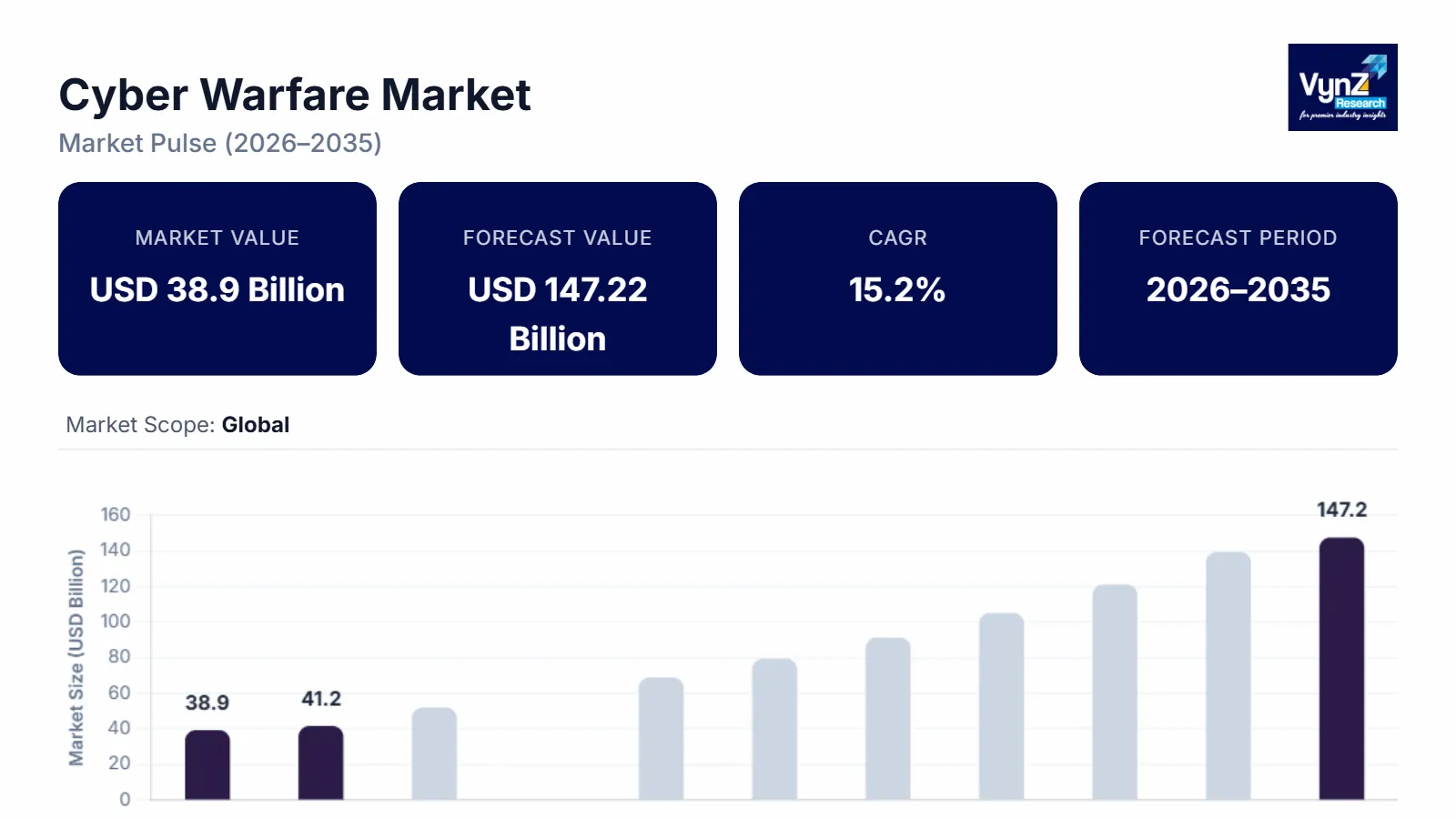
Market growth will be stimulated by higher levels of protection needed for military networks, increasing cyber espionage levels, the modernization of command-and-control infrastructure, and the application of artificial intelligence to threaten detection and response. NATO has also maintained its efforts to improve cyber defense as an operational capability with its 2025 Cyber Coalition exercise, where 1,300 cyber defenders from NATO Allies and partner states responded to authentic cyber security incidents, and it assessed 4,875 incidents between July 2024 and June 2025.
Research Methodology
VynZ Research employs a blend of secondary research, company disclosures, government publications, regulatory reports, tech assessments, industry databases, and methodical market analysis. The VynZ Research team assesses market indicators across component deployment security, end user, and regional factors, then triangulates the various figures available to produce a cohesive 2025 base year and 2026 to 2035 projections. Government and institutional sources including NATO, ENISA ,the UK Department for Science, Innovation and Technology, and other public bodies are taken into account where relevant to cyber defense expenditure, threat activity, infrastructure security, and technology penetration.
Research Highlights
- Solutions accounted for an estimated 66.80% of the market in 2025, supported by continuing procurement of integrated cyber defense and mission security platforms.
- Cloud based deployment is estimated to expand at approximately 17.40% CAGR from 2026 to 2035 due to greater use of distributed command, intelligence, and data environments.
- Defense and aerospace represented approximately 32.10% of market revenue in 2025, reflecting sustained modernization of digitally connected military systems.
- Services are estimated to record approximately 16.10% CAGR from 2026 to 2035, as organizations require specialized monitoring, incident response, training, and mission support.
- North America accounted for approximately 39.40% of the market in 2025, because of established defense cyber programs and sustained investment in digital resilience.
Cyber Warfare Market Dynamics
Market Trends
The global cyber warfare market is converging towards integrated platforms that unify threat intelligence, network monitoring, identity controls, cloud protection, analytics, and automated response, driven by the increased complexity of digitally connected systems across military and government networks. NATO’s 2026 Alliance Digital Strategy highlights the importance of Zero Trust principles, post quantum cryptography, mission critical service protection, and collaboration with trusted technology providers as central to future cyber resilience, reflecting an overall shift towards continuous verification and security embedded within operational systems. A further trend is the increased utilization of artificial intelligence and automation within cyber defense, as highlighted within Microsoft’s 2025 Digital Defense Report, which recognizes the rising use of AI by threat actors, but also the emphasis on AI, automation, identity protection, cloud resilience, and collaboration as defensive priorities.
Growth Drivers
The growth trajectory of the market is significantly propelled by the digital transformation of military command, intelligence, communications, and mission control functions. NATO reported that malicious cyber activity continues to target critical infrastructure, military installations, and government services, and its newly established Integrated Cyber Defense Centre commenced operations in 2025, aiming to bolster situational awareness and protection of the Alliance’s cyber domains. Such strategic initiatives underscore the demand for secure, reliable communications, monitoring systems, cyber networks, and mission specific capabilities. The increased emphasis on the protection of critical infrastructure is another key growth driver, as organizations across government, defense, utilities, transport, health, and communications rely on increasingly interconnected digital systems.
Market Restraints / Challenges
Despite the attractive growth outlook, the market is challenged by the complexities of skills shortages, procurement processes, and the need for interoperability across legacy and emerging cloud-based technologies, particularly as defense organizations seek to transition towards more agile and scalable digital infrastructures. The evolving nature of cyber threats and the rapid pace of technological advancement further contribute to the challenges within the market. Microsoft’s 2025 Digital Defense Report highlighted the increased use of artificial intelligence by threat actors to drive phishing at scale and automate intrusion attempts, while attacks against cloud environments are also becoming more disruptive. As such, organizations are required to make ongoing investments in skilled personnel, infrastructure, threat intelligence, secure software development, and monitoring, increasing the financial and operational burden associated with sustaining cyber resilience.
Market Opportunities
The market presents attractive opportunities for providers that can offer integrated cyber defense platforms which unify network, endpoint, cloud, identity, threat intelligence, and security operations capabilities, as governments and defense organizations seek to transition towards more consolidated views across dispersed systems. NATO’s 2026 digital strategy further reflects the emphasis on Zero Trust, secure data handling, post quantum cryptography, and the need for mission critical service protection, as well as the value of trusted technology partnerships. Such requirements highlight opportunities for providers that can embed security functions within command, communications, intelligence, and mission control environments. An additional opportunity is represented by the growing adoption of artificial intelligence for threat detection, along with the development of cyber ranges, simulation platforms, and specialized cyber services which support the training, testing, and operational readiness of defense organizations.
Global Cyber Warfare Market Report Coverage
|
Report Metric |
Details |
|
Historical Period |
2020 - 2024 |
|
Base Year Considered |
2025 |
|
Forecast Period |
2026 - 2035 |
|
Market Size in 2025 |
USD 38.95 Billion |
|
Revenue Forecast in 2035 |
USD 147.22 Billion |
|
Growth Rate |
15.2% |
|
Segments Covered in the Report |
Offering, Deployment Mode, Solution Type, End User |
|
Report Scope |
Market Trends, Drivers, and Restraints; Revenue Estimation and Forecast; Segmentation Analysis; Companies’ Strategic Developments; Market Share Analysis of Key Players; Company Profiling |
|
Regions Covered in the Report |
North America, Europe, Asia Pacific, Rest of the World |
|
Key Companies |
BAE Systems, Boeing, Booz Allen Hamilton, Check Point Software Technologies, Cisco Systems, General Dynamics, Israel Aerospace Industries, Leonardo, Lockheed Martin, Microsoft |
|
Customization |
Available upon request |
Cyber Warfare Market Segmentation
By Offering
Based on offering, solutions represented the largest portion of the market in 2025, accounting for an estimated 66.80% of revenue. The position reflects the continuing requirement for integrated platforms supporting network protection, threat intelligence, mission security, cyber situational awareness, and digital infrastructure protection.
Services are expected to record approximately 16.10% CAGR from 2026 to 2035, supported by increasing demand for specialized expertise and continuous operational support.
By Deployment Mode
On premise environments retained an estimated 36.70% share in 2025 because defense organizations continue to operate sensitive workloads in controlled environments where classification, connectivity, latency, and mission assurance requirements remain important.
Cloud based deployment is expected to register approximately 17.40% CAGR from 2026 to 2035. NATO's Alliance Digital Strategy places emphasis on secure digital infrastructure, Zero Trust principles, resilient mission critical services, and trusted technology collaboration, while Microsoft has highlighted secure cloud and edge architectures for defense and intelligence environments.
By Solution Type
Network security accounted for an estimated 38.20% share of the market in 2025, reflecting its foundational role in protecting communications, command systems, operational networks, and connected infrastructure.
Cloud security and endpoint protection will record faster growth at 19.27% CAGR due to greater adoption as defense organizations extend digital operations beyond traditional controlled networks. Demand is consequently moving toward security architectures capable of protecting identities, endpoints, applications, data, and cloud workloads together rather than treating each environment as an isolated security layer.
By End User
Defense and aerospace represented approximately 32.10% of market revenue in 2025, making it the largest end user category. The concentration reflects the strategic importance of military command networks, intelligence systems, communications infrastructure, weapons platforms, and mission data.
Critical infrastructure operators and government organizations are also generating increasing demand because essential services depend on interconnected digital systems, and expected to register 21.28% CAGR during the forecast period.
Regional Insights
North America
North America accounted for approximately 39.40% of the Cyber Warfare market in 2025, supported by extensive defense modernization programs, established cybersecurity industries, and significant government investment in digital infrastructure protection. The United States maintains a broad ecosystem spanning defense contractors, technology companies, federal agencies, intelligence organizations, and specialized cybersecurity providers. NATO's continued development of integrated cyber defense capabilities also reinforces cooperation between North American and allied institutions, supporting demand for advanced cyber situational awareness, resilient communications, threat intelligence, and secure mission systems.
Europe
Europe held an estimated 18.60% market share in 2025, supported by growing investment in cyber resilience, military modernization, critical infrastructure protection, and cross border cooperation. NATO reported continued cyber activity against government services, critical infrastructure, and military operations, while the European Commission's cyber defense policy focuses on stronger cooperation, improved detection and response, and greater resilience. These priorities are increasing demand for secure digital infrastructure, cyber monitoring, incident response, and specialized defense capabilities.
Asia Pacific
Asia Pacific represented nearly 17.10% of the market in 2025 and is expected to register the fastest regional expansion through the forecast period. Growth is supported by rapid digitalization, modernization of military communications, expanding critical infrastructure, and rising investment in national cyber capabilities. Regional governments are increasingly focused on protecting strategic infrastructure and public services as connectivity expands, while defense organizations are incorporating cyber capabilities into broader modernization programs.
Rest of the World
Rest of the World accounted for the remaining approximately 24.90% of the market in 2025, covering Latin America, the Middle East, and Africa along with other markets outside the three principal regional groups. Demand is supported by expanding digital infrastructure, government modernization, critical infrastructure protection, and increasing dependence on connected public services. The development of national cybersecurity institutions and greater cooperation with international organizations are supporting the gradual expansion of cyber capabilities.
Competitive Landscape / Company Insights
The cyber warfare market is moderately to highly competitive, with defense contractors, cybersecurity specialists, cloud technology providers, and government technology integrators participating across different capability areas. Companies are investing in artificial intelligence, threat intelligence, secure cloud environments, cyber resilience, zero trust architectures, and mission focused services. NATO identifies industry cooperation as an important element of cyber capability development, while the UK Department for Science, Innovation and Technology identifies substantial activity across cyber products, services, managed security, and specialist providers. Competitive activity therefore spans both established defense groups and technology focused cybersecurity companies.
Mini Profiles
BAE Systems focuses on defense, intelligence, cyber technology, and mission systems, supported by extensive relationships with government and military customers across major defense markets.
Boeing combines aerospace and defense capabilities with digital engineering, secure systems, communications, and technology programs supporting connected military and government environments.
General Dynamics provides cyber, information technology, mission systems, secure communications, and technology services for defense, intelligence, and government customers.
Lockheed Martin develops integrated cyber capabilities spanning offensive and defensive technologies, resilient platforms, artificial intelligence, threat detection, and secure mission architectures.
Microsoft supports government and defense organizations through cloud, identity, security operations, artificial intelligence, threat intelligence, and secure digital infrastructure capabilities.
Key Players
- BAE Systems
- Boeing
- Booz Allen Hamilton
- Check Point Software Technologies
- Cisco Systems
- General Dynamics
- Israel Aerospace Industries
- Leonardo
- Lockheed Martin
- Microsoft
Recent Developments
General Dynamics announced a $285 million cybersecurity services contract through General Dynamics Information Technology to support Virginia agencies with vulnerability management, zero trust services, artificial intelligence enabled monitoring, and a 24-hour security operations center.
Lockheed Martin highlighted artificial intelligence and machine learning applications for cybersecurity in 2025, including threat detection, vulnerability assessment, and cloud transformation. The company described these technologies as part of broader efforts to improve cyber resilience across defense platforms and mission systems.
BAE Systems launched Velhawk cybersecurity solutions to strengthen customer resilience and accelerate cyber defense capabilities. The company has also continued cyber research and development focused on resilient systems capable of adapting to evolving attacks and protecting mission environments.
Global Cyber Warfare Market Coverage
Offering Insight and Forecast 2026 - 2035
- Solutions
- Services
Deployment Mode Insight and Forecast 2026 - 2035
- On Premises
- Cloud Based
- Hybrid
Solution Type Insight and Forecast 2026 - 2035
- Network Security
- Endpoint Security
- Cloud Security
- Others
End User Insight and Forecast 2026 - 2035
- Defense and Aerospace
- Critical Infrastructure Operators
- Intelligence Agencies
- Government
- Other End Users
Global Cyber Warfare Market by Region
- North America
- By Offering
- By Deployment Mode
- By Solution Type
- By End User
- By Country - U.S., Canada, Mexico
- Europe
- By Offering
- By Deployment Mode
- By Solution Type
- By End User
- By Country - Germany, U.K., France, Italy, Spain, Russia, Rest of Europe
- Asia-Pacific (APAC)
- By Offering
- By Deployment Mode
- By Solution Type
- By End User
- By Country - China, Japan, India, South Korea, Vietnam, Thailand, Malaysia, Rest of Asia-Pacific
- Rest of the World (RoW)
- By Offering
- By Deployment Mode
- By Solution Type
- By End User
- By Country - Brazil, Saudi Arabia, South Africa, U.A.E., Other Countries
Table of Contents for Cyber Warfare Market Report
1. Research Overview
1.1. The Report Offers
1.2. Market Coverage
1.2.1. By
Offering
1.2.2. By
Deployment Mode
1.2.3. By
Solution Type
1.2.4. By
End User
1.3. Research Phases
1.4. Limitations
1.5. Market Methodology
1.5.1. Data Sources
1.5.1.1.
Primary Research
1.5.1.2.
Secondary Research
1.5.2. Methodology
1.5.2.1.
Data Exploration
1.5.2.2.
Forecast Parameters
1.5.2.3.
Data Validation
1.5.2.4.
Assumptions
1.5.3. Study Period & Data Reporting Unit
2. Executive Summary
3. Industry Overview
3.1. Industry Dynamics
3.1.1. Market Growth Drivers
3.1.2. Market Restraints
3.1.3. Key Market Trends
3.1.4. Major Opportunities
3.2. Industry Ecosystem
3.2.1. Porter’s Five Forces Analysis
3.2.2. Recent Development Analysis
3.2.3. Value Chain Analysis
3.3. Competitive Insight
3.3.1. Competitive Position of Industry
Players
3.3.2. Market Attractive Analysis
3.3.3. Market Share Analysis
4. Global Market Estimate and Forecast
4.1. Global Market Overview
4.2. Global Market Estimate and Forecast to 2035
5. Market Segmentation Estimate and Forecast
5.1. By Offering
5.1.1. Solutions
5.1.1.1. Market Definition
5.1.1.2. Market Estimation and Forecast to 2035
5.1.2. Services
5.1.2.1. Market Definition
5.1.2.2. Market Estimation and Forecast to 2035
5.2. By Deployment Mode
5.2.1. On Premises
5.2.1.1. Market Definition
5.2.1.2. Market Estimation and Forecast to 2035
5.2.2. Cloud Based
5.2.2.1. Market Definition
5.2.2.2. Market Estimation and Forecast to 2035
5.2.3. Hybrid
5.2.3.1. Market Definition
5.2.3.2. Market Estimation and Forecast to 2035
5.3. By Solution Type
5.3.1. Network Security
5.3.1.1. Market Definition
5.3.1.2. Market Estimation and Forecast to 2035
5.3.2. Endpoint Security
5.3.2.1. Market Definition
5.3.2.2. Market Estimation and Forecast to 2035
5.3.3. Cloud Security
5.3.3.1. Market Definition
5.3.3.2. Market Estimation and Forecast to 2035
5.3.4. Others
5.3.4.1. Market Definition
5.3.4.2. Market Estimation and Forecast to 2035
5.4. By End User
5.4.1. Defense and Aerospace
5.4.1.1. Market Definition
5.4.1.2. Market Estimation and Forecast to 2035
5.4.2. Critical Infrastructure Operators
5.4.2.1. Market Definition
5.4.2.2. Market Estimation and Forecast to 2035
5.4.3. Intelligence Agencies
5.4.3.1. Market Definition
5.4.3.2. Market Estimation and Forecast to 2035
5.4.4. Government
5.4.4.1. Market Definition
5.4.4.2. Market Estimation and Forecast to 2035
5.4.5. Other End Users
5.4.5.1. Market Definition
5.4.5.2. Market Estimation and Forecast to 2035
6. North America Market Estimate and Forecast
6.1. By
Offering
6.2. By
Deployment Mode
6.3. By
Solution Type
6.4. By
End User
6.4.1.
U.S. Market Estimate and Forecast
6.4.2.
Canada Market Estimate and Forecast
6.4.3.
Mexico Market Estimate and Forecast
7. Europe Market Estimate and Forecast
7.1. By
Offering
7.2. By
Deployment Mode
7.3. By
Solution Type
7.4. By
End User
7.4.1.
Germany Market Estimate and Forecast
7.4.2.
France Market Estimate and Forecast
7.4.3.
U.K. Market Estimate and Forecast
7.4.4.
Italy Market Estimate and Forecast
7.4.5.
Spain Market Estimate and Forecast
7.4.6.
Russia Market Estimate and Forecast
7.4.7.
Rest of Europe Market Estimate and Forecast
8. Asia-Pacific (APAC) Market Estimate and Forecast
8.1. By
Offering
8.2. By
Deployment Mode
8.3. By
Solution Type
8.4. By
End User
8.4.1.
China Market Estimate and Forecast
8.4.2.
Japan Market Estimate and Forecast
8.4.3.
India Market Estimate and Forecast
8.4.4.
South Korea Market Estimate and Forecast
8.4.5.
Rest of Asia-Pacific Market Estimate and Forecast
9. Rest of the World (RoW) Market Estimate and Forecast
9.1. By
Offering
9.2. By
Deployment Mode
9.3. By
Solution Type
9.4. By
End User
9.4.1.
Brazil Market Estimate and Forecast
9.4.2.
Saudi Arabia Market Estimate and Forecast
9.4.3.
South Africa Market Estimate and Forecast
9.4.4.
U.A.E. Market Estimate and Forecast
9.4.5.
Other Countries Market Estimate and Forecast
10. Company Profiles
10.1.
BAE Systems
10.1.1.
Snapshot
10.1.2.
Overview
10.1.3.
Offerings
10.1.4.
Financial
Insight
10.1.5.
Recent
Developments
10.2.
Boeing
10.2.1.
Snapshot
10.2.2.
Overview
10.2.3.
Offerings
10.2.4.
Financial
Insight
10.2.5.
Recent
Developments
10.3.
Booz Allen Hamilton
10.3.1.
Snapshot
10.3.2.
Overview
10.3.3.
Offerings
10.3.4.
Financial
Insight
10.3.5.
Recent
Developments
10.4.
Check Point Software Technologies
10.4.1.
Snapshot
10.4.2.
Overview
10.4.3.
Offerings
10.4.4.
Financial
Insight
10.4.5.
Recent
Developments
10.5.
Cisco Systems
10.5.1.
Snapshot
10.5.2.
Overview
10.5.3.
Offerings
10.5.4.
Financial
Insight
10.5.5.
Recent
Developments
10.6.
General Dynamics
10.6.1.
Snapshot
10.6.2.
Overview
10.6.3.
Offerings
10.6.4.
Financial
Insight
10.6.5.
Recent
Developments
10.7.
Israel Aerospace Industries
10.7.1.
Snapshot
10.7.2.
Overview
10.7.3.
Offerings
10.7.4.
Financial
Insight
10.7.5.
Recent
Developments
10.8.
Leonardo
10.8.1.
Snapshot
10.8.2.
Overview
10.8.3.
Offerings
10.8.4.
Financial
Insight
10.8.5.
Recent
Developments
10.9.
Lockheed Martin
10.9.1.
Snapshot
10.9.2.
Overview
10.9.3.
Offerings
10.9.4.
Financial
Insight
10.9.5.
Recent
Developments
10.10.
Microsoft
10.10.1.
Snapshot
10.10.2.
Overview
10.10.3.
Offerings
10.10.4.
Financial
Insight
10.10.5.
Recent
Developments
11. Appendix
11.1. Exchange Rates
11.2. Abbreviations
Note: Financial insight and recent developments of different companies are subject to the availability of information in the secondary domain.
Frequently Asked Questions
Purchase Options
Latest Report
Research Methodology
- Desk Research / Pilot Interviews
- Build Market Size Model
- Research and Analysis
- Final Deliverable
Connect With Our Sales Team
- Toll-Free: +1-888-253-3960
- Phone: +91 9960 288 381
- Email: enquiry@vynzresearch.com
Cyber Warfare Market