
Aircraft Wheels & Brakes Market Size & Share Growth Forecast Report (2026-2035)
Industry Insight by Wheel Type (Main landing gear wheels, Nose wheels), by Brake Type (Carbon brakes, Steel brakes), by Aircraft Type (Commercial aircraft, Military aircraft, General aviation and other aircraft), by End User (Original equipment manufacturers, Aftermarket)
| Status : Published | Published On : Oct, 2026 | Report Code : VRAD12058 | Industry : Aerospace and Defense | Available Format :

|
Page : 158 |
Aircraft Wheels & Brakes Market Overview
The global aircraft wheels and brakes market was estimated at USD 5.23 billion in 2025 and is projected to reach USD 5.58 billion in 2026, expanding to USD 9.91 billion by 2035 at a proposed CAGR of 6.6% from 2026 to 2035.
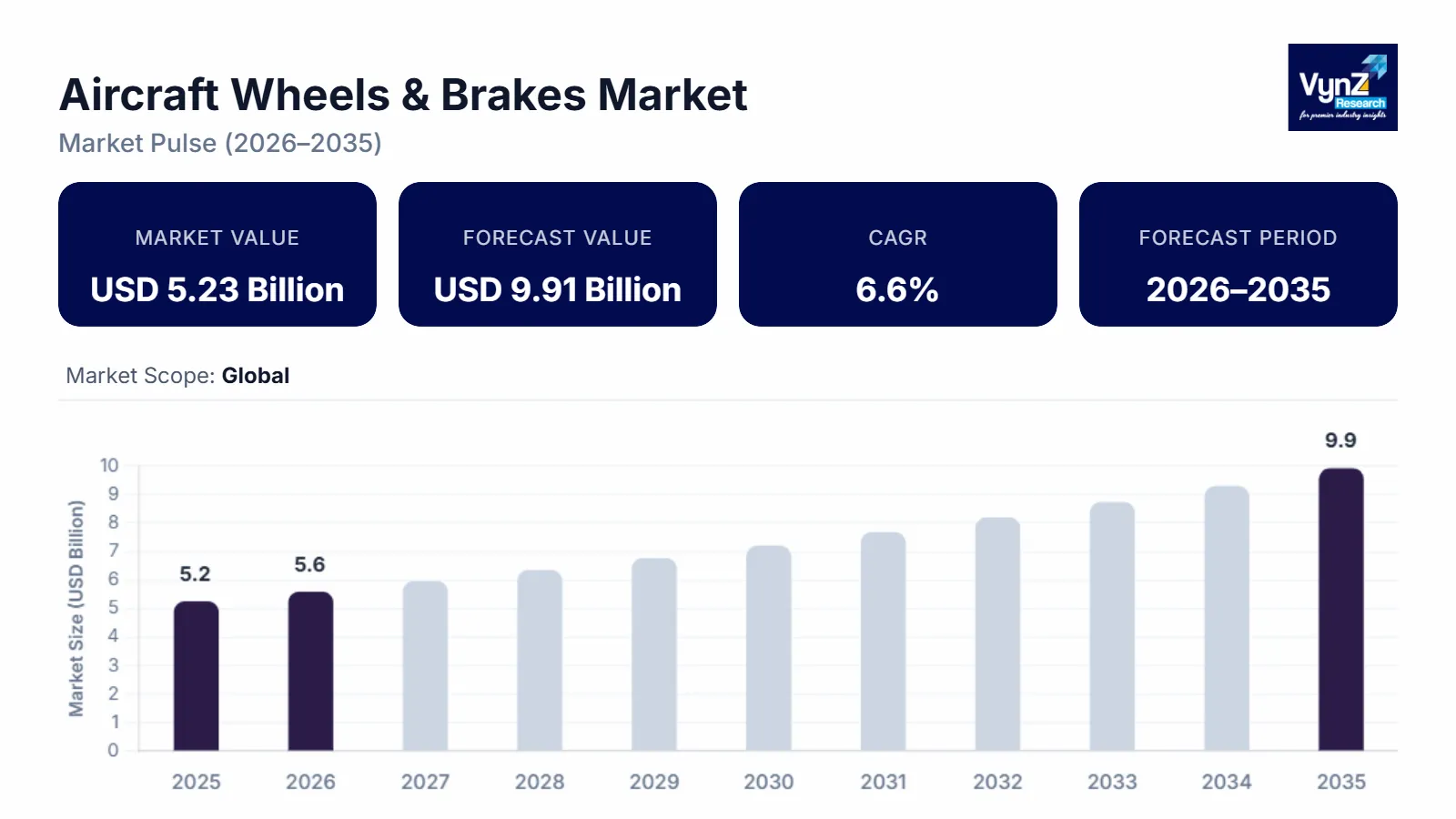
The estimates reflect demand for aircraft wheel assemblies, carbon and steel brakes, braking controls, and aftermarket services across commercial and military aviation. Market expansion is supported by rising commercial aircraft production, defence fleet modernization, and recurring replacement requirements for components exposed to high mechanical loads and braking temperatures. Carbon friction materials, electronic braking controls, and manufacturing automation are also influencing procurement decisions by helping operators manage aircraft weight, component life, and maintenance schedules. Boeing's long-term outlook anticipates substantial growth in the global commercial fleet, while the Federal Aviation Administration's airframe maintenance guidance highlights the need for regular inspection of wheels, bearings, tyres, and brakes. These factors support demand across new aircraft programmes and the installed fleet.
Research Methodology
VynZ Research evaluates the industry through secondary research covering aircraft component manufacturers, aerospace suppliers, aviation regulators, airline fleet requirements, and maintenance, repair and overhaul activities. The VynZ Research team reviews published market estimates, company disclosures, aircraft production outlooks, and technical information to establish a consistent definition of the market. The analysis distinguishes wheels and brakes from broader landing gear and aircraft braking systems to reduce the risk of combining non-comparable revenue estimates. Forecast assumptions are then assessed against fleet expansion, replacement demand, material innovation, and aftermarket requirements, with proposed figures adjusted to maintain consistency across the forecast period.
Research Highlights
- The main landing gear wheel segment accounted for approximately 65% of the market demand in 2025 , supported by its greater load-bearing requirements and role in supporting most aircraft weight during landing.
- Carbon brakes accounted for around 61% of revenue in 2025, supported by their favorable weight characteristics.
- Commercial aircraft represented nearly 72% of total market revenue in 2025, reflecting the size of the passenger and cargo fleet, ongoing aircraft deliveries, and regular maintenance requirements.
- The aftermarket segment is projected to expand at an estimated 7% CAGR through 2035, as repeated landing cycles generate ongoing demand for inspections, brake replacement, wheel servicing, and overhaul.
- North America held approximately 34% of global revenue in 2025, supported by its established aerospace manufacturing base, extensive aircraft fleet, and strong maintenance infrastructure.
Aircraft Wheels & Brakes Market Dynamics
Market Trends
The industry is moving towards lighter wheel assemblies, longer-life friction materials, and braking systems that simplify maintenance without compromising operational reliability. Carbon brakes are gaining relevance on suitable commercial and military aircraft because their lower weight and heat-management characteristics can help reduce operating burdens. Collins Aerospace identifies longer brake life, lower weight, and faster cooling as benefits of its DURACARB carbon brake technology, while also emphasizing reduced maintenance requirements. These engineering priorities are influencing aircraft manufacturers and operators as they assess lifecycle costs rather than initial component prices alone. Another important trend is the integration of electronic controls, monitoring capabilities, and more automated manufacturing processes.
Growth Drivers
Commercial fleet expansion remains a major demand driver because every new aircraft requires certified wheels and braking equipment, while aircraft already in service generate continuing replacement and maintenance requirements. Growth in air travel, fleet renewal, and the expansion of airline networks support demand for both original equipment and aftermarket components. Military aircraft procurement and fleet sustainment provide another source of demand, particularly for durable components and braking controls designed for demanding operating conditions. The FAA's maintenance guidance also demonstrates the importance of inspecting wheels, bearings, tires, and brakes as part of airframe maintenance. Together, aircraft production, defense programs, and mandatory maintenance practices support demand across both original equipment and aftermarket channels.
Market Restraints / Challenges
High certification requirements, substantial engineering costs, and lengthy qualification cycles can limit the entry of new suppliers. Wheels and brakes are safety-critical aircraft components, and manufacturers must demonstrate reliable performance under demanding loads, temperatures, and operating conditions. Any design change can require extensive testing and approval before entering service, increasing development costs and extending commercialization timelines. Suppliers must also maintain traceability, production consistency, and technical support throughout the component lifecycle, making it difficult for smaller manufacturers to compete directly with established aerospace suppliers across major commercial and defense programs. Supply chain constraints and production bottlenecks can further affect delivery schedules and profitability.
Market Opportunities
The growing installed aircraft fleet creates opportunities in component repair, overhaul, exchange programs, and long-term supply agreements. Aftermarket services can provide recurring revenue because wheels and brakes experience repeated stress during taxiing, take-off, and landing operations. Suppliers that combine replacement components with technical support, repair capacity, and efficient distribution can improve availability for airlines and defense operators. This opportunity is particularly relevant to older fleets, where extending component life and maintaining dependable parts supply can be more practical than replacing aircraft. Long-term service agreements also help operators plan maintenance costs and reduce the risk of extended aircraft downtime. A further opportunity lies in advanced carbon brakes, electronic braking controls, and more efficient manufacturing processes. New aircraft programs and fleet modernization can support the adoption of improved braking systems, while automated production may help manufacturers increase output without proportionately expanding factory space. Investment in repair networks and regional service capabilities can also strengthen supplier access to airlines operating in growing aviation markets.
Global Aircraft Wheels & Brakes Market Report Coverage
|
Report Metric |
Details |
|
Historical Period |
2020 - 2024 |
|
Base Year Considered |
2025 |
|
Forecast Period |
2026 - 2035 |
|
Market Size in 2025 |
USD 5.23 Billion |
|
Revenue Forecast in 2035 |
USD 9.91 Billion |
|
Growth Rate |
6.6% |
|
Segments Covered in the Report |
Wheel Type, Brake Type, Aircraft Type, End User |
|
Report Scope |
Market Trends, Drivers, and Restraints; Revenue Estimation and Forecast; Segmentation Analysis; Companies’ Strategic Developments; Market Share Analysis of Key Players; Company Profiling |
|
Regions Covered in the Report |
North America, Europe, Asia Pacific, Rest of the World |
|
Key Companies |
AAR, Boeing, Collins Aerospace, Crane Aerospace & Electronics, Eaton, Honeywell, Liebherr, Meggitt, Parker Hannifin, Safran |
|
Customization |
Available upon request |
Aircraft Wheels & Brakes Market Segmentation
By Wheel Type
Main landing gear wheels held the largest share, accounting for approximately 65% of the revenue in 2025, owing to their greater load-bearing role and the multiple wheel assemblies used on many commercial aircraft.
Nose wheels segment is estimated to grow at a 6.8% CAGR from 2026 to 2035, reflecting the need for reliable nose wheel assemblies across new aircraft and the existing fleet. The Federal Aviation Administration's maintenance guidance identifies wheels and associated components as important inspection items, reinforcing the role of continuing maintenance in this segment.
By Brake Type
Carbon brakes accounted for around 61% of revenue in 2025, supported by their favorable weight characteristics, heat absorption capacity, and potential for longer service intervals on suitable aircraft.
Steel brakes remain relevant where aircraft design, operating conditions, acquisition cost, and maintenance practices favor their use and estimated growth of 8.2% CAGR from 2026 to 2035. Their demand is supported by established applications and replacement requirements across selected aircraft platforms.
By Aircraft Type
Commercial aircraft represented nearly 72% of total market revenue in 2025, reflecting the size of the passenger and cargo fleet, ongoing aircraft deliveries, and regular maintenance requirements.
Military aircraft demand is supported by fleet modernization, defense procurement, and the need to maintain operational readiness across transport, fighter, and other mission aircraft. This category is expected to grow at 6.4% CAGR from 2026 to 2035, depending on production capabilities.
By End User
OEMs contributed around 57% of the market in 2025, supported by commercial aircraft production, military aircraft programs, and demand for factory-installed wheel and brake systems.
The aftermarket is projected to record an estimated 7% CAGR from 2026 to 2035, driven by component wear, scheduled inspections, repairs, replacement, and overhaul.
Regional Insights
North America
North America accounted for 34% of global revenue in 2025, supported by established aircraft manufacturing, a substantial commercial fleet, defense aviation programs, and a mature maintenance network. The United States remains an important center for aerospace engineering and component production, with suppliers serving both original equipment programs and aftermarket customers. The Federal Aviation Administration's airframe maintenance guidance reinforces the continuing importance of inspection and servicing for wheels, bearings, tires, and brakes. These established capabilities support regional demand for certified components, replacement parts, and technical services.
Europe
Europe represented 27% of global revenue in 2025, owing to aircraft manufacturing, aerospace component engineering, and the presence of established landing and braking system suppliers. France, Germany, the United Kingdom, and other aerospace centers contribute to the region's manufacturing and maintenance ecosystem. Safran's investment in additional machining and surface treatment facilities at Molsheim, France, in 2025 demonstrates continued efforts to expand production and maintenance capacity for landing and braking systems. Such investment supports suppliers' ability to serve aircraft production programs and airline maintenance requirements.
Asia Pacific
Asia Pacific held 24% of global revenue in 2025 and is expected to remain an important growth region as airlines expand capacity, new aircraft enter service, and regional maintenance capabilities develop. China, India, Japan, and Southeast Asian markets contribute through commercial aviation, manufacturing partnerships, and fleet support requirements. Boeing's long-term outlook identifies emerging markets as an important source of future aircraft demand, driven by expanding airline networks and sustained aviation investment. Growth in this region will depend on aircraft deliveries, local supplier capability, and the availability of certified repair and overhaul services.
Rest of the World
The rest of the world accounted for 15% of global revenue in 2025, including the Middle East, Latin America, and Africa. Demand is supported by airline fleet expansion, defense requirements, and investment in aviation infrastructure, although market maturity and local maintenance capacity vary significantly across countries. In the Middle East, Safran's 2025 agreement with Riyadh Air to supply wheels and electric carbon brakes for its future Boeing 787-9 fleet illustrates the opportunities created by new airline programs.
Competitive Landscape / Company Insights
The industry is concentrated among established aerospace suppliers with certified products, long-standing aircraft manufacturer relationships, and global service networks. Safran, Collins Aerospace, Honeywell, and Meggitt are identified among the principal participants in wheels and brakes, while specialized suppliers contribute braking controls and related components. Competition centers on product reliability, weight reduction, lifecycle cost, manufacturing capacity, and aftermarket support rather than price alone. Investments in carbon friction technology, production automation, and repair capabilities are helping suppliers respond to aircraft production growth and recurring maintenance demand.
Mini Profiles
AAR provides aviation aftermarket services, including component support and repair capabilities, serving commercial and government operators through an established aerospace services network.
Boeing develops commercial and defense aircraft programs that create demand for certified wheels, braking systems, replacement parts, and lifecycle support across global fleets.
Collins Aerospace supplies aircraft wheels and braking systems, including carbon brake technology designed to reduce component weight, extend brake life, and improve maintenance efficiency.
Eaton supplies aerospace components and hydraulic technologies that support aircraft system performance, with repair and aftermarket services contributing to lifecycle support.
Honeywell participates in aerospace systems and component markets, serving aircraft operators and manufacturers through established engineering capabilities and global customer relationships.
Key Players
- AAR
- Boeing
- Collins Aerospace
- Crane Aerospace & Electronics
- Eaton
- Honeywell
- Liebherr
- Meggitt
- Parker Hannifin
- Safran
Recent Developments
Safran has secured an agreement to supply wheels and electric carbon brakes for Riyadh Air's future fleet of more than 70 Boeing 787-9 aircraft. The arrangement also includes technical support, brake testing equipment, and assistance with repair capabilities.
Collins Aerospace has entered into distribution agreements to improve parts availability and logistics support for C-130 Hercules wheels and brakes. The initiative is intended to strengthen lifecycle support for military operators and improve access to critical components.
Crane Aerospace & Electronics has been selected to provide a brake control system for Otto Aerospace's Phantom 3500 business jet. The system uses a modular architecture intended to support reliable braking performance while meeting the aircraft program's efficiency requirements.
AAR has signed a component repair agreement with Cebu Pacific, expanding its aftermarket service activities. Such repair arrangements reflect the continuing importance of component availability and maintenance support for airline operations.
Eaton has expanded its commercial aerospace repair support through an authorized service center agreement with AAR covering hydraulic components for large commercial aircraft. The arrangement strengthens regional repair access and supports the wider aircraft component aftermarket.
Global Aircraft Wheels & Brakes Market Coverage
Wheel Type Insight and Forecast 2026 - 2035
- Main landing gear wheels
- Nose wheels
Brake Type Insight and Forecast 2026 - 2035
- Carbon brakes
- Steel brakes
Aircraft Type Insight and Forecast 2026 - 2035
- Commercial aircraft
- Military aircraft
- General aviation and other aircraft
End User Insight and Forecast 2026 - 2035
- Original equipment manufacturers
- Aftermarket
Global Aircraft Wheels & Brakes Market by Region
- North America
- By Wheel Type
- By Brake Type
- By Aircraft Type
- By End User
- By Country - U.S., Canada, Mexico
- Europe
- By Wheel Type
- By Brake Type
- By Aircraft Type
- By End User
- By Country - Germany, U.K., France, Italy, Spain, Russia, Rest of Europe
- Asia-Pacific (APAC)
- By Wheel Type
- By Brake Type
- By Aircraft Type
- By End User
- By Country - China, Japan, India, South Korea, Vietnam, Thailand, Malaysia, Rest of Asia-Pacific
- Rest of the World (RoW)
- By Wheel Type
- By Brake Type
- By Aircraft Type
- By End User
- By Country - Brazil, Saudi Arabia, South Africa, U.A.E., Other Countries
Table of Contents for Aircraft Wheels & Brakes Market Report
1. Research Overview
1.1. The Report Offers
1.2. Market Coverage
1.2.1. By
Wheel Type
1.2.2. By
Brake Type
1.2.3. By
Aircraft Type
1.2.4. By
End User
1.3. Research Phases
1.4. Limitations
1.5. Market Methodology
1.5.1. Data Sources
1.5.1.1.
Primary Research
1.5.1.2.
Secondary Research
1.5.2. Methodology
1.5.2.1.
Data Exploration
1.5.2.2.
Forecast Parameters
1.5.2.3.
Data Validation
1.5.2.4.
Assumptions
1.5.3. Study Period & Data Reporting Unit
2. Executive Summary
3. Industry Overview
3.1. Industry Dynamics
3.1.1. Market Growth Drivers
3.1.2. Market Restraints
3.1.3. Key Market Trends
3.1.4. Major Opportunities
3.2. Industry Ecosystem
3.2.1. Porter’s Five Forces Analysis
3.2.2. Recent Development Analysis
3.2.3. Value Chain Analysis
3.3. Competitive Insight
3.3.1. Competitive Position of Industry
Players
3.3.2. Market Attractive Analysis
3.3.3. Market Share Analysis
4. Global Market Estimate and Forecast
4.1. Global Market Overview
4.2. Global Market Estimate and Forecast to 2035
5. Market Segmentation Estimate and Forecast
5.1. By Wheel Type
5.1.1. Main landing gear wheels
5.1.1.1. Market Definition
5.1.1.2. Market Estimation and Forecast to 2035
5.1.2. Nose wheels
5.1.2.1. Market Definition
5.1.2.2. Market Estimation and Forecast to 2035
5.2. By Brake Type
5.2.1. Carbon brakes
5.2.1.1. Market Definition
5.2.1.2. Market Estimation and Forecast to 2035
5.2.2. Steel brakes
5.2.2.1. Market Definition
5.2.2.2. Market Estimation and Forecast to 2035
5.3. By Aircraft Type
5.3.1. Commercial aircraft
5.3.1.1. Market Definition
5.3.1.2. Market Estimation and Forecast to 2035
5.3.2. Military aircraft
5.3.2.1. Market Definition
5.3.2.2. Market Estimation and Forecast to 2035
5.3.3. General aviation and other aircraft
5.3.3.1. Market Definition
5.3.3.2. Market Estimation and Forecast to 2035
5.4. By End User
5.4.1. Original equipment manufacturers
5.4.1.1. Market Definition
5.4.1.2. Market Estimation and Forecast to 2035
5.4.2. Aftermarket
5.4.2.1. Market Definition
5.4.2.2. Market Estimation and Forecast to 2035
6. North America Market Estimate and Forecast
6.1. By
Wheel Type
6.2. By
Brake Type
6.3. By
Aircraft Type
6.4. By
End User
6.4.1.
U.S. Market Estimate and Forecast
6.4.2.
Canada Market Estimate and Forecast
6.4.3.
Mexico Market Estimate and Forecast
7. Europe Market Estimate and Forecast
7.1. By
Wheel Type
7.2. By
Brake Type
7.3. By
Aircraft Type
7.4. By
End User
7.4.1.
Germany Market Estimate and Forecast
7.4.2.
France Market Estimate and Forecast
7.4.3.
U.K. Market Estimate and Forecast
7.4.4.
Italy Market Estimate and Forecast
7.4.5.
Spain Market Estimate and Forecast
7.4.6.
Russia Market Estimate and Forecast
7.4.7.
Rest of Europe Market Estimate and Forecast
8. Asia-Pacific (APAC) Market Estimate and Forecast
8.1. By
Wheel Type
8.2. By
Brake Type
8.3. By
Aircraft Type
8.4. By
End User
8.4.1.
China Market Estimate and Forecast
8.4.2.
Japan Market Estimate and Forecast
8.4.3.
India Market Estimate and Forecast
8.4.4.
South Korea Market Estimate and Forecast
8.4.5.
Rest of Asia-Pacific Market Estimate and Forecast
9. Rest of the World (RoW) Market Estimate and Forecast
9.1. By
Wheel Type
9.2. By
Brake Type
9.3. By
Aircraft Type
9.4. By
End User
9.4.1.
Brazil Market Estimate and Forecast
9.4.2.
Saudi Arabia Market Estimate and Forecast
9.4.3.
South Africa Market Estimate and Forecast
9.4.4.
U.A.E. Market Estimate and Forecast
9.4.5.
Other Countries Market Estimate and Forecast
10. Company Profiles
10.1.
AAR
10.1.1.
Snapshot
10.1.2.
Overview
10.1.3.
Offerings
10.1.4.
Financial
Insight
10.1.5.
Recent
Developments
10.2.
Boeing
10.2.1.
Snapshot
10.2.2.
Overview
10.2.3.
Offerings
10.2.4.
Financial
Insight
10.2.5.
Recent
Developments
10.3.
Collins Aerospace
10.3.1.
Snapshot
10.3.2.
Overview
10.3.3.
Offerings
10.3.4.
Financial
Insight
10.3.5.
Recent
Developments
10.4.
Crane Aerospace & Electronics
10.4.1.
Snapshot
10.4.2.
Overview
10.4.3.
Offerings
10.4.4.
Financial
Insight
10.4.5.
Recent
Developments
10.5.
Eaton
10.5.1.
Snapshot
10.5.2.
Overview
10.5.3.
Offerings
10.5.4.
Financial
Insight
10.5.5.
Recent
Developments
10.6.
Honeywell
10.6.1.
Snapshot
10.6.2.
Overview
10.6.3.
Offerings
10.6.4.
Financial
Insight
10.6.5.
Recent
Developments
10.7.
Liebherr
10.7.1.
Snapshot
10.7.2.
Overview
10.7.3.
Offerings
10.7.4.
Financial
Insight
10.7.5.
Recent
Developments
10.8.
Meggitt
10.8.1.
Snapshot
10.8.2.
Overview
10.8.3.
Offerings
10.8.4.
Financial
Insight
10.8.5.
Recent
Developments
10.9.
Parker Hannifin
10.9.1.
Snapshot
10.9.2.
Overview
10.9.3.
Offerings
10.9.4.
Financial
Insight
10.9.5.
Recent
Developments
10.10.
Safran
10.10.1.
Snapshot
10.10.2.
Overview
10.10.3.
Offerings
10.10.4.
Financial
Insight
10.10.5.
Recent
Developments
11. Appendix
11.1. Exchange Rates
11.2. Abbreviations
Note: Financial insight and recent developments of different companies are subject to the availability of information in the secondary domain.
Frequently Asked Questions
Purchase Options
Latest Report
Research Methodology
- Desk Research / Pilot Interviews
- Build Market Size Model
- Research and Analysis
- Final Deliverable
Connect With Our Sales Team
- Toll-Free: +1-888-253-3960
- Phone: +91 9960 288 381
- Email: enquiry@vynzresearch.com
Aircraft Wheels & Brakes Market