
Satellite Communication System Market Size & Share Growth Forecast Report (2026-2035)
Industry Insight by Component (Equipment, Services, Software), by Orbit (Low Earth Orbit (LEO), Medium Earth Orbit (MEO), Geostationary Earth Orbit (GEO), Other Orbits), by Platform (Land, Maritime, Airborne, Space), by End User (Commercial, Government and Defence, Other End Users)
| Status : Published | Published On : Jul, 2026 | Report Code : VRAD12052 | Industry : Aerospace and Defense | Available Format :

|
Page : 154 |
Satellite Communication System Market Overview
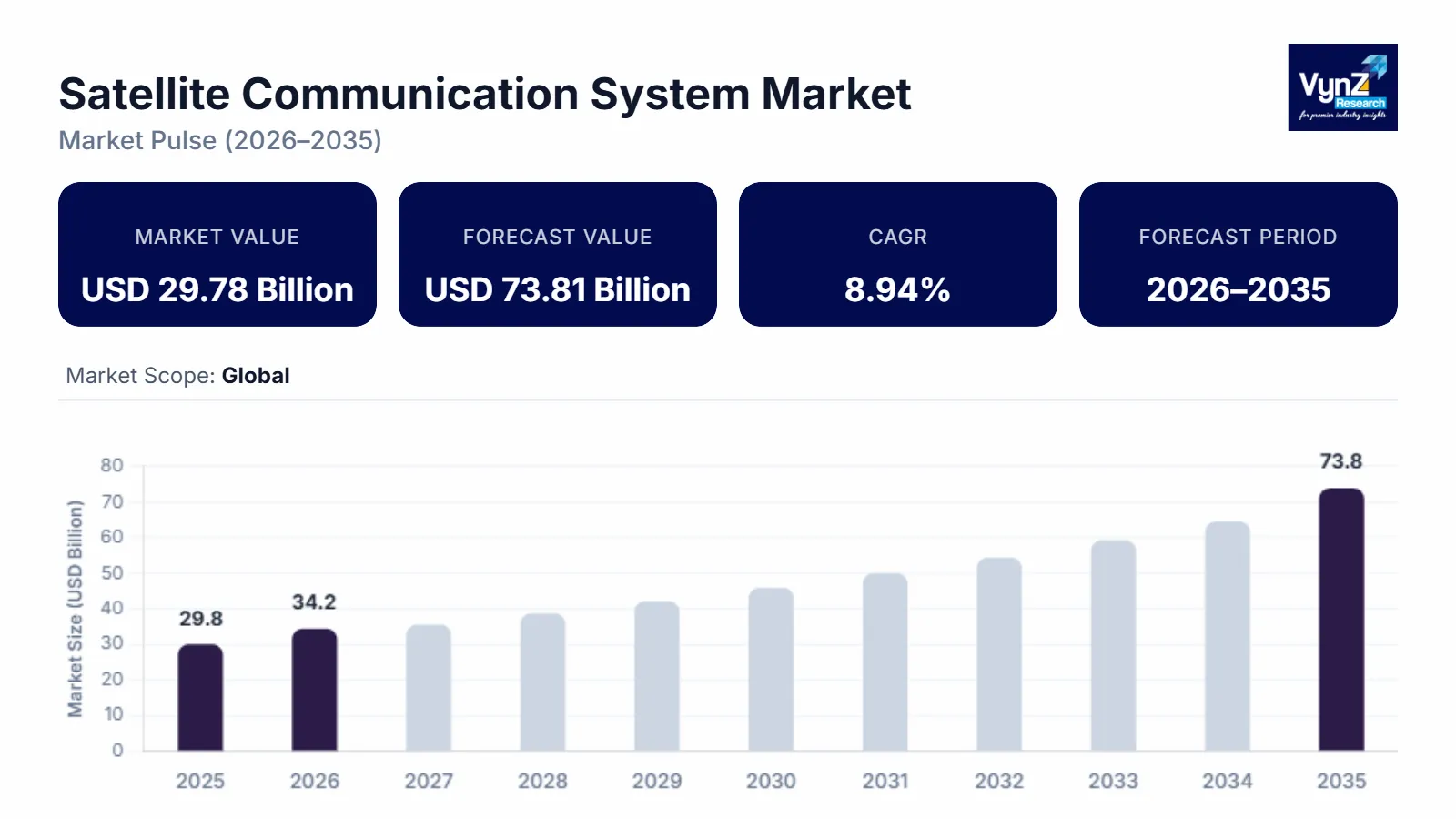
The satellite communication system market size was estimated at about USD 29.78 billion in 2025 and is expected to reach around USD 34.19 billion in 2026, rising to nearly USD 73.81 billion by 2035, growing at an estimated 8.94% CAGR from 2026 to 2035.
Research Highlights
- Equipment held 48.6% market share in 2025 due to expanding satellite infrastructure investments.
- GEO accounted for 52.8% share in 2025 supported by broadcasting and government communications.
- Government and defense captured 46.3% share in 2025 owing to rising security investments.
- LEO segment is projected to grow at 11.4% CAGR because of broadband constellations.
- North America held 34.8% share in 2025, supported by defense and broadband expansion.
Market growth is basically driven by more deployment of low earth orbit satellite constellations, a steadily expanding appetite for high-speed broadband connectivity, and a higher take up of satellite linked defense as well as emergency communications. There is also a growing shift toward software defined satellite networks and at the same time, demand is rising from telecommunications providers, maritime operators, aviation teams, and government bodies, while ongoing investments in national space programs and digital connectivity initiatives keep coming from organizations like NASA, the European Space Agency (ESA), the U.S. Federal Communications Commission (FCC), and the International Telecommunication Union (ITU). All of that supports market expansion across big regions such as North America, Europe, and Asia Pacific, as expected.
Satellite Communication System Market Dynamics
Market Trends
The industry is seeing some real shifts going on around network virtualization, software defined satellite setup, and also higher adoption of low earth orbit constellation types. A big thing shaping the market is how multi orbit satellite networks are getting stitched together more tightly for higher throughput, less delay, and smooth worldwide connectivity. The International Telecommunication Union (ITU) and the European Space Agency (ESA) keep pointing out that expanding satellite capacity and spectrum management efforts still speeds up the move toward the next generation of communication infrastructure, kind of nonstop. Another emerging move is AI enabled satellite operations. This is mostly being pushed by digital transformation, and autonomous network management. There are programs with support from NASA, the U.S. Federal Communications Commission (FCC), and the European Union Space Program (EUSPA) that are nudging companies to lean into intelligent network optimization, secure communications, and connected services that feel integrated end-to-end.
Growth Drivers
The market is mainly being fueled by demand for broadband connectivity, especially across remote areas, defense communication, and commercial aviation. Plus, more investment into national space infrastructure and satellite deployment programs by NASA, the Indian Space Research Organization (ISRO), and the European Space Agency (ESA), is pushing the market forward and improving communication resilience. Also, rapid deployment of low earth orbit satellite constellations is boosting adoption. When governments, enterprises, and telecom operators are prioritizing secure, high speed, reliable services, the appetite for advanced satellite communications systems should stay strong for the forecast window.
Market Restraints / Challenges
Even with all these positive growth signs, there are challenges that could slow the pace. High deployment and launch costs, along with stronger spectrum coordination requirements, keep pressing commercial viability, especially for smaller players that do not have as much funding buffer. The International Telecommunication Union (ITU) notes that spectrum allocation and orbital resource management are still major regulatory headaches. Dependency on specialized satellite components, and advanced semiconductor technologies creates operational constraints for manufacturers. On top of that, supply chain disruptions and limited availability of high reliability electronic components can push costs up, and stretch project timelines.
Market Opportunities
There are some pretty meaningful opportunities here, especially in next generation broadband connectivity. This is most visible through expanding low earth orbit satellite networks and direct to device communication services. Companies that provide high performance, software defined, and digitally controlled satellite solutions are in a good spot to meet demand from telecommunications, maritime, aviation, and government groups. The International Telecommunication Union (ITU) also keeps promoting satellite technologies to strengthen digital inclusion worldwide. Another opportunity comes from satellite enabled Internet of Things, and secure defense communications. With more public and private investment going into this area, long term growth potential looks strong. Advances in artificial intelligence, cloud-based network management, and satellite edge computing, supported through programs led by NASA, ESA, and EUSPA, are expected to improve service efficiency, sharpen network performance, and push more commercial adoption over time.
Global Satellite Communication System Market Report Coverage
|
Report Metric |
Details |
|
Historical Period |
2020 - 2024 |
|
Base Year Considered |
2025 |
|
Forecast Period |
2026 - 2035 |
|
Market Size in 2025 |
USD 29.78 Billion |
|
Revenue Forecast in 2035 |
USD 73.81 Billion |
|
Growth Rate |
8.94% |
|
Segments Covered in the Report |
Component, Orbit, Platform, End User |
|
Report Scope |
Market Trends, Drivers, and Restraints; Revenue Estimation and Forecast; Segmentation Analysis; Companies’ Strategic Developments; Market Share Analysis of Key Players; Company Profiling |
|
Regions Covered in the Report |
North America, Europe, Asia Pacific, Rest of the World |
|
Key Companies |
Airbus SE, Eutelsat, Gilat Satellite Networks, Hughes Network Systems, Intelsat, Iridium Communications, SES S.A., Starlink, Telesat, Viasat Inc. |
|
Customization |
Available upon request |
Satellite Communication System Market Segmentation
By Component
In terms of component, the equipment space takes the lead, with a share estimated around 48.6% in 2025, and that’s mainly linked to steady investments in satellite terminals, gateways, antennas, and onboard comms payloads. At the same time, more satellite launches and ongoing ground infrastructure upgrades keep pushing the need upward. Things like programs managed by NASA, the European Space Agency (ESA) and the Indian Space Research Organization (ISRO) also help speed up the rollout of advanced communication kit for both commercial and government use.
Meanwhile the software segment is set up to grow quickest, with an estimated 10.2% CAGR over the forecast window. Adoption of software defined networking, artificial intelligence-based network management, and cloud enabled satellite operations is giving it that momentum. Also, the International Telecommunication Union (ITU) and the U.S. Federal Communications Commission (FCC) keep pushing more efficient spectrum use and better next generation satellite network management, which makes software adoption stick across the whole industry.
By Orbit
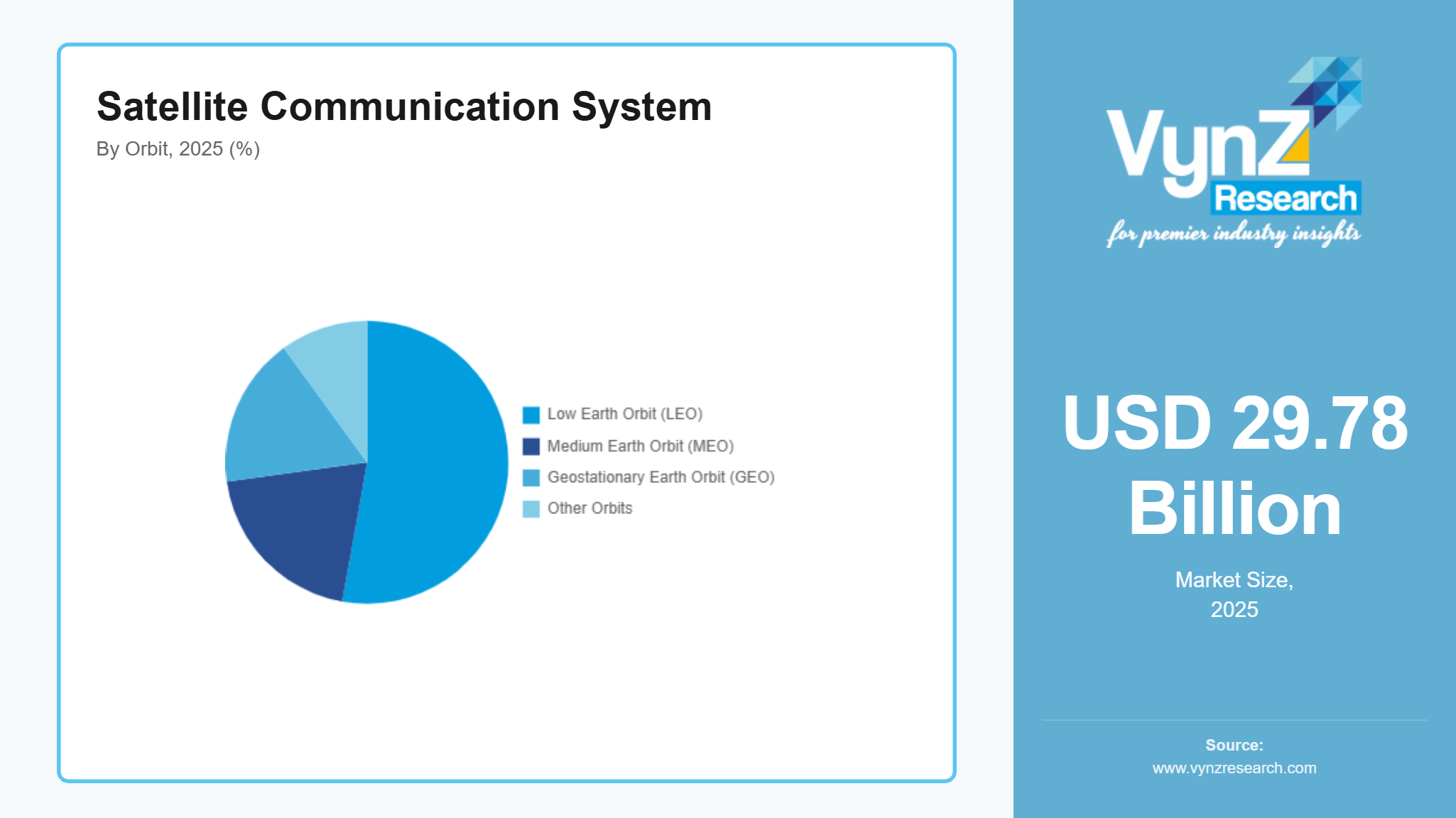
For orbit types, geostationary earth orbit is still the biggest holding about 52.8% market share in 2025. This is largely because it’s already well used in broadcasting, fixed satellite services, and government communication networks. Long service life, wide coverage, and relatively mature infrastructure all play a role in keeping it at the front.
Low earth orbit looks like it’ll climb the most, with an estimated 11.4% CAGR through 2035. More broadband constellation deployments, lower communication latency, and more global connectivity initiatives are pulling investment toward this area. Support from NASA, ESA, and FCC keeps encouraging next generation satellite communication infrastructure, especially for broadband access, defense, and remote connectivity types of use cases.
By Platform
Looking at platform, the land segment takes the largest revenue portion, estimated about 44.9% in 2025. This is supported by broad uptake across defense communications, enterprise connectivity, public safety, and telecommunications infrastructure overall. As digital connectivity projects grow, and as government communication programs keep expanding, demand keeps getting reinforced. Groups like ITU, NASA, and ISRO support satellite enabled terrestrial communication approaches too, aimed at improving links in underserved areas.
The airborne platform is expected to stretch faster, recording around 9.8% CAGR across the forecast period. Demand for in flight connectivity, real time navigation, surveillance systems, plus secure defense communications keep boosting the willingness to invest. Aviation modernization programs supported by the International Civil Aviation Organization (ICAO) and satellite communication initiatives developed by ESA also add fuel to segment growth.
By End User
On end users, government and defense leads by market share, estimated at approximately 46.3% in 2025. The main drivers are increasing investments in secure communications, intelligence activities, disaster response, and national security infrastructure. Defense modernization programs, including those involving the U.S. Department of Defense, NASA, and ESA, continue to strengthen procurement of advanced satellite communication systems.
For commercial, it’s projected to be the fastest grower, with an estimated 9.6% CAGR during the forecast period. Demand for broadband connectivity, maritime communications, aviation services, enterprise networking, and satellite enabled Internet of Things applications is pushing expansion forward. The International Telecommunication Union (ITU) continues to highlight satellite technologies as a core piece of universal digital connectivity, which helps support long term commercial adoption.
Regional Insights
North America
North America made up around 34.8% of the satellite communication system market in 2025, mostly because of big, ongoing spending on satellite communication infrastructure, defense modernization, and commercial broadband services throughout the United States and Canada. There is strong demand from government organizations, aerospace firms, and telecommunications providers which is helping the region keep climbing. Efforts driven by NASA, the U.S. Federal Communications Commission (FCC), and the U.S. Department of Defense (DoD) keep pushing satellite rollouts, spectrum coordination, and safer communication features forward. Also, government plans meant for next generation satellite broadband, plus the mounting uptake of low earth orbit communication networks and space based connectivity services, continue to push businesses toward investment in more advanced satellite systems.
Europe
Europe was estimated at 24.6% of the market in 2025, largely tied to broader commercial satellite programs, defense communication efforts, and cross border digital connectivity initiatives. Demand stays fairly steady as adoption grows in aviation, maritime operations, emergency response, and government communication environments. The European Space Agency (ESA) and the European Union Agency for the Space Program (EUSPA) keep funding secure satellite communication infrastructure and space innovation activities across multiple member countries. More public money aimed at sovereign satellite communication capabilities and sturdier space infrastructure is also giving the market momentum.
Asia Pacific
Asia Pacific represented about 18.9% of the global market in 2025 due to more satellite launches, wider broadband reach, and fast investment in national space programs across China, India, Japan, and South Korea. Groups like the Indian Space Research Organization (ISRO), the China National Space Administration (CNSA), and the Japan Aerospace Exploration Agency (JAXA) are steadily boosting regional satellite communication know-how, mainly through advanced satellite placement and digital infrastructure building. Government investment in satellite manufacturing, earth observation, and secure communication systems helps commercial take-up spread across telecommunications, defense, and aviation. On top of that, national digital connectivity initiatives keep supporting long term market growth across the region.
Rest of the World
The rest of the world accounted for an estimated 21.7% of the global market in 2025. This is backed by expanding satellite broadband deployment, disaster management initiatives, and stronger investment in digital connectivity across Latin America, the Middle East, and Africa. Governments are working to improve communication resilience using satellite enabled infrastructure, as well as public sector connectivity programs. Organizations such as the International Telecommunication Union (ITU) and the World Bank keep supporting satellite led digital inclusion and connectivity initiatives in emerging economies. In addition, higher investments in rural broadband, maritime communication, and emergency response networks are expected to bring longer horizon opportunities for market players.
Competitive Landscape / Company Insights
The market is moderately-to-highly competitive where global and regional players keep pushing satellite technology innovation, modernizing networks, and building strategic partnerships as well as geographic expansion. Market participants still put money into research and development, software defined satellite systems, and secure communications features, to make their competitive edge stay stronger. Regulatory frameworks and spectrum management steps put in place by the International Telecommunication Union, (ITU) along with space programs steered by NASA, the European Space Agency, (ESA) and ISRO, all keep backing technological progress and long-term industry competitiveness too.
Mini Profiles
Airbus SE focuses on satellite manufacturing, secure communication systems, and space technologies, supported by strong global partnerships, advanced research capabilities, and long-standing expertise in aerospace and defense programs.
Eutelsat operates in commercial and government satellite communication services, emphasizing broadband connectivity, mobility solutions, and expanding low earth orbit capabilities through strategic network investments.
Gilat Satellite Networks leverages advanced satellite ground equipment, enterprise communication solutions, and strategic technology partnerships to strengthen its presence across telecommunications, defense, and mobility markets worldwide.
Hughes Network Systems specializes in broadband satellite services, network infrastructure, and managed connectivity solutions, supported by extensive service capabilities and continuous innovation in satellite networking technologies.
Intelsat provides global satellite communication services for aviation, maritime, media, and government sectors, backed by a broad satellite fleet, international coverage, and ongoing investments in next generation connectivity.
Key Players
- Airbus SE
- Eutelsat
- Gilat Satellite Networks
- Hughes Network Systems
- Intelsat
- Iridium Communications
- SES S.A.
- Starlink
- Telesat
- Viasat Inc.
Recent Developments
In April 2025, Iridium Communications completed the acquisition of Satelles to strengthen its position in satellite-based positioning, navigation, and timing services. The acquisition expanded Iridium's resilient timing capabilities for government, defense, and critical infrastructure applications.
In April 2025, SES S.A. completed its acquisition of Intelsat, creating a larger multi orbit satellite operator with expanded capabilities across aviation, maritime, government, and enterprise connectivity. The transaction strengthened its global satellite fleet and service portfolio for commercial and public sector customers.
In January 2026, Starlink received regulatory approval to begin direct to mobile satellite services in partnership with T Mobile in the United States. The development marked a significant expansion of direct to device satellite connectivity for consumer and emergency communication services.
In January 2026, Telesat advanced deployment of its Lightspeed low earth orbit constellation through continued collaboration with Viasat, supporting multi orbit broadband connectivity for mobility and defense customers. The initiative strengthened next generation satellite communication capabilities and commercial service readiness.
In June 2026, Viasat Inc. was selected by the U.S. Space Force to deliver a dual band satellite communication system under the Protected Tactical SATCOM Global program. The contract reinforced the company's position in secure military satellite communications and resilient government connectivity solutions.
Global Satellite Communication System Market Coverage
Component Insight and Forecast 2026 - 2035
- Equipment
- Services
- Software
Orbit Insight and Forecast 2026 - 2035
- Low Earth Orbit (LEO)
- Medium Earth Orbit (MEO)
- Geostationary Earth Orbit (GEO)
- Other Orbits
Platform Insight and Forecast 2026 - 2035
- Land
- Maritime
- Airborne
- Space
End User Insight and Forecast 2026 - 2035
- Commercial
- Government and Defence
- Other End Users
Global Satellite Communication System Market by Region
- North America
- By Component
- By Orbit
- By Platform
- By End User
- By Country - U.S., Canada, Mexico
- Europe
- By Component
- By Orbit
- By Platform
- By End User
- By Country - Germany, U.K., France, Italy, Spain, Russia, Rest of Europe
- Asia-Pacific (APAC)
- By Component
- By Orbit
- By Platform
- By End User
- By Country - China, Japan, India, South Korea, Vietnam, Thailand, Malaysia, Rest of Asia-Pacific
- Rest of the World (RoW)
- By Component
- By Orbit
- By Platform
- By End User
- By Country - Brazil, Saudi Arabia, South Africa, U.A.E., Other Countries
Table of Contents for Satellite Communication System Market Report
1. Research Overview
1.1. The Report Offers
1.2. Market Coverage
1.2.1. By
Component
1.2.2. By
Orbit
1.2.3. By
Platform
1.2.4. By
End User
1.3. Research Phases
1.4. Limitations
1.5. Market Methodology
1.5.1. Data Sources
1.5.1.1.
Primary Research
1.5.1.2.
Secondary Research
1.5.2. Methodology
1.5.2.1.
Data Exploration
1.5.2.2.
Forecast Parameters
1.5.2.3.
Data Validation
1.5.2.4.
Assumptions
1.5.3. Study Period & Data Reporting Unit
2. Executive Summary
3. Industry Overview
3.1. Industry Dynamics
3.1.1. Market Growth Drivers
3.1.2. Market Restraints
3.1.3. Key Market Trends
3.1.4. Major Opportunities
3.2. Industry Ecosystem
3.2.1. Porter’s Five Forces Analysis
3.2.2. Recent Development Analysis
3.2.3. Value Chain Analysis
3.3. Competitive Insight
3.3.1. Competitive Position of Industry
Players
3.3.2. Market Attractive Analysis
3.3.3. Market Share Analysis
4. Global Market Estimate and Forecast
4.1. Global Market Overview
4.2. Global Market Estimate and Forecast to 2035
5. Market Segmentation Estimate and Forecast
5.1. By Component
5.1.1. Equipment
5.1.1.1. Market Definition
5.1.1.2. Market Estimation and Forecast to 2035
5.1.2. Services
5.1.2.1. Market Definition
5.1.2.2. Market Estimation and Forecast to 2035
5.1.3. Software
5.1.3.1. Market Definition
5.1.3.2. Market Estimation and Forecast to 2035
5.2. By Orbit
5.2.1. Low Earth Orbit (LEO)
5.2.1.1. Market Definition
5.2.1.2. Market Estimation and Forecast to 2035
5.2.2. Medium Earth Orbit (MEO)
5.2.2.1. Market Definition
5.2.2.2. Market Estimation and Forecast to 2035
5.2.3. Geostationary Earth Orbit (GEO)
5.2.3.1. Market Definition
5.2.3.2. Market Estimation and Forecast to 2035
5.2.4. Other Orbits
5.2.4.1. Market Definition
5.2.4.2. Market Estimation and Forecast to 2035
5.3. By Platform
5.3.1. Land
5.3.1.1. Market Definition
5.3.1.2. Market Estimation and Forecast to 2035
5.3.2. Maritime
5.3.2.1. Market Definition
5.3.2.2. Market Estimation and Forecast to 2035
5.3.3. Airborne
5.3.3.1. Market Definition
5.3.3.2. Market Estimation and Forecast to 2035
5.3.4. Space
5.3.4.1. Market Definition
5.3.4.2. Market Estimation and Forecast to 2035
5.4. By End User
5.4.1. Commercial
5.4.1.1. Market Definition
5.4.1.2. Market Estimation and Forecast to 2035
5.4.2. Government and Defence
5.4.2.1. Market Definition
5.4.2.2. Market Estimation and Forecast to 2035
5.4.3. Other End Users
5.4.3.1. Market Definition
5.4.3.2. Market Estimation and Forecast to 2035
6. North America Market Estimate and Forecast
6.1. By
Component
6.2. By
Orbit
6.3. By
Platform
6.4. By
End User
6.4.1.
U.S. Market Estimate and Forecast
6.4.2.
Canada Market Estimate and Forecast
6.4.3.
Mexico Market Estimate and Forecast
7. Europe Market Estimate and Forecast
7.1. By
Component
7.2. By
Orbit
7.3. By
Platform
7.4. By
End User
7.4.1.
Germany Market Estimate and Forecast
7.4.2.
France Market Estimate and Forecast
7.4.3.
U.K. Market Estimate and Forecast
7.4.4.
Italy Market Estimate and Forecast
7.4.5.
Spain Market Estimate and Forecast
7.4.6.
Russia Market Estimate and Forecast
7.4.7.
Rest of Europe Market Estimate and Forecast
8. Asia-Pacific (APAC) Market Estimate and Forecast
8.1. By
Component
8.2. By
Orbit
8.3. By
Platform
8.4. By
End User
8.4.1.
China Market Estimate and Forecast
8.4.2.
Japan Market Estimate and Forecast
8.4.3.
India Market Estimate and Forecast
8.4.4.
South Korea Market Estimate and Forecast
8.4.5.
Rest of Asia-Pacific Market Estimate and Forecast
9. Rest of the World (RoW) Market Estimate and Forecast
9.1. By
Component
9.2. By
Orbit
9.3. By
Platform
9.4. By
End User
9.4.1.
Brazil Market Estimate and Forecast
9.4.2.
Saudi Arabia Market Estimate and Forecast
9.4.3.
South Africa Market Estimate and Forecast
9.4.4.
U.A.E. Market Estimate and Forecast
9.4.5.
Other Countries Market Estimate and Forecast
10. Company Profiles
10.1.
Airbus SE
10.1.1.
Snapshot
10.1.2.
Overview
10.1.3.
Offerings
10.1.4.
Financial
Insight
10.1.5.
Recent
Developments
10.2.
Eutelsat
10.2.1.
Snapshot
10.2.2.
Overview
10.2.3.
Offerings
10.2.4.
Financial
Insight
10.2.5.
Recent
Developments
10.3.
Gilat Satellite Networks
10.3.1.
Snapshot
10.3.2.
Overview
10.3.3.
Offerings
10.3.4.
Financial
Insight
10.3.5.
Recent
Developments
10.4.
Hughes Network Systems
10.4.1.
Snapshot
10.4.2.
Overview
10.4.3.
Offerings
10.4.4.
Financial
Insight
10.4.5.
Recent
Developments
10.5.
Intelsat
10.5.1.
Snapshot
10.5.2.
Overview
10.5.3.
Offerings
10.5.4.
Financial
Insight
10.5.5.
Recent
Developments
10.6.
Iridium Communications
10.6.1.
Snapshot
10.6.2.
Overview
10.6.3.
Offerings
10.6.4.
Financial
Insight
10.6.5.
Recent
Developments
10.7.
SES S.A.
10.7.1.
Snapshot
10.7.2.
Overview
10.7.3.
Offerings
10.7.4.
Financial
Insight
10.7.5.
Recent
Developments
10.8.
Starlink
10.8.1.
Snapshot
10.8.2.
Overview
10.8.3.
Offerings
10.8.4.
Financial
Insight
10.8.5.
Recent
Developments
10.9.
Telesat
10.9.1.
Snapshot
10.9.2.
Overview
10.9.3.
Offerings
10.9.4.
Financial
Insight
10.9.5.
Recent
Developments
10.10.
Viasat Inc.
10.10.1.
Snapshot
10.10.2.
Overview
10.10.3.
Offerings
10.10.4.
Financial
Insight
10.10.5.
Recent
Developments
11. Appendix
11.1. Exchange Rates
11.2. Abbreviations
Note: Financial insight and recent developments of different companies are subject to the availability of information in the secondary domain.
Frequently Asked Questions
Purchase Options
Latest Report
Research Methodology
- Desk Research / Pilot Interviews
- Build Market Size Model
- Research and Analysis
- Final Deliverable
Connect With Our Sales Team
- Toll-Free: +1-888-253-3960
- Phone: +91 9960 288 381
- Email: enquiry@vynzresearch.com
Satellite Communication System Market