
Automotive Interior Market Size & Share Growth Forecast Report (2026-2035)
Industry Insight by Component Type (Instrument panels and cockpit modules, Infotainment and connected displays, Seating systems, Interior lighting, Door and body trim panels, HVAC and thermal-comfort systems, Upholstery and other interior components), by Material Type (Synthetic leather, Fabrics, Genuine leather, Plastics and polymers, Natural and recycled materials), by Propulsion Type (Internal-combustion-engine vehicles, Electric vehicles), by Vehicle Type (Passenger cars, Light commercial vehicles, Medium and heavy commercial vehicles)
| Status : Published | Published On : Oct, 2026 | Report Code : VRAT9681 | Industry : Automotive & Transportation | Available Format :

|
Page : 161 |
Automotive Interior Market Overview
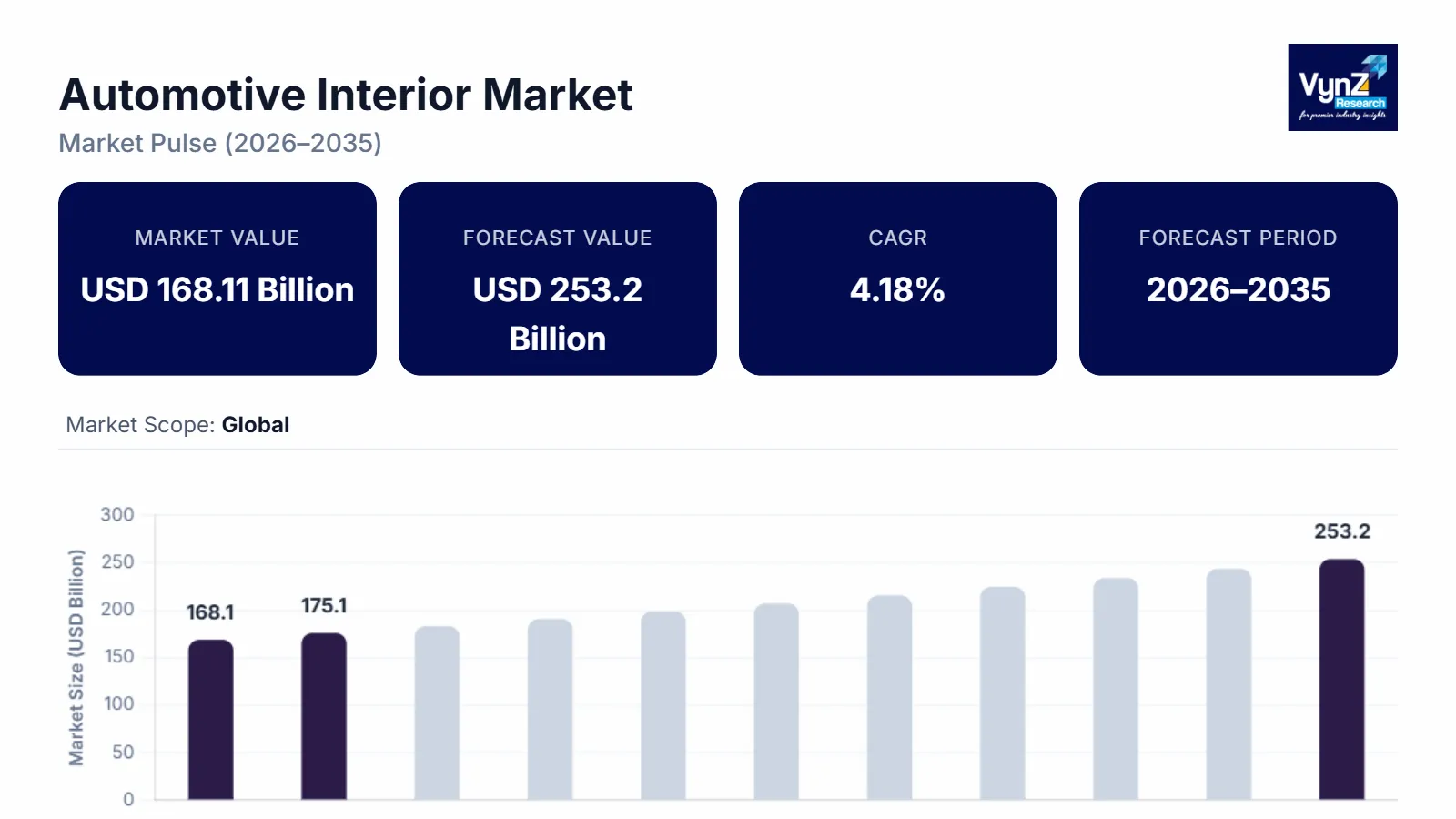
The automotive interior market size was estimated at about USD 168.11 billion in 2025 and is expected to reach around USD 175.14 billion in 2026, rising up to roughly USD 253.2 billion in 2035, growing at approximately 4.18% CAGR from 2026 to 2035.
Research Methodology
This report uses the market definition, segmentation, 2025 component shares, and 2026–2035 growth indicators published by government-backed sources drawn from India’s Ministry of Heavy Industries and SIAM data reported through the Press Information Bureau, the International Energy Agency’s Global EV Outlook 2026, the European Commission’s end-of-life vehicle regulation, and the European Automobile Manufacturers’ Association. Company developments are taken from supplier announcements. Segment growth rates are reported only where the market source provides them. Other qualitative assessments are analytical interpretations, not separately measured market shares.
Research Highlights
- Seating systems accounted for 34.05% of automotive interior revenue in 2025, supported by universal fitment and demand for comfort, safety and powered-seat features.
- Synthetic leather represented 40.46% of material revenue in 2025, reflecting cost, design flexibility and broad applicability across vehicle price bands.
- Passenger cars contributed 66.13% of market revenue in 2025, consistent with their larger role in global light-vehicle production and interior feature adoption.
- Natural and recycled materials are forecast to grow at a 4.24% CAGR through 2035 as automakers respond to lifecycle-emissions and circularity requirements.
- Asia Pacific held 37.43% of market revenue in 2025, supported by production scale and fast EV adoption.
Automotive Interior Market Dynamics
Market Trends
Automotive interiors are shifting from trim-led design toward integrated cabin experiences combining large displays, configurable lighting, connected infotainment, occupant monitoring and adaptable seating. Software-defined vehicle architectures and over-the-air-upgradable cockpit systems are important market influences. Continental’s customizable E Ink cockpit concept and Hyundai Mobis’s next-generation display work illustrates how interfaces, materials and electronics are being combined into a single interior proposition.
Sustainability is also influencing material selection. The European Commission’s End-of-Life Vehicles Regulation entered into force on 13 August 2026 and includes a requirement for 15% recycled plastic content in new vehicles from 2032, rising to 25% from 2036. This creates a long-term incentive for suppliers to develop recycled polymers, traceable materials and trim parts designed for dismantling and recovery.
Growth Drivers
Vehicle production and the continued addition of comfort and electronic features support demand for seating, instrument panels, infotainment, lighting and trim. India’s Ministry of Heavy Industries reported 5.061 million passenger vehicles produced in FY 2024–25, compared with 4.902 million in FY 2023–24, based on SIAM data. More vehicles entering production enlarge the addressable market for both factory-installed interiors and replacement components.
Electrification is changing cabin layouts and feature priorities. The IEA’s Global EV Outlook 2026 reports that electric-car sales exceeded 20 million globally in 2025, equal to about one-quarter of new-car sales. EV platforms can enable different floor and console layouts, while quieter cabins raise the importance of fit, finish, acoustics and seating comfort. These changes support higher-value cockpit integration and materials, although the benefit varies by vehicle segment and specification.
Market Restraints / Challenges
Automotive interior suppliers face cost pressure from polymer resins, polyurethane foam, textiles, electronic components and surface-finishing inputs. Volatile input prices can narrow margins when OEM contracts do not allow timely pass-through, while suppliers must still meet strict durability, flammability, odor, chemical and crash-safety requirements. Multi-material interiors also add validation work and can make late-stage design changes expensive.
Electronics integration increases exposure to semiconductor availability, software compatibility and functional-safety validation. Display-heavy cockpits require coordination between hardware, software and trim teams, and a delay in one module can affect the full vehicle launch. Regulatory requirements for recycled content and end-of-life treatment create opportunity but also require material traceability, testing and supplier qualification, which may weigh more heavily on smaller suppliers.
Market Opportunities
Recycled and lower-impact materials offer a growing opportunity for suppliers that can deliver consistent appearance, durability and cost at scale. The European Commission’s vehicle-circularity rules create a clear policy signal for recycled plastic content, repairability and easier component recovery. Suppliers that document recycled feedstock and design trim parts for disassembly can improve their position in OEM sourcing decisions, particularly for high-volume panels and interior functional parts.
Smart cabins offer another route to value creation. Integrated displays, adaptable seating, ambient lighting, occupant sensing and thermal-comfort systems allow automakers to differentiate vehicles without relying only on powertrain performance. The IEA reports continued growth in global EV adoption, while supplier announcements from Hyundai Mobis, Yanfeng, Adient and Lear show active development of display, smart-cabin and comfort technologies. Commercial success will depend on balancing premium features with cost targets and clear user benefits.
Global Automotive Interior Market Report Coverage
|
Report Metric |
Details |
|
Historical Period |
2020 - 2024 |
|
Base Year Considered |
2025 |
|
Forecast Period |
2026 - 2035 |
|
Market Size in 2025 |
USD 168.11 Billion |
|
Revenue Forecast in 2035 |
USD 253.2 Billion |
|
Growth Rate |
4.18% |
|
Segments Covered in the Report |
Component Type, Material Type, Propulsion Type, Vehicle Type |
|
Report Scope |
Market Trends, Drivers, and Restraints; Revenue Estimation and Forecast; Segmentation Analysis; Companies’ Strategic Developments; Market Share Analysis of Key Players; Company Profiling |
|
Regions Covered in the Report |
Asia Pacific, North America, Europe, South America, Middle East and Africa |
|
Key Companies |
Adient, Continental, DENSO, FORVIA, Grupo Antolin, Hyundai Mobis, Lear, Magna International, Panasonic, Yanfeng |
|
Customization |
Available upon request |
Automotive Interior Market Segmentation
By Component Type
Seating systems accounted for the largest share, at 34.05% of revenue in 2025. Their position reflects universal fitment across vehicle categories and the addition of powered adjustment, heating, ventilation, massage and integrated safety features in higher trims.
Driver and occupant monitoring systems are projected to record the fastest component-level growth at a 4.23% CAGR through 2035. The demand is linked to increasing cabin sensing, driver attention functions and the integration of safety features into cockpit electronics.
By Material Type
Synthetic leather led the category with 40.46% of revenue in 2025, supported by its design flexibility, range of colors and textures, ease of cleaning, and ability to serve multiple price points.
Natural and recycled materials are forecast to grow at a 4.24% CAGR through 2035. This outlook is consistent with rising attention to lifecycle emissions and circularity, including the European Commission’s requirement for recycled plastic content in new vehicles.
By Propulsion Type
ICE vehicles accounted for 72.47% of market revenue in 2025, reflecting the large installed production base and continued sales of conventional and hybridized platforms.
Electric vehicles are projected to grow at a 4.27% CAGR through 2035. EV platforms can free up cabin space by changing the packaging of powertrain components, while quiet operation increases sensitivity to noise, vibration and finish quality.
By Vehicle Type
Passenger cars accounted for 66.13% of automotive interior revenue in 2025, making them the largest vehicle-type segment. Their share reflects high production volumes and broad variation in trim levels, from entry models with basic seating and instrument panels to premium cars with advanced displays, ambient lighting, multi-zone climate control and more sophisticated surface materials.
Electric passenger cars are projected to grow at a 4.21% CAGR through 2035. The IEA reports that one-quarter of new cars sold worldwide in 2025 were electric, strengthening the importance of cabin layouts and feature packages tailored to electrified platforms.
Regional Insights
Asia Pacific
Asia Pacific accounted for 37.43% of global automotive interior revenue in 2025. The region benefits from large vehicle-production bases, strong supplier networks and a fast-growing electric-vehicle market. The IEA reports that China remained the world’s largest electric-car market in 2025, with electric cars representing nearly 55% of its new-car sales. This supports continued development of digital cockpits, integrated displays and higher-content seating and trim. Regional opportunities include localization of interior modules, EV-specific cabin packaging and production of cost-competitive materials.
North America
North America remains an important market for high-content interiors, particularly seating, infotainment, cockpit modules and comfort features in SUVs and pickup trucks. Supplier investment is shaped by OEM platform launches, consumer demand for upgraded trims and the need to manage cost and manufacturing flexibility. The IEA reports that electric cars accounted for just under 10% of U.S. car sales in 2025, indicating that electrification is relevant but that ICE and hybrid platforms remain central to interior demand. Growth opportunities are strongest in integrated cockpit electronics, premium seating and lightweight trim systems that support vehicle efficiency without compromising perceived quality.
Europe
Europe’s automotive interior market is influenced by premium vehicle production, safety requirements and increasing circularity expectations. The European Automobile Manufacturers’ Association’s 2026 Pocket Guide reports that EU vehicle production in 2025 remained around three million units below the 2019 level, while battery-electric vehicles reached 17.4% of EU car sales. This production environment supports demand for efficiency and platform consolidation, while electrification continues to reshape cabin specifications. The European Commission’s End-of-Life Vehicles Regulation entered into force in August 2026 and includes future recycled-plastic content requirements for new vehicles. This creates a pathway for suppliers able to document material composition and design trim parts for repair, dismantling and recovery.
South America, Middle East and Africa
South America, the Middle East and Africa, with a 35.17% share, provide additional demand through vehicle assembly, imports, fleet use and replacement of worn interior components. Market conditions differ considerably by country, so a single growth rate would conceal variation in purchasing power, local production and vehicle mix. In markets with more price-sensitive buyers, durable fabrics, synthetic leather and repairable trim are likely to remain important; premium connected-cabin features are more dependent on vehicle segment and import mix.
Competitive Landscape / Company Insights
The automotive interior market has a medium level of concentration and includes global suppliers with capabilities across seating, cockpit electronics, trim, materials and integrated modules. Adient, Lear, Yanfeng, Magna and FORVIA are among the major participants, alongside companies such as Grupo Antolin, Toyota Boshoku, Hyundai Mobis and Continental. Competition centers on OEM program wins, engineering integration, cost control, quality, material innovation and global production coverage. The IEA, European Commission and national industry statistics provide context for shifts in electrification and sustainability requirements; they do not independently rank suppliers.
Mini Profiles
Adient develops automotive seating systems and related technologies for global automakers. Its competitive strengths include manufacturing reach, seat engineering, comfort innovations and adaptable designs that serve different vehicle segments and price points.
Continental supplies cockpit and display technologies for automakers, combining interface design with electronics integration. Its solutions support customizable, connected and increasingly digital vehicle interiors across multiple vehicle categories.
DENSO develops automotive systems and electronic technologies that support cabin climate control, sensing and broader vehicle integration. Its engineering capabilities serve automakers seeking reliable, efficient and increasingly connected cabin functions.
FORVIA combines seating, interior systems and electronics capabilities for global automakers. Its portfolio spans cabin surfaces, comfort systems and cockpit technologies, supporting integrated design, manufacturing and feature development.
Grupo Antolin specializes in automotive interior components and modules for global vehicle manufacturers. Its portfolio includes overhead systems, door panels, cockpits and trim, supported by engineering and production capabilities.
Key Players
- Adient
- Continental AG
- DENSO Corporation
- FORVIA
- Grupo Antolin
- Hyundai Mobis
- Lear Corporation
- Magna International Inc.
- Panasonic Holdings Corporation
- Yanfeng Automotive Interiors
Recent Developments
Hyundai Mobis announced a global alliance for holographic windshield displays with ZEISS, tesa and Sekurit. The collaboration combines system, optics, film and automotive-glass expertise and targets mass production from 2029.
Yanfeng unveiled its XiM27 smart-cabin concept as a production-ready, drivable platform. It integrates adaptable seating, a flexible cabin layout, a large display and AI-based personalization to demonstrate an interior designed for multiple passenger activities.
Lear announced that its Seating and E-Systems businesses received 2025 GM Supplier of the Year awards. The recognition reflects its work across seating and electrical systems, two areas that increasingly intersect in integrated cabin designs.
Magna advanced its integrated interior-sensing systems, reporting that its camera- and radar-based technologies had been awarded or entered production on five OEM programs across North America, Europe and Asia over the preceding 18 months. The systems support driver-attention monitoring, seat-occupancy detection and child-presence detection.
Panasonic Automotive Systems and Qualcomm expanded their collaboration around the Snapdragon Cockpit Elite platform for cockpit domain controllers and high-performance computing. The announcement highlighted connected infotainment, generative-AI-enabled applications and next-generation cabin experiences, with vehicle deployments expected from 2026.
Global Automotive Interior Market Coverage
Component Type Insight and Forecast 2026 - 2035
- Instrument panels and cockpit modules
- Infotainment and connected displays
- Seating systems
- Interior lighting
- Door and body trim panels
- HVAC and thermal-comfort systems
- Upholstery and other interior components
Material Type Insight and Forecast 2026 - 2035
- Synthetic leather
- Fabrics
- Genuine leather
- Plastics and polymers
- Natural and recycled materials
Propulsion Type Insight and Forecast 2026 - 2035
- Internal-combustion-engine vehicles
- Electric vehicles
Vehicle Type Insight and Forecast 2026 - 2035
- Passenger cars
- Light commercial vehicles
- Medium and heavy commercial vehicles
Global Automotive Interior Market by Region
- North America
- By Component Type
- By Material Type
- By Propulsion Type
- By Vehicle Type
- By Country - U.S., Canada, Mexico
- Europe
- By Component Type
- By Material Type
- By Propulsion Type
- By Vehicle Type
- By Country - Germany, U.K., France, Italy, Spain, Russia, Rest of Europe
- Asia-Pacific (APAC)
- By Component Type
- By Material Type
- By Propulsion Type
- By Vehicle Type
- By Country - China, Japan, India, South Korea, Vietnam, Thailand, Malaysia, Rest of Asia-Pacific
- Rest of the World (RoW)
- By Component Type
- By Material Type
- By Propulsion Type
- By Vehicle Type
- By Country - Brazil, Saudi Arabia, South Africa, U.A.E., Other Countries
Table of Contents for Automotive Interior Market Report
1. Research Overview
1.1. The Report Offers
1.2. Market Coverage
1.2.1. By
Component Type
1.2.2. By
Material Type
1.2.3. By
Propulsion Type
1.2.4. By
Vehicle Type
1.3. Research Phases
1.4. Limitations
1.5. Market Methodology
1.5.1. Data Sources
1.5.1.1.
Primary Research
1.5.1.2.
Secondary Research
1.5.2. Methodology
1.5.2.1.
Data Exploration
1.5.2.2.
Forecast Parameters
1.5.2.3.
Data Validation
1.5.2.4.
Assumptions
1.5.3. Study Period & Data Reporting Unit
2. Executive Summary
3. Industry Overview
3.1. Industry Dynamics
3.1.1. Market Growth Drivers
3.1.2. Market Restraints
3.1.3. Key Market Trends
3.1.4. Major Opportunities
3.2. Industry Ecosystem
3.2.1. Porter’s Five Forces Analysis
3.2.2. Recent Development Analysis
3.2.3. Value Chain Analysis
3.3. Competitive Insight
3.3.1. Competitive Position of Industry
Players
3.3.2. Market Attractive Analysis
3.3.3. Market Share Analysis
4. Global Market Estimate and Forecast
4.1. Global Market Overview
4.2. Global Market Estimate and Forecast to 2035
5. Market Segmentation Estimate and Forecast
5.1. By Component Type
5.1.1. Instrument panels and cockpit modules
5.1.1.1. Market Definition
5.1.1.2. Market Estimation and Forecast to 2035
5.1.2. Infotainment and connected displays
5.1.2.1. Market Definition
5.1.2.2. Market Estimation and Forecast to 2035
5.1.3. Seating systems
5.1.3.1. Market Definition
5.1.3.2. Market Estimation and Forecast to 2035
5.1.4. Interior lighting
5.1.4.1. Market Definition
5.1.4.2. Market Estimation and Forecast to 2035
5.1.5. Door and body trim panels
5.1.5.1. Market Definition
5.1.5.2. Market Estimation and Forecast to 2035
5.1.6. HVAC and thermal-comfort systems
5.1.6.1. Market Definition
5.1.6.2. Market Estimation and Forecast to 2035
5.1.7. Upholstery and other interior components
5.1.7.1. Market Definition
5.1.7.2. Market Estimation and Forecast to 2035
5.2. By Material Type
5.2.1. Synthetic leather
5.2.1.1. Market Definition
5.2.1.2. Market Estimation and Forecast to 2035
5.2.2. Fabrics
5.2.2.1. Market Definition
5.2.2.2. Market Estimation and Forecast to 2035
5.2.3. Genuine leather
5.2.3.1. Market Definition
5.2.3.2. Market Estimation and Forecast to 2035
5.2.4. Plastics and polymers
5.2.4.1. Market Definition
5.2.4.2. Market Estimation and Forecast to 2035
5.2.5. Natural and recycled materials
5.2.5.1. Market Definition
5.2.5.2. Market Estimation and Forecast to 2035
5.3. By Propulsion Type
5.3.1. Internal-combustion-engine vehicles
5.3.1.1. Market Definition
5.3.1.2. Market Estimation and Forecast to 2035
5.3.2. Electric vehicles
5.3.2.1. Market Definition
5.3.2.2. Market Estimation and Forecast to 2035
5.4. By Vehicle Type
5.4.1. Passenger cars
5.4.1.1. Market Definition
5.4.1.2. Market Estimation and Forecast to 2035
5.4.2. Light commercial vehicles
5.4.2.1. Market Definition
5.4.2.2. Market Estimation and Forecast to 2035
5.4.3. Medium and heavy commercial vehicles
5.4.3.1. Market Definition
5.4.3.2. Market Estimation and Forecast to 2035
6. North America Market Estimate and Forecast
6.1. By
Component Type
6.2. By
Material Type
6.3. By
Propulsion Type
6.4. By
Vehicle Type
6.4.1.
U.S. Market Estimate and Forecast
6.4.2.
Canada Market Estimate and Forecast
6.4.3.
Mexico Market Estimate and Forecast
7. Europe Market Estimate and Forecast
7.1. By
Component Type
7.2. By
Material Type
7.3. By
Propulsion Type
7.4. By
Vehicle Type
7.4.1.
Germany Market Estimate and Forecast
7.4.2.
France Market Estimate and Forecast
7.4.3.
U.K. Market Estimate and Forecast
7.4.4.
Italy Market Estimate and Forecast
7.4.5.
Spain Market Estimate and Forecast
7.4.6.
Russia Market Estimate and Forecast
7.4.7.
Rest of Europe Market Estimate and Forecast
8. Asia-Pacific (APAC) Market Estimate and Forecast
8.1. By
Component Type
8.2. By
Material Type
8.3. By
Propulsion Type
8.4. By
Vehicle Type
8.4.1.
China Market Estimate and Forecast
8.4.2.
Japan Market Estimate and Forecast
8.4.3.
India Market Estimate and Forecast
8.4.4.
South Korea Market Estimate and Forecast
8.4.5.
Rest of Asia-Pacific Market Estimate and Forecast
9. Rest of the World (RoW) Market Estimate and Forecast
9.1. By
Component Type
9.2. By
Material Type
9.3. By
Propulsion Type
9.4. By
Vehicle Type
9.4.1.
Brazil Market Estimate and Forecast
9.4.2.
Saudi Arabia Market Estimate and Forecast
9.4.3.
South Africa Market Estimate and Forecast
9.4.4.
U.A.E. Market Estimate and Forecast
9.4.5.
Other Countries Market Estimate and Forecast
10. Company Profiles
10.1.
Adient
10.1.1.
Snapshot
10.1.2.
Overview
10.1.3.
Offerings
10.1.4.
Financial
Insight
10.1.5.
Recent
Developments
10.2.
Continental AG
10.2.1.
Snapshot
10.2.2.
Overview
10.2.3.
Offerings
10.2.4.
Financial
Insight
10.2.5.
Recent
Developments
10.3.
DENSO Corporation
10.3.1.
Snapshot
10.3.2.
Overview
10.3.3.
Offerings
10.3.4.
Financial
Insight
10.3.5.
Recent
Developments
10.4.
FORVIA
10.4.1.
Snapshot
10.4.2.
Overview
10.4.3.
Offerings
10.4.4.
Financial
Insight
10.4.5.
Recent
Developments
10.5.
Grupo Antolin
10.5.1.
Snapshot
10.5.2.
Overview
10.5.3.
Offerings
10.5.4.
Financial
Insight
10.5.5.
Recent
Developments
10.6.
Hyundai Mobis
10.6.1.
Snapshot
10.6.2.
Overview
10.6.3.
Offerings
10.6.4.
Financial
Insight
10.6.5.
Recent
Developments
10.7.
Lear Corporation
10.7.1.
Snapshot
10.7.2.
Overview
10.7.3.
Offerings
10.7.4.
Financial
Insight
10.7.5.
Recent
Developments
10.8.
Magna International Inc.
10.8.1.
Snapshot
10.8.2.
Overview
10.8.3.
Offerings
10.8.4.
Financial
Insight
10.8.5.
Recent
Developments
10.9.
Panasonic Holdings Corporation
10.9.1.
Snapshot
10.9.2.
Overview
10.9.3.
Offerings
10.9.4.
Financial
Insight
10.9.5.
Recent
Developments
10.10.
Yanfeng Automotive Interiors
10.10.1.
Snapshot
10.10.2.
Overview
10.10.3.
Offerings
10.10.4.
Financial
Insight
10.10.5.
Recent
Developments
11. Appendix
11.1. Exchange Rates
11.2. Abbreviations
Note: Financial insight and recent developments of different companies are subject to the availability of information in the secondary domain.
Frequently Asked Questions
Purchase Options
Latest Report
Research Methodology
- Desk Research / Pilot Interviews
- Build Market Size Model
- Research and Analysis
- Final Deliverable
Connect With Our Sales Team
- Toll-Free: +1-888-253-3960
- Phone: +91 9960 288 381
- Email: enquiry@vynzresearch.com
Automotive Interior Market