
ADAS Sensor Market Size & Share Growth Forecast Report (2026-2035)
Industry Insight by Sensor Type (Camera sensors, Radar sensors, Ultrasonic sensors, LiDAR sensors, Infrared sensors, Other sensors), by Vehicle Type (Passenger vehicles, Light commercial vehicles, Heavy commercial vehicles), by Application (Adaptive cruise control, Automatic emergency braking, Lane departure warning and lane keeping assistance, Parking assistance, Blind spot detection, Forward collision warning, Other applications), by End User (Original equipment manufacturers, Aftermarket)
| Status : Published | Published On : Oct, 2026 | Report Code : VRAT9678 | Industry : Automotive & Transportation | Available Format :

|
Page : 134 |
ADAS Sensor Market Overview
The global ADAS sensor market was estimated at USD 21.80 billion in 2025 and is projected to reach USD 24.00 billion in 2026, increasing to approximately USD 60.40 billion by 2035, at an estimated CAGR of 10.80% from 2026 to 2035.
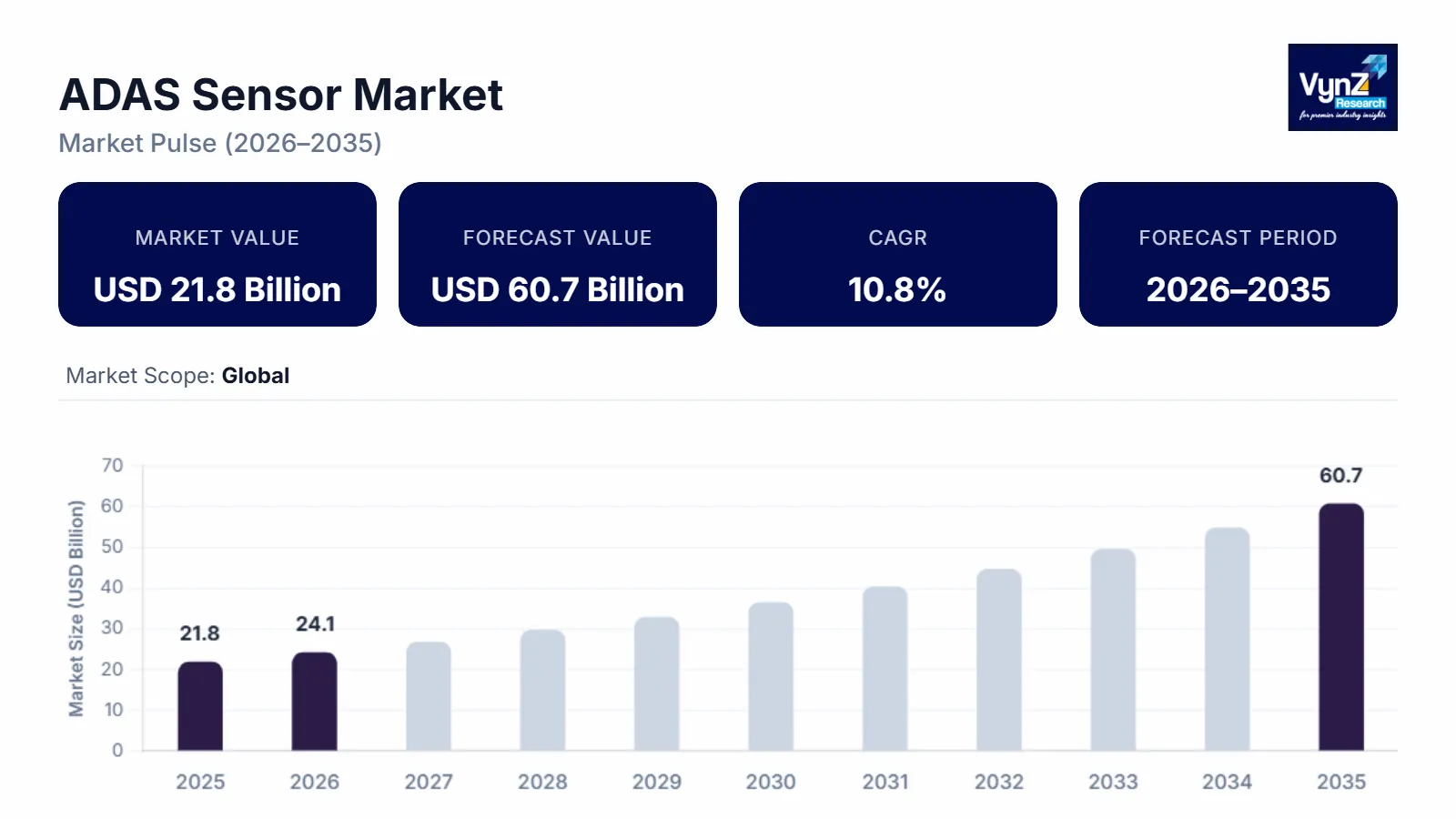
The market covers camera, radar, ultrasonic, LiDAR and other sensing technologies used in advanced driver assistance and automated driving applications. Market growth is driven by increasing vehicle safety requirements, the expansion of sensor-based collision prevention systems and the development of automated driving technologies. The US National Highway Traffic Safety Administration has finalised a rule requiring automatic emergency braking, including pedestrian detection, on new light vehicles, with compliance required by September 2029. This regulatory direction strengthens the role of cameras, radar and supporting sensors in vehicle design, while advances in sensor fusion are encouraging manufacturers to combine multiple sensing technologies to improve detection reliability.
Research Methodology
VynZ Research applies a structured research methodology combining secondary research, market assessment and forecast modelling to evaluate the global ADAS sensor market. The VynZ Research team reviews automotive supplier disclosures, vehicle manufacturer announcements, safety regulations, technical publications and publicly available industry data. Government-backed information from the US National Highway Traffic Safety Administration (NHTSA), the European Commission and relevant national vehicle safety authorities help assess regulatory requirements and the adoption of active safety technologies. Market estimates are developed by comparing available industry forecasts, evaluating differences in sensor-only and broader ADAS market definitions, and applying consistent annual growth calculations. Segment and regional estimates are then reviewed for internal consistency.
Research Highlights
- Camera sensors accounted for an estimated 38.50% of the global ADAS sensor market in 2025, supported by widespread use in lane monitoring, traffic sign recognition and collision warning systems.
- OEMs held approximately 89% of market demand in 2025, reflecting the widespread installation of sensors during vehicle manufacturing.
- Passenger vehicles contributed approximately 76% of market demand in 2025, due to growing integration of active safety features in mass market and premium vehicle models.
- The LiDAR sensor segment is projected to record an estimated CAGR of 12.60% from 2026 to 2035, driven by demand for high resolution environmental perception and advanced automated driving functions.
- Asia Pacific accounted for an estimated 38.10% of global market revenue in 2025, because of high vehicle production volumes, automotive electronics manufacturing and increasing adoption of driver assistance technologies.
ADAS Sensor Market Dynamics
Market Trends
The ADAS sensor industry is moving toward integrated sensor architectures that combine camera, radar and LiDAR inputs to improve environmental perception. Cameras provide visual information for lane detection, traffic sign recognition and object classification, while radar supports distance and speed measurement in changing weather and lighting conditions. Automakers are increasingly adopting sensor fusion to reduce dependence on a single sensing technology and improve the reliability of advanced safety functions. This shift is encouraging suppliers to develop compact sensors, integrated processing capabilities and systems that can be calibrated more efficiently across different vehicle platforms. Another emerging trend is the development of more affordable high-resolution radar and LiDAR technologies for advanced driving assistance.
Growth Drivers
The growth of the ADAS sensor market is largely supported by rising demand for active vehicle safety systems, including automatic emergency braking, adaptive cruise control, lane keeping assistance and blind spot monitoring. These functions depend on reliable sensing hardware to identify surrounding vehicles, pedestrians and road conditions. Increasing vehicle electrification and the development of automated driving functions are also supporting demand. Electric vehicle manufacturers frequently integrate advanced driver assistance features as part of broader electronic vehicle architectures, while conventional vehicle manufacturers are extending similar functions into additional model categories. Growing production of vehicles equipped with multiple cameras, radar units and ultrasonic sensors increases the number of sensing components required per vehicle. Continued reductions in sensor costs, improved processing performance and better integration with vehicle control systems are expected to support adoption across a wider range of price segments.
Market Restraints / Challenges
Despite favorable growth prospects, the ADAS sensor market faces cost and integration challenges, particularly for systems that combine multiple sensor types. High-performance radar, LiDAR and camera modules require specialized components, testing and calibration, increasing development costs for vehicle manufacturers and suppliers. Sensor performance can also be affected by heavy rain, fog, glare, dirt and obstructed camera views, creating a need for additional validation and system redundancy. Another challenge is the complexity of sensor fusion, software validation and long term system reliability. Sensors from different suppliers may require extensive integration to ensure consistent object detection and reliable operation across changing road conditions.
Market Opportunities
The expansion of affordable driver assistance features into mass market vehicles presents a significant opportunity for sensor manufacturers. Suppliers that can develop compact camera modules, cost efficient radar systems and integrated sensing packages may benefit as automakers seek to improve safety without substantially increasing vehicle prices. Regulatory developments and consumer demand for additional safety features are encouraging manufacturers to introduce scalable systems across more vehicle categories. Local production, improved component availability and standardised sensor platforms can further reduce costs and support broader adoption. Another opportunity lies in LiDAR, imaging radar and advanced sensor fusion for higher levels of driving automation.
Global ADAS Sensor Market Report Coverage
|
Report Metric |
Details |
|
Historical Period |
2020 - 2024 |
|
Base Year Considered |
2025 |
|
Forecast Period |
2026 - 2035 |
|
Market Size in 2025 |
USD 21.80 Billion |
|
Revenue Forecast in 2035 |
USD 60.40 Billion |
|
Growth Rate |
10.80% |
|
Segments Covered in the Report |
Sensor Type, Vehicle Type, Application, End User |
|
Report Scope |
Market Trends, Drivers, and Restraints; Revenue Estimation and Forecast; Segmentation Analysis; Companies’ Strategic Developments; Market Share Analysis of Key Players; Company Profiling |
|
Regions Covered in the Report |
North America, Europe, Asia Pacific, Rest of the World |
|
Key Companies |
Aptiv, Bosch, Continental, Denso, Magna International, Mobileye, NXP Semiconductors, Qualcomm, Valeo, ZF |
|
Customization |
Available upon request |
ADAS Sensor Market Segmentation
By Sensor Type
Camera sensors are estimated to have accounted for approximately 38.50% of market revenue in 2025, supported by their widespread use in lane departure warning, traffic sign recognition, forward collision warning and pedestrian detection.
LiDAR is projected to record an estimated CAGR of 12.60% from 2026 to 2035, supported by demand for detailed environmental mapping and advanced automated driving functions.
By Vehicle Type
Passenger vehicles are estimated to have contributed approximately 76% of market demand in 2025, supported by high production volumes and the growing availability of driver assistance features in family cars, SUVs and premium models.
Commercial vehicles are expected to grow at a CAGR of 11.40% from 2026 to 2035, supported by demand for forward collision warning, lane departure alerts and other active safety functions.
By Application
Automatic emergency braking and forward collision warning are important demand areas because they rely on accurate detection of vehicles and pedestrians and is expected to hold 42% of the market in 2025.
Adaptive cruise control and lane assistance functions are also expected to contribute to market expansion and grow at about 9.27% CAGR through 2036 depending on system affordability, regulatory expectations and the ability of manufacturers to maintain consistent performance across different road conditions.
By End User
OEMs are estimated to have accounted for approximately 89% of market demand in 2025, reflecting the widespread installation of sensors during vehicle manufacturing.
The aftermarket is expected to grow at a CAGR of 12.10% from 2026 to 2035, supported by maintenance needs and demand for additional safety capabilities in compatible vehicles.
Regional Insights
North America
North America is estimated to have accounted for approximately 26.50% of the global ADAS sensor market in 2025, supported by established automotive manufacturers, advanced vehicle electronics capabilities and growing adoption of active safety technologies. The United States is a major contributor, with demand driven by passenger vehicles, commercial fleets and the development of advanced driving assistance functions. The NHTSA's automatic emergency braking rule is expected to reinforce the importance of sensors capable of detecting vehicles and pedestrians under specified conditions. Supplier innovation and the integration of camera, radar and other sensing technologies are likely to support regional demand.
Europe
Europe is estimated to have represented approximately 24.20% of global market revenue in 2025, supported by established automotive engineering capabilities, vehicle safety standards and demand for advanced driver assistance systems. European Union vehicle safety requirements have encouraged the integration of technologies such as intelligent speed assistance, lane keeping support and advanced emergency braking. The region's established passenger vehicle manufacturers and automotive suppliers continue to invest in sensing systems that support collision avoidance and higher levels of driving automation. Future growth will depend on vehicle production, regulatory implementation, sensor affordability and the adoption of advanced safety features across different vehicle categories.
Asia Pacific
Asia Pacific is estimated to have accounted for approximately 38.10% of global ADAS sensor market revenue in 2025, making it the largest regional market. China, Japan, India and South Korea support demand through large vehicle manufacturing bases, automotive electronics production and the expansion of safety technologies. The growing availability of driver assistance functions in domestic vehicle models is creating opportunities for camera, radar and ultrasonic sensor suppliers. Regional manufacturing capabilities and competition among automotive technology providers may also help reduce component costs, encouraging adoption beyond premium vehicle categories. Growth will vary according to vehicle safety requirements, consumer purchasing power and the pace of technology integration across national markets.
Rest of the World
The Rest of the World is estimated to have accounted for approximately 11.20% of global ADAS sensor market revenue in 2025, covering Latin America, the Middle East, Africa and other markets outside North America, Europe and Asia Pacific. Growth is supported by gradual vehicle modernization, increasing availability of imported models equipped with advanced safety features and rising interest in collision prevention technologies. However, adoption remains uneven because of differences in vehicle affordability, local safety regulations, road infrastructure and the availability of specialized repair and calibration services.
Competitive Landscape / Company Insights
The ADAS sensor market is competitive, with automotive suppliers and technology companies developing cameras, radar, LiDAR, ultrasonic sensors and integrated perception systems. Competition centers on sensor accuracy, production costs, system integration and compatibility with vehicle platforms. Companies are increasingly combining sensing hardware with software and computing capabilities to meet automakers' requirements for scalable safety features. Regulatory developments, including the NHTSA's automatic emergency braking requirements, are encouraging suppliers to improve detection reliability and support wider adoption of active safety technologies.
Mini Profiles
Aptiv develops automotive electrical architectures, sensing technologies and advanced safety solutions, supporting the integration of driver assistance systems into connected and software defined vehicles.
Bosch supplies radar sensors, cameras and integrated driver assistance technologies, focusing on scalable hardware and software solutions for different vehicle categories and safety requirements.
Continental develops automotive radar sensors and advanced safety systems, supplying sensing technologies that support object detection, collision prevention and the progression toward automated driving.
Denso provides automotive components and electronic systems, including technologies supporting vehicle safety, environmental perception and the integration of advanced driver assistance functions.
Magna supplies automotive systems and driver assistance technologies, supporting vehicle manufacturers with integrated engineering, sensing and system development capabilities across multiple vehicle platforms.
Key Players
- Aptiv
- Bosch
- Continental
- Denso
- Magna International
- Mobileye
- NXP Semiconductors
- Qualcomm
- Valeo
- ZF
Recent Developments
Mobileye announced that Mahindra selected its SuperVision and Surround ADAS platforms for future vehicle models, with integrated perception, driver monitoring and advanced parking functions. The program highlights growing demand for consolidated sensing and computing systems designed for wider vehicle adoption.
Qualcomm and BMW introduced the Snapdragon Ride Pilot automated driving system, combining automotive computing hardware with a jointly developed software stack and camera and radar configurations. The platform is designed to support driving assistance across vehicle segments and simplify the integration of advanced safety functions.
Valeo announced a collaboration with Capgemini to test and validate an integrated Level 2+ driver assistance system combining cameras, radar and software capabilities. The development reflects growing interest in integrated sensing solutions that can simplify vehicle engineering and improve deployment efficiency.
Continental reported reaching a cumulative production milestone of 200 million radar sensors, reflecting the continued use of radar technology in automotive safety systems. The company also reported substantial radar-related series orders, indicating continued demand for sensing components used in advanced driver assistance and automated driving applications.
Hyundai Mobis announced a collaboration with Qualcomm to develop next-generation automotive computing platforms combining ADAS capabilities and digital cockpit functions. The planned integration of sensing technologies, software and processing hardware reflects the industry's movement toward consolidated vehicle electronics architectures.
Global ADAS Sensor Market Coverage
Sensor Type Insight and Forecast 2026 - 2035
- Camera sensors
- Radar sensors
- Ultrasonic sensors
- LiDAR sensors
- Infrared sensors
- Other sensors
Vehicle Type Insight and Forecast 2026 - 2035
- Passenger vehicles
- Light commercial vehicles
- Heavy commercial vehicles
Application Insight and Forecast 2026 - 2035
- Adaptive cruise control
- Automatic emergency braking
- Lane departure warning and lane keeping assistance
- Parking assistance
- Blind spot detection
- Forward collision warning
- Other applications
End User Insight and Forecast 2026 - 2035
- Original equipment manufacturers
- Aftermarket
Global ADAS Sensor Market by Region
- North America
- By Sensor Type
- By Vehicle Type
- By Application
- By End User
- By Country - U.S., Canada, Mexico
- Europe
- By Sensor Type
- By Vehicle Type
- By Application
- By End User
- By Country - Germany, U.K., France, Italy, Spain, Russia, Rest of Europe
- Asia-Pacific (APAC)
- By Sensor Type
- By Vehicle Type
- By Application
- By End User
- By Country - China, Japan, India, South Korea, Vietnam, Thailand, Malaysia, Rest of Asia-Pacific
- Rest of the World (RoW)
- By Sensor Type
- By Vehicle Type
- By Application
- By End User
- By Country - Brazil, Saudi Arabia, South Africa, U.A.E., Other Countries
Table of Contents for ADAS Sensor Market Report
1. Research Overview
1.1. The Report Offers
1.2. Market Coverage
1.2.1. By
Sensor Type
1.2.2. By
Vehicle Type
1.2.3. By
Application
1.2.4. By
End User
1.3. Research Phases
1.4. Limitations
1.5. Market Methodology
1.5.1. Data Sources
1.5.1.1.
Primary Research
1.5.1.2.
Secondary Research
1.5.2. Methodology
1.5.2.1.
Data Exploration
1.5.2.2.
Forecast Parameters
1.5.2.3.
Data Validation
1.5.2.4.
Assumptions
1.5.3. Study Period & Data Reporting Unit
2. Executive Summary
3. Industry Overview
3.1. Industry Dynamics
3.1.1. Market Growth Drivers
3.1.2. Market Restraints
3.1.3. Key Market Trends
3.1.4. Major Opportunities
3.2. Industry Ecosystem
3.2.1. Porter’s Five Forces Analysis
3.2.2. Recent Development Analysis
3.2.3. Value Chain Analysis
3.3. Competitive Insight
3.3.1. Competitive Position of Industry
Players
3.3.2. Market Attractive Analysis
3.3.3. Market Share Analysis
4. Global Market Estimate and Forecast
4.1. Global Market Overview
4.2. Global Market Estimate and Forecast to 2035
5. Market Segmentation Estimate and Forecast
5.1. By Sensor Type
5.1.1. Camera sensors
5.1.1.1. Market Definition
5.1.1.2. Market Estimation and Forecast to 2035
5.1.2. Radar sensors
5.1.2.1. Market Definition
5.1.2.2. Market Estimation and Forecast to 2035
5.1.3. Ultrasonic sensors
5.1.3.1. Market Definition
5.1.3.2. Market Estimation and Forecast to 2035
5.1.4. LiDAR sensors
5.1.4.1. Market Definition
5.1.4.2. Market Estimation and Forecast to 2035
5.1.5. Infrared sensors
5.1.5.1. Market Definition
5.1.5.2. Market Estimation and Forecast to 2035
5.1.6. Other sensors
5.1.6.1. Market Definition
5.1.6.2. Market Estimation and Forecast to 2035
5.2. By Vehicle Type
5.2.1. Passenger vehicles
5.2.1.1. Market Definition
5.2.1.2. Market Estimation and Forecast to 2035
5.2.2. Light commercial vehicles
5.2.2.1. Market Definition
5.2.2.2. Market Estimation and Forecast to 2035
5.2.3. Heavy commercial vehicles
5.2.3.1. Market Definition
5.2.3.2. Market Estimation and Forecast to 2035
5.3. By Application
5.3.1. Adaptive cruise control
5.3.1.1. Market Definition
5.3.1.2. Market Estimation and Forecast to 2035
5.3.2. Automatic emergency braking
5.3.2.1. Market Definition
5.3.2.2. Market Estimation and Forecast to 2035
5.3.3. Lane departure warning and lane keeping assistance
5.3.3.1. Market Definition
5.3.3.2. Market Estimation and Forecast to 2035
5.3.4. Parking assistance
5.3.4.1. Market Definition
5.3.4.2. Market Estimation and Forecast to 2035
5.3.5. Blind spot detection
5.3.5.1. Market Definition
5.3.5.2. Market Estimation and Forecast to 2035
5.3.6. Forward collision warning
5.3.6.1. Market Definition
5.3.6.2. Market Estimation and Forecast to 2035
5.3.7. Other applications
5.3.7.1. Market Definition
5.3.7.2. Market Estimation and Forecast to 2035
5.4. By End User
5.4.1. Original equipment manufacturers
5.4.1.1. Market Definition
5.4.1.2. Market Estimation and Forecast to 2035
5.4.2. Aftermarket
5.4.2.1. Market Definition
5.4.2.2. Market Estimation and Forecast to 2035
6. North America Market Estimate and Forecast
6.1. By
Sensor Type
6.2. By
Vehicle Type
6.3. By
Application
6.4. By
End User
6.4.1.
U.S. Market Estimate and Forecast
6.4.2.
Canada Market Estimate and Forecast
6.4.3.
Mexico Market Estimate and Forecast
7. Europe Market Estimate and Forecast
7.1. By
Sensor Type
7.2. By
Vehicle Type
7.3. By
Application
7.4. By
End User
7.4.1.
Germany Market Estimate and Forecast
7.4.2.
France Market Estimate and Forecast
7.4.3.
U.K. Market Estimate and Forecast
7.4.4.
Italy Market Estimate and Forecast
7.4.5.
Spain Market Estimate and Forecast
7.4.6.
Russia Market Estimate and Forecast
7.4.7.
Rest of Europe Market Estimate and Forecast
8. Asia-Pacific (APAC) Market Estimate and Forecast
8.1. By
Sensor Type
8.2. By
Vehicle Type
8.3. By
Application
8.4. By
End User
8.4.1.
China Market Estimate and Forecast
8.4.2.
Japan Market Estimate and Forecast
8.4.3.
India Market Estimate and Forecast
8.4.4.
South Korea Market Estimate and Forecast
8.4.5.
Rest of Asia-Pacific Market Estimate and Forecast
9. Rest of the World (RoW) Market Estimate and Forecast
9.1. By
Sensor Type
9.2. By
Vehicle Type
9.3. By
Application
9.4. By
End User
9.4.1.
Brazil Market Estimate and Forecast
9.4.2.
Saudi Arabia Market Estimate and Forecast
9.4.3.
South Africa Market Estimate and Forecast
9.4.4.
U.A.E. Market Estimate and Forecast
9.4.5.
Other Countries Market Estimate and Forecast
10. Company Profiles
10.1.
Aptiv
10.1.1.
Snapshot
10.1.2.
Overview
10.1.3.
Offerings
10.1.4.
Financial
Insight
10.1.5.
Recent
Developments
10.2.
Bosch
10.2.1.
Snapshot
10.2.2.
Overview
10.2.3.
Offerings
10.2.4.
Financial
Insight
10.2.5.
Recent
Developments
10.3.
Continental
10.3.1.
Snapshot
10.3.2.
Overview
10.3.3.
Offerings
10.3.4.
Financial
Insight
10.3.5.
Recent
Developments
10.4.
Denso
10.4.1.
Snapshot
10.4.2.
Overview
10.4.3.
Offerings
10.4.4.
Financial
Insight
10.4.5.
Recent
Developments
10.5.
Magna International
10.5.1.
Snapshot
10.5.2.
Overview
10.5.3.
Offerings
10.5.4.
Financial
Insight
10.5.5.
Recent
Developments
10.6.
Mobileye
10.6.1.
Snapshot
10.6.2.
Overview
10.6.3.
Offerings
10.6.4.
Financial
Insight
10.6.5.
Recent
Developments
10.7.
NXP Semiconductors
10.7.1.
Snapshot
10.7.2.
Overview
10.7.3.
Offerings
10.7.4.
Financial
Insight
10.7.5.
Recent
Developments
10.8.
Qualcomm
10.8.1.
Snapshot
10.8.2.
Overview
10.8.3.
Offerings
10.8.4.
Financial
Insight
10.8.5.
Recent
Developments
10.9.
Valeo
10.9.1.
Snapshot
10.9.2.
Overview
10.9.3.
Offerings
10.9.4.
Financial
Insight
10.9.5.
Recent
Developments
10.10.
ZF
10.10.1.
Snapshot
10.10.2.
Overview
10.10.3.
Offerings
10.10.4.
Financial
Insight
10.10.5.
Recent
Developments
11. Appendix
11.1. Exchange Rates
11.2. Abbreviations
Note: Financial insight and recent developments of different companies are subject to the availability of information in the secondary domain.
Frequently Asked Questions
Purchase Options
Latest Report
Research Methodology
- Desk Research / Pilot Interviews
- Build Market Size Model
- Research and Analysis
- Final Deliverable
Connect With Our Sales Team
- Toll-Free: +1-888-253-3960
- Phone: +91 9960 288 381
- Email: enquiry@vynzresearch.com
ADAS Sensor Market