
Automated Guided Vehicles Market Size & Share Growth Forecast Report (2026-2035)
Industry Insight by Product Type (Automated forklift AGVs, Tow, tractor and tug AGVs, Unit load AGVs, Assembly line AGVs, Pallet truck AGVs, Cart and small load AGVs, Special purpose AGVs, Other product types), by Navigation Technology (Laser guided, Magnetic guided, Inductive guided, Optical tape guided, Vision guided, Other navigation technologies), by Application (Material handling and transportation, Order picking and sortation, Trailer loading and unloading, Packaging and palletizing, Assembly operations, Cold chain and refrigerated storage, Hazardous materials handling), by End User (Automotive, Food and beverage, Retail and e-commerce, Electronics and electrical, Pharmaceutical and healthcare, Logistics and third party logistics, Aerospace and defense, General manufacturing, Other end user industries)
| Status : Published | Published On : Oct, 2026 | Report Code : VRAT9679 | Industry : Automotive & Transportation | Available Format :

|
Page : 145 |
Automated Guided Vehicles Market Overview
The automated guided vehicles market was estimated at USD 6.04 billion in 2025 and is projected to reach USD 6.56 billion in 2026, expanding to USD 14.48 billion by 2035 at an estimated CAGR of 9.2% from 2026 to 2035.
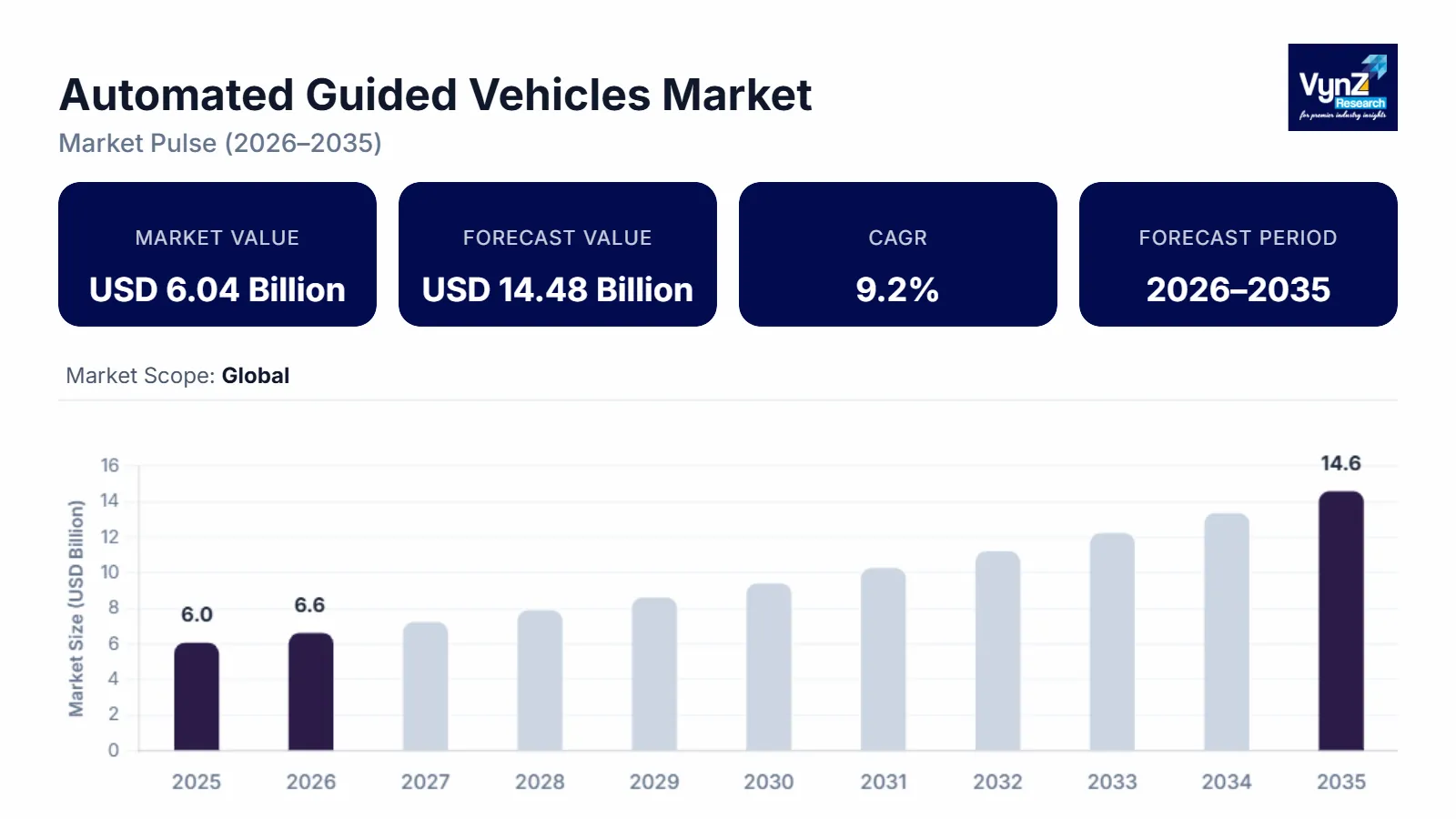
Growth is supported by the increasing use of automated material handling systems across manufacturing, warehousing and distribution operations, where businesses are seeking consistent throughput, safer internal transport and lower dependence on repetitive manual tasks. Published estimates differ according to the vehicle categories and related technologies included in their market definitions.
Market growth is also supported by warehouse automation, labor availability constraints and the expansion of high-throughput manufacturing and fulfilment operations. The International Federation of Robotics reported that factories installed 542,000 industrial robots in 2024, with Asia accounting for 74% of new installations, illustrating the wider industrial shift toward automation. These figures refer to industrial robots rather than AGVs specifically, but provide relevant evidence of the broader investment environment.
Research Methodology
The VynZ Research team assessed published market estimates, product classifications, industry adoption trends and regional automation indicators to develop the market baseline and forecast. The analysis uses a combination of top-down market benchmarking and bottom-up assessment of vehicle types, applications and end-user demand. Supporting evidence includes International Federation of Robotics publications, company disclosures and other relevant institutional information. As AGV revenue is not measured consistently across all sources, calculated estimates are distinguished from directly reported statistics. The forecast presented here is a VynZ Research working estimate, informed by industry benchmarks and an extended forecast horizon.
Research Highlights
- Unit load vehicles accounted for an estimated 31.2% of the automated guided vehicles market in 2025, supported by their widespread use in transporting pallets, containers and production materials across manufacturing facilities and distribution centers.
- Laser guided vehicles held an estimated 40.9% share of the navigation technology segment in 2025, driven by their suitability for structured industrial environments requiring consistent routes and reliable material movement.
- Material handling and transportation represented an estimated 35% share of the application segment in 2025, supported by recurring demand for moving components, pallets and finished goods between storage, production and dispatch areas.
- Automated forklift vehicles are estimated to register a CAGR of 8.7% from 2026 to 2035, driven by rising demand for automated pallet lifting, warehouse replenishment and internal goods transportation.
- Asia Pacific accounted for an estimated 31.8% of the global market in 2025, supported by its large manufacturing base and increasing investment in industrial automation.
Automated Guided Vehicles Market Dynamics
Market Trends
The industry is moving toward vehicles with more flexible navigation, improved obstacle detection and integration with warehouse management and manufacturing execution systems. Laser guidance remains an established option for structured routes, while vision-based navigation and simultaneous localization and mapping can support operations in facilities where layouts change more frequently. Demand is also shifting toward connected fleets that allow operators to coordinate vehicle movements, monitor equipment utilization and adjust material flows without extensive manual intervention. These developments are particularly relevant to distribution centers and production facilities managing diverse loads and variable throughput requirements. Another important trend is the convergence of traditional guided vehicles with autonomous mobile robots, particularly in facilities seeking to combine predictable transport routes with flexible movement around changing obstacles.
Growth Drivers
Manufacturing modernization is a central growth driver because automotive, electronics, food processing and general industrial facilities require dependable movement of components between storage, assembly and dispatch. Automated guided vehicles can support repetitive transport tasks, improve process consistency and reduce the need for workers to move materials manually over long distances. Warehouse and e-commerce fulfilment requirements provide an additional source of demand as distribution operators seek to coordinate inbound goods, replenishment, order preparation and outbound dispatch. Automated vehicles can be integrated with conveyors, storage systems and fleet software to reduce unnecessary travel and improve material flow. Their adoption is influenced by facility layout, labor costs, safety requirements and the volume of recurring transport tasks, making scalable vehicle fleets particularly relevant for large distribution centers and third-party logistics providers.
Market Restraints / Challenges
High initial investment remains a barrier for smaller manufacturers and warehouse operators, particularly when deployment requires fleet management software, charging infrastructure, facility modifications, system integration and employee training. The financial case depends on vehicle utilization, the volume of repetitive transport tasks and the cost of maintaining existing manual processes. Facilities with irregular workflows or frequent layout changes may require more advanced navigation and integration capabilities, which can increase implementation complexity and lengthen the period required to recover the investment. Operational integration presents another challenge because automated vehicles must coexist safely with workers, forklifts and other material handling equipment. Inadequate route planning, inconsistent inventory data, network interruptions or poor coordination with warehouse control systems can reduce the expected productivity gains. Battery performance, component availability, cybersecurity and access to qualified maintenance personnel can also affect fleet reliability.
Market Opportunities
Flexible navigation, improved fleet coordination and modular deployment offer opportunities for manufacturers serving facilities that cannot justify large, fixed automation installations. Systems that can be introduced gradually and integrated with existing warehouse management platforms may be attractive to mid-sized businesses seeking to automate selected transport routes before expanding to wider operations. Suppliers that support mixed fleets and provide clear operational monitoring can address the needs of facilities transitioning from manual handling to more comprehensive automation. Industrial expansion in Asia Pacific and continued modernization in North America and Europe also create opportunities for vehicles designed around specific payloads and operating conditions. Daifuku's development of a high-load-capacity AGV for automotive production illustrates the demand for vehicles suited to heavy component movement and flexible production lines. The company reported a towing capacity exceeding six tons for this model, demonstrating how application-specific engineering can address demanding manufacturing requirements.
Global Automated Guided Vehicles Market Report Coverage
|
Report Metric |
Details |
|
Historical Period |
2020 - 2024 |
|
Base Year Considered |
2025 |
|
Forecast Period |
2026 - 2035 |
|
Market Size in 2025 |
USD 6.04 Billion |
|
Revenue Forecast in 2035 |
USD 14.48 Billion |
|
Growth Rate |
9.2% |
|
Segments Covered in the Report |
Product Type, Navigation Technology, Application, End User |
|
Report Scope |
Market Trends, Drivers, and Restraints; Revenue Estimation and Forecast; Segmentation Analysis; Companies’ Strategic Developments; Market Share Analysis of Key Players; Company Profiling |
|
Regions Covered in the Report |
North America, Europe, Asia Pacific, Rest of the World |
|
Key Companies |
ABB, BALYO, Comau, Daifuku, E&K Automation, Hyster-Yale, JBT, Jungheinrich, KION Group, Toyota Material Handling |
|
Customization |
Available upon request |
Automated Guided Vehicles Market Segmentation
By Product Type
Unit load vehicles held the largest share among product types in 2025, accounting for approximately 31.2% of global revenue. Their use across pallet, container and tote movement makes them suitable for manufacturing facilities and distribution centers with recurring material transfer requirements.
Automated forklifts are estimated to record an 8.7% CAGR from 2026 to 2035, supported by demand for automated pallet lifting, storage replenishment and movement between warehouse zones.
By Navigation Technology
Laser-guided systems represented approximately 40.9% of the market in 2025, reflecting their established role in structured industrial environments where predictable routes and repeatable movement are important.
Vision and flexible navigation technologies are estimated to grow at approximately 9.5% CAGR from 2026 to 2035 as facilities require vehicles to operate around changing layouts, temporary obstructions and mixed traffic. These technologies can reduce dependence on fixed guidance infrastructure, although deployment performance depends on sensing conditions, mapping quality and integration with safety systems.
By Application
Material handling and transportation accounted for approximately 35% of market revenue in 2025, supported by recurring movement of components, pallets and finished goods between storage, production and dispatch areas.
Order picking and sortation are estimated to grow at approximately 8.8% CAGR from 2026 to 2035, reflecting the need to coordinate growing product variety, fulfilment throughput and internal replenishment.
By End User
The automotive industry held approximately 34.2% of market revenue in 2025, reflecting its established use of automated transport for components, subassemblies and production line replenishment.
Retail and e-commerce are estimated to record an 8.3% CAGR from 2026 to 2035 as distribution facilities seek to coordinate replenishment and internal transport across high-volume operations.
Regional Insights
North America
North America accounted for 33.1% of the global market in 2025. Demand is supported by manufacturing automation, large distribution networks and investment in warehouse productivity, particularly in the United States. The International Federation of Robotics reported that US factories installed approximately 34,200 industrial robots in 2024, illustrating the region's established industrial automation base. Industrial robot installations are not equivalent to AGV deployments, but provide a useful indicator of the wider automation environment.
Europe
Europe represented 28.6% of the market in 2025. Demand is associated with established automotive and industrial manufacturing, warehouse modernization and the need to improve material handling productivity. Germany remains an important industrial center, while other markets, including France, Italy and the United Kingdom, support demand through manufacturing and distribution operations. Published regional market estimates differ, partly because of variations in vehicle classifications and revenue coverage.
Asia Pacific
Asia Pacific accounted for 31.8% of global revenue in 2025. China, Japan, South Korea and India contribute through automotive production, electronics manufacturing and expanding logistics infrastructure. The International Federation of Robotics reported that Asia accounted for 74% of new industrial robot installations in 2024, with China representing 54% of global installations. These figures refer to industrial robots rather than AGVs, but indicate the region's substantial investment in factory automation.
Rest of the World
The rest of the world, comprising Latin America, the Middle East and Africa, accounted for 6.5% of the market in 2025. Adoption remains concentrated in selected manufacturing facilities, ports, warehouses and large logistics operations where predictable material movement can justify the investment. The region is estimated to expand at an 8.4% CAGR from 2026 to 2035 as industrial diversification and distribution infrastructure create opportunities for automated transport systems.
Competitive Landscape / Company Insights
The market is moderately to highly competitive, with global material handling and automation providers competing through vehicle portfolios, navigation technology, system integration and after-sales support. ABB, Daifuku, JBT, Jungheinrich, KION Group and Toyota Material Handling participate in broader industrial automation or intralogistics markets, while specialist suppliers focus on guided transport and autonomous material handling. Competition increasingly extends beyond the vehicle itself to fleet orchestration, safety systems and integration with warehouse software. Company disclosures and industry publications indicate continuing investment in flexible automation, though the market shares of individual AGV suppliers are not consistently reported.
Mini Profiles
ABB supplies industrial automation, robotics and motion technologies, with capabilities relevant to connected manufacturing operations and automated material movement.
BALYO develops robotic solutions that automate material handling using industrial trucks, serving logistics and manufacturing facilities seeking automated transport.
Comau provides industrial automation, robotics and manufacturing systems, with expertise relevant to automotive production and integrated factory operations.
Daifuku develops material handling and intralogistics systems, including AGVs for production environments requiring heavy load movement and flexible transport.
E&K Automation specializes in driverless transport systems and customized material handling solutions for industrial and logistics applications.
Key Players
- ABB
- BALYO
- Comau
- Daifuku
- E&K Automation
- Hyster-Yale
- JBT
- Jungheinrich
- KION Group
- Toyota Material Handling
Recent Developments
Seegrid expanded its autonomous material handling milestones, reporting that its vehicles had surpassed 17 million autonomous miles in customer facilities. Its product portfolio also continued to develop around autonomous lift truck applications and industrial safety requirements.
Jungheinrich took a stake in Navflex to advance autonomous truck loading and unloading. The collaboration focuses on AI based navigation and process control for variable loading dock environments, with field tests planned under real operating conditions.
Daifuku developed the TRVS high load capacity AGV for automotive production lines. The vehicle is designed to tow a cart carrying a vehicle body, with a capacity exceeding six tons and a compact configuration intended to support flexible production layouts.
KION Group advanced the integration of physical AI into warehouse operations and presented developments involving AI enabled supply chain automation. These initiatives reflect the growing emphasis on connecting robotics, software and operational data across intralogistics systems.
JBT continued to present its automated guided vehicle portfolio for industrial and automotive material handling, including counterbalance forked vehicles and fleet management software. Its published portfolio emphasizes scalability, fleet interoperability and integration across complex manufacturing and logistics environments.
Global Automated Guided Vehicles Market Coverage
Product Type Insight and Forecast 2026 - 2035
- Automated forklift AGVs
- Tow
- tractor and tug AGVs
- Unit load AGVs
- Assembly line AGVs
- Pallet truck AGVs
- Cart and small load AGVs
- Special purpose AGVs
- Other product types
Navigation Technology Insight and Forecast 2026 - 2035
- Laser guided
- Magnetic guided
- Inductive guided
- Optical tape guided
- Vision guided
- Other navigation technologies
Application Insight and Forecast 2026 - 2035
- Material handling and transportation
- Order picking and sortation
- Trailer loading and unloading
- Packaging and palletizing
- Assembly operations
- Cold chain and refrigerated storage
- Hazardous materials handling
End User Insight and Forecast 2026 - 2035
- Automotive
- Food and beverage
- Retail and e-commerce
- Electronics and electrical
- Pharmaceutical and healthcare
- Logistics and third party logistics
- Aerospace and defense
- General manufacturing
- Other end user industries
Global Automated Guided Vehicles Market by Region
- North America
- By Product Type
- By Navigation Technology
- By Application
- By End User
- By Country - U.S., Canada, Mexico
- Europe
- By Product Type
- By Navigation Technology
- By Application
- By End User
- By Country - Germany, U.K., France, Italy, Spain, Russia, Rest of Europe
- Asia-Pacific (APAC)
- By Product Type
- By Navigation Technology
- By Application
- By End User
- By Country - China, Japan, India, South Korea, Vietnam, Thailand, Malaysia, Rest of Asia-Pacific
- Rest of the World (RoW)
- By Product Type
- By Navigation Technology
- By Application
- By End User
- By Country - Brazil, Saudi Arabia, South Africa, U.A.E., Other Countries
Table of Contents for Automated Guided Vehicles Market Report
1. Research Overview
1.1. The Report Offers
1.2. Market Coverage
1.2.1. By
Product Type
1.2.2. By
Navigation Technology
1.2.3. By
Application
1.2.4. By
End User
1.3. Research Phases
1.4. Limitations
1.5. Market Methodology
1.5.1. Data Sources
1.5.1.1.
Primary Research
1.5.1.2.
Secondary Research
1.5.2. Methodology
1.5.2.1.
Data Exploration
1.5.2.2.
Forecast Parameters
1.5.2.3.
Data Validation
1.5.2.4.
Assumptions
1.5.3. Study Period & Data Reporting Unit
2. Executive Summary
3. Industry Overview
3.1. Industry Dynamics
3.1.1. Market Growth Drivers
3.1.2. Market Restraints
3.1.3. Key Market Trends
3.1.4. Major Opportunities
3.2. Industry Ecosystem
3.2.1. Porter’s Five Forces Analysis
3.2.2. Recent Development Analysis
3.2.3. Value Chain Analysis
3.3. Competitive Insight
3.3.1. Competitive Position of Industry
Players
3.3.2. Market Attractive Analysis
3.3.3. Market Share Analysis
4. Global Market Estimate and Forecast
4.1. Global Market Overview
4.2. Global Market Estimate and Forecast to 2035
5. Market Segmentation Estimate and Forecast
5.1. By Product Type
5.1.1. Automated forklift AGVs
5.1.1.1. Market Definition
5.1.1.2. Market Estimation and Forecast to 2035
5.1.2. Tow
5.1.2.1. Market Definition
5.1.2.2. Market Estimation and Forecast to 2035
5.1.3. tractor and tug AGVs
5.1.3.1. Market Definition
5.1.3.2. Market Estimation and Forecast to 2035
5.1.4. Unit load AGVs
5.1.4.1. Market Definition
5.1.4.2. Market Estimation and Forecast to 2035
5.1.5. Assembly line AGVs
5.1.5.1. Market Definition
5.1.5.2. Market Estimation and Forecast to 2035
5.1.6. Pallet truck AGVs
5.1.6.1. Market Definition
5.1.6.2. Market Estimation and Forecast to 2035
5.1.7. Cart and small load AGVs
5.1.7.1. Market Definition
5.1.7.2. Market Estimation and Forecast to 2035
5.1.8. Special purpose AGVs
5.1.8.1. Market Definition
5.1.8.2. Market Estimation and Forecast to 2035
5.1.9. Other product types
5.1.9.1. Market Definition
5.1.9.2. Market Estimation and Forecast to 2035
5.2. By Navigation Technology
5.2.1. Laser guided
5.2.1.1. Market Definition
5.2.1.2. Market Estimation and Forecast to 2035
5.2.2. Magnetic guided
5.2.2.1. Market Definition
5.2.2.2. Market Estimation and Forecast to 2035
5.2.3. Inductive guided
5.2.3.1. Market Definition
5.2.3.2. Market Estimation and Forecast to 2035
5.2.4. Optical tape guided
5.2.4.1. Market Definition
5.2.4.2. Market Estimation and Forecast to 2035
5.2.5. Vision guided
5.2.5.1. Market Definition
5.2.5.2. Market Estimation and Forecast to 2035
5.2.6. Other navigation technologies
5.2.6.1. Market Definition
5.2.6.2. Market Estimation and Forecast to 2035
5.3. By Application
5.3.1. Material handling and transportation
5.3.1.1. Market Definition
5.3.1.2. Market Estimation and Forecast to 2035
5.3.2. Order picking and sortation
5.3.2.1. Market Definition
5.3.2.2. Market Estimation and Forecast to 2035
5.3.3. Trailer loading and unloading
5.3.3.1. Market Definition
5.3.3.2. Market Estimation and Forecast to 2035
5.3.4. Packaging and palletizing
5.3.4.1. Market Definition
5.3.4.2. Market Estimation and Forecast to 2035
5.3.5. Assembly operations
5.3.5.1. Market Definition
5.3.5.2. Market Estimation and Forecast to 2035
5.3.6. Cold chain and refrigerated storage
5.3.6.1. Market Definition
5.3.6.2. Market Estimation and Forecast to 2035
5.3.7. Hazardous materials handling
5.3.7.1. Market Definition
5.3.7.2. Market Estimation and Forecast to 2035
5.4. By End User
5.4.1. Automotive
5.4.1.1. Market Definition
5.4.1.2. Market Estimation and Forecast to 2035
5.4.2. Food and beverage
5.4.2.1. Market Definition
5.4.2.2. Market Estimation and Forecast to 2035
5.4.3. Retail and e-commerce
5.4.3.1. Market Definition
5.4.3.2. Market Estimation and Forecast to 2035
5.4.4. Electronics and electrical
5.4.4.1. Market Definition
5.4.4.2. Market Estimation and Forecast to 2035
5.4.5. Pharmaceutical and healthcare
5.4.5.1. Market Definition
5.4.5.2. Market Estimation and Forecast to 2035
5.4.6. Logistics and third party logistics
5.4.6.1. Market Definition
5.4.6.2. Market Estimation and Forecast to 2035
5.4.7. Aerospace and defense
5.4.7.1. Market Definition
5.4.7.2. Market Estimation and Forecast to 2035
5.4.8. General manufacturing
5.4.8.1. Market Definition
5.4.8.2. Market Estimation and Forecast to 2035
5.4.9. Other end user industries
5.4.9.1. Market Definition
5.4.9.2. Market Estimation and Forecast to 2035
6. North America Market Estimate and Forecast
6.1. By
Product Type
6.2. By
Navigation Technology
6.3. By
Application
6.4. By
End User
6.4.1.
U.S. Market Estimate and Forecast
6.4.2.
Canada Market Estimate and Forecast
6.4.3.
Mexico Market Estimate and Forecast
7. Europe Market Estimate and Forecast
7.1. By
Product Type
7.2. By
Navigation Technology
7.3. By
Application
7.4. By
End User
7.4.1.
Germany Market Estimate and Forecast
7.4.2.
France Market Estimate and Forecast
7.4.3.
U.K. Market Estimate and Forecast
7.4.4.
Italy Market Estimate and Forecast
7.4.5.
Spain Market Estimate and Forecast
7.4.6.
Russia Market Estimate and Forecast
7.4.7.
Rest of Europe Market Estimate and Forecast
8. Asia-Pacific (APAC) Market Estimate and Forecast
8.1. By
Product Type
8.2. By
Navigation Technology
8.3. By
Application
8.4. By
End User
8.4.1.
China Market Estimate and Forecast
8.4.2.
Japan Market Estimate and Forecast
8.4.3.
India Market Estimate and Forecast
8.4.4.
South Korea Market Estimate and Forecast
8.4.5.
Rest of Asia-Pacific Market Estimate and Forecast
9. Rest of the World (RoW) Market Estimate and Forecast
9.1. By
Product Type
9.2. By
Navigation Technology
9.3. By
Application
9.4. By
End User
9.4.1.
Brazil Market Estimate and Forecast
9.4.2.
Saudi Arabia Market Estimate and Forecast
9.4.3.
South Africa Market Estimate and Forecast
9.4.4.
U.A.E. Market Estimate and Forecast
9.4.5.
Other Countries Market Estimate and Forecast
10. Company Profiles
10.1.
ABB
10.1.1.
Snapshot
10.1.2.
Overview
10.1.3.
Offerings
10.1.4.
Financial
Insight
10.1.5.
Recent
Developments
10.2.
BALYO
10.2.1.
Snapshot
10.2.2.
Overview
10.2.3.
Offerings
10.2.4.
Financial
Insight
10.2.5.
Recent
Developments
10.3.
Comau
10.3.1.
Snapshot
10.3.2.
Overview
10.3.3.
Offerings
10.3.4.
Financial
Insight
10.3.5.
Recent
Developments
10.4.
Daifuku
10.4.1.
Snapshot
10.4.2.
Overview
10.4.3.
Offerings
10.4.4.
Financial
Insight
10.4.5.
Recent
Developments
10.5.
E&K Automation
10.5.1.
Snapshot
10.5.2.
Overview
10.5.3.
Offerings
10.5.4.
Financial
Insight
10.5.5.
Recent
Developments
10.6.
Hyster-Yale
10.6.1.
Snapshot
10.6.2.
Overview
10.6.3.
Offerings
10.6.4.
Financial
Insight
10.6.5.
Recent
Developments
10.7.
JBT
10.7.1.
Snapshot
10.7.2.
Overview
10.7.3.
Offerings
10.7.4.
Financial
Insight
10.7.5.
Recent
Developments
10.8.
Jungheinrich
10.8.1.
Snapshot
10.8.2.
Overview
10.8.3.
Offerings
10.8.4.
Financial
Insight
10.8.5.
Recent
Developments
10.9.
KION Group
10.9.1.
Snapshot
10.9.2.
Overview
10.9.3.
Offerings
10.9.4.
Financial
Insight
10.9.5.
Recent
Developments
10.10.
Toyota Material Handling
10.10.1.
Snapshot
10.10.2.
Overview
10.10.3.
Offerings
10.10.4.
Financial
Insight
10.10.5.
Recent
Developments
11. Appendix
11.1. Exchange Rates
11.2. Abbreviations
Note: Financial insight and recent developments of different companies are subject to the availability of information in the secondary domain.
Frequently Asked Questions
Purchase Options
Latest Report
Research Methodology
- Desk Research / Pilot Interviews
- Build Market Size Model
- Research and Analysis
- Final Deliverable
Connect With Our Sales Team
- Toll-Free: +1-888-253-3960
- Phone: +91 9960 288 381
- Email: enquiry@vynzresearch.com
Automated Guided Vehicles Market