
Japan Aftermarket TPMS Market Size & Share - Growth Forecast Report (2026-2035)
Industry Insight by Type (Direct TPMS, Indirect TPMS), by Technology Integration (Stand-alone TPMS Units, Smart/Connected TPMS), by Vehicle Type (Passenger Cars, Commercial Vehicles), by Distribution Channel (Offline, Online)
| Status : Published | Published On : Feb, 2026 | Report Code : VRAT9667 | Industry : Automotive & Transportation | Available Format :

|
Page : 120 |
Japan Aftermarket TPMS Market Overview
The Japan aftermarket TPMS market which was valued at approximately USD 145.4 million in 2025 and is estimated to reach around USD 174.9 million in 2026, is projected to reach close to USD 606.2 million by 2035, expanding at a CAGR of about 14.8% during the forecast period from 2026 to 2035.
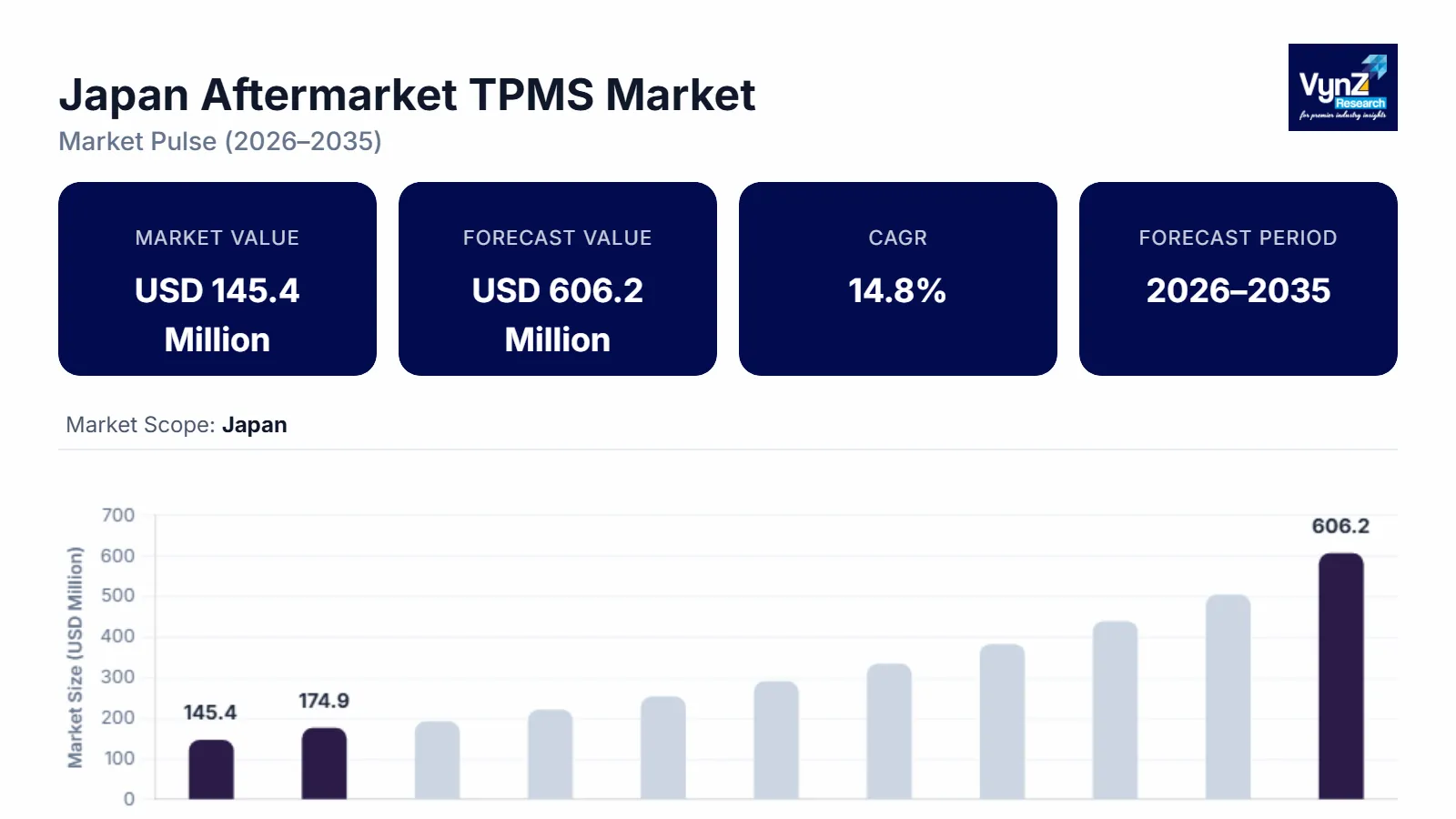
The market is experiencing significant growth due to a combination of regulatory, technological, and consumer-driven factors. Stricter vehicle safety standards and mandatory tire pressure monitoring for new vehicles have encouraged owners of older cars to retrofit TPMS, boosting aftermarket demand. Increasing awareness of vehicle safety, fuel efficiency, and tire longevity has led both passenger car and commercial vehicle owners to adopt TPMS solutions more proactively. Technological advancements, including smart and connected TPMS systems that integrate with mobile apps and vehicle electronics, appeal to tech-savvy consumers seeking real-time monitoring and predictive alerts.
Additionally, the rise of e-commerce and online auto-parts platforms has expanded accessibility, complementing traditional offline channels such as service centers and specialty retailers. Combined with Japan’s aging vehicle fleet and a strong emphasis on maintenance, these factors are driving steady growth across direct and indirect TPMS, stand-alone and connected systems, and across both passenger and commercial vehicle segments.
Japan Aftermarket TPMS Market Dynamics
Market Trends
A growing trend in Japan’s aftermarket TPMS (Tire Pressure Monitoring System) market is the integration of wireless, internationally compatible TPMS hardware, reflecting regulatory harmonization and rising consumer demand for connected vehicle safety features. In October 2024, Japan’s Ministry of Internal Affairs and Communications (MIC) amended its Ordinance for Enforcement of the Radio Act to officially add the 433.795–434.045 MHz band for lowpower automotive devices, including TPMS and remote keyless entry systems, aligning domestic spectrum policy with global standards. This acceptance of the 433 MHz band has enabled aftermarket suppliers to adopt wireless sensor designs that are compatible with international vehicles, reducing fragmentation and broadening product choice. Previously, many Japanese vehicles used 315 MHz systems, limiting crossmarket aftermarket compatibility; the regulatory update opens the door for a new generation of smart TPMS that can broadcast tire pressure data reliably and integrate with mobile apps and telematics dashboards. As buyers increasingly view connected safety technologies as valuable retrofit options - especially for SUVs, electric vehicles, and older fleet cars - this harmonization of frequency standards is catalyzing a trend toward wireless, smart TPMS adoption in Japan’s aftermarket segment.
Growth Drivers
One key driver of growth in Japan’s aftermarket TPMS sector is governmentled regulatory modernization, which has improved technical clarity and market access for advanced TPMS technologies. In February 2025, the Japanese Ministry of Internal Affairs and Communications (MIC) expanded its radio equipment regulations to officially include TPMS devices on the 433 MHz frequency band - a spectrum widely used internationally for tire pressure systems. This regulatory update reduced historical barriers associated with radio certification and helped OEM and aftermarket manufacturers develop products that are compliant with both domestic and global standards. As a result, parts suppliers and installers can bring more modern, wireless, and connected TPMS solutions to Japanese consumers at competitive costs. Alongside this, public safety campaigns and vehicle inspection requirements emphasize tire health, making reliable TPMS units appealing not only for compliance reasons but also for everyday safety and fuelefficiency improvements. The combination of clearer technical frameworks and heightened safety emphasis is encouraging broader TPMS adoption across vehicle classes.
Market Restraints / Challenges
A key challenge facing Japan’s aftermarket TPMS market is regulatory alignment and certification complexity, which can slow product introduction and elevate costs for suppliers. Although Japan’s radio regulation updates expanded permitted spectrum for TPMS, the Ordinance for Enforcement of the Radio Act specifies detailed technical conditions that manufacturers must meet to gain certification for wireless TPMS devices, such as limits on transmission duration and strict interference protections. For small and midsized aftermarket suppliers, navigating these evolving requirements, preparing technical documentation, and securing approvals from the Ministry of Internal Affairs and Communications can be resourceintensive. This burden is heightened for companies seeking to offer products compatible with both legacy domestic vehicles and newer internationally standardized frequencies. Because the certification timeline can extend over months, it may delay product launches and hinder rapid response to consumer demand trends, especially for smart or connected TPMS variants that incorporate advanced wireless protocols.
Additionally, Japanese vehicle owners often expect professional installation and calibration services - requiring shops to invest in specific tools and training to handle a broader range of TPMS models. These technical, regulatory, and service infrastructure hurdles collectively restrain the pace at which aftermarket TPMS innovation and supply can expand in Japan.
Market Opportunities
A significant opportunity for Japan’s aftermarket TPMS market is servicing the large population of older vehicles that lack builtin TPMS but must comply with evolving safety expectations and inspection practices. Japan has an aging automobile fleet, partly due to high ownership rates among private drivers and commercial operators; many vehicles on the road were manufactured before TPMS became widely standard. Recognizing this, the Ministry of Land, Infrastructure, Transport and Tourism (MLIT) continues to emphasize the importance of advanced vehicle monitoring systems, including TPMS, as part of its broader safety strategies, and encourages voluntary measures to retrofit safety upgrades in older vehicles. This regulatory encouragement presents a clear opportunity for aftermarket manufacturers and installers to offer retrofit TPMS kits tailored to a diverse range of makes, models, and years. With growing consumer awareness of tirerelated safety risks and fuel efficiency benefits, the retrofit segment - especially for SUVs, commercial vans, and fleet vehicles represents a fertile market.
Japan Aftermarket TPMS Market Report Coverage
|
Report Metric |
Details |
|
Historical Period |
2020 - 2024 |
|
Base Year Considered |
2025 |
|
Forecast Period |
2026 - 2035 |
|
Market Size in 2025 |
USD 145.2 Million |
|
Revenue Forecast in 2035 |
USD 606.2 Million |
|
Growth Rate |
14.8% |
|
Segments Covered in the Report |
Type, Technology Integration, Vehicle Type, Distribution Channel |
|
Report Scope |
Market Trends, Drivers, and Restraints; Revenue Estimation and Forecast; Segmentation Analysis; Companies’ Strategic Developments; Market Share Analysis of Key Players; Company Profiling |
|
Regions Covered in the Report |
Greater Tokyo, Osaka–Kobe, Nagoya and Central Japan |
|
Key Companies |
Denso Corporation, Pacific Industrial Co., Ltd., Orange Electronic Co., Ltd., Omron Corporation, Sensata Technologies, Continental AG, NXP Semiconductors N.V., Bridgestone Corporation, CUB Elecparts Inc., Autobacs Seven Co., Ltd., and Yellow Hat Ltd. |
|
Customization |
Available upon request |
Japan Aftermarket TPMS Market Segmentation
By Type
Direct TPMS dominates the market with a share of approx. 65% in 2025 due to its ability to provide accurate, real-time pressure readings from sensors installed on each wheel. This precision is critical in Japan, where vehicle safety is closely regulated through programs like Shaken, which emphasize tire condition and overall roadworthiness. Direct TPMS helps prevent accidents caused by underinflated tires, improves fuel efficiency, and extends tire life, making it highly valued by both passenger car owners and commercial fleet operators.
Additionally, growing awareness of vehicle maintenance and safety has increased the demand for retrofitting older vehicles with direct TPMS. Its adoption is further supported by Japan’s evolving automotive landscape, including a rising number of SUVs and light commercial vehicles that benefit from individual tire monitoring. As a result, direct TPMS not only commands the largest market share in the aftermarket segment but also shows the fastest growth rate, driven by regulatory compliance and consumer preference for reliable, sensor-based safety technology.
By Technology Integration
In Japan’s aftermarket TPMS market, stand-alone TPMS units currently represent the largest segment in terms of market share, which held around 55% in 2025. These systems are self-contained, providing tire pressure readings directly through a dedicated display without relying on vehicle electronics or smartphone connectivity. Their popularity stems from simplicity, affordability, and ease of installation, making them suitable for a broad range of passenger cars, commercial vehicles, and older vehicles that lack integrated TPMS systems. Many Japanese vehicle owners prefer stand-alone units because they require minimal technical knowledge, can be quickly retrofitted, and comply with safety inspection requirements under programs like Shaken.
Conversely, smart or connected TPMS is the fastest-growing segment in the aftermarket. These systems connect to smartphones, vehicle telematics, or cloud platforms, providing real-time alerts, historical tire data, and predictive maintenance insights. Growth is driven by Japan’s increasing adoption of connected vehicle technologies, rising consumer awareness of tire safety, and fleet operators seeking advanced monitoring for efficiency and accident prevention. While initially more expensive than stand-alone units, smart TPMS adoption is accelerating due to its added convenience, data-driven insights, and integration with modern vehicle ecosystems, positioning it as the most rapidly expanding technology segment in Japan’s aftermarket TPMS market.
By Vehicle Type
In Japan’s aftermarket TPMS market, passenger cars form the largest segment by vehicle type with a market share of around 70% in 2025. This is because passenger vehicles-including sedans, hatchbacks, and SUVs-represent the vast majority of Japan’s registered fleet, and many older models lack factory-installed TPMS. Owners of these vehicles are increasingly retrofitting direct TPMS systems to comply with safety inspections under the Shaken program, prevent tire blowouts, and improve fuel efficiency. The combination of fleet size, regulatory focus on tire condition, and consumer safety awareness ensures passenger cars dominate aftermarket sales in terms of volume.
There passenger cars further classified into followings
- Hatchbacks
- Sedans
- SUVs and MUVs
Commercial vehicles, including light and medium trucks, heavy trucks, and buses, are the fastest-growing segment in the aftermarket. Fleet operators prioritize predictive maintenance, fuel efficiency, and operational safety, making TPMS retrofits an attractive investment. Smart or connected TPMS is particularly gaining traction in this segment, allowing operators to monitor multiple vehicles in real time and reduce tire-related downtime. Rising regulatory attention to commercial vehicle safety and increasing operational efficiency requirements are driving growth in aftermarket TPMS adoption among fleet vehicles, making commercial vehicles the segment with the highest growth potential.
There commercial vehicles further classified into followings
- Light Commercial Vehicles
- Medium and Heavy Commercial Vehicles
- Buses and Coaches
By Distribution Channel
In Japan’s aftermarket TPMS market, the offline distribution channel, including auto-parts stores, specialty shops, and service centers, remains the largest segment, with a market share of about 60% in 2025. Most consumers still prefer hands-on guidance and professional installation when purchasing TPMS units, particularly for direct systems that require sensor calibration. Auto-parts stores and service centers also provide technical support, installation tools, and advice tailored to specific vehicle models, which is important given Japan’s strict safety inspections under the Shaken program. The familiarity and trust associated with offline retailers make this channel dominant in terms of sales volume, particularly among older car owners and fleet operators who prioritize reliability and expert service.
In contrast, the online distribution channel, including OEM websites, mobile apps, and e-commerce platforms, is the fastest-growing segment at a CAGR of 15.1% in the coming years. Increasing internet penetration, growing smartphone adoption, and the convenience of home delivery are driving consumers toward online TPMS purchases. This channel allows buyers to compare products, access the latest smart or connected TPMS units, and benefit from broader choices at competitive prices. Rising acceptance of digital shopping, combined with fleet operators leveraging online platforms for bulk orders, ensures the online channel is expanding more rapidly than traditional offline outlets.
Regional Insights
In Japan’s aftermarket TPMS market, the Greater Tokyo Metropolitan Area holds the largest market share due to its dominant vehicle population and highly developed automotive aftermarket ecosystem. The area has the highest concentration of passenger cars, taxis, and light commercial vehicles, creating sustained demand for TPMS replacements and retrofits. A dense presence of auto-parts chains, speciality workshops, and service centers ensures easy access to installation services, while strong consumer awareness around safety and vehicle maintenance supports consistent adoption of direct TPMS solutions. Early acceptance of automotive technologies further strengthens Tokyo’s leading position.
The Osaka–Kobe metropolitan area ranks second in market share, supported by high urban traffic density and a large base of daily-use vehicles. Vehicle owners in this metro area place increasing importance on preventive maintenance to reduce breakdown risks, which supports aftermarket TPMS demand. The presence of established service networks and competitive auto-parts retailers encourages replacement of ageing TPMS sensors, particularly in older passenger vehicles that lack factory-installed systems.
Nagoya and Central Japan form the third-largest market for aftermarket TPMS. Strong automotive awareness among vehicle owners, combined with high vehicle ownership rates, drives steady adoption. Many users in this area prioritize long-term vehicle reliability and fuel efficiency, making TPMS retrofits a practical aftermarket upgrade.
Competitive Landscape / Company Insights
The Japan aftermarket TPMS market is moderately to highly competitive, with both global and regional players emphasizing sensor technology innovation, smart/connected TPMS development, and geographic and segment expansion. Leading automotive and TPMS suppliers focus on developing high-accuracy direct TPMS, wireless connectivity solutions, and integration with telematics platforms for both passenger cars and commercial vehicles. Market adoption is further reinforced by government safety regulations, vehicle inspection programs such as Shaken, and policies from the Ministry of Land, Infrastructure, Transport and Tourism (MLIT), which encourage reliable tire pressure monitoring and preventive maintenance. These frameworks promote high standards for product quality, installation safety, and system compliance, prompting vendors to enhance aftermarket support, training, and long-term partnerships with auto service centers, fleet operators, and e-commerce platforms. Continuous innovation in sensor durability, smart TPMS functionality, and consumer-friendly interfaces ensures that companies maintain a competitive edge while meeting Japan’s stringent safety and efficiency requirements.
Mini Profiles
Denso Corporation stays active in the TPMS and automotive electronics market through its advanced sensor technologies, vehicle electronics integration, and extensive relationships with OEMs. Its systems are widely used for direct TPMS in passenger cars and commercial vehicles, with a focus on reliability, real-time monitoring, and compliance with Japan’s safety inspection programs. Denso also invests in smart TPMS solutions that integrate with telematics and connected car platforms.
Pacific Industrial Co., Ltd. specializes in TPMS sensor manufacturing and aftermarket solutions for the Japanese market. It is known for producing durable, cost-effective direct TPMS units suitable for passenger and light commercial vehicles. The company focuses on precision engineering, easy installation, and aftermarket support, which has made it a trusted supplier for service centers and automotive retailers.
Orange Electronic Co., Ltd. concentrates on smart and wireless TPMS technologies, offering both OEM and aftermarket solutions. Its products emphasize real-time tire monitoring, mobile app connectivity, and predictive alerts, appealing to tech-savvy consumers and fleet operators who prioritize proactive vehicle maintenance.
Omron Corporation provides a range of automotive sensors, including TPMS components, for both passenger and commercial vehicles. Omron focuses on sensor accuracy, integration with vehicle electronics, and long-term durability, making it a preferred choice for fleet operators and service centers that require reliable, high-performance TPMS solutions.
Key Players
- Denso Corporation
- Pacific Industrial Co., Ltd.
- Orange Electronic Co., Ltd.
- Omron Corporation
- Sensata Technologies
- Continental AG
- NXP Semiconductors N.V.
- Bridgestone Corporation
- CUB Elecparts Inc.
- Autobacs Seven Co., Ltd.
- Yellow Hat Ltd.
Recent Developments
November 2025 - Pacific Industrial Co., Ltd. introduced an enhanced smart TPMS platform aimed at both OEM and aftermarket customers in Japan. The new system integrates wireless data transmission with smartphonebased monitoring, providing drivers with live tire pressure information, alerts, and improved diagnostic convenience. This development reflects the broader shift in Japan toward connected vehicle safety solutions and the demand for aftermarket TPMS units that offer digital visibility and ease of use without requiring factory integration.
October 2025 - Denso Corporation announced progress in the development of ultra‑low‑power TPMS sensors optimized for next‑generation electric vehicles. These sensors are designed to deliver longer battery life, improved wireless communication stability, and better integration with vehicle control units, addressing the specific requirements of EV and hybrid platforms where energy efficiency and reliable tire pressure monitoring are increasingly important.
Japan Aftermarket TPMS Market Coverage
Type Insight and Forecast 2026 - 2035
- Direct TPMS
- Indirect TPMS
Technology Integration Insight and Forecast 2026 - 2035
- Stand-alone TPMS Units
- Smart/Connected TPMS
Vehicle Type Insight and Forecast 2026 - 2035
- Passenger Cars
- Commercial Vehicles
Distribution Channel Insight and Forecast 2026 - 2035
- Offline
- Online
Japan Aftermarket TPMS Market by Region
- Greater Tokyo
- By Type
- By Technology Integration
- By Vehicle Type
- By Distribution Channel
- Osaka–Kobe
- By Type
- By Technology Integration
- By Vehicle Type
- By Distribution Channel
- Nagoya and Central Japan
- By Type
- By Technology Integration
- By Vehicle Type
- By Distribution Channel
Table of Contents for Japan Aftermarket TPMS Market Report
1. Research Overview
1.1. The Report Offers
1.2. Market Coverage
1.2.1. By
Type
1.2.2. By
Technology Integration
1.2.3. By
Vehicle Type
1.2.4. By
Distribution Channel
1.3. Research Phases
1.4. Limitations
1.5. Market Methodology
1.5.1. Data Sources
1.5.1.1.
Primary Research
1.5.1.2.
Secondary Research
1.5.2. Methodology
1.5.2.1.
Data Exploration
1.5.2.2.
Forecast Parameters
1.5.2.3.
Data Validation
1.5.2.4.
Assumptions
1.5.3. Study Period & Data Reporting Unit
2. Executive Summary
3. Industry Overview
3.1. Industry Dynamics
3.1.1. Market Growth Drivers
3.1.2. Market Restraints
3.1.3. Key Market Trends
3.1.4. Major Opportunities
3.2. Industry Ecosystem
3.2.1. Porter’s Five Forces Analysis
3.2.2. Recent Development Analysis
3.2.3. Value Chain Analysis
3.3. Competitive Insight
3.3.1. Competitive Position of Industry
Players
3.3.2. Market Attractive Analysis
3.3.3. Market Share Analysis
4. Japan Market Estimate and Forecast
4.1. Japan Market Overview
4.2. Japan Market Estimate and Forecast to 2035
5. Market Segmentation Estimate and Forecast
5.1. By Type
5.1.1. Direct TPMS
5.1.1.1. Market Definition
5.1.1.2. Market Estimation and Forecast to 2035
5.1.2. Indirect TPMS
5.1.2.1. Market Definition
5.1.2.2. Market Estimation and Forecast to 2035
5.2. By Technology Integration
5.2.1. Stand-alone TPMS Units
5.2.1.1. Market Definition
5.2.1.2. Market Estimation and Forecast to 2035
5.2.2. Smart/Connected TPMS
5.2.2.1. Market Definition
5.2.2.2. Market Estimation and Forecast to 2035
5.3. By Vehicle Type
5.3.1. Passenger Cars
5.3.1.1. Market Definition
5.3.1.2. Market Estimation and Forecast to 2035
5.3.2. Commercial Vehicles
5.3.2.1. Market Definition
5.3.2.2. Market Estimation and Forecast to 2035
5.4. By Distribution Channel
5.4.1. Offline
5.4.1.1. Market Definition
5.4.1.2. Market Estimation and Forecast to 2035
5.4.2. Online
5.4.2.1. Market Definition
5.4.2.2. Market Estimation and Forecast to 2035
6. Greater Tokyo Market Estimate and Forecast
6.1. By
Type
6.2. By
Technology Integration
6.3. By
Vehicle Type
6.4. By
Distribution Channel
7. Osaka–Kobe Market Estimate and Forecast
7.1. By
Type
7.2. By
Technology Integration
7.3. By
Vehicle Type
7.4. By
Distribution Channel
8. Nagoya and Central Japan Market Estimate and Forecast
8.1. By
Type
8.2. By
Technology Integration
8.3. By
Vehicle Type
8.4. By
Distribution Channel
9. Company Profiles
9.1.
Denso Corporation
9.1.1.
Snapshot
9.1.2.
Overview
9.1.3.
Offerings
9.1.4.
Financial
Insight
9.1.5.
Recent
Developments
9.2.
Pacific Industrial Co., Ltd.
9.2.1.
Snapshot
9.2.2.
Overview
9.2.3.
Offerings
9.2.4.
Financial
Insight
9.2.5.
Recent
Developments
9.3.
Orange Electronic Co., Ltd.
9.3.1.
Snapshot
9.3.2.
Overview
9.3.3.
Offerings
9.3.4.
Financial
Insight
9.3.5.
Recent
Developments
9.4.
Omron Corporation
9.4.1.
Snapshot
9.4.2.
Overview
9.4.3.
Offerings
9.4.4.
Financial
Insight
9.4.5.
Recent
Developments
9.5.
Sensata Technologies
9.5.1.
Snapshot
9.5.2.
Overview
9.5.3.
Offerings
9.5.4.
Financial
Insight
9.5.5.
Recent
Developments
9.6.
Continental AG
9.6.1.
Snapshot
9.6.2.
Overview
9.6.3.
Offerings
9.6.4.
Financial
Insight
9.6.5.
Recent
Developments
9.7.
NXP Semiconductors N.V.
9.7.1.
Snapshot
9.7.2.
Overview
9.7.3.
Offerings
9.7.4.
Financial
Insight
9.7.5.
Recent
Developments
9.8.
Bridgestone Corporation
9.8.1.
Snapshot
9.8.2.
Overview
9.8.3.
Offerings
9.8.4.
Financial
Insight
9.8.5.
Recent
Developments
9.9.
CUB Elecparts Inc.
9.9.1.
Snapshot
9.9.2.
Overview
9.9.3.
Offerings
9.9.4.
Financial
Insight
9.9.5.
Recent
Developments
9.10.
Autobacs Seven Co., Ltd.
9.10.1.
Snapshot
9.10.2.
Overview
9.10.3.
Offerings
9.10.4.
Financial
Insight
9.10.5.
Recent
Developments
9.11.
Yellow Hat Ltd.
9.11.1.
Snapshot
9.11.2.
Overview
9.11.3.
Offerings
9.11.4.
Financial
Insight
9.11.5.
Recent
Developments
10. Appendix
10.1. Exchange Rates
10.2. Abbreviations
Note: Financial insight and recent developments of different companies are subject to the availability of information in the secondary domain.
Frequently Asked Questions
Purchase Options
Latest Report
Research Methodology
- Desk Research / Pilot Interviews
- Build Market Size Model
- Research and Analysis
- Final Deliverable
Connect With Our Sales Team
- Toll-Free: +1-888-253-3960
- Phone: +91 9960 288 381
- Email: enquiry@vynzresearch.com
Japan Aftermarket TPMS Market