
China Electric Two-Wheeler Market Size & Share Growth Forecast Report (2026-2035)
Industry Insight by Product (Electric Scooters, Electric Motorcycles), by Battery Type (Sealed Lead-acid Batteries, Lithium-ion Batteries), by Battery Technology (Removable Battery Systems, Swappable Battery Systems, Fixed Battery Systems), by Voltage (Below 48V, 48V, Above 48V)
| Status : Published | Published On : May, 2026 | Report Code : VRAT9675 | Industry : Automotive & Transportation | Available Format :

|
Page : 120 |
China Electric Two-Wheeler Market Overview
The China electric two-wheeler market which was valued at approximately USD 19.8 billion in 2025 and is estimated to rise further up to almost USD 21.6 billion by 2026, is projected to reach around USD 47.3 billion by 2035, expanding at a CAGR of about 9.1% during the forecast period from 2026 to 2035.
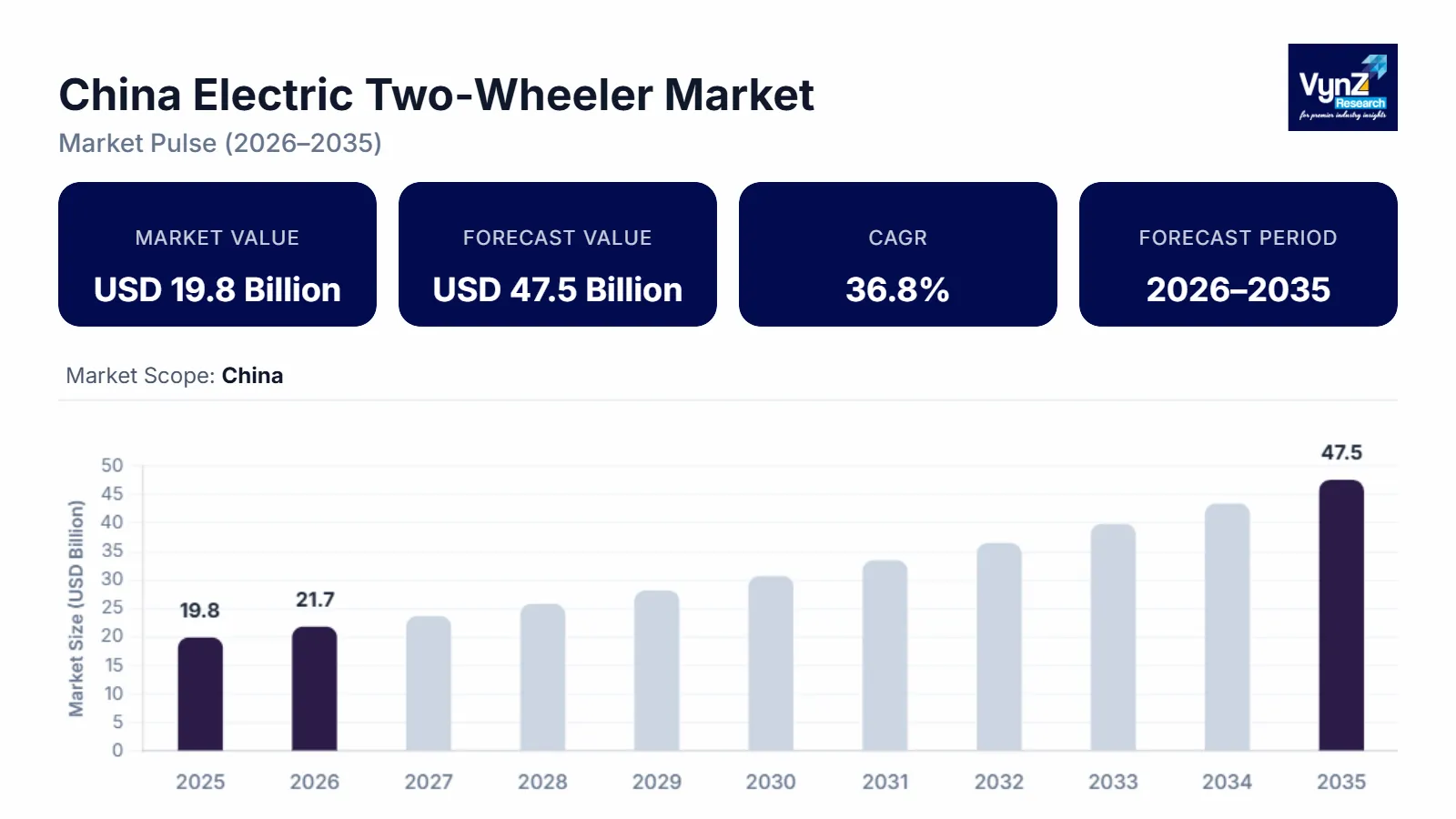
Market growth is pushed by the increase in urban mobility needs, fuel cost worries and also the expanding government push for low emission transport systems. More people are picking up lithium-ion battery powered electric scooters and motorcycles and there is a growing mindset toward cost efficient personal mobility approaches. So, the industry expansion is getting a faster pace across big provinces like Guangdong, Jiangsu and Zhejiang.
Government direction around sustainable transport and clean energy vehicle take up keeps reinforcing how this market moves forward across China. Policies from the Ministry of Industry and Information Technology and clean mobility programs backed by the National Development and Reform Commission are basically pushing investments into charging infrastructure, battery tech improvements and more intelligent mobility solutions. Also, the reports released by the International Energy Agency keep pointing to China’s strong top tier placement in electric mobility roll out and the link to higher electrification goals, modernization of urban transport, and the growing merger of smart connected vehicle technologies within passenger mobility use cases.
China Electric Two-Wheeler Market Dynamics
Market Trends
The industry is seeing important changes in how batteries get integrated, how smart mobility is being used, and how the connected vehicle world is forming. One trend that is really driving everything is the shift toward lithium-ion battery powered scooters and motorcycles, which basically shows what people want better energy efficiency, faster charging, and stronger overall vehicle performance. At the same time, more lightweight vehicle platforms, plus app connected mobility systems, are helping new product ideas pop up across city transportation lines.
Another trend is the push for intelligent connectivity together with battery swapping facilities. This is coming from quick digitalization and also from the growing reality of city commutes. Because of that, manufacturers are leaning more into fast charging compatibility, better telematics and extra vehicle safety features, and this makes them stand out versus competitors. Reports from the International Energy Agency and electrification efforts promoted by the Ministry of Industry and Information Technology keep pointing out that China’s electric mobility modernization is moving faster across the two-wheeler transport scene.
Growth Drivers
The growth of the market is mostly due to rising urban mobility needs and that keeps pushing adoption for personal commuting and short-range transportation. More investment is going into charging infrastructure, battery manufacturing sites, and smart transportation systems, causing market expansion. Also, higher urban population density plus fuel cost worries is making electric scooters and motorcycles more attractive, especially in big metropolitan areas.
Government clean mobility policies help adoption happen faster. Since consumers are thinking about cost effectiveness, lower upkeep and environmental responsibility, demand for electric mobility solutions should stay solid through the forecast period. Transportation electrification actions brought in by the National Development and Reform Commission plus environmental sustainability programs supported by the Ministry of Ecology and Environment are also strengthening investment in low emission transport infrastructure, and advanced battery technologies.
Market Restraints / Challenges
Even if the outlook looks positive, the market still has problems that could slow down expansion. Battery raw material prices can swing around and the industry’s dependence on lithium supply chains keeps pressing production costs and profit margins, especially for price sensitive manufacturers, and for smaller regional companies. Because raw material procurement costs are inconsistent, pricing pressure is spreading across the whole electric vehicle manufacturing ecosystem.
There’s also a situation with gaps in charging infrastructure and limits around battery recycling, which becomes an operational headache for manufacturers and mobility operators. When firms rely on outside battery component suppliers and when charging access is uneven in rural regions, it can create adoption obstacles and make scaling harder. The International Energy Agency reports plus transportation policy reviews from the Ministry of Transport suggest that infrastructure upgrades and battery disposal management remain key for long term industry health.
Market Opportunities
There are opportunities mainly in battery swapping infrastructure and connected urban mobility solutions and these are getting stronger with rising urbanization and demand for more efficient personal travel. Businesses that can offer affordable, high performance and smart connected electric scooters are well placed to grab extra demand from students, working professionals and delivery service operators. Also, the continued replacement of fuel powered two wheelers with battery operated alternatives is supporting long term growth.
Another opportunity area is premium electric motorcycles and intelligent mobility platforms. As investments rise in digital enabled transport services, it opens doors for higher value offerings and stronger customer engagement. Improvements in smart navigation, telematics integration and fast charging technologies are expected to make daily operations easier and also improve the user experience. Government backed electrification programs pushed by the Ministry of Industry and Information Technology, together with sustainable mobility notes referenced by the International Energy Agency, should further support future investment chances across the market.
China Electric Two-Wheeler Market Report Coverage
|
Report Metric |
Details |
|
Historical Period |
2020 - 2024 |
|
Base Year Considered |
2025 |
|
Forecast Period |
2026 - 2035 |
|
Market Size in 2025 |
USD 19.8 Billion |
|
Revenue Forecast in 2035 |
USD 47.3 Billion |
|
Growth Rate |
9.1% |
|
Segments Covered in the Report |
By Product, By Battery Type, By Battery Technology, By Voltage |
|
Report Scope |
Market Trends, Drivers, and Restraints; Revenue Estimation and Forecast; Segmentation Analysis; Companies’ Strategic Developments; Market Share Analysis of Key Players; Company Profiling |
|
Regions Covered in the Report |
Guangdong, Jiangsu, Zhejiang, Rest of China |
|
Key Companies |
AIMA Technology Group Co. Ltd., Jiangsu Kingbon Vehicle Co. Ltd., Jiangsu Xinri E-Vehicle Co. Ltd. (SUNRA), Lima Vehicle Industry Group Co. Ltd., NIU Technologies, Segway-Ninebot, TAILG Group, Xiaodao Electric Vehicle, Yadea Technology Group, Zhejiang Luyuan Electric Vehicle Co. Ltd. |
|
Customization |
Available upon request |
China Electric Two-Wheeler Market Segmentation
By Product
Electric scooters in 2025 made up about 61% of total market revenue because of heavy urban commuting demand plus lower running costs adoption across crowded metropolitan areas. People are also leaning more toward compact personal mobility choices and app-connected smart scooter deployments keep rising. On top of that, clean transport ideas backed by the Ministry of Industry and Information Technology are still pushing broader electric scooter take up across urban transportation systems.
Electric motorcycles are expected to grow the quickest over the forecast window, with an estimated CAGR of 9.8% from 2026 to 2035. This is happening because more riders want higher-speed mobility, battery performance is getting better and younger consumers seem more into premium electric mobility products. Even charging networks are expanding and advanced battery systems are developing, which in turn helps these motorcycles gain traction for both commercial use and more recreational transport needs.
By Battery Type
Sealed lead-acid batteries had the biggest share in 2025, contributing around 56% of total revenue. It is due to lower upfront acquisition costs, an already established supply chain, and wide usage in entry level electric scooters as well as commuter vehicles. This type is still especially common in cost sensitive city and rural markets, where affordability and simpler maintenance feel like the main buying drivers. Public transportation electrification programs and local manufacturing support policies are further reinforcing demand across China’s mass market mobility landscape.
Lithium-ion batteries are projected to grow the fastest, with an estimated CAGR of 10.4% between 2026 and 2035. Growth is linked to growing preference for lighter battery systems plus longer riding range and quicker charging efficiency. More smart connected electric vehicles are being rolled out and premium mobility platforms are also speeding up lithium-ion battery integration. The International Energy Agency keeps pointing to the increasing importance of lithium-ion technologies for long term electric mobility modernization and sustainable transportation deployment.
By Battery Technology
Removable battery systems held the largest market share in 2025, roughly 53% of total segment revenue. Their advantage comes from charging convenience, the trend of apartment living in cities and rising demand for flexible mobility arrangements in densely populated areas. Buyers still like removable battery equipped vehicles because charging is easier and they become less dependent on fixed charging infrastructure. Battery swapping station rollout along with urban charging support programs are also strengthening demand across major metropolitan regions.
Swappable battery technology is expected to post the fastest growth and the estimated CAGR is 10.7% from 2026 to 2035. This growth is backed by rising investments in smart mobility infrastructure, fleet electrification for commercial fleets and fast energy replacement solutions especially for delivery operations. More cooperation between mobility operators and battery service providers is also speeding adoption across urban logistics and shared mobility services. Clean transportation strategies supported by the National Development and Reform Commission continue to back the expansion of battery swapping ecosystems across the country.
By Voltage
48V electric two wheelers accounted for the largest share in 2025, representing about 58% of the revenue. It is due to heavy use in short distance commuting, cheaper battery costs and broad affordability for mass market consumer groups. These models are still a favorite for daily commuters and students because maintenance expenses are lower and charging requirements feel practical. Also, expansion of low-speed urban mobility infrastructure and rising demand for economical transportation options keep reinforcing this dominance.
Vehicles operating above 48V are expected to grow the fastest, with an estimated CAGR around 9.9% from 2026 to 2035. This is driven by consumers wanting better vehicle speed, stronger performance capability and longer battery range. More premium electric motorcycle penetration and connected mobility solutions are adding momentum as they help expand the segment across metropolitan transportation markets. Clean mobility initiatives promoted by the Ministry of Ecology and Environment and electrification programs cited by the International Energy Agency continue to encourage the development of higher efficiency electric mobility platforms across China’s transportation industry.
Regional Insights
Guangdong
Guangdong sort of accounted for about 29% of the market in 2025, pushed by solid manufacturing capacity, dense city life, and faster expansion of smart mobility services. Higher demand from big urban centers like Guangzhou, Shenzhen and Foshan keep helping the market move forward. The province also depends on advanced electric vehicle supply chains, battery manufacturing groundwork, and connected mobility platforms rolling out across the urban transit scenario.
Jiangsu
Jiangsu made up about 24% of the market in 2025 and it is showing steady climb mainly because industrial activity keeps widening, urban transport gets upgraded, and regional electrification policies are supportive. The uptake is increasing across day-to-day commuting, commercial parcel delivery work, and app-based mobility services. So, demand stays consistent in cities such as Nanjing, Suzhou and also Wuxi, over time.
Zhejiang
Zhejiang accounted for close to 21% of the market in 2025, helped by more urban modernization projects, more digital commerce activity happening, and growing awareness among buyers about ecofriendly transport options. Demand remains strong in Hangzhou, Ningbo, and Wenzhou, which keeps creating longer term chances for electric mobility producers and charging infrastructure providers.
Rest of China
The rest of China collectively it reached around 26% of the market in 2025, driven by rising need for urban mobility and the gradual turn toward electrified transport across provinces such as Shandong, Henan, Sichuan Anhui, and Hubei. More electric scooters plus battery powered commuter vehicles are getting adopted in tier two and tier three cities and that momentum keeps stretching market growth across those regions.
Competitive Landscape / Company Insights
The market is quite competitive with both domestic and regional firms trying to push harder on battery innovation, cost friendliness, and dealership expansion all at once, just to get deeper into the market faster. Meanwhile, firms are putting more money into intelligent mobility tools, lithium-ion battery development, and even connected vehicle features, so they can raise day to day operational efficiency, plus get more direct customer attention. Also, the government, through electrification push initiatives led by the Ministry of Industry and Information Technology, and the sustainable mobility recommendations from the International Energy Agency, still keeps encouraging tech upgrades and overall industry growth across the whole market landscape.
Mini Profiles
AIMA Technology Group Co. Ltd. focuses on intelligent electric two wheeler solutions, supported by strong brand recognition, extensive dealership networks, and rising consumer demand across urban mobility applications.
Jiangsu Kingbon Vehicle Co. Ltd. operates in cost competitive electric mobility segments, emphasizing durable vehicle performance, battery efficiency, and expanding regional transportation distribution capabilities.
Lima Vehicle Industry Group Co. Ltd. leverages large scale manufacturing infrastructure and diversified electric scooter offerings to strengthen market presence across commuter and commercial mobility sectors.
NIU Technologies focuses on premium smart electric scooters, supported by advanced connectivity features, intelligent battery management systems, and growing digital retail penetration across metropolitan markets.
Segway-Ninebot emphasizes intelligent urban mobility solutions, supported by advanced vehicle connectivity technologies, strong innovation capabilities, and expanding adoption across smart commuter transportation applications.
Key Players
- AIMA Technology Group Co. Ltd.
- Jiangsu Kingbon Vehicle Co. Ltd.
- Jiangsu Xinri E-Vehicle Co. Ltd. (SUNRA)
- Lima Vehicle Industry Group Co. Ltd.
- NIU Technologies
- Segway-Ninebot
- TAILG Group
- Xiaodao Electric Vehicle
- Yadea Technology Group
- Zhejiang Luyuan Electric Vehicle Co. Ltd.
Recent Developments
In November, 2025, Yadea Technology Group showcased the Yadea Velax electric motorcycle and an advanced charging ecosystem during EICMA 2025 in Milan. The company also highlighted fast charging battery technologies and expansion of its global electric mobility strategy.
In December, 2025, Zhejiang Luyuan Electric Vehicle Co. Ltd. introduced new intelligent mobility technologies and announced strategic collaborations with BMW, DOBOT, and UDEER AI during its partner conference. The company also revealed plans for expanded smart mobility ecosystems and upgraded electric two-wheeler product platforms.
In March, 2026, Jiangsu Xinri E-Vehicle Co. Ltd. (SUNRA) strengthened its international electric scooter distribution activities targeting expanding urban mobility demand across overseas markets. The company also continued promoting lightweight connected electric two-wheeler platforms for commuter transportation applications.
In October, 2025, TAILG Group expanded investments in high performance lithium battery powered electric scooters to strengthen its position in China’s smart mobility market. The company also focused on enhancing intelligent vehicle connectivity and urban commuter transportation solutions.
In January, 2026, Zhejiang Luyuan Electric Vehicle Co. Ltd. accelerated development of intelligent control systems and smart manufacturing infrastructure through new mobility technology projects in Hangzhou. The company emphasized AI integration and connected electric mobility innovation to strengthen future product competitiveness.
China Electric Two-Wheeler Market Coverage
Product Insight and Forecast 2026 - 2035
- Electric Scooters
- Electric Motorcycles
Battery Type Insight and Forecast 2026 - 2035
- Sealed Lead-acid Batteries
- Lithium-ion Batteries
Battery Technology Insight and Forecast 2026 - 2035
- Removable Battery Systems
- Swappable Battery Systems
- Fixed Battery Systems
Voltage Insight and Forecast 2026 - 2035
- Below 48V
- 48V
- Above 48V
China Electric Two-Wheeler Market by Region
- Guangdong
- By Product
- By Battery Type
- By Battery Technology
- By Voltage
- Jiangsu
- By Product
- By Battery Type
- By Battery Technology
- By Voltage
- Zhejiang
- By Product
- By Battery Type
- By Battery Technology
- By Voltage
- Rest of China
- By Product
- By Battery Type
- By Battery Technology
- By Voltage
Table of Contents for China Electric Two-Wheeler Market Report
1. Research Overview
1.1. The Report Offers
1.2. Market Coverage
1.2.1. By
Product
1.2.2. By
Battery Type
1.2.3. By
Battery Technology
1.2.4. By
Voltage
1.3. Research Phases
1.4. Limitations
1.5. Market Methodology
1.5.1. Data Sources
1.5.1.1.
Primary Research
1.5.1.2.
Secondary Research
1.5.2. Methodology
1.5.2.1.
Data Exploration
1.5.2.2.
Forecast Parameters
1.5.2.3.
Data Validation
1.5.2.4.
Assumptions
1.5.3. Study Period & Data Reporting Unit
2. Executive Summary
3. Industry Overview
3.1. Industry Dynamics
3.1.1. Market Growth Drivers
3.1.2. Market Restraints
3.1.3. Key Market Trends
3.1.4. Major Opportunities
3.2. Industry Ecosystem
3.2.1. Porter’s Five Forces Analysis
3.2.2. Recent Development Analysis
3.2.3. Value Chain Analysis
3.3. Competitive Insight
3.3.1. Competitive Position of Industry
Players
3.3.2. Market Attractive Analysis
3.3.3. Market Share Analysis
4. China Market Estimate and Forecast
4.1. China Market Overview
4.2. China Market Estimate and Forecast to 2035
5. Market Segmentation Estimate and Forecast
5.1. By Product
5.1.1. Electric Scooters
5.1.1.1. Market Definition
5.1.1.2. Market Estimation and Forecast to 2035
5.1.2. Electric Motorcycles
5.1.2.1. Market Definition
5.1.2.2. Market Estimation and Forecast to 2035
5.2. By Battery Type
5.2.1. Sealed Lead-acid Batteries
5.2.1.1. Market Definition
5.2.1.2. Market Estimation and Forecast to 2035
5.2.2. Lithium-ion Batteries
5.2.2.1. Market Definition
5.2.2.2. Market Estimation and Forecast to 2035
5.3. By Battery Technology
5.3.1. Removable Battery Systems
5.3.1.1. Market Definition
5.3.1.2. Market Estimation and Forecast to 2035
5.3.2. Swappable Battery Systems
5.3.2.1. Market Definition
5.3.2.2. Market Estimation and Forecast to 2035
5.3.3. Fixed Battery Systems
5.3.3.1. Market Definition
5.3.3.2. Market Estimation and Forecast to 2035
5.4. By Voltage
5.4.1. Below 48V
5.4.1.1. Market Definition
5.4.1.2. Market Estimation and Forecast to 2035
5.4.2. 48V
5.4.2.1. Market Definition
5.4.2.2. Market Estimation and Forecast to 2035
5.4.3. Above 48V
5.4.3.1. Market Definition
5.4.3.2. Market Estimation and Forecast to 2035
6. Guangdong Market Estimate and Forecast
6.1. By
Product
6.2. By
Battery Type
6.3. By
Battery Technology
6.4. By
Voltage
7. Jiangsu Market Estimate and Forecast
7.1. By
Product
7.2. By
Battery Type
7.3. By
Battery Technology
7.4. By
Voltage
8. Zhejiang Market Estimate and Forecast
8.1. By
Product
8.2. By
Battery Type
8.3. By
Battery Technology
8.4. By
Voltage
9. Rest of China Market Estimate and Forecast
9.1. By
Product
9.2. By
Battery Type
9.3. By
Battery Technology
9.4. By
Voltage
10. Company Profiles
10.1.
AIMA Technology Group Co. Ltd.
10.1.1.
Snapshot
10.1.2.
Overview
10.1.3.
Offerings
10.1.4.
Financial
Insight
10.1.5.
Recent
Developments
10.2.
Jiangsu Kingbon Vehicle Co. Ltd.
10.2.1.
Snapshot
10.2.2.
Overview
10.2.3.
Offerings
10.2.4.
Financial
Insight
10.2.5.
Recent
Developments
10.3.
Jiangsu Xinri E-Vehicle Co. Ltd. (SUNRA)
10.3.1.
Snapshot
10.3.2.
Overview
10.3.3.
Offerings
10.3.4.
Financial
Insight
10.3.5.
Recent
Developments
10.4.
Lima Vehicle Industry Group Co. Ltd.
10.4.1.
Snapshot
10.4.2.
Overview
10.4.3.
Offerings
10.4.4.
Financial
Insight
10.4.5.
Recent
Developments
10.5.
NIU Technologies
10.5.1.
Snapshot
10.5.2.
Overview
10.5.3.
Offerings
10.5.4.
Financial
Insight
10.5.5.
Recent
Developments
10.6.
Segway-Ninebot
10.6.1.
Snapshot
10.6.2.
Overview
10.6.3.
Offerings
10.6.4.
Financial
Insight
10.6.5.
Recent
Developments
10.7.
TAILG Group
10.7.1.
Snapshot
10.7.2.
Overview
10.7.3.
Offerings
10.7.4.
Financial
Insight
10.7.5.
Recent
Developments
10.8.
Xiaodao Electric Vehicle
10.8.1.
Snapshot
10.8.2.
Overview
10.8.3.
Offerings
10.8.4.
Financial
Insight
10.8.5.
Recent
Developments
10.9.
Yadea Technology Group
10.9.1.
Snapshot
10.9.2.
Overview
10.9.3.
Offerings
10.9.4.
Financial
Insight
10.9.5.
Recent
Developments
10.10.
Zhejiang Luyuan Electric Vehicle Co. Ltd.
10.10.1.
Snapshot
10.10.2.
Overview
10.10.3.
Offerings
10.10.4.
Financial
Insight
10.10.5.
Recent
Developments
11. Appendix
11.1. Exchange Rates
11.2. Abbreviations
Note: Financial insight and recent developments of different companies are subject to the availability of information in the secondary domain.
Frequently Asked Questions
Purchase Options
Latest Report
Research Methodology
- Desk Research / Pilot Interviews
- Build Market Size Model
- Research and Analysis
- Final Deliverable
Connect With Our Sales Team
- Toll-Free: +1-888-253-3960
- Phone: +91 9960 288 381
- Email: enquiry@vynzresearch.com
China Electric Two-Wheeler Market