
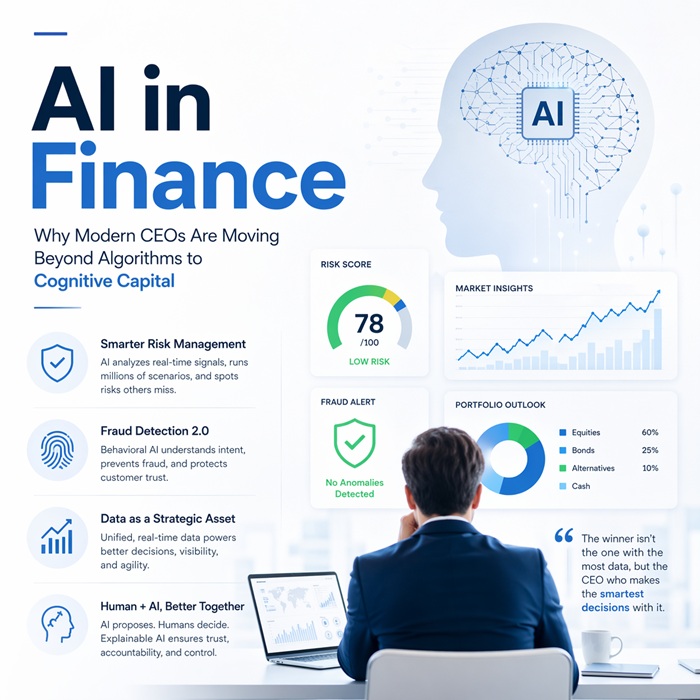
Most AI in the finance sector over the last five years has just been glorified automation. It was about making spreadsheets run faster. But for a CEO in today’s market, speed is no longer the differentiator, everyone has speed. The real battleground is now judgment at scale. We are moving away from simple predictive analytics and entering the era of cognitive finance. This isn't just about a new software patch; it’s a total teardown and rebuild of how we perceive risk, how we hunt for alpha, and how we protect the firm’s reputation in a world where a flash crash can happen in the blink of an eye.
Rethinking the Risk Equation
The old way of managing risk was essentially looking at a map of where you’ve already been. You looked at historical defaults, 10-year yields, and past market cycles. But in a post-2025 economy, the past is a poor teacher. Geopolitical shifts and climate-driven market shocks don't follow historical "bell curves."
AI allows a CEO to move toward dynamic, multi-vector risk.
- Beyond the Spreadsheet: We aren't just looking at numbers. AI is now reading the world, analyzing the tone of central bank speeches, tracking real-time supply chain disruptions via satellite, and gauging retail sentiment on fragmented social platforms.
- Hyper-Simulation: Instead of a static stress test done once a quarter for regulators, your systems should be running millions of "What If" scenarios every hour. What if a major port closes? What if a specific currency devalues by 4% overnight?
- The Black Swan Filter: Traditional models often ignore outliers. AI-driven cognitive systems are designed specifically to flag the impossible scenarios that actually end up sinking firms.
Fraud Detection: Moving from Defense to Pre-emption
For a CEO, fraud is more than just a line-item loss; it’s a massive friction point for your best customers. There is nothing a high-net-worth client hates more than having their card declined at a dinner because a dumb algorithm flagged a legitimate transaction.
The new standard is behavioral DNA. AI-native systems don't just look at the amount of a transaction; they look at the intent. They understand the nuance of a client’s life. If a transaction looks weird but fits the broader lifestyle pattern of the user, the AI lets it go. Conversely, it can spot sleeper fraud, where small, seemingly innocent actions over six months are actually the preamble to a massive heist, and shut it down before the first dollar actually leaves the vault.
The Strategic Redesign: Data as a Fiduciary Duty
The CEO’s job is to ensure the firm’s data isn't just stored, but active. If your data is sitting in silos, your AI is essentially blind.
|
The Legacy Problem |
The AI-Native Solution |
The CEO’s Win |
|
Data Silos |
A unified Data Fabric that connects every department. |
Complete visibility of the firm's total liquidity in seconds. |
|
Static Reporting |
Monthly Look-Back decks. |
Real-time dashboards that show projected outcomes. |
|
Manual Compliance |
Armies of auditors checking boxes. |
Compliance-by-Design where the AI flags violations as they happen. |
The Black Box Dilemma: Who is Accountable?
Here is the uncomfortable truth: You cannot point at a computer and blame it when things go wrong in front of a regulator or a judge. As a CEO, the biggest hurdle to AI adoption isn't the technology; it's the accountability gap.
This is why Explainable AI (XAI) is your most important strategic investment. You need to be able to open the hood and show exactly why an algorithm denied a mortgage or sold off a position. If your tech team tells you the AI is too complex to explain, they are giving you a liability, not an asset.
CEO Mandate: Demand human-in-the-loop systems. AI should propose the move, but for high-stakes decisions, a human expert with skin in the game must still sign off. This isn't slowing things down; it’s protecting the firm’s future.
Leadership Execution: The 12-Month Pivot
If you’re leading a financial institution, stop treating AI as a tech project. It’s an organizational redesign.
- Stop the Pilot Purgatory: Most firms have 20 different AI pilots that never go live. Pick the two with the highest ROI and force them into production.
- Incentivize Algorithmic Skepticism: Reward your analysts when they find a flaw in the AI’s logic. You want a team that uses AI as a tool, not a crutch.
- Focus on Data Liquidity: Spend the money now to clean up your legacy data. You can’t build a skyscraper on a swamp.
The Bottom Line
In the world of finance, AI is a great filter. There will be firms that use it to become leaner, faster, and more precise, and there will be firms that get buried by the overhead of their own legacy systems. The winner isn't the one with the most data; it's the CEO who has the courage to trust the machine's insights while maintaining the human wisdom to know when to override them.