
Aluminum Die Casting Market Size & Share Growth Forecast Report (2026-2035)
Industry Insight by Production Process (High pressure die casting, Low pressure die casting, Vacuum die casting, Other processes), by Application (Transportation, Industrial machinery, Building and construction, Telecommunications, Consumer durables, Energy, Other applications), by Alloy Type (Aluminum silicon alloys, Aluminum magnesium alloys, Aluminum copper alloys, Other aluminum alloys), by End Use (Automotive, Aerospace and defense, Industrial manufacturing, Construction, Marine, Other end use industries)
| Status : Published | Published On : Oct, 2026 | Report Code : VRCH2148 | Industry : Chemicals & Materials | Available Format :

|
Page : 158 |
Aluminum Die Casting Market Overview
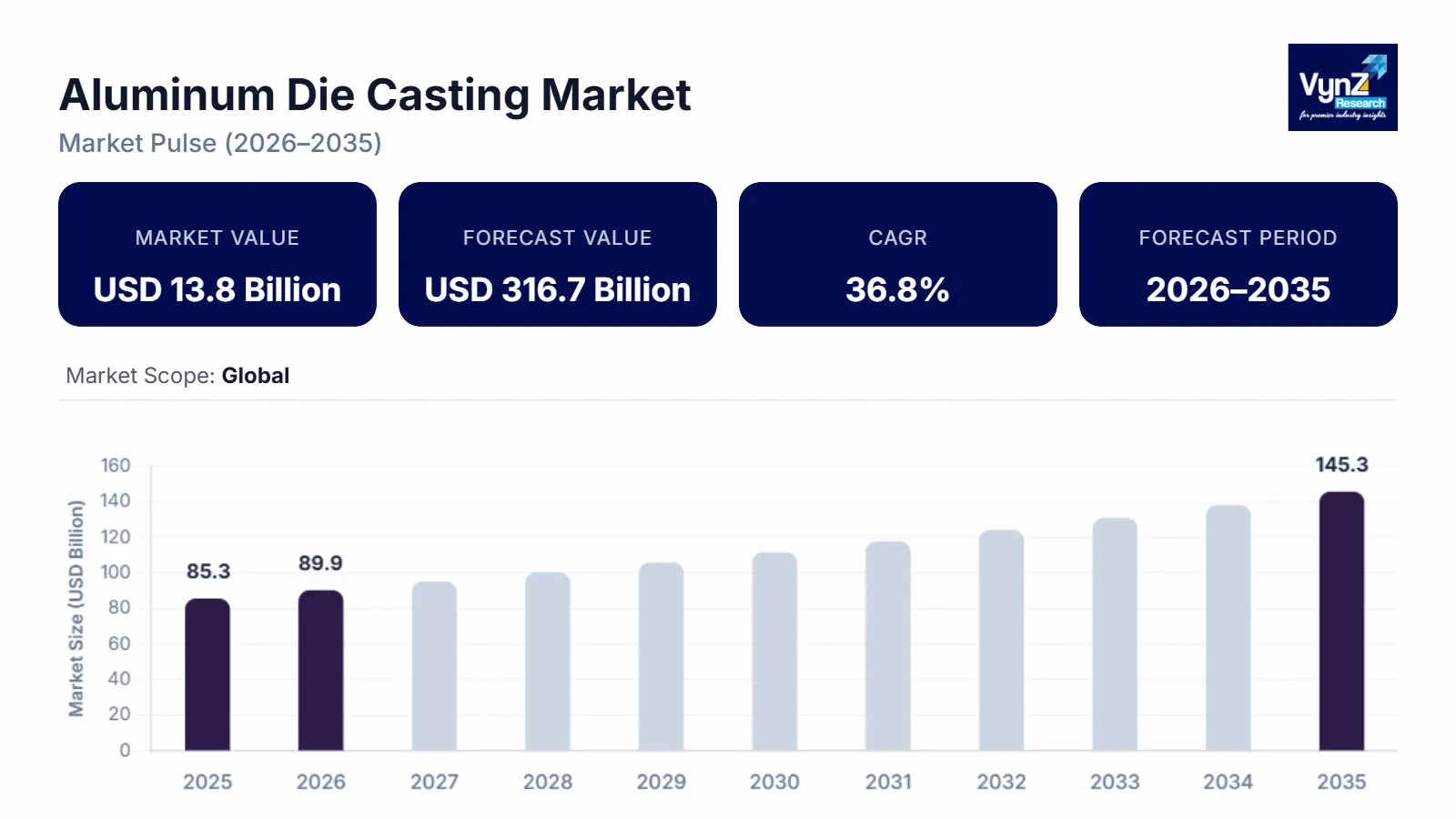
The global aluminum die casting market was valued at an estimated USD 85.25 billion in 2025 and is projected to reach USD 90 billion in 2026, advancing to approximately USD 145.47 billion by 2035, at a proposed CAGR of 5.48% from 2026 to 2035.
The aluminum die casting industry is benefiting from demand for lightweight automotive components, electric vehicle manufacturing, industrial machinery and precision-engineered parts. Aluminum die casting supports the manufacture of housings, brackets, heat management components and precision parts at commercial production volumes. Improvements in robotic handling, mold simulation and automated inspection can help manufacturers reduce defects and improve throughput, making the process more attractive to customers seeking repeatable quality and competitive component costs.
Research Methodology
VynZ Research evaluates the industry through secondary research, company disclosures, manufacturing trends, government publications and relevant industry statistics. The VynZ Research team compares available market estimates, assesses demand across production processes and applications, and develops independent forecasts using a consistent base year and proposed growth rate. The analysis also considers raw material costs, automotive production, electric mobility, regional manufacturing capacity and technological developments. Published figures are used as reference points, while the market estimates and forecasts presented in this report are analytical estimates rather than independently audited industry totals.
Research Highlights
- High pressure die casting accounted for approximately 68% of global revenue in 2025, supported by its high production speed.
- Transportation represented approximately 56% of market revenue in 2025, reflecting extensive use of aluminum components in vehicle structures.
- Automotive contributed approximately 64% of revenue in 2025, reflecting the extensive use of aluminum castings in structural assemblies.
- Vacuum die casting is expected to expand at a CAGR of 6.35% from 2026 to 2035, as manufacturers seek to reduce gas entrapment and improve component integrity.
- North America is estimated to represent approximately 20% of global revenue in 2025, supported by automotive manufacturing, commercial vehicles, industrial machinery and demand for engineered components.
Aluminum Die Casting Market Dynamics
Market Trends
The industry is shifting toward larger structural castings, integrated component designs and automated production systems, particularly in automotive manufacturing. High-pressure die casting enables manufacturers to produce intricate parts with consistent dimensions, while vacuum-assisted processes help reduce gas porosity in components requiring improved mechanical performance. These technologies are increasingly relevant to electric vehicles, where battery housings, motor enclosures and structural assemblies must balance weight, durability and production efficiency. Another important trend is the growing emphasis on recycled aluminum, digital process monitoring and defect detection. The U.S. Geological Survey reported that secondary aluminum production from new and old scrap increased by an estimated 5% in the United States in 2024, highlighting the importance of recycled material within the wider aluminum supply chain.
Growth Drivers
Automotive lightweighting remains a major demand driver, as manufacturers use aluminum components to reduce vehicle mass while maintaining structural performance. The expansion of electric mobility also creates demand for battery enclosures, motor housings, inverter cases and chassis components. According to the International Energy Agency, electric car sales exceeded 17 million worldwide in 2024, and its 2025 outlook anticipated further growth, reinforcing the need for lightweight and efficiently manufactured vehicle components. Industrial machinery, electronics and construction equipment provide additional sources of demand.
Market Restraints / Challenges
Volatile aluminum prices and energy expenses can affect production costs, particularly for manufacturers operating energy-intensive melting and casting facilities. The U.S. Geological Survey's Mineral Commodity Summaries 2025 documented changes in primary and secondary aluminum production and a 3% increase in the estimated average annual U.S. market price in 2024. Such movements can complicate procurement planning and margins when component prices are fixed under long-term supply agreements. High capital expenditure is another constraint, as advanced casting presses, precision tooling, vacuum systems, machining equipment and quality control infrastructure require substantial investment.
Market Opportunities
Electric vehicle platforms and integrated structural components offer opportunities for manufacturers capable of producing large, thin-walled and dimensionally consistent castings. As automakers redesign vehicle architectures, suppliers with advanced tooling, simulation and process control capabilities may secure higher value contracts. The International Energy Agency's reporting on rising electric vehicle adoption provides a broader demand indicator for these applications, although actual die casting demand will vary by vehicle design and component sourcing strategy. Further opportunities lie in recycled aluminum, low defect manufacturing and integrated finishing services. Suppliers that combine casting with machining, surface treatment, inspection and assembly can simplify procurement for original equipment manufacturers.
Global Aluminum Die Casting Market Report Coverage
|
Report Metric |
Details |
|
Historical Period |
2020 - 2024 |
|
Base Year Considered |
2025 |
|
Forecast Period |
2026 - 2035 |
|
Market Size in 2025 |
USD 85.25 Billion |
|
Revenue Forecast in 2035 |
USD 145.47 Billion |
|
Growth Rate |
5.48% |
|
Segments Covered in the Report |
Production Process, Application, Alloy Type, End Use |
|
Report Scope |
Market Trends, Drivers, and Restraints; Revenue Estimation and Forecast; Segmentation Analysis; Companies’ Strategic Developments; Market Share Analysis of Key Players; Company Profiling |
|
Regions Covered in the Report |
North America, Europe, Asia Pacific, Rest of the World |
|
Key Companies |
Alcast Technologies, Bühler, Consolidated Metco, Dynacast, Endurance Technologies, Linamar, Nemak, Ryobi, YIZUMI, Kimura Group |
|
Customization |
Available upon request |
Aluminum Die Casting Market Segmentation
By Production Process
High pressure die casting accounted for approximately 68% of global revenue in 2025, supported by its high production speed, suitability for intricate geometries and widespread use in automotive manufacturing.
Vacuum die casting is expected to expand at a faster pace, with a proposed CAGR of 6.35% from 2026 to 2035, as manufacturers seek to reduce gas entrapment and improve component integrity.
By Application
Transportation represented approximately 56% of market revenue in 2025, reflecting extensive use of aluminum components in vehicle structures, powertrain systems, transmission housings and thermal management assemblies.
Industrial machinery is expected to record stronger growth, with a proposed CAGR of 6.10% during 2026 to 2035, as equipment manufacturers seek durable housings, precision components and lightweight parts for automated systems.
By Alloy Type
Aluminum silicon alloys accounted for approximately 61% of market revenue in 2025 because of their favorable casting characteristics and broad suitability for automotive and industrial components.
Aluminum magnesium alloys are projected to record a proposed CAGR of 6% from 2026 to 2035, supported by applications requiring a combination of reduced weight and corrosion resistance.
By End Use
Automotive contributed approximately 64% of revenue in 2025, reflecting the extensive use of aluminum castings in powertrain housings, transmission components, chassis systems and structural assemblies.
Industrial manufacturing is expected to expand at a CAGR of 5.6% from 2026 to 2035as machinery producers adopt precision cast parts for equipment housings, mechanical assemblies and thermal management systems.
Regional Insights
Asia Pacific
Asia Pacific accounted for approximately 50% of global revenue in 2025, making it the largest regional market. China, Japan, India and South Korea support demand through automotive manufacturing, electronics production, industrial equipment and established metal processing networks. The region benefits from a large supplier base and proximity to vehicle and machinery manufacturers, allowing die casting companies to serve high volume production programs. China's position in electric vehicle manufacturing also supports demand for lightweight structural parts, battery housings and motor components.
North America
North America is estimated to represent approximately 20% of global revenue in 2025, supported by automotive manufacturing, commercial vehicles, industrial machinery and demand for engineered components. The United States and Mexico are important production locations, while Canadian manufacturers participate in automotive and industrial supply chains. Vehicle lightweighting and electric mobility support the use of aluminum castings in structural components, housings and thermal management systems. The U.S. Geological Survey reported that transportation accounted for 36% of U.S. aluminum consumption in 2024, providing broader evidence of the importance of transport related demand for aluminum products, although this figure is not specific to die casting.
Europe
Europe is estimated to contribute approximately 19% of global revenue in 2025, supported by established automotive manufacturers, industrial engineering companies and suppliers of precision components. Germany, Italy, France and other manufacturing centers generate demand for cast parts used in vehicle structures, powertrain systems, machinery and electrical equipment. The region's transition toward lower emission transport and greater production efficiency supports interest in lightweight materials, recycled aluminum and process optimization. However, uneven automotive production and investment cycles can influence supplier utilization and new tooling demand.
Rest of the World
The Rest of the World is estimated to account for the remaining 11% of global revenue in 2025, covering Latin America, the Middle East and Africa. Demand is supported by automotive assembly, industrial equipment, construction machinery and the gradual expansion of manufacturing capacity in selected countries. Brazil and Mexico have automotive supply chains, while parts of the Middle East are investing in industrial diversification and manufacturing infrastructure. The size of individual markets and the availability of local casting capabilities vary considerably across this broader regional grouping.
Competitive Landscape / Company Insights
The aluminum die casting market is characterized by established automotive suppliers, specialist casting manufacturers and equipment providers competing through production capacity, tooling expertise, component quality and technological innovation. Companies are investing in large casting machines, automated inspection, integrated machining and lightweight structural components to meet evolving customer requirements. Recent acquisitions and equipment investments also indicate a focus on expanding technical capabilities and serving higher value applications.
Mini Profiles
Alcast Technologies specializes in aluminum casting solutions, serving customers requiring engineered components and manufacturing support for industrial applications.
Bühler supplies die casting equipment and integrated manufacturing technologies, supporting automated production, large structural castings and process efficiency.
Consolidated Metco supplies engineered components for commercial vehicles, with manufacturing capabilities focused on transportation and heavy-duty applications.
Dynacast provides precision die casting and related manufacturing services, including tooling, component finishing and assembly for industrial customers.
Endurance Technologies manufactures automotive components, including aluminum castings and machined parts, serving vehicle manufacturers and related supply chains.
Key Players
- Alcast Technologies
- Bühler
- Consolidated Metco
- Dynacast
- Endurance Technologies
- Kimura Group
- Linamar Corporation
- Nemak
- Ryobi Limited
- YIZUMI
Recent Developments
Nemak completed its acquisition of GF Casting Solutions' automotive business in 2026 after satisfying the required regulatory approvals and closing conditions. The transaction expanded its manufacturing footprint and strengthened its capabilities in lightweight structural, chassis and electric mobility components.
Kimura Group advanced its aluminum casting capabilities through the launch of its Advanced Aluminum HQ Plant in Shizuoka, Japan, with operations beginning in 2026. The facility supports prototype development and small lot production of large, thin walled aluminum castings.
YIZUMI delivered its LEAP 1400U die casting machine to GF Casting Solutions' Romanian facility in 2025. The deployment reflects continued investment in advanced die casting equipment and production capacity in Europe.
Ryobi Limited introduced an ultra large die casting machine with a clamping force of 6,500 tons at its Kikugawa Plant in 2025. The equipment began supporting prototype production of large automotive components, including parts designed to consolidate multiple conventional components into a single casting.
Linamar Corporation completed acquisitions involving Aludyne's North American assets and Georg Fischer's Leipzig casting facility in 2025. These transactions expanded its structural component capabilities and diversified its casting operations across automotive and heavy industrial applications.
Global Aluminum Die Casting Market Coverage
Production Process Insight and Forecast 2026 - 2035
- High pressure die casting
- Low pressure die casting
- Vacuum die casting
- Other processes
Application Insight and Forecast 2026 - 2035
- Transportation
- Industrial machinery
- Building and construction
- Telecommunications
- Consumer durables
- Energy
- Other applications
Alloy Type Insight and Forecast 2026 - 2035
- Aluminum silicon alloys
- Aluminum magnesium alloys
- Aluminum copper alloys
- Other aluminum alloys
End Use Insight and Forecast 2026 - 2035
- Automotive
- Aerospace and defense
- Industrial manufacturing
- Construction
- Marine
- Other end use industries
Global Aluminum Die Casting Market by Region
- North America
- By Production Process
- By Application
- By Alloy Type
- By End Use
- By Country - U.S., Canada, Mexico
- Europe
- By Production Process
- By Application
- By Alloy Type
- By End Use
- By Country - Germany, U.K., France, Italy, Spain, Russia, Rest of Europe
- Asia-Pacific (APAC)
- By Production Process
- By Application
- By Alloy Type
- By End Use
- By Country - China, Japan, India, South Korea, Vietnam, Thailand, Malaysia, Rest of Asia-Pacific
- Rest of the World (RoW)
- By Production Process
- By Application
- By Alloy Type
- By End Use
- By Country - Brazil, Saudi Arabia, South Africa, U.A.E., Other Countries
Table of Contents for Aluminum Die Casting Market Report
1. Research Overview
1.1. The Report Offers
1.2. Market Coverage
1.2.1. By
Production Process
1.2.2. By
Application
1.2.3. By
Alloy Type
1.2.4. By
End Use
1.3. Research Phases
1.4. Limitations
1.5. Market Methodology
1.5.1. Data Sources
1.5.1.1.
Primary Research
1.5.1.2.
Secondary Research
1.5.2. Methodology
1.5.2.1.
Data Exploration
1.5.2.2.
Forecast Parameters
1.5.2.3.
Data Validation
1.5.2.4.
Assumptions
1.5.3. Study Period & Data Reporting Unit
2. Executive Summary
3. Industry Overview
3.1. Industry Dynamics
3.1.1. Market Growth Drivers
3.1.2. Market Restraints
3.1.3. Key Market Trends
3.1.4. Major Opportunities
3.2. Industry Ecosystem
3.2.1. Porter’s Five Forces Analysis
3.2.2. Recent Development Analysis
3.2.3. Value Chain Analysis
3.3. Competitive Insight
3.3.1. Competitive Position of Industry
Players
3.3.2. Market Attractive Analysis
3.3.3. Market Share Analysis
4. Global Market Estimate and Forecast
4.1. Global Market Overview
4.2. Global Market Estimate and Forecast to 2035
5. Market Segmentation Estimate and Forecast
5.1. By Production Process
5.1.1. High pressure die casting
5.1.1.1. Market Definition
5.1.1.2. Market Estimation and Forecast to 2035
5.1.2. Low pressure die casting
5.1.2.1. Market Definition
5.1.2.2. Market Estimation and Forecast to 2035
5.1.3. Vacuum die casting
5.1.3.1. Market Definition
5.1.3.2. Market Estimation and Forecast to 2035
5.1.4. Other processes
5.1.4.1. Market Definition
5.1.4.2. Market Estimation and Forecast to 2035
5.2. By Application
5.2.1. Transportation
5.2.1.1. Market Definition
5.2.1.2. Market Estimation and Forecast to 2035
5.2.2. Industrial machinery
5.2.2.1. Market Definition
5.2.2.2. Market Estimation and Forecast to 2035
5.2.3. Building and construction
5.2.3.1. Market Definition
5.2.3.2. Market Estimation and Forecast to 2035
5.2.4. Telecommunications
5.2.4.1. Market Definition
5.2.4.2. Market Estimation and Forecast to 2035
5.2.5. Consumer durables
5.2.5.1. Market Definition
5.2.5.2. Market Estimation and Forecast to 2035
5.2.6. Energy
5.2.6.1. Market Definition
5.2.6.2. Market Estimation and Forecast to 2035
5.2.7. Other applications
5.2.7.1. Market Definition
5.2.7.2. Market Estimation and Forecast to 2035
5.3. By Alloy Type
5.3.1. Aluminum silicon alloys
5.3.1.1. Market Definition
5.3.1.2. Market Estimation and Forecast to 2035
5.3.2. Aluminum magnesium alloys
5.3.2.1. Market Definition
5.3.2.2. Market Estimation and Forecast to 2035
5.3.3. Aluminum copper alloys
5.3.3.1. Market Definition
5.3.3.2. Market Estimation and Forecast to 2035
5.3.4. Other aluminum alloys
5.3.4.1. Market Definition
5.3.4.2. Market Estimation and Forecast to 2035
5.4. By End Use
5.4.1. Automotive
5.4.1.1. Market Definition
5.4.1.2. Market Estimation and Forecast to 2035
5.4.2. Aerospace and defense
5.4.2.1. Market Definition
5.4.2.2. Market Estimation and Forecast to 2035
5.4.3. Industrial manufacturing
5.4.3.1. Market Definition
5.4.3.2. Market Estimation and Forecast to 2035
5.4.4. Construction
5.4.4.1. Market Definition
5.4.4.2. Market Estimation and Forecast to 2035
5.4.5. Marine
5.4.5.1. Market Definition
5.4.5.2. Market Estimation and Forecast to 2035
5.4.6. Other end use industries
5.4.6.1. Market Definition
5.4.6.2. Market Estimation and Forecast to 2035
6. North America Market Estimate and Forecast
6.1. By
Production Process
6.2. By
Application
6.3. By
Alloy Type
6.4. By
End Use
6.4.1.
U.S. Market Estimate and Forecast
6.4.2.
Canada Market Estimate and Forecast
6.4.3.
Mexico Market Estimate and Forecast
7. Europe Market Estimate and Forecast
7.1. By
Production Process
7.2. By
Application
7.3. By
Alloy Type
7.4. By
End Use
7.4.1.
Germany Market Estimate and Forecast
7.4.2.
France Market Estimate and Forecast
7.4.3.
U.K. Market Estimate and Forecast
7.4.4.
Italy Market Estimate and Forecast
7.4.5.
Spain Market Estimate and Forecast
7.4.6.
Russia Market Estimate and Forecast
7.4.7.
Rest of Europe Market Estimate and Forecast
8. Asia-Pacific (APAC) Market Estimate and Forecast
8.1. By
Production Process
8.2. By
Application
8.3. By
Alloy Type
8.4. By
End Use
8.4.1.
China Market Estimate and Forecast
8.4.2.
Japan Market Estimate and Forecast
8.4.3.
India Market Estimate and Forecast
8.4.4.
South Korea Market Estimate and Forecast
8.4.5.
Rest of Asia-Pacific Market Estimate and Forecast
9. Rest of the World (RoW) Market Estimate and Forecast
9.1. By
Production Process
9.2. By
Application
9.3. By
Alloy Type
9.4. By
End Use
9.4.1.
Brazil Market Estimate and Forecast
9.4.2.
Saudi Arabia Market Estimate and Forecast
9.4.3.
South Africa Market Estimate and Forecast
9.4.4.
U.A.E. Market Estimate and Forecast
9.4.5.
Other Countries Market Estimate and Forecast
10. Company Profiles
10.1.
Alcast Technologies
10.1.1.
Snapshot
10.1.2.
Overview
10.1.3.
Offerings
10.1.4.
Financial
Insight
10.1.5.
Recent
Developments
10.2.
Bühler
10.2.1.
Snapshot
10.2.2.
Overview
10.2.3.
Offerings
10.2.4.
Financial
Insight
10.2.5.
Recent
Developments
10.3.
Consolidated Metco
10.3.1.
Snapshot
10.3.2.
Overview
10.3.3.
Offerings
10.3.4.
Financial
Insight
10.3.5.
Recent
Developments
10.4.
Dynacast
10.4.1.
Snapshot
10.4.2.
Overview
10.4.3.
Offerings
10.4.4.
Financial
Insight
10.4.5.
Recent
Developments
10.5.
Endurance Technologies
10.5.1.
Snapshot
10.5.2.
Overview
10.5.3.
Offerings
10.5.4.
Financial
Insight
10.5.5.
Recent
Developments
10.6.
Kimura Group
10.6.1.
Snapshot
10.6.2.
Overview
10.6.3.
Offerings
10.6.4.
Financial
Insight
10.6.5.
Recent
Developments
10.7.
Linamar Corporation
10.7.1.
Snapshot
10.7.2.
Overview
10.7.3.
Offerings
10.7.4.
Financial
Insight
10.7.5.
Recent
Developments
10.8.
Nemak
10.8.1.
Snapshot
10.8.2.
Overview
10.8.3.
Offerings
10.8.4.
Financial
Insight
10.8.5.
Recent
Developments
10.9.
Ryobi Limited
10.9.1.
Snapshot
10.9.2.
Overview
10.9.3.
Offerings
10.9.4.
Financial
Insight
10.9.5.
Recent
Developments
10.10.
YIZUMI
10.10.1.
Snapshot
10.10.2.
Overview
10.10.3.
Offerings
10.10.4.
Financial
Insight
10.10.5.
Recent
Developments
11. Appendix
11.1. Exchange Rates
11.2. Abbreviations
Note: Financial insight and recent developments of different companies are subject to the availability of information in the secondary domain.
Frequently Asked Questions
Purchase Options
Latest Report
Research Methodology
- Desk Research / Pilot Interviews
- Build Market Size Model
- Research and Analysis
- Final Deliverable
Connect With Our Sales Team
- Toll-Free: +1-888-253-3960
- Phone: +91 9960 288 381
- Email: enquiry@vynzresearch.com
Aluminum Die Casting Market