
Animal Health Market Size & Share Growth Forecast Report (2026-2035)
Industry Insight by Product Type (Pharmaceuticals, Biologics, Medicated feed additives, Diagnostics, Equipment and disposables, Others), by Animal Type (Production animals, Companion animals), by Distribution Channel (Hospital and clinic pharmacies, Retail pharmacies, E-commerce, Others), by End User (Veterinary hospitals and clinics, Livestock farms and production systems, Reference laboratories, Point of care testing facilities, Others)
| Status : Published | Published On : Oct, 2026 | Report Code : VRHC1354 | Industry : Healthcare | Available Format :

|
Page : 146 |
Animal Health Market Overview
The global animal health market was estimated at USD 67.40 billion in 2025 and is projected to reach USD 73 billion in 2026, expanding at a proposed CAGR of 8.3% from 2026 to 2035 to reach approximately USD 147.80 billion by 2035.
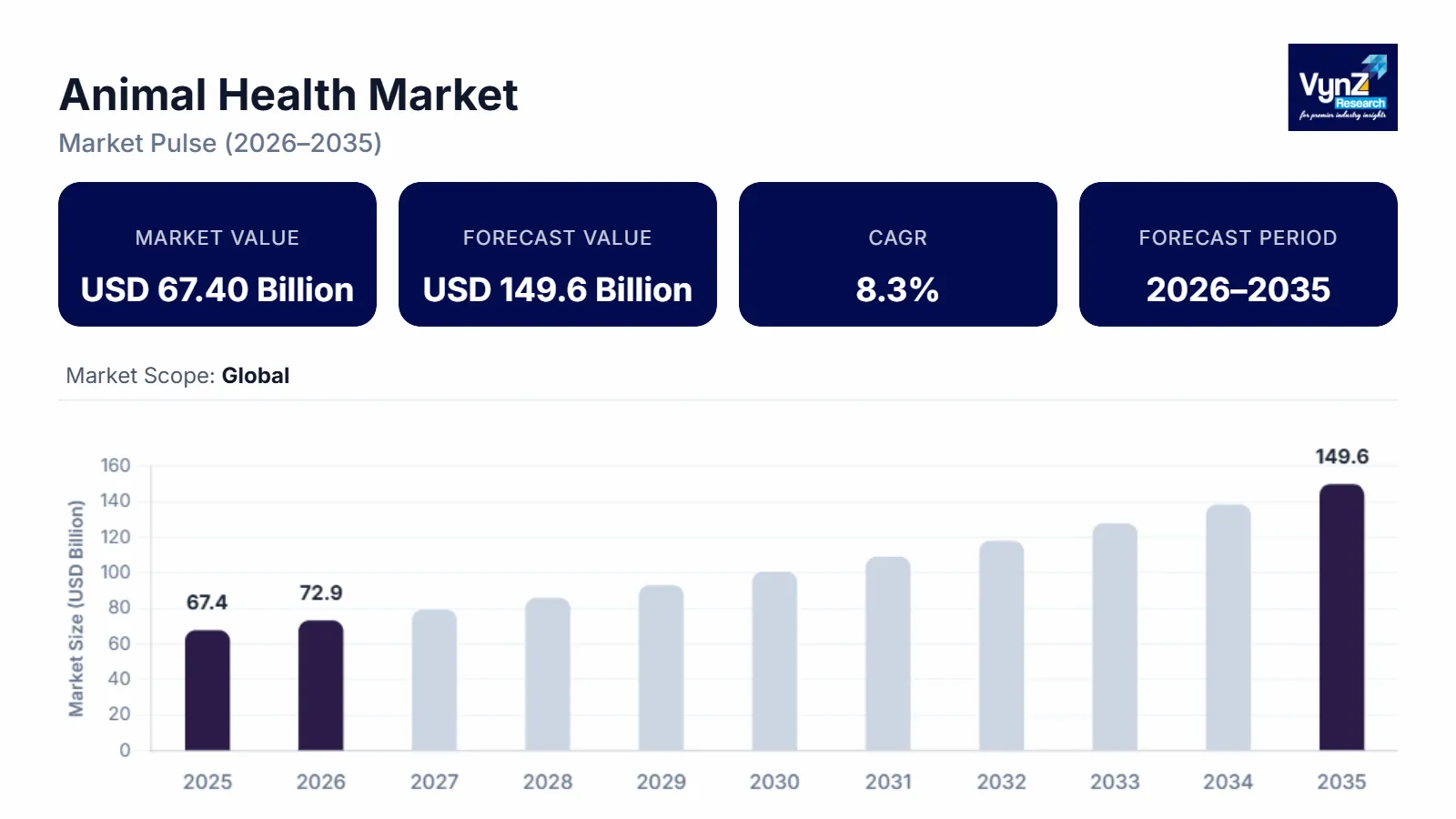
Demand is supported by rising expenditure on companion animals, increasing livestock disease prevention requirements, advances in veterinary pharmaceuticals and diagnostics, and wider adoption of vaccination programs. The World Organization for Animal Health (WOAH), in its State of the World's Animal Health 2025 report, highlighted the importance of vaccination in managing infectious animal diseases, protecting food security and reducing antimicrobial resistance risks.
Research Methodology
The VynZ Research team evaluates the animal health industry using secondary research, company disclosures, regulatory publications, government data and established market research references. The assessment considers veterinary pharmaceuticals, biologics, vaccines, diagnostics, medicated feed additives, animal populations, disease prevalence, veterinary service availability and expenditure on preventive care. WOAH publications provide evidence on animal disease risks and vaccination, while the United States Food and Drug Administration (FDA) maintains records of approved veterinary medicines and regulatory developments. Market estimates are developed through comparative analysis and compound annual growth calculations, with assumptions adjusted to reflect the forecast period and available industry evidence.
Research Highlights
- Pharmaceuticals accounted for an estimated 43.1% of global animal health market revenue in 2025, supported by the continuing need to treat infectious diseases, parasitic conditions and chronic animal health disorders.
- Production animals represented an estimated 65% of market revenue in 2025, reflecting demand for veterinary medicines, vaccination and disease management across livestock production systems.
- Veterinary hospitals and clinics accounted for an estimated 50.1% of end user revenue in 2025, supported by access to professional treatment, diagnostics, prescription medicines and preventive care.
- The companion animal segment is assigned a proposed CAGR of 9.1% from 2026 to 2035, reflecting demand for advanced treatments, preventive healthcare and diagnostic services for pets.
- North America is estimated to hold approximately 34% of global revenue in 2025, supported by established veterinary infrastructure, pharmaceutical innovation and expenditure on companion animal healthcare.
Animal Health Market Dynamics
Market Trends
The animal health industry is witnessing greater emphasis on preventive veterinary care, advanced biologics, diagnostic testing and long-term disease management. Companion animal owners are increasingly seeking veterinary consultations, vaccination, parasite control and specialized treatment, while livestock producers priorities disease prevention and productivity. These developments are encouraging manufacturers to expand their portfolios across pharmaceuticals, vaccines, diagnostics and nutritional products. WOAH's State of the World's Animal Health 2025 report identified vaccination as an important tool for controlling priority animal diseases and reducing the need for antibiotics, reinforcing the industry's shift towards prevention alongside treatment. Another important trend is the development of more targeted veterinary treatments and rapid diagnostic technologies.
Growth Drivers
Increasing expenditure on companion animal healthcare is a major growth driver, as pet owners seek preventive services, diagnostic testing, parasite control and specialized therapies. Veterinary hospitals and clinics benefit from recurring demand for vaccinations, prescription medicines and chronic disease management, while manufacturers are expanding products for dermatology, mobility, infectious diseases and other conditions. Product innovation also supports market development by giving veterinarians additional treatment options. Recent veterinary medicine launches and approvals demonstrate continuing investment in targeted therapies and more convenient treatment schedules. The livestock sector provides another important source of demand through its need to manage infectious diseases, maintain animal productivity and protect food supply chains.
Market Restraints / Challenges
Despite favorable demand prospects, the animal health market faces challenges relating to product development costs, regulatory approvals and affordability. New veterinary medicines and biologics require research, safety evaluation, manufacturing investment and market-specific authorization, which can extend development timelines and restrict access for smaller companies. Price sensitivity is particularly important in livestock markets, where producers must balance treatment expenditure against operating margins and expected productivity. Differences in veterinary infrastructure and purchasing power across countries can also affect access to advanced medicines, diagnostic services and preventive healthcare. Antimicrobial resistance, disease outbreaks and supply chain disruptions create additional operational risks.
Market Opportunities
The expansion of preventive healthcare and companion animal treatment presents opportunities for manufacturers offering differentiated vaccines, biologics, pharmaceuticals and diagnostic products. Advanced treatments for dermatological conditions, mobility disorders and infectious diseases can support product portfolio expansion, while rapid testing may improve clinical decision-making and monitoring. Growing demand for veterinary services also creates opportunities for diagnostic laboratories, specialist clinics and companies developing integrated testing platforms. These opportunities depend on clinical evidence, regulatory approval, affordability and the ability to demonstrate meaningful benefits for animal welfare and treatment outcomes. A further opportunity lies in improving livestock disease prevention through accessible vaccination, diagnostics and coordinated surveillance.
Global Animal Health Market Report Coverage
|
Report Metric |
Details |
|
Historical Period |
2020 - 2024 |
|
Base Year Considered |
2025 |
|
Forecast Period |
2026 - 2035 |
|
Market Size in 2025 |
USD 67.40 Billion |
|
Revenue Forecast in 2035 |
USD 147.80 Billion |
|
Growth Rate |
8.3% |
|
Segments Covered in the Report |
Product Type, Animal Type, Distribution Channel, End User |
|
Report Scope |
Market Trends, Drivers, and Restraints; Revenue Estimation and Forecast; Segmentation Analysis; Companies’ Strategic Developments; Market Share Analysis of Key Players; Company Profiling |
|
Regions Covered in the Report |
North America, Europe, Asia Pacific, Rest of the World |
|
Key Companies |
Animalcare Group, Boehringer Ingelheim, Ceva Santé Animale, Dechra Pharmaceuticals, Elanco Animal Health, IDEXX Laboratories, Merck Animal Health, Vetoquinol, Virbac, Zoetis |
|
Customization |
Available upon request |
Animal Health Market Segmentation
By Product Type
Pharmaceuticals accounted for an estimated 43.1% of market revenue in 2025, supported by their widespread use in treating infections, parasitic diseases, inflammation and other animal health conditions.
Biologics are assigned a proposed CAGR of 9.0% from 2026 to 2035, reflecting the potential for vaccine development, targeted therapies and improvements in disease prevention.
By Animal Type
Production animals held approximately 65% of global revenue in 2025, reflecting the extensive use of vaccines, pharmaceuticals, nutritional products and disease management solutions across livestock systems.
Companion animals account for an estimated 35% of revenue in 2025 and are assigned a proposed CAGR of 9.1% through 2035, making them the fastest-growing animal category in this forecast.
By Distribution Channel
Hospital and clinic pharmacies represented approximately 42.3% of market revenue in 2025, reflecting their close connection with veterinary consultations, prescription medicines, vaccinations and diagnostic services.
E-commerce is assigned a proposed CAGR of 10.2% from 2026 to 2035, supported by the growing availability of online pet care products, repeat-purchase services and digital purchasing platforms.
By End User
Veterinary hospitals and clinics represented approximately 50.1% of end user revenue in 2025, supported by their role in diagnosis, treatment, vaccination, surgery and ongoing disease management.
Point of care testing and in-house diagnostic facilities are assigned a proposed CAGR of 9.6% from 2026 to 2035, reflecting demand for faster results and more timely treatment decisions.
Regional Insights
North America
North America is estimated to account for approximately 34% of global animal health market revenue in 2025, supported by established veterinary infrastructure, advanced pharmaceutical development and expenditure on companion animal healthcare. The United States represents a major market for veterinary medicines, diagnostics and preventive treatments, while livestock health requirements contribute additional demand. The FDA maintains records of approved animal drugs and updates its Green Book regularly, supporting product oversight and regulatory transparency. Continued investment in specialized veterinary therapies and diagnostic technologies is expected to support regional market development through 2035.
Europe
Europe is estimated to represent approximately 24% of global revenue in 2025, supported by established veterinary medicine suppliers, companion animal treatment and livestock disease prevention. The region's regulatory framework influences the approval, distribution and responsible use of veterinary medicinal products, encouraging manufacturers to maintain product quality and regulatory compliance. Demand is shaped by veterinary service access, animal welfare requirements and the need to manage infectious diseases in livestock. Investment in biologics, preventive treatments and diagnostic solutions is expected to contribute to regional expansion, although market performance varies between individual countries.
Asia Pacific
Asia Pacific is estimated to account for approximately 23% of the global market in 2025 and is assigned a proposed CAGR of 10% from 2026 to 2035, making it the fastest-growing region in this forecast. Livestock production, expanding veterinary infrastructure, growing companion animal ownership and rising awareness of preventive healthcare support demand. China, India, Japan and Australia represent important markets with differing product mixes and disease management priorities. Government vaccination programs and animal disease surveillance are particularly relevant to livestock health, while increased access to veterinary clinics and diagnostic products supports the companion animal segment.
Rest of the World
The rest of the world, comprising Latin America and the Middle East and Africa, is estimated to account for the remaining 19% of global revenue in 2025, with a proposed CAGR of 8% through 2035. Livestock health, agricultural production and growing access to veterinary medicines support demand in these markets. Brazil and other Latin American countries have significant commercial animal production systems, while selected Middle Eastern and African markets are investing in animal disease management and veterinary services.
Competitive Landscape / Company Insights
The animal health market is competitive, with pharmaceutical manufacturers, biotechnology companies and diagnostic providers investing in product development, portfolio expansion and international distribution. Zoetis, Merck Animal Health, Boehringer Ingelheim, Elanco and IDEXX Laboratories participate across important treatment and diagnostic categories. Competition is shaped by product efficacy, regulatory approvals, manufacturing capabilities, veterinary relationships and access to specialized markets. Companies are increasingly pursuing differentiated therapies, advanced diagnostics and preventive healthcare solutions to address changing requirements across companion animals and livestock.
Mini Profiles
Animalcare Group supplies veterinary medicines and animal health products, with a portfolio serving companion animals and livestock through established veterinary distribution channels.
Boehringer Ingelheim develops veterinary pharmaceuticals and vaccines, supporting disease prevention and treatment across companion animals, livestock and equine health.
Ceva Santé Animale develops veterinary medicines, vaccines and animal health solutions, with a portfolio addressing livestock productivity and companion animal care.
Dechra Pharmaceuticals specialises in veterinary medicines, including treatments for chronic conditions and other health requirements affecting companion animals and production animals.
Elanco develops pharmaceuticals, vaccines and other animal health products, serving livestock producers and companion animal owners through veterinary and agricultural channels.
Key Players
- Animalcare Group
- Boehringer Ingelheim
- Ceva Santé Animale
- Dechra Pharmaceuticals
- Elanco Animal Health
- IDEXX Laboratories
- Merck Animal Health
- Vetoquinol
- Virbac
- Zoetis
Recent Developments
IDEXX Laboratories expanded its Catalyst diagnostic platform with the introduction of the Catalyst Cortisol Test, which provides quantitative cortisol measurements for veterinary assessment of Addison's disease and Cushing's syndrome in dogs. The launch strengthened the company's point-of-care diagnostic portfolio and expanded testing options available to veterinary practices.
Merck Animal Health announced an agreement to acquire TARGAN, a company developing automated biological identification technology for commercial poultry production. The proposed acquisition is intended to strengthen its poultry portfolio and expand access to technologies designed to improve production outcomes.
Vetoquinol continued developing its veterinary medicine portfolio and strengthening its international market presence through product and commercial initiatives. The company's strategic focus includes maintaining a diversified range of treatments for companion animals and livestock, although specific recent product announcements require confirmation from its official corporate disclosures.
Virbac expanded its animal health portfolio through the introduction of a combined vaccine against porcine parvovirus and leptospirosis in France. The company also began a European rollout of its revamped Veterinary HPM nutritional range, responding to demand for specialized animal nutrition and preventive care.
Zoetis launched Lenivia, an injectable monoclonal antibody treatment for osteoarthritis pain in dogs in Great Britain. The treatment provides pain relief for up to three months following a single injection, expanding the company's companion animal therapeutics portfolio.
Global Animal Health Market Coverage
Product Type Insight and Forecast 2026 - 2035
- Pharmaceuticals
- Biologics
- Medicated feed additives
- Diagnostics
- Equipment and disposables
- Others
Animal Type Insight and Forecast 2026 - 2035
- Production animals
- Companion animals
Distribution Channel Insight and Forecast 2026 - 2035
- Hospital and clinic pharmacies
- Retail pharmacies
- E-commerce
- Others
End User Insight and Forecast 2026 - 2035
- Veterinary hospitals and clinics
- Livestock farms and production systems
- Reference laboratories
- Point of care testing facilities
- Others
Global Animal Health Market by Region
- North America
- By Product Type
- By Animal Type
- By Distribution Channel
- By End User
- By Country - U.S., Canada, Mexico
- Europe
- By Product Type
- By Animal Type
- By Distribution Channel
- By End User
- By Country - Germany, U.K., France, Italy, Spain, Russia, Rest of Europe
- Asia-Pacific (APAC)
- By Product Type
- By Animal Type
- By Distribution Channel
- By End User
- By Country - China, Japan, India, South Korea, Vietnam, Thailand, Malaysia, Rest of Asia-Pacific
- Rest of the World (RoW)
- By Product Type
- By Animal Type
- By Distribution Channel
- By End User
- By Country - Brazil, Saudi Arabia, South Africa, U.A.E., Other Countries
Table of Contents for Animal Health Market Report
1. Research Overview
1.1. The Report Offers
1.2. Market Coverage
1.2.1. By
Product Type
1.2.2. By
Animal Type
1.2.3. By
Distribution Channel
1.2.4. By
End User
1.3. Research Phases
1.4. Limitations
1.5. Market Methodology
1.5.1. Data Sources
1.5.1.1.
Primary Research
1.5.1.2.
Secondary Research
1.5.2. Methodology
1.5.2.1.
Data Exploration
1.5.2.2.
Forecast Parameters
1.5.2.3.
Data Validation
1.5.2.4.
Assumptions
1.5.3. Study Period & Data Reporting Unit
2. Executive Summary
3. Industry Overview
3.1. Industry Dynamics
3.1.1. Market Growth Drivers
3.1.2. Market Restraints
3.1.3. Key Market Trends
3.1.4. Major Opportunities
3.2. Industry Ecosystem
3.2.1. Porter’s Five Forces Analysis
3.2.2. Recent Development Analysis
3.2.3. Value Chain Analysis
3.3. Competitive Insight
3.3.1. Competitive Position of Industry
Players
3.3.2. Market Attractive Analysis
3.3.3. Market Share Analysis
4. Global Market Estimate and Forecast
4.1. Global Market Overview
4.2. Global Market Estimate and Forecast to 2035
5. Market Segmentation Estimate and Forecast
5.1. By Product Type
5.1.1. Pharmaceuticals
5.1.1.1. Market Definition
5.1.1.2. Market Estimation and Forecast to 2035
5.1.2. Biologics
5.1.2.1. Market Definition
5.1.2.2. Market Estimation and Forecast to 2035
5.1.3. Medicated feed additives
5.1.3.1. Market Definition
5.1.3.2. Market Estimation and Forecast to 2035
5.1.4. Diagnostics
5.1.4.1. Market Definition
5.1.4.2. Market Estimation and Forecast to 2035
5.1.5. Equipment and disposables
5.1.5.1. Market Definition
5.1.5.2. Market Estimation and Forecast to 2035
5.1.6. Others
5.1.6.1. Market Definition
5.1.6.2. Market Estimation and Forecast to 2035
5.2. By Animal Type
5.2.1. Production animals
5.2.1.1. Market Definition
5.2.1.2. Market Estimation and Forecast to 2035
5.2.2. Companion animals
5.2.2.1. Market Definition
5.2.2.2. Market Estimation and Forecast to 2035
5.3. By Distribution Channel
5.3.1. Hospital and clinic pharmacies
5.3.1.1. Market Definition
5.3.1.2. Market Estimation and Forecast to 2035
5.3.2. Retail pharmacies
5.3.2.1. Market Definition
5.3.2.2. Market Estimation and Forecast to 2035
5.3.3. E-commerce
5.3.3.1. Market Definition
5.3.3.2. Market Estimation and Forecast to 2035
5.3.4. Others
5.3.4.1. Market Definition
5.3.4.2. Market Estimation and Forecast to 2035
5.4. By End User
5.4.1. Veterinary hospitals and clinics
5.4.1.1. Market Definition
5.4.1.2. Market Estimation and Forecast to 2035
5.4.2. Livestock farms and production systems
5.4.2.1. Market Definition
5.4.2.2. Market Estimation and Forecast to 2035
5.4.3. Reference laboratories
5.4.3.1. Market Definition
5.4.3.2. Market Estimation and Forecast to 2035
5.4.4. Point of care testing facilities
5.4.4.1. Market Definition
5.4.4.2. Market Estimation and Forecast to 2035
5.4.5. Others
5.4.5.1. Market Definition
5.4.5.2. Market Estimation and Forecast to 2035
6. North America Market Estimate and Forecast
6.1. By
Product Type
6.2. By
Animal Type
6.3. By
Distribution Channel
6.4. By
End User
6.4.1.
U.S. Market Estimate and Forecast
6.4.2.
Canada Market Estimate and Forecast
6.4.3.
Mexico Market Estimate and Forecast
7. Europe Market Estimate and Forecast
7.1. By
Product Type
7.2. By
Animal Type
7.3. By
Distribution Channel
7.4. By
End User
7.4.1.
Germany Market Estimate and Forecast
7.4.2.
France Market Estimate and Forecast
7.4.3.
U.K. Market Estimate and Forecast
7.4.4.
Italy Market Estimate and Forecast
7.4.5.
Spain Market Estimate and Forecast
7.4.6.
Russia Market Estimate and Forecast
7.4.7.
Rest of Europe Market Estimate and Forecast
8. Asia-Pacific (APAC) Market Estimate and Forecast
8.1. By
Product Type
8.2. By
Animal Type
8.3. By
Distribution Channel
8.4. By
End User
8.4.1.
China Market Estimate and Forecast
8.4.2.
Japan Market Estimate and Forecast
8.4.3.
India Market Estimate and Forecast
8.4.4.
South Korea Market Estimate and Forecast
8.4.5.
Rest of Asia-Pacific Market Estimate and Forecast
9. Rest of the World (RoW) Market Estimate and Forecast
9.1. By
Product Type
9.2. By
Animal Type
9.3. By
Distribution Channel
9.4. By
End User
9.4.1.
Brazil Market Estimate and Forecast
9.4.2.
Saudi Arabia Market Estimate and Forecast
9.4.3.
South Africa Market Estimate and Forecast
9.4.4.
U.A.E. Market Estimate and Forecast
9.4.5.
Other Countries Market Estimate and Forecast
10. Company Profiles
10.1.
Animalcare Group
10.1.1.
Snapshot
10.1.2.
Overview
10.1.3.
Offerings
10.1.4.
Financial
Insight
10.1.5.
Recent
Developments
10.2.
Boehringer Ingelheim
10.2.1.
Snapshot
10.2.2.
Overview
10.2.3.
Offerings
10.2.4.
Financial
Insight
10.2.5.
Recent
Developments
10.3.
Ceva Santé Animale
10.3.1.
Snapshot
10.3.2.
Overview
10.3.3.
Offerings
10.3.4.
Financial
Insight
10.3.5.
Recent
Developments
10.4.
Dechra Pharmaceuticals
10.4.1.
Snapshot
10.4.2.
Overview
10.4.3.
Offerings
10.4.4.
Financial
Insight
10.4.5.
Recent
Developments
10.5.
Elanco Animal Health
10.5.1.
Snapshot
10.5.2.
Overview
10.5.3.
Offerings
10.5.4.
Financial
Insight
10.5.5.
Recent
Developments
10.6.
IDEXX Laboratories
10.6.1.
Snapshot
10.6.2.
Overview
10.6.3.
Offerings
10.6.4.
Financial
Insight
10.6.5.
Recent
Developments
10.7.
Merck Animal Health
10.7.1.
Snapshot
10.7.2.
Overview
10.7.3.
Offerings
10.7.4.
Financial
Insight
10.7.5.
Recent
Developments
10.8.
Vetoquinol
10.8.1.
Snapshot
10.8.2.
Overview
10.8.3.
Offerings
10.8.4.
Financial
Insight
10.8.5.
Recent
Developments
10.9.
Virbac
10.9.1.
Snapshot
10.9.2.
Overview
10.9.3.
Offerings
10.9.4.
Financial
Insight
10.9.5.
Recent
Developments
10.10.
Zoetis
10.10.1.
Snapshot
10.10.2.
Overview
10.10.3.
Offerings
10.10.4.
Financial
Insight
10.10.5.
Recent
Developments
11. Appendix
11.1. Exchange Rates
11.2. Abbreviations
Note: Financial insight and recent developments of different companies are subject to the availability of information in the secondary domain.
Frequently Asked Questions
Purchase Options
Latest Report
Research Methodology
- Desk Research / Pilot Interviews
- Build Market Size Model
- Research and Analysis
- Final Deliverable
Connect With Our Sales Team
- Toll-Free: +1-888-253-3960
- Phone: +91 9960 288 381
- Email: enquiry@vynzresearch.com
Animal Health Market