
Asia Pacific Hand Sanitizer Market Size & Share Growth Forecast Report (2026-2035)
Industry Insight by Product Type (Gel, Liquid, Foam, Spray), by Distribution Channel (Supermarkets and Hypermarkets, Pharmacies and Drug Stores, Convenience Stores, Online Retail, Others), by Packaging Type (Bottles, Pump Dispensers, Sachets, Cans, Others), by End User (Hospitals and Healthcare Facilities, Households, Corporate Offices, Hospitality and Food Services, Educational Institutions, Others), by Region (China, India, Japan, Southeast Asia, Rest of Asia Pacific)
| Status : Published | Published On : May, 2026 | Report Code : VRHC1337 | Industry : Healthcare | Available Format :

|
Page : 132 |
Asia Pacific Hand Sanitizer Market Overview
The Asia Pacific hand sanitizer market which was valued at approximately USD 3.1 billion in 2025 and is estimated to reach around USD 3.5 billion in 2026, is projected to reach approximately USD 8.4 billion by 2035, expanding at a CAGR of about 10.2% during the forecast period from 2026 to 2035.
.webp)
The market develops because people learn about hygiene and infection control methods which they apply in healthcare facilities and business spaces and their home environments. The World Health Organization (WHO) and local health authorities maintain their hand hygiene advocacy through public health guidelines which help decrease infectious disease transmission therefore driving product sales in crowded marketplaces. The industry continues to grow because consumers increasingly prefer alcohol-based products which are safe for their skin and effective for sanitizing purposes.
The Asia Pacific region experiences long-term demand growth because cities expand, healthcare spending increases and workplace hygiene requirements become more common. The government initiatives which enhance public healthcare readiness and improve sanitation systems lead to increased product adoption throughout the entire region. National health agencies from China, India, and Japan maintain their funding for hygiene education initiatives, healthcare sanitization requirements and hospital-based infection prevention measures. The market shows growth because regulations which promote preventive healthcare become more effective through healthcare establishments which provide sanitization products at both physical stores and online shopping platforms.
Asia Pacific Hand Sanitizer Market Dynamics
Market Trends
The market is undergoing significant changes because people now understand hygiene better while they choose different product formulas and shop for items at stores. Skin friendly products which contain natural ingredients are in high demand according to current market research because consumers now want to use personal care items which do not cause skin irritation and protect the environment. Urban consumers who understand hygiene better are adopting household and healthcare products which use more moisturizing agents and herbal extracts and fragrance-free products. The growing smartphone usage and rising e-commerce adoption in Asia Pacific markets lead to fast development of digital retail distribution systems. Regional healthcare agencies and international health organizations have established public health guidelines which request people to practice regular handwashing in both public areas and healthcare facilities. The company product range now results from these market developments while businesses should direct their efforts toward developing travel friendly products, touch-free sanitization devices and high-end disinfecting products because these items now define market competition.
Growth Drivers
The market experiences its major market growth through increasing infection control requirements which hospitals, transportation facilities, workplaces and educational institutions need to fulfill. The Asian markets now expand because countries in Asia enhance their healthcare system development and sanitation capabilities. Public health systems which promote preventive hygiene methods contribute to ongoing product demand in all areas throughout the region. The rising consumer understanding about communicable diseases has become an essential factor which drives increased adoption rates. Businesses and consumers will continue to demand alcohol-based products along with advanced sanitization solutions because they consider health, safety, cleanliness and regulatory standards as their main priorities. International and regional public health bodies support hand disinfection practices through their healthcare recommendations which drive industry development over time.
Market Restraints / Challenges
The market will experience growth limitations from specific obstacles which it needs to address before progress becomes possible. The cost of raw materials which include alcohol-based components and packaging materials has risen affecting the profitability of small regional manufacturers who work in markets where prices are critical. Supply chain costs for raw materials and transportation will create pricing challenges during economic downturns because both variable costs and transportation expenses increase. Manufacturers and suppliers face operational difficulties because they need to follow both regulatory requirements and product quality standards. The requirement for multiple countries to meet strict formulation rules together with their need for imported raw materials results in both cost increases and certification delays and operational difficulties. The government has established stricter safety regulations which control the chemical content, labeling requirements and product efficacy verification process for items that healthcare and institutional buyers distribute.
Market Opportunities
The market creates abundant business prospects through its need for sanitation services in healthcare and institutional environments because developing countries experience higher healthcare awareness and build their hygiene facilities. The demand from hospitals, schools, offices and public transportation needs will increase because companies provide low-cost sanitization products which do not harm the skin and deliver maximum effectiveness. The increasing urban population and enhanced healthcare access create ideal conditions for businesses to expand their market reach in developing regional areas. The global market offers an important business chance through its premium hygiene products which use advanced technology because customers now choose touch-free systems. Automatic dispensing technologies, digital retail systems and eco-friendly packaging systems will create better access to products while maintaining customer loyalty through better service. The public sector will support future market growth across Asia Pacific by financing sanitation awareness programs and developing infection control strategies.
Asia Pacific Hand Sanitizer Market Report Coverage
|
Report Metric |
Details |
|
Historical Period |
2020 - 2024 |
|
Base Year Considered |
2025 |
|
Forecast Period |
2026 - 2035 |
|
Market Size in 2025 |
USD 3.1 Billion |
|
Revenue Forecast in 2035 |
USD 8.4 Billion |
|
Growth Rate |
10.2% |
|
Segments Covered in the Report |
Product Type, Distribution Channel, Packaging Type, End User |
|
Report Scope |
Market Trends, Drivers, and Restraints; Revenue Estimation and Forecast; Segmentation Analysis; Companies’ Strategic Developments; Market Share Analysis of Key Players; Company Profiling |
|
Regions Covered in the Report |
China, India, Japan, Southeast Asia, Rest of Asia Pacific |
|
Key Companies |
3M Company, Best Sanitizers Inc., GOJO Industries Inc., Godrej Consumer Products Ltd., Henkel AG & Co. KGaA, Procter & Gamble, Reckitt Benckiser Group plc, The Himalaya Drug Company, Unilever, Vi-Jon Inc. |
|
Customization |
Available upon request |
Asia Pacific Hand Sanitizer Market Segmentation
By Product Type
The market share in 2025 was highest from gel-based sanitizers which generated approximately 48% of total market revenue. The product dominates because customers understand it better which makes it easy to use and the product is available in both retail stores and healthcare facilities. The controlled dispensing of gel formulations makes them the preferred choice in hospitals, workplaces and educational facilities because the product keeps its effectiveness on surfaces for extended periods. Healthcare authorities across Asia Pacific maintain their hand sanitization recommendation which leads to increased product demand, because people practice regular hand washing. The ongoing segment growth in major regional economies results from two factors which are the development of modern retail infrastructure and the rising hygiene awareness among urban consumers.
Foam and spray sanitizers will experience the fastest growth during the period from 2026 to 2035 according to their projected compound annual growth rate of 11.4%. People want touch-free hygiene solutions which make it easier to use products that absorb quickly, and more people now use these products in commercial businesses and hospitality places. Companies that create products now focus on making skin friendly products which leave behind minimal residue to increase consumer demand for new sanitization products. The rapid category growth in the region results from increased purchasing across airports and restaurants and healthcare facilities.
By Distribution Channel
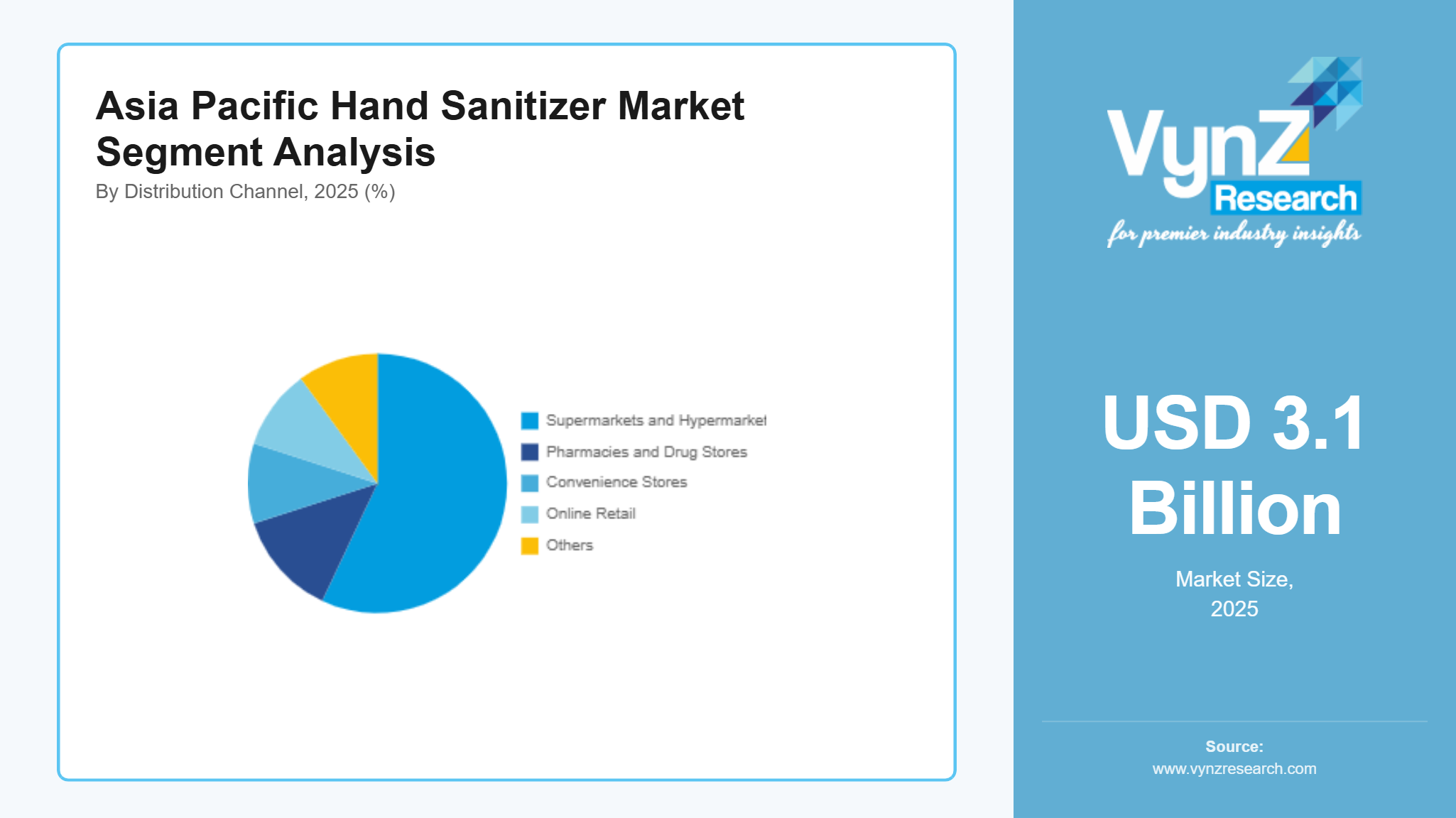
Supermarkets and pharmacies accounted for the largest share of the market in 2025, contributing approximately 57% of total revenue. Consumers prefer to verify product quality before buying because they can access products immediately at retail stores, which makes these stores more popular. Medical retail outlets function as trust boosters for pharmacies because patients use them to buy healthcare products. China, India and Southeast Asia benefit from government run hygiene education programs which maintain market demand for physical retail stores through their organized retail network expansion.
The online retail market will expand the fastest between 2026 and 2035 when it will achieve a compound annual growth rate of 12.1%. Digitalization progresses because more people use smartphones now while logistics systems become better, which drives customers to choose e commerce websites. Subscription services, promotional pricing and expanded product availability create better shopping experiences for customers in urban and semi urban areas. The combination of digital payment systems with same day delivery services helps online channels perform better, especially among younger users and working professionals.
By Packaging Type
The market in 2025 saw bottle packaging take the highest share of 46% which made it the top packaging type. People widely use these products because they are affordable, allow for more storage and they work well for both personal use and institutional needs. Bottled sanitizers remain highly preferred across hospitals, offices, educational institutions, and households because they provide easy transportation and they work with refill systems. Bulk bottle packaging formats continue to be the preferred choice for public sector healthcare and sanitation procurement which leads to their strong market presence throughout Asia Pacific.
Pump dispensers and sachet packaging are expected to show the highest growth rate according to their predicted compound annual growth rate of 10.8% during the upcoming forecast period. Commercial spaces need touch minimized dispensing systems to meet their requirements which makes travelers and office workers prefer portable hygiene products, so this sector is expanding. The hospitality industry, transportation sector and food service industry all drive the rising need for automated dispensing systems which deliver compact solutions. Packaging manufacturers now prioritize recyclable packaging materials which include sustainable options, so they boost the adoption of their products among consumers who care about environmental protection.
By End User
The market in 2025 saw hospitals and healthcare facilities take the lead for market share at 41% of total revenue. The product dominates because strict infection prevention standards force continuous sanitization and government healthcare rules require medical facilities to maintain hygienic conditions. Hospitals, clinics and diagnostic centers maintain product usage because international health organizations and regional public health agencies recommend regular hand disinfection. The growth of healthcare facilities and patient safety awareness drive the long-term market expansion in Asia Pacific.
Corporate offices and hospitality facilities will experience the highest growth rate between 2026 and 2035 with their compound annual growth rate estimated at 11.2%. More people now visit hotel, restaurant and public venue with better hygienic standards, and these venues now implement stricter sanitation measures. The distribution of sanitization stations is rising in educational institutions and commercial buildings because governments and organizations have made preventive hygiene practices their top priority. The demand for non-healthcare products keeps growing because urban areas expand and service sector industries grow.
Regional Insights
China
China's hand sanitizer market in 2025, which reached 29% of the Asia Pacific total, resulted from its extensive healthcare infrastructure, domestic manufacturing capacity and urban residents' growing hygiene awareness. Major cities including Beijing, Shanghai, and Guangzhou continue to witness strong demand for sanitization products across hospitals, transportation hubs, educational institutions, and commercial facilities. Regional market development receives additional support through modern retail network expansion and rising e-commerce platform accessibility. The government funds infection control programs, public sanitation initiatives and healthcare readiness measures which lead to more investments in sanitation products and medical supplies. Public health authorities have established stricter sanitation regulations for healthcare facilities and public spaces, while consumers increasingly demand portable and skin-friendly hygiene products, which drives companies to develop new products and open stores throughout the nation.
India
The market in 2025 received 18% of its total volume from India, which experiences continuous market expansion because urban areas grow, people learn more about healthcare and hygiene becomes common in homes and workspaces. Major cities including Mumbai, Delhi, Bengaluru, and Hyderabad experience rising demand for sanitization services in hospitals, schools, offices, hospitality facilities and public transportation systems. The growing availability of retail stores and the rising trend of online shopping are driving deeper market access for products in both metropolitan areas and tier two cities. Market growth receives substantial support from government-led sanitation projects and preventive healthcare initiatives. National hygiene awareness programs, combined with increasing healthcare expenditure and stronger infection control practices across institutional environments, continue to support demand for sanitization products. The regional market benefits from increased pharmacy chain expansion and digital commerce infrastructure development.
Japan
Japan's hand sanitizer market in 2025 represented approximately 14% of the total Asia Pacific market. The country develops through its modern healthcare system and high public understanding of infection control and people choosing to use superior hygiene products. Major urban centers such as Tokyo, Osaka, and Yokohama continue to demonstrate strong consumption across healthcare facilities, corporate offices, hospitality establishments, and transportation networks. The market expands because customers now prefer sanitization solutions that are compact, skin-friendly and use cutting-edge technology. Government-supported public hygiene guidelines and strict healthcare sanitation standards continue to reinforce product demand across institutional and commercial settings. The elderly population growth and stronger dedication to preventive healthcare methods drive ongoing hand hygiene product usage across the nation. The market gains fresh opportunities through product development that creates solutions for sensitive skin and touchless product dispensing.
Southeast Asia
Southeast Asia held an 11% share of the regional market in 2025 because urban areas in Indonesia, Thailand, Vietnam and Malaysia experienced rapid development, people gained more disposable income and public sanitation became widely understood. Sanitization product manufacturers will benefit from permanent market openings that arise when tourism, hospitality and business infrastructure development expand. Consumers in urban and semi-urban regions gain better access to products because modern retail chains and digital commerce platforms expand their market presence. Government actions that back sanitation standards and public health emergency plans drive healthcare facilities, transportation hubs and educational institutions to adopt institutionalized standards. The regional market for hand hygiene products and advanced dispensing systems grows because healthcare facilities and infection prevention programs receive more financial backing from the government.
Rest of Asia Pacific
The market share for 2025 in the Rest of Asia Pacific region, which includes South Korea, Australia, New Zealand, and other emerging regional markets, makes up 8% of the total market. The healthcare sector funding increase and public awareness about hygiene protection and institutional sanitation needs expansion drive growth in these countries. Educational institutions, healthcare facilities and commercial establishments use these products, which leads to significant market consumption in the respective regions. The market for hygiene products will maintain its stable demand because government-supported healthcare programs and sanitation rules create lasting customer requirements for these products. The remaining share comes from countries outside China, India, Japan, and Southeast Asia and includes both growing and established markets that see healthcare systems expand and public understanding of infection prevention methods increase.
Competitive Landscape / Company Insights
The market maintains a situation of moderate competition because multinational companies and regional manufacturers practice product development, formulation safety testing and market distribution growth to enhance their market presence. Companies are investing their resources into research and development work, sustainable packaging development and digital retail system implementation to enhance their consumer outreach and brand recognition. The industry continues to develop its competitive strategies because public health authorities issue regulatory guidelines which determine product safety requirements, alcohol concentration limits and labeling standards. The establishment of strategic partnerships between healthcare institutions and retail networks helps businesses expand their operations in different regions.
Mini Profiles
3M Company focuses on healthcare hygiene and sanitization solutions, supported by strong industrial distribution networks, established brand recognition, and broad institutional presence across healthcare, commercial, and consumer hygiene applications throughout Asia Pacific markets.
Best Sanitizers Inc. operates in institutional and commercial hygiene segments, emphasizing product performance, regulatory compliance, and advanced sanitization formulations designed for food processing, healthcare, and industrial hygiene applications across regional markets.
GOJO Industries Inc. leverages strong healthcare expertise and strategic distribution partnerships to expand market presence, supported by recognized hygiene brands and increasing adoption across hospitals, workplaces, and public sanitation environments.
Godrej Consumer Products Ltd. focuses on affordable personal hygiene and household sanitization products, supported by extensive retail penetration, local manufacturing capabilities, and strong consumer reach across urban and semi urban Asian markets.
Henkel AG & Co. KGaA operates in premium and professional hygiene segments, emphasizing innovation, sustainable product development, and advanced formulation technologies to strengthen its presence across healthcare and commercial sanitization applications.
Key Players
- 3M Company
- Best Sanitizers Inc.
- GOJO Industries Inc.
- Godrej Consumer Products Ltd.
- Henkel AG & Co. KGaA
- Procter & Gamble
- Reckitt Benckiser Group plc
- The Himalaya Drug Company
- Unilever
- Vi-Jon Inc.
Recent Developments
In February 2025, Procter & Gamble expanded production capacity for hygiene and personal care products across Asia Pacific facilities to support increasing consumer demand for sanitization solutions. The company also strengthened digital retail partnerships to improve product accessibility across urban markets.
In April 2025, Unilever increased investment in sustainable hygiene and personal care packaging solutions across Asian markets. The company further expanded premium hygiene product offerings through retail and e commerce distribution channels.
In June 2025, Vi-Jon Inc. introduced new private label sanitization products designed for institutional and healthcare applications. The expansion supported the company’s strategy to strengthen commercial hygiene distribution across international markets.
In March 2025, The Himalaya Drug Company expanded its herbal hygiene and wellness portfolio with additional hand sanitization products formulated using plant-based ingredients. The company also increased retail penetration across pharmacies and online distribution platforms in Asia.
In April 2025, Reckitt Benckiser Group plc expanded its Lysol hygiene portfolio with new scented disinfecting products designed for household sanitization applications. The development supported the company’s strategy of strengthening premium hygiene offerings across consumer markets.
Asia Pacific Hand Sanitizer Market Coverage
Product Type Insight and Forecast 2026 - 2035
- Gel
- Liquid
- Foam
- Spray
Distribution Channel Insight and Forecast 2026 - 2035
- Supermarkets and Hypermarkets
- Pharmacies and Drug Stores
- Convenience Stores
- Online Retail
- Others
Packaging Type Insight and Forecast 2026 - 2035
- Bottles
- Pump Dispensers
- Sachets
- Cans
- Others
End User Insight and Forecast 2026 - 2035
- Hospitals and Healthcare Facilities
- Households
- Corporate Offices
- Hospitality and Food Services
- Educational Institutions
- Others
Region Insight and Forecast 2026 - 2035
- China
- India
- Japan
- Southeast Asia
- Rest of Asia Pacific
Asia Pacific Hand Sanitizer Market by Region
- China
- By Product Type
- By Distribution Channel
- By Packaging Type
- By End User
- By Region
- Japan
- By Product Type
- By Distribution Channel
- By Packaging Type
- By End User
- By Region
- India
- By Product Type
- By Distribution Channel
- By Packaging Type
- By End User
- By Region
- South Korea
- By Product Type
- By Distribution Channel
- By Packaging Type
- By End User
- By Region
- Vietnam
- By Product Type
- By Distribution Channel
- By Packaging Type
- By End User
- By Region
- Thailand
- By Product Type
- By Distribution Channel
- By Packaging Type
- By End User
- By Region
- Malaysia
- By Product Type
- By Distribution Channel
- By Packaging Type
- By End User
- By Region
- Rest of Asia-Pacific
- By Product Type
- By Distribution Channel
- By Packaging Type
- By End User
- By Region
Table of Contents for Asia Pacific Hand Sanitizer Market Report
1. Research Overview
1.1. The Report Offers
1.2. Market Coverage
1.2.1. By
Product Type
1.2.2. By
Distribution Channel
1.2.3. By
Packaging Type
1.2.4. By
End User
1.2.5. By
Region
1.3. Research Phases
1.4. Limitations
1.5. Market Methodology
1.5.1. Data Sources
1.5.1.1.
Primary Research
1.5.1.2.
Secondary Research
1.5.2. Methodology
1.5.2.1.
Data Exploration
1.5.2.2.
Forecast Parameters
1.5.2.3.
Data Validation
1.5.2.4.
Assumptions
1.5.3. Study Period & Data Reporting Unit
2. Executive Summary
3. Industry Overview
3.1. Industry Dynamics
3.1.1. Market Growth Drivers
3.1.2. Market Restraints
3.1.3. Key Market Trends
3.1.4. Major Opportunities
3.2. Industry Ecosystem
3.2.1. Porter’s Five Forces Analysis
3.2.2. Recent Development Analysis
3.2.3. Value Chain Analysis
3.3. Competitive Insight
3.3.1. Competitive Position of Industry
Players
3.3.2. Market Attractive Analysis
3.3.3. Market Share Analysis
4. Asia Market Estimate and Forecast
4.1. Asia Market Overview
4.2. Asia Market Estimate and Forecast to 2035
5. Market Segmentation Estimate and Forecast
5.1. By Product Type
5.1.1. Gel
5.1.1.1. Market Definition
5.1.1.2. Market Estimation and Forecast to 2035
5.1.2. Liquid
5.1.2.1. Market Definition
5.1.2.2. Market Estimation and Forecast to 2035
5.1.3. Foam
5.1.3.1. Market Definition
5.1.3.2. Market Estimation and Forecast to 2035
5.1.4. Spray
5.1.4.1. Market Definition
5.1.4.2. Market Estimation and Forecast to 2035
5.2. By Distribution Channel
5.2.1. Supermarkets and Hypermarkets
5.2.1.1. Market Definition
5.2.1.2. Market Estimation and Forecast to 2035
5.2.2. Pharmacies and Drug Stores
5.2.2.1. Market Definition
5.2.2.2. Market Estimation and Forecast to 2035
5.2.3. Convenience Stores
5.2.3.1. Market Definition
5.2.3.2. Market Estimation and Forecast to 2035
5.2.4. Online Retail
5.2.4.1. Market Definition
5.2.4.2. Market Estimation and Forecast to 2035
5.2.5. Others
5.2.5.1. Market Definition
5.2.5.2. Market Estimation and Forecast to 2035
5.3. By Packaging Type
5.3.1. Bottles
5.3.1.1. Market Definition
5.3.1.2. Market Estimation and Forecast to 2035
5.3.2. Pump Dispensers
5.3.2.1. Market Definition
5.3.2.2. Market Estimation and Forecast to 2035
5.3.3. Sachets
5.3.3.1. Market Definition
5.3.3.2. Market Estimation and Forecast to 2035
5.3.4. Cans
5.3.4.1. Market Definition
5.3.4.2. Market Estimation and Forecast to 2035
5.3.5. Others
5.3.5.1. Market Definition
5.3.5.2. Market Estimation and Forecast to 2035
5.4. By End User
5.4.1. Hospitals and Healthcare Facilities
5.4.1.1. Market Definition
5.4.1.2. Market Estimation and Forecast to 2035
5.4.2. Households
5.4.2.1. Market Definition
5.4.2.2. Market Estimation and Forecast to 2035
5.4.3. Corporate Offices
5.4.3.1. Market Definition
5.4.3.2. Market Estimation and Forecast to 2035
5.4.4. Hospitality and Food Services
5.4.4.1. Market Definition
5.4.4.2. Market Estimation and Forecast to 2035
5.4.5. Educational Institutions
5.4.5.1. Market Definition
5.4.5.2. Market Estimation and Forecast to 2035
5.4.6. Others
5.4.6.1. Market Definition
5.4.6.2. Market Estimation and Forecast to 2035
5.5. By Region
5.5.1. China
5.5.1.1. Market Definition
5.5.1.2. Market Estimation and Forecast to 2035
5.5.2. India
5.5.2.1. Market Definition
5.5.2.2. Market Estimation and Forecast to 2035
5.5.3. Japan
5.5.3.1. Market Definition
5.5.3.2. Market Estimation and Forecast to 2035
5.5.4. Southeast Asia
5.5.4.1. Market Definition
5.5.4.2. Market Estimation and Forecast to 2035
5.5.5. Rest of Asia Pacific
5.5.5.1. Market Definition
5.5.5.2. Market Estimation and Forecast to 2035
6. China Market Estimate and Forecast
6.1. By
Product Type
6.2. By
Distribution Channel
6.3. By
Packaging Type
6.4. By
End User
6.5. By
Region
7. Japan Market Estimate and Forecast
7.1. By
Product Type
7.2. By
Distribution Channel
7.3. By
Packaging Type
7.4. By
End User
7.5. By
Region
8. India Market Estimate and Forecast
8.1. By
Product Type
8.2. By
Distribution Channel
8.3. By
Packaging Type
8.4. By
End User
8.5. By
Region
9. South Korea Market Estimate and Forecast
9.1. By
Product Type
9.2. By
Distribution Channel
9.3. By
Packaging Type
9.4. By
End User
9.5. By
Region
10. Vietnam Market Estimate and Forecast
10.1. By
Product Type
10.2. By
Distribution Channel
10.3. By
Packaging Type
10.4. By
End User
10.5. By
Region
11. Thailand Market Estimate and Forecast
11.1. By
Product Type
11.2. By
Distribution Channel
11.3. By
Packaging Type
11.4. By
End User
11.5. By
Region
12. Malaysia Market Estimate and Forecast
12.1. By
Product Type
12.2. By
Distribution Channel
12.3. By
Packaging Type
12.4. By
End User
12.5. By
Region
13. Rest of Asia-Pacific Market Estimate and Forecast
13.1. By
Product Type
13.2. By
Distribution Channel
13.3. By
Packaging Type
13.4. By
End User
13.5. By
Region
14. Company Profiles
14.1.
3M Company
14.1.1.
Snapshot
14.1.2.
Overview
14.1.3.
Offerings
14.1.4.
Financial
Insight
14.1.5.
Recent
Developments
14.2.
Best Sanitizers Inc.
14.2.1.
Snapshot
14.2.2.
Overview
14.2.3.
Offerings
14.2.4.
Financial
Insight
14.2.5.
Recent
Developments
14.3.
GOJO Industries Inc.
14.3.1.
Snapshot
14.3.2.
Overview
14.3.3.
Offerings
14.3.4.
Financial
Insight
14.3.5.
Recent
Developments
14.4.
Godrej Consumer Products Ltd.
14.4.1.
Snapshot
14.4.2.
Overview
14.4.3.
Offerings
14.4.4.
Financial
Insight
14.4.5.
Recent
Developments
14.5.
Henkel AG & Co. KGaA
14.5.1.
Snapshot
14.5.2.
Overview
14.5.3.
Offerings
14.5.4.
Financial
Insight
14.5.5.
Recent
Developments
14.6.
Procter & Gamble
14.6.1.
Snapshot
14.6.2.
Overview
14.6.3.
Offerings
14.6.4.
Financial
Insight
14.6.5.
Recent
Developments
14.7.
Reckitt Benckiser Group plc
14.7.1.
Snapshot
14.7.2.
Overview
14.7.3.
Offerings
14.7.4.
Financial
Insight
14.7.5.
Recent
Developments
14.8.
The Himalaya Drug Company
14.8.1.
Snapshot
14.8.2.
Overview
14.8.3.
Offerings
14.8.4.
Financial
Insight
14.8.5.
Recent
Developments
14.9.
Unilever
14.9.1.
Snapshot
14.9.2.
Overview
14.9.3.
Offerings
14.9.4.
Financial
Insight
14.9.5.
Recent
Developments
14.10.
Vi-Jon Inc.
14.10.1.
Snapshot
14.10.2.
Overview
14.10.3.
Offerings
14.10.4.
Financial
Insight
14.10.5.
Recent
Developments
15. Appendix
15.1. Exchange Rates
15.2. Abbreviations
Note: Financial insight and recent developments of different companies are subject to the availability of information in the secondary domain.
Frequently Asked Questions
Purchase Options
Latest Report
Research Methodology
- Desk Research / Pilot Interviews
- Build Market Size Model
- Research and Analysis
- Final Deliverable
Connect With Our Sales Team
- Toll-Free: +1-888-253-3960
- Phone: +91 9960 288 381
- Email: enquiry@vynzresearch.com
Asia Pacific Hand Sanitizer Market