
Assistive Technologies for Visually Impaired Market Size & Share Growth Forecast Report (2026-2035)
Industry Insight by Product Type (Low vision aids, Screen readers and accessibility software, Braille devices, Mobility and navigation aids, Other assistive products), by Technology (Optical and electronic systems, Software-based accessibility tools, AI-enabled visual assistance, Computer vision and optical character recognition, Integrated hardware and software solutions), by Distribution Channel (Direct sales, Specialist retailers and distributors, Online channels, Institutional procurement), by End User (Individual users, Educational institutions, Enterprises and workplaces, Healthcare and rehabilitation organizations, Government and disability support organizations)
| Status : Published | Published On : Oct, 2026 | Report Code : VRHC1356 | Industry : Healthcare | Available Format :

|
Page : 156 |
Assistive Technologies for Visually Impaired Market Overview
The assistive technologies for visually impaired market is estimated at USD 7.79 billion in 2025 and USD 8.60 billion in 2026, with a proposed CAGR of 12.6% from 2026 to 2035, reaching a calculated USD 25.97 billion by 2035.
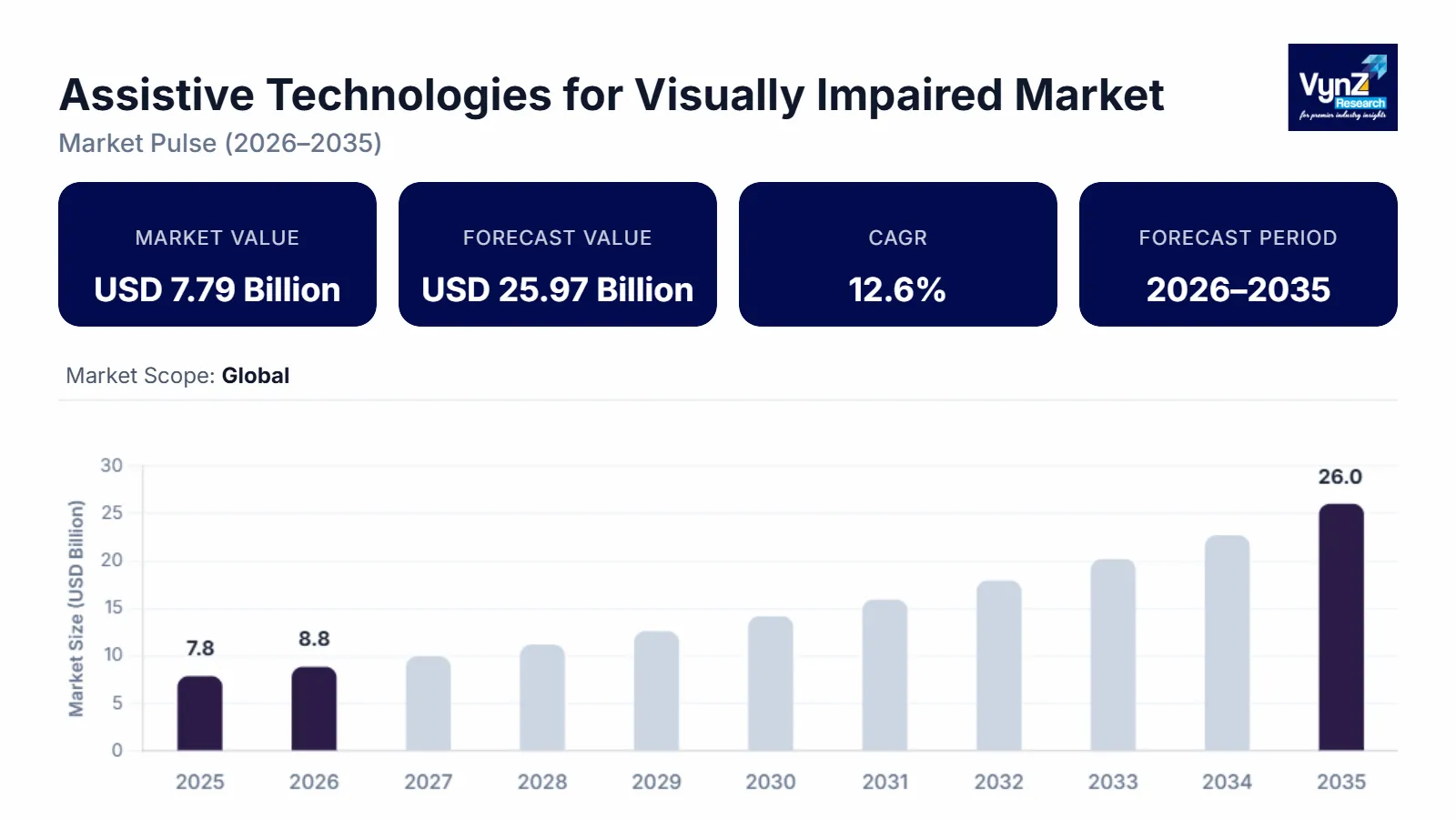
The sector includes low vision aids, screen readers, braille devices, accessible software, mobility assistance tools, and AI-enabled visual interpretation systems. Market growth is supported by the rising need for accessible information, wider use of smartphones, and advances in artificial intelligence and computer vision. The World Health Organization reported in February 2026 that at least 2.2 billion people globally experience near or distance vision impairment, with at least 1 billion cases preventable or not yet addressed. Its assistive technology guidance also highlights substantial unmet access needs. These findings establish the scale of the accessibility challenge, while investment in accessible education, employment, rehabilitation, and digital services supports potential demand for assistive products.
Research Methodology
VynZ Research assesses the market through a structured review of published industry research, company disclosures, government accessibility policies, demographic evidence, and developments in assistive technology. The VynZ Research team evaluates product categories, purchasing channels, end-user requirements, regional adoption, and technology integration to establish the market framework. Historical figures and published forecasts are used as comparison points, while the proposed estimates are derived from explicit assumptions concerning adoption, product availability, institutional procurement, and software development. Government evidence from the World Health Organization supports the demand analysis, but does not independently validate the commercial market valuation.
Research Highlights
- Low vision aids accounted for approximately 46.8% of 2025 revenue, supported by demand for magnification and accessible reading tools among people with partial sight.
- Individual users contributed 52% of 2025 revenue, as personal devices and mobile accessibility applications support independent living and everyday information access.
- Direct sales held about 39.5% of the market in 2025, supported by specialist product demonstrations and technical assistance.
- AI-enabled visual assistance is projected to expand at an estimated CAGR of 15.4% from 2026 to 2035, driven by improvements in optical character recognition, image description, and real-time scene interpretation.
- North America accounted for 37.5% of 2025 revenue, due to established assistive technology suppliers, digital accessibility initiatives, and adoption across education and workplaces.
Assistive Technologies for Visually Impaired Market Dynamics
Market Trends
The industry is moving towards connected, portable, and AI-enabled solutions that combine magnification, text recognition, speech output, and environmental interpretation. Smartphone-based tools and wearable devices can provide access to printed information and surrounding objects without requiring a separate specialist device for every task. Product development is also emphasizing simpler interfaces and compatibility with mainstream computers and mobile platforms, although accuracy and usability vary by application. In May 2025, Apple announced accessibility features including Magnifier for Mac, Braille Access, and Accessibility Reader, demonstrating the expansion of visual accessibility functions within general-purpose devices. Another important trend is the integration of assistive technology into education, employment, and everyday digital services.
Growth Drivers
The growing population living with vision impairment represents a fundamental demand driver, particularly as population ageing increases the likelihood of conditions affecting sight. The World Health Organization identifies uncorrected refractive errors, cataracts, glaucoma, diabetic retinopathy, and age-related macular degeneration among the leading causes of vision impairment. Although clinical treatment remains essential where appropriate, assistive products can help people with persistent visual limitations access written material, digital services, and daily activities. Demand is therefore influenced not only by the number of affected people, but also by the availability of rehabilitation services, affordability of devices, and awareness of practical accessibility options. Technological development provides a second growth driver through improvements in text recognition, speech synthesis, portable magnification, and accessible operating systems.
Market Restraints / Challenges
High upfront costs remain a significant barrier, particularly for specialist braille displays, electronic magnifiers, and wearable visual assistance systems. Additional expenses can arise from software subscriptions, maintenance, replacement parts, connectivity, and user training, making the total cost of ownership higher than the initial purchase price. Affordability is especially important in lower-income markets, where access to basic eye care and corrective products may already be limited. The World Health Organization's evidence on unmet vision care and assistive technology needs indicates that the existence of a suitable product does not guarantee access, making financing, distribution, and service availability important constraints on commercial adoption. Product limitations and fragmented compatibility can also affect adoption. AI-enabled applications may misinterpret complex scenes, struggle with poor lighting, or require an internet connection, while users may need time and training to operate specialist devices effectively. Differences in language support, accessible digital content, device ecosystems, and technical assistance can reduce the practical value of a product even when its core functions are suitable.
Market Opportunities
Affordable software, smartphone-compatible accessories, and modular devices present opportunities to reach users who cannot justify expensive specialist equipment. Products that combine magnification, text-to-speech, optical character recognition, and adjustable display settings may meet multiple needs through one interface. There is also scope for localized products with support for regional languages, offline functions, and accessible instructional material. The World Health Organization's 2026 guidance on integrated vision rehabilitation highlights procurement, service delivery, workforce development, and coordination as important areas for strengthening access, creating opportunities for suppliers that work with public agencies, schools, rehabilitation providers, and disability organizations. Further opportunities lie in AI-enabled wearable devices, accessible workplace platforms, and integrated braille and digital reading systems.
Global Assistive Technologies for Visually Impaired Market Report Coverage
|
Report Metric |
Details |
|
Historical Period |
2020 - 2024 |
|
Base Year Considered |
2025 |
|
Forecast Period |
2026 - 2035 |
|
Market Size in 2025 |
USD 7.79 Billion |
|
Revenue Forecast in 2035 |
USD 25.97 Billion |
|
Growth Rate |
12.6% |
|
Segments Covered in the Report |
Product Type, Technology, Distribution Channel, End User |
|
Report Scope |
Market Trends, Drivers, and Restraints; Revenue Estimation and Forecast; Segmentation Analysis; Companies’ Strategic Developments; Market Share Analysis of Key Players; Company Profiling |
|
Regions Covered in the Report |
North America, Europe, Asia Pacific, Rest of the World |
|
Key Companies |
Aira, BAUM Retec, Caretec, Dolphin Computer Access, Enhanced Vision, Eschenbach Optik, Freedom Scientific, HumanWare, HIMS, OrCam Technologies |
|
Customization |
Available upon request |
Assistive Technologies for Visually Impaired Market Segmentation
By Product Type
The low vision aids segment accounted for 46.8% of the market in 2025, equivalent to USD 3.65 billion. Its leading position reflects demand for electronic magnifiers, optical aids, and reading systems among people who retain some functional vision.
The screen readers and accessibility software segment is projected to grow at an estimated CAGR of 14.2% from 2026 to 2035, supported by increasing digital accessibility requirements and integration with mainstream operating systems.
By Technology
Software-based accessibility tools represented nearly 34.6% of the market in 2025, corresponding to USD 2.69 billion. Their adoption is supported by screen reading, text-to-speech, magnification, and compatibility with existing smartphones and computers.
AI-enabled assistive technologies are projected to record the fastest growth, with an estimated CAGR of 15.4% from 2026 to 2035. Developments in optical character recognition, image description, object detection, and real-time scene interpretation are increasing the range of tasks supported by visual assistance tools.
By Distribution Channel
Direct sales held about 39.5% of the market in 2025, equivalent to USD 3.08 billion, supported by specialist product demonstrations, device configuration, and technical assistance.
Online distribution is projected to grow at an estimated CAGR of 15.0% from 2026 to 2035, supported by wider access to product information, remote purchasing, and software delivery.
By End User
Individual users are estimated to contribute 52% of the market in 2025, equivalent to USD 4.05 billion, supported by personal demand for reading aids, accessible software, electronic magnifiers, and mobile visual assistance.
Enterprises and educational institutions are projected to record a combined estimated CAGR of 13.8% from 2026 to 2035, due to the adoption of accessible digital resources and workplace technology.
Regional Insights
North America
North America is estimated to account for 37.5% of the market in 2025, supported by established specialist suppliers, accessibility software adoption, and procurement across education, healthcare, and employment. The United States represents an important market for screen readers, electronic magnifiers, braille devices, and AI-enabled visual assistance. Mainstream technology development also contributes to the regional ecosystem, as accessibility functions are increasingly integrated into consumer devices. Growth will depend on product affordability, institutional purchasing, reimbursement or funding arrangements where applicable, and the availability of technical support for specialist equipment.
Europe
Europe is estimated to represent 34.2% of global revenue in 2025, supported by established low vision technology suppliers, public services, specialist distributors, and demand from education and rehabilitation settings. Germany, the United Kingdom, France, and other European markets contribute to demand for electronic magnifiers, braille devices, screen readers, and accessible reading systems. Product adoption is influenced by national support arrangements, digital accessibility policies, procurement practices, and the availability of user training. Suppliers that offer multilingual software, compatible hardware, and dependable service networks may be better positioned to serve diverse European markets.
Asia Pacific
Asia Pacific is projected to be the fastest-growing regional market, with an estimated CAGR of 14.8% during 2026 to 2035. Growth is associated with the scale of the population requiring vision care, wider smartphone use, expanding digital services, and rising awareness of accessibility needs. China, Japan, India, South Korea, and Australia represent important markets with different levels of purchasing power, public support, manufacturing capacity, and specialist distribution. Demand may increase for mobile accessibility applications and lower-cost electronic magnifiers, while institutional buyers continue to require braille systems, accessible learning tools, and rehabilitation equipment.
Rest of the World
The rest of the world is estimated to account for 13.5% of revenue in 2025, covering Latin America, the Middle East, and Africa. Demand is shaped by the availability of specialist distributors, accessible education, public rehabilitation services, imported device costs, and support from disability organizations. In markets with limited access to specialist equipment, smartphone-based applications and lower-cost reading aids may offer more accessible entry points, although they cannot replace every dedicated device or rehabilitation service.
Competitive Landscape / Company Insights
The market is moderately competitive, with specialist manufacturers and software developers serving low vision, braille, reading, and navigation requirements. Competition centers on product usability, technical reliability, compatibility, distribution, and customer support. Companies are expanding accessible reading functions and AI-enabled features, while specialist suppliers continue to develop dedicated devices for users with specific needs. Recent announcements from Apple, HumanWare, HIMS, and Zoomax illustrate ongoing product development across mainstream accessibility software, digital reading, braille systems, and electronic magnification.
Mini Profiles
Aira provides visual interpretation and remote assistance services that help blind and low vision users access information, navigate environments, and complete everyday activities with greater independence.
BAUM Retec develops specialist assistive technology, including braille displays and accessible computer solutions, supporting tactile access to digital information for blind users in educational and professional environments.
Caretec specializes in products designed for blind and visually impaired users, with an emphasis on practical everyday aids that support independent living, accessibility, and routine activities.
Dolphin Computer Access develops screen reading, magnification, and accessibility software that enables users with visual impairments to interact with computers, documents, and digital applications more effectively.
Enhanced Vision supplies electronic magnification and low vision products designed to improve access to printed materials, visual information, and everyday reading activities for people with reduced sight.
Key Players
- Aira
- Apple
- BAUM
- Retec
- Caretec
- Dolphin Computer Access
- Enhanced Vision
- HIMS
- HumanWare
- Vispero
- Zoomax
Recent Developments
Apple announced new accessibility features covering Magnifier for Mac, Braille Access, and Accessibility Reader, extending visual assistance and accessible reading capabilities across its device ecosystem. The announced updates also included expanded vision accessibility functions for Apple Vision Pro.
HIMS introduced a major Braille eMotion software update with additional braille practice functionality, language profiles, and direct embossing support. The improvements also addressed screen reader compatibility and expanded the device's practical capabilities for braille users.
HumanWare introduced the Victor Reader Stratus 2, a DAISY audio player designed to improve access to digital reading materials and online libraries. The company also indicated that the original model would remain available, maintaining options for users with existing CD collections.
Vispero continued the transition of the JAWS and related accessibility software branding from Freedom Scientific to Vispero, as reflected in the 2026 software update documentation. The release also included refreshed application icons and updated product naming across its software ecosystem.
Zoomax showcased AI-powered features for its Snow Pad product series and previewed the Snow Eye Pro at a specialist low vision exhibition. The developments focused on real-time text recognition, adaptable viewing functions, and improvements to portable electronic magnification.
Global Assistive Technologies for Visually Impaired Market Coverage
Product Type Insight and Forecast 2026 - 2035
- Low vision aids
- Screen readers and accessibility software
- Braille devices
- Mobility and navigation aids
- Other assistive products
Technology Insight and Forecast 2026 - 2035
- Optical and electronic systems
- Software-based accessibility tools
- AI-enabled visual assistance
- Computer vision and optical character recognition
- Integrated hardware and software solutions
Distribution Channel Insight and Forecast 2026 - 2035
- Direct sales
- Specialist retailers and distributors
- Online channels
- Institutional procurement
End User Insight and Forecast 2026 - 2035
- Individual users
- Educational institutions
- Enterprises and workplaces
- Healthcare and rehabilitation organizations
- Government and disability support organizations
Global Assistive Technologies for Visually Impaired Market by Region
- North America
- By Product Type
- By Technology
- By Distribution Channel
- By End User
- By Country - U.S., Canada, Mexico
- Europe
- By Product Type
- By Technology
- By Distribution Channel
- By End User
- By Country - Germany, U.K., France, Italy, Spain, Russia, Rest of Europe
- Asia-Pacific (APAC)
- By Product Type
- By Technology
- By Distribution Channel
- By End User
- By Country - China, Japan, India, South Korea, Vietnam, Thailand, Malaysia, Rest of Asia-Pacific
- Rest of the World (RoW)
- By Product Type
- By Technology
- By Distribution Channel
- By End User
- By Country - Brazil, Saudi Arabia, South Africa, U.A.E., Other Countries
Table of Contents for Assistive Technologies for Visually Impaired Market Report
1. Research Overview
1.1. The Report Offers
1.2. Market Coverage
1.2.1. By
Product Type
1.2.2. By
Technology
1.2.3. By
Distribution Channel
1.2.4. By
End User
1.3. Research Phases
1.4. Limitations
1.5. Market Methodology
1.5.1. Data Sources
1.5.1.1.
Primary Research
1.5.1.2.
Secondary Research
1.5.2. Methodology
1.5.2.1.
Data Exploration
1.5.2.2.
Forecast Parameters
1.5.2.3.
Data Validation
1.5.2.4.
Assumptions
1.5.3. Study Period & Data Reporting Unit
2. Executive Summary
3. Industry Overview
3.1. Industry Dynamics
3.1.1. Market Growth Drivers
3.1.2. Market Restraints
3.1.3. Key Market Trends
3.1.4. Major Opportunities
3.2. Industry Ecosystem
3.2.1. Porter’s Five Forces Analysis
3.2.2. Recent Development Analysis
3.2.3. Value Chain Analysis
3.3. Competitive Insight
3.3.1. Competitive Position of Industry
Players
3.3.2. Market Attractive Analysis
3.3.3. Market Share Analysis
4. Global Market Estimate and Forecast
4.1. Global Market Overview
4.2. Global Market Estimate and Forecast to 2035
5. Market Segmentation Estimate and Forecast
5.1. By Product Type
5.1.1. Low vision aids
5.1.1.1. Market Definition
5.1.1.2. Market Estimation and Forecast to 2035
5.1.2. Screen readers and accessibility software
5.1.2.1. Market Definition
5.1.2.2. Market Estimation and Forecast to 2035
5.1.3. Braille devices
5.1.3.1. Market Definition
5.1.3.2. Market Estimation and Forecast to 2035
5.1.4. Mobility and navigation aids
5.1.4.1. Market Definition
5.1.4.2. Market Estimation and Forecast to 2035
5.1.5. Other assistive products
5.1.5.1. Market Definition
5.1.5.2. Market Estimation and Forecast to 2035
5.2. By Technology
5.2.1. Optical and electronic systems
5.2.1.1. Market Definition
5.2.1.2. Market Estimation and Forecast to 2035
5.2.2. Software-based accessibility tools
5.2.2.1. Market Definition
5.2.2.2. Market Estimation and Forecast to 2035
5.2.3. AI-enabled visual assistance
5.2.3.1. Market Definition
5.2.3.2. Market Estimation and Forecast to 2035
5.2.4. Computer vision and optical character recognition
5.2.4.1. Market Definition
5.2.4.2. Market Estimation and Forecast to 2035
5.2.5. Integrated hardware and software solutions
5.2.5.1. Market Definition
5.2.5.2. Market Estimation and Forecast to 2035
5.3. By Distribution Channel
5.3.1. Direct sales
5.3.1.1. Market Definition
5.3.1.2. Market Estimation and Forecast to 2035
5.3.2. Specialist retailers and distributors
5.3.2.1. Market Definition
5.3.2.2. Market Estimation and Forecast to 2035
5.3.3. Online channels
5.3.3.1. Market Definition
5.3.3.2. Market Estimation and Forecast to 2035
5.3.4. Institutional procurement
5.3.4.1. Market Definition
5.3.4.2. Market Estimation and Forecast to 2035
5.4. By End User
5.4.1. Individual users
5.4.1.1. Market Definition
5.4.1.2. Market Estimation and Forecast to 2035
5.4.2. Educational institutions
5.4.2.1. Market Definition
5.4.2.2. Market Estimation and Forecast to 2035
5.4.3. Enterprises and workplaces
5.4.3.1. Market Definition
5.4.3.2. Market Estimation and Forecast to 2035
5.4.4. Healthcare and rehabilitation organizations
5.4.4.1. Market Definition
5.4.4.2. Market Estimation and Forecast to 2035
5.4.5. Government and disability support organizations
5.4.5.1. Market Definition
5.4.5.2. Market Estimation and Forecast to 2035
6. North America Market Estimate and Forecast
6.1. By
Product Type
6.2. By
Technology
6.3. By
Distribution Channel
6.4. By
End User
6.4.1.
U.S. Market Estimate and Forecast
6.4.2.
Canada Market Estimate and Forecast
6.4.3.
Mexico Market Estimate and Forecast
7. Europe Market Estimate and Forecast
7.1. By
Product Type
7.2. By
Technology
7.3. By
Distribution Channel
7.4. By
End User
7.4.1.
Germany Market Estimate and Forecast
7.4.2.
France Market Estimate and Forecast
7.4.3.
U.K. Market Estimate and Forecast
7.4.4.
Italy Market Estimate and Forecast
7.4.5.
Spain Market Estimate and Forecast
7.4.6.
Russia Market Estimate and Forecast
7.4.7.
Rest of Europe Market Estimate and Forecast
8. Asia-Pacific (APAC) Market Estimate and Forecast
8.1. By
Product Type
8.2. By
Technology
8.3. By
Distribution Channel
8.4. By
End User
8.4.1.
China Market Estimate and Forecast
8.4.2.
Japan Market Estimate and Forecast
8.4.3.
India Market Estimate and Forecast
8.4.4.
South Korea Market Estimate and Forecast
8.4.5.
Rest of Asia-Pacific Market Estimate and Forecast
9. Rest of the World (RoW) Market Estimate and Forecast
9.1. By
Product Type
9.2. By
Technology
9.3. By
Distribution Channel
9.4. By
End User
9.4.1.
Brazil Market Estimate and Forecast
9.4.2.
Saudi Arabia Market Estimate and Forecast
9.4.3.
South Africa Market Estimate and Forecast
9.4.4.
U.A.E. Market Estimate and Forecast
9.4.5.
Other Countries Market Estimate and Forecast
10. Company Profiles
10.1.
Aira
10.1.1.
Snapshot
10.1.2.
Overview
10.1.3.
Offerings
10.1.4.
Financial
Insight
10.1.5.
Recent
Developments
10.2.
Apple
10.2.1.
Snapshot
10.2.2.
Overview
10.2.3.
Offerings
10.2.4.
Financial
Insight
10.2.5.
Recent
Developments
10.3.
BAUM Retec
10.3.1.
Snapshot
10.3.2.
Overview
10.3.3.
Offerings
10.3.4.
Financial
Insight
10.3.5.
Recent
Developments
10.4.
Caretec
10.4.1.
Snapshot
10.4.2.
Overview
10.4.3.
Offerings
10.4.4.
Financial
Insight
10.4.5.
Recent
Developments
10.5.
Dolphin Computer Access
10.5.1.
Snapshot
10.5.2.
Overview
10.5.3.
Offerings
10.5.4.
Financial
Insight
10.5.5.
Recent
Developments
10.6.
Enhanced Vision
10.6.1.
Snapshot
10.6.2.
Overview
10.6.3.
Offerings
10.6.4.
Financial
Insight
10.6.5.
Recent
Developments
10.7.
HIMS
10.7.1.
Snapshot
10.7.2.
Overview
10.7.3.
Offerings
10.7.4.
Financial
Insight
10.7.5.
Recent
Developments
10.8.
HumanWare
10.8.1.
Snapshot
10.8.2.
Overview
10.8.3.
Offerings
10.8.4.
Financial
Insight
10.8.5.
Recent
Developments
10.9.
Vispero
10.9.1.
Snapshot
10.9.2.
Overview
10.9.3.
Offerings
10.9.4.
Financial
Insight
10.9.5.
Recent
Developments
10.10.
Zoomax
10.10.1.
Snapshot
10.10.2.
Overview
10.10.3.
Offerings
10.10.4.
Financial
Insight
10.10.5.
Recent
Developments
11. Appendix
11.1. Exchange Rates
11.2. Abbreviations
Note: Financial insight and recent developments of different companies are subject to the availability of information in the secondary domain.
Frequently Asked Questions
Purchase Options
Latest Report
Research Methodology
- Desk Research / Pilot Interviews
- Build Market Size Model
- Research and Analysis
- Final Deliverable
Connect With Our Sales Team
- Toll-Free: +1-888-253-3960
- Phone: +91 9960 288 381
- Email: enquiry@vynzresearch.com
Assistive Technologies for Visually Impaired Market