
Cell Free Protein Synthesis Market Size & Share - Growth Forecast Report (2026-2035)
Industry Insight by Offering (Established / Complete Solutions, Advanced / Value-Added Solutions), by Workflow (Conventional Workflows, Advanced Workflows), by Method (Established Methods, Emerging Methods), by Application (Core Research Applications, Emerging Applications), by End User (Research-focused Organizations, Commercial & Industrial Users)
| Status : Published | Published On : Feb, 2026 | Report Code : VRHC1316 | Industry : Healthcare | Available Format : | Page : 180 |
Cell Free Protein Synthesis Market Overview
The global cell-free protein synthesis market, valued at approximately USD 220.00 million in 2025 and estimated to reach around USD 237.38 million in 2026, is projected to reach nearly USD 470.58 million by 2035, expanding at a CAGR of about 7.9% from 2026 to 2035.
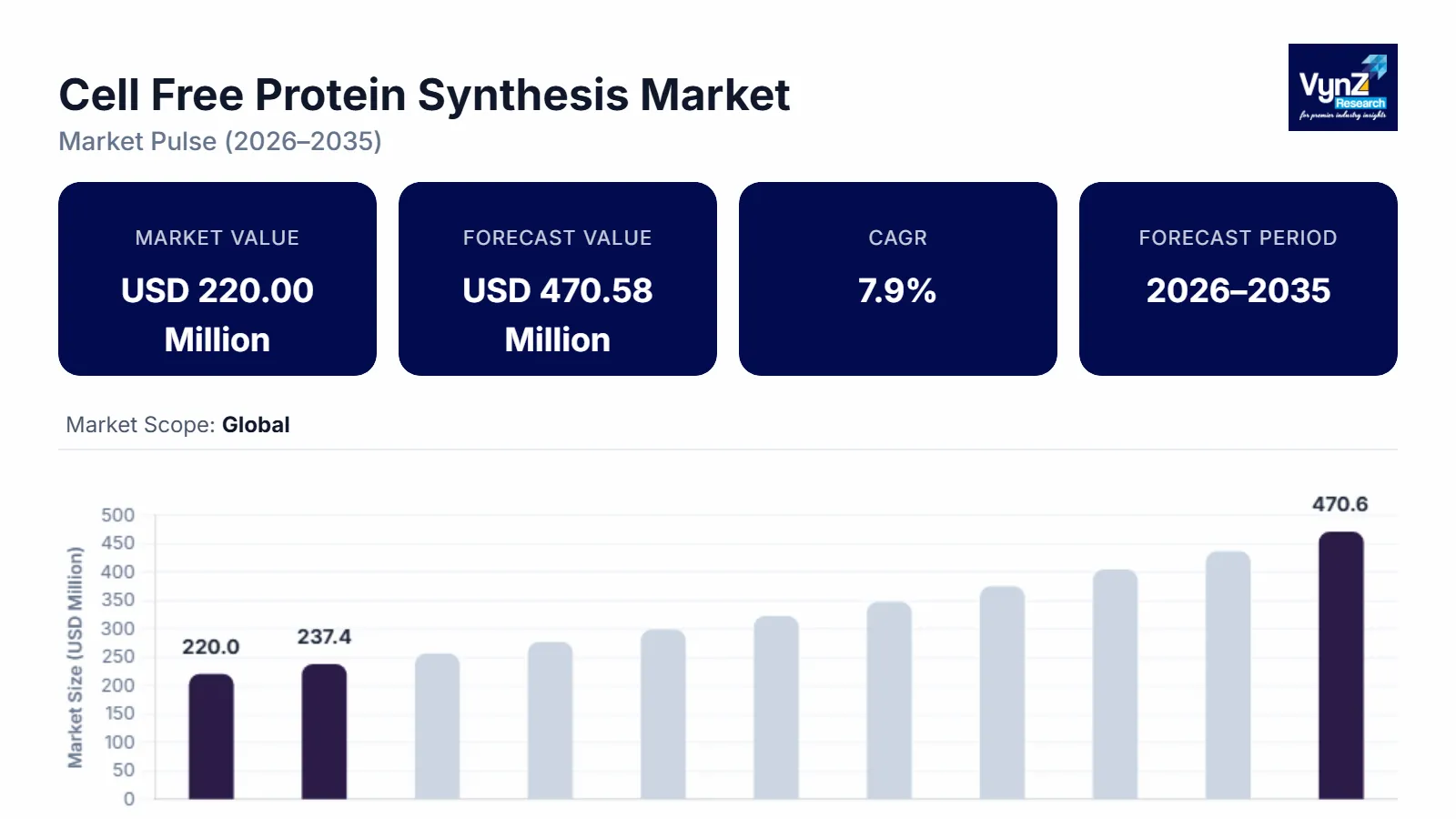
Market expansion is primarily supported by the increasing requirement for rapid and scalable protein expression systems and the growing application of cell free platforms across functional genomics, proteomics, and biologics research environments within academic and commercial research settings.
Adoption is supported by the rising utilization of coupled transcription translation technologies for vaccine antigen development, enzyme engineering and therapeutic protein screening aligned with publicly funded life sciences research frameworks. Government-backed programs supported by institutions such as the National Institutes of Health and the World Health Organization emphasize accelerated biologics development reproducibility and translational efficiency. These initiatives continue to encourage adoption of advanced protein synthesis solutions across North America, Europe and Asia Pacific, while the remaining demand is contributed by Latin America and the Middle East and Africa, supporting sustained market expansion across the global biotechnology and pharmaceutical landscape.
Cell Free Protein Synthesis Market Dynamics
Market Trends
The market is undergoing a structural transition toward rapid and flexible protein expression platforms that reduce dependence on living cell systems, aligned with public sector investments in advanced biomedical research and synthetic biology infrastructure. Government supported research frameworks led by institutions such as the National Institutes of Health and national biotechnology missions across Europe and Asia emphasize accelerated protein production workflows to support vaccine development, diagnostics, and functional genomics. These initiatives are driving increased adoption of open and continuous cell free systems capable of producing complex proteins with shorter development timelines and higher experimental control.
Another prominent trend is the growing integration of cell free platforms in high throughput screening and on demand protein manufacturing environments, supported by regulatory and funding alignment for translational research. Public health agencies and global health organizations including the World Health Organization have highlighted the importance of rapid protein expression technologies for outbreak preparedness and biologics research. This has encouraged manufacturers to focus on scalable kits automation compatible systems and standardized reagents that support reproducibility flexibility and cost optimization across academic pharmaceutical and industrial research laboratories.
Growth Drivers
The expansion of the market is strongly supported by rising demand for faster protein expression methods in drug discovery vaccine research and synthetic biology applications. Government funded life sciences programs in the United States, Europe and Asia Pacific prioritize technologies that shorten development cycles and reduce biological variability, supporting sustained demand for cell free platforms. Increased public investment in translational research infrastructure and biologics manufacturing capabilities continues to reinforce adoption across research institutes contract research organizations and pharmaceutical companies.
Another key growth driver is the increasing use of cell free systems for producing toxic or complex proteins that are difficult to express in living cells. As research institutions and biopharmaceutical developers prioritize efficiency reproducibility and regulatory compliance, demand for flexible protein synthesis solutions remains strong. Public health research initiatives supported by agencies such as the National Institutes of Health and equivalent biomedical authorities emphasize scalable protein production for diagnostics and therapeutic validation, further strengthening long term market growth prospects.
Market Restraints / Challenges
Despite favorable growth conditions, the industry faces challenges related to high reagent costs and limited scalability compared with traditional cell-based expression systems. Government backed research assessments highlight that enzyme stability energy substrate requirements and reagent optimization continue to affect cost efficiency particularly for large scale protein production. These constraints can limit adoption among cost sensitive academic laboratories and emerging biotechnology firms with restricted research budgets.
Additionally, dependence on specialized enzymes and proprietary reagents presents operational challenges for manufacturers and end users. Supply chain disruptions and limited availability of high-quality biological inputs can lead to cost pressures and production inconsistencies. Public sector reviews of biotechnology supply chains emphasize the need for resilient sourcing and standardization to ensure long term scalability. These factors may temporarily constrain broader commercial deployment particularly during periods of increased global demand for life sciences research materials.
Market Opportunities
The market presents significant opportunities in decentralized and on demand protein production, particularly driven by increased public funding for rapid diagnostics vaccine prototyping and emergency response research. Institutions supported by national health agencies and global health organizations are increasingly exploring cell free systems for portable and point of care applications. Companies offering modular automation ready and high-performance platforms are well positioned to capture incremental demand from public research institutes biotechnology startups and pharmaceutical innovation centers.
Another key opportunity lies in expanding applications within synthetic biology metabolic engineering and cell free biomanufacturing. Rising public and private investment in advanced biotechnology tools is creating opportunities for premium reagent systems and integrated workflows that support higher margins and long-term partnerships. Advancements in automation digital laboratory platforms and standardized protocols are expected to improve adoption efficiency and customer engagement supporting sustained growth across global research and industrial biotechnology ecosystems.
Global Cell Free Protein Synthesis Market Report Coverage
|
Report Metric |
Details |
|
Historical Period |
2020 - 2024 |
|
Base Year Considered |
2025 |
|
Forecast Period |
2026 - 2035 |
|
Market Size in 2025 |
USD 220.00 Million |
|
Revenue Forecast in 2035 |
USD 470.58 Million |
|
Growth Rate |
7.9% |
|
Segments Covered in the Report |
Offering, Workflow, Method, Application, End User |
|
Report Scope |
Market Trends, Drivers, and Restraints; Revenue Estimation and Forecast; Segmentation Analysis; Companies’ Strategic Developments; Market Share Analysis of Key Players; Company Profiling |
|
Regions Covered in the Report |
North America, Europe, Asia Pacific, Other Regions |
|
Key Companies |
BioDiscovery LLC, Bioneer Corporation, Cambridge Isotope Laboratories, Inc., Cayman Chemical, CD Biosynsis, CellFree Sciences Co., Ltd., Creative Biogene, Creative Biolabs, Genecopoeia, Inc., Jena Bioscience GmbH, Kaneka Corporation, LeniobiO GmbH, Sino Biological, Inc., Synthelis Biotech, Synbio Technologies, Takara Bio Inc., Thermo Fisher Scientific Inc., VectorBuilder Inc |
|
Customization |
Available upon request |
Cell Free Protein Synthesis Market Segmentation
By Offering
The market is driven by the increasing commercialization of complete solutions that support efficient and reproducible protein expression across research and industrial environments. This segment accounted for approximately 54% of total market revenue in 2025, supported by strong demand for standardized platforms that reduce experimental variability and improve workflow efficiency. Research institutions and biopharmaceutical developers continue to prioritize offerings that integrate critical reaction components, enabling faster setup and consistent protein yields. Growth for established offerings is estimated at around 7.2%, supported by sustained public and private investment in life sciences research infrastructure.
Advanced and value-added offerings are expected to register comparatively higher growth, estimated at nearly 8.6%, driven by rising adoption in high throughput screening, synthetic biology, and vaccine research applications. Increasing emphasis on automation compatibility and scalability is encouraging suppliers to enhance solution flexibility and performance. These trends are reinforcing the strategic importance of offering-based differentiation within the competitive landscape.
By Workflow
Conventional workflows represented approximately 59% of total revenue in 2025, supported by their established validation, ease of adoption, and suitability for academic and early-stage research. These workflows continue to experience stable growth of around 6.8%, driven by their widespread use in functional genomics and molecular biology studies.
More advanced workflows are emerging as the fastest-growing category, with an estimated growth rate of 9.0% during the forecast period. Adoption is supported by the need for higher protein yield, improved reaction control, and reduced manual intervention. Pharmaceutical research organizations and industrial biotechnology firms increasingly prefer optimized workflows that enable faster iteration cycles and improved reproducibility, contributing to sustained expansion of this segment.
By Method
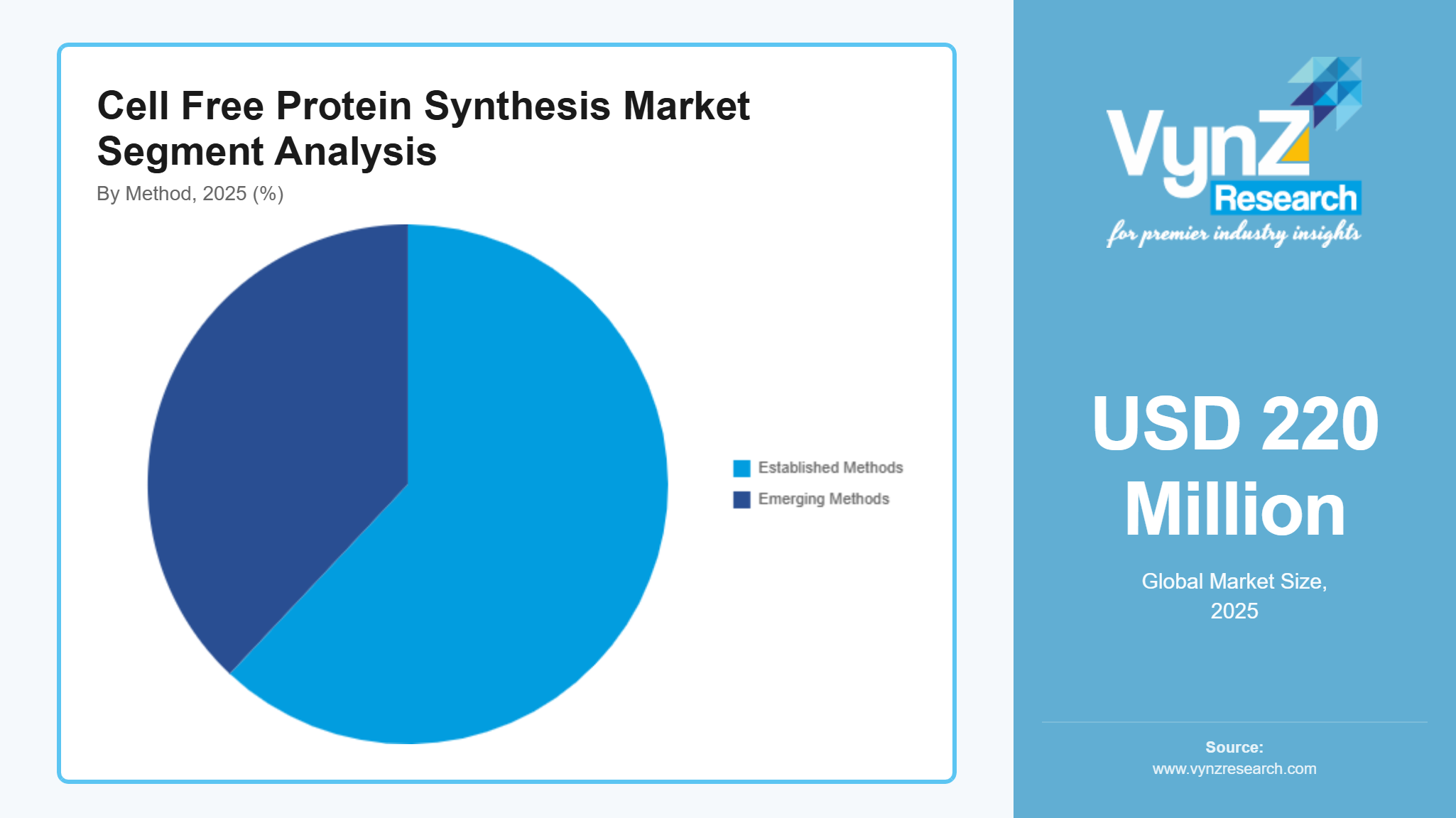
The market is influenced by system design choices that affect scalability, efficiency, and experimental flexibility. Established methods accounted for approximately 62% of market revenue in 2025, reflecting their broad adoption across academic laboratories and publicly funded research programs. These methods benefit from extensive validation and ease of implementation, supporting consistent demand and a steady growth rate of nearly 6.9%.
Emerging methods are expected to grow at a faster pace, with an estimated growth rate of 9.2%, driven by increasing demand for higher productivity and continuous processing capabilities. These methods are gaining traction in advanced research and industrial applications where efficiency and output consistency are critical. Ongoing innovation in energy regeneration and reaction optimization continues to enhance the commercial viability of advanced methods.
By Application
The market demonstrates strong adoption across research-driven use cases, contributing approximately 48% of total revenue in 2025. Demand is supported by the flexibility of cell free systems in expressing complex and toxic proteins, making them highly suitable for functional genomics, enzyme engineering, and molecular biology research. Growth for core applications is estimated at around 7.1%, supported by expanding government-backed research initiatives and increased experimental throughput requirements.
Emerging applications are expected to register higher growth, estimated at nearly 8.7%, as cell free protein synthesis gains importance in vaccine antigen development, diagnostics, and synthetic biology. Public health research priorities emphasizing rapid prototyping and translational efficiency continue to accelerate adoption, strengthening the long-term contribution of this segment.
By End User
Research-focused organizations accounted for approximately 65% of total market revenue in 2025, supported by sustained public funding for life sciences research and increasing collaboration between academic institutions and biopharmaceutical companies. Growth for this segment is estimated at nearly 7.4%, driven by ongoing demand for flexible and rapid protein expression platforms.
Commercial and industrial end users represent a smaller but rapidly expanding segment, registering an estimated growth rate of 8.9% during the forecast period. Rising adoption is driven by increasing use of cell free systems in drug discovery, diagnostics development, and synthetic biology-based production workflows. As enterprises prioritize speed, reproducibility, and cost efficiency, this end user segment is expected to play a growing role in overall market expansion.
Regional Insights
North America
North America accounted for approximately 32% of the global cell free protein synthesis market in 2025, supported by strong public funding for life sciences research, advanced biotechnology infrastructure, and high adoption across academic and biopharmaceutical institutions. The United States represents the largest contributor, driven by sustained investments from government-backed agencies such as the National Institutes of Health, the National Science Foundation, and the Biomedical Advanced Research and Development Authority, which emphasize rapid protein expression technologies for drug discovery, vaccine development, and diagnostics. Concentrated research activity across hubs including Boston, San Diego, and the San Francisco Bay Area continues to reinforce regional demand.
Government initiatives focused on translational research and pandemic preparedness are accelerating adoption of cell free platforms capable of rapid prototyping and scalable protein production. Increased collaboration between public research institutions and biotechnology firms is strengthening commercialization pathways, while federal support for synthetic biology and advanced manufacturing further enhances long-term regional market growth.
Asia Pacific
Asia Pacific is estimated to account for approximately 29% of the market in 2025, driven by expanding biotechnology research capacity, rising government investment in life sciences, and growing adoption of advanced protein synthesis tools across academic and industrial laboratories. China and Japan lead regional demand, supported by national biotechnology strategies and public funding programs aimed at strengthening domestic biopharmaceutical innovation. Government-backed research initiatives emphasize synthetic biology, biologics development, and rapid diagnostic capabilities, creating favorable conditions for cell free protein synthesis adoption.
In India, increased funding under national biotechnology and health research missions, along with growing collaboration between public research institutes and private biopharmaceutical companies, is supporting steady market expansion. The region benefits from rising research output, improving laboratory infrastructure, and increased focus on cost-effective and scalable protein expression technologies, contributing to sustained growth momentum.
Europe
Europe represents approximately 17% of the global market in 2025, supported by strong regulatory alignment, advanced academic research ecosystems, and coordinated public funding initiatives. Programs such as Horizon Europe and national biomedical research frameworks across Germany, the United Kingdom, France, and the Netherlands promote innovation in synthetic biology, molecular research, and biomanufacturing technologies. These initiatives emphasize reproducibility, scalability, and rapid development cycles, supporting adoption of cell free protein synthesis systems across research institutions and pharmaceutical companies.
European public health agencies and research councils continue to support protein engineering and vaccine research, reinforcing demand for flexible expression platforms. Increasing cross-border collaboration and emphasis on translational research further strengthen regional market performance, particularly in advanced research clusters and innovation-driven economies.
Other Regions
The remaining regions collectively contribute approximately 22% of the global market, including Latin America and the Middle East and Africa. Growth in these regions is supported by gradual expansion of biomedical research infrastructure, increased participation in international research collaborations, and government-backed initiatives focused on healthcare innovation and diagnostics. While adoption remains comparatively slower than in North America, Asia Pacific, and Europe, improving laboratory capabilities and rising public investment in life sciences position these regions as long-term growth opportunities for cell free protein synthesis technologies.
Competitive Landscape / Company Insights
The cell free protein synthesis market is moderately competitive, with global and specialized players focusing on product innovation, reagent optimization, and expansion of application coverage. Key companies emphasize scalable platforms and high reproducibility. Market adoption is reinforced by government backed life sciences funding frameworks supported by the National Institutes of Health and initiatives aligned with the World Health Organization, encouraging continued investment in advanced protein expression technologies across research and biopharmaceutical applications.
Mini Profiles
AMSBIO focuses on life science research reagents and services, supported by global distribution, strong brand recognition, and cost-efficient solutions, enabling researchers to advance drug discovery, cell biology, and molecular biology studies.
Biotech Rabbit operates in premium biotechnology segments, emphasizing high-quality recombinant proteins, antibodies, and custom services, delivering reliable solutions for academic, pharmaceutical, and industrial research with precision and reproducibility.
Cambridge Isotope Laboratories, Inc. leverages local manufacturing and strategic partnerships to expand market presence, providing stable isotopes, custom-labeled compounds, and analytical standards for research, diagnostics, and pharmaceutical development worldwide.
Excellgen, Inc. focuses on gene synthesis, molecular cloning, and custom DNA/RNA services, supported by digital platforms, rapid turnaround, and global technical support, catering to biotechnology and synthetic biology markets efficiently.
GenScript operates in mass biotechnology and synthetic biology segments, emphasizing automation, digital design tools, and scalable production, delivering proteins, gene synthesis, and CRISPR solutions for research and therapeutic development globally.
Key Players
- BioDiscovery LLC
- Bioneer Corporation
- Cambridge Isotope Laboratories, Inc.
- Cayman Chemical
- CD Biosynsis
- Cell Free Sciences Co., Ltd.
- Creative Biogene
- Creative Biolabs
- Genecopoeia, Inc.
- Jena Bioscience GmbH
- Kaneka Corporation
- LeniobiO GmbH
- Sino Biological, Inc.
- Synthelis Biotech
- Synbio Technologies
- Takara Bio Inc.
- Thermo Fisher Scientific Inc.
- VectorBuilder Inc.
Recent Developments
In November 2025, The FDA approved Promega's OncoMate MSI Dx Analysis System as a companion diagnostic to help identify patients with microsatellite-stable endometrial cancer who might benefit from the combination therapy of LENVIMA and KEYTRUDA (pembrolizumab). This marks a key regulatory milestone for its diagnostic platform in oncology precision medicine.
In May 2025, Thermo Fisher Scientific, a global leader in serving science, partnered with GenNext Technologies, a pioneer in protein footprinting, to launch an integrated structural biology workflow designed to enhance biotherapeutic development for research and drug discovery labs. The collaboration combines GenNext’s AutoFox Protein Footprinting System with Thermo Fisher’s advanced liquid chromatography–mass spectrometry (LC‑MS) solutions, including Thermo Scientific Orbitrap mass spectrometers, sample preparation technologies, and structural proteomics consumables such as crosslinkers and fluorescence labels.
In March 2025, PURExpress Pro is a next-generation cell-free protein synthesis (CFPS) kit from New England Biolabs (NEB) which is engineered to boost protein yields and accelerate synthetic biology workflows in research laboratories. This advanced system delivers enhanced performance, enabling faster turnaround times and higher expression efficiency as PURExpress Pro is ideal for applications such as rapid protein prototyping, synthetic biology research, high-throughput screening, and helping scientists move from gene to functional protein more efficiently.
Global Cell Free Protein Synthesis Market Coverage
Offering Insight and Forecast 2026 - 2035
- Established / Complete Solutions
- Advanced / Value-Added Solutions
Workflow Insight and Forecast 2026 - 2035
- Conventional Workflows
- Advanced Workflows
Method Insight and Forecast 2026 - 2035
- Established Methods
- Emerging Methods
Application Insight and Forecast 2026 - 2035
- Core Research Applications
- Emerging Applications
End User Insight and Forecast 2026 - 2035
- Research-focused Organizations
- Commercial & Industrial Users
Global Cell Free Protein Synthesis Market by Region
- North America
- By Offering
- By Workflow
- By Method
- By Application
- By End User
- By Country - U.S., Canada, Mexico
- Europe
- By Offering
- By Workflow
- By Method
- By Application
- By End User
- By Country - Germany, U.K., France, Italy, Spain, Russia, Rest of Europe
- Asia-Pacific (APAC)
- By Offering
- By Workflow
- By Method
- By Application
- By End User
- By Country - China, Japan, India, South Korea, Vietnam, Thailand, Malaysia, Rest of Asia-Pacific
- Rest of the World (RoW)
- By Offering
- By Workflow
- By Method
- By Application
- By End User
- By Country - Brazil, Saudi Arabia, South Africa, U.A.E., Other Countries
Table of Contents for Cell Free Protein Synthesis Market Report
1. Research Overview
1.1. The Report Offers
1.2. Market Coverage
1.2.1. By
Offering
1.2.2. By
Workflow
1.2.3. By
Method
1.2.4. By
Application
1.2.5. By
End User
1.3. Research Phases
1.4. Limitations
1.5. Market Methodology
1.5.1. Data Sources
1.5.1.1.
Primary Research
1.5.1.2.
Secondary Research
1.5.2. Methodology
1.5.2.1.
Data Exploration
1.5.2.2.
Forecast Parameters
1.5.2.3.
Data Validation
1.5.2.4.
Assumptions
1.5.3. Study Period & Data Reporting Unit
2. Executive Summary
3. Industry Overview
3.1. Industry Dynamics
3.1.1. Market Growth Drivers
3.1.2. Market Restraints
3.1.3. Key Market Trends
3.1.4. Major Opportunities
3.2. Industry Ecosystem
3.2.1. Porter’s Five Forces Analysis
3.2.2. Recent Development Analysis
3.2.3. Value Chain Analysis
3.3. Competitive Insight
3.3.1. Competitive Position of Industry
Players
3.3.2. Market Attractive Analysis
3.3.3. Market Share Analysis
4. Global Market Estimate and Forecast
4.1. Global Market Overview
4.2. Global Market Estimate and Forecast to 2035
5. Market Segmentation Estimate and Forecast
5.1. By Offering
5.1.1. Established / Complete Solutions
5.1.1.1. Market Definition
5.1.1.2. Market Estimation and Forecast to 2035
5.1.2. Advanced / Value-Added Solutions
5.1.2.1. Market Definition
5.1.2.2. Market Estimation and Forecast to 2035
5.2. By Workflow
5.2.1. Conventional Workflows
5.2.1.1. Market Definition
5.2.1.2. Market Estimation and Forecast to 2035
5.2.2. Advanced Workflows
5.2.2.1. Market Definition
5.2.2.2. Market Estimation and Forecast to 2035
5.3. By Method
5.3.1. Established Methods
5.3.1.1. Market Definition
5.3.1.2. Market Estimation and Forecast to 2035
5.3.2. Emerging Methods
5.3.2.1. Market Definition
5.3.2.2. Market Estimation and Forecast to 2035
5.4. By Application
5.4.1. Core Research Applications
5.4.1.1. Market Definition
5.4.1.2. Market Estimation and Forecast to 2035
5.4.2. Emerging Applications
5.4.2.1. Market Definition
5.4.2.2. Market Estimation and Forecast to 2035
5.5. By End User
5.5.1. Research-focused Organizations
5.5.1.1. Market Definition
5.5.1.2. Market Estimation and Forecast to 2035
5.5.2. Commercial & Industrial Users
5.5.2.1. Market Definition
5.5.2.2. Market Estimation and Forecast to 2035
6. North America Market Estimate and Forecast
6.1. By
Offering
6.2. By
Workflow
6.3. By
Method
6.4. By
Application
6.5. By
End User
6.5.1.
U.S. Market Estimate and Forecast
6.5.2.
Canada Market Estimate and Forecast
6.5.3.
Mexico Market Estimate and Forecast
7. Europe Market Estimate and Forecast
7.1. By
Offering
7.2. By
Workflow
7.3. By
Method
7.4. By
Application
7.5. By
End User
7.5.1.
Germany Market Estimate and Forecast
7.5.2.
France Market Estimate and Forecast
7.5.3.
U.K. Market Estimate and Forecast
7.5.4.
Italy Market Estimate and Forecast
7.5.5.
Spain Market Estimate and Forecast
7.5.6.
Russia Market Estimate and Forecast
7.5.7.
Rest of Europe Market Estimate and Forecast
8. Asia-Pacific (APAC) Market Estimate and Forecast
8.1. By
Offering
8.2. By
Workflow
8.3. By
Method
8.4. By
Application
8.5. By
End User
8.5.1.
China Market Estimate and Forecast
8.5.2.
Japan Market Estimate and Forecast
8.5.3.
India Market Estimate and Forecast
8.5.4.
South Korea Market Estimate and Forecast
8.5.5.
Rest of Asia-Pacific Market Estimate and Forecast
9. Rest of the World (RoW) Market Estimate and Forecast
9.1. By
Offering
9.2. By
Workflow
9.3. By
Method
9.4. By
Application
9.5. By
End User
9.5.1.
Brazil Market Estimate and Forecast
9.5.2.
Saudi Arabia Market Estimate and Forecast
9.5.3.
South Africa Market Estimate and Forecast
9.5.4.
U.A.E. Market Estimate and Forecast
9.5.5.
Other Countries Market Estimate and Forecast
10. Company Profiles
10.1.
BioDiscovery LLC
10.1.1.
Snapshot
10.1.2.
Overview
10.1.3.
Offerings
10.1.4.
Financial
Insight
10.1.5.
Recent
Developments
10.2.
Bioneer Corporation
10.2.1.
Snapshot
10.2.2.
Overview
10.2.3.
Offerings
10.2.4.
Financial
Insight
10.2.5.
Recent
Developments
10.3.
Cambridge Isotope Laboratories, Inc.
10.3.1.
Snapshot
10.3.2.
Overview
10.3.3.
Offerings
10.3.4.
Financial
Insight
10.3.5.
Recent
Developments
10.4.
Cayman Chemical
10.4.1.
Snapshot
10.4.2.
Overview
10.4.3.
Offerings
10.4.4.
Financial
Insight
10.4.5.
Recent
Developments
10.5.
CD Biosynsis
10.5.1.
Snapshot
10.5.2.
Overview
10.5.3.
Offerings
10.5.4.
Financial
Insight
10.5.5.
Recent
Developments
10.6.
CellFree Sciences Co., Ltd.
10.6.1.
Snapshot
10.6.2.
Overview
10.6.3.
Offerings
10.6.4.
Financial
Insight
10.6.5.
Recent
Developments
10.7.
Creative Biogene
10.7.1.
Snapshot
10.7.2.
Overview
10.7.3.
Offerings
10.7.4.
Financial
Insight
10.7.5.
Recent
Developments
10.8.
Creative Biolabs
10.8.1.
Snapshot
10.8.2.
Overview
10.8.3.
Offerings
10.8.4.
Financial
Insight
10.8.5.
Recent
Developments
10.9.
Genecopoeia, Inc.
10.9.1.
Snapshot
10.9.2.
Overview
10.9.3.
Offerings
10.9.4.
Financial
Insight
10.9.5.
Recent
Developments
10.10.
Jena Bioscience GmbH
10.10.1.
Snapshot
10.10.2.
Overview
10.10.3.
Offerings
10.10.4.
Financial
Insight
10.10.5.
Recent
Developments
10.11.
Kaneka Corporation
10.11.1.
Snapshot
10.11.2.
Overview
10.11.3.
Offerings
10.11.4.
Financial
Insight
10.11.5.
Recent
Developments
10.12.
LeniobiO GmbH
10.12.1.
Snapshot
10.12.2.
Overview
10.12.3.
Offerings
10.12.4.
Financial
Insight
10.12.5.
Recent
Developments
10.13.
Sino Biological, Inc.
10.13.1.
Snapshot
10.13.2.
Overview
10.13.3.
Offerings
10.13.4.
Financial
Insight
10.13.5.
Recent
Developments
10.14.
Synthelis Biotech
10.14.1.
Snapshot
10.14.2.
Overview
10.14.3.
Offerings
10.14.4.
Financial
Insight
10.14.5.
Recent
Developments
10.15.
Synbio Technologies
10.15.1.
Snapshot
10.15.2.
Overview
10.15.3.
Offerings
10.15.4.
Financial
Insight
10.15.5.
Recent
Developments
10.16.
Takara Bio Inc.
10.16.1.
Snapshot
10.16.2.
Overview
10.16.3.
Offerings
10.16.4.
Financial
Insight
10.16.5.
Recent
Developments
10.17.
Thermo Fisher Scientific Inc.
10.17.1.
Snapshot
10.17.2.
Overview
10.17.3.
Offerings
10.17.4.
Financial
Insight
10.17.5.
Recent
Developments
10.18.
VectorBuilder Inc.
10.18.1.
Snapshot
10.18.2.
Overview
10.18.3.
Offerings
10.18.4.
Financial
Insight
10.18.5.
Recent
Developments
11. Appendix
11.1. Exchange Rates
11.2. Abbreviations
Note: Financial insight and recent developments of different companies are subject to the availability of information in the secondary domain.
Frequently Asked Questions
Purchase Options
Latest Report
Research Methodology
- Desk Research / Pilot Interviews
- Build Market Size Model
- Research and Analysis
- Final Deliverable
Connect With Our Sales Team
- Toll-Free: +1-888-253-3960
- Phone: +91 9960 288 381
- Email: enquiry@vynzresearch.com
Cell Free Protein Synthesis Market