
Europe Beauty Devices Market -Size & Share Growth Forecast Report (2026-2035)
Industry Insight by Product Type (Hair removal devices, Skin care and cleansing devices, Hair care devices, Oral beauty devices), by Application (Facial and skin treatment, Hair care treatment, Oral beauty treatment), by Mode of Operation (Electric and battery-operated devices, Smart and app connected devices, Manual devices), by Price Range (Economy, Mid-range, Premium), by End User (Household consumers, Beauty clinics and dermatology centers, Professional wellness facilities)
| Status : Published | Published On : Jun, 2026 | Report Code : VRHC1341 | Industry : Healthcare | Available Format :

|
Page : 156 |
Europe Beauty Devices Market Overview
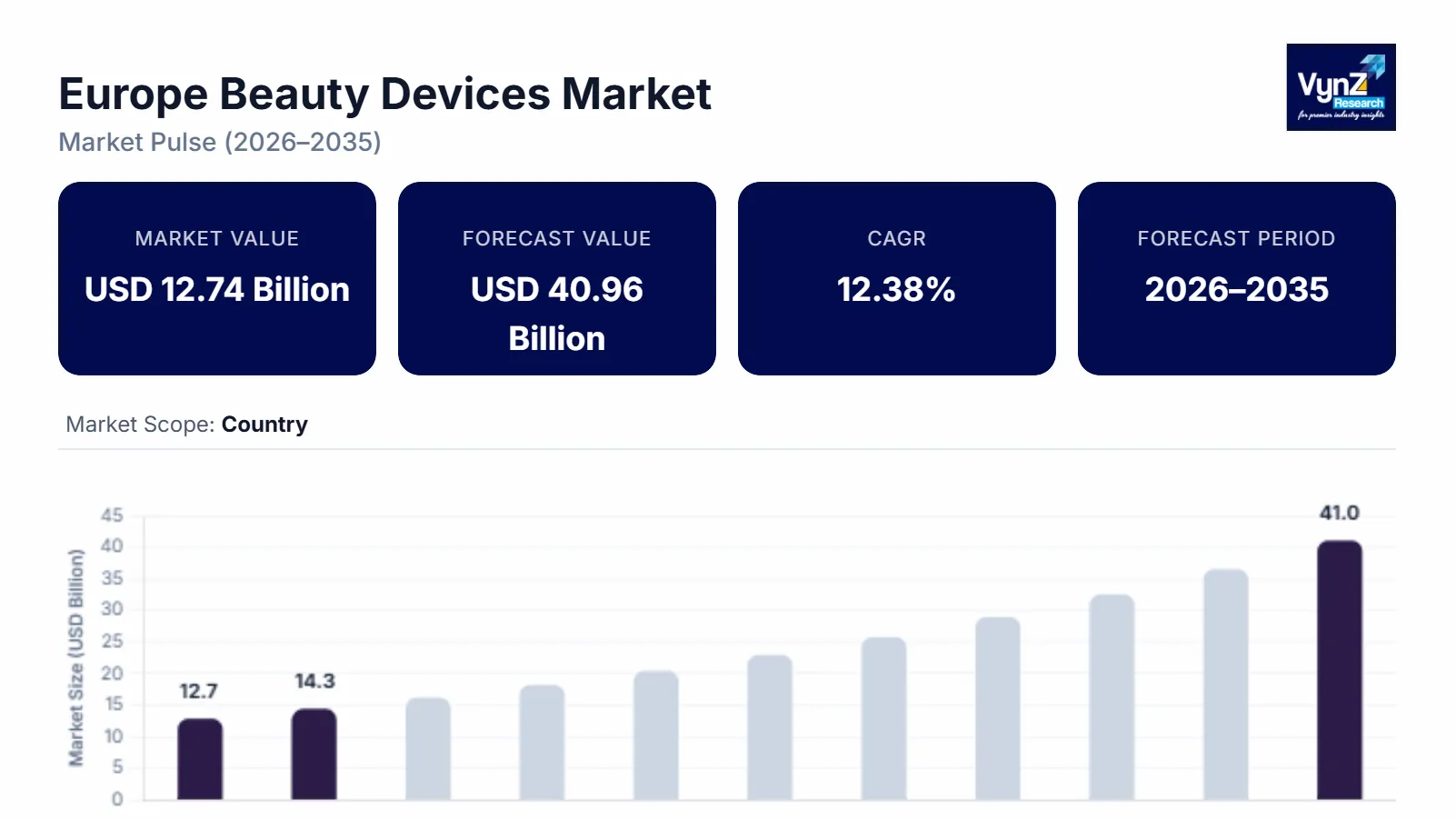
The Europe beauty devices market size was estimated at about USD 12.74 billion in 2025 and is expected to reach around USD 14.29 billion in 2026 rising up to roughly USD 40.96 billion in 2035, growing at approximately 12.38% CAGR from 2026 to 2035.
Research Highlights
- Hair removal devices led with 34% share in 2025 due to strong home use demand.
- Skin care and cleansing devices are the fastest-growing segment with a 13.1% CAGR driven by AI-powered skincare adoption.
- Facial and skin treatment applications accounted for 41% market share in 2025, supported by rising anti-aging demand.
- Smart and app-connected beauty devices are projected to grow at a 13.4% CAGR due to increasing digital health integration.
- Germany led the regional market with a 24% share in 2025, supported by advanced dermatology infrastructure.
The market is growing because more people prefer want to look good and maintain their beauty without surgery thereby pushing the demand for cleansing systems, hair removal tools, and other beauty treatment devices that can be used at home. The World Health Organization and other health groups in Europe are advising people to take care of their skin and age in a responsible way and these devices help them achieve their objectives. The government is also helping by making sure these products are safe to use for people across Europe, especially in countries like Germany, France and the United Kingdom where people are spending a lot of money on beauty devices to make them look and feel good.
Europe Beauty Devices Market Dynamics
Market Trends
The market is changing at a fast pace because people want to use technology to take care of their skin and hair being assured by the World Health Organization and other health groups in Europe that these technologies are proven to be safe to use and effective to help people stay healthy. A lot of initiatives are taken to raise awareness regarding beauty, ageing and how to take care of both while the government is making stringent rules to keep people safe when they use these products.
Growth drivers
The market is growing due to the increasing number of ageing generation who want to look good and take care of their skin and hair using certified beauty devices and advanced technologies approved by the World Health Organization laser hair removal and skin tightening that help them look younger. A higher acceptance of these products is increasing sales which is pushing the market even further.
Market Restraints / Challenges
One of the most significant challenges faced by the industry is the high cost of these beauty devices and advanced technologies that deter people with tight budget from buying them. Additionally, stringent rules formulated by the government regarding manufacturing these products also hamper market growth because companies need to spend a lot of money to ensure safety and functionality of these beauty devices.
Market Opportunities
There are lots of opportunities in the market for companies who are engaged in making these beauty devices to grow. Higher adoption and use of them for personal care, development of technology, and growing awareness of ageing and beauty treatments among the ageing generation promote adoption and sales of these products. The government is also funding several companies to research on these technologies and produce even better devices.
Europe Beauty Devices Market Report Coverage
|
Report Metric |
Details |
|
Historical Period |
2020 - 2024 |
|
Base Year Considered |
2025 |
|
Forecast Period |
2026 - 2035 |
|
Market Size in 2025 |
USD 12.74 Billion |
|
Revenue Forecast in 2035 |
USD 40.96 Billion |
|
Growth Rate |
12.38% |
|
Segments Covered in the Report |
Product Type, Application, Mode of Operation, Price Range, End User |
|
Report Scope |
Market Trends, Drivers, and Restraints; Revenue Estimation and Forecast; Segmentation Analysis; Companies’ Strategic Developments; Market Share Analysis of Key Players; Company Profiling |
|
Regions Covered in the Report |
|
|
Key Companies |
Alma Lasers, Home Skinovations Ltd., Koninklijke Philips N.V., L’Oreal SA, Lumenis Ltd., Panasonic Corporation, Photomedax Inc., Syneron-Candela, The Proctor & Gamble Company, TRIA Beauty, Inc. |
|
Customization |
Available upon request |
Europe Beauty Devices Market Segmentation
By Product Type
Hair removal devices were the leading segment in the market in 2025 with almost 34% of the total revenue which is mainly attributed to the increasing preference of consumers for specific beauty devices like hair removal, skin tightening, and more. These products are durable and safe to use at home, as certified by the European Commission and other health groups.
Skin care and cleansing devices are expected to grow at around 13.1% CAGR from 2026 to 2035 mainly because wider adoption and liking among people to take care of their skin and look young.
By Application
Facial and skin treatment applications contributed around 41% of the total market revenue due to wider awareness and adoption of these products and a lot of money is also invested in developing new products to treat the face and skin.
Hair care and oral beauty applications is likely to grow by around 12.8% from 2026 to 2035 subject to increasing acceptance and knowledge about the products from different platforms and social media.
By Mode of Operation
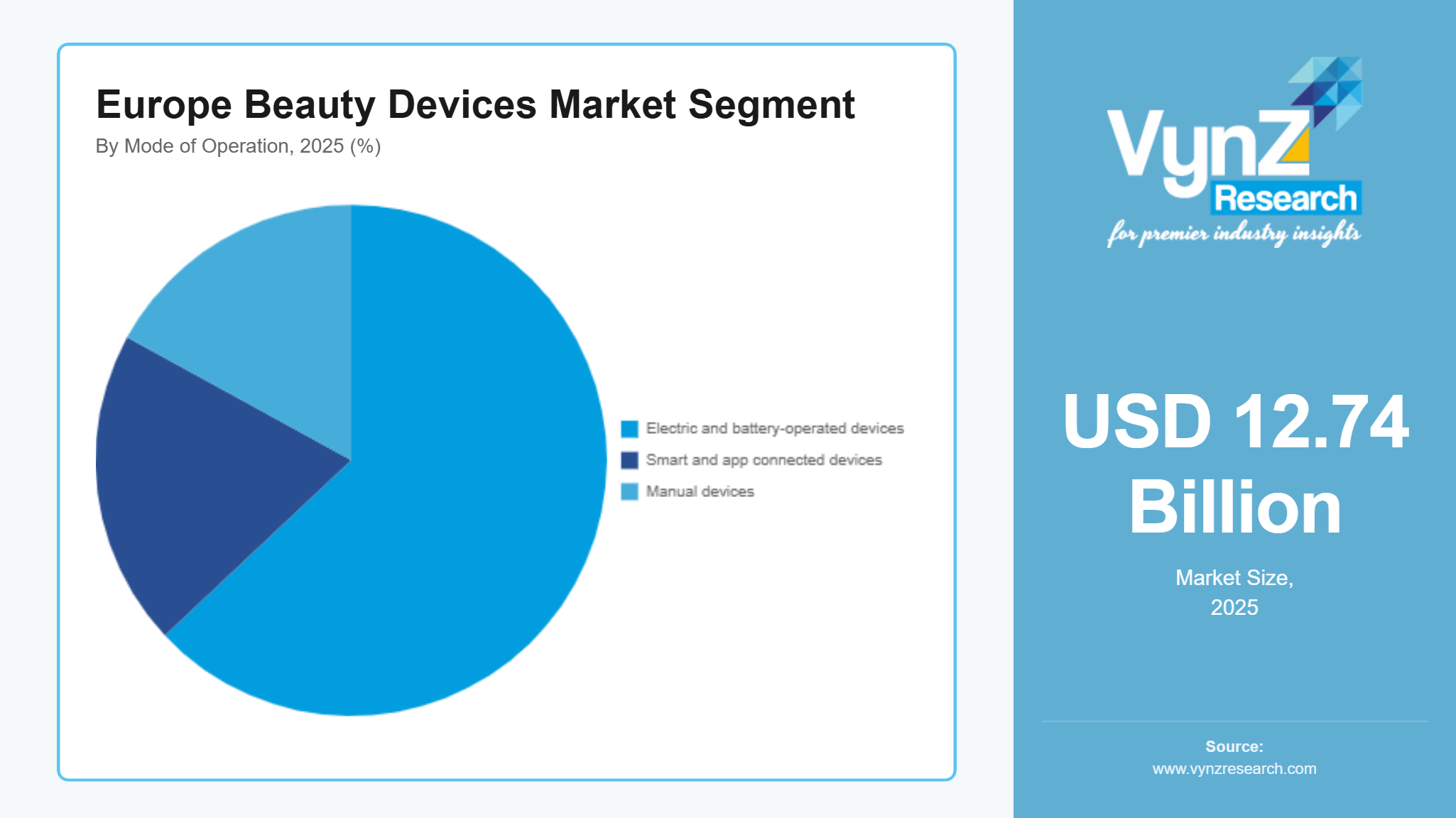
Electric and battery-operated beauty devices reigned the market in 2025 with around 63% of the revenue contribution mainly because these devices are easy to use and good for the environment. The European Commission is making rules to help companies make devices that are safe and environmentally friendly.
Smart and app connected beauty devices will grow at about 13.4% from 2026 to 2035 since it offers additional convenience to users because they can connect these devices to their phones which helps in operation.
By End User
Household consumers contributed about 58% of the revenue to the market in 2025 which is mainly attributed to their growing preference to look good and higher preference for advanced technologies and beauty devices.
Beauty clinics and other professional places will expand at nearly 12.9% CAGR from 2026 to 2035 due to availability of advanced equipment, professional service and proper care to maintain beauty.
Regional Insights
Germany
Germany held around 24% of the market share in 2025 because consumers here prefer technologies to take care of their skin and overall beauty and use these advanced devices extensively in cities like Berlin and Munich in particular, pushing the demand and market further.
The United Kingdom
The United Kingdom contributed around 19% of the market share in 2025 due to the fact that people in the United Kingdom are becoming more aware of how to take care of their skin and how to use these advanced devices that help them look good, especially in cities like London and Manchester where the demand for these products is really high.
France
France accounted for about 16% of the market share in 2025 which is attributed to the preference of the younger French generation to look good. The ageing group in France also use these devices that help them look younger and a glowing skin, especially in cities like Paris and Lyon where people are buying these devices in huge scale.
Italy
Italy held around 11% of the market share in 2025 due to the growing elderly population in cities like Milan and Rome and their desire to look younger, thereby encouraging them to use these devices that are safe and effective, pushing the demand and the market further.
Rest of Europe
The rest of Europe together contributed nearly 30% of the market share in 2025 because of growing awareness among people in the European countries of how to take care of their skin with the use of these safe and effective beauty devices.
Competitive Landscape / Company Insights
The market is moderately competitive with the major and smaller players engaged in making devices that are effective and safe, investing in advanced technologies and emphasizing research and development to design better beauty devices. The European Commission is making rules to help companies ensure safety of the product and even funding them for further research and development.
Mini Profiles
Alma Lasers focuses on professional aesthetic and laser-based beauty technologies, supported by strong clinical expertise, expanding distribution partnerships, and increasing adoption across dermatology clinics and premium wellness centers.
Home Skinovations Ltd. operates in the home-based skincare device segment, emphasizing portable treatment technologies, consumer convenience, and cost-effective personal beauty solutions for residential users.
Koninklijke Philips N.V. leverages strong digital capabilities, global retail presence, and advanced personal care technologies to expand its position across connected grooming and skincare device categories.
L’Oreal SA focuses on premium beauty innovation and AI integrated skincare technologies, supported by strong brand recognition, research investments, and expanding digital beauty ecosystems across Europe.
Panasonic Corporation operates across mass and premium beauty device categories, emphasizing product durability, energy efficient technologies, and technologically advanced grooming and skincare solutions for global consumers.
Key Players
Recent Developments
In March 2025, Candela announced the global launch of its Glacē treatment platform at the American Academy of Dermatology Annual Meeting. The company introduced advanced hydrodermabrasion and LED integrated skincare technology targeting rising demand for premium facial rejuvenation solutions.
In March 2025, Lumenis Ltd. expanded its FoLix laser hair treatment platform into the Canadian market following regulatory clearance. The development strengthened the company’s international presence in advanced hair restoration and non invasive aesthetic technologies.
In July 2025, The Proctor & Gamble Company reported continued growth across its beauty and personal care business segments driven by strong skincare and haircare demand. The company also increased investments in premium wellness and digital beauty innovation strategies to strengthen consumer engagement.
In November 2025, Syneron-Candela continued expansion of advanced dermatology and skin rejuvenation technologies through broader commercialization of LED integrated and hydrodermabrasion treatment systems. The company focused on strengthening professional aesthetic treatment capabilities across premium skincare clinics and wellness centers.
In December 2025, Photomedax Inc. increased focus on connected skincare and light based aesthetic treatment technologies amid rising demand for home based beauty devices. The company continued strengthening its beauty technology portfolio through product enhancement and digital wellness integration strategies.
Europe Beauty Devices Market Coverage
Product Type Insight and Forecast 2026 - 2035
- Hair removal devices
- Skin care and cleansing devices
- Hair care devices
- Oral beauty devices
Application Insight and Forecast 2026 - 2035
- Facial and skin treatment
- Hair care treatment
- Oral beauty treatment
Mode of Operation Insight and Forecast 2026 - 2035
- Electric and battery-operated devices
- Smart and app connected devices
- Manual devices
Price Range Insight and Forecast 2026 - 2035
- Economy
- Mid-range
- Premium
End User Insight and Forecast 2026 - 2035
- Household consumers
- Beauty clinics and dermatology centers
- Professional wellness facilities
Europe Beauty Devices Market by Region
- Germany
- By Product Type
- By Application
- By Mode of Operation
- By Price Range
- By End User
- U.K.
- By Product Type
- By Application
- By Mode of Operation
- By Price Range
- By End User
- France
- By Product Type
- By Application
- By Mode of Operation
- By Price Range
- By End User
- Italy
- By Product Type
- By Application
- By Mode of Operation
- By Price Range
- By End User
- Spain
- By Product Type
- By Application
- By Mode of Operation
- By Price Range
- By End User
- Russia
- By Product Type
- By Application
- By Mode of Operation
- By Price Range
- By End User
- Rest of Europe
- By Product Type
- By Application
- By Mode of Operation
- By Price Range
- By End User
Table of Contents for Europe Beauty Devices Market Report
1. Research Overview
1.1. The Report Offers
1.2. Market Coverage
1.2.1. By
Product Type
1.2.2. By
Application
1.2.3. By
Mode of Operation
1.2.4. By
Price Range
1.2.5. By
End User
1.3. Research Phases
1.4. Limitations
1.5. Market Methodology
1.5.1. Data Sources
1.5.1.1.
Primary Research
1.5.1.2.
Secondary Research
1.5.2. Methodology
1.5.2.1.
Data Exploration
1.5.2.2.
Forecast Parameters
1.5.2.3.
Data Validation
1.5.2.4.
Assumptions
1.5.3. Study Period & Data Reporting Unit
2. Executive Summary
3. Industry Overview
3.1. Industry Dynamics
3.1.1. Market Growth Drivers
3.1.2. Market Restraints
3.1.3. Key Market Trends
3.1.4. Major Opportunities
3.2. Industry Ecosystem
3.2.1. Porter’s Five Forces Analysis
3.2.2. Recent Development Analysis
3.2.3. Value Chain Analysis
3.3. Competitive Insight
3.3.1. Competitive Position of Industry
Players
3.3.2. Market Attractive Analysis
3.3.3. Market Share Analysis
4. Europe Market Estimate and Forecast
4.1. Europe Market Overview
4.2. Europe Market Estimate and Forecast to 2035
5. Market Segmentation Estimate and Forecast
5.1. By Product Type
5.1.1. Hair removal devices
5.1.1.1. Market Definition
5.1.1.2. Market Estimation and Forecast to 2035
5.1.2. Skin care and cleansing devices
5.1.2.1. Market Definition
5.1.2.2. Market Estimation and Forecast to 2035
5.1.3. Hair care devices
5.1.3.1. Market Definition
5.1.3.2. Market Estimation and Forecast to 2035
5.1.4. Oral beauty devices
5.1.4.1. Market Definition
5.1.4.2. Market Estimation and Forecast to 2035
5.2. By Application
5.2.1. Facial and skin treatment
5.2.1.1. Market Definition
5.2.1.2. Market Estimation and Forecast to 2035
5.2.2. Hair care treatment
5.2.2.1. Market Definition
5.2.2.2. Market Estimation and Forecast to 2035
5.2.3. Oral beauty treatment
5.2.3.1. Market Definition
5.2.3.2. Market Estimation and Forecast to 2035
5.3. By Mode of Operation
5.3.1. Electric and battery-operated devices
5.3.1.1. Market Definition
5.3.1.2. Market Estimation and Forecast to 2035
5.3.2. Smart and app connected devices
5.3.2.1. Market Definition
5.3.2.2. Market Estimation and Forecast to 2035
5.3.3. Manual devices
5.3.3.1. Market Definition
5.3.3.2. Market Estimation and Forecast to 2035
5.4. By Price Range
5.4.1. Economy
5.4.1.1. Market Definition
5.4.1.2. Market Estimation and Forecast to 2035
5.4.2. Mid-range
5.4.2.1. Market Definition
5.4.2.2. Market Estimation and Forecast to 2035
5.4.3. Premium
5.4.3.1. Market Definition
5.4.3.2. Market Estimation and Forecast to 2035
5.5. By End User
5.5.1. Household consumers
5.5.1.1. Market Definition
5.5.1.2. Market Estimation and Forecast to 2035
5.5.2. Beauty clinics and dermatology centers
5.5.2.1. Market Definition
5.5.2.2. Market Estimation and Forecast to 2035
5.5.3. Professional wellness facilities
5.5.3.1. Market Definition
5.5.3.2. Market Estimation and Forecast to 2035
6. Germany Market Estimate and Forecast
6.1. By
Product Type
6.2. By
Application
6.3. By
Mode of Operation
6.4. By
Price Range
6.5. By
End User
7. U.K. Market Estimate and Forecast
7.1. By
Product Type
7.2. By
Application
7.3. By
Mode of Operation
7.4. By
Price Range
7.5. By
End User
8. France Market Estimate and Forecast
8.1. By
Product Type
8.2. By
Application
8.3. By
Mode of Operation
8.4. By
Price Range
8.5. By
End User
9. Italy Market Estimate and Forecast
9.1. By
Product Type
9.2. By
Application
9.3. By
Mode of Operation
9.4. By
Price Range
9.5. By
End User
10. Spain Market Estimate and Forecast
10.1. By
Product Type
10.2. By
Application
10.3. By
Mode of Operation
10.4. By
Price Range
10.5. By
End User
11. Russia Market Estimate and Forecast
11.1. By
Product Type
11.2. By
Application
11.3. By
Mode of Operation
11.4. By
Price Range
11.5. By
End User
12. Rest of Europe Market Estimate and Forecast
12.1. By
Product Type
12.2. By
Application
12.3. By
Mode of Operation
12.4. By
Price Range
12.5. By
End User
13. Company Profiles
13.1.
Alma Lasers
13.1.1.
Snapshot
13.1.2.
Overview
13.1.3.
Offerings
13.1.4.
Financial
Insight
13.1.5.
Recent
Developments
13.2.
Skinovations Ltd.
13.2.1.
Snapshot
13.2.2.
Overview
13.2.3.
Offerings
13.2.4.
Financial
Insight
13.2.5.
Recent
Developments
13.3.
Koninklijke
13.3.1.
Snapshot
13.3.2.
Overview
13.3.3.
Offerings
13.3.4.
Financial
Insight
13.3.5.
Recent
Developments
13.4.
Philips N.V.
13.4.1.
Snapshot
13.4.2.
Overview
13.4.3.
Offerings
13.4.4.
Financial
Insight
13.4.5.
Recent
Developments
13.5.
L’Oreal SA
13.5.1.
Snapshot
13.5.2.
Overview
13.5.3.
Offerings
13.5.4.
Financial
Insight
13.5.5.
Recent
Developments
13.6.
Lumenis Ltd.
13.6.1.
Snapshot
13.6.2.
Overview
13.6.3.
Offerings
13.6.4.
Financial
Insight
13.6.5.
Recent
Developments
13.7.
Panasonic Corporation
13.7.1.
Snapshot
13.7.2.
Overview
13.7.3.
Offerings
13.7.4.
Financial
Insight
13.7.5.
Recent
Developments
13.8.
Photomedax Inc.
13.8.1.
Snapshot
13.8.2.
Overview
13.8.3.
Offerings
13.8.4.
Financial
Insight
13.8.5.
Recent
Developments
13.9.
Syneron-Candela
13.9.1.
Snapshot
13.9.2.
Overview
13.9.3.
Offerings
13.9.4.
Financial
Insight
13.9.5.
Recent
Developments
13.10.
The Proctor & Gamble Company
13.10.1.
Snapshot
13.10.2.
Overview
13.10.3.
Offerings
13.10.4.
Financial
Insight
13.10.5.
Recent
Developments
13.11.
TRIA Beauty, Inc.
13.11.1.
Snapshot
13.11.2.
Overview
13.11.3.
Offerings
13.11.4.
Financial
Insight
13.11.5.
Recent
Developments
14. Appendix
14.1. Exchange Rates
14.2. Abbreviations
Note: Financial insight and recent developments of different companies are subject to the availability of information in the secondary domain.
Frequently Asked Questions
Purchase Options
Latest Report
Research Methodology
- Desk Research / Pilot Interviews
- Build Market Size Model
- Research and Analysis
- Final Deliverable
Connect With Our Sales Team
- Toll-Free: +1-888-253-3960
- Phone: +91 9960 288 381
- Email: enquiry@vynzresearch.com
Europe Beauty Devices Market