
U.S. Surgical Robots Market Size & Share Growth Forecast Report (2026-2035)
Industry Insight by Component (Robotic Systems, Instruments and Accessories, Services), by Application (General Surgery, Urology, Gynaecology, Orthopaedic Surgery, Neurosurgery, Others), by End User (Hospitals, Ambulatory Surgical Centres, Specialty Clinics)
| Status : Published | Published On : Aug, 2026 | Report Code : VRHC1347 | Industry : Healthcare | Available Format :

|
Page : 123 |
U.S. Surgical Robots Market Overview
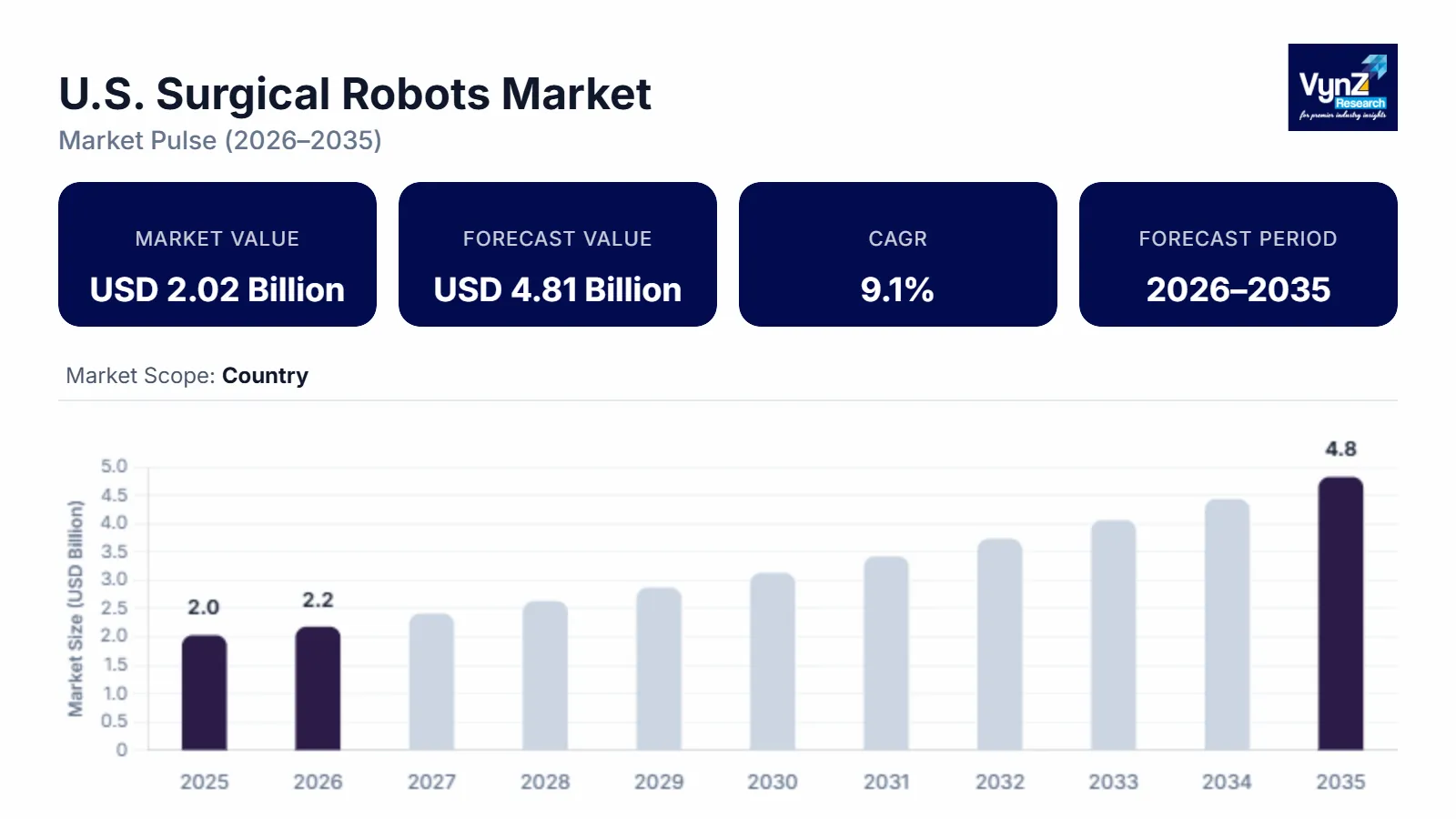
The U.S. surgical robots market size was estimated at approximately USD 2.02 billion in 2025 and is expected to reach around USD 2.17 billion in 2026, rising to nearly USD 4.81 billion by 2035, growing at an estimated 9.1% CAGR during 2026 to 2035.
Research Highlights
- Robotic systems held 52.8% share in 2025 due to hospital installations.
- General surgery captured 29.7% share in 2025 supported by minimally invasive procedures.
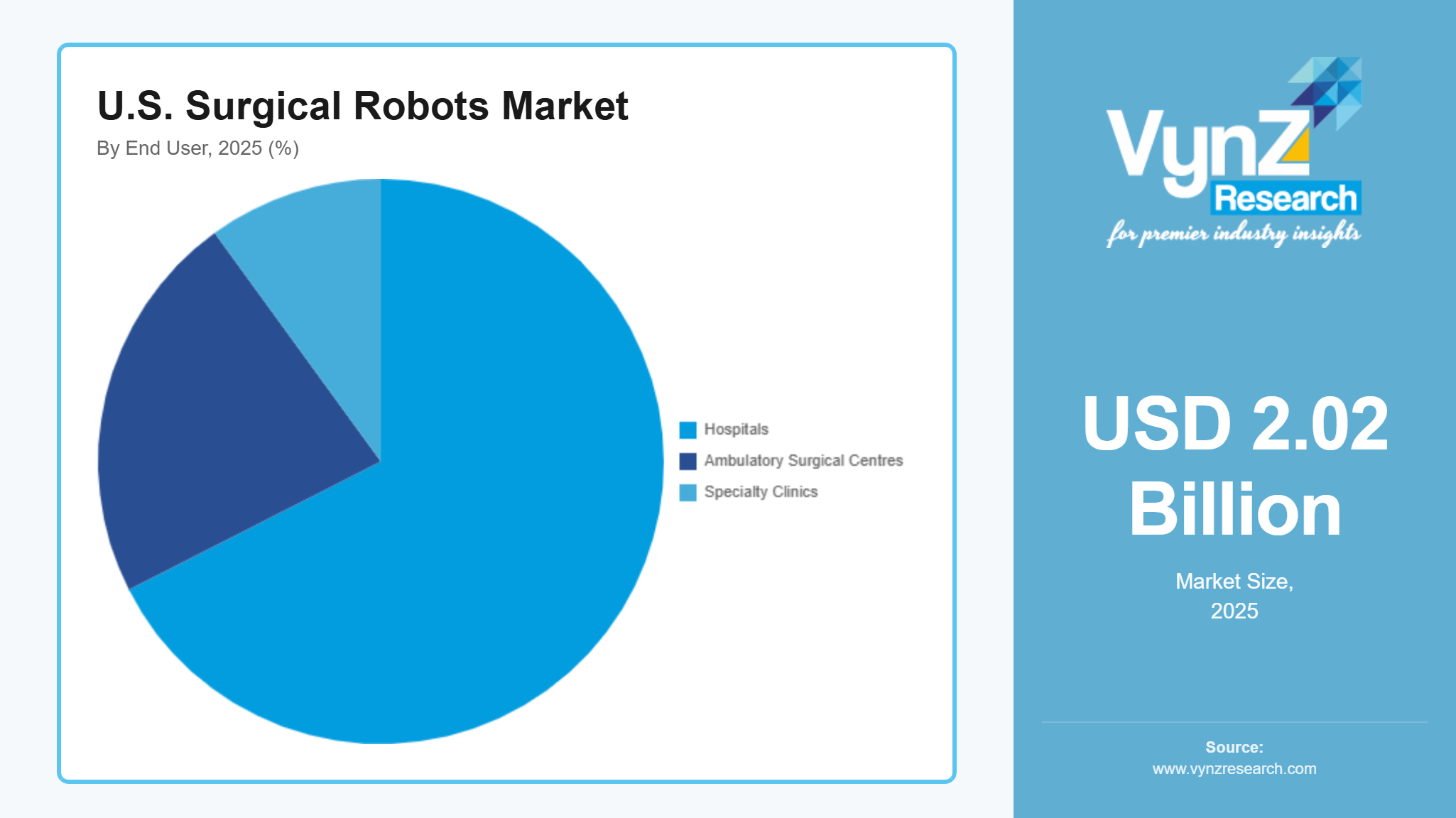
- Hospitals generated 67.5% revenue in 2025 owing to higher surgical volumes.
- Instruments and accessories are projected at 10.4% CAGR during 2026 to 2035.
- California represented 31.6% market share in 2025 supported by advanced healthcare infrastructure.
The market growth is fueled by a growing need for robot-assisted surgery in urology, orthopedics, general surgery, and gynecology, as well as growing investments in advanced healthcare infrastructures and digital operating rooms. The establishment of robotic surgery programs at major medical institutions nationwide, often with support from the U.S. Food and Drug Administration (FDA), reimbursement encouragement from the Centers for Medicare & Medicaid Services (CMS), and research funding from the NIH (National Institutes of Health), is driving the increased use of these systems in premier healthcare centers in California, Texas, Florida, and Massachusetts. The expansion of robotic-assisted surgical procedures in these high-profile settings will be driven by continued innovation and investment in robotic technologies and surgical personnel.
U.S. Surgical Robots Market Dynamics
Market Trends
The market is witnessing a rise in robotic-assisted minimally invasive surgery, adoption of artificial intelligence technologies, and digital operation theatre solutions. One of the key trends driving the market is the adoption of next-gen robotic systems that offer advanced visualization, haptic feedback, 3D visualization, and precision to perform surgeries. Hospitals and healthcare facilities are opting for multi-specialty robotic systems that cater to a wide range of procedures like urology, orthopedics, general surgery, gynecology, thoracic surgery, and colorectal surgery. Another key trend in the U.S. Surgical Robots Market is the growing adoption of robotic systems equipped with artificial intelligence, cloud-based technologies, analytics, and self-learning capabilities to enable robotic-assisted surgeries.
Growth Drivers
The demand for minimally invasive procedures is one of the prime growth drivers influencing the U.S. surgical robots market at a healthy CAGR during the forecast period. These procedures are majorly adopted by hospitals, ambulatory surgical centers, and specialty surgical centers. An increase in the prevalence of chronic illnesses, surge in the number of surgeries, and preference for procedures involving lesser recovery time and reduced risks are some of the factors fueling the growth of the U.S. Surgical Robots Market. Moreover, the constant technological advancements in robotic-assisted surgical technologies, including navigation, imaging, artificial intelligence, and precision instruments, are anticipated to complement the growth of the U.S. Surgical Robots Market during the forecast period.
Market Restraints / Challenges
Some of the key challenges that may impede the growth of the market include high costs associated with these systems, expensive maintenance and repair services, and the need for proper training for their effective utilization. These factors are creating a restraint for the growth of the market, especially for community hospitals with a limited budget. The strict regulatory guidelines and the requirement of skilled professionals to operate these systems may also impact the U.S. Surgical Robots Market growth during the forecast period. The extensive training and expertise needed to operate robotic-assisted systems and maintain them can also affect their adoption to a certain extent.
Market Opportunities
Artificial intelligence-driven surgical robots, robotic systems for outpatient surgeries, and next-gen image-guided robotic systems are some of the prime opportunities in the market driven by the growing demand for minimally invasive procedures and precision medicine. Manufacturers providing image-guided robotic-assisted systems and surgical robots for ambulatory surgery centers are well-positioned to expand their market share. Another significant opportunity in the U.S. Surgical Robots Market includes the rising interest in orthopedic robotic surgery, soft tissue robots, and telemanipulation and robotic-assisted surgeries. Companies can promote their products in the U.S. Surgical Robots Market by focusing on these areas to strengthen long-term partnerships with hospitals and surgical centers. Advancements in machine learning algorithms, augmented reality, digital imaging, and robotic-assisted procedures are also supporting procedural accuracy and improving the efficiency of the care provided by these systems.
U.S. Surgical Robots Market Report Coverage
|
Report Metric |
Details |
|
Historical Period |
2020 - 2024 |
|
Base Year Considered |
2025 |
|
Forecast Period |
2026 - 2035 |
|
Market Size in 2025 |
USD 2.02 Billion |
|
Revenue Forecast in 2035 |
USD 4.81 Billion |
|
Growth Rate |
9.1% |
|
Segments Covered in the Report |
Component, Application, End User |
|
Report Scope |
Market Trends, Drivers, and Restraints; Revenue Estimation and Forecast; Segmentation Analysis; Companies’ Strategic Developments; Market Share Analysis of Key Players; Company Profiling |
|
Regions Covered in the Report |
California, Texas, Massachusetts, Rest of the U.S. |
|
Key Companies |
Asensus Surgical, Inc., CMR Surgical Ltd., Globus Medical, Inc., Intuitive Surgical, Inc., Johnson & Johnson (Auris Health), Medtronic plc, Moon Surgical SAS, Smith+Nephew plc, Stryker Corporation, Zimmer Biomet Holdings, Inc. |
|
Customization |
Available upon request |
U.S. Surgical Robots Market Segmentation
By Component
Robotic systems dominated the market with a share of around 52.8% in 2025. This is because of the rising adoption of robotic systems in various surgical procedures and specialty centers. Increasing investment in advanced surgical suites, growing number of robotic surgery programs, and continuous developments in robotic visualization and navigation solutions are some of the factors driving the segment.
Instruments and accessories are anticipated to register the highest growth rate of 10.4% during the forecast period. This is due to the growing number of surgical procedures creating a demand for repeated replacements of these instruments.
By Application
General surgery led the market with a share of 29.7% in 2025 because of the growing number of robotic-assisted procedures in the U.S. The adoption of robotic systems is increasing due to the benefits offered by minimally invasive procedures and the investment in advanced surgical suites by various hospitals.
Orthopedic surgery is anticipated to register the highest growth rate of 9.8% during the forecast period. This segment is growing due to the rising adoption of robotic-assisted joint-replacement procedures. Additionally, the aging population and continuous developments in robotic navigation systems will also contribute to the growth of this segment.
By End User
Hospitals led the market with a share of 67.5% in 2025 due to the increased capital expenditure and higher surgical volumes in this setting. Also, there is a significant presence of advanced surgical suites in hospitals and a higher number of experienced robotic surgeons compared to other settings.
Ambulatory surgical centers are anticipated to grow at the highest rate of 9.6% during the forecast period because of the rising number of ambulatory surgeries being performed in the U.S. Additionally, these procedures are cost-effective and require shorter hospital stays.
Regional Insights
California
California accounted for 31.6% of the U.S. surgical robots market in 2025, led by the number of tertiary care hospitals, academic medical centers, and premier healthcare systems in Los Angeles, San Francisco, San Diego, Sacramento, Palo Alto, and throughout the state. Investments in robotic-assisted surgery, minimally invasive procedures, and medical technologies are supporting increased adoption across the region. In addition, the U.S. Food and Drug Administration (FDA), and National Institutes of Health (NIH) continue to promote advanced surgery and biomedical research. Growing investments in hospital-based robotic operating rooms, surgeon training programs, and advanced imaging technologies will drive the region’s larger-than-average market share in the U.S.
Texas
Texas contributed about 27.4% of the market in 2025 supported by an increase in healthcare infrastructure and the early adoptions of robotic surgery across the state, including Houston, Dallas, Austin, San Antonio, Fort Worth, and other prominent cities. Surgeries and procedures are rising throughout Texas, while the expansion of the state’s private hospital networks and investment in medical technologies also play a role. At the same time, the Texas Health and Human Services Commission (HHSC), along with the Centers for Medicare & Medicaid Services (CMS), promotes healthcare access and quality. The increasing number of robotic surgery centers of excellence and physician training programs in Texas will generate substantial demand for robotic surgical systems in the coming years.
Massachusetts
Massachusetts accounted for 21.8% of the market in 2025 driven by the state’s academic medical centers and research institutes, as well as a high rate of advanced surgery across the region, including in Boston, Cambridge, Worcester, Springfield, and other cities. Ongoing investment in clinical studies, robotic surgery, and medical research will further strengthen demand for robotic-assisted procedures. National Institutes of Health (NIH), U.S. Food and Drug Administration (FDA), and other private and public organizations continue to facilitate robotics innovation, clinical trials, and regulatory approvals. Collaborations between healthcare facilities, academic medical centers, and leading medical device companies will support the region’s long-term growth.
Rest of the U.S.
The Rest of the U.S. held 19.2% of the market in 2025, led by Florida, New York, Illinois, Pennsylvania, Ohio, North Carolina, Michigan, Georgia, Washington, Arizona, and other states. Investments in robotic-assisted surgery across the region are supporting the adoption of minimally invasive procedures and the development of ambulatory surgery centers. Meanwhile, healthcare programs led by the U.S. Centers for Medicare & Medicaid Services (CMS), NIH, FDA, and others promote advanced surgery and robotics innovation in diagnostic equipment, therapy, and other applications.
Competitive Landscape / Company Insights
The market is consolidated with medical technology companies vying to stay ahead of the rest of the industry in robotic-assisted surgery, artificial intelligence technology, and products, as well as research endeavors, partnerships, and other competitive actions. Medical technology and robotics companies are also investing significantly in developing surgical robots, visualization technologies, digital surgery, and training programs. Market expansion will also be driven by regulatory guidance from the U.S Food and Drug Administration, NIH, and healthcare quality programs at the Center for Medicare and Medicaid Services.
Mini Profiles
Asensus Surgical, Inc. develops intelligent robotic surgical platforms supported by digital laparoscopy, real-time analytics, and advanced image-guided surgical technologies.
CMR Surgical Ltd. focuses on minimally invasive robotic surgery systems, emphasizing flexible robotic arms, ergonomic design, and hospital workflow efficiency.
Globus Medical, Inc. specializes in robotic navigation and musculoskeletal surgical technologies, supported by continuous innovation in spine and orthopedic procedures.
Intuitive Surgical, Inc. leads robotic-assisted surgery through advanced multi-specialty platforms, extensive clinical evidence, and a broad global installation base.
Johnson & Johnson (Auris Health) develops next-generation robotic surgery technologies supported by digital surgery capabilities, artificial intelligence integration, and strong healthcare expertise.
Key Players
- Asensus
- Surgical, Inc.
- CMR Surgical Ltd.
- Globus Medical, Inc.
- Intuitive Surgical, Inc.
- Johnson & Johnson (Auris Health)
- Medtronic plc
- Moon Surgical SAS
- Smith+Nephew plc
- Stryker Corporation
- Zimmer Biomet Holdings, Inc.
Recent Developments
In January 2026, Medtronic plc expanded the clinical rollout of its Hugo™ robotic-assisted surgery system across additional healthcare institutions. The expansion strengthened its presence in minimally invasive robotic surgery.
In March 2026, Moon Surgical SAS announced broader deployment of its Maestro surgical robotics platform to improve workflow efficiency in operating rooms. The initiative supported greater adoption of collaborative robotic assistance.
In February 2025, Smith+Nephew plc enhanced its robotic orthopedic surgery portfolio with new software capabilities for improved surgical planning and procedural accuracy. The upgrade strengthened digital surgery performance.
In April 2025, Stryker Corporation expanded its Mako robotic platform through software enhancements supporting improved orthopedic surgical precision and clinical workflow optimization. The development reinforced its leadership in robotic joint replacement.
In June 2025, Zimmer Biomet Holdings, Inc. introduced new digital capabilities for its ROSA robotic surgery platform to improve intraoperative planning and data integration. The enhancement supported greater procedural efficiency and surgeon confidence.
U.S. Surgical Robots Market Coverage
Component Insight and Forecast 2026 - 2035
- Robotic Systems
- Instruments and Accessories
- Services
Application Insight and Forecast 2026 - 2035
- General Surgery
- Urology
- Gynaecology
- Orthopaedic Surgery
- Neurosurgery
- Others
End User Insight and Forecast 2026 - 2035
- Hospitals
- Ambulatory Surgical Centres
- Specialty Clinics
U.S. Surgical Robots Market by Region
- California
- By Component
- By Application
- By End User
- Texas
- By Component
- By Application
- By End User
- Massachusetts
- By Component
- By Application
- By End User
- Rest of the U.S.
- By Component
- By Application
- By End User
Table of Contents for U.S. Surgical Robots Market Report
1. Research Overview
1.1. The Report Offers
1.2. Market Coverage
1.2.1. By
Component
1.2.2. By
Application
1.2.3. By
End User
1.3. Research Phases
1.4. Limitations
1.5. Market Methodology
1.5.1. Data Sources
1.5.1.1.
Primary Research
1.5.1.2.
Secondary Research
1.5.2. Methodology
1.5.2.1.
Data Exploration
1.5.2.2.
Forecast Parameters
1.5.2.3.
Data Validation
1.5.2.4.
Assumptions
1.5.3. Study Period & Data Reporting Unit
2. Executive Summary
3. Industry Overview
3.1. Industry Dynamics
3.1.1. Market Growth Drivers
3.1.2. Market Restraints
3.1.3. Key Market Trends
3.1.4. Major Opportunities
3.2. Industry Ecosystem
3.2.1. Porter’s Five Forces Analysis
3.2.2. Recent Development Analysis
3.2.3. Value Chain Analysis
3.3. Competitive Insight
3.3.1. Competitive Position of Industry
Players
3.3.2. Market Attractive Analysis
3.3.3. Market Share Analysis
4. U.S. Market Estimate and Forecast
4.1. U.S. Market Overview
4.2. U.S. Market Estimate and Forecast to 2035
5. Market Segmentation Estimate and Forecast
5.1. By Component
5.1.1. Robotic Systems
5.1.1.1. Market Definition
5.1.1.2. Market Estimation and Forecast to 2035
5.1.2. Instruments and Accessories
5.1.2.1. Market Definition
5.1.2.2. Market Estimation and Forecast to 2035
5.1.3. Services
5.1.3.1. Market Definition
5.1.3.2. Market Estimation and Forecast to 2035
5.2. By Application
5.2.1. General Surgery
5.2.1.1. Market Definition
5.2.1.2. Market Estimation and Forecast to 2035
5.2.2. Urology
5.2.2.1. Market Definition
5.2.2.2. Market Estimation and Forecast to 2035
5.2.3. Gynaecology
5.2.3.1. Market Definition
5.2.3.2. Market Estimation and Forecast to 2035
5.2.4. Orthopaedic Surgery
5.2.4.1. Market Definition
5.2.4.2. Market Estimation and Forecast to 2035
5.2.5. Neurosurgery
5.2.5.1. Market Definition
5.2.5.2. Market Estimation and Forecast to 2035
5.2.6. Others
5.2.6.1. Market Definition
5.2.6.2. Market Estimation and Forecast to 2035
5.3. By End User
5.3.1. Hospitals
5.3.1.1. Market Definition
5.3.1.2. Market Estimation and Forecast to 2035
5.3.2. Ambulatory Surgical Centres
5.3.2.1. Market Definition
5.3.2.2. Market Estimation and Forecast to 2035
5.3.3. Specialty Clinics
5.3.3.1. Market Definition
5.3.3.2. Market Estimation and Forecast to 2035
6. California Market Estimate and Forecast
6.1. By
Component
6.2. By
Application
6.3. By
End User
7. Texas Market Estimate and Forecast
7.1. By
Component
7.2. By
Application
7.3. By
End User
8. Massachusetts Market Estimate and Forecast
8.1. By
Component
8.2. By
Application
8.3. By
End User
9. Rest of the U.S. Market Estimate and Forecast
9.1. By
Component
9.2. By
Application
9.3. By
End User
10. Company Profiles
10.1.
Asensus Surgical, Inc.
10.1.1.
Snapshot
10.1.2.
Overview
10.1.3.
Offerings
10.1.4.
Financial
Insight
10.1.5.
Recent
Developments
10.2.
CMR Surgical Ltd.
10.2.1.
Snapshot
10.2.2.
Overview
10.2.3.
Offerings
10.2.4.
Financial
Insight
10.2.5.
Recent
Developments
10.3.
Globus Medical, Inc.
10.3.1.
Snapshot
10.3.2.
Overview
10.3.3.
Offerings
10.3.4.
Financial
Insight
10.3.5.
Recent
Developments
10.4.
Intuitive Surgical, Inc.
10.4.1.
Snapshot
10.4.2.
Overview
10.4.3.
Offerings
10.4.4.
Financial
Insight
10.4.5.
Recent
Developments
10.5.
Johnson & Johnson (Auris Health)
10.5.1.
Snapshot
10.5.2.
Overview
10.5.3.
Offerings
10.5.4.
Financial
Insight
10.5.5.
Recent
Developments
10.6.
Medtronic plc
10.6.1.
Snapshot
10.6.2.
Overview
10.6.3.
Offerings
10.6.4.
Financial
Insight
10.6.5.
Recent
Developments
10.7.
Moon Surgical SAS
10.7.1.
Snapshot
10.7.2.
Overview
10.7.3.
Offerings
10.7.4.
Financial
Insight
10.7.5.
Recent
Developments
10.8.
Smith+Nephew plc
10.8.1.
Snapshot
10.8.2.
Overview
10.8.3.
Offerings
10.8.4.
Financial
Insight
10.8.5.
Recent
Developments
10.9.
Stryker Corporation
10.9.1.
Snapshot
10.9.2.
Overview
10.9.3.
Offerings
10.9.4.
Financial
Insight
10.9.5.
Recent
Developments
10.10.
Zimmer Biomet Holdings, Inc.
10.10.1.
Snapshot
10.10.2.
Overview
10.10.3.
Offerings
10.10.4.
Financial
Insight
10.10.5.
Recent
Developments
11. Appendix
11.1. Exchange Rates
11.2. Abbreviations
Note: Financial insight and recent developments of different companies are subject to the availability of information in the secondary domain.
Frequently Asked Questions
Purchase Options
Latest Report
Research Methodology
- Desk Research / Pilot Interviews
- Build Market Size Model
- Research and Analysis
- Final Deliverable
Connect With Our Sales Team
- Toll-Free: +1-888-253-3960
- Phone: +91 9960 288 381
- Email: enquiry@vynzresearch.com
U.S. Surgical Robots Market