
Autogyro Market Size & Share Growth Forecast Report (2026-2035)
Industry Insight by Aircraft Type (Single-seat autogyros, Two-seat autogyros), by Component (Engines, Rotor systems, Propellers, Other components), by Application (Recreational and sport flying, Flight training, Tourism and aerial tours, Aerial work and public safety), by End User (Private owners, Flight schools, Commercial operators, Government and public agencies)
| Status : Published | Published On : Oct, 2026 | Report Code : VRICT5252 | Industry : ICT & Media | Available Format :

|
Page : 147 |
Autogyro Market Overview
The autogyro market is estimated at USD 54.8 million in 2025 and USD 56.9 million in 2026, with a proposed CAGR of 7.6% from 2026 to 2035, reaching approximately USD 110 million by 2035.
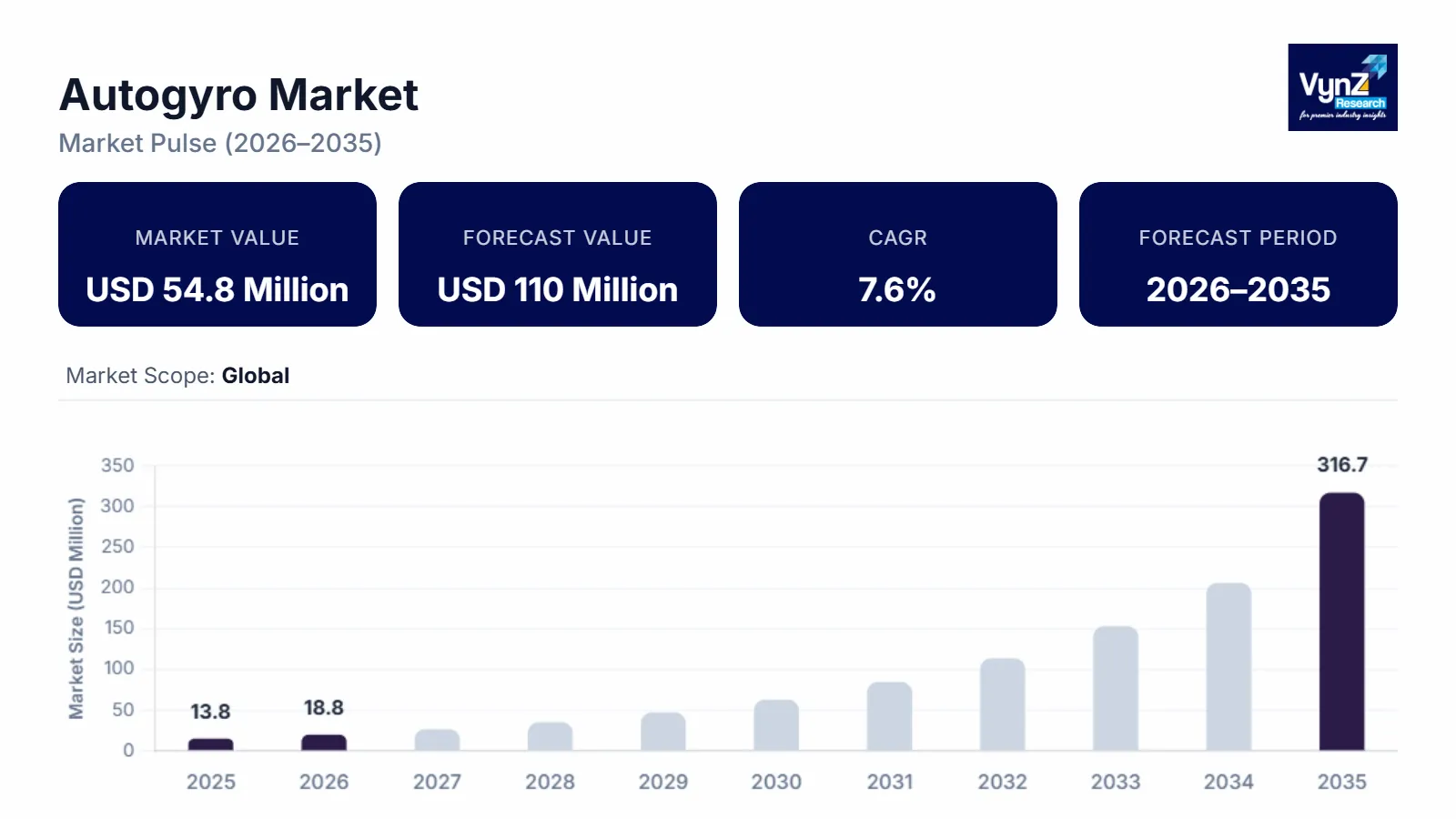
The industry covers single-seat and two-seat gyroplanes, propulsion and rotor components, and aircraft used for recreational flying, training, tourism, and selected operational missions. Demand is influenced by aircraft affordability, pilot training availability, regulatory certification, and improvements in engine performance and flight safety systems. Market growth is influenced by recreational aviation, demand for pilot training, and the development of specialist aircraft for tourism and selected public-sector missions. Regulatory changes also shape the industry's operating environment. The Federal Aviation Administration's Modernization of Special Airworthiness Certification initiative includes phased implementation dates affecting light-sport aircraft certification, while EASA has issued updated gyroplane licensing and operating provisions. These developments may affect aircraft certification pathways, training requirements, and manufacturer access to particular markets, although the commercial impact depends on aircraft category and jurisdiction.
Research Methodology
VynZ Research evaluates the autogyro market through a structured review of published industry estimates, manufacturer disclosures, aviation regulations, aircraft specifications, and regional operating requirements. The VynZ Research team assesses aircraft configurations, component demand, end-use applications, distribution channels, and regional adoption to develop a consistent market framework. Published market values provide a reference baseline, while the proposed forecast incorporates assumptions regarding recreational aviation, flight training, tourism, public-sector applications, and certification developments. Regulatory information from the Federal Aviation Administration and the European Union Aviation Safety Agency is used to assess operating requirements, although regulatory publications do not independently establish market revenue.
Research Highlights
- Two-seatautogyros are estimated to account for 62% of 2025 market revenue supported by recreational flying, training, and passenger-oriented applications.
- Engine components are estimated to represent 34% of 2025 revenue, reflecting the importance of propulsion performance, reliability, and engine configuration in aircraft purchasing.
- Recreational and sport flying is estimated to contribute 55% of 2025 revenue, equivalent to USD 30.14 million, supported by private ownership and leisure aviation.
- Tourism and aerial tour applications are projected to grow at an estimated CAGR of 9.2% from 2026 to 2035, supported by demand for low-altitude sightseeing and specialized flying experiences.
- North America is estimated to account for 34% of 2025 revenue, equivalent to USD 18.63 million, supported by recreational aviation, flight training, and a specialist aircraft manufacturing base.
Autogyro Market Dynamics
Market Trends
The autogyro industry is increasingly focused on improved cockpit comfort, enclosed-cabin designs, engine performance, and additional safety equipment. Manufacturers are differentiating aircraft through seating configuration, avionics, rotor systems, and features intended to support recreational, training, and specialist operational use. Some suppliers also offer kits or builder-assistance programs, providing alternative purchasing routes for customers who do not select a fully factory-built aircraft. Product choice remains closely linked to local certification requirements, pilot experience, intended use, maintenance access, and total ownership costs. Another trend is the growing emphasis on certification and operational compliance.
Growth Drivers
Recreational flying and flight training remain important sources of demand because autogyros offer an alternative to conventional fixed-wing aircraft for selected leisure and instructional applications. Their configuration, visibility, and operating characteristics can appeal to private pilots and specialist flying schools, although suitability depends on the mission, aircraft performance, weather, and applicable regulations. Manufacturers benefit when they can offer reliable aircraft, accessible maintenance, pilot training support, and a clear certification pathway. Growth is likely to vary between countries according to aviation infrastructure, disposable income, flying-club participation, and the availability of qualified instructors. A second driver is demand for aircraft in tourism, observation, and selected public-sector roles.
Market Restraints / Challenges
High purchase costs and ongoing ownership expenses can restrict adoption, particularly among recreational buyers and smaller flying schools. Aircraft acquisition is only one component of total cost, which may also include insurance, hangarage, fuel, maintenance, spare parts, pilot training, and regulatory compliance. Demand can therefore be sensitive to household discretionary spending and the financial position of small aviation operators. Specialist manufacturers also face a relatively limited customer base compared with mass-market aircraft categories, making production volumes, dealer coverage, and component sourcing important factors in cost control. Certification and pilot training requirements create additional challenges because rules differ between jurisdictions and aircraft categories.
Market Opportunities
One opportunity lies in the development of accessible aircraft configurations for flight schools, private owners, and tourism operators. Manufacturers offering clear maintenance documentation, training support, configurable cockpits, and dependable parts supply may be better positioned to reach customers who prioritize ownership practicality. Expansion in recreational aviation and flying-club activity can support demand where local infrastructure and licensing requirements permit. Kit-built and factory-built options may also serve different customer preferences, although their eligibility and operating limitations must be evaluated under the relevant national rules. Further opportunities exist in improved safety systems, advanced engine configurations, and aircraft designed for specialized observation and aerial work.
Global Autogyro Market Report Coverage
|
Report Metric |
Details |
|
Historical Period |
2020 - 2024 |
|
Base Year Considered |
2025 |
|
Forecast Period |
2026 - 2035 |
|
Market Size in 2025 |
USD 54.8 Million |
|
Revenue Forecast in 2035 |
USD 110 Million |
|
Growth Rate |
7.6% |
|
Segments Covered in the Report |
Aircraft Type, Component, Application, End User |
|
Report Scope |
Market Trends, Drivers, and Restraints; Revenue Estimation and Forecast; Segmentation Analysis; Companies’ Strategic Developments; Market Share Analysis of Key Players; Company Profiling |
|
Regions Covered in the Report |
North America, Europe, Asia Pacific, Rest of the World |
|
Key Companies |
Air Command International, AutoGyro, Aviomania Aircraft, Bensen Aircraft Corporation, Celier Aviation, ELA Aviation, Magni Gyro, SilverLight Aviation, Sport Copter, Trixy Aviation |
|
Customization |
Available upon request |
Autogyro Market Segmentation
By Aircraft Type
Two-seat models held the largest share at 62% in 2025, equivalent to USD 33.98 million, reflecting their suitability for dual instruction, recreational passenger flights, and some tourism applications.
Single-seat aircraft are projected to grow at an estimated CAGR of 6.8% from 2026 to 2035, supported by recreational demand and interest in simpler aircraft configurations.
By Component
Engines accounted for 34% of 2025 revenue, equivalent to USD 18.63 million, reflecting their importance to aircraft performance, reliability, and operating costs.
Other components are projected to grow at an estimated CAGR of 8.4% from 2026 to 2035, supported by avionics upgrades, cockpit improvements, and safety-related equipment.
By Application
Recreational and sport flying represented 55% of the market in 2025, equivalent to USD 30.14 million, making it the largest application category. Demand is supported by private ownership, leisure flying, and flying-club activities.
Tourism and aerial tours are projected to register an estimated CAGR of 9.2% from 2026 to 2035, due to sightseeing applications and specialist operators seeking distinctive low-altitude flight experiences.
By End User
Private owners accounted for 58% of 2025 revenue, equivalent to USD 31.78 million, reflecting the role of recreational aviation in the autogyro market.
Commercial operators are projected to grow at an estimated CAGR of 8.9% from 2026 to 2035, supported by tourism and specialist operational requirements.
Regional Insights
North America
North America is estimated to account for 34% of the autogyro market in 2025, equivalent to USD 18.63 million. The region benefits from recreational aviation, flight training, specialist manufacturers, and demand for aircraft used in selected aerial activities. The United States is an important market for manufacturers and kit suppliers, while aviation clubs and private operators contribute to demand. The FAA's MOSAIC program introduces changes to light-sport aircraft certification and related operating requirements, creating a relevant regulatory context for manufacturers planning compliant aircraft configurations.
Europe
Europe is estimated to represent 29% of the market in 2025, equivalent to USD 15.89 million. Germany, Italy, Spain, and other European aviation markets have established gyroplane manufacturers and specialist operators. The presence of companies such as AutoGyro, Magni Gyro, and ELA Aviation supports the region's manufacturing and product-development base. EASA has established airworthiness specifications for gyroplanes and updated relevant licensing and operating provisions, making regulatory compliance an important factor in regional production and sales.
Asia Pacific
Asia Pacific is estimated to account for 22% of 2025 revenue, equivalent to USD 12.06 million. The region includes markets with differing levels of recreational aviation infrastructure, pilot training capacity, and regulatory readiness. Demand may develop through flight schools, private aviation, tourism, and selected aerial work applications, although market maturity varies considerably by country. The introduction of a dedicated gyroplane pilot-training framework by India's Directorate General of Civil Aviation in 2026 represents a relevant regulatory development for the potential establishment of training and operational activity.
Rest of the World
The rest of the world is estimated to contribute 15% of market revenue in 2025, equivalent to USD 8.22 million. This category includes Latin America, the Middle East, and Africa, where demand is influenced by recreational aviation, tourism, specialist aircraft operations, and access to pilot training. Selected public-sector deployments demonstrate potential use beyond private flying, although the suitability of autogyros varies according to mission requirements, operating conditions, and local aviation rules. Manufacturer-reported deliveries to public agencies illustrate these applications without establishing the overall size of the regional market.
Competitive Landscape / Company Insights
The autogyro market is served by specialist manufacturers including AutoGyro, Magni Gyro, ELA Aviation, SilverLight Aviation, and smaller kit and aircraft suppliers. Competition centers on aircraft configuration, engine performance, safety features, certification, manufacturing quality, and after-sales support. The FAA's light-sport certification changes and EASA's gyroplane licensing provisions influence product development and access to regulated markets. Manufacturers are also differentiating their offerings through enclosed cockpits, upgraded engines, and factory-built configurations, while smaller suppliers continue to target recreational and specialist customers.
Mini Profiles
AutoGyro develops gyroplanes for recreational, training, and specialist applications, with a broad model range and an international distribution network.
Bensen Aircraft Corporation is associated with compact gyroplane designs and kit-oriented aircraft development, serving specialist builders and recreational aviation enthusiasts.
Celier Aviation produces gyroplanes and aircraft kits, with a focus on lightweight configurations and recreational flying applications.
Flight Design operates in the light-aircraft sector, with expertise in aircraft design and production relevant to the broader recreational aviation market.
Trixy Aviation develops gyroplane models with different cockpit configurations and equipment options, targeting private pilots and specialist recreational users.
Key Players
- Air Command International
- AutoGyro GmbH
- Aviomania Aircraft
- Bensen Aircraft Corporation
- Celier Aviation
- ELA Aviation
- Magni Gyro
- SilverLight Aviation
- Sport Copter
- Trixy Aviation
Recent Developments
ELA Aviation continued to advance its Eclipse REVO gyroplane, featuring a carbon-composite airframe and a system designed for very short takeoff distances. A 2026 industry report also described collaboration with MEL Composites to optimize lightweight composite structures and manufacturing processes.
Magni Gyro reported production of its 1,600th gyroplane, marking a manufacturing milestone for the Italian specialist. The company also announced type approval for the M16 914, M24 914, and M24 915 models in Georgia, supporting their registration and operation in that market.
SilverLight Aviation announced that its AR-1 would be offered as a factory-built gyroplane designed to comply with MOSAIC and ASTM standards. The company stated that it had begun taking orders for the configuration, with initial deliveries scheduled for late 2026.
Air Command International presented its Integrity gyroplane featuring a 100 hp Polaris engine at EAA AirVenture 2026. The company reported that the project had been in development for seven years and planned test flights for September 2026.
Global Autogyro Market Coverage
Aircraft Type Insight and Forecast 2026 - 2035
- Single-seat autogyros
- Two-seat autogyros
Component Insight and Forecast 2026 - 2035
- Engines
- Rotor systems
- Propellers
- Other components
Application Insight and Forecast 2026 - 2035
- Recreational and sport flying
- Flight training
- Tourism and aerial tours
- Aerial work and public safety
End User Insight and Forecast 2026 - 2035
- Private owners
- Flight schools
- Commercial operators
- Government and public agencies
Global Autogyro Market by Region
- North America
- By Aircraft Type
- By Component
- By Application
- By End User
- By Country - U.S., Canada, Mexico
- Europe
- By Aircraft Type
- By Component
- By Application
- By End User
- By Country - Germany, U.K., France, Italy, Spain, Russia, Rest of Europe
- Asia-Pacific (APAC)
- By Aircraft Type
- By Component
- By Application
- By End User
- By Country - China, Japan, India, South Korea, Vietnam, Thailand, Malaysia, Rest of Asia-Pacific
- Rest of the World (RoW)
- By Aircraft Type
- By Component
- By Application
- By End User
- By Country - Brazil, Saudi Arabia, South Africa, U.A.E., Other Countries
Table of Contents for Autogyro Market Report
1. Research Overview
1.1. The Report Offers
1.2. Market Coverage
1.2.1. By
Aircraft Type
1.2.2. By
Component
1.2.3. By
Application
1.2.4. By
End User
1.3. Research Phases
1.4. Limitations
1.5. Market Methodology
1.5.1. Data Sources
1.5.1.1.
Primary Research
1.5.1.2.
Secondary Research
1.5.2. Methodology
1.5.2.1.
Data Exploration
1.5.2.2.
Forecast Parameters
1.5.2.3.
Data Validation
1.5.2.4.
Assumptions
1.5.3. Study Period & Data Reporting Unit
2. Executive Summary
3. Industry Overview
3.1. Industry Dynamics
3.1.1. Market Growth Drivers
3.1.2. Market Restraints
3.1.3. Key Market Trends
3.1.4. Major Opportunities
3.2. Industry Ecosystem
3.2.1. Porter’s Five Forces Analysis
3.2.2. Recent Development Analysis
3.2.3. Value Chain Analysis
3.3. Competitive Insight
3.3.1. Competitive Position of Industry
Players
3.3.2. Market Attractive Analysis
3.3.3. Market Share Analysis
4. Global Market Estimate and Forecast
4.1. Global Market Overview
4.2. Global Market Estimate and Forecast to 2035
5. Market Segmentation Estimate and Forecast
5.1. By Aircraft Type
5.1.1. Single-seat autogyros
5.1.1.1. Market Definition
5.1.1.2. Market Estimation and Forecast to 2035
5.1.2. Two-seat autogyros
5.1.2.1. Market Definition
5.1.2.2. Market Estimation and Forecast to 2035
5.2. By Component
5.2.1. Engines
5.2.1.1. Market Definition
5.2.1.2. Market Estimation and Forecast to 2035
5.2.2. Rotor systems
5.2.2.1. Market Definition
5.2.2.2. Market Estimation and Forecast to 2035
5.2.3. Propellers
5.2.3.1. Market Definition
5.2.3.2. Market Estimation and Forecast to 2035
5.2.4. Other components
5.2.4.1. Market Definition
5.2.4.2. Market Estimation and Forecast to 2035
5.3. By Application
5.3.1. Recreational and sport flying
5.3.1.1. Market Definition
5.3.1.2. Market Estimation and Forecast to 2035
5.3.2. Flight training
5.3.2.1. Market Definition
5.3.2.2. Market Estimation and Forecast to 2035
5.3.3. Tourism and aerial tours
5.3.3.1. Market Definition
5.3.3.2. Market Estimation and Forecast to 2035
5.3.4. Aerial work and public safety
5.3.4.1. Market Definition
5.3.4.2. Market Estimation and Forecast to 2035
5.4. By End User
5.4.1. Private owners
5.4.1.1. Market Definition
5.4.1.2. Market Estimation and Forecast to 2035
5.4.2. Flight schools
5.4.2.1. Market Definition
5.4.2.2. Market Estimation and Forecast to 2035
5.4.3. Commercial operators
5.4.3.1. Market Definition
5.4.3.2. Market Estimation and Forecast to 2035
5.4.4. Government and public agencies
5.4.4.1. Market Definition
5.4.4.2. Market Estimation and Forecast to 2035
6. North America Market Estimate and Forecast
6.1. By
Aircraft Type
6.2. By
Component
6.3. By
Application
6.4. By
End User
6.4.1.
U.S. Market Estimate and Forecast
6.4.2.
Canada Market Estimate and Forecast
6.4.3.
Mexico Market Estimate and Forecast
7. Europe Market Estimate and Forecast
7.1. By
Aircraft Type
7.2. By
Component
7.3. By
Application
7.4. By
End User
7.4.1.
Germany Market Estimate and Forecast
7.4.2.
France Market Estimate and Forecast
7.4.3.
U.K. Market Estimate and Forecast
7.4.4.
Italy Market Estimate and Forecast
7.4.5.
Spain Market Estimate and Forecast
7.4.6.
Russia Market Estimate and Forecast
7.4.7.
Rest of Europe Market Estimate and Forecast
8. Asia-Pacific (APAC) Market Estimate and Forecast
8.1. By
Aircraft Type
8.2. By
Component
8.3. By
Application
8.4. By
End User
8.4.1.
China Market Estimate and Forecast
8.4.2.
Japan Market Estimate and Forecast
8.4.3.
India Market Estimate and Forecast
8.4.4.
South Korea Market Estimate and Forecast
8.4.5.
Rest of Asia-Pacific Market Estimate and Forecast
9. Rest of the World (RoW) Market Estimate and Forecast
9.1. By
Aircraft Type
9.2. By
Component
9.3. By
Application
9.4. By
End User
9.4.1.
Brazil Market Estimate and Forecast
9.4.2.
Saudi Arabia Market Estimate and Forecast
9.4.3.
South Africa Market Estimate and Forecast
9.4.4.
U.A.E. Market Estimate and Forecast
9.4.5.
Other Countries Market Estimate and Forecast
10. Company Profiles
10.1.
Air Command International
10.1.1.
Snapshot
10.1.2.
Overview
10.1.3.
Offerings
10.1.4.
Financial
Insight
10.1.5.
Recent
Developments
10.2.
AutoGyro GmbH
10.2.1.
Snapshot
10.2.2.
Overview
10.2.3.
Offerings
10.2.4.
Financial
Insight
10.2.5.
Recent
Developments
10.3.
Aviomania Aircraft
10.3.1.
Snapshot
10.3.2.
Overview
10.3.3.
Offerings
10.3.4.
Financial
Insight
10.3.5.
Recent
Developments
10.4.
Bensen Aircraft Corporation
10.4.1.
Snapshot
10.4.2.
Overview
10.4.3.
Offerings
10.4.4.
Financial
Insight
10.4.5.
Recent
Developments
10.5.
Celier Aviation
10.5.1.
Snapshot
10.5.2.
Overview
10.5.3.
Offerings
10.5.4.
Financial
Insight
10.5.5.
Recent
Developments
10.6.
ELA Aviation
10.6.1.
Snapshot
10.6.2.
Overview
10.6.3.
Offerings
10.6.4.
Financial
Insight
10.6.5.
Recent
Developments
10.7.
Magni Gyro
10.7.1.
Snapshot
10.7.2.
Overview
10.7.3.
Offerings
10.7.4.
Financial
Insight
10.7.5.
Recent
Developments
10.8.
SilverLight Aviation
10.8.1.
Snapshot
10.8.2.
Overview
10.8.3.
Offerings
10.8.4.
Financial
Insight
10.8.5.
Recent
Developments
10.9.
Sport Copter
10.9.1.
Snapshot
10.9.2.
Overview
10.9.3.
Offerings
10.9.4.
Financial
Insight
10.9.5.
Recent
Developments
10.10.
Trixy Aviation
10.10.1.
Snapshot
10.10.2.
Overview
10.10.3.
Offerings
10.10.4.
Financial
Insight
10.10.5.
Recent
Developments
11. Appendix
11.1. Exchange Rates
11.2. Abbreviations
Note: Financial insight and recent developments of different companies are subject to the availability of information in the secondary domain.
Frequently Asked Questions
Purchase Options
Latest Report
Research Methodology
- Desk Research / Pilot Interviews
- Build Market Size Model
- Research and Analysis
- Final Deliverable
Connect With Our Sales Team
- Toll-Free: +1-888-253-3960
- Phone: +91 9960 288 381
- Email: enquiry@vynzresearch.com
Autogyro Market