
Autonomous Mobile Manipulator Robots Market Size & Share Growth Forecast Report (2026-2035)
Industry Insight by System Type (Differential, Omnidirectional), by Application (Material handling and transportation, Assembly, Welding, Machine tending and inspection, Automobile inspection), by Payload Capacity (Below 10 kg, 10–20 kg, Above 20 kg), by End Use (Manufacturing, Logistics and warehousing, Automotive, Electronics, Healthcare and research)
| Status : Published | Published On : Nov, 2026 | Report Code : VRICT5253 | Industry : ICT & Media | Available Format :

|
Page : 165 |
Autonomous Mobile Manipulator Robots Market Overview
The global autonomous mobile manipulator robots market is estimated at USD 591 million in 2025 and USD 739 million in 2026, with projections indicating approximately USD 5510 million by 2035, reflecting an estimated 25% CAGR from 2026 to 2035.
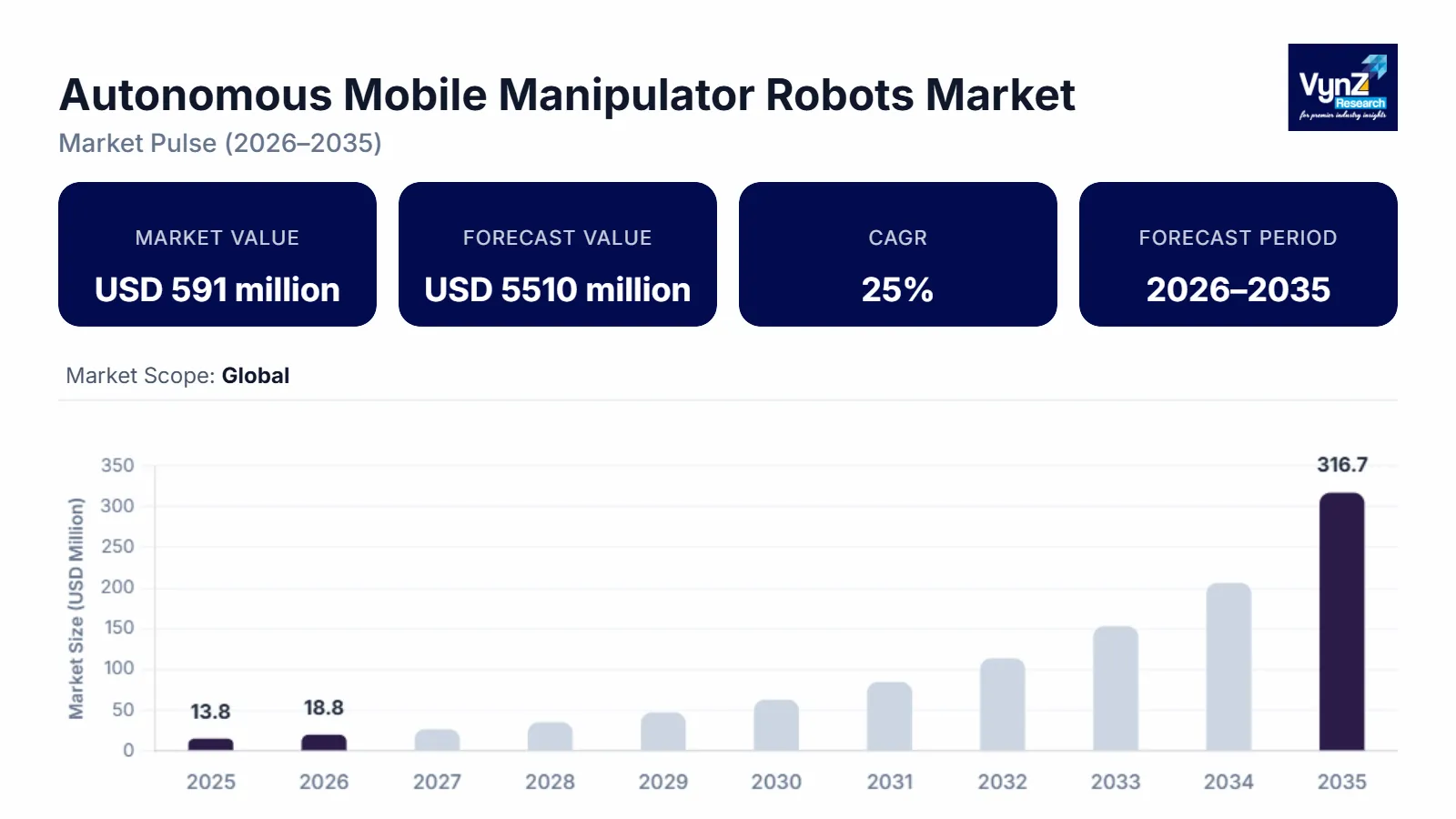
Market growth is driven by increasing factory automation, demand for flexible material handling, and advances in machine vision, artificial intelligence, and autonomous navigation. Rising adoption across automotive manufacturing, electronics, warehousing, and machine tending is encouraging investment in mobile platforms capable of transporting materials and executing manipulation tasks within a single system. The International Federation of Robotics reported more than 600,000 new industrial robot installations worldwide in 2025, while its 2025 report recorded 542,000 installations in 2024, highlighting the scale of industrial automation supporting adjacent robotics markets.
Research Methodology
VynZ Research applies a structured methodology combining secondary research, company disclosures, product announcements, industry statistics, and comparative market assessment. The VynZ Research team evaluates market definitions, technology adoption, application patterns, regional demand, competitive positioning, and expected investment in industrial automation. Published market estimates are reviewed against available historical figures and forecast assumptions before developing the report's estimates for 2025, 2026, and 2035. Where direct segment-level revenue data are unavailable, estimates are treated as analytical approximations rather than independently verified statistics. The methodology also considers the limitations of comparing autonomous mobile manipulators with broader autonomous mobile robot and industrial robotics categories.
Research Highlights
- The differential system type segment is estimated to account for approximately 58.2% of the market in 2025, supported by its established use in industrial transport and material handling applications.
- The assembly application segment is estimated to represent approximately 31.6% of market revenue in 2025, reflecting demand for flexible automation in manufacturing operations and repetitive workstation tasks.
- The 10–20 kg payload capacity segment is estimated to hold approximately 34.2% of the market in 2025, supported by its suitability for handling components and materials across electronics and light industrial applications.
- The omnidirectional system type segment is estimated to register a 26.4% CAGR from 2026 to 2035, supported by demand for improved maneuverability in congested production environments.
- Asia Pacific is estimated to account for approximately 40% of market revenue in 2025, supported by its manufacturing base and substantial industrial robot adoption.
Autonomous Mobile Manipulator Robots Market Dynamics
Market Trends
The autonomous mobile manipulator robots industry is moving toward integrated systems that combine autonomous navigation, robotic arms, machine vision, and intelligent task planning. Manufacturers increasingly seek equipment capable of moving between workstations, handling components, and performing repetitive operations without requiring fixed robotic installations at every location. The integration of visual simultaneous localization and mapping, or Visual SLAM, is also improving navigation flexibility. Another emerging trend is the development of systems with improved perception and manipulation capabilities, allowing robots to work with changing product layouts and less structured environments. Advances in force sensing, camera-based object recognition, and artificial intelligence are increasing the range of tasks that mobile manipulators can perform.
Growth Drivers
The growth of the autonomous mobile manipulator robots market is largely supported by increasing demand for manufacturing flexibility and automated material handling. Automotive, electronics, and machinery producers require systems that can transport components between workstations while performing activities such as picking, loading, inspection, and machine tending. Combining mobility with manipulation can reduce separate handling stages and improve equipment utilization, particularly in facilities where product configurations and production schedules change frequently. The continued expansion of industrial robotics provides a supportive adoption environment, although demand for mobile manipulators remains distinct from demand for conventional fixed industrial robots. Additionally, labor availability, workplace safety requirements, and the need for consistent production throughput are encouraging companies to automate repetitive internal logistics and handling operations.
Market Restraints / Challenges
Despite favorable growth prospects, the autonomous mobile manipulator robots market faces implementation costs and integration complexity that may restrict adoption among smaller manufacturers. A deployment can require a mobile base, robotic arm, gripper, perception sensors, safety equipment, fleet management software, and integration with existing production systems. The total investment also depends on payload requirements, reach, operating speed, environmental conditions, and the number of tasks being automated. Furthermore, reliable coordination between navigation and manipulation remains a technical challenge, particularly in facilities with narrow aisles, moving personnel, uneven floor conditions, or frequently changing work areas. Inadequate integration can lead to delays, inaccurate positioning, and additional commissioning requirements. Businesses also need trained personnel for programming, preventive maintenance, safety validation, and troubleshooting.
Market Opportunities
The market presents significant opportunities in flexible manufacturing, where producers require automation that can be relocated as production lines and product requirements change. Mobile manipulators can connect transport and handling functions across multiple workstations, creating potential applications in component feeding, machine tending, quality inspection, and assembly support. Modular robotic arms, interchangeable end effectors, and adaptable navigation software can improve the usefulness of a single platform across several operations. Suppliers that simplify deployment and offer reliable integration with existing manufacturing systems may benefit as automation expands beyond large, highly standardized production facilities. Another opportunity lies in logistics, electronics manufacturing, laboratory operations, and smaller production environments where conventional fixed automation may be difficult to justify. Improvements in perception, force sensing, and autonomous decision making can enable mobile manipulators to work with a broader range of objects and operating conditions. Research and commercial developments in embodied artificial intelligence are also creating opportunities for more adaptive robotic systems.
Global Autonomous Mobile Manipulator Robots Market Report Coverage
|
Report Metric |
Details |
|
Historical Period |
2020 - 2024 |
|
Base Year Considered |
2025 |
|
Forecast Period |
2026 - 2035 |
|
Market Size in 2025 |
USD 591 Million |
|
Revenue Forecast in 2035 |
USD 5510 Million |
|
Growth Rate |
25% |
|
Segments Covered in the Report |
System Type, Application, Payload Capacity, End Use |
|
Report Scope |
Market Trends, Drivers, and Restraints; Revenue Estimation and Forecast; Segmentation Analysis; Companies’ Strategic Developments; Market Share Analysis of Key Players; Company Profiling |
|
Regions Covered in the Report |
North America, Europe, Asia Pacific, Rest of the World |
|
Key Companies |
ABB, AgileX Robotics, Boston Dynamics, Clearpath Robotics, Doosan Robotics, Flexiv, Hyundai Robotics, KUKA AG, OMRON Corporation, The Mobile Robot Company |
|
Customization |
Available upon request |
Autonomous Mobile Manipulator Robots Market Segmentation
By System Type
The differential-drive system segment is estimated to account for approximately 58.2% of market revenue in 2025, supported by its relatively simple mechanical design, cost efficiency, and suitability for indoor industrial environments.
Omnidirectional mobile manipulator systems are expected to record a CAGR of 26.4% from 2026 to 2035, driven by demand for greater maneuverability in compact production areas and congested industrial workspaces.
By Application
The assembly application segment is estimated to account for approximately 31.6% of market revenue in 2025, reflecting demand for automated component delivery, workstation support, and repetitive handling tasks in manufacturing environments.
Machine tending applications are projected to register a CAGR of 26.2% from 2026 to 2035, as manufacturers seek to connect material transport with repetitive operational tasks. These activities can benefit from autonomous positioning, object recognition, and coordinated arm movements, particularly when components must move between several work areas or be loaded into and removed from machines.
By Payload Capacity
The 10–20 kg payload capacity segment is estimated to represent approximately 34.2% of market revenue in 2025, reflecting its suitability for transporting and manipulating components used in manufacturing, assembly, and intralogistics operations.
Mobile manipulators with payload capacities above 20 kg are expected to record a CAGR of 25.8% from 2026 to 2035, supported by applications involving heavier components, larger containers, and more demanding material-handling tasks.
By End Use
The logistics end-use segment is estimated to account for approximately 38.4% of market revenue in 2025, supported by the need to move goods, containers, and components between storage areas, picking zones, and operational workstations.
The manufacturing end-use segment is projected to register a CAGR of 25.6% from 2026 to 2035, as factories increasingly seek flexible automation across production lines and work areas.
Regional Insights
North America
North America is estimated to account for approximately 21% of the autonomous mobile manipulator robots market in 2025, supported by industrial automation investment, advanced manufacturing capabilities, and demand for flexible material handling. The United States represents a major potential adoption market because automotive, electronics, and logistics operators require automation that can accommodate changing production requirements. The International Federation of Robotics reported that industrial robot installations in the United States increased by 12% in 2025, indicating continued investment in manufacturing automation, although this figure does not measure mobile manipulators separately.
Europe
Europe is estimated to account for approximately 18% of the market in 2025, supported by established industrial automation capabilities, engineering expertise, and demand for flexible production systems. Germany remains an important manufacturing center, while France, Italy, and other European economies provide additional opportunities across automotive, machinery, electronics, and industrial logistics. The International Federation of Robotics reported that Europe recorded approximately 85,000 industrial robot installations in 2024, demonstrating the region's substantial industrial automation base.
Asia Pacific
Asia Pacific is estimated to account for approximately 40% of market revenue in 2025, making it the largest regional market. Its position is supported by extensive manufacturing activity, electronics production, automotive supply chains, and continued investment in industrial automation. The International Federation of Robotics reported that Asia accounted for 74% of new industrial robot installations in 2024, with China alone representing 54% of worldwide deployments that year. These figures provide evidence of the region's manufacturing and automation strength, although they refer to industrial robots overall rather than autonomous mobile manipulators specifically.
Rest of the World
The Rest of the World region is estimated to account for the remaining 21% of market revenue in 2025, covering Latin America, the Middle East, and Africa. Adoption opportunities arise from industrial modernization automotive production, logistics development, and investment in manufacturing infrastructure. Brazil and Mexico provide potential demand across industrial and automotive applications, while selected Middle Eastern economies are investing in logistics and industrial diversification. The regional estimate combines markets with differing levels of automation maturity, infrastructure readiness, and access to specialist robotics integration services.
Competitive Landscape / Company Insights
The autonomous mobile manipulator robots market is characterized by established industrial automation suppliers, mobile robotics specialists, and companies developing adaptive robotic platforms. Competition centers on navigation accuracy, manipulation performance, payload capacity, software integration, safety, and ease of deployment. ABB, OMRON, KUKA, and other established automation companies offer capabilities relevant to integrated mobile systems, while specialized developers are expanding the range of mobile platforms and manipulation technologies. Product development increasingly focuses on AI-enabled navigation, flexible programming, and broader application suitability.
Mini Profiles
ABB develops industrial automation and mobile robotics technologies, including autonomous mobile platforms with AI-enabled navigation and programming tools for manufacturing and intralogistics applications.
Boston Dynamics develops advanced robotic systems combining mobility, perception, and manipulation, with research into autonomous whole-body behaviors supporting more complex robotic tasks.
Clearpath Robotics supplies mobile robotic platforms and research systems that support autonomous navigation, industrial development, and robotic application testing.
Doosan Robotics develops collaborative robotic arms and intelligent automation solutions, with growing investment in AI-enabled robotics and integrated industrial applications.
Flexiv develops adaptive robots with force sensing and advanced manipulation capabilities, targeting manufacturing applications that require controlled interaction with objects and equipment.
Key Players
- ABB
- AgileX
- Robotics
- Boston Dynamics
- Clearpath Robotics
- Doosan Robotics
- Flexiv
- Hyundai Robotics
- KUKA AG
- OMRON Corporation
- The Mobile Robot Company
Recent Developments
AgileX Robotics expanded its embodied AI portfolio in 2025 with additional mobile robotics and manipulation technologies, including the Pika data collection solution and updated mobile platforms. In 2026, the company introduced Pika Pro to support robot data collection for manipulation research and further extended its international presence.
Hyundai unveiled MobED as a production-ready autonomous mobility platform at the International Robot Exhibition in 2025. The company announced plans for the MobED Pro and MobED Basic models to become available for sale in the first half of 2026.
KUKA AG introduced the KMR iisy CR autonomous mobile robot variant for cleanroom applications in 2025, targeting semiconductor and electronics manufacturing environments. The system is designed for applications requiring mobile automation and compliance with stringent cleanroom requirements.
OMRON Corporation introduced the OL-450S autonomous mobile robot in 2025, adding an omnidirectional material handling platform with an integrated lifting plate and a 450 kg payload capacity. The system targets applications including automotive, electronics, medical, and other industrial environments requiring automated transport.
The Mobile Robot Company launched the J1600 as its first product in 2026, following a market launch in 2025. The autonomous pallet jack is designed for indoor pallet transport and offers both manual operation and autonomous movement between saved locations.
Global Autonomous Mobile Manipulator Robots Market Coverage
System Type Insight and Forecast 2026 - 2035
- Differential
- Omnidirectional
Application Insight and Forecast 2026 - 2035
- Material handling and transportation
- Assembly
- Welding
- Machine tending and inspection
- Automobile inspection
Payload Capacity Insight and Forecast 2026 - 2035
- Below 10 kg
- 10–20 kg
- Above 20 kg
End Use Insight and Forecast 2026 - 2035
- Manufacturing
- Logistics and warehousing
- Automotive
- Electronics
- Healthcare and research
Global Autonomous Mobile Manipulator Robots Market by Region
- North America
- By System Type
- By Application
- By Payload Capacity
- By End Use
- By Country - U.S., Canada, Mexico
- Europe
- By System Type
- By Application
- By Payload Capacity
- By End Use
- By Country - Germany, U.K., France, Italy, Spain, Russia, Rest of Europe
- Asia-Pacific (APAC)
- By System Type
- By Application
- By Payload Capacity
- By End Use
- By Country - China, Japan, India, South Korea, Vietnam, Thailand, Malaysia, Rest of Asia-Pacific
- Rest of the World (RoW)
- By System Type
- By Application
- By Payload Capacity
- By End Use
- By Country - Brazil, Saudi Arabia, South Africa, U.A.E., Other Countries
Table of Contents for Autonomous Mobile Manipulator Robots Market Report
1. Research Overview
1.1. The Report Offers
1.2. Market Coverage
1.2.1. By
System Type
1.2.2. By
Application
1.2.3. By
Payload Capacity
1.2.4. By
End Use
1.3. Research Phases
1.4. Limitations
1.5. Market Methodology
1.5.1. Data Sources
1.5.1.1.
Primary Research
1.5.1.2.
Secondary Research
1.5.2. Methodology
1.5.2.1.
Data Exploration
1.5.2.2.
Forecast Parameters
1.5.2.3.
Data Validation
1.5.2.4.
Assumptions
1.5.3. Study Period & Data Reporting Unit
2. Executive Summary
3. Industry Overview
3.1. Industry Dynamics
3.1.1. Market Growth Drivers
3.1.2. Market Restraints
3.1.3. Key Market Trends
3.1.4. Major Opportunities
3.2. Industry Ecosystem
3.2.1. Porter’s Five Forces Analysis
3.2.2. Recent Development Analysis
3.2.3. Value Chain Analysis
3.3. Competitive Insight
3.3.1. Competitive Position of Industry
Players
3.3.2. Market Attractive Analysis
3.3.3. Market Share Analysis
4. Global Market Estimate and Forecast
4.1. Global Market Overview
4.2. Global Market Estimate and Forecast to 2035
5. Market Segmentation Estimate and Forecast
5.1. By System Type
5.1.1. Differential
5.1.1.1. Market Definition
5.1.1.2. Market Estimation and Forecast to 2035
5.1.2. Omnidirectional
5.1.2.1. Market Definition
5.1.2.2. Market Estimation and Forecast to 2035
5.2. By Application
5.2.1. Material handling and transportation
5.2.1.1. Market Definition
5.2.1.2. Market Estimation and Forecast to 2035
5.2.2. Assembly
5.2.2.1. Market Definition
5.2.2.2. Market Estimation and Forecast to 2035
5.2.3. Welding
5.2.3.1. Market Definition
5.2.3.2. Market Estimation and Forecast to 2035
5.2.4. Machine tending and inspection
5.2.4.1. Market Definition
5.2.4.2. Market Estimation and Forecast to 2035
5.2.5. Automobile inspection
5.2.5.1. Market Definition
5.2.5.2. Market Estimation and Forecast to 2035
5.3. By Payload Capacity
5.3.1. Below 10 kg
5.3.1.1. Market Definition
5.3.1.2. Market Estimation and Forecast to 2035
5.3.2. 10–20 kg
5.3.2.1. Market Definition
5.3.2.2. Market Estimation and Forecast to 2035
5.3.3. Above 20 kg
5.3.3.1. Market Definition
5.3.3.2. Market Estimation and Forecast to 2035
5.4. By End Use
5.4.1. Manufacturing
5.4.1.1. Market Definition
5.4.1.2. Market Estimation and Forecast to 2035
5.4.2. Logistics and warehousing
5.4.2.1. Market Definition
5.4.2.2. Market Estimation and Forecast to 2035
5.4.3. Automotive
5.4.3.1. Market Definition
5.4.3.2. Market Estimation and Forecast to 2035
5.4.4. Electronics
5.4.4.1. Market Definition
5.4.4.2. Market Estimation and Forecast to 2035
5.4.5. Healthcare and research
5.4.5.1. Market Definition
5.4.5.2. Market Estimation and Forecast to 2035
6. North America Market Estimate and Forecast
6.1. By
System Type
6.2. By
Application
6.3. By
Payload Capacity
6.4. By
End Use
6.4.1.
U.S. Market Estimate and Forecast
6.4.2.
Canada Market Estimate and Forecast
6.4.3.
Mexico Market Estimate and Forecast
7. Europe Market Estimate and Forecast
7.1. By
System Type
7.2. By
Application
7.3. By
Payload Capacity
7.4. By
End Use
7.4.1.
Germany Market Estimate and Forecast
7.4.2.
France Market Estimate and Forecast
7.4.3.
U.K. Market Estimate and Forecast
7.4.4.
Italy Market Estimate and Forecast
7.4.5.
Spain Market Estimate and Forecast
7.4.6.
Russia Market Estimate and Forecast
7.4.7.
Rest of Europe Market Estimate and Forecast
8. Asia-Pacific (APAC) Market Estimate and Forecast
8.1. By
System Type
8.2. By
Application
8.3. By
Payload Capacity
8.4. By
End Use
8.4.1.
China Market Estimate and Forecast
8.4.2.
Japan Market Estimate and Forecast
8.4.3.
India Market Estimate and Forecast
8.4.4.
South Korea Market Estimate and Forecast
8.4.5.
Rest of Asia-Pacific Market Estimate and Forecast
9. Rest of the World (RoW) Market Estimate and Forecast
9.1. By
System Type
9.2. By
Application
9.3. By
Payload Capacity
9.4. By
End Use
9.4.1.
Brazil Market Estimate and Forecast
9.4.2.
Saudi Arabia Market Estimate and Forecast
9.4.3.
South Africa Market Estimate and Forecast
9.4.4.
U.A.E. Market Estimate and Forecast
9.4.5.
Other Countries Market Estimate and Forecast
10. Company Profiles
10.1.
ABB
10.1.1.
Snapshot
10.1.2.
Overview
10.1.3.
Offerings
10.1.4.
Financial
Insight
10.1.5.
Recent
Developments
10.2.
AgileX Robotics
10.2.1.
Snapshot
10.2.2.
Overview
10.2.3.
Offerings
10.2.4.
Financial
Insight
10.2.5.
Recent
Developments
10.3.
Boston Dynamics
10.3.1.
Snapshot
10.3.2.
Overview
10.3.3.
Offerings
10.3.4.
Financial
Insight
10.3.5.
Recent
Developments
10.4.
Clearpath Robotics
10.4.1.
Snapshot
10.4.2.
Overview
10.4.3.
Offerings
10.4.4.
Financial
Insight
10.4.5.
Recent
Developments
10.5.
Doosan Robotics
10.5.1.
Snapshot
10.5.2.
Overview
10.5.3.
Offerings
10.5.4.
Financial
Insight
10.5.5.
Recent
Developments
10.6.
Flexiv
10.6.1.
Snapshot
10.6.2.
Overview
10.6.3.
Offerings
10.6.4.
Financial
Insight
10.6.5.
Recent
Developments
10.7.
Hyundai Robotics
10.7.1.
Snapshot
10.7.2.
Overview
10.7.3.
Offerings
10.7.4.
Financial
Insight
10.7.5.
Recent
Developments
10.8.
KUKA AG
10.8.1.
Snapshot
10.8.2.
Overview
10.8.3.
Offerings
10.8.4.
Financial
Insight
10.8.5.
Recent
Developments
10.9.
OMRON Corporation
10.9.1.
Snapshot
10.9.2.
Overview
10.9.3.
Offerings
10.9.4.
Financial
Insight
10.9.5.
Recent
Developments
10.10.
The Mobile Robot Company
10.10.1.
Snapshot
10.10.2.
Overview
10.10.3.
Offerings
10.10.4.
Financial
Insight
10.10.5.
Recent
Developments
11. Appendix
11.1. Exchange Rates
11.2. Abbreviations
Note: Financial insight and recent developments of different companies are subject to the availability of information in the secondary domain.
Frequently Asked Questions
Purchase Options
Latest Report
Research Methodology
- Desk Research / Pilot Interviews
- Build Market Size Model
- Research and Analysis
- Final Deliverable
Connect With Our Sales Team
- Toll-Free: +1-888-253-3960
- Phone: +91 9960 288 381
- Email: enquiry@vynzresearch.com
Autonomous Mobile Manipulator Robots Market