
Digital Publishing Market Size & Share Growth Forecast Report (2026-2035)
Industry Insight by Publishing Type (eBooks and Digital Books, Digital Journals, Digital Magazines, Digital News Publishing, Learning and Courseware Publishing, Others), by Format (eBooks, PDF, Audio Publishing), by Enterprise Type (Large Enterprises, Small Enterprises & Medium-Sized Enterprises), by End User (Individual Consumers, Students, Educators and Trainers, Academic and Research Users), by Region (North America, Europe, Asia Pacific, South America, Middle East & Africa)
| Status : Published | Published On : Sep, 2026 | Report Code : VRICT5244 | Industry : ICT & Media | Available Format :

|
Page : 145 |
Digital Publishing Market Overview
The global digital publishing market size was estimated at USD 163.84 billion in 2025 and is expected to increase to USD 173.21 billion in 2026. The market is projected to grow at a CAGR of approximately 6.4% during the forecast period 2026 to 2035, and is expected to reach USD 297.75 billion by 2035.
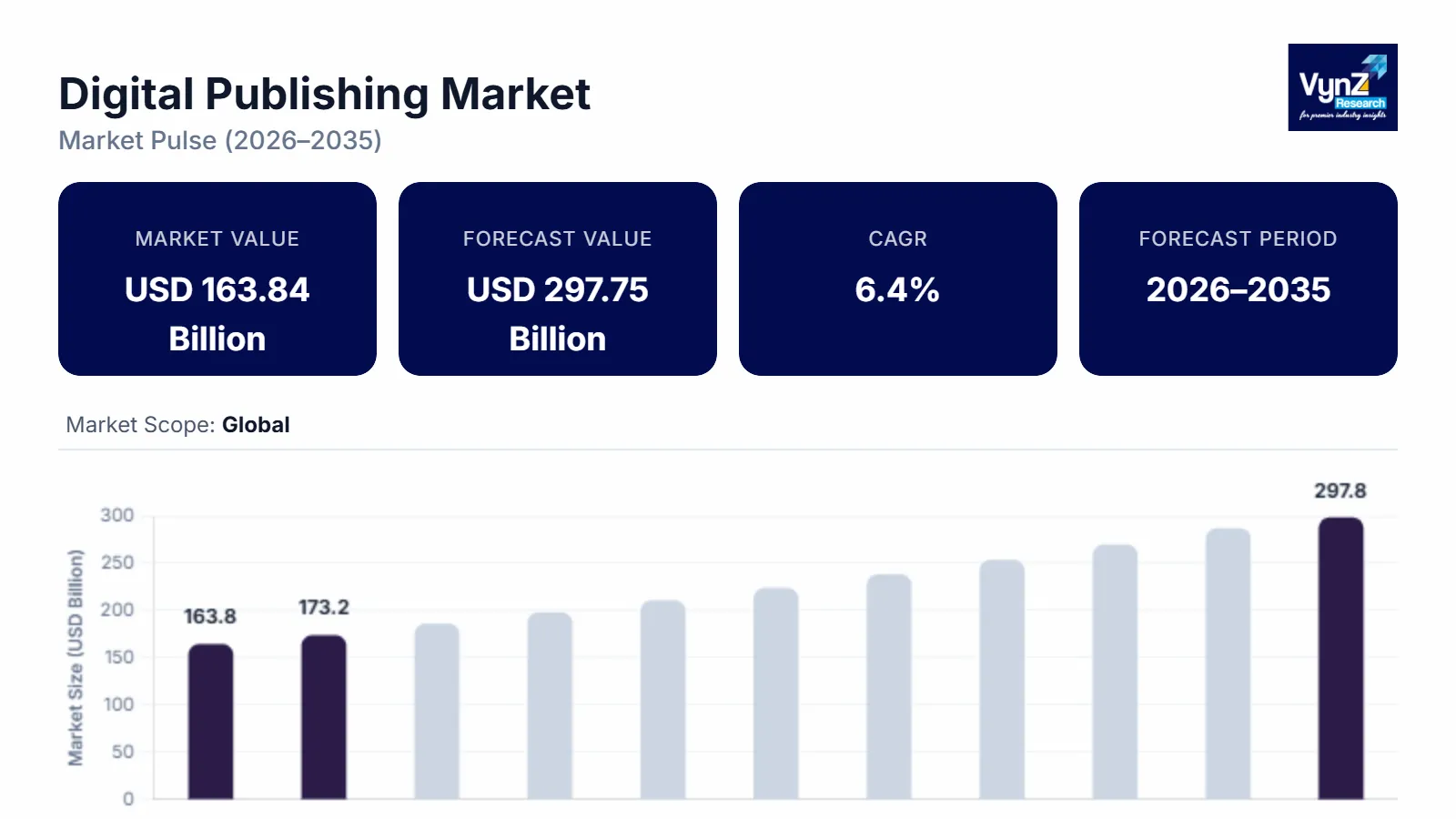
The growth of the digital publishing market is attributed to the rising internet and smartphone penetration, digital learning, subscriptions, multimedia publishing, and a growing inclination toward convenient digital access.
Publishers are witnessing a rise in digital content consumption beyond online books and newspapers. The dissemination of journals, educational material, professional information, magazines, newsletters, audiobooks, and interactive content through websites, mobile apps, and other digital channels is on the rise.
According to the VynZ research, future trends in digital publishing will be driven by personalization, diverse monetization models, multimedia content, and deeper connections with audiences.
Research Methodology
VynZ Research performs primary research with publishers, digital-content platforms, technology providers, distributors, educational organizations and industry professionals in order to understand market conditions, adoption patterns and emerging business models. Secondary research makes use of government agencies, international institutions, industry associations, company disclosures, regulatory publications and credible databases in order to establish market trends, industry developments and supporting evidence. Market estimates have been made across publishing type, format, enterprise type, end user and geographic markets in order to assess historical indicators, adoption patterns and industry developments to establish a market baseline and identify growth patterns. Forecasts have considered digital connectivity, consumer behavior, publishing technologies, monetization models, education trends, multimedia adoption and regional market conditions to shape the forecast. The team also performs consistency checks on market size, CAGR, segment shares, regional shares and forecast calculations prior to publication.
Market Definition: The digital publishing market consists of the creation, production, distribution and monetization of professionally produced content delivered primarily through digital channels. The market includes eBooks and digital books, digital journals, digital magazines, digital news publishing, learning and courseware publishing, digital audio publishing, web-based publishing, professional and academic digital content, digital publishing platforms and related services. The scope excludes physical books that are distributed primarily through traditional print channels, printed newspapers and magazines, general digital advertising that is unrelated to published content, software products that do not include a publishing application, and user-generated social-media activity that does not constitute a publishing product.
Research Highlights
- Digital and eBooks are expected to hold the leading position with a 24.5% share due to increasing demand.
- PDF dominated the format segment with a 42.8% share in 2025 due to higher adoption.
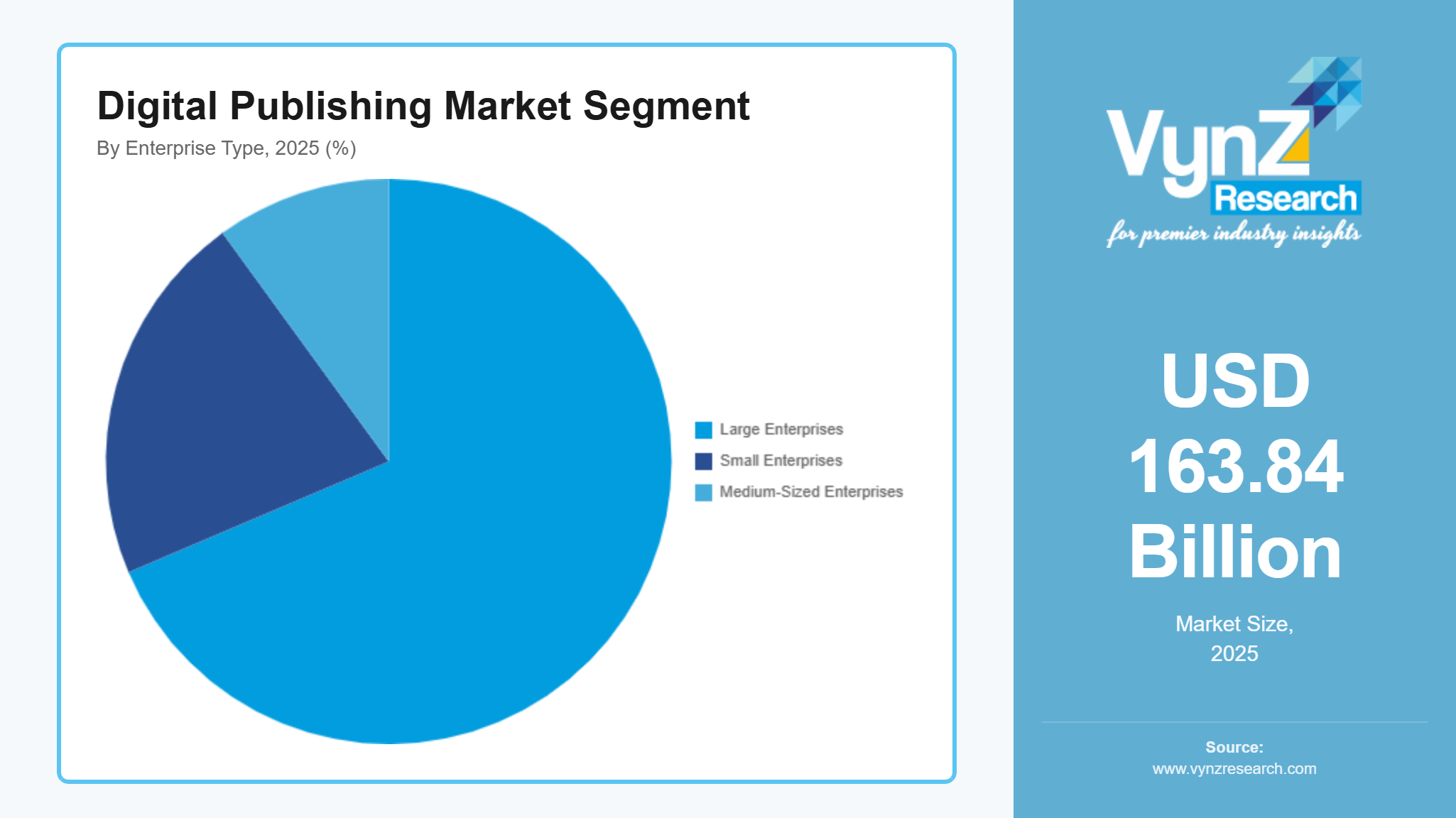
- Large enterprises accounted for 68.6% of the market in 2025 due to greater publishing capacity.
- Individual consumers are expected to record a CAGR of 7.8% due to growing liking.
- Asia Pacific dominated the global market with a 38.54% share in 2025, supported by widespread smartphone-based digital content consumption.
Digital Publishing Market Dynamics
Market Trends
Digital publishing is witnessing a shift towards multimedia and interactive content where publishers are embracing video, podcasts, infographics, animation and other tools to enhance articles, magazines, eBook, and educational content. This trend is useful to publishers because it helps to engage more readers while addressing varying consumption preferences. The younger generation, for instance, is gradually becoming more attached to short and visually engaging digital content. VynZ Research analysis indicates that publishers that capitalize on their ability to combine quality written content and multimedia elements stand to benefit from the opportunity to offer more engaging content while generating additional revenue streams. Subscription services have also become more attractive to publishers due to their potential to offer steady streams of income while enabling the company to connect directly to its customers. Generative AI is also playing a greater role in digital publishing with publishers leveraging on the technology to meet the rising demand for content. Publishers are capitalizing on the growing importance of direct-to-consumer engagement by offering their audience access to their content via their digital platforms, apps, newsletters, memberships, and subscriptions.
Growth Drivers
The growing internet penetration and rising smartphone penetration are factors that are fueling the rising demand for digital books, journals, news, educational content, and other forms of published content. According to the International Telecommunication Union, about 6 billion individuals or 74% of the global population were connected to the internet in 2025. Smartphones also enable individuals to access content on the go. The rising importance of digital education is also adding fuel to the growth of the digital publishing market as students and teachers turn to eBook, course books, digital textbooks, and other forms of digital content. There is a growing need for content that can be accessed remotely while also being easily renewed and updated. In addition, the growing demand for on-demand content is fueling the rate at which consumers are accessing content. Audiobooks and other audio-based publications are also complementing the rising consumption of content.
Restraints and Challenges
Content publishers are noticing that most consumers are subscribing to multiple digital services, which means that they have to convince customers to invest in their specific offerings. Customer retention is also a significant challenge, especially for subscription-based services where companies need to keep more customers to maintain a steady stream of income. There is also a problem with unauthorized redistribution of content, including popular books, journals, and other content that publishers want to make available exclusively on their platforms. Although publishers could utilize digital rights management, access control, and other tools to prevent illegal redistribution, the tools could also end up frustrating legitimate consumers. Most publishers also rely on social networks and search engines to drive traffic to their platforms, and any changes in the policies or monetization strategies of these platforms can affect how publishers do business. Generative AI is also being used in the creation of content, and there are still unclear IP guidelines regarding training data, credit for content creation, and other aspects of the technology. Publishers must invest in policies that offer guidelines for AI-generated content and AI-assisted content while ensuring that they do not infringe on the rights of other publishers.
Market Opportunities
Publishers could invest in more translated content, digital education, audiobooks, recommendation engines, and other innovations to meet the rising demand for content. Firms could also invest in AI-assisted content creation and offer direct-to-consumer subscriptions while taking advantage of interactive content formats. The market also presents several opportunities for publishers to benefit from the rising smartphone and internet penetration rates, especially in emerging economies. VYNZ Research analysis indicates that the companies that are likely to benefit from the growing demand for content include those that utilize their content libraries, audience data, monetization strategies, and distribution infrastructure to maximize their opportunities.
Global Digital Publishing Market Report Coverage
|
Report Metric |
Details |
|
Historical Period |
2020 - 2024 |
|
Base Year Considered |
2025 |
|
Forecast Period |
2026 - 2035 |
|
Market Size in 2025 |
USD 163.84 Billion |
|
Revenue Forecast in 2035 |
USD 297.75 Billion |
|
Growth Rate |
6.4% |
|
Segments Covered in the Report |
Publishing Type, Format, Enterprise Type, End User |
|
Report Scope |
Market Trends, Drivers, and Restraints; Revenue Estimation and Forecast; Segmentation Analysis; Companies’ Strategic Developments; Market Share Analysis of Key Players; Company Profiling |
|
Regions Covered in the Report |
North America, Europe, Asia Pacific, South America, Middle East & Africa |
|
Key Companies |
Adobe, Alphabet, Amazon, Apple, Canva, News Corp, Pearson, Penguin Random House, RELX, Scribd |
|
Customization |
Available upon request |
Digital Publishing Market Segmentation
By Publishing Type
Digital books and eBooks dominated the publishing-type segment with 24.5% in 2026, driven by their convenience, portability, and accessibility on smartphones, tablets, and e-readers. The popularity of digital books has been growing due to their involvement in casual reading, education, and professional development. As modern consumers prefer to collect vast amounts of information in one place without being tied to paper formats, digital books gain more popularity.
The segment of eBooks and digital books is expected to experience the highest CAGR of 8.6% during the forecast period. Modern consumers engage in online reading more frequently, while access to educational material and libraries increases. Moreover, the development of convenient reading apps and expanded functionality will contribute to the segment’s growth.
By Format
PDF dominated the format segment in 2025 with 42.8%. It can be explained by the format’s versatility and convenience, allowing preserving the source’s design and providing simple access to content. PDFs contain almost any information type: reports, scientific articles, educational materials, business documents, and digital books. Since they are easily found on the web and downloaded, the format’s popularity has grown significantly.
The anticipated CAGR of 9.2% for the audio segment will drive the growth of the publishing industry during the forecast period. Audio publishing provides access to content in a convenient and engaging way, fitting into busy schedules. As audiobooks and music streaming gain popularity, the demand for audio files increases, while smartphones’ emergence has made them more accessible to the general audience.
By Enterprise Type
Large enterprises dominated the enterprise-type segment with 68.6% in 2025. It can be explained by their status as major players in the publishing industry, which allows them to profit from the rising demand for digital content. They possess the resources to develop and maintain online platforms, utilize artificial intelligence and Big Data, and distribute content globally. Large companies attract more users with their diverse content libraries, offering traditional and digital books, audiobooks, subscriptions, and other services.
The small and medium enterprises segment is expected to grow at a 7.9% CAGR, driven by technological advancements and innovations that provide access to publishing tools. As online bookkeeping, accounting, printing, and other solutions become more available, SMEs enter the market and compete with larger companies. It makes the publishing landscape more diverse as SMEs focus on specific audiences and provide unique content without the resources of big corporations.
By End User
Individuals are expected to dominate the end-user segment in 2026 with 37.6%. It can be explained by the significant presence of digital content consumption in people’s everyday lives. Smartphones and internet access allow individuals to access books, journals, newspapers, online encyclopedias, and other materials. Moreover, the subscription culture and convenient media access increase content consumption among individuals.
Individuals are anticipated to grow the fastest at 7.8% CAGR during the forecast period. Consumers engage with content more often than ever, making content consumption a significant part of their lives. As more users access media on smartphones and other digital devices, the demand for content increases, pushing the publishing industry to grow. Individuals enjoy the variety of digital content and prefer its affordability and accessibility over traditional books, newspapers, magazines, and journals.
Regional Insights
Asia Pacific
Asia Pacific held the largest regional share with 38.54% in 2025, representing approximately USD 63.17 billion. The region has strong smartphone-based content consumption across China, India, Japan and South Korea. Digital books, web novels, comics and educational content have become integrated into everyday consumption patterns. Regional platforms also leverage subscription services, microtransactions and integrated payment systems to monetize large digital audiences.
North America
North America accounted for approximately 27.98% of the global market in 2025, corresponding to a market value of approximately USD 45.85 billion. The region has a mature digital-content ecosystem and strong adoption of premium news, academic databases, audiobooks and subscription-based reading services. Established copyright protection and digital rights management practices also support continued publisher investment.
Europe
Europe represented approximately 24.17% of the global market in 2025, with a market value of approximately USD 39.61 billion. The region has high digital literacy, an established publishing industry and strong demand for eBooks, journals, e-learning and professional-development content. Demand for multilingual publications also supports the use of digital formats across European markets. Europe is projected to record approximately 5.5% growth over the coming years.
South America
South America is estimated to account for approximately 5.64% of the global Digital Publishing Market in 2025, based on VYNZ Research's regional allocation of the remaining global market after the three directly reported major regions. Brazil represents the region's largest opportunity because of its population, expanding digital ecosystem and increasing consumption of online books, news, education and entertainment content. Improving connectivity and smartphone adoption should continue to expand the addressable audience.
Middle East & Africa
Middle East & Africa is estimated to represent approximately 3.67% of the global market in 2025, based on VYNZ Research's allocation of the remaining market. The region is emerging as an attractive growth market as smartphone penetration, digital education and mobile-first content consumption increase. The region is projected to record the highest regional CAGR of approximately 8.7%, supported by younger populations and increasing demand for digital learning and localized content.
Competitive Landscape / Company Insights
Digital publishing market consists of established publishers, technologists and digital-content platforms that compete in areas of content creation, distribution, audience acquisition and monetization. Competition is intensifying around subscription conversion, personalization, multimedia delivery, AI-powered workflows and direct audience engagement. Large players benefit from their content libraries and distribution networks, while smaller publishers are embracing cloud platforms and self-publishing tools to target niche markets. VynZ Research analysis suggests that companies that balance content quality, technology and diversified monetization strategies will strengthen their market positions.
Mini Profiles
Adobe provides digital content creation, document management and digital experience technologies. Its tools support publishing workflows, document creation, design and digital content management across enterprise and creative users.
Alphabet participates in digital publishing through search, content discovery, digital advertising and online distribution ecosystems. Its platforms influence how publishers attract audiences and monetize digital traffic.
Amazon operates across digital books, e-readers and digital publishing through the Kindle ecosystem. Its Kindle Direct Publishing platform enables authors and publishers to distribute digital books directly to readers.
Apple supports digital publishing through Apple Books, Apple News, Podcasts and its broader device ecosystem. Its services allow publishers and content providers to reach audiences through subscription and digital distribution models.
Canva provides tools for creating digital documents, presentations, graphics, publications and multimedia content. Its browser-based platform enables businesses, educational users and individuals to create digital material.
Key Players
- Adobe
- Alphabet
- Amazon
- Apple
- Canva
- News Corp
- Pearson
- Penguin Random House
- RELX
- Scribd
Recent Developments
Amazon's Kindle Direct Publishing documentation states that from January 20, 2026, verified purchasers can download EPUB and PDF files for confirmed DRM-free Kindle books. The development gives readers greater format flexibility while creating additional considerations around digital rights protection.
Apple introduced News+ Food, bringing recipes and food-related content from publishers into its News+ subscription. The development illustrates how digital publishers and platforms are expanding beyond conventional articles and magazines toward specialized content experiences.
OverDrive announced a worldwide distribution partnership with Podium Entertainment for audiobooks, becoming its exclusive audiobook sales partner outside the U.S. and Canada. The development expanded access to Podium's audiobook catalogue through libraries and schools.
Global Digital Publishing Market Coverage
Publishing Type Insight and Forecast 2026 - 2035
- eBooks and Digital Books
- Digital Journals
- Digital Magazines
- Digital News Publishing
- Learning and Courseware Publishing
- Others
Format Insight and Forecast 2026 - 2035
- eBooks
- Audio Publishing
Enterprise Type Insight and Forecast 2026 - 2035
- Large Enterprises
- Small & Medium-Sized Enterprises
End User Insight and Forecast 2026 - 2035
- Individual Consumers
- Students
- Educators and Trainers
- Academic and Research Users
Region Insight and Forecast 2026 - 2035
- North America
- Europe
- Asia Pacific
- South America
- Middle East & Africa
Global Digital Publishing Market by Region
- North America
- By Publishing Type
- By Format
- By Enterprise Type
- By End User
- By Region
- By Country - U.S., Canada, Mexico
- Europe
- By Publishing Type
- By Format
- By Enterprise Type
- By End User
- By Region
- By Country - Germany, U.K., France, Italy, Spain, Russia, Rest of Europe
- Asia-Pacific (APAC)
- By Publishing Type
- By Format
- By Enterprise Type
- By End User
- By Region
- By Country - China, Japan, India, South Korea, Vietnam, Thailand, Malaysia, Rest of Asia-Pacific
- Rest of the World (RoW)
- By Publishing Type
- By Format
- By Enterprise Type
- By End User
- By Region
- By Country - Brazil, Saudi Arabia, South Africa, U.A.E., Other Countries
Table of Contents for Digital Publishing Market Report
1. Research Overview
1.1. The Report Offers
1.2. Market Coverage
1.2.1. By
Publishing Type
1.2.2. By
Format
1.2.3. By
Enterprise Type
1.2.4. By
End User
1.2.5. By
Region
1.3. Research Phases
1.4. Limitations
1.5. Market Methodology
1.5.1. Data Sources
1.5.1.1.
Primary Research
1.5.1.2.
Secondary Research
1.5.2. Methodology
1.5.2.1.
Data Exploration
1.5.2.2.
Forecast Parameters
1.5.2.3.
Data Validation
1.5.2.4.
Assumptions
1.5.3. Study Period & Data Reporting Unit
2. Executive Summary
3. Industry Overview
3.1. Industry Dynamics
3.1.1. Market Growth Drivers
3.1.2. Market Restraints
3.1.3. Key Market Trends
3.1.4. Major Opportunities
3.2. Industry Ecosystem
3.2.1. Porter’s Five Forces Analysis
3.2.2. Recent Development Analysis
3.2.3. Value Chain Analysis
3.3. Competitive Insight
3.3.1. Competitive Position of Industry
Players
3.3.2. Market Attractive Analysis
3.3.3. Market Share Analysis
4. Global Market Estimate and Forecast
4.1. Global Market Overview
4.2. Global Market Estimate and Forecast to 2035
5. Market Segmentation Estimate and Forecast
5.1. By Publishing Type
5.1.1. eBooks and Digital Books
5.1.1.1. Market Definition
5.1.1.2. Market Estimation and Forecast to 2035
5.1.2. Digital Journals
5.1.2.1. Market Definition
5.1.2.2. Market Estimation and Forecast to 2035
5.1.3. Digital Magazines
5.1.3.1. Market Definition
5.1.3.2. Market Estimation and Forecast to 2035
5.1.4. Digital News Publishing
5.1.4.1. Market Definition
5.1.4.2. Market Estimation and Forecast to 2035
5.1.5. Learning and Courseware Publishing
5.1.5.1. Market Definition
5.1.5.2. Market Estimation and Forecast to 2035
5.1.6. Others
5.1.6.1. Market Definition
5.1.6.2. Market Estimation and Forecast to 2035
5.2. By Format
5.2.1. eBooks
5.2.1.1. Market Definition
5.2.1.2. Market Estimation and Forecast to 2035
5.2.2. PDF
5.2.2.1. Market Definition
5.2.2.2. Market Estimation and Forecast to 2035
5.2.3. Audio Publishing
5.2.3.1. Market Definition
5.2.3.2. Market Estimation and Forecast to 2035
5.3. By Enterprise Type
5.3.1. Large Enterprises
5.3.1.1. Market Definition
5.3.1.2. Market Estimation and Forecast to 2035
5.3.2. Small & Medium-Sized Enterprises
5.3.2.1. Market Definition
5.3.2.2. Market Estimation and Forecast to 2035
5.4. By End User
5.4.1. Individual Consumers
5.4.1.1. Market Definition
5.4.1.2. Market Estimation and Forecast to 2035
5.4.2. Students
5.4.2.1. Market Definition
5.4.2.2. Market Estimation and Forecast to 2035
5.4.3. Educators and Trainers
5.4.3.1. Market Definition
5.4.3.2. Market Estimation and Forecast to 2035
5.4.4. Academic and Research Users
5.4.4.1. Market Definition
5.4.4.2. Market Estimation and Forecast to 2035
5.5. By Region
5.5.1. North America
5.5.1.1. Market Definition
5.5.1.2. Market Estimation and Forecast to 2035
5.5.2. Europe
5.5.2.1. Market Definition
5.5.2.2. Market Estimation and Forecast to 2035
5.5.3. Asia Pacific
5.5.3.1. Market Definition
5.5.3.2. Market Estimation and Forecast to 2035
5.5.4. South America
5.5.4.1. Market Definition
5.5.4.2. Market Estimation and Forecast to 2035
5.5.5. Middle East & Africa
5.5.5.1. Market Definition
5.5.5.2. Market Estimation and Forecast to 2035
6. North America Market Estimate and Forecast
6.1. By
Publishing Type
6.2. By
Format
6.3. By
Enterprise Type
6.4. By
End User
6.5. By
Region
6.5.1.
U.S. Market Estimate and Forecast
6.5.2.
Canada Market Estimate and Forecast
6.5.3.
Mexico Market Estimate and Forecast
7. Europe Market Estimate and Forecast
7.1. By
Publishing Type
7.2. By
Format
7.3. By
Enterprise Type
7.4. By
End User
7.5. By
Region
7.5.1.
Germany Market Estimate and Forecast
7.5.2.
France Market Estimate and Forecast
7.5.3.
U.K. Market Estimate and Forecast
7.5.4.
Italy Market Estimate and Forecast
7.5.5.
Spain Market Estimate and Forecast
7.5.6.
Russia Market Estimate and Forecast
7.5.7.
Rest of Europe Market Estimate and Forecast
8. Asia-Pacific (APAC) Market Estimate and Forecast
8.1. By
Publishing Type
8.2. By
Format
8.3. By
Enterprise Type
8.4. By
End User
8.5. By
Region
8.5.1.
China Market Estimate and Forecast
8.5.2.
Japan Market Estimate and Forecast
8.5.3.
India Market Estimate and Forecast
8.5.4.
South Korea Market Estimate and Forecast
8.5.5.
Rest of Asia-Pacific Market Estimate and Forecast
9. Rest of the World (RoW) Market Estimate and Forecast
9.1. By
Publishing Type
9.2. By
Format
9.3. By
Enterprise Type
9.4. By
End User
9.5. By
Region
9.5.1.
Brazil Market Estimate and Forecast
9.5.2.
Saudi Arabia Market Estimate and Forecast
9.5.3.
South Africa Market Estimate and Forecast
9.5.4.
U.A.E. Market Estimate and Forecast
9.5.5.
Other Countries Market Estimate and Forecast
10. Company Profiles
10.1.
Adobe
10.1.1.
Snapshot
10.1.2.
Overview
10.1.3.
Offerings
10.1.4.
Financial
Insight
10.1.5.
Recent
Developments
10.2.
Alphabet
10.2.1.
Snapshot
10.2.2.
Overview
10.2.3.
Offerings
10.2.4.
Financial
Insight
10.2.5.
Recent
Developments
10.3.
Amazon
10.3.1.
Snapshot
10.3.2.
Overview
10.3.3.
Offerings
10.3.4.
Financial
Insight
10.3.5.
Recent
Developments
10.4.
Apple
10.4.1.
Snapshot
10.4.2.
Overview
10.4.3.
Offerings
10.4.4.
Financial
Insight
10.4.5.
Recent
Developments
10.5.
Canva
10.5.1.
Snapshot
10.5.2.
Overview
10.5.3.
Offerings
10.5.4.
Financial
Insight
10.5.5.
Recent
Developments
10.6.
News Corp
10.6.1.
Snapshot
10.6.2.
Overview
10.6.3.
Offerings
10.6.4.
Financial
Insight
10.6.5.
Recent
Developments
10.7.
Pearson
10.7.1.
Snapshot
10.7.2.
Overview
10.7.3.
Offerings
10.7.4.
Financial
Insight
10.7.5.
Recent
Developments
10.8.
Penguin Random House
10.8.1.
Snapshot
10.8.2.
Overview
10.8.3.
Offerings
10.8.4.
Financial
Insight
10.8.5.
Recent
Developments
10.9.
RELX
10.9.1.
Snapshot
10.9.2.
Overview
10.9.3.
Offerings
10.9.4.
Financial
Insight
10.9.5.
Recent
Developments
10.10.
Scribd
10.10.1.
Snapshot
10.10.2.
Overview
10.10.3.
Offerings
10.10.4.
Financial
Insight
10.10.5.
Recent
Developments
11. Appendix
11.1. Exchange Rates
11.2. Abbreviations
Note: Financial insight and recent developments of different companies are subject to the availability of information in the secondary domain.
Frequently Asked Questions
Purchase Options
Latest Report
Research Methodology
- Desk Research / Pilot Interviews
- Build Market Size Model
- Research and Analysis
- Final Deliverable
Connect With Our Sales Team
- Toll-Free: +1-888-253-3960
- Phone: +91 9960 288 381
- Email: enquiry@vynzresearch.com
Digital Publishing Market