
Butterfly Valves Market Size & Share Growth Forecast Report (2026-2035)
Industry Insight by Type (High-performance butterfly valves, Lined butterfly valves, Resilient-seated butterfly valves), by Design (Concentric, Double-offset, Triple-offset), by Function (On/off (isolation), Control, Throttling), by End User (Oil and gas, Water and wastewater, Energy and power, Chemical, Pharmaceutical, Other end users)
| Status : Published | Published On : Nov, 2026 | Report Code : VRSME9228 | Industry : Semiconductor & Electronics | Available Format :

|
Page : 145 |
Butterfly Valves Market Overview
The global butterfly valves market was valued at an estimated USD 13 billion in 2025 and is projected to reach USD 14.5 billion in 2026, increasing to USD 26 billion by 2035, registering a CAGR of 6.89% from 2026 to 2035.
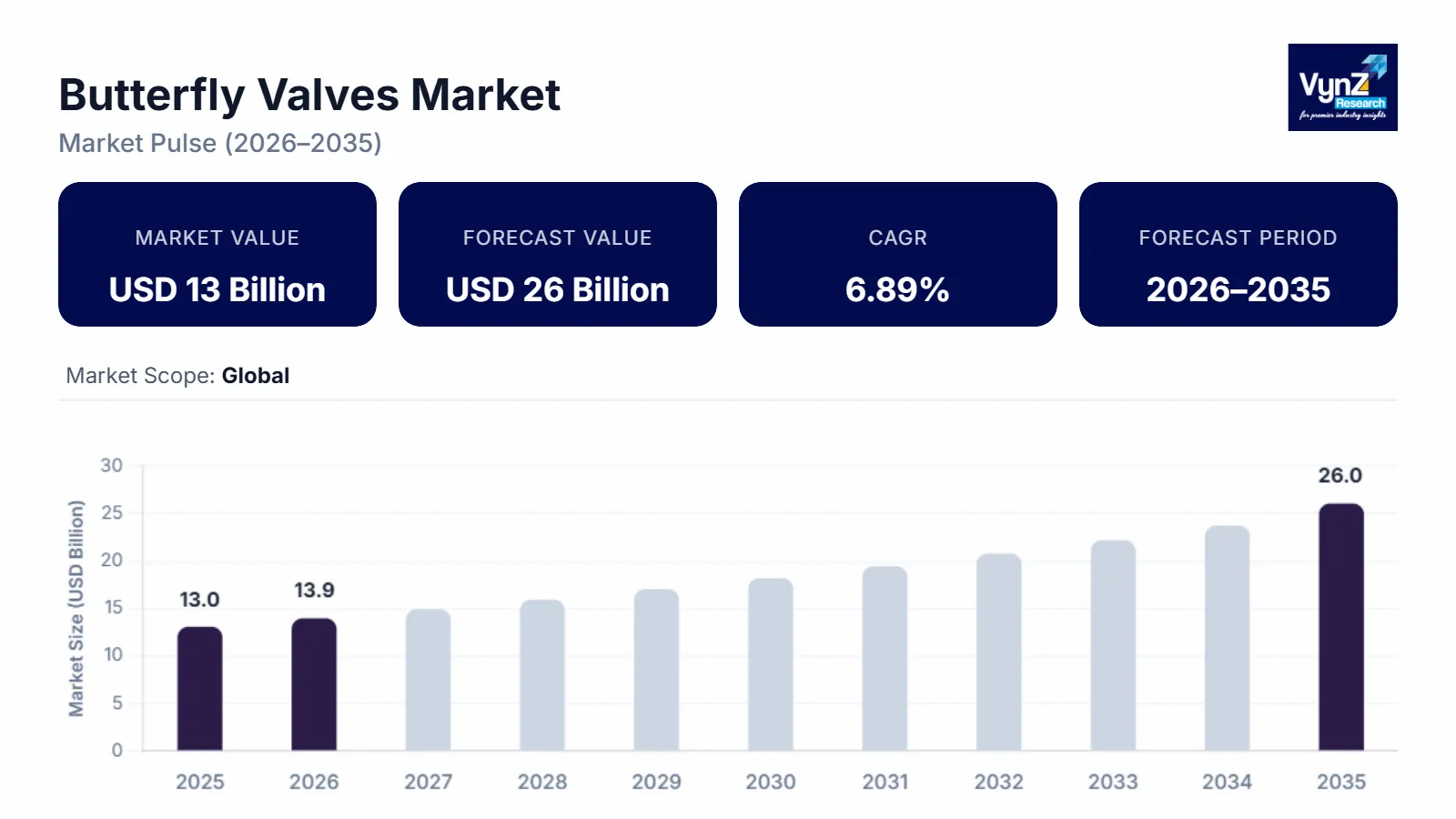
The butterfly valves market is expanding as industrial operators invest in efficient flow control systems, pipeline modernization and water management infrastructure. Growing requirements across oil and gas, power generation, chemical processing and wastewater treatment are supporting demand for high-performance valve designs, while increasing automation and the need for reliable fluid handling are encouraging the adoption of advanced actuation and sealing technologies.
Market growth is supported by expanding industrial infrastructure, rising investments in water management and increasing demand for reliable pipeline systems. The International Energy Agency and the US Environmental Protection Agency identified the requirement for pipeline rehabilitation and associated flow-control equipment. These developments are strengthening demand across major industrial markets.
Research Methodology
VynZ Research employs a combination of primary and secondary research to evaluate the global butterfly valve industry. The VynZ Research team examines company publications, product portfolios, industrial developments, government reports, trade statistics and publicly available industry information to understand market conditions. Primary research involves discussions with industry participants, manufacturers, distributors and other relevant stakeholders, while secondary research helps establish historical trends, segment performance and regional demand. The collected information is assessed through data triangulation, cross-verification and market modelling to develop consistent estimates and long-term forecasts.
Research Highlights
- High-performance butterfly valves accounted for an estimated 54% of the global market in 2025, supported by their suitability for high-pressure applications and demanding industrial operations.
- Double-offset butterfly valves represented approximately 39% of market revenue in 2025, driven by improved sealing performance and reduced friction during operation.
- On/off butterfly valves held an estimated 59% share in 2025, reflecting their widespread use in pipeline isolation and industrial fluid management.
- Triple-offset butterfly valves are projected to register an estimated CAGR of 8% from 2026 to 2035, supported by increasing requirements for tight shutoff and high-temperature applications.
- Asia Pacific accounted for approximately 39% of global market revenue in 2025, supported by industrial expansion, water infrastructure investments and growing manufacturing activity.
Butterfly Valves Market Dynamics
Market Trends
The global industry is witnessing increasing adoption of high-performance and automated butterfly valves as industrial facilities prioritize operational reliability, accurate flow regulation and lower maintenance requirements. Double-offset and triple-offset designs are gaining attention in applications involving higher operating pressures, elevated temperatures and demanding sealing conditions, where conventional configurations may not provide the required performance. Manufacturers are also expanding electric and pneumatic actuation options to support automated pipeline operations, improve process consistency and reduce manual intervention across industrial facilities. Another notable trend involves the development of specialized valve materials and hygienic designs for chemical processing, pharmaceuticals, food production and water treatment.
Growth Drivers
Increasing investment in water supply, wastewater treatment and pipeline rehabilitation represents a major growth driver for the industry. Infrastructure requirements support demand for valves used in water distribution networks, treatment plants and pumping stations. Similar investment priorities across developing economies are encouraging municipalities and industrial operators to modernize existing fluid management systems. Demand from oil and gas, power generation and chemical processing is providing additional support, particularly for high-performance and metal-seated valve configurations. Increasing emphasis on equipment reliability, process safety and operational efficiency is therefore supporting the adoption of advanced butterfly valves across industrial applications.
Market Restraints / Challenges
Fluctuations in the prices of stainless steel, carbon steel, nickel alloys, elastomers and specialized sealing materials can increase manufacturing expenses and affect profit margins. High-performance and triple-offset valves often require more precise machining, specialized components and extensive testing, increasing production costs compared with standard configurations. Manufacturers also face challenges in maintaining consistent product quality while meeting application-specific pressure, temperature and leakage requirements. These cost considerations can restrict adoption among smaller industrial operators and price-sensitive customers, particularly in developing markets. Furthermore, compliance with international engineering and safety standards requires manufacturers to maintain appropriate testing facilities, certification procedures and quality assurance systems, adding to product development and operating costs.
Market Opportunities
The modernization of municipal water networks and expansion of wastewater treatment facilities present significant opportunities for manufacturers. Governments are increasingly prioritizing water security, infrastructure rehabilitation, efficient distribution and improved wastewater management, creating demand for durable flow-control equipment. Regulatory developments are encouraging investment in treatment facilities and associated pipeline systems, creating opportunities for manufacturers offering corrosion-resistant, automated and low-maintenance butterfly valves. Another opportunity lies in the expansion of automated industrial facilities and specialized energy infrastructure. Increasing investment in hydrogen production, LNG facilities, power generation and chemical processing is creating demand for valves capable of handling demanding pressure and temperature conditions.
Global Butterfly Valves Market Report Coverage
|
Report Metric |
Details |
|
Historical Period |
2020 - 2024 |
|
Base Year Considered |
2025 |
|
Forecast Period |
2026 - 2035 |
|
Market Size in 2025 |
USD 13 Billion |
|
Revenue Forecast in 2035 |
USD 26 Billion |
|
Growth Rate |
6.89% |
|
Segments Covered in the Report |
Type, Design, Function, End User |
|
Report Scope |
Market Trends, Drivers, and Restraints; Revenue Estimation and Forecast; Segmentation Analysis; Companies’ Strategic Developments; Market Share Analysis of Key Players; Company Profiling |
|
Regions Covered in the Report |
North America, Europe, Asia Pacific, Rest of the World |
|
Key Companies |
Alfa Laval, AVK Group, Bray International, Crane Company, Emerson Electric, Flowserve Corporation, KSB SE & Co. KGaA, Pentair plc, Valmet, Velan Inc |
|
Customization |
Available upon request |
Butterfly Valves Market Segmentation
By Type
High-performance butterfly valves represented the largest product category, accounting for an estimated 54% of global revenue in 2025. Their leading position is supported by their ability to handle higher operating pressures, elevated temperatures and demanding industrial conditions.
Lined butterfly valves are expected to register an estimated CAGR of 7.9% from 2026 to 2035, supported by increasing requirements for corrosion resistance in chemical processing, water treatment and other applications involving aggressive fluids.
By Design
Double-offset butterfly valves accounted for approximately 39% of global market revenue in 2025, making them the leading design category. Their established industrial acceptance, operational durability and suitability for a broad range of pressure conditions continue to support their market position.
Triple-offset butterfly valves are projected to record the fastest growth, with an estimated CAGR of 8% during 2026–2035. Their metal-to-metal seating arrangement and cam-action operation support tight shutoff in applications involving high temperatures, demanding pressures and critical process conditions.
By Function
On/off butterfly valves held an estimated 59% share of global revenue in 2025, supported by their extensive use in pipeline isolation, distribution networks and industrial processing systems. Their quarter-turn operating mechanism enables relatively quick opening and closing, making them suitable for applications requiring dependable flow interruption.
Control butterfly valves are expected to register an estimated CAGR of 6.85% from 2026 to 2035, supported by the increasing use of automated process systems and requirements for more precise flow regulation.
By End User
Oil and gas accounted for the largest end-user share, representing approximately 34% of global market revenue in 2025. Continued investment in LNG infrastructure, refinery modernization and pipeline maintenance is supporting demand, although project approvals and capital expenditure remain influenced by energy prices and regional investment conditions.
Water and wastewater applications are projected to register an estimated CAGR of 7.40% from 2026 to 2035, making this one of the fastest-growing end-user categories. Expanding municipal distribution networks, wastewater treatment capacity and industrial water recycling requirements are increasing demand for valves used in pumping stations, treatment facilities and pipeline infrastructure.
Regional Insights
North America
North America accounted for an estimated 21% of the global market in 2025, supported by established oil and gas infrastructure, industrial manufacturing and continued investment in municipal water systems. The United States represents the largest national market within the region, with demand supported by pipeline modernization, wastewater treatment upgrades and industrial automation. The US Environmental Protection Agency identified substantial investment requirements for drinking water distribution and transmission infrastructure, creating opportunities for manufacturers supplying durable valves for municipal and industrial pipeline networks.
Europe
Europe represented approximately 19% of global revenue in 2025, supported by established manufacturing industries, chemical processing, power generation and municipal water infrastructure. Germany, the United Kingdom, France and Italy remain important markets due to their industrial production capabilities and established engineering sectors. The European Commission's revised Urban Wastewater Treatment Directive, effective from January 2025, is strengthening requirements for wastewater collection, treatment and resource recovery, encouraging infrastructure upgrades and creating additional demand for reliable flow-control equipment.
Asia Pacific
Asia Pacific held the largest regional position, accounting for approximately 39% of global revenue in 2025. China, India, Japan and South Korea represent major demand centers due to their manufacturing capacity, industrial infrastructure and expanding water management requirements. China's Ministry of Water Resources reported that investment in water conservancy construction exceeded CNY 1.28 trillion in 2025, reflecting sustained public expenditure on water infrastructure, flood management and related projects. Such investment supports demand for valves across water distribution, treatment facilities and industrial pipeline systems.
Rest of the World
The Rest of the World region accounted for the remaining estimated 21% of global market revenue in 2025, covering Latin America, the Middle East and Africa. Demand is supported by oil and gas production, refinery development, desalination facilities, mining operations and expanding municipal water infrastructure. Countries such as Saudi Arabia, the United Arab Emirates, Brazil and South Africa are important demand centres because of their industrial investments and requirements for reliable pipeline and fluid management systems.
Competitive Landscape / Company Insights
The butterfly valve industry is moderately competitive, with global manufacturers focusing on product development, engineering capabilities, distribution expansion and application-specific solutions. Leading companies compete through high-performance designs, advanced sealing technologies, automated actuation and specialized materials for demanding industrial applications. Growing requirements across water infrastructure, oil and gas, power generation and chemical processing are encouraging investment in product innovation and manufacturing capabilities. Companies with established distribution networks and diversified valve portfolios are positioned to address demand across multiple industrial applications.
Mini Profiles
Alfa Laval
Develops hygienic and industrial valve solutions, including butterfly valves designed for food processing, pharmaceutical and other applications requiring reliable fluid handling.
Bray International
Supplies resilient-seated and high-performance butterfly valves, actuators and control accessories for industrial, chemical, water and energy applications.
Crane Company
Provides engineered flow-control products and industrial valve solutions for power generation, process industries and critical infrastructure applications.
Emerson Electric
Offers industrial automation and flow-control technologies, including valve and actuation solutions for process industries and energy facilities.
Flowserve Corporation
Manufactures industrial flow-control products, including specialized valves and automated systems for energy, chemical processing and general industrial applications.
Key Players
- Alfa Laval
- AVK Group
- Bray International
- Crane Company
- Emerson Electric
- Flowserve Corporation
- KSB SE & Co. KGaA
- Pentair plc
- Valmet
- Velan Inc
Recent Developments
AVK Group reorganized its industrial valve business in 2025, with InterApp Italiana becoming AVK Industrial Solutions. The development brought several established industrial valve brands under a more consolidated business identity, supporting its industrial product portfolio and market presence.
KSB SE & Co. KGaA featured its ECOLINE-S butterfly and dual-plate check valve portfolio in its 2025 product development presentation. The development reflects the company's continued focus on expanding its industrial valve range for different operating requirements.
Pentair plc completed its acquisition of Hydra-Stop, expanding its portfolio of specialty valve solutions, insertion valves and line-stop fittings for municipal water utilities. The transaction strengthens its presence in infrastructure applications associated with water distribution and pipeline maintenance.
Valmet highlighted its Neles Neldisc triple-eccentric butterfly valve technology, emphasizing its suitability for control and shutoff applications. The product configuration supports demanding industrial services through its sealing arrangement, material options and reduced seat contact during operation.
Velan Inc. delivered a fleet of 42-inch Class 900 bidirectional Torqseal triple-offset butterfly valves for a major LNG development project in Texas. The delivery demonstrates the company's ability to manufacture large-diameter, high-pressure valve solutions for specialized energy infrastructure.
Global Butterfly Valves Market Coverage
Type Insight and Forecast 2026 - 2035
- High-performance butterfly valves
- Lined butterfly valves
- Resilient-seated butterfly valves
Design Insight and Forecast 2026 - 2035
- Concentric
- Double-offset
- Triple-offset
Function Insight and Forecast 2026 - 2035
- On/off (isolation)
- Control
- Throttling
End User Insight and Forecast 2026 - 2035
- Oil and gas
- Water and wastewater
- Energy and power
- Chemical
- Pharmaceutical
- Other end users
Global Butterfly Valves Market by Region
- North America
- By Type
- By Design
- By Function
- By End User
- By Country - U.S., Canada, Mexico
- Europe
- By Type
- By Design
- By Function
- By End User
- By Country - Germany, U.K., France, Italy, Spain, Russia, Rest of Europe
- Asia-Pacific (APAC)
- By Type
- By Design
- By Function
- By End User
- By Country - China, Japan, India, South Korea, Vietnam, Thailand, Malaysia, Rest of Asia-Pacific
- Rest of the World (RoW)
- By Type
- By Design
- By Function
- By End User
- By Country - Brazil, Saudi Arabia, South Africa, U.A.E., Other Countries
Table of Contents for Butterfly Valves Market Report
1. Research Overview
1.1. The Report Offers
1.2. Market Coverage
1.2.1. By
Type
1.2.2. By
Design
1.2.3. By
Function
1.2.4. By
End User
1.3. Research Phases
1.4. Limitations
1.5. Market Methodology
1.5.1. Data Sources
1.5.1.1.
Primary Research
1.5.1.2.
Secondary Research
1.5.2. Methodology
1.5.2.1.
Data Exploration
1.5.2.2.
Forecast Parameters
1.5.2.3.
Data Validation
1.5.2.4.
Assumptions
1.5.3. Study Period & Data Reporting Unit
2. Executive Summary
3. Industry Overview
3.1. Industry Dynamics
3.1.1. Market Growth Drivers
3.1.2. Market Restraints
3.1.3. Key Market Trends
3.1.4. Major Opportunities
3.2. Industry Ecosystem
3.2.1. Porter’s Five Forces Analysis
3.2.2. Recent Development Analysis
3.2.3. Value Chain Analysis
3.3. Competitive Insight
3.3.1. Competitive Position of Industry
Players
3.3.2. Market Attractive Analysis
3.3.3. Market Share Analysis
4. Global Market Estimate and Forecast
4.1. Global Market Overview
4.2. Global Market Estimate and Forecast to 2035
5. Market Segmentation Estimate and Forecast
5.1. By Type
5.1.1. High-performance butterfly valves
5.1.1.1. Market Definition
5.1.1.2. Market Estimation and Forecast to 2035
5.1.2. Lined butterfly valves
5.1.2.1. Market Definition
5.1.2.2. Market Estimation and Forecast to 2035
5.1.3. Resilient-seated butterfly valves
5.1.3.1. Market Definition
5.1.3.2. Market Estimation and Forecast to 2035
5.2. By Design
5.2.1. Concentric
5.2.1.1. Market Definition
5.2.1.2. Market Estimation and Forecast to 2035
5.2.2. Double-offset
5.2.2.1. Market Definition
5.2.2.2. Market Estimation and Forecast to 2035
5.2.3. Triple-offset
5.2.3.1. Market Definition
5.2.3.2. Market Estimation and Forecast to 2035
5.3. By Function
5.3.1. On/off (isolation)
5.3.1.1. Market Definition
5.3.1.2. Market Estimation and Forecast to 2035
5.3.2. Control
5.3.2.1. Market Definition
5.3.2.2. Market Estimation and Forecast to 2035
5.3.3. Throttling
5.3.3.1. Market Definition
5.3.3.2. Market Estimation and Forecast to 2035
5.4. By End User
5.4.1. Oil and gas
5.4.1.1. Market Definition
5.4.1.2. Market Estimation and Forecast to 2035
5.4.2. Water and wastewater
5.4.2.1. Market Definition
5.4.2.2. Market Estimation and Forecast to 2035
5.4.3. Energy and power
5.4.3.1. Market Definition
5.4.3.2. Market Estimation and Forecast to 2035
5.4.4. Chemical
5.4.4.1. Market Definition
5.4.4.2. Market Estimation and Forecast to 2035
5.4.5. Pharmaceutical
5.4.5.1. Market Definition
5.4.5.2. Market Estimation and Forecast to 2035
5.4.6. Other end users
5.4.6.1. Market Definition
5.4.6.2. Market Estimation and Forecast to 2035
6. North America Market Estimate and Forecast
6.1. By
Type
6.2. By
Design
6.3. By
Function
6.4. By
End User
6.4.1.
U.S. Market Estimate and Forecast
6.4.2.
Canada Market Estimate and Forecast
6.4.3.
Mexico Market Estimate and Forecast
7. Europe Market Estimate and Forecast
7.1. By
Type
7.2. By
Design
7.3. By
Function
7.4. By
End User
7.4.1.
Germany Market Estimate and Forecast
7.4.2.
France Market Estimate and Forecast
7.4.3.
U.K. Market Estimate and Forecast
7.4.4.
Italy Market Estimate and Forecast
7.4.5.
Spain Market Estimate and Forecast
7.4.6.
Russia Market Estimate and Forecast
7.4.7.
Rest of Europe Market Estimate and Forecast
8. Asia-Pacific (APAC) Market Estimate and Forecast
8.1. By
Type
8.2. By
Design
8.3. By
Function
8.4. By
End User
8.4.1.
China Market Estimate and Forecast
8.4.2.
Japan Market Estimate and Forecast
8.4.3.
India Market Estimate and Forecast
8.4.4.
South Korea Market Estimate and Forecast
8.4.5.
Rest of Asia-Pacific Market Estimate and Forecast
9. Rest of the World (RoW) Market Estimate and Forecast
9.1. By
Type
9.2. By
Design
9.3. By
Function
9.4. By
End User
9.4.1.
Brazil Market Estimate and Forecast
9.4.2.
Saudi Arabia Market Estimate and Forecast
9.4.3.
South Africa Market Estimate and Forecast
9.4.4.
U.A.E. Market Estimate and Forecast
9.4.5.
Other Countries Market Estimate and Forecast
10. Company Profiles
10.1.
Alfa Laval
10.1.1.
Snapshot
10.1.2.
Overview
10.1.3.
Offerings
10.1.4.
Financial
Insight
10.1.5.
Recent
Developments
10.2.
AVK Group
10.2.1.
Snapshot
10.2.2.
Overview
10.2.3.
Offerings
10.2.4.
Financial
Insight
10.2.5.
Recent
Developments
10.3.
Bray International
10.3.1.
Snapshot
10.3.2.
Overview
10.3.3.
Offerings
10.3.4.
Financial
Insight
10.3.5.
Recent
Developments
10.4.
Crane Company
10.4.1.
Snapshot
10.4.2.
Overview
10.4.3.
Offerings
10.4.4.
Financial
Insight
10.4.5.
Recent
Developments
10.5.
Emerson Electric
10.5.1.
Snapshot
10.5.2.
Overview
10.5.3.
Offerings
10.5.4.
Financial
Insight
10.5.5.
Recent
Developments
10.6.
Flowserve Corporation
10.6.1.
Snapshot
10.6.2.
Overview
10.6.3.
Offerings
10.6.4.
Financial
Insight
10.6.5.
Recent
Developments
10.7.
KSB SE & Co. KGaA
10.7.1.
Snapshot
10.7.2.
Overview
10.7.3.
Offerings
10.7.4.
Financial
Insight
10.7.5.
Recent
Developments
10.8.
Pentair plc
10.8.1.
Snapshot
10.8.2.
Overview
10.8.3.
Offerings
10.8.4.
Financial
Insight
10.8.5.
Recent
Developments
10.9.
Valmet
10.9.1.
Snapshot
10.9.2.
Overview
10.9.3.
Offerings
10.9.4.
Financial
Insight
10.9.5.
Recent
Developments
10.10.
Velan Inc.
10.10.1.
Snapshot
10.10.2.
Overview
10.10.3.
Offerings
10.10.4.
Financial
Insight
10.10.5.
Recent
Developments
11. Appendix
11.1. Exchange Rates
11.2. Abbreviations
Note: Financial insight and recent developments of different companies are subject to the availability of information in the secondary domain.
Frequently Asked Questions
Purchase Options
Latest Report
Research Methodology
- Desk Research / Pilot Interviews
- Build Market Size Model
- Research and Analysis
- Final Deliverable
Connect With Our Sales Team
- Toll-Free: +1-888-253-3960
- Phone: +91 9960 288 381
- Email: enquiry@vynzresearch.com
Butterfly Valves Market