
North America Vertical Farming Market Size & Share Growth Forecast Report (2026-2035)
Industry Insight by Growth Mechanism (Hydroponics, Aeroponics, Aquaponics), by Structure (Building Based Vertical Farms, Shipping Container Vertical Farms), by Component (Lighting Systems, Climate Control Systems, Sensors, Irrigation Systems, Software and Automation Solutions), by Crop Type (Leafy Greens, Herbs, Tomatoes, Strawberries, Peppers, Cucumbers, Other Specialty Crops), by End User (Commercial Growers, Retail and Grocery Chains, Food Service Providers, Research Institutions, Others)
| Status : Published | Published On : Jul, 2026 | Report Code : VRSME9223 | Industry : Semiconductor & Electronics | Available Format :

|
Page : 132 |
North America Vertical Farming Market Overview
The North America vertical farming market size was estimated at about USD 3.85 billion in 2025 and is expected to reach around USD 4.45 billion in 2026, rising to roughly USD 18.95 billion by 2035, growing at approximately 17.5% CAGR from 2026 to 2035.
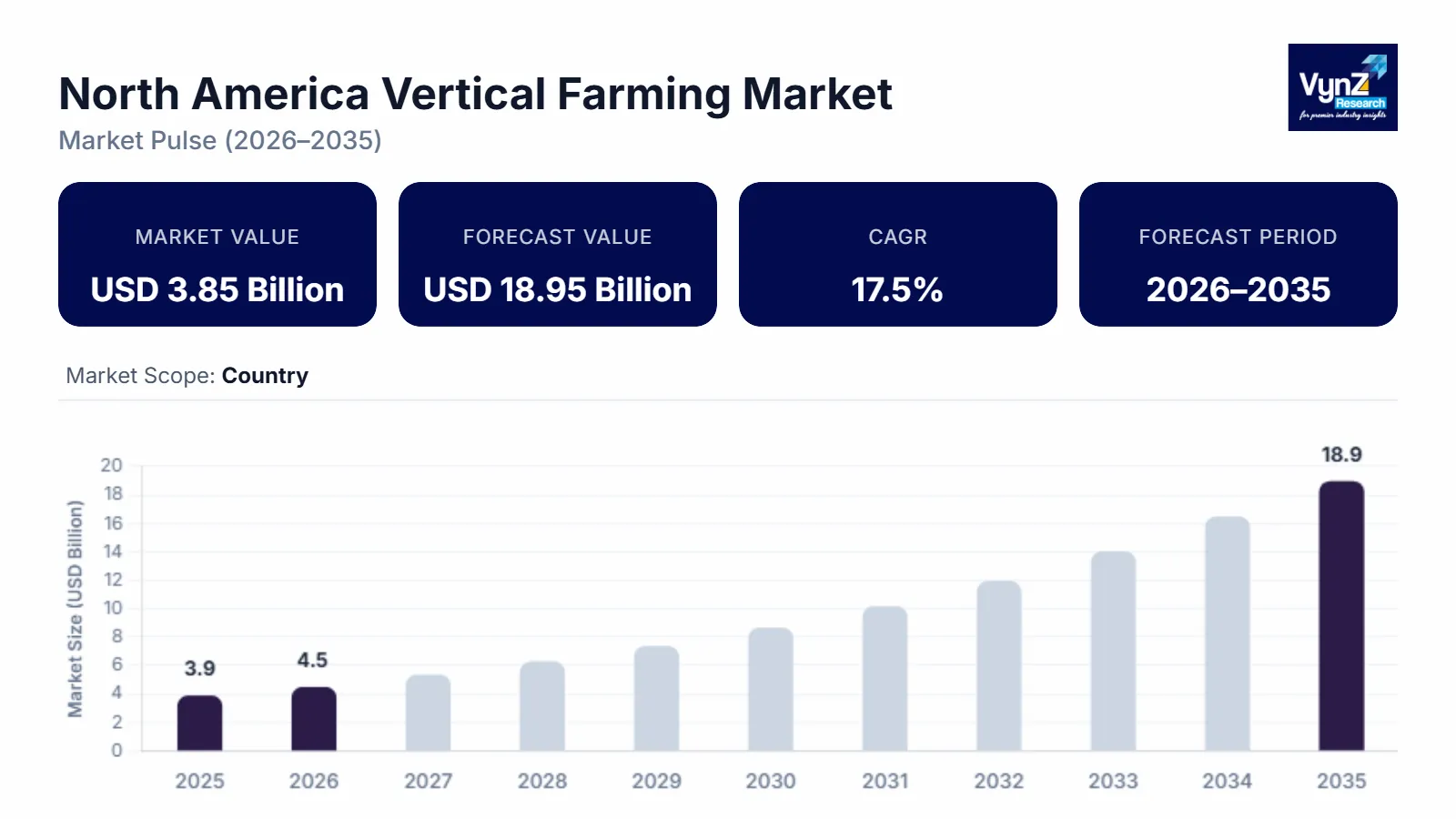
Research Highlights
- Hydroponics held 58.4% market share in 2025 due to efficient nutrient delivery and commercial scalability.
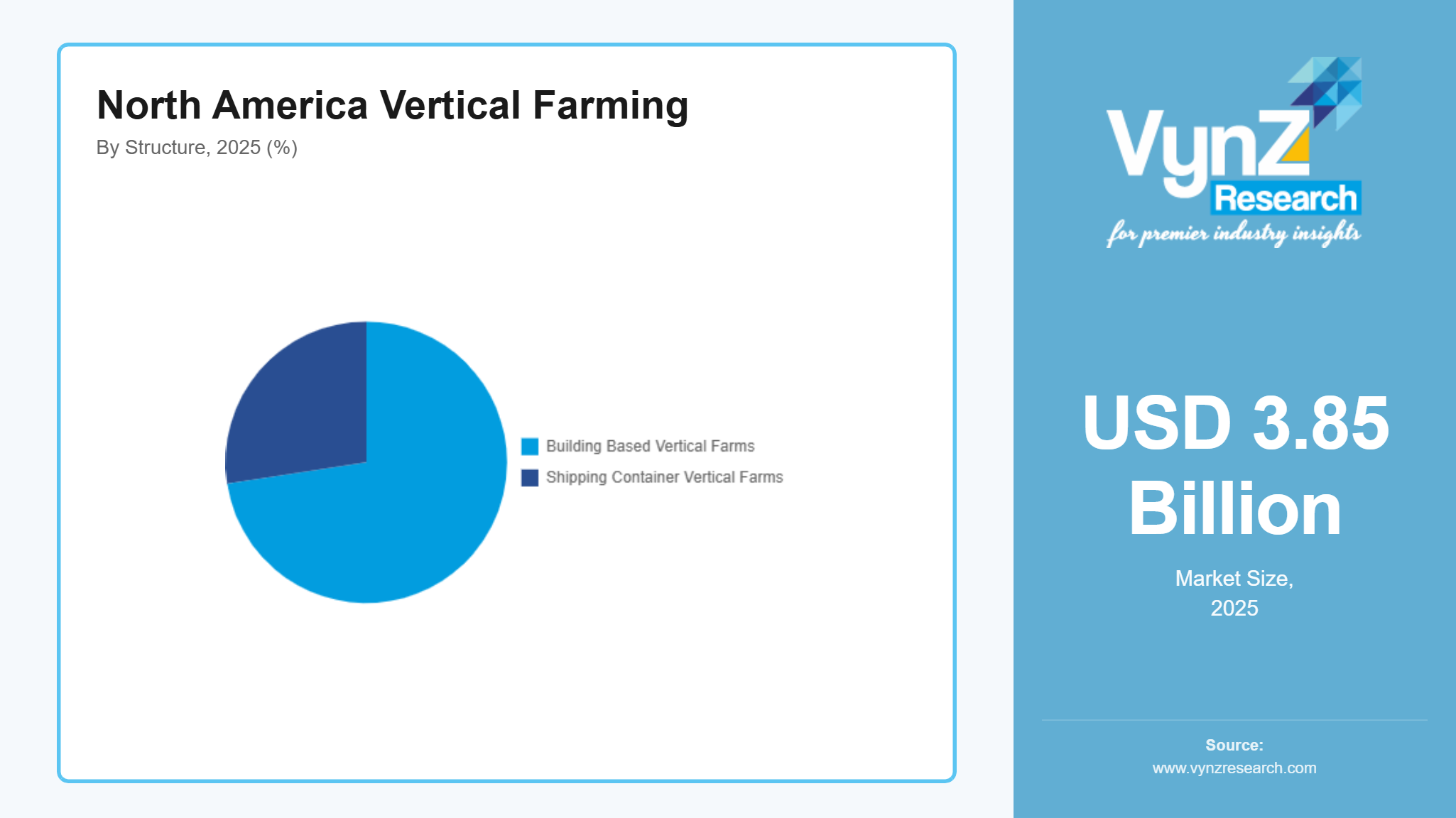
- Building based vertical farms captured 72.6% share in 2025 supported by large scale commercial production capacity.
- Lighting systems accounted for 34.8% market share in 2025 owing to widespread adoption of energy efficient LED technologies.
- Fruit bearing crops are projected to grow at 18.2% CAGR during 2026–2035 supported by precision cultivation technologies.
- The United States represented 61.8% of the market in 2025 due to strong controlled environment agriculture investments.
Market growth is motivated by increasing demand for year-round fresh produce, rapid adoption of controlled environment agriculture and advancements in LED lighting and precision automation along with rising implementation of AI enabled farm management systems. Growing preference for locally produced pesticide free vegetables and continued investments in sustainable food production initiatives are further supporting industry expansion across the United States, Canada, and Mexico. According to the United States Department of Agriculture (USDA), controlled environment agriculture has become an important approach for improving food resilience, reducing resource consumption, and strengthening domestic production. The United States Department of Energy (DOE) has also highlighted the role of energy efficient LED technologies in improving the commercial viability of indoor farming systems, while Agriculture and Agri Food Canada (AAFC) continue to support innovation programs focused on sustainable greenhouse and indoor crop production.
North America Vertical Farming Market Dynamics
Market Trends
The industry is witnessing notable shifts in controlled environment agriculture, automation and resource efficient food production. One of the key trends shaping the market is the increasing adoption of AI driven climate control and precision farming technologies reflecting growing preference for higher crop yields, energy efficiency, and reduced water consumption. According to the United States Department of Agriculture (USDA), controlled environment agriculture is becoming increasingly important for strengthening domestic food production and improving resource efficiency.
Growth Drivers
The growth of the market is largely supported by increasing demand for locally produced fresh vegetables and year-round food security which continues to generate consistent demand across commercial farms, retail supply chains, and food service operators. Increasing investments in controlled environment agriculture facilities and sustainable food infrastructure are further accelerating market expansion. The United States Department of Agriculture (USDA) continues to promote innovation that improves agricultural productivity and supply chain resilience. Additionally, increasing emphasis on sustainable farming practices is playing a crucial role in boosting adoption.
Market Restraints / Challenges
Despite favorable growth prospects, the market faces certain challenges that may limit its expansion. High capital investment and energy intensive operations continue to affect profitability and market penetration particularly among small and medium scale operators. Furthermore, dependence on advanced automation systems and skilled technical personnel poses operational challenges for growers and technology providers. Reliance on sophisticated equipment and imported components can increase production costs, create maintenance complexities and delay facility expansion during periods of supply chain disruption.
Market Opportunities
The market presents significant opportunities in urban agriculture and sustainable food production particularly driven by increasing consumer demand for locally grown fresh produce and technological advancements in controlled environment farming. Companies offering automated, high performance and resource efficient cultivation systems are well positioned to capture growing demand from commercial growers, retailers, and institutional food suppliers. The United States Department of Agriculture (USDA) continues to encourage innovative production systems that improve food resilience and resource conservation. Another key opportunity lies in digital farming technologies where growing investments in AI based monitoring, robotics and smart greenhouse management are creating avenues for higher operational efficiency and long term profitability.
North America Vertical Farming Market Report Coverage
|
Report Metric |
Details |
|
Historical Period |
2020 - 2024 |
|
Base Year Considered |
2025 |
|
Forecast Period |
2026 - 2035 |
|
Market Size in 2025 |
USD 3.85 Billion |
|
Revenue Forecast in 2035 |
USD 18.95 Billion |
|
Growth Rate |
17.5% |
|
Segments Covered in the Report |
Growth Mechanism, Structure, Component, Crop Type, End User |
|
Report Scope |
Market Trends, Drivers, and Restraints; Revenue Estimation and Forecast; Segmentation Analysis; Companies’ Strategic Developments; Market Share Analysis of Key Players; Company Profiling |
|
Regions Covered in the Report |
United States, Canada, Mexico, Rest of North America |
|
Key Companies |
AeroFarms, BrightFarms, Bowery Farming, Freight Farms, Gotham Greens, Kalera, Local Bounti, Plenty Unlimited Inc., Square Roots, Vertical Harvest |
|
Customization |
Available upon request |
North America Vertical Farming Market Segmentation
By Growth Mechanism
Hydroponics accounted for the largest market share of approximately 58.4% in 2025 and is expected to expand at nearly 17.2% CAGR through 2035 supported by high commercial adoption, efficient nutrient delivery, and lower water consumption.
Aeroponics is projected to register the fastest growth at an estimated 18.9% CAGR due to increasing investments in precision agriculture and water conservation technologies. The technology offers superior oxygen availability for plant roots and significantly lower water usage, making it attractive for commercial leafy vegetable production.
By Structure
Building based facilities held the largest revenue share of approximately 72.6% in 2025 and are projected to grow at nearly 17.3% CAGR as commercial operators continue to prioritize higher production capacity, operational scalability, and year-round cultivation.
Shipping container vertical farms are expected to witness the fastest expansion with an estimated 18.4% CAGR supported by their modular design, rapid deployment capability and suitability for urban environments with limited agricultural land.
By Component
Lighting systems represented the largest share of approximately 34.8% in 2025 and are expected to record nearly 17.0% CAGR owing to widespread deployment of advanced LED technologies across commercial indoor farms.
Software, automation, and intelligent monitoring solutions are anticipated to register the fastest growth at around 19.1% CAGR backed by increasing adoption of artificial intelligence, IoT enabled monitoring, and predictive crop management platforms.
By Crop Type
Leafy greens accounted for the largest market share of nearly 46.9% in 2025 and are projected to expand at approximately 17.4% CAGR supported by shorter cultivation cycles, high consumer demand and consistent commercial production.
Fruit bearing crops, particularly strawberries and tomatoes, are expected to record the fastest growth at an estimated 18.2% CAGR because of continuous improvements in controlled pollination, climate management, and precision lighting technologies.
By End User
Commercial growers accounted for the highest revenue share of approximately 54.2% in 2025 and are expected to maintain growth at nearly 17.3% CAGR due to increasing investments in large scale indoor farming facilities and growing demand for locally produced fresh vegetables.
Retail chains and food service providers are expected to register the fastest growth at an estimated 18.1% CAGR due to increasing consumer preference for fresh locally cultivated produce, shorter supply chains, and reduced post-harvest losses.
Regional Insights
United States
The United States accounted for approximately 62% of the market in 2025 and is expected to grow at nearly 17.6% CAGR through 2035 due to strong investment in controlled environment agriculture, rapid technology adoption and increasing demand for locally produced fresh food. Major production hubs, including California, New York, Texas, and Illinois continue to support commercial expansion. According to the United States Department of Agriculture (USDA), controlled environment agriculture is strengthening domestic food resilience and improving agricultural productivity through advanced cultivation technologies.
Canada
Canada held around 12% of the regional market in 2025 and is projected to expand at around 17.1% CAGR during the forecast period supported by increasing investments in sustainable agriculture, urban food production and controlled environment farming across Ontario, British Columbia, and Quebec. According to Agriculture and Agri Food Canada (AAFC), innovation programs continue to promote advanced greenhouse and indoor farming technologies that improve food security and environmental sustainability.
Mexico
Mexico represented nearly 7% of the market in 2025 and is expected to register nearly 18.0% CAGR supported by expanding urban agriculture, modernization of food production systems and increasing demand for premium fresh produce. According to the Secretariat of Agriculture and Rural Development (SADER), Mexico, agricultural modernization and technology adoption remain important priorities for improving productivity and strengthening domestic food supply.
Rest of North America
The Rest of North America, comprising smaller regional markets and territories, contributed about 19% of the market in 2025 and is anticipated to grow at nearly 16.8% CAGR through 2035 supported by increasing awareness of sustainable food production, gradual adoption of controlled environment agriculture, and improving access to advanced farming technologies. Government backed agricultural sustainability initiatives and regional food security programs continue to encourage investment in modern cultivation systems.
Competitive Landscape / Company Insights
The market is highly competitive with the presence of global and regional players focusing on technological innovation, automation, energy efficient cultivation systems, and geographic expansion. Companies are increasingly investing in research and development, AI enabled farm management, and advanced LED lighting technologies to strengthen their market position. The United States Department of Agriculture (USDA) continues to support controlled environment agriculture through research and innovation initiatives, while the United States Department of Energy (DOE) promotes energy efficient technologies that enhance the commercial viability of indoor farming operations.
Mini Profiles
AeroFarms focuses on advanced indoor vertical farming systems and leafy green production, supported by proprietary aeroponic technology, continuous research and development, and strong expertise in controlled environment agriculture across North America.
Bowery Farming operates in the premium indoor farming segment, emphasizing AI driven cultivation, automated farm operations, consistent crop quality, and sustainable production methods that improve efficiency and year-round supply.
Freight Farms leverages modular container farming solutions, digital monitoring platforms, and strategic partnerships to expand its market presence while enabling localized food production in urban and remote locations.
Gotham Greens specializes in commercial greenhouse and vertical farming operations, supported by extensive retail partnerships, sustainable cultivation practices, and efficient regional distribution of fresh produce across North America.
Local Bounti focuses on hybrid-controlled environment farming technologies, supported by resource efficient production systems, expanding cultivation facilities, and strong emphasis on supplying premium fresh produce to retail customers.
Key Players
- AeroFarms
- BrightFarms
- Bowery Farming
- Freight Farms
- Gotham Greens
- Kalera
- Local
- Bounti
- Plenty Unlimited Inc.
- Square Roots
- Vertical Harvest
Recent Developments
In March 2025, BrightFarms opened the world's first large scale indoor vertical farm dedicated to growing strawberries through its parent company, Plenty Unlimited. The facility combines advanced vertical farming technology with commercial berry production to strengthen year-round fresh produce supply.
In May 2025, Freight Farms continued expanding its modular container farming solutions across educational institutions and commercial growers, increasing deployment of controlled environment agriculture systems for localized food production and sustainability initiatives.
In May 2025, Plenty Unlimited Inc. successfully completed its financial restructuring and emerged from Chapter 11 proceedings. The company secured fresh funding and announced plans to expand its vertical strawberry farming technology into additional commercial locations.
In August 2025, Square Roots continued expanding its climate-controlled farming network through strategic partnerships with food retailers and distribution partners, strengthening regional supply of locally grown fresh produce and improving operational efficiency.
In August 2025, Vertical Harvest expanded commercial production capacity by investing in advanced controlled environment technologies and sustainable cultivation systems, supporting year-round crop production and improving regional food availability.
North America Vertical Farming Market Coverage
Growth Mechanism Insight and Forecast 2026 - 2035
- Hydroponics
- Aeroponics
- Aquaponics
Structure Insight and Forecast 2026 - 2035
- Building Based Vertical Farms
- Shipping Container Vertical Farms
Component Insight and Forecast 2026 - 2035
- Lighting Systems
- Climate Control Systems
- Sensors
- Irrigation Systems
- Software and Automation Solutions
Crop Type Insight and Forecast 2026 - 2035
- Leafy Greens
- Herbs
- Tomatoes
- Strawberries
- Peppers
- Cucumbers
- Other Specialty Crops
End User Insight and Forecast 2026 - 2035
- Commercial Growers
- Retail and Grocery Chains
- Food Service Providers
- Research Institutions
- Others
North America Vertical Farming Market by Region
- U.S.
- By Growth Mechanism
- By Structure
- By Component
- By Crop Type
- By End User
- Canada
- By Growth Mechanism
- By Structure
- By Component
- By Crop Type
- By End User
- Mexico
- By Growth Mechanism
- By Structure
- By Component
- By Crop Type
- By End User
Table of Contents for North America Vertical Farming Market Report
1. Research Overview
1.1. The Report Offers
1.2. Market Coverage
1.2.1. By
Growth Mechanism
1.2.2. By
Structure
1.2.3. By
Component
1.2.4. By
Crop Type
1.2.5. By
End User
1.3. Research Phases
1.4. Limitations
1.5. Market Methodology
1.5.1. Data Sources
1.5.1.1.
Primary Research
1.5.1.2.
Secondary Research
1.5.2. Methodology
1.5.2.1.
Data Exploration
1.5.2.2.
Forecast Parameters
1.5.2.3.
Data Validation
1.5.2.4.
Assumptions
1.5.3. Study Period & Data Reporting Unit
2. Executive Summary
3. Industry Overview
3.1. Industry Dynamics
3.1.1. Market Growth Drivers
3.1.2. Market Restraints
3.1.3. Key Market Trends
3.1.4. Major Opportunities
3.2. Industry Ecosystem
3.2.1. Porter’s Five Forces Analysis
3.2.2. Recent Development Analysis
3.2.3. Value Chain Analysis
3.3. Competitive Insight
3.3.1. Competitive Position of Industry
Players
3.3.2. Market Attractive Analysis
3.3.3. Market Share Analysis
4. North Market Estimate and Forecast
4.1. North Market Overview
4.2. North Market Estimate and Forecast to 2035
5. Market Segmentation Estimate and Forecast
5.1. By Growth Mechanism
5.1.1. Hydroponics
5.1.1.1. Market Definition
5.1.1.2. Market Estimation and Forecast to 2035
5.1.2. Aeroponics
5.1.2.1. Market Definition
5.1.2.2. Market Estimation and Forecast to 2035
5.1.3. Aquaponics
5.1.3.1. Market Definition
5.1.3.2. Market Estimation and Forecast to 2035
5.2. By Structure
5.2.1. Building Based Vertical Farms
5.2.1.1. Market Definition
5.2.1.2. Market Estimation and Forecast to 2035
5.2.2. Shipping Container Vertical Farms
5.2.2.1. Market Definition
5.2.2.2. Market Estimation and Forecast to 2035
5.3. By Component
5.3.1. Lighting Systems
5.3.1.1. Market Definition
5.3.1.2. Market Estimation and Forecast to 2035
5.3.2. Climate Control Systems
5.3.2.1. Market Definition
5.3.2.2. Market Estimation and Forecast to 2035
5.3.3. Sensors
5.3.3.1. Market Definition
5.3.3.2. Market Estimation and Forecast to 2035
5.3.4. Irrigation Systems
5.3.4.1. Market Definition
5.3.4.2. Market Estimation and Forecast to 2035
5.3.5. Software and Automation Solutions
5.3.5.1. Market Definition
5.3.5.2. Market Estimation and Forecast to 2035
5.4. By Crop Type
5.4.1. Leafy Greens
5.4.1.1. Market Definition
5.4.1.2. Market Estimation and Forecast to 2035
5.4.2. Herbs
5.4.2.1. Market Definition
5.4.2.2. Market Estimation and Forecast to 2035
5.4.3. Tomatoes
5.4.3.1. Market Definition
5.4.3.2. Market Estimation and Forecast to 2035
5.4.4. Strawberries
5.4.4.1. Market Definition
5.4.4.2. Market Estimation and Forecast to 2035
5.4.5. Peppers
5.4.5.1. Market Definition
5.4.5.2. Market Estimation and Forecast to 2035
5.4.6. Cucumbers
5.4.6.1. Market Definition
5.4.6.2. Market Estimation and Forecast to 2035
5.4.7. Other Specialty Crops
5.4.7.1. Market Definition
5.4.7.2. Market Estimation and Forecast to 2035
5.5. By End User
5.5.1. Commercial Growers
5.5.1.1. Market Definition
5.5.1.2. Market Estimation and Forecast to 2035
5.5.2. Retail and Grocery Chains
5.5.2.1. Market Definition
5.5.2.2. Market Estimation and Forecast to 2035
5.5.3. Food Service Providers
5.5.3.1. Market Definition
5.5.3.2. Market Estimation and Forecast to 2035
5.5.4. Research Institutions
5.5.4.1. Market Definition
5.5.4.2. Market Estimation and Forecast to 2035
5.5.5. Others
5.5.5.1. Market Definition
5.5.5.2. Market Estimation and Forecast to 2035
6. U.S. Market Estimate and Forecast
6.1. By
Growth Mechanism
6.2. By
Structure
6.3. By
Component
6.4. By
Crop Type
6.5. By
End User
7. Canada Market Estimate and Forecast
7.1. By
Growth Mechanism
7.2. By
Structure
7.3. By
Component
7.4. By
Crop Type
7.5. By
End User
8. Mexico Market Estimate and Forecast
8.1. By
Growth Mechanism
8.2. By
Structure
8.3. By
Component
8.4. By
Crop Type
8.5. By
End User
9. Company Profiles
9.1.
AeroFarms
9.1.1.
Snapshot
9.1.2.
Overview
9.1.3.
Offerings
9.1.4.
Financial
Insight
9.1.5.
Recent
Developments
9.2.
BrightFarms
9.2.1.
Snapshot
9.2.2.
Overview
9.2.3.
Offerings
9.2.4.
Financial
Insight
9.2.5.
Recent
Developments
9.3.
Bowery Farming
9.3.1.
Snapshot
9.3.2.
Overview
9.3.3.
Offerings
9.3.4.
Financial
Insight
9.3.5.
Recent
Developments
9.4.
Freight Farms
9.4.1.
Snapshot
9.4.2.
Overview
9.4.3.
Offerings
9.4.4.
Financial
Insight
9.4.5.
Recent
Developments
9.5.
Gotham Greens
9.5.1.
Snapshot
9.5.2.
Overview
9.5.3.
Offerings
9.5.4.
Financial
Insight
9.5.5.
Recent
Developments
9.6.
Kalera
9.6.1.
Snapshot
9.6.2.
Overview
9.6.3.
Offerings
9.6.4.
Financial
Insight
9.6.5.
Recent
Developments
9.7.
Local Bounti
9.7.1.
Snapshot
9.7.2.
Overview
9.7.3.
Offerings
9.7.4.
Financial
Insight
9.7.5.
Recent
Developments
9.8.
Plenty Unlimited Inc.
9.8.1.
Snapshot
9.8.2.
Overview
9.8.3.
Offerings
9.8.4.
Financial
Insight
9.8.5.
Recent
Developments
9.9.
Square Roots
9.9.1.
Snapshot
9.9.2.
Overview
9.9.3.
Offerings
9.9.4.
Financial
Insight
9.9.5.
Recent
Developments
9.10.
Vertical Harvest
9.10.1.
Snapshot
9.10.2.
Overview
9.10.3.
Offerings
9.10.4.
Financial
Insight
9.10.5.
Recent
Developments
10. Appendix
10.1. Exchange Rates
10.2. Abbreviations
Note: Financial insight and recent developments of different companies are subject to the availability of information in the secondary domain.
Frequently Asked Questions
Purchase Options
Latest Report
Research Methodology
- Desk Research / Pilot Interviews
- Build Market Size Model
- Research and Analysis
- Final Deliverable
Connect With Our Sales Team
- Toll-Free: +1-888-253-3960
- Phone: +91 9960 288 381
- Email: enquiry@vynzresearch.com
North America Vertical Farming Market