
U.S. Bike-Sharing Market Size & Share - Growth Forecast Report (2026-2035)
Industry Insight by Bicycle Type (Conventional Bicycles, Electric Bicycles), by Sharing Model (Station Based, Dockless), by Service Type (Short Term Rentals, Subscription Based Services), by End Use (Government Operators, Private Operators)
| Status : Published | Published On : Aug, 2026 | Report Code : VRAT9677 | Industry : Automotive & Transportation | Available Format :

|
Page : 136 |
U.S. Bike-Sharing Market Overview
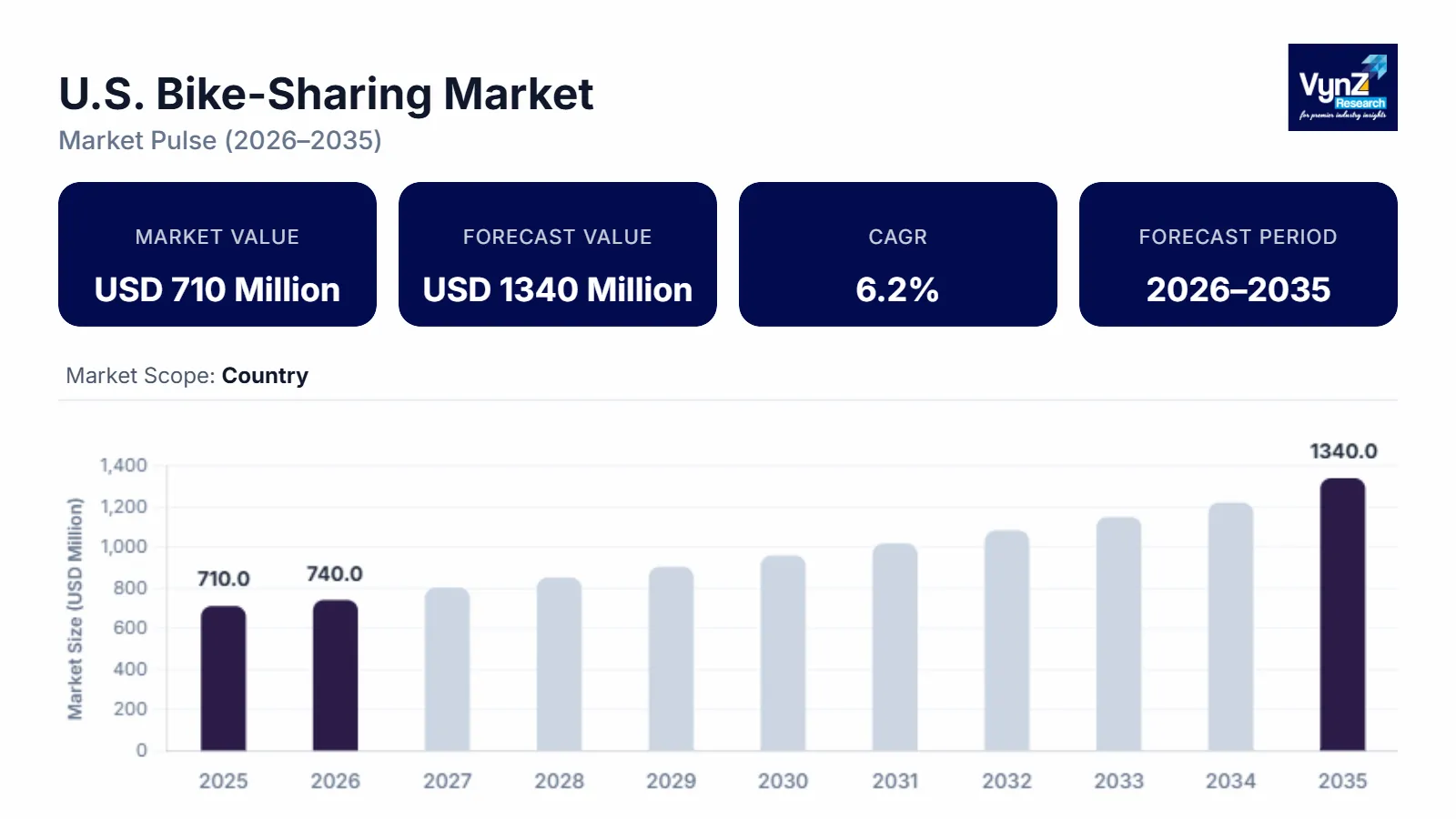
The U.S. bike-sharing market size was estimated at approximately USD 710 million in 2025 and is expected to reach around USD 740 million in 2026, rising to nearly USD 1,340 million by 2035, with an estimated 6.2% CAGR from 2026 to 2035.
Research Highlights
- Conventional bicycles held 58.7% market share in 2025 due to lower costs.
- Short term rentals captured 63.5% share in 2025 supported by flexible usage.
- Government operators accounted for 56.8% revenue share in 2025 owing to public programs.
- Electric bicycles are projected to grow at 8.9% CAGR during 2026–2035 because of higher urban mobility demand.
- Northeastern U.S. represented 29.4% market share in 2025 supported by dense urban networks.
Market growth is influenced by increasing urbanization, rising demand for sustainable transportation options, and the growing popularity of smartphone-based mobility apps, plus the growing usage of e-bikes in shared transportation systems. Increasing need for efficient transportation and investment in bicycle-friendly infrastructure and smart mobility programs by USDOT, FTA and state agencies to promote low-emission mobility and alternative transportation are driving the market in New York, California, Washington, Illinois and other leading states.
U.S. Bike-Sharing Market Dynamics
Market Trends
The U.S. bike-sharing market is witnessing a positive trend in terms of shared mobility, electric bicycle usage, and digitalization. One of the major trends influencing the market is the rising usage of e-bikes in sharing platforms due to shifting consumer preferences towards quick, convenient, and eco-friendly transportation. The transportation sector is witnessing the development of micro-mobility programs and bicycle-friendly infrastructure to promote alternate ways of short-distance travel. The USDOT offers programs to promote active transportation, mobility, and bike-friendly infrastructure. Another significant trend is the application of apps, location-based systems, tap-and-go cards, and analytics in the shared bicycle industry due to digitization and changing consumer behavior.
Growth Drivers
The primary factor that propels the growth of the market is the demand for sustainable transportation alternatives that would offer flexibility to travelers. The need for shared transportation is increasing across developed countries due to the growing concern about climate change and improved first-mile and last-mile connectivity. The increasing number of local bike-sharing schemes across the U.S. indicates the need for minimizing carbon footprints for attaining sustainability goals. The EPA promotes programs that ensure clean transportation and minimize environmental impact. Moreover, the development of bicycle-friendly infrastructure and intelligent transportation solutions is anticipated to drive the U.S. Bike-Sharing Market growth during the forecast period.
Market Restraints/Challenges
One of the primary challenges that hinder the growth of the market is the dependence of shared bike services on weather and seasonal variations. These factors impact the adoption of shared bikes, resulting in hampered service utilization and hindered market growth. In addition, the rising costs of maintenance, redistribution, vandalism, and management is challenging for market players, affecting their profit margins. Another challenge for the U.S. Bike-Sharing Market is the need for continuous investments in supporting infrastructure for e-bikes. The increasing reliance on e-bikes for commercial purposes requires appropriate charging infrastructure and smart city programs for convenient and eco-friendly travel.
Market Opportunities
One of the prominent opportunities for the market is the demand for electric bike-sharing services. The rising need for shared transport and government initiatives for promoting zero-emission vehicles would benefit the e-bike manufacturers and suppliers. Firms that offer flexible transportation solutions through innovative platforms and subscriptions are anticipated to gain significantly, as they address the needs of a large consumer base, including students and travelers. These companies would witness heightened investment in the future due to the expanding consumer base. Another remarkable opportunity for the U.S. Bike-Sharing Market is the utilization of shared bike platforms for offering public transport services.
U.S. Bike-Sharing Market Report Coverage
|
Report Metric |
Details |
|
Historical Period |
2020 - 2024 |
|
Base Year Considered |
2025 |
|
Forecast Period |
2026 - 2035 |
|
Market Size in 2025 |
USD 710 Million |
|
Revenue Forecast in 2035 |
USD 1.340 Million |
|
Growth Rate |
6.2% |
|
Segments Covered in the Report |
Type, Sharing Model, Service Type, End Use |
|
Report Scope |
Market Trends, Drivers, and Restraints; Revenue Estimation and Forecast; Segmentation Analysis; Companies’ Strategic Developments; Market Share Analysis of Key Players; Company Profiling |
|
Regions Covered in the Report |
Northeastern U.S., Western U.S., Southern U.S., Other U.S. Regions |
|
Key Companies |
Bird Global Inc., Citi Bike, Lyft Inc., Lime, Spin, TIER Mobility, Veo, Wheels, Zagster, Zoomo |
|
Customization |
Available upon request |
U.S. Bike-Sharing Market Segmentation
By Type
In 2025, the conventional segment was the largest with a share of around 58.7%. The segment is majorly driven by the demand for lower maintenance costs associated with traditional cycles. It is also widely distributed and accessible for short-distance travel.
The electric bicycle segment is projected to witness exponential growth and is estimated to register a CAGR of around 8.9% during the forecast period. This is primarily because of the higher flexibility associated with them coupled with technological advancements.
By Sharing Model
In 2025, the former accounted for 54.2% of the total market share. It is majorly driven by the organized management of these systems and their ability to offer reliable transportation services.
The latter is projected to register a CAGR of 7.4% during the forecast period. It is expected to gain substantial growth due to the convenience offered by the flexible booking and pickup/drop-off options.
By Service Type
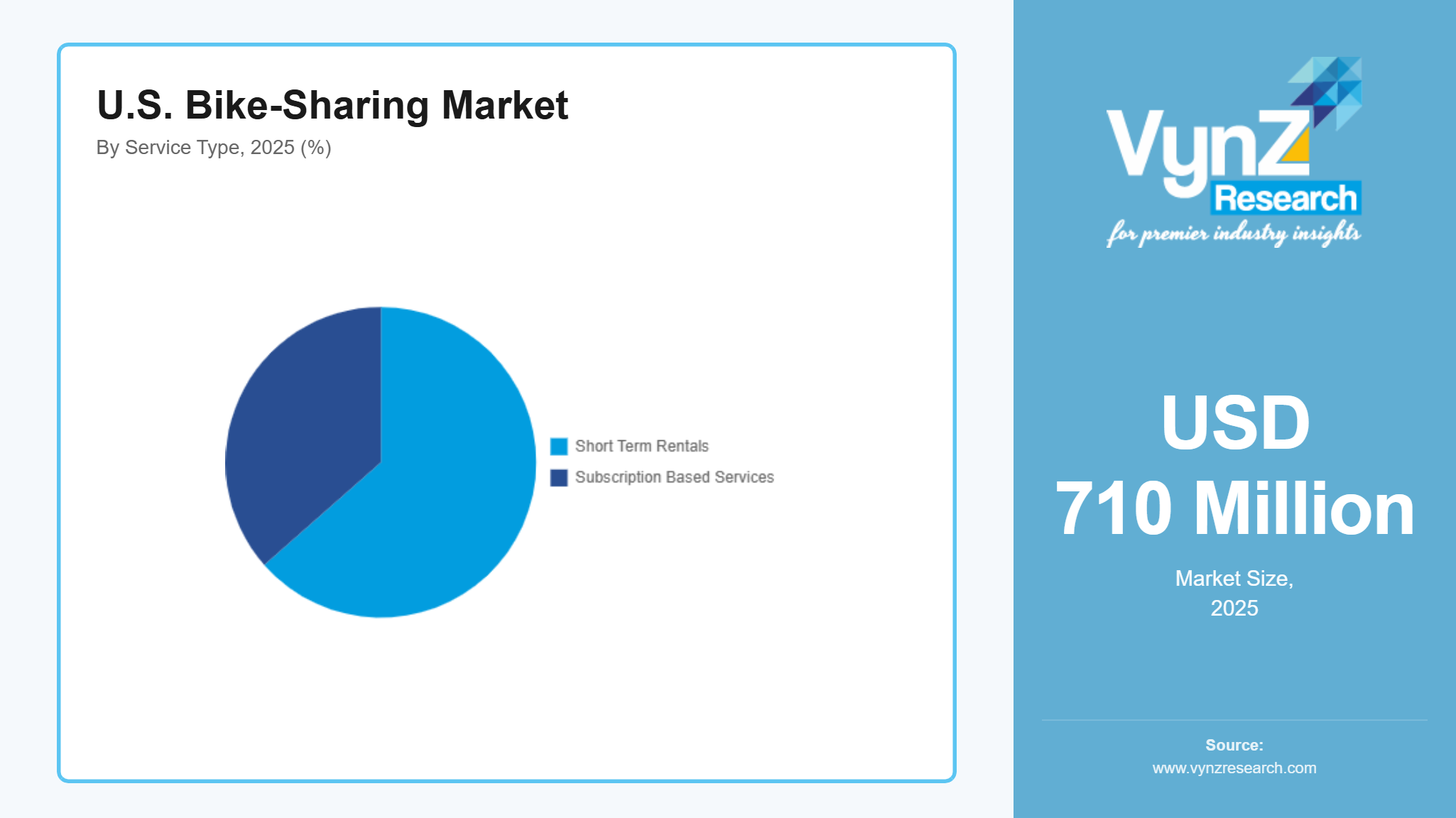
Short-term rentals accounted for 63.5% of the total market share due to higher flexibility to the users. This is the primary reason that this segment has witnessed significant adoption, especially for tourism.
Subscription-based service is projected to register a CAGR of 7.8% during the forecast period due to their ability to offer reliable transportation services at reasonable rates. Operators are capitalizing on the higher flexibility of these plans and the ability to earn stable revenues from these services.
By End Use
In 2025, the government segment accounted for 56.8% of the total market value since the programs are majorly promoted by municipal authorities. They rely on conventional bikes to offer transportation services to the residents while minimizing costs. Several initiatives are being taken by the government to ensure higher accessibility to these programs while reducing carbon emissions.
The private segment is projected to register a CAGR of 7.1% during the forecast period. It is anticipated that private operators will capitalize on the rising need for flexible transportation services coupled with higher investment in advanced technologies.
Regional Insights
Northeastern U.S.
The Northeastern U.S. captured 29.4% of the U.S. bike-sharing market in 2025, with the region witnessing a significant number of investments and an increase in the number of shared bicycle users in the major cities of New York, Massachusetts, and Pennsylvania. The region has seen a surge of investment in the cycling infrastructure to promote the mode of transport by complementing it with public transportation. The USDOT is promoting active transportation and has invested in numerous bike infrastructure projects to improve the cycling experience.
Western U.S.
The Western U.S. commanded a share of 27.6% in the market in 2025 being home to popular cycling-friendly cities such as San Francisco, Seattle, and Portland, among others. Sustainability-focused initiatives and substantial investment in the development of the cycling infrastructure across the state have led to a significant rise in the usage of shared bicycles. Federal agencies such as the FTA are witnessing rising interest in transportation modes that minimize carbon footprint and are working towards improving interconnectivity and multimodal commuting within the region.
Southern U.S.
The Southern U.S. registered a share of 20.3% in the market in 2025. The region has seen a rise in the number of start-ups and shared transportation offerings due to the increase in the adoption of smart city initiatives in the major cities such as Texas, Florida, and Georgia, among others. Municipal authorities have taken initiatives to encourage and invest in the development of bicycle infrastructure to reduce traffic congestion and promote commuting using shared transportation. The combination of increased investments in bike infrastructure and digitization of the shared cycling experience is assisting the region in witnessing exponential growth.
The remaining 22.7% being distributed across the Midwestern U.S., Mountain States, and the other regions that are projected to witness significant growth due to the rising investments in improved cycling infrastructure, sustainability-focused initiatives, and increasing investment in the digitization of the shared cycling experience.
Competitive Landscape / Company Insights
The market is quite competitive as the key players focus on enhancing their presence through the addition of more bikes, e-bikes, and digital platforms and promoting partnerships with local authorities. The companies also invest heavily in developing connected fleet management systems, apps, and GPS tracking systems. Additionally, USDOT, FTA, and other authorities promote alternative transportation, encouraging the development of shared mobility schemes that offer transportation at an affordable rate while reducing greenhouse gas emissions.
Mini Profiles
Bird Global Inc. focuses on shared electric bicycles and micromobility solutions, supported by digital platforms, urban partnerships, and technology driven fleet management capabilities.
Citi Bike operates one of the largest bike-sharing networks in the U.S., emphasizing urban accessibility, public transportation integration, and convenient commuter mobility solutions.
Lyft Inc. operates shared bicycle and micromobility services through Lyft Bikes and Scooters, supported by strong digital infrastructure and transportation network integration.
Lime provides shared electric bicycles and micromobility solutions across global cities, supported by app-based access, flexible operations, and extensive urban partnerships.
Spin focuses on shared bicycles and electric mobility services, supported by smart fleet technology, university partnerships, and municipal transportation collaborations.
Key Players
- Bird Global Inc.
- Citi Bike
- Lyft Inc.
- Lime
- Spin
- TIER Mobility
- Veo
- Wheels
- Zagster
- Zoomo
Recent Developments
In January 2026, Veo expanded its shared micromobility technology portfolio by introducing improved fleet management solutions and enhanced electric bicycle operations. The development supports increasing demand for efficient urban mobility services and sustainable transportation alternatives.
In March 2026, Lime expanded its electric bicycle sharing operations across additional urban markets in the United States. The expansion strengthens its position in app-based mobility services and supports growing demand for flexible transportation solutions.
In February 2025, Lyft Inc. expanded its Citi Bike operations through continued investments in fleet availability, station improvements, and digital user experience enhancements. The initiative supports increasing commuter adoption of shared bicycle services.
In April 2025, Bird Global Inc. strengthened its micromobility technology platform by improving operational efficiency and expanding partnerships with urban transportation stakeholders. The development supports broader adoption of shared electric mobility solutions.
In May 2025, Spin expanded its electric bicycle and scooter sharing services through additional city and institutional partnerships. The development improves service accessibility and supports sustainable transportation adoption across urban communities.
U.S. Bike-Sharing Market Coverage
Bicycle Type Insight and Forecast 2026 - 2035
- Conventional Bicycles
- Electric Bicycles
Sharing Model Insight and Forecast 2026 - 2035
- Station Based
- Dockless
Service Type Insight and Forecast 2026 - 2035
- Short Term Rentals
- Subscription Based Services
End Use Insight and Forecast 2026 - 2035
- Government Operators
- Private Operators
U.S. Bike-Sharing Market by Region
Table of Contents for U.S. Bike-Sharing Market Report
1. Research Overview
1.1. The Report Offers
1.2. Market Coverage
1.2.1. By
Bicycle Type
1.2.2. By
Sharing Model
1.2.3. By
Service Type
1.2.4. By
End Use
1.3. Research Phases
1.4. Limitations
1.5. Market Methodology
1.5.1. Data Sources
1.5.1.1.
Primary Research
1.5.1.2.
Secondary Research
1.5.2. Methodology
1.5.2.1.
Data Exploration
1.5.2.2.
Forecast Parameters
1.5.2.3.
Data Validation
1.5.2.4.
Assumptions
1.5.3. Study Period & Data Reporting Unit
2. Executive Summary
3. Industry Overview
3.1. Industry Dynamics
3.1.1. Market Growth Drivers
3.1.2. Market Restraints
3.1.3. Key Market Trends
3.1.4. Major Opportunities
3.2. Industry Ecosystem
3.2.1. Porter’s Five Forces Analysis
3.2.2. Recent Development Analysis
3.2.3. Value Chain Analysis
3.3. Competitive Insight
3.3.1. Competitive Position of Industry
Players
3.3.2. Market Attractive Analysis
3.3.3. Market Share Analysis
4. U.S. Market Estimate and Forecast
4.1. U.S. Market Overview
4.2. U.S. Market Estimate and Forecast to 2035
5. Market Segmentation Estimate and Forecast
5.1. By Bicycle Type
5.1.1. Conventional Bicycles
5.1.1.1. Market Definition
5.1.1.2. Market Estimation and Forecast to 2035
5.1.2. Electric Bicycles
5.1.2.1. Market Definition
5.1.2.2. Market Estimation and Forecast to 2035
5.2. By Sharing Model
5.2.1. Station Based
5.2.1.1. Market Definition
5.2.1.2. Market Estimation and Forecast to 2035
5.2.2. Dockless
5.2.2.1. Market Definition
5.2.2.2. Market Estimation and Forecast to 2035
5.3. By Service Type
5.3.1. Short Term Rentals
5.3.1.1. Market Definition
5.3.1.2. Market Estimation and Forecast to 2035
5.3.2. Subscription Based Services
5.3.2.1. Market Definition
5.3.2.2. Market Estimation and Forecast to 2035
5.4. By End Use
5.4.1. Government Operators
5.4.1.1. Market Definition
5.4.1.2. Market Estimation and Forecast to 2035
5.4.2. Private Operators
5.4.2.1. Market Definition
5.4.2.2. Market Estimation and Forecast to 2035
5. Company Profiles
5.1.
Bird Global Inc.
5.1.1.
Snapshot
5.1.2.
Overview
5.1.3.
Offerings
5.1.4.
Financial
Insight
5.1.5.
Recent
Developments
5.2.
Citi Bike
5.2.1.
Snapshot
5.2.2.
Overview
5.2.3.
Offerings
5.2.4.
Financial
Insight
5.2.5.
Recent
Developments
5.3.
Lyft Inc.
5.3.1.
Snapshot
5.3.2.
Overview
5.3.3.
Offerings
5.3.4.
Financial
Insight
5.3.5.
Recent
Developments
5.4.
Lime
5.4.1.
Snapshot
5.4.2.
Overview
5.4.3.
Offerings
5.4.4.
Financial
Insight
5.4.5.
Recent
Developments
5.5.
Spin
5.5.1.
Snapshot
5.5.2.
Overview
5.5.3.
Offerings
5.5.4.
Financial
Insight
5.5.5.
Recent
Developments
5.6.
TIER Mobility
5.6.1.
Snapshot
5.6.2.
Overview
5.6.3.
Offerings
5.6.4.
Financial
Insight
5.6.5.
Recent
Developments
5.7.
Veo
5.7.1.
Snapshot
5.7.2.
Overview
5.7.3.
Offerings
5.7.4.
Financial
Insight
5.7.5.
Recent
Developments
5.8.
Wheels
5.8.1.
Snapshot
5.8.2.
Overview
5.8.3.
Offerings
5.8.4.
Financial
Insight
5.8.5.
Recent
Developments
5.9.
Zagster
5.9.1.
Snapshot
5.9.2.
Overview
5.9.3.
Offerings
5.9.4.
Financial
Insight
5.9.5.
Recent
Developments
5.10.
Zoomo
5.10.1.
Snapshot
5.10.2.
Overview
5.10.3.
Offerings
5.10.4.
Financial
Insight
5.10.5.
Recent
Developments
6. Appendix
6.1. Exchange Rates
6.2. Abbreviations
Note: Financial insight and recent developments of different companies are subject to the availability of information in the secondary domain.
Purchase Options
Latest Report
Research Methodology
- Desk Research / Pilot Interviews
- Build Market Size Model
- Research and Analysis
- Final Deliverable
Connect With Our Sales Team
- Toll-Free: +1-888-253-3960
- Phone: +91 9960 288 381
- Email: enquiry@vynzresearch.com
U.S. Bike-Sharing Market