
U.S. Two-Wheeler Logistics Market Size & Share | Growth Forecast Report (2026-2035)
Industry Insight by Vehicle Type (Motorcycles, Scooters, Electric Scooters, Electric Motorcycles), by Service Type (Food Delivery, Parcel and Courier Delivery, Grocery Delivery, Pharmacy Delivery, Others), by Propulsion Type (Internal Combustion Engine (ICE), Electric), by End User (E-commerce Companies, Courier and Logistics Providers, Food Delivery Platforms, Healthcare & Pharmacy Providers)
| Status : Published | Published On : Aug, 2026 | Report Code : VRAT9677 | Industry : Automotive & Transportation | Available Format :

|
Page : 122 |
U.S. Two-Wheeler Logistics Market Overview
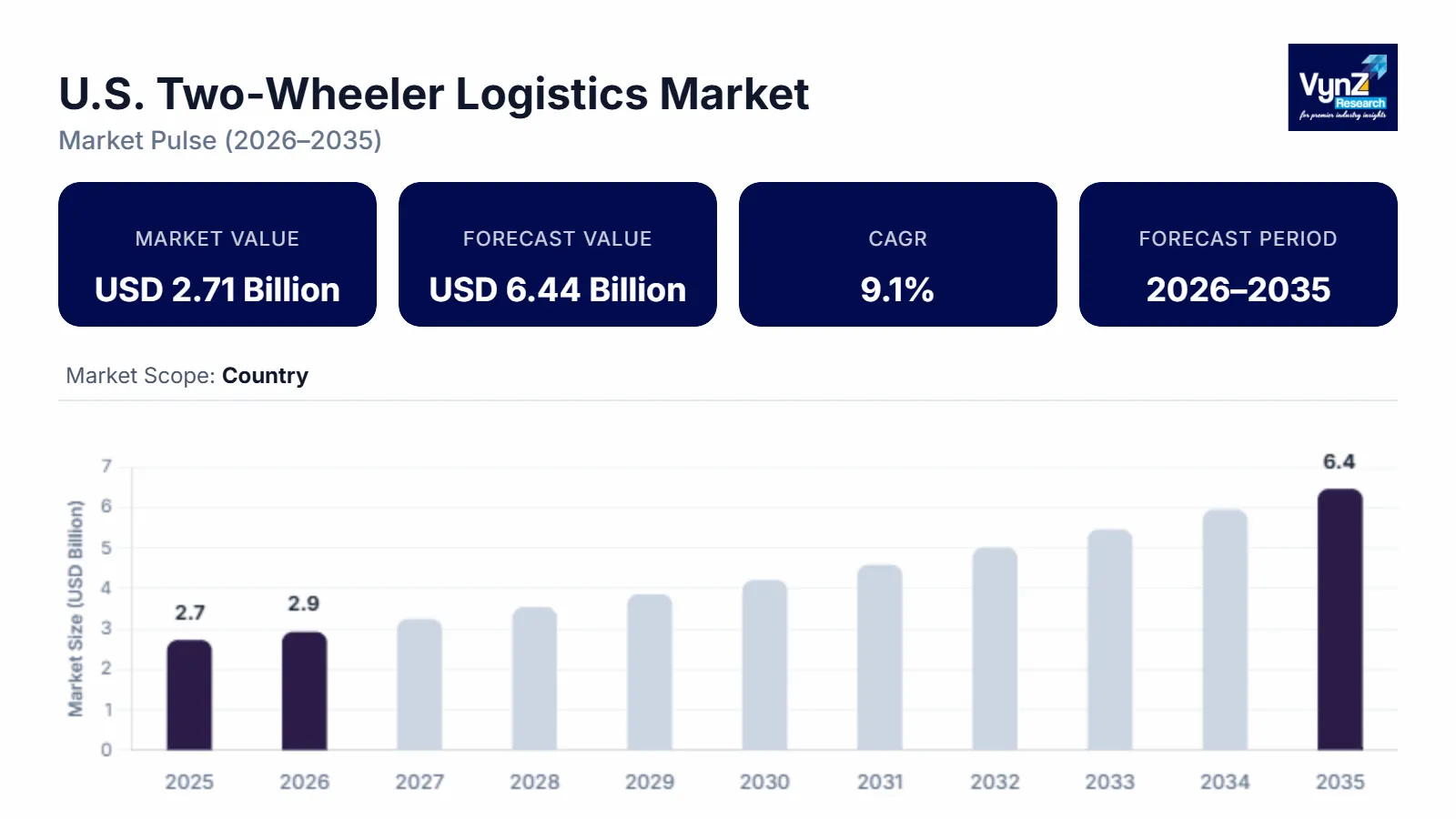
The U.S. two-wheeler logistics market size was estimated at approximately USD 2.71 billion in 2025 and is expected to reach around USD 2.91 billion in 2026, rising to nearly USD 6.44 billion by 2035, growing at an estimated 9.1% CAGR during 2026 to 2035.
Research Highlights
- Motorcycles held 38.7% share in 2025 due to higher payload capacity.
- Parcel and courier delivery captured 34.6% share in 2025 supported by e-commerce growth.
- Courier and logistics providers generated 42.8% revenue in 2025 owing to rising parcel volumes.
- Electric scooters are projected at 10.8% CAGR during 2026 to 2035 because of fleet electrification.
- California represented 29.8% market share in 2025 supported by urban delivery demand.
Market growth is fueled by the rising need for quick commercial deliveries within urban areas. The growing adoption of electric two-wheelers for commercial use and the rising investments in digitalization of fleet management solutions are some of the major growth drivers for the market. The rising usage of two-wheelers, supported by USDOT, NHTSA, and FHWA, for commercial purposes by courier firms, restaurant delivery services, pharmacy organizations, and e-commerce giants, is projected to propel the growth of the electric two-wheeler market in California, Texas, Florida, New York, and the rest of the US during the forecast period. Enhanced emphasis on developing smart cities and adopting electric vehicles will supplement market growth in the years ahead.
U.S. Two-Wheeler Logistics Market Dynamics
Market Trends
The market is witnessing a significant rise in the adoption of electric fleets, advanced telematics for optimizing delivery routes, and emerging micro-mobility logistics. One of the major trends impacting the market is the growing use of electric motorcycles and scooters to cater to the rising need for cost-effective and quick commercial deliveries. In addition, logistic companies are focusing on deploying telematics, GPS enabled fleet management solutions and other technologies to enhance their operations. Another major trend is the rapid adoption of advanced artificial intelligence, cloud-based fleet management, and route optimization solutions in order to leverage the digitization opportunities and address the surging demand for e-commerce deliveries.
Growth Drivers
The market growth is primarily propelled by the growing need for logistics services from e-commerce and food delivery companies. In addition, the surging demand for same-day deliveries and rising investments in micro-fulfilment centers are projected to propel the growth of the market during the forecast period. As the e-commerce sector is witnessing robust growth, the U.S census bureau is witnessing a rise in e-commerce sales. Moreover, the adoption of electric two-wheelers, digitalization of logistics, and the growing emphasis on sustainable transportation solutions are anticipated to drive the U.S. Two-Wheeler Logistics Market growth. With logistic companies focusing on leveraging electric two-wheelers for their operations due to their cost-effectiveness, the demand for two-wheeler logistics services is expected to witness a significant rise in the coming years.
Market Restraints/Challenges
Despite the positive growth drivers, the market is expected to encounter various challenges that may hinder its growth. The limited cargo capacity along with the rising safety concerns and adverse weather impact the deliveries using two-wheelers, which in turn, may impede the growth of the market. In addition, the surging insurance costs and high maintenance costs of two-wheelers may reduce the profitability of logistic providers. Compliance with government regulations, battery swapping, and the skill set of delivery personnel present as potential challenges to the growth of the market. The differences in state-wise traffic laws and the availability of charging infrastructure may add to the complexities involved in two-wheeler logistics.
Market Opportunities
The market has lucrative opportunities in electric two-wheeler logistics, autonomous delivery, and micromobility logistics. Companies operating in the logistics space offering smart fleet management solutions, battery swapping, and artificial intelligence enabled route planning and optimization are well positioned to meet the growing demand for two-wheeler logistics services in the near future. Another major opportunity for the market participants is the growing investment in quick commerce, healthcare logistics, and urban micro-fulfilment to support the surging digital retail sales. The digitization of the urban logistics sector presents an opportunity for companies to tap into the e-commerce and food delivery logistics segment and establish long term partnerships with key market participants.
U.S. Two-Wheeler Logistics Market Report Coverage
|
Report Metric |
Details |
|
Historical Period |
2020 - 2024 |
|
Base Year Considered |
2025 |
|
Forecast Period |
2026 - 2035 |
|
Market Size in 2025 |
USD 2.71 Billion |
|
Revenue Forecast in 2035 |
USD 6.44 Billion |
|
Growth Rate |
9.1% |
|
Segments Covered in the Report |
Vehicle Type, Service Type, Propulsion Type, End User |
|
Report Scope |
Market Trends, Drivers, and Restraints; Revenue Estimation and Forecast; Segmentation Analysis; Companies’ Strategic Developments; Market Share Analysis of Key Players; Company Profiling |
|
Regions Covered in the Report |
California, Texas, Florida, Rest of the U.S. |
|
Key Companies |
Amazon Logistics, DoorDash, Inc., DHL Express USA, FedEx Corporation, Gopuff, Instacart, Roadie, Inc., Uber Eats, UPS Inc., Walmart Spark |
|
Customization |
Available upon request |
U.S. Two-Wheeler Logistics Market Segmentation
By Vehicle Type
In 2025, motorcycles held the highest share of the market with approximately 38.7% owing to their high cargo capacity, long driving range, and utilization in courier, parcel, and food delivery services. Being cost-effective compared to conventional delivery vans and suitable for traffic-heavy urban areas contributes to their substantial demand.
Electric scooters are projected to register the highest compound annual growth rate of approximately 10.8% during the forecast period. The growing adoption of electric vehicles in commercial and industrial logistics, reduced maintenance cost, and government support for zero-emission transportation are factors influencing the segment’s growth.
By Service Type
Parcel and courier delivery segment holds the highest revenue share in 2025, accounting for approximately 34.6% of the overall market. The growth of the segment is attributable to the proliferation of e-commerce, increased demand for same-day delivery services, and rising investments in modernizing urban logistics infrastructure.
The grocery delivery segment is projected to register the highest CAGR of approximately 10.2% during the forecast period. The rising consumer propensity towards online grocery shopping and quick commerce services fuels the segment growth.
By Propulsion Type
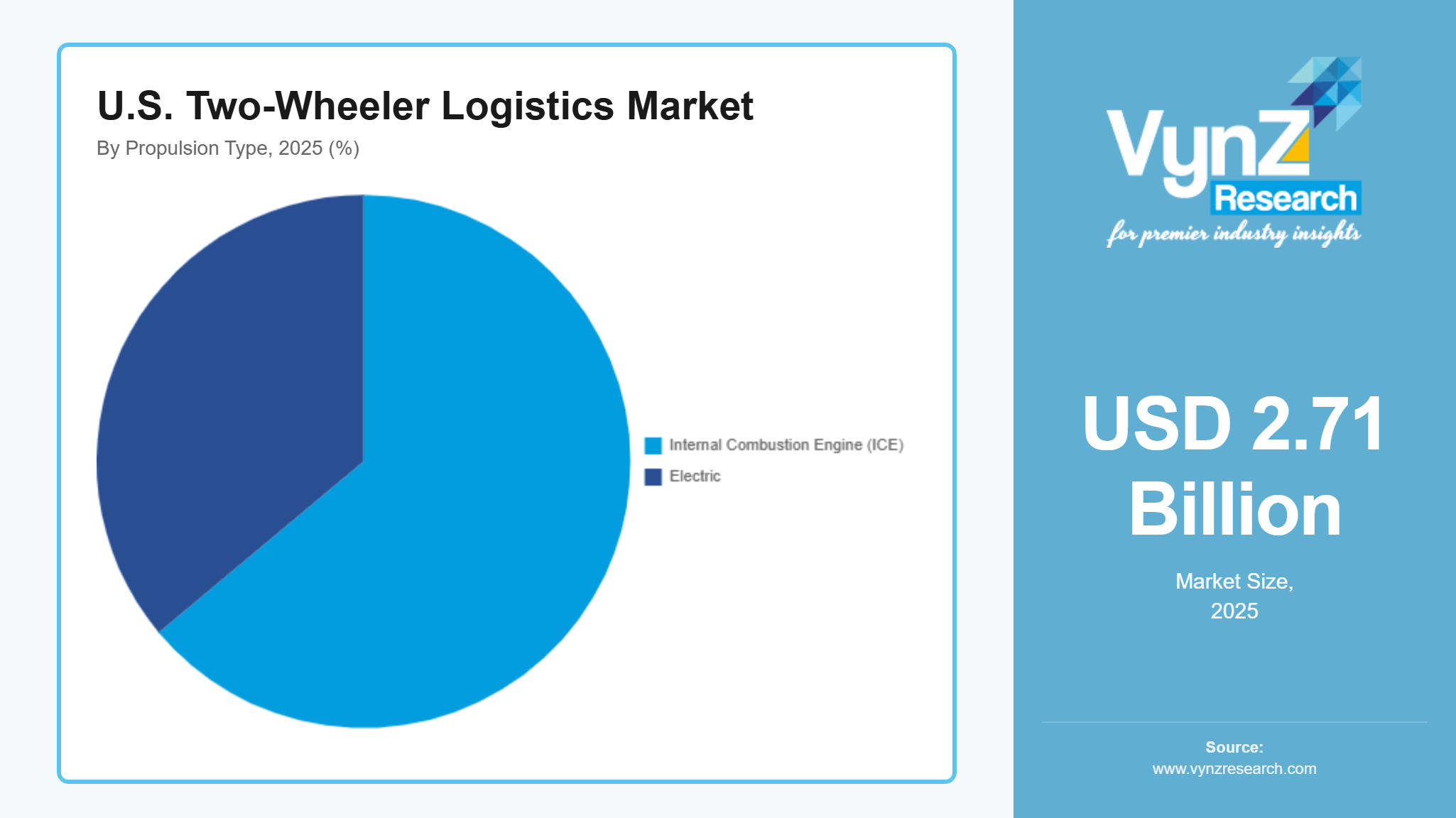
Internal combustion engine (ICE) held the highest revenue share in 2025 with approximately 63.9%. The ICE segment’s dominance is due to the vehicles’ long driving range, well-established refueling infrastructure, and flexibility in delivering goods over short and long distances.
Electric is anticipated to register the highest CAGR of approximately 11.3% during the forecast period. The growing environmental concerns, reduced operational costs, and shifting toward emission-free commercial and industrial logistics are significant factors boosting the segment’s growth.
By End User
Courier and logistics providers held the highest end-user segment with approximately 42.8% revenue share in 2025. The growing e-commerce industry, increased demand for last-mile delivery services, and rising investments by courier companies in two-wheeler logistics networks are some factors influencing the segment’s growth.
Healthcare & pharmacy providers are projected to register the highest CAGR of approximately 9.7% during the forecast period. The growing consumer inclination toward online medicine delivery and same-day home healthcare services boosts the segment’s growth.
Regional Insights
California
California contributed approximately 29.8% to the U.S. market in 2025. The state possesses a high urban population, well-developed e-commerce logistics chains, and highly developed food delivery and courier networks in Los Angeles, San Francisco, San Diego, Sacramento, San Jose, and other cities. Strong consumer demand for same-day delivery, the popularity of two-wheelers, and the influx of investments into sustainable transport development promote market growth. The development of quick commerce, digital logistics, and micro-fulfillment centers reinforce California’s position as the largest U.S. market.
Texas
Texas held approximately 27.1% to the market in 2025. The state’s growing population, increasing parcel delivery volumes, and e-commerce logistics, and extensive commercial delivery networks in Houston, Dallas, Austin, San Antonio, Fort Worth, and other cities are also factors influencing the market. Growing demand for freight transportation, two-wheelers as a means of transport, and significant investments in logistics infrastructure promote market growth. Expanding transportation logistics and embracing electric commercial fleets are projected to present significant growth opportunities for the Texas market in the future.
Florida
Florida accounted for approximately 23.4% to the market in 2025. The state is characterized by a large population, a thriving tourism industry, and well-developed logistics chains, which include extensive food delivery and courier networks in Miami, Orlando, Tampa, Jacksonville, Fort Lauderdale, and other cities. Moreover, continuous urbanization, growing investments in courier services, and significant demand for same-day delivery stimulate the development of transportation logistics. The growing importance of electric scooters and motorcycles in commercial delivery is projected to drive significant market growth in the Florida region.
Rest of the U.S.
The Rest of the U.S. contributed approximately 19.7% to the market in 2025. The region includes New York, Illinois, Georgia, Washington, Arizona, North Carolina, Pennsylvania, Ohio, Colorado, Massachusetts, and the rest of the U.S. Growing investments in developing logistics infrastructure, the development of courier and food delivery networks, and sustainable transport trends promote market growth. USDOT (U.S. Department of Transportation), NHTSA (National Highway Traffic Safety Administration), FHWA (Federal Highway Administration), and other regulatory bodies promote sustainable transportation, safety, and infrastructure development.
Competitive Landscape / Company Insights
The market has a moderately competitive landscape as firms dealing in logistics services, fleet operators and transport service providers adopt strategies such as electrification of two-wheelers, digital route optimization and improving the performance of last-mile logistics. Moreover, industry participants are focusing on leveraging electric two-wheelers, telematics, artificial intelligence-driven dispatch, and partnering to further expand their market share. Besides, the market growth is anticipated to accelerate due to initiatives taken by USDOT for transportation, safety regulations imposed by the National Highway Traffic Safety Administration, and sustainable transportation programs by the U.S Department of Energy.
Mini Profiles
Amazon Logistics focuses on last-mile parcel delivery and digital logistics solutions, supported by an extensive fulfilment network and advanced route optimization technologies.
DoorDash, Inc. operates in on-demand delivery services, emphasizing rapid urban deliveries, fleet efficiency, and technology-driven dispatch management.
FedEx Corporation leverages integrated logistics infrastructure, advanced tracking systems, and nationwide distribution capabilities to strengthen last-mile delivery operations.
Gopuff specializes in instant commerce and hyperlocal deliveries, supported by strategically located micro-fulfilment centers and digital ordering platforms.
Instacart focuses on grocery delivery services, supported by strong retail partnerships, real-time inventory integration, and a scalable delivery network.
Key Players
- Amazon Logistics
- DoorDash, Inc.
- DHL Express USA
- FedEx Corporation
- Gopuff
- Instacart
- Roadie, Inc.
- Uber Eats
- UPS Inc.
- Walmart Spark
Recent Developments
In January 2026, DHL Express USA expanded its sustainable last-mile delivery program by deploying additional electric two-wheelers across selected U.S. metropolitan markets. The initiative supported lower urban delivery emissions and improved operational efficiency.
In March 2026, Roadie, Inc. enhanced its delivery platform with advanced route optimization and real-time fleet visibility tools. The upgrade improved delivery efficiency for same-day logistics operations.
In February 2025, Uber Eats expanded its electric delivery vehicle program across major U.S. cities to support sustainable food delivery operations. The initiative strengthened its environmental sustainability strategy.
In April 2025, UPS Inc. increased investment in smart logistics technologies and urban micro-distribution capabilities to improve last-mile delivery performance. The expansion enhanced operational efficiency in high-density delivery zones.
In June 2025, Walmart Spark introduced new driver support and delivery optimization features through its digital platform. The enhancements improved delivery speed and customer fulfilment capabilities.
U.S. Two-Wheeler Logistics Market Coverage
Vehicle Type Insight and Forecast 2026 - 2035
- Motorcycles
- Scooters
- Electric Scooters
- Electric Motorcycles
Service Type Insight and Forecast 2026 - 2035
- Food Delivery
- Parcel and Courier Delivery
- Grocery Delivery
- Pharmacy Delivery
- Others
Propulsion Type Insight and Forecast 2026 - 2035
- Internal Combustion Engine (ICE)
- Electric
End User Insight and Forecast 2026 - 2035
- E-commerce Companies
- Courier and Logistics Providers
- Food Delivery Platforms
- Healthcare & Pharmacy Providers
U.S. Two-Wheeler Logistics Market by Region
- California
- By Vehicle Type
- By Service Type
- By Propulsion Type
- By End User
- Texas
- By Vehicle Type
- By Service Type
- By Propulsion Type
- By End User
- Florida
- By Vehicle Type
- By Service Type
- By Propulsion Type
- By End User
- Rest of the U.S.
- By Vehicle Type
- By Service Type
- By Propulsion Type
- By End User
Table of Contents for U.S. Two-Wheeler Logistics Market Report
1. Research Overview
1.1. The Report Offers
1.2. Market Coverage
1.2.1. By
Vehicle Type
1.2.2. By
Service Type
1.2.3. By
Propulsion Type
1.2.4. By
End User
1.3. Research Phases
1.4. Limitations
1.5. Market Methodology
1.5.1. Data Sources
1.5.1.1.
Primary Research
1.5.1.2.
Secondary Research
1.5.2. Methodology
1.5.2.1.
Data Exploration
1.5.2.2.
Forecast Parameters
1.5.2.3.
Data Validation
1.5.2.4.
Assumptions
1.5.3. Study Period & Data Reporting Unit
2. Executive Summary
3. Industry Overview
3.1. Industry Dynamics
3.1.1. Market Growth Drivers
3.1.2. Market Restraints
3.1.3. Key Market Trends
3.1.4. Major Opportunities
3.2. Industry Ecosystem
3.2.1. Porter’s Five Forces Analysis
3.2.2. Recent Development Analysis
3.2.3. Value Chain Analysis
3.3. Competitive Insight
3.3.1. Competitive Position of Industry
Players
3.3.2. Market Attractive Analysis
3.3.3. Market Share Analysis
4. U.S. Market Estimate and Forecast
4.1. U.S. Market Overview
4.2. U.S. Market Estimate and Forecast to 2035
5. Market Segmentation Estimate and Forecast
5.1. By Vehicle Type
5.1.1. Motorcycles
5.1.1.1. Market Definition
5.1.1.2. Market Estimation and Forecast to 2035
5.1.2. Scooters
5.1.2.1. Market Definition
5.1.2.2. Market Estimation and Forecast to 2035
5.1.3. Electric Scooters
5.1.3.1. Market Definition
5.1.3.2. Market Estimation and Forecast to 2035
5.1.4. Electric Motorcycles
5.1.4.1. Market Definition
5.1.4.2. Market Estimation and Forecast to 2035
5.2. By Service Type
5.2.1. Food Delivery
5.2.1.1. Market Definition
5.2.1.2. Market Estimation and Forecast to 2035
5.2.2. Parcel and Courier Delivery
5.2.2.1. Market Definition
5.2.2.2. Market Estimation and Forecast to 2035
5.2.3. Grocery Delivery
5.2.3.1. Market Definition
5.2.3.2. Market Estimation and Forecast to 2035
5.2.4. Pharmacy Delivery
5.2.4.1. Market Definition
5.2.4.2. Market Estimation and Forecast to 2035
5.2.5. Others
5.2.5.1. Market Definition
5.2.5.2. Market Estimation and Forecast to 2035
5.3. By Propulsion Type
5.3.1. Internal Combustion Engine (ICE)
5.3.1.1. Market Definition
5.3.1.2. Market Estimation and Forecast to 2035
5.3.2. Electric
5.3.2.1. Market Definition
5.3.2.2. Market Estimation and Forecast to 2035
5.4. By End User
5.4.1. E-commerce Companies
5.4.1.1. Market Definition
5.4.1.2. Market Estimation and Forecast to 2035
5.4.2. Courier and Logistics Providers
5.4.2.1. Market Definition
5.4.2.2. Market Estimation and Forecast to 2035
5.4.3. Food Delivery Platforms
5.4.3.1. Market Definition
5.4.3.2. Market Estimation and Forecast to 2035
5.4.4. Healthcare & Pharmacy Providers
5.4.4.1. Market Definition
5.4.4.2. Market Estimation and Forecast to 2035
6. California Market Estimate and Forecast
6.1. By
Vehicle Type
6.2. By
Service Type
6.3. By
Propulsion Type
6.4. By
End User
7. Texas Market Estimate and Forecast
7.1. By
Vehicle Type
7.2. By
Service Type
7.3. By
Propulsion Type
7.4. By
End User
8. Florida Market Estimate and Forecast
8.1. By
Vehicle Type
8.2. By
Service Type
8.3. By
Propulsion Type
8.4. By
End User
9. Rest of the U.S. Market Estimate and Forecast
9.1. By
Vehicle Type
9.2. By
Service Type
9.3. By
Propulsion Type
9.4. By
End User
10. Company Profiles
10.1.
Amazon Logistics
10.1.1.
Snapshot
10.1.2.
Overview
10.1.3.
Offerings
10.1.4.
Financial
Insight
10.1.5.
Recent
Developments
10.2.
DoorDash, Inc.
10.2.1.
Snapshot
10.2.2.
Overview
10.2.3.
Offerings
10.2.4.
Financial
Insight
10.2.5.
Recent
Developments
10.3.
DHL Express USA
10.3.1.
Snapshot
10.3.2.
Overview
10.3.3.
Offerings
10.3.4.
Financial
Insight
10.3.5.
Recent
Developments
10.4.
FedEx Corporation
10.4.1.
Snapshot
10.4.2.
Overview
10.4.3.
Offerings
10.4.4.
Financial
Insight
10.4.5.
Recent
Developments
10.5.
Gopuff
10.5.1.
Snapshot
10.5.2.
Overview
10.5.3.
Offerings
10.5.4.
Financial
Insight
10.5.5.
Recent
Developments
10.6.
Instacart
10.6.1.
Snapshot
10.6.2.
Overview
10.6.3.
Offerings
10.6.4.
Financial
Insight
10.6.5.
Recent
Developments
10.7.
Roadie, Inc.
10.7.1.
Snapshot
10.7.2.
Overview
10.7.3.
Offerings
10.7.4.
Financial
Insight
10.7.5.
Recent
Developments
10.8.
Uber Eats
10.8.1.
Snapshot
10.8.2.
Overview
10.8.3.
Offerings
10.8.4.
Financial
Insight
10.8.5.
Recent
Developments
10.9.
UPS Inc.
10.9.1.
Snapshot
10.9.2.
Overview
10.9.3.
Offerings
10.9.4.
Financial
Insight
10.9.5.
Recent
Developments
10.10.
Walmart Spark
10.10.1.
Snapshot
10.10.2.
Overview
10.10.3.
Offerings
10.10.4.
Financial
Insight
10.10.5.
Recent
Developments
11. Appendix
11.1. Exchange Rates
11.2. Abbreviations
Note: Financial insight and recent developments of different companies are subject to the availability of information in the secondary domain.
Frequently Asked Questions
Purchase Options
Latest Report
Research Methodology
- Desk Research / Pilot Interviews
- Build Market Size Model
- Research and Analysis
- Final Deliverable
Connect With Our Sales Team
- Toll-Free: +1-888-253-3960
- Phone: +91 9960 288 381
- Email: enquiry@vynzresearch.com
U.S. Two-Wheeler Logistics Market