
U.S. Automobile Electronic Market Size & Share Growth Forecast Report (2026-2035)
Industry Insight by Application (Advanced Driver Assistance Systems (ADAS), Infotainment & Communication, Powertrain Control, Body Electronics, Safety Systems, Others), by Component Type (Electronic Control Units (ECUs), Sensors, Microcontrollers, Integrated Circuits (ICs), Displays, Connectors, Others), by Vehicle Type (Passenger Vehicles, Commercial Vehicles), by End Use (Original Equipment Manufacturers (OEMs), Aftermarket)
| Status : Published | Published On : Aug, 2026 | Report Code : VRAT9675 | Industry : Automotive & Transportation | Available Format :

|
Page : 145 |
U.S. Automobile Electronic Market Overview
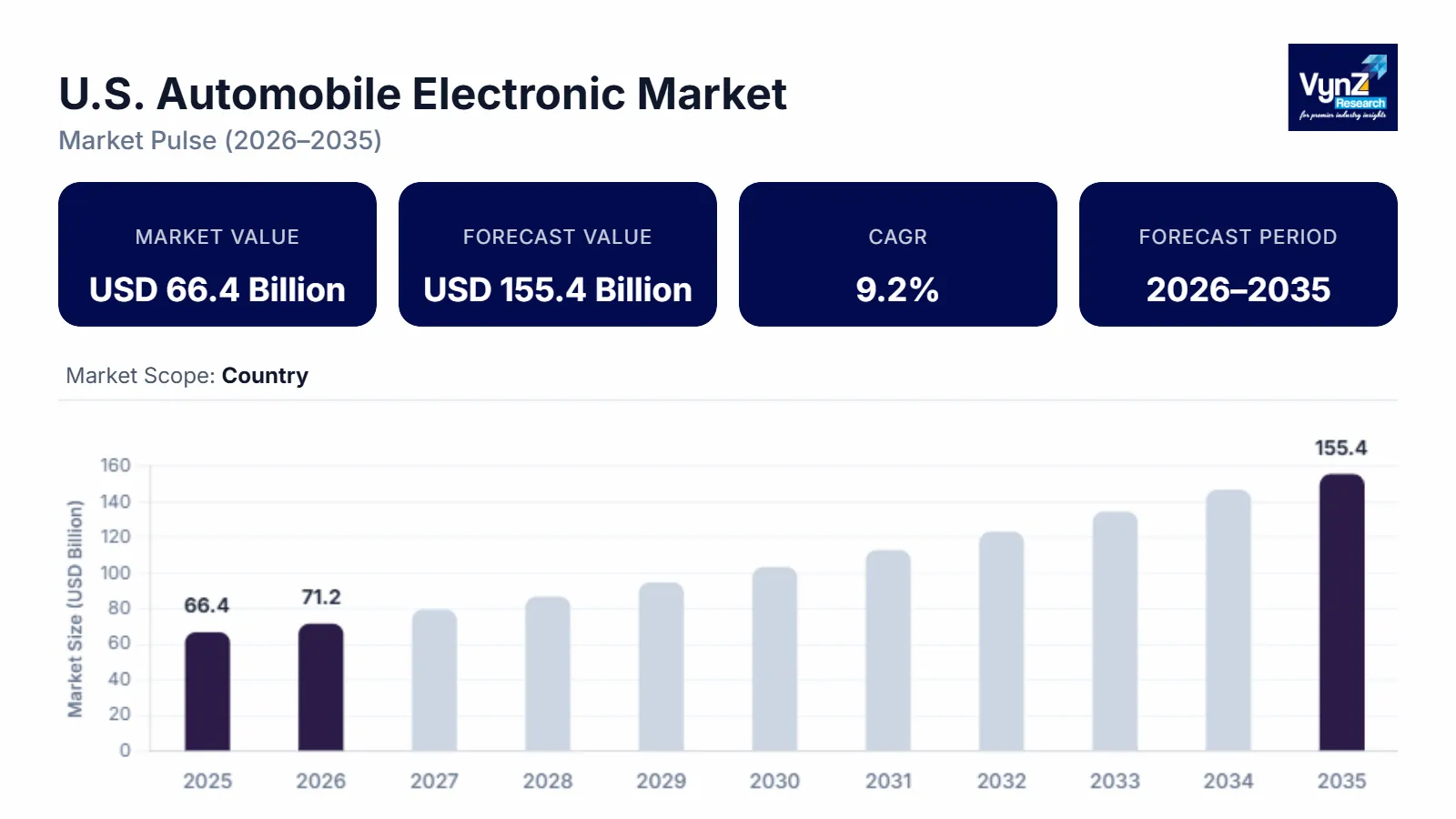
The U.S. automobile electronic market was estimated at about USD 66.4 billion in 2025 and is expected to reach around USD 71.2 billion in 2026, rising up to nearly USD 155.4 billion by 2035, registering an estimated 9.2% CAGR during 2026 to 2035.
Research Highlights
- Infotainment accounted for 31.4% market share in 2025 due to high connected vehicle demand.
- Microcontrollers held 29.5% market share in 2025 supported by rising electronic integration.
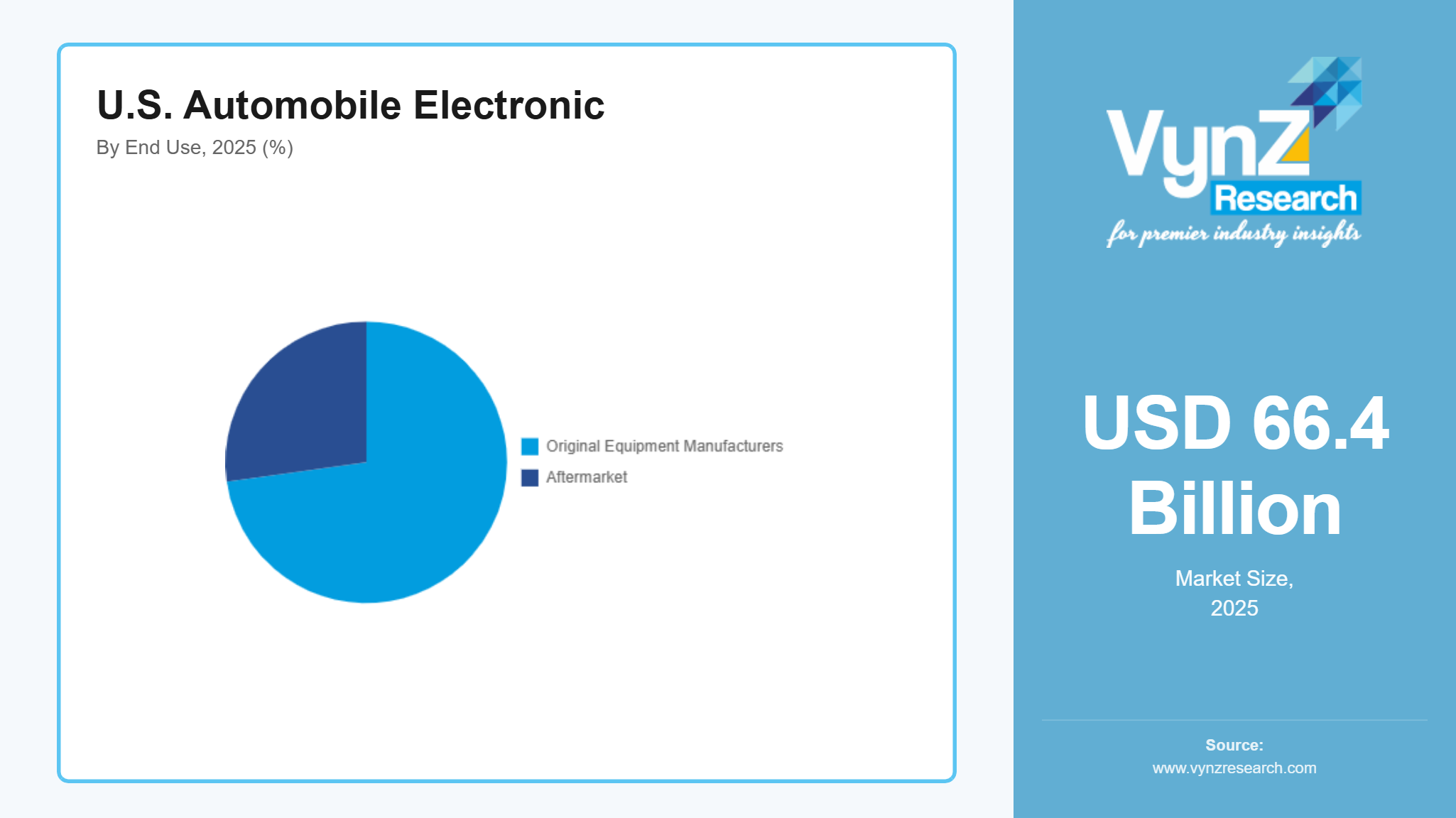
- OEMs captured 72.8% revenue share in 2025 owing to increasing vehicle production.
- ADAS is projected to grow at 10.8% CAGR during 2026 to 2035 driven by safety regulations.
- Midwest U.S. held 34.2% market share in 2025 supported by automotive manufacturing investments.
Market growth is driven by the increasing integration of advanced driver assistance systems, production of connected and electric vehicles, and semiconductor content per vehicle, along with the growing adoption of zonal electronic architectures and vehicle software platforms. In addition, the increase in demand for intelligent passenger cars and commercial fleet digitization, combined with the investments from the U.S. Department of Energy Vehicle Technologies Office, manufacturing initiatives from the U.S. Department of Commerce CHIPS Program, vehicle safety regulations from the National Highway Traffic Safety Administration, and transportation modernization efforts from the U.S. Department of Transportation, are expected to propel the growth of the market in Michigan, Texas, and California, among others.
U.S. Automobile Electronic Market Dynamics
Market Trends
The U.S. automobile electronic market is witnessing growing interest in vehicle digitalization, software defined functions and intelligent mobility. One of the leading trends is represented by the introduction of advanced driver assistance systems, powerful processors and domain controllers that reflect the industry’s preferences for improved vehicle safety, energy management and connectivity. The National Highway Traffic Safety Administration’s (NHTSA) ongoing work on automated driving systems, human machine interfaces, connected vehicles and automotive cybersecurity is anticipated to support the growth of the automobile electronic market during the forecast period.
Growth Drivers
The growth is primarily driven by the rising production of electric and hybrid vehicles, which is projected to see a consistent demand for automotive electronics in the passenger vehicle, commercial vehicle and connected mobility markets. The rising investments in semiconductor production, battery manufacturing and domestic supplier networks are also supporting the growth of the market. The U.S. Department of Commerce’s initiatives to promote domestic semiconductor manufacturing under the CHIPS Act and the U.S. Department of Energy’s Vehicle Technologies Office’s R&D efforts in vehicle electrification are also contributing factors.
Market Restraints / Challenges
Even though the market is projected to witness strong growth, it faces some challenges that could impact its growth trajectory. With the industry dependent on semiconductor supplies for technologically advanced automotive electronics, the supply chain disruptions and raw material shortages for high-performance processors and computer chips could affect the manufacturing process. Moreover, the complexity of electronics and associated costs also present a challenge to the automobile electronics market. The need for enhanced cybersecurity features, software development and validation processes add to the design complexity, hindering the rapid commercialization of electronic systems and solutions. The increasing cybersecurity threats and software complexities associated with connected and automated vehicles also pose a challenge to OEMs and suppliers.
Market Opportunities
The market opportunity is being driven by software-defined vehicles and the rising adoption of artificial intelligence (AI) across connected and automated vehicles. Firms providing high-performance processors, intelligent sensors, radar solutions, power electronics, and other critical technologies are anticipated to benefit from the rising investments in electric vehicles, fleets and mobility services. The U.S. government’s initiatives to promote clean transportation technologies and advanced transportation systems are also contributing factors to the market growth. The growing investment in connected vehicle platforms and intelligent transportation systems also presents a significant opportunity for electronic system developers and suppliers. The rising emphasis on digital mobility and transportation data analytics is also facilitating higher growth rates for automotive electronics manufacturers.
U.S. Automobile Electronic Market Report Coverage
|
Report Metric |
Details |
|
Historical Period |
2020 - 2024 |
|
Base Year Considered |
2025 |
|
Forecast Period |
2026 - 2035 |
|
Market Size in 2025 |
USD 66.4 Billion |
|
Revenue Forecast in 2035 |
USD 155.4 Billion |
|
Growth Rate |
9.2% |
|
Segments Covered in the Report |
Application, Component Type, Vehicle Type, End Use |
|
Report Scope |
Market Trends, Drivers, and Restraints; Revenue Estimation and Forecast; Segmentation Analysis; Companies’ Strategic Developments; Market Share Analysis of Key Players; Company Profiling |
|
Regions Covered in the Report |
Midwest U.S., Southern U.S., Western U.S., Other U.S. Regions |
|
Key Companies |
Aptiv PLC, Continental AG, Denso Corporation, Hitachi Astemo Ltd., Infineon Technologies AG, Magna International Inc., NXP Semiconductors N.V., Robert Bosch GmbH, Valeo SA, ZF Friedrichshafen AG |
|
Customization |
Available upon request |
U.S. Automobile Electronic Market Segmentation
By Application
Infotainment and communication led the market in 2025, with a share of around 31.4%, fueled by the rapid rise in connected cars, digital cockpits, and cloud-based mobility services. The adoption of large displays, voice recognition, navigation systems, and wireless connectivity in passenger vehicles is set to drive the growth of this segment.
Advanced driver assistance systems are expected to register the highest growth rate at a CAGR of 10.8% through 2035, driven by regulatory guidelines and the rising need for automated driving systems.
By Component Type
Microcontrollers led the market in 2025, registering a revenue share of around 29.5%, owing to their widespread adoption in powertrain control, safety systems, and body electronics, as well as infotainment systems. Microcontrollers’ dominance in the automobile electronics market is explained by their rising need in controlling the complex functions of modern vehicles while enabling higher-performance computing.
Power electronics and intelligent sensors are anticipated to witness the highest growth at a CAGR of 11.1% in the automobile electronics market over the forecast period. The rising need for silicon carbide power devices and the surge in demand for e-mobility are likely to propel the growth of power electronics.
By Vehicle Type
In terms of revenue, passenger vehicles led the market in 2025, registering a share of nearly 63.7%, driven by the high production volumes of these vehicles and the rising adoption of automobile electronics in both battery electric and conventional vehicles. The high demand for connected vehicles, advanced infotainment systems, and driver assistance technologies, as well as the need for digital cockpits and enhanced in-cabin experiences, is projected to drive the segment’s growth through the forecast period.
Commercial vehicles are anticipated to register a higher growth rate of 9.6% through 2035, owing to the rising need to retrofit commercial vehicles with telematics, driver-assistance systems, and predictive maintenance solutions. Additionally, the growing emphasis on connected commercial vehicles and intelligent transportation infrastructure, as well as the rising adoption of electric commercial vehicles, is expected to drive the electronics adoption in this segment.
By End Use
The original equipment manufacturers segment led the market in 2025, registering a share of around 72.8%, driven by the high production volumes of technologically advanced vehicles and the incorporation of high-end automobile electronics during the manufacturing process. The original equipment manufacturers segment is anticipated to witness steady growth through 2035, fueled by the rising emphasis on software-defined vehicles, semiconductor partnerships, and intelligent manufacturing.
On the other hand, the aftermarket segment is expected to register the highest growth at 10.3% through 2035, owing to the rising demand for retrofit driver-assistance systems, connected infotainment, and advanced diagnostic systems, among others. Aftermarket demand for automobile electronics is also rising due to the need for long-term vehicle ownership, as well as the growing need for independent workshops, which is further fueled by the proliferation of digital vehicle diagnostics and software-based maintenance solutions.
Regional Insights
Midwest U.S.
The Midwest region of the U.S. secured around 34.2% of the U.S. automobile electronic market in 2025, attributable to the established automotive manufacturing and semiconductor industry, including significant car assembly plants in Michigan, Ohio, and Indiana. The demand for automobiles and related electronics by original equipment manufacturers (OEMs) and Tier 1 suppliers will remain strong through 2025. Moreover, increased investments in electric vehicle manufacturing and battery storage by the U.S. Bureau of Economic Analysis (BEA) and the U.S. Department of Energy (DOE) Vehicle Technologies Office will further augment the demand for automobiles in the region. The Midwest will witness robust investments in automotive semiconductors, advanced battery technologies, and related electronics due to favorable government policies and growing electric vehicle adoption, supported by the U.S. Department of Commerce CHIPS Program and National Institute of Standards and Technology (NIST). The rising demand for smart and connected cars is also projected to propel the regional automotive electronics market.
Southern U.S.
Similarly, the Southern U.S. saw around 25.8% of the market in 2025. The region is anticipated to witness substantial growth in the coming years, supported by growing automotive manufacturing, foreign direct investment, and electric vehicle production in Texas, Tennessee, Georgia, Alabama, and Mississippi. Additionally, the rising adoption of automotive electronics in passenger cars and commercial vehicles will drive the demand for sensors, power electronics, and software in the region. The efforts by the U.S. Department of Energy (DOE) and U.S. Department of Transportation (USDOT) to promote clean transportation, battery manufacturing, and intelligent mobility programs will also contribute to the demand for automotive electronics.
Western U.S.
The Western U.S. registered around 17.4% of the market in 2025 primarily due to the thriving automotive electronics industry and substantial R&D efforts in connected and autonomous driving technologies, including electric vehicles. Significant automotive electronics manufacturing clusters in California, Arizona, and Nevada are anticipated to strengthen the regional market over the forecast period. Further, the National Highway Traffic Safety Administration (NHTSA)’s emphasis on connected and automated vehicles and the U.S. Environmental Protection Agency’s (EPA) promotion of vehicle electrification and advanced technologies are expected to impel the regional market growth.
The remaining 22.6% is segmented across the Northeastern U.S., Mountain States, and others, which will also register substantial growth during the forecast period.
Competitive Landscape / Company Insights
The market competition is intense as global and domestic automakers invest in high-tech electronics, software-defined vehicles, semiconductors and strategic partnerships to strengthen their position. Companies focus on R&D, artificial intelligence, cybersecurity and domestic manufacturing to meet the growing demand for connected and automated cars and stay ahead of the competition. The market is further boosted by the U.S. Department of Commerce via the CHIPS Program, the U.S. Department of Energy (DOE) and National Highway Traffic Safety Administration (NHTSA) promotion of automotive technology, vehicle safety and innovation.
Mini Profiles
Aptiv PLC develops advanced automotive electronics, software defined vehicle platforms, advanced driver assistance systems, and electrical architectures, supported by strong engineering expertise, global manufacturing capabilities, and long-standing partnerships with major automotive manufacturers.
Continental AG operates across premium and mass automotive electronics segments, emphasizing intelligent mobility solutions, advanced safety technologies, connected vehicle systems, and continuous innovation to strengthen its competitive position worldwide.
Denso Corporation leverages extensive research capabilities, strategic partnerships, and advanced manufacturing technologies to expand its presence in automotive electronics, delivering powertrain, thermal management, sensing, and electrification solutions.
Hitachi Astemo Ltd. focuses on advanced mobility technologies, electric powertrain systems, autonomous driving components, and integrated electronic control solutions, supported by strong technological capabilities and global automotive customer relationships.
Infineon Technologies AG specializes in automotive semiconductors, power electronics, microcontrollers, and sensor technologies, supported by continuous investment in research and development, energy efficient solutions, and a diversified global customer base.
Key Players
- Aptiv PLC
- Continental AG
- Denso Corporation
- Hitachi
- Astemo Ltd.
- Infineon Technologies AG
- Magna International Inc.
- NXP Semiconductors N.V.
- Bosch GmbH
- Valeo SA
- ZF Friedrichshafen AG
Recent Developments
In January 2026, Bosch GmbH announced that its vehicle integration platform would adopt NXP Semiconductors' S32N7 processor to support centralized computing and software defined vehicle architectures. The collaboration is designed to simplify vehicle electronics while enabling AI powered functions and reducing system complexity in next generation vehicles.
In March 2026, ZF Friedrichshafen AG partnered with SiliconAuto to unveil a new automotive I/O interface chip integrated with a companion microcontroller for high-performance computing platforms. The solution enables real time sensor data processing for advanced driver assistance and autonomous driving applications.
In April 2026, Continental AG expanded its high-performance computing portfolio by introducing advanced domain controllers integrating infotainment, connectivity, and ADAS functions. The launch strengthens the company's software defined vehicle capabilities while supporting centralized electronic architectures.
In February 2026, NXP Semiconductors N.V. expanded its automotive semiconductor portfolio with new vehicle networking and processing solutions for connected, autonomous, and electric vehicles. The latest technologies improve computing performance, functional safety, and software integration across modern automotive platforms.
In April 2026, Magna International Inc. showcased its latest electrification, advanced driver assistance, and intelligent vehicle technologies during Auto Shanghai 2026, reinforcing its focus on next generation mobility solutions. The company highlighted integrated systems designed to improve vehicle safety, efficiency, and software driven functionality.
U.S. Automobile Electronic Market Coverage
Application Insight and Forecast 2026 - 2035
- Advanced Driver Assistance Systems (ADAS)
- Infotainment & Communication
- Powertrain Control
- Body Electronics
- Safety Systems
- Others
Component Type Insight and Forecast 2026 - 2035
- Electronic Control Units (ECUs)
- Sensors
- Microcontrollers
- Integrated Circuits (ICs)
- Displays
- Connectors
- Others
Vehicle Type Insight and Forecast 2026 - 2035
- Passenger Vehicles
- Commercial Vehicles
End Use Insight and Forecast 2026 - 2035
- Original Equipment Manufacturers (OEMs)
- Aftermarket
U.S. Automobile Electronic Market by Region
- Midwest U.S.
- By Application
- By Component Type
- By Vehicle Type
- By End Use
- Southern U.S.
- By Application
- By Component Type
- By Vehicle Type
- By End Use
- Western U.S.
- By Application
- By Component Type
- By Vehicle Type
- By End Use
- Other U.S. Regions
- By Application
- By Component Type
- By Vehicle Type
- By End Use
Table of Contents for U.S. Automobile Electronic Market Report
1. Research Overview
1.1. The Report Offers
1.2. Market Coverage
1.2.1. By
Application
1.2.2. By
Component Type
1.2.3. By
Vehicle Type
1.2.4. By
End Use
1.3. Research Phases
1.4. Limitations
1.5. Market Methodology
1.5.1. Data Sources
1.5.1.1.
Primary Research
1.5.1.2.
Secondary Research
1.5.2. Methodology
1.5.2.1.
Data Exploration
1.5.2.2.
Forecast Parameters
1.5.2.3.
Data Validation
1.5.2.4.
Assumptions
1.5.3. Study Period & Data Reporting Unit
2. Executive Summary
3. Industry Overview
3.1. Industry Dynamics
3.1.1. Market Growth Drivers
3.1.2. Market Restraints
3.1.3. Key Market Trends
3.1.4. Major Opportunities
3.2. Industry Ecosystem
3.2.1. Porter’s Five Forces Analysis
3.2.2. Recent Development Analysis
3.2.3. Value Chain Analysis
3.3. Competitive Insight
3.3.1. Competitive Position of Industry
Players
3.3.2. Market Attractive Analysis
3.3.3. Market Share Analysis
4. U.S. Market Estimate and Forecast
4.1. U.S. Market Overview
4.2. U.S. Market Estimate and Forecast to 2035
5. Market Segmentation Estimate and Forecast
5.1. By Application
5.1.1. Advanced Driver Assistance Systems (ADAS)
5.1.1.1. Market Definition
5.1.1.2. Market Estimation and Forecast to 2035
5.1.2. Infotainment & Communication
5.1.2.1. Market Definition
5.1.2.2. Market Estimation and Forecast to 2035
5.1.3. Powertrain Control
5.1.3.1. Market Definition
5.1.3.2. Market Estimation and Forecast to 2035
5.1.4. Body Electronics
5.1.4.1. Market Definition
5.1.4.2. Market Estimation and Forecast to 2035
5.1.5. Safety Systems
5.1.5.1. Market Definition
5.1.5.2. Market Estimation and Forecast to 2035
5.1.6. Others
5.1.6.1. Market Definition
5.1.6.2. Market Estimation and Forecast to 2035
5.2. By Component Type
5.2.1. Electronic Control Units (ECUs)
5.2.1.1. Market Definition
5.2.1.2. Market Estimation and Forecast to 2035
5.2.2. Sensors
5.2.2.1. Market Definition
5.2.2.2. Market Estimation and Forecast to 2035
5.2.3. Microcontrollers
5.2.3.1. Market Definition
5.2.3.2. Market Estimation and Forecast to 2035
5.2.4. Integrated Circuits (ICs)
5.2.4.1. Market Definition
5.2.4.2. Market Estimation and Forecast to 2035
5.2.5. Displays
5.2.5.1. Market Definition
5.2.5.2. Market Estimation and Forecast to 2035
5.2.6. Connectors
5.2.6.1. Market Definition
5.2.6.2. Market Estimation and Forecast to 2035
5.2.7. Others
5.2.7.1. Market Definition
5.2.7.2. Market Estimation and Forecast to 2035
5.3. By Vehicle Type
5.3.1. Passenger Vehicles
5.3.1.1. Market Definition
5.3.1.2. Market Estimation and Forecast to 2035
5.3.2. Commercial Vehicles
5.3.2.1. Market Definition
5.3.2.2. Market Estimation and Forecast to 2035
5.4. By End Use
5.4.1. Original Equipment Manufacturers (OEMs)
5.4.1.1. Market Definition
5.4.1.2. Market Estimation and Forecast to 2035
5.4.2. Aftermarket
5.4.2.1. Market Definition
5.4.2.2. Market Estimation and Forecast to 2035
6. Midwest U.S. Market Estimate and Forecast
6.1. By
Application
6.2. By
Component Type
6.3. By
Vehicle Type
6.4. By
End Use
7. Southern U.S. Market Estimate and Forecast
7.1. By
Application
7.2. By
Component Type
7.3. By
Vehicle Type
7.4. By
End Use
8. Western U.S. Market Estimate and Forecast
8.1. By
Application
8.2. By
Component Type
8.3. By
Vehicle Type
8.4. By
End Use
9. Other U.S. Regions Market Estimate and Forecast
9.1. By
Application
9.2. By
Component Type
9.3. By
Vehicle Type
9.4. By
End Use
10. Company Profiles
10.1.
Aptiv PLC
10.1.1.
Snapshot
10.1.2.
Overview
10.1.3.
Offerings
10.1.4.
Financial
Insight
10.1.5.
Recent
Developments
10.2.
Continental AG
10.2.1.
Snapshot
10.2.2.
Overview
10.2.3.
Offerings
10.2.4.
Financial
Insight
10.2.5.
Recent
Developments
10.3.
Denso Corporation
10.3.1.
Snapshot
10.3.2.
Overview
10.3.3.
Offerings
10.3.4.
Financial
Insight
10.3.5.
Recent
Developments
10.4.
Hitachi
10.4.1.
Snapshot
10.4.2.
Overview
10.4.3.
Offerings
10.4.4.
Financial
Insight
10.4.5.
Recent
Developments
10.5.
Astemo Ltd.
10.5.1.
Snapshot
10.5.2.
Overview
10.5.3.
Offerings
10.5.4.
Financial
Insight
10.5.5.
Recent
Developments
10.6.
Infineon Technologies AG
10.6.1.
Snapshot
10.6.2.
Overview
10.6.3.
Offerings
10.6.4.
Financial
Insight
10.6.5.
Recent
Developments
10.7.
Magna International Inc.
10.7.1.
Snapshot
10.7.2.
Overview
10.7.3.
Offerings
10.7.4.
Financial
Insight
10.7.5.
Recent
Developments
10.8.
NXP Semiconductors N.V.
10.8.1.
Snapshot
10.8.2.
Overview
10.8.3.
Offerings
10.8.4.
Financial
Insight
10.8.5.
Recent
Developments
10.9.
Bosch GmbH
10.9.1.
Snapshot
10.9.2.
Overview
10.9.3.
Offerings
10.9.4.
Financial
Insight
10.9.5.
Recent
Developments
10.10.
Valeo SA
10.10.1.
Snapshot
10.10.2.
Overview
10.10.3.
Offerings
10.10.4.
Financial
Insight
10.10.5.
Recent
Developments
10.11.
ZF Friedrichshafen AG
10.11.1.
Snapshot
10.11.2.
Overview
10.11.3.
Offerings
10.11.4.
Financial
Insight
10.11.5.
Recent
Developments
11. Appendix
11.1. Exchange Rates
11.2. Abbreviations
Note: Financial insight and recent developments of different companies are subject to the availability of information in the secondary domain.
Purchase Options
Latest Report
Research Methodology
- Desk Research / Pilot Interviews
- Build Market Size Model
- Research and Analysis
- Final Deliverable
Connect With Our Sales Team
- Toll-Free: +1-888-253-3960
- Phone: +91 9960 288 381
- Email: enquiry@vynzresearch.com
U.S. Automobile Electronic Market