
U.S. Automotive Battery Market Size & Share - Growth Forecast Report (2026-2035)
Industry Insight by Battery Type (Lithium Ion, Lead Acid, Nickel Metal Hydride, Others), by Propulsion Type (Battery Electric Vehicles (BEV), Plug in Hybrid Electric Vehicles (PHEV), Hybrid Electric Vehicles (HEV), Internal Combustion Engine (ICE) Vehicles), by Vehicle Type (Passenger Vehicles, Commercial Vehicles, Two Wheelers, Off Highway Vehicles), by End Use (Original Equipment Manufacturers (OEMs), Aftermarket)
| Status : Published | Published On : Aug, 2026 | Report Code : VRAT9677 | Industry : Automotive & Transportation | Available Format :

|
Page : 134 |
U.S. Automotive Battery Market Overview
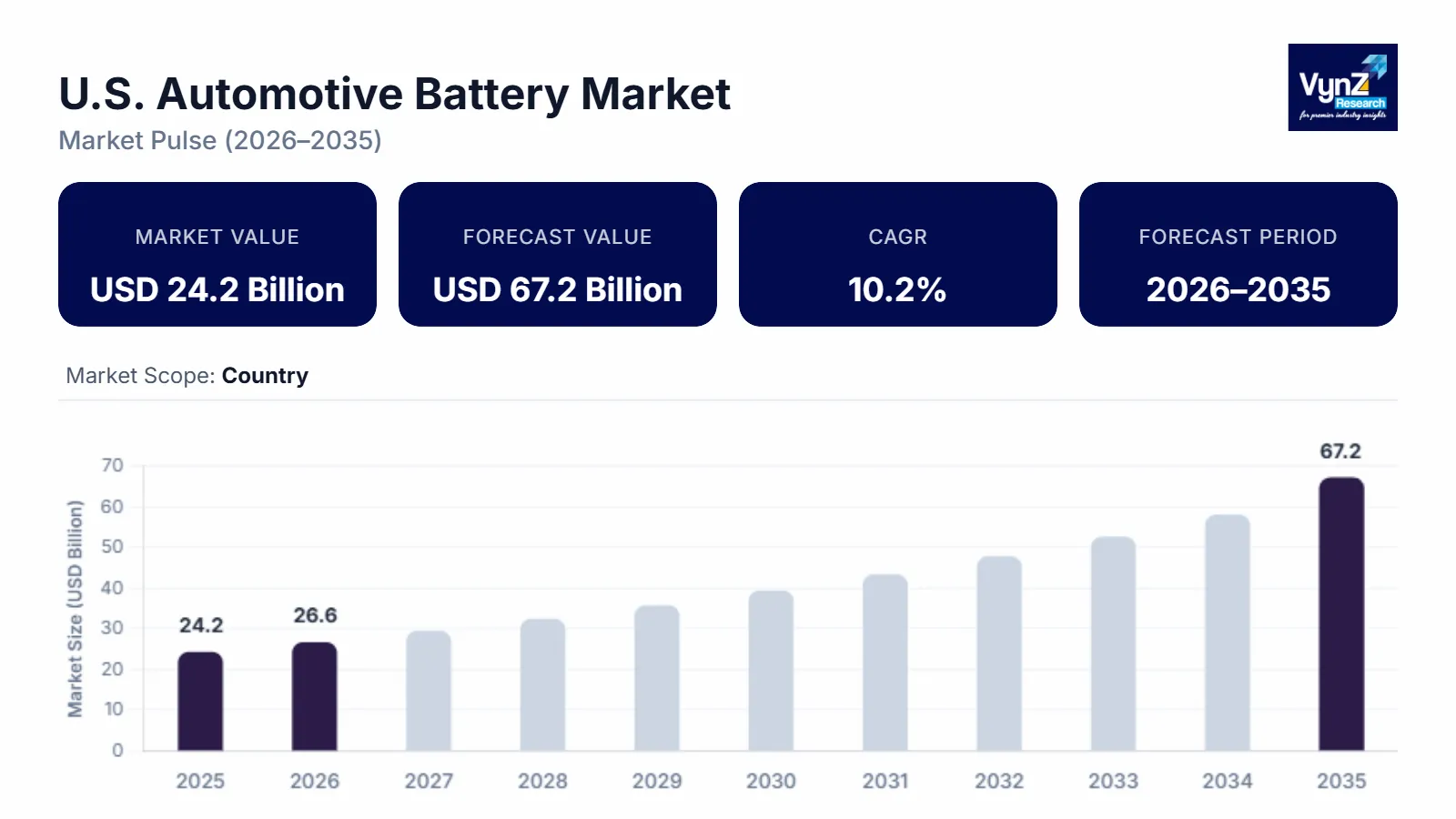
The U.S. automotive battery market size was estimated at approximately USD 24.2 billion in 2025 and is expected to reach around USD 26.6 billion in 2026, rising to nearly USD 67.2 billion by 2035, growing at an estimated 10.2% CAGR during 2026 to 2035.
Research Highlights
- Lithium-ion batteries held 67.8% market share in 2025 due to expanding EV production.
- Passenger vehicles captured 69.4% market share in 2025 supported by rising vehicle demand.
- OEMs accounted for 61.2% revenue share in 2025 owing to domestic battery manufacturing.
- Battery electric vehicles are projected to grow at 12.9% CAGR during 2026 to 2035.
- Midwest U.S. represented 32.8% market share in 2025 driven by battery manufacturing investments.
Market growth is supported by growing demand for electric vehicles, expanding domestic battery production, and investments in advanced lithium-ion technologies, with increasing adoption of battery management systems and fast charging. Demand from both passenger and commercial vehicles and incentives from the U.S. Department of Energy (DOE), domestic battery supply chain initiatives from the U.S. Department of Commerce, and clean transportation programs from the U.S. Environmental Protection Agency (EPA) will propel the market across major manufacturing hubs like Michigan, Tennessee, Georgia, and Nevada.
U.S. Automotive Battery Market Dynamics
Market Trends
The U.S. Automotive Battery Market is witnessing a shift towards lithium iron phosphate, advanced lithium-ion, and other alternate battery chemistries, as well as towards localized battery manufacturing, and an increased focus on sustainable supply chains for raw materials. One of the dominant trends impacting the market is the rising adoption of lithium iron phosphate and advanced lithium batteries and the shift away from lead-acid batteries. The U.S. Department of Energy (DOE) is promoting research on next-generation batteries through the Vehicle Technologies Office while local manufacturers are ramping up production rates to meet demand. Another major trend is the rising use of battery management systems, thermal management systems and high energy density cells driven by innovation in the automotive battery space.
Growth Drivers
The market growth is being propelled by the increasing production of electric vehicles, which in turn is creating sustained demand for automotive batteries in the U.S. The growth of the market is further complemented by the growing investment in gigafactories, local processing of minerals, and production of advanced battery cells in the U.S. The U.S. Department of Energy (DOE) is encouraging domestic battery manufacturing to secure the supply chain of battery materials, cells, and critical minerals. Additionally, the market is being propelled by the increasing affordability of batteries and investment in advanced charging technologies. Manufacturers are prioritizing long driving ranges, cheaper batteries, and faster-charging networks, which is projected to sustain the demand for high-performance automotive batteries in the U.S. over the forecast period.
Market Restraints / Challenges
Even as the market is projected to witness robust growth over the forecast period, there are certain challenges posed by a growing reliance on imports of critical minerals and battery materials that could impede the growth of the market in the near term. Additionally, fluctuations in the pricing of raw materials and minerals could also challenge the sustainability of investment and production in the U.S. Automotive Battery Market over the forecast period. Studies conducted by government agencies are emphasizing the need to establish long-term domestic supply chains for critical minerals that are crucial to battery manufacturing. Further complicating the outlook for the market is the uncertainty surrounding the demand for electric vehicles and evolving incentives for clean transportation.
Market Opportunities
The market presents lucrative opportunities in domestic battery manufacturing, as highlighted by the rising investments in local production, processing of materials, and expanding markets for electric vehicles in the U.S. Battery manufacturers that are focusing on advanced lithium-ion, solid-state, and high-performance batteries are poised to benefit from the surging demand in the U.S. passenger vehicle market and commercial vehicle market. Further supporting the growth prospects for automotive battery manufacturers in the U.S. is the continued investment by the U.S. Department of Energy (DOE) in battery manufacturing, processing, and critical minerals. Another major opportunity for battery manufacturers in the U.S. is the increasing investment in battery recycling, second-life applications, and battery management systems.
U.S. Automotive Battery Market Report Coverage
|
Report Metric |
Details |
|
Historical Period |
2020 - 2024 |
|
Base Year Considered |
2025 |
|
Forecast Period |
2026 - 2035 |
|
Market Size in 2025 |
USD 24.2 Billion |
|
Revenue Forecast in 2035 |
USD 67.2 Billion |
|
Growth Rate |
10.2% |
|
Segments Covered in the Report |
Battery Type, Propulsion Type, Vehicle Type, End Use |
|
Report Scope |
Market Trends, Drivers, and Restraints; Revenue Estimation and Forecast; Segmentation Analysis; Companies’ Strategic Developments; Market Share Analysis of Key Players; Company Profiling |
|
Regions Covered in the Report |
Midwest U.S., Southern U.S., Western U.S., Other U.S. Regions |
|
Key Companies |
Clarios, Contemporary Amperex Technology Co., Limited (CATL), EnerSys, Exide Technologies, GS Yuasa Corporation, LG Energy Solution Ltd., Panasonic Holdings Corporation, Samsung SDI Co., Ltd., SK On Co., Ltd., Tesla, Inc. |
|
Customization |
Available upon request |
U.S. Automotive Battery Market Segmentation
By Battery Type
The lithium-ion battery segment was the largest in 2025 accounting for 67.8% of the total market value, and is expected to grow at the highest compound annual rate through 2035. The primary factors driving the growth of this segment are the increase in battery electric vehicle production and adoption, improvement in battery energy density, and reduction in battery costs.
The lead-acid battery segment is expected to register CAGR of 4.2% during 2026 and 2035. The U.S. DOE is supporting advanced battery development while also emphasizing strong domestic battery supply chains.
By Propulsion Type
Internal combustion engine (ICE) vehicles dominated the market in 2025, accounting for 46.5% of the total battery demand. This segment’s dominance is majorly attributed to the high existing vehicle stock of ICE vehicles and high demand for replacement batteries for starting, lighting, and ignition.
The battery electric vehicle segment is anticipated to register the highest CAGR of 12.9% through 2035 driven by the demand for fuel-efficient vehicles and the growing emphasis on reducing carbon emissions.
By Vehicle Type
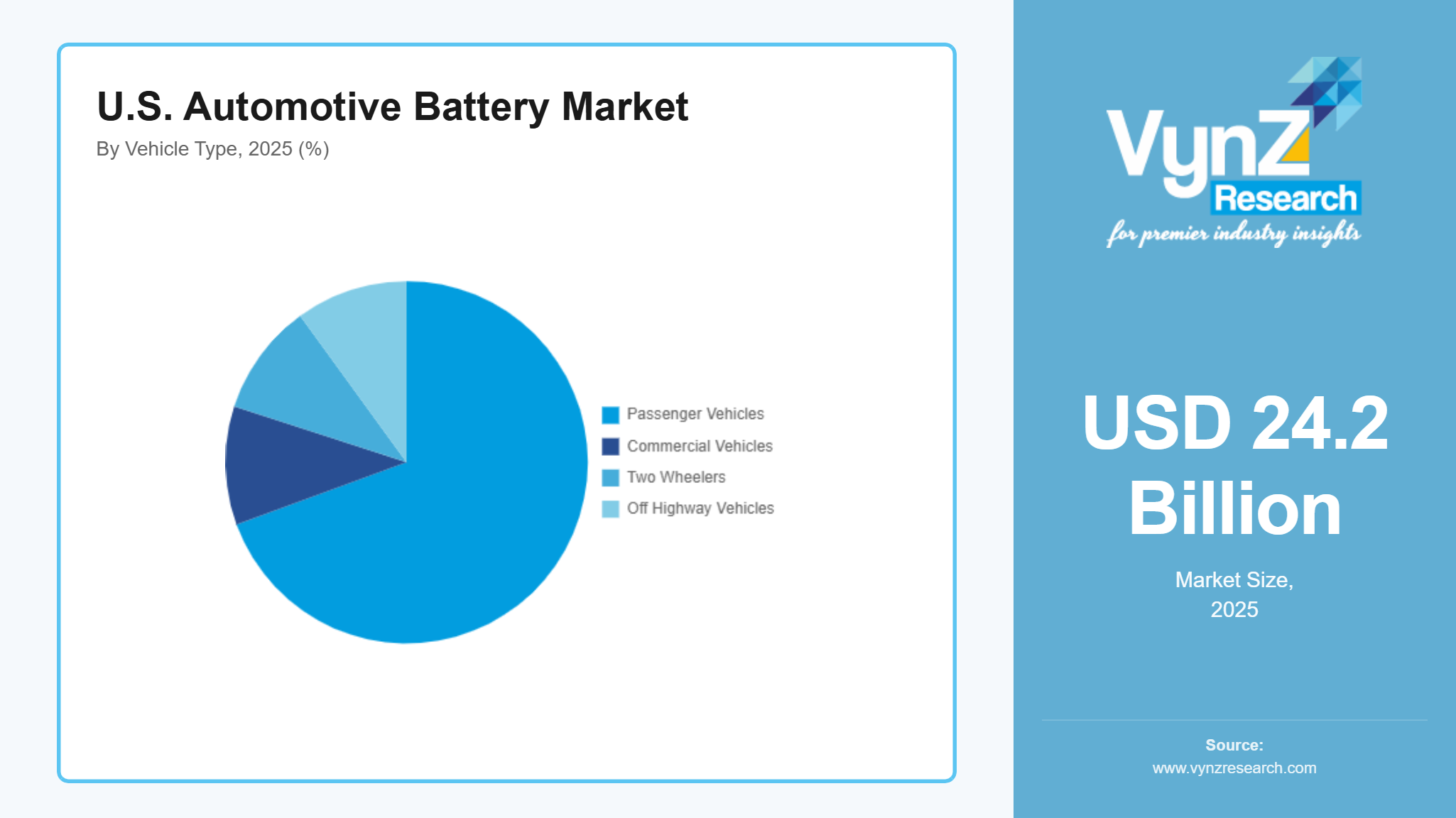
The passenger vehicle segment dominated the U.S. automotive battery market in 2025, accounting for 69.4% of the total revenue. This segment is primarily driven by the high production volume of electric passenger vehicles, the high rate of adoption of advanced battery technologies in sport utility vehicles (SUVs) and cars, and the increasing investment in battery R&D activities by major automakers.
The commercial vehicle segment is projected to register the highest growth through 2035 with an estimated CAGR of 11.4%, driven by the growing demand for electric commercial vehicles in the U.S.
By End Use
The OEM segment accounted for 61.2% of the revenue in 2025 and is projected to witness significant growth through 2035. The segment growth is driven by the rise in domestic vehicle manufacturing, increasing localization of battery production to meet the demand for electric vehicles, and a significant investment in gigafactories by automakers and battery manufacturers across the U.S.
The aftermarket segment is anticipated to register a CAGR of 10.6% through 2035 driven by the need for battery replacements, changing consumer behavior, longer vehicle ownership periods, and the growing number of battery diagnostic and maintenance centers.
Regional Insights
Midwest U.S.
The Midwest U.S. region accounted for around 32.8% of the U.S. Automotive Battery Market in 2025. This is primarily driven by established automotive manufacturing hubs, battery gigafactories, and electric vehicle production facilities in Michigan, Ohio, and Indiana, among others. Demand for lithium-ion battery packs, battery management systems, and energy storage solutions is growing steadily on the back of the region’s heavy concentration of automotive manufacturers and battery suppliers. The U.S. Department of Energy (DOE) is also supporting domestic battery manufacturing through initiatives like the Battery Materials Processing and Battery Manufacturing programs. Meanwhile, the U.S. Department of Commerce is promoting the expansion of the domestic battery supply chain through advanced manufacturing programs.
Southern U.S.
In terms of revenue, the Southern U.S. region is estimated to account for around 24.9% of the market in 2025. The region is witnessing significant investment in battery manufacturing, with large-scale battery gigafactories set to open in Tennessee, Georgia, Kentucky, North Carolina, and other states. Growing EV manufacturing capacity and supportive industrial policies are driving demand for automotive batteries and components in the region. As per the U.S. DOE, several federal initiatives are supporting domestic battery manufacturing and production capacity, helping enhance the competitive standing and supply chain security of the region.
Western U.S.
The Western U.S. region is estimated to account for around 18.1% of the market in 2025. The region is seeing a surge in battery technology innovation, electric mobility, and clean energy manufacturing, with California, Nevada, Arizona, and other states investing heavily in lithium processing and battery R&D initiatives. The U.S. Environmental Protection Agency (EPA) and the U.S. Department of Energy (DOE) are also supporting the development of electric vehicles, battery storage, and clean transportation across the region through federal funding and research programs.
The remaining 24.2% is dominated by the Northeastern U.S., Mountain states, and other regions, which are also witnessing significant investments in electric mobility infrastructure, battery recycling, and advanced battery manufacturing, which is anticipated to drive regional market growth over the forecast period.
Competitive Landscape / Company Insights
The market is highly competitive, with global and local players focusing on R&D, product development, battery localization, strategic partnerships, and production expansion. Entities are investing in lithium-ion battery technology, solid state battery development, battery recycling, and research and development to improve their position in the market. The industry is projected to grow steadily due to the efforts of the U.S. Department of Energy (DOE), the U.S. Department of Commerce, the U.S. Environmental Protection Agency (EPA), which promote the production of batteries and clean transportation in the U.S.
Mini Profiles
Clarios focuses on advanced low voltage automotive batteries, battery management solutions, and recycling technologies, supported by an extensive manufacturing network and strong aftermarket distribution.
EnerSys operates across industrial and automotive battery segments, emphasizing high-performance energy storage solutions, technological innovation, and reliable battery systems for transportation applications.
GS Yuasa Corporation leverages advanced battery technologies, strategic partnerships, and global manufacturing capabilities to expand its presence across conventional and electric vehicle battery markets.
Panasonic Holdings Corporation specializes in high energy density lithium-ion batteries, supported by continuous research, advanced manufacturing, and long-term partnerships with leading electric vehicle manufacturers.
Tesla, Inc. focuses on battery innovation, large scale cell production, and vertically integrated manufacturing, strengthening its position through continuous investments in battery technology and energy storage solutions.
Key Players
- Clarios
- Contemporary Amperex Technology Co., Limited (CATL)
- EnerSys
- Exide Technologies
- GS Yuasa Corporation
- LG Energy Solution Ltd.
- Panasonic Holdings Corporation
- Samsung SDI Co., Ltd.
- SK On Co., Ltd.
- Tesla, Inc.
Recent Developments
In January 2026, Samsung SDI Co., Ltd. introduced next generation high energy density cylindrical battery cells designed to improve electric vehicle driving range and charging performance. The development strengthens the company's advanced battery portfolio for global automotive manufacturers.
In March 2026, LG Energy Solution Ltd. expanded battery production capacity in North America to support increasing electric vehicle demand. The investment enhances regional supply chain resilience and strengthens long term manufacturing capabilities.
In April 2026, SK On Co., Ltd. announced additional investments in advanced battery manufacturing technologies to improve production efficiency and battery performance. The expansion supports growing demand from electric vehicle manufacturers across North America.
In February 2025, Exide Technologies expanded its automotive battery recycling capabilities through investments in sustainable manufacturing and circular economy initiatives. The development supports increasing demand for environmentally responsible battery production.
In May 2025, Contemporary Amperex Technology Co., Limited (CATL) unveiled advanced battery technologies designed to improve charging speed, energy density, and battery lifespan for next generation electric vehicles. The innovation reinforces the company's leadership in automotive battery
U.S. Automotive Battery Market Coverage
Battery Type Insight and Forecast 2026 - 2035
- Lithium Ion
- Lead Acid
- Nickel Metal Hydride
- Others
Propulsion Type Insight and Forecast 2026 - 2035
- Battery Electric Vehicles (BEV)
- Plug in Hybrid Electric Vehicles (PHEV)
- Hybrid Electric Vehicles (HEV)
- Internal Combustion Engine (ICE) Vehicles
Vehicle Type Insight and Forecast 2026 - 2035
- Passenger Vehicles
- Commercial Vehicles
- Two Wheelers
- Off Highway Vehicles
End Use Insight and Forecast 2026 - 2035
- Original Equipment Manufacturers (OEMs)
- Aftermarket
U.S. Automotive Battery Market by Region
- Midwest U.S.
- By Battery Type
- By Propulsion Type
- By Vehicle Type
- By End Use
- Southern U.S.
- By Battery Type
- By Propulsion Type
- By Vehicle Type
- By End Use
- Western U.S.
- By Battery Type
- By Propulsion Type
- By Vehicle Type
- By End Use
- Other U.S. Regions
- By Battery Type
- By Propulsion Type
- By Vehicle Type
- By End Use
Table of Contents for U.S. Automotive Battery Market Report
1. Research Overview
1.1. The Report Offers
1.2. Market Coverage
1.2.1. By
Battery Type
1.2.2. By
Propulsion Type
1.2.3. By
Vehicle Type
1.2.4. By
End Use
1.3. Research Phases
1.4. Limitations
1.5. Market Methodology
1.5.1. Data Sources
1.5.1.1.
Primary Research
1.5.1.2.
Secondary Research
1.5.2. Methodology
1.5.2.1.
Data Exploration
1.5.2.2.
Forecast Parameters
1.5.2.3.
Data Validation
1.5.2.4.
Assumptions
1.5.3. Study Period & Data Reporting Unit
2. Executive Summary
3. Industry Overview
3.1. Industry Dynamics
3.1.1. Market Growth Drivers
3.1.2. Market Restraints
3.1.3. Key Market Trends
3.1.4. Major Opportunities
3.2. Industry Ecosystem
3.2.1. Porter’s Five Forces Analysis
3.2.2. Recent Development Analysis
3.2.3. Value Chain Analysis
3.3. Competitive Insight
3.3.1. Competitive Position of Industry
Players
3.3.2. Market Attractive Analysis
3.3.3. Market Share Analysis
4. U.S. Market Estimate and Forecast
4.1. U.S. Market Overview
4.2. U.S. Market Estimate and Forecast to 2035
5. Market Segmentation Estimate and Forecast
5.1. By Battery Type
5.1.1. Lithium Ion
5.1.1.1. Market Definition
5.1.1.2. Market Estimation and Forecast to 2035
5.1.2. Lead Acid
5.1.2.1. Market Definition
5.1.2.2. Market Estimation and Forecast to 2035
5.1.3. Nickel Metal Hydride
5.1.3.1. Market Definition
5.1.3.2. Market Estimation and Forecast to 2035
5.1.4. Others
5.1.4.1. Market Definition
5.1.4.2. Market Estimation and Forecast to 2035
5.2. By Propulsion Type
5.2.1. Battery Electric Vehicles (BEV)
5.2.1.1. Market Definition
5.2.1.2. Market Estimation and Forecast to 2035
5.2.2. Plug in Hybrid Electric Vehicles (PHEV)
5.2.2.1. Market Definition
5.2.2.2. Market Estimation and Forecast to 2035
5.2.3. Hybrid Electric Vehicles (HEV)
5.2.3.1. Market Definition
5.2.3.2. Market Estimation and Forecast to 2035
5.2.4. Internal Combustion Engine (ICE) Vehicles
5.2.4.1. Market Definition
5.2.4.2. Market Estimation and Forecast to 2035
5.3. By Vehicle Type
5.3.1. Passenger Vehicles
5.3.1.1. Market Definition
5.3.1.2. Market Estimation and Forecast to 2035
5.3.2. Commercial Vehicles
5.3.2.1. Market Definition
5.3.2.2. Market Estimation and Forecast to 2035
5.3.3. Two Wheelers
5.3.3.1. Market Definition
5.3.3.2. Market Estimation and Forecast to 2035
5.3.4. Off Highway Vehicles
5.3.4.1. Market Definition
5.3.4.2. Market Estimation and Forecast to 2035
5.4. By End Use
5.4.1. Original Equipment Manufacturers (OEMs)
5.4.1.1. Market Definition
5.4.1.2. Market Estimation and Forecast to 2035
5.4.2. Aftermarket
5.4.2.1. Market Definition
5.4.2.2. Market Estimation and Forecast to 2035
6. Midwest U.S. Market Estimate and Forecast
6.1. By
Battery Type
6.2. By
Propulsion Type
6.3. By
Vehicle Type
6.4. By
End Use
7. Southern U.S. Market Estimate and Forecast
7.1. By
Battery Type
7.2. By
Propulsion Type
7.3. By
Vehicle Type
7.4. By
End Use
8. Western U.S. Market Estimate and Forecast
8.1. By
Battery Type
8.2. By
Propulsion Type
8.3. By
Vehicle Type
8.4. By
End Use
9. Other U.S. Regions Market Estimate and Forecast
9.1. By
Battery Type
9.2. By
Propulsion Type
9.3. By
Vehicle Type
9.4. By
End Use
10. Company Profiles
10.1.
Clarios
10.1.1.
Snapshot
10.1.2.
Overview
10.1.3.
Offerings
10.1.4.
Financial
Insight
10.1.5.
Recent
Developments
10.2.
Contemporary Amperex Technology Co., Limited (CATL)
10.2.1.
Snapshot
10.2.2.
Overview
10.2.3.
Offerings
10.2.4.
Financial
Insight
10.2.5.
Recent
Developments
10.3.
EnerSys
10.3.1.
Snapshot
10.3.2.
Overview
10.3.3.
Offerings
10.3.4.
Financial
Insight
10.3.5.
Recent
Developments
10.4.
Exide Technologies
10.4.1.
Snapshot
10.4.2.
Overview
10.4.3.
Offerings
10.4.4.
Financial
Insight
10.4.5.
Recent
Developments
10.5.
GS Yuasa Corporation
10.5.1.
Snapshot
10.5.2.
Overview
10.5.3.
Offerings
10.5.4.
Financial
Insight
10.5.5.
Recent
Developments
10.6.
LG Energy Solution Ltd.
10.6.1.
Snapshot
10.6.2.
Overview
10.6.3.
Offerings
10.6.4.
Financial
Insight
10.6.5.
Recent
Developments
10.7.
Panasonic Holdings Corporation
10.7.1.
Snapshot
10.7.2.
Overview
10.7.3.
Offerings
10.7.4.
Financial
Insight
10.7.5.
Recent
Developments
10.8.
Samsung SDI Co., Ltd.
10.8.1.
Snapshot
10.8.2.
Overview
10.8.3.
Offerings
10.8.4.
Financial
Insight
10.8.5.
Recent
Developments
10.9.
SK On Co., Ltd.
10.9.1.
Snapshot
10.9.2.
Overview
10.9.3.
Offerings
10.9.4.
Financial
Insight
10.9.5.
Recent
Developments
10.10.
Tesla, Inc.
10.10.1.
Snapshot
10.10.2.
Overview
10.10.3.
Offerings
10.10.4.
Financial
Insight
10.10.5.
Recent
Developments
11. Appendix
11.1. Exchange Rates
11.2. Abbreviations
Note: Financial insight and recent developments of different companies are subject to the availability of information in the secondary domain.
Purchase Options
Latest Report
Research Methodology
- Desk Research / Pilot Interviews
- Build Market Size Model
- Research and Analysis
- Final Deliverable
Connect With Our Sales Team
- Toll-Free: +1-888-253-3960
- Phone: +91 9960 288 381
- Email: enquiry@vynzresearch.com
U.S. Automotive Battery Market