
U.S. Automotive Ultrasonic Sensors Market Size & Share Growth Forecast Report (2026-2035)
Industry Insight by Vehicle Type (Passenger Vehicles, Commercial Vehicles), by Application (Parking Assistance, Blind Spot Detection, Collision Avoidance, Automated Driving Support Systems), by Sensor Type (Short Range Ultrasonic Sensors, Long Range Ultrasonic Sensors), by End Use (Original Equipment Manufacturers (OEMs), Aftermarket)
| Status : Published | Published On : Aug, 2026 | Report Code : VRAT9676 | Industry : Automotive & Transportation | Available Format :

|
Page : 134 |
U.S. Automotive Ultrasonic Sensors Market Overview
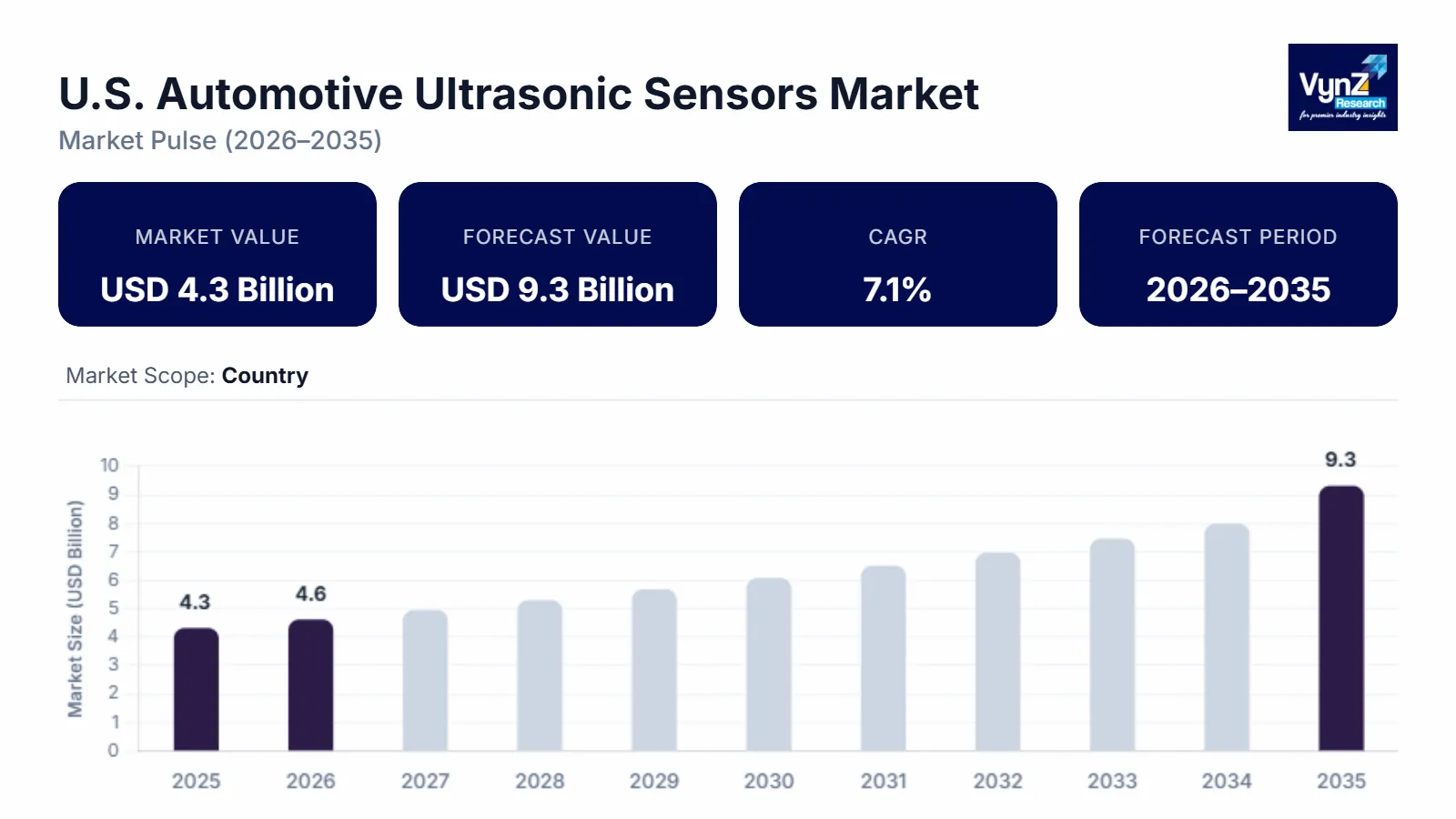
The U.S. automotive ultrasonic sensors market size was estimated at approximately USD 4.3 billion in 2025 and is expected to reach around USD 4.6 billion in 2026, rising to nearly USD 9.3 billion by 2035, growing at an estimated 7.1% CAGR during 2026 to 2035.
Research Highlights
- Parking assistance held 46.8% market share in 2025 supported by safety adoption.
- Short range sensors captured 64.5% share in 2025 backed by parking applications.
- OEMs accounted for 78.3% revenue share in 2025 owing to factory installations.
- Automated driving support grew at 9.2% CAGR during 2026–2035 due to growing ADAS adoption.
- Midwest U.S. represented 31.6% market share in 2025 supported by automotive manufacturing.
Market growth is propelled by the rise of advanced driver assistance systems, growing demand for automated parking, and intelligent safety features, as well as the increasing adoption of sensor fusion platforms that employ a combination of sensors such as ultrasonic sensors with vision and radar. Increased demand for connected and autonomous cars, as well as safety programs led by the National Highway Traffic Safety Administration (NHTSA), vehicle automation research conducted by the U.S. Department of Transportation (USDOT), and automaker R&D supported by the U.S. Department of Energy (DOE), will propel the market growth in regions such as Michigan, California, Texas, and Ohio.
U.S. Automotive Ultrasonic Sensors Market Dynamics
Market Trends
In US Automotive Ultrasonic Sensors Market, one of the growing trends is the use of ultrasonic sensors in driver assistance systems. The changing buyer preferences indicate the demand for enhanced features related to low speed protection and parking assistance functions. The National Highway Traffic Safety Administration (NHTSA) is supporting research activities and vehicle safety programs related to driver assistance and automated cars. Another trend is the introduction of sensors in combination with position estimation, video, radar and artificial intelligence technologies to develop automated cars. The rising trend of autonomous vehicles and electric vehicles is influencing the product development strategies of manufacturers.
Growth Drivers
The primary growth driver for market is the increasing demand for driver assistance systems. The persistent demand for advanced driver assistance systems from manufacturers of passenger cars and commercial vehicles is supporting the growth of the market. The adoption of parking assistance, blind spot detection and collision avoidance systems in cars is gaining momentum. The National Highway Traffic Safety Administration (NHTSA) has been taking initiatives to promote vehicle safety and research activities related to automation. These factors are contributing towards the demand for ultrasonic sensors in the US. Another growth driver is the rising production of electric and semi-autonomous vehicles.
Market Restraints / Challenges
One of the major challenges for market is the competition from alternative sensor technologies. The use of radar sensors, video and position estimation sensors is limiting the adoption of ultrasonic sensors in advanced driver assistance systems. The limitations related to ultra sonic sensors in terms of range and precision are influencing the decisions of automobile manufacturers. Another challenge is the supply chain related complexities for semiconductor and electronic components. The variations in the supply and price of sensors and related electronic components can impact the business strategies of manufacturers and suppliers.
Market Opportunities
The growing trends of automated parking systems and driver assistance systems present major growth opportunities for the market. The growing buyer preferences for smart and safe vehicles is creating demand for sensors with advanced perception and accuracy. The companies providing ultra sonic sensors, computer vision-based sensors and driver assistance features are well positioned to benefit from the changing market dynamics. The companies can leverage the opportunities by focusing on the demand from automotive manufacturers for integrated sensors. Another opportunity is the development of advanced sensing solutions by combining ultra-sonics with radar, video and position estimation technologies.
U.S. Automotive Ultrasonic Sensors Market Report Coverage
|
Report Metric |
Details |
|
Historical Period |
2020 - 2024 |
|
Base Year Considered |
2025 |
|
Forecast Period |
2026 - 2035 |
|
Market Size in 2025 |
USD 4.3 Billion |
|
Revenue Forecast in 2035 |
USD 9.3 Billion |
|
Growth Rate |
7.1% |
|
Segments Covered in the Report |
Vehicle Type, Application, Sensor Type, End Use |
|
Report Scope |
Market Trends, Drivers, and Restraints; Revenue Estimation and Forecast; Segmentation Analysis; Companies’ Strategic Developments; Market Share Analysis of Key Players; Company Profiling |
|
Regions Covered in the Report |
Midwest U.S., Southern U.S., Western U.S., Other U.S. Regions |
|
Key Companies |
Continental AG, Denso Corporation, HELLA GmbH & Co. KGaA, Murata Manufacturing Co., Ltd., Robert Bosch GmbH, Sensata Technologies Holding PLC, Siemens AG, Texas Instruments Incorporated, Valeo SA, ZF Friedrichshafen AG |
|
Customization |
Available upon request |
U.S. Automotive Ultrasonic Sensors Market Segmentation
By Vehicle Type
In 2025, passenger cars held the largest market share of around 71.6% owing to high production rates, growing safety features demand, and rising adoption of parking assistance features in passenger vehicles. The demand in the U.S. passenger vehicle industry is anticipated to surge due to the increased utilization of automotive ultrasonic sensors in mid-range and premium vehicles.
Commercial vehicles are anticipated to register the second highest growth rate of around 8.4% during the forecast period. The adoption of sensors is proliferating due to the rising number of commercial vehicles and their growing need for maneuverability, automation, and enhanced functionality.
By Application
In terms of revenue, parking assistance led the market and is projected to register the highest market share of around 46.8% in 2025. This segment is anticipated to experience remarkable growth during the forecast period on account of the high adoption of parking assistance systems in passenger cars. It provides safe and easy vehicle parking with good economic benefits.
Automated driving support is projected to witness the fastest growth of around 9.2% CAGR during the forecast period. The segment growth is primarily attributed to the introduction of numerous driving assistance systems and the rising adoption of sensor fusion technology.
By Sensor Type
Short-range ultrasonic sensors led the U.S. automotive ultrasonic sensors market with the highest market share of around 64.5% in 2025. Easy installation, less cost, and compact size are the prime factors influencing the adoption of short-range sensors in commercial and passenger vehicles, which is projected to foster the segment growth during the forecast period.
Long-Range Ultrasonic Sensors are projected to witness the fastest growth during the forecast period with a CAGR of 8.1%. This segment is expected to witness exponential growth due to the rising demand for long-range sensors in automotive parking and advanced driving assistance systems.
By End Use
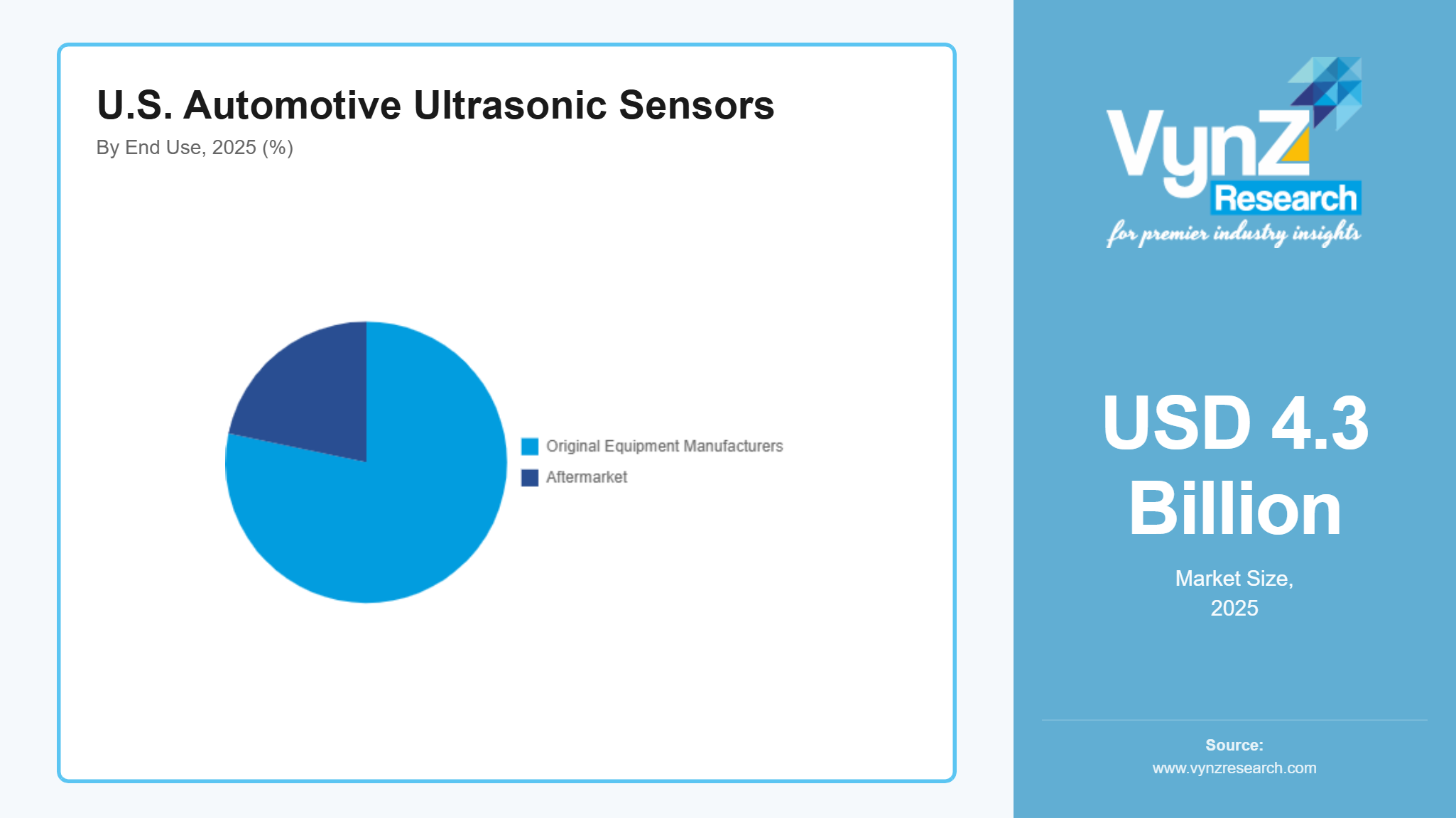
In 2025, Original Equipment Manufacturers (OEMs) accounted for the largest market share of around 78.3% due to the growing adoption of automotive ultrasonic sensors in OEMs and the rising collaborations between automaker and sensor manufacturers.
Aftermarket segment is anticipated to register the fastest growth rate of around 6.8% CAGR during the forecast period. This segment is experiencing exponential growth on account of the rising vehicle ownership and the growing demand for automotive ultrasonic sensors after vehicle purchase.
Regional Insights
Midwest United States
The Midwest United States accounted for about 31.6% of the U.S. automotive ultrasonic sensors market in 2025. This region is anticipated to maintain its lead due to the presence of a robust automotive manufacturing network and suppliers, as well as the rising need for advanced automotive technologies in Michigan, Ohio, and Indiana. The growth of the automotive sector in the region is also supported by the U.S. Department of Energy (DOE) and National Highway Traffic Safety Administration’s (NHTSA) emphasis on advanced vehicle technologies and manufacturing sustainability.
Southern United States
The Southern U.S. comprised about 24.7% of the market in 2025. The region is projected to witness substantial growth in ultrasonic sensors demand in 2025, supported by the rise in automotive manufacturing activity and the growing need for EVs, automated driving systems, and connected vehicles in Texas, Tennessee, Georgia, Alabama, and other states. Growth in the adoption of automated parking systems and electric and connected cars is expected to complement the growth of the automotive sensors market in the Southern U.S.
Western United States
The Western U.S. contributed about 18.5% of the market in 2025. The region is expected to witness elevated demand for automotive ultrasonic sensors in 2025, supported by the rising need for automotive technologies and autonomous mobility in California, Arizona, Nevada, and other states. A vibrant automotive technology ecosystem consisting of numerous software firms, developers, and researchers in automated driving and intelligent transportation systems is anticipated to drive the growth of the ultrasonic sensors market in the West.
The remaining 25.2% is expected to be contributed by the Northeastern United States, Mountain West, and other regions. The rising adoption of connected, automated, and electric vehicles, as well as the rising need for vehicle safety and smart mobility solutions, is projected to drive the ultrasonic sensors market growth in these regions during the forecast period.
Competitive Landscape / Company Insights
The market is moderately to highly competitive as key global and regional market participants are focusing on sensor design, advanced driver-assistance development, strategic partnerships, and automotive technology expansion. Additionally, companies are investing heavily in research and development, downscaling sensor design, artificial intelligence-based automotive perception, and vehicle safety technology to gain a competitive advantage. The National Highway Traffic Safety Administration (NHTSA), U.S. Department of Transportation (USDOT), U.S. Department of Energy (DOE), and other leading organizations are supporting and promoting the development of advanced transportation technologies and systems.
Mini Profiles
Continental AG focuses on automotive ultrasonic sensing solutions, advanced driver assistance technologies, and intelligent mobility systems, supported by global manufacturing capabilities and strong automotive partnerships.
Denso Corporation develops ultrasonic sensors, vehicle safety systems, and electronic components, supported by extensive research capabilities, strategic collaborations, and global automotive supply networks.
HELLA GmbH & Co. KGaA operates in automotive sensor and lighting segments, emphasizing innovative sensing technologies, vehicle safety solutions, and advanced electronic integration.
Murata Manufacturing Co., Ltd. specializes in electronic components and ultrasonic sensing technologies, supported by advanced materials expertise, miniaturisation capabilities, and global technology partnerships.
Robert Bosch GmbH provides automotive sensor technologies, driver assistance solutions, and electronic systems, supported by strong research capabilities and extensive OEM relationships.
Key Players
- Continental AG
- Denso Corporation
- HELLA GmbH & Co. KGaA
- Murata Manufacturing Co., Ltd.
- Robert Bosch GmbH
- Sensata Technologies Holding PLC
- Siemens AG
- Texas Instruments Incorporated
- Valeo SA
- ZF Friedrichshafen AG
Recent Developments
In January 2026, Valeo SA expanded its intelligent mobility technology portfolio by introducing enhanced driver assistance solutions integrating advanced sensing capabilities for automated parking and vehicle safety applications. The development supports increasing demand for automated driving functions across global automotive markets.
In March 2026, Texas Instruments Incorporated introduced new automotive semiconductor solutions designed to improve sensor processing performance and vehicle electronic system efficiency. The technology supports next generation driver assistance systems requiring improved signal processing capabilities.
In February 2025, Sensata Technologies Holding PLC expanded its automotive sensing portfolio with solutions designed for electric vehicles and advanced vehicle monitoring applications. The development strengthens the company’s position in intelligent mobility and automotive electronics.
In May 2025, ZF Friedrichshafen AG expanded its advanced mobility technology offerings with new solutions supporting automated driving and vehicle perception systems. The development aligns with increasing demand for integrated sensor technologies.
In April 2025, Siemens AG strengthened its automotive digital technology capabilities through expanded industrial software and simulation solutions supporting vehicle development processes. The initiative supports manufacturers developing advanced electronic and automated vehicle platforms.
U.S. Automotive Ultrasonic Sensors Market Coverage
Vehicle Type Insight and Forecast 2026 - 2035
- Passenger Vehicles
- Commercial Vehicles
Application Insight and Forecast 2026 - 2035
- Parking Assistance
- Blind Spot Detection
- Collision Avoidance
- Automated Driving Support Systems
Sensor Type Insight and Forecast 2026 - 2035
- Short Range Ultrasonic Sensors
- Long Range Ultrasonic Sensors
End Use Insight and Forecast 2026 - 2035
- Original Equipment Manufacturers (OEMs)
- Aftermarket
U.S. Automotive Ultrasonic Sensors Market by Region
- Midwest U.S.
- By Vehicle Type
- By Application
- By Sensor Type
- By End Use
- Southern U.S.
- By Vehicle Type
- By Application
- By Sensor Type
- By End Use
- Western U.S.
- By Vehicle Type
- By Application
- By Sensor Type
- By End Use
- Other U.S. Regions
- By Vehicle Type
- By Application
- By Sensor Type
- By End Use
Table of Contents for U.S. Automotive Ultrasonic Sensors Market Report
1. Research Overview
1.1. The Report Offers
1.2. Market Coverage
1.2.1. By
Vehicle Type
1.2.2. By
Application
1.2.3. By
Sensor Type
1.2.4. By
End Use
1.3. Research Phases
1.4. Limitations
1.5. Market Methodology
1.5.1. Data Sources
1.5.1.1.
Primary Research
1.5.1.2.
Secondary Research
1.5.2. Methodology
1.5.2.1.
Data Exploration
1.5.2.2.
Forecast Parameters
1.5.2.3.
Data Validation
1.5.2.4.
Assumptions
1.5.3. Study Period & Data Reporting Unit
2. Executive Summary
3. Industry Overview
3.1. Industry Dynamics
3.1.1. Market Growth Drivers
3.1.2. Market Restraints
3.1.3. Key Market Trends
3.1.4. Major Opportunities
3.2. Industry Ecosystem
3.2.1. Porter’s Five Forces Analysis
3.2.2. Recent Development Analysis
3.2.3. Value Chain Analysis
3.3. Competitive Insight
3.3.1. Competitive Position of Industry
Players
3.3.2. Market Attractive Analysis
3.3.3. Market Share Analysis
4. U.S. Market Estimate and Forecast
4.1. U.S. Market Overview
4.2. U.S. Market Estimate and Forecast to 2035
5. Market Segmentation Estimate and Forecast
5.1. By Vehicle Type
5.1.1. Passenger Vehicles
5.1.1.1. Market Definition
5.1.1.2. Market Estimation and Forecast to 2035
5.1.2. Commercial Vehicles
5.1.2.1. Market Definition
5.1.2.2. Market Estimation and Forecast to 2035
5.2. By Application
5.2.1. Parking Assistance
5.2.1.1. Market Definition
5.2.1.2. Market Estimation and Forecast to 2035
5.2.2. Blind Spot Detection
5.2.2.1. Market Definition
5.2.2.2. Market Estimation and Forecast to 2035
5.2.3. Collision Avoidance
5.2.3.1. Market Definition
5.2.3.2. Market Estimation and Forecast to 2035
5.2.4. Automated Driving Support Systems
5.2.4.1. Market Definition
5.2.4.2. Market Estimation and Forecast to 2035
5.3. By Sensor Type
5.3.1. Short Range Ultrasonic Sensors
5.3.1.1. Market Definition
5.3.1.2. Market Estimation and Forecast to 2035
5.3.2. Long Range Ultrasonic Sensors
5.3.2.1. Market Definition
5.3.2.2. Market Estimation and Forecast to 2035
5.4. By End Use
5.4.1. Original Equipment Manufacturers (OEMs)
5.4.1.1. Market Definition
5.4.1.2. Market Estimation and Forecast to 2035
5.4.2. Aftermarket
5.4.2.1. Market Definition
5.4.2.2. Market Estimation and Forecast to 2035
6. Midwest U.S. Market Estimate and Forecast
6.1. By
Vehicle Type
6.2. By
Application
6.3. By
Sensor Type
6.4. By
End Use
7. Southern U.S. Market Estimate and Forecast
7.1. By
Vehicle Type
7.2. By
Application
7.3. By
Sensor Type
7.4. By
End Use
8. Western U.S. Market Estimate and Forecast
8.1. By
Vehicle Type
8.2. By
Application
8.3. By
Sensor Type
8.4. By
End Use
9. Other U.S. Regions Market Estimate and Forecast
9.1. By
Vehicle Type
9.2. By
Application
9.3. By
Sensor Type
9.4. By
End Use
10. Company Profiles
10.1.
Continental AG
10.1.1.
Snapshot
10.1.2.
Overview
10.1.3.
Offerings
10.1.4.
Financial
Insight
10.1.5.
Recent
Developments
10.2.
Denso Corporation
10.2.1.
Snapshot
10.2.2.
Overview
10.2.3.
Offerings
10.2.4.
Financial
Insight
10.2.5.
Recent
Developments
10.3.
HELLA GmbH & Co. KGaA
10.3.1.
Snapshot
10.3.2.
Overview
10.3.3.
Offerings
10.3.4.
Financial
Insight
10.3.5.
Recent
Developments
10.4.
Murata Manufacturing Co., Ltd.
10.4.1.
Snapshot
10.4.2.
Overview
10.4.3.
Offerings
10.4.4.
Financial
Insight
10.4.5.
Recent
Developments
10.5.
Robert Bosch GmbH
10.5.1.
Snapshot
10.5.2.
Overview
10.5.3.
Offerings
10.5.4.
Financial
Insight
10.5.5.
Recent
Developments
10.6.
Sensata Technologies Holding PLC
10.6.1.
Snapshot
10.6.2.
Overview
10.6.3.
Offerings
10.6.4.
Financial
Insight
10.6.5.
Recent
Developments
10.7.
Siemens AG
10.7.1.
Snapshot
10.7.2.
Overview
10.7.3.
Offerings
10.7.4.
Financial
Insight
10.7.5.
Recent
Developments
10.8.
Texas Instruments Incorporated
10.8.1.
Snapshot
10.8.2.
Overview
10.8.3.
Offerings
10.8.4.
Financial
Insight
10.8.5.
Recent
Developments
10.9.
Valeo SA
10.9.1.
Snapshot
10.9.2.
Overview
10.9.3.
Offerings
10.9.4.
Financial
Insight
10.9.5.
Recent
Developments
10.10.
ZF Friedrichshafen AG
10.10.1.
Snapshot
10.10.2.
Overview
10.10.3.
Offerings
10.10.4.
Financial
Insight
10.10.5.
Recent
Developments
11. Appendix
11.1. Exchange Rates
11.2. Abbreviations
Note: Financial insight and recent developments of different companies are subject to the availability of information in the secondary domain.
Frequently Asked Questions
Purchase Options
Latest Report
Research Methodology
- Desk Research / Pilot Interviews
- Build Market Size Model
- Research and Analysis
- Final Deliverable
Connect With Our Sales Team
- Toll-Free: +1-888-253-3960
- Phone: +91 9960 288 381
- Email: enquiry@vynzresearch.com
U.S. Automotive Ultrasonic Sensors Market