
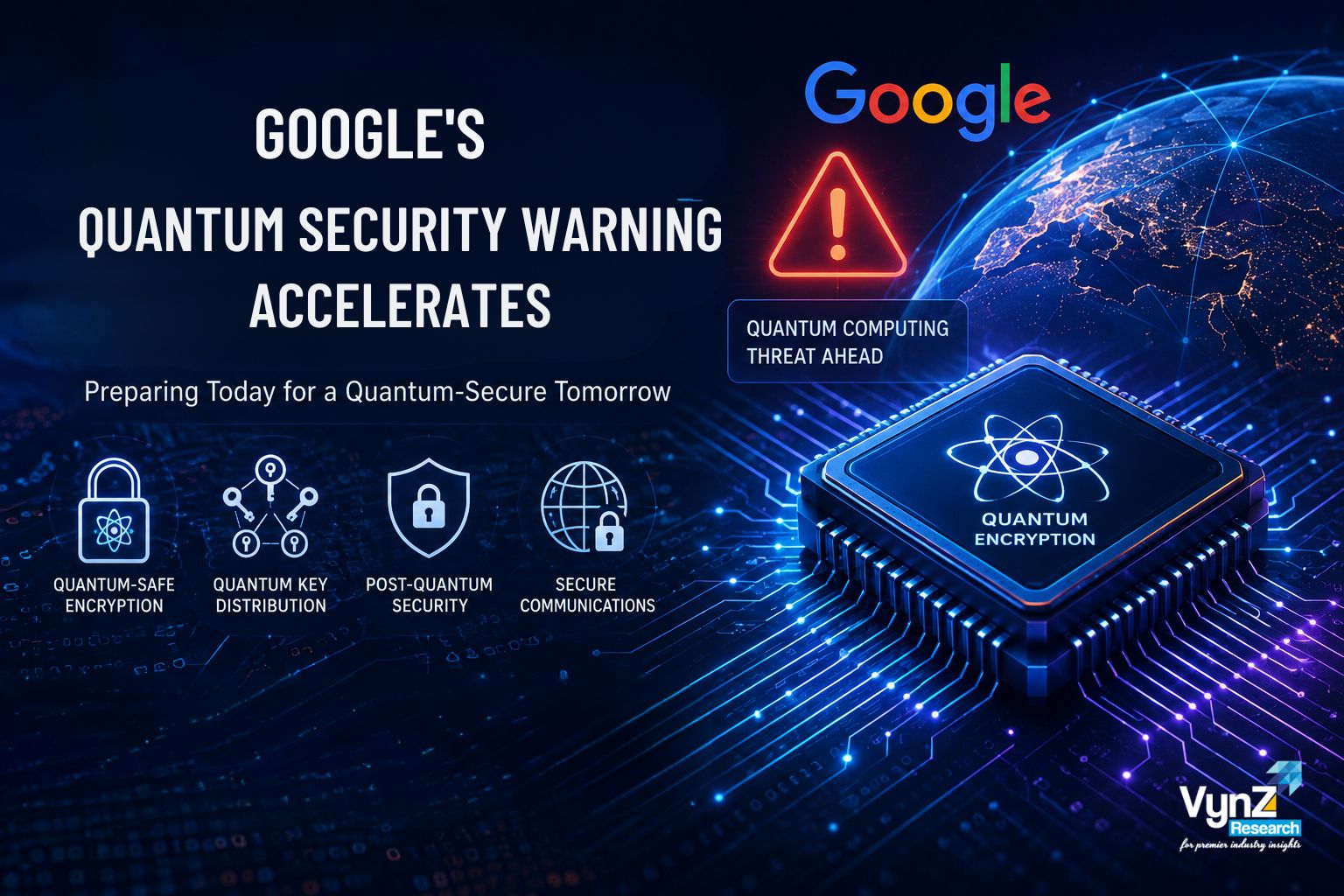
Google’s message - quantum computing could mess with or at minimum weaken the encryption a lot of us rely on right now - is not only theoretical anymore. Lately, it feels like the whole cybersecurity industry has entered a more restless stage, where these quantum warnings are being taken more seriously and talked about pretty much daily. With bigger pressure coming from tech heavyweights like Google, the market for quantum-safe security solutions is moving ahead quickly.
Today, standard encryption is what helps protect all kinds of systems, from banking routines to government messages and cloud-stored files. But many analysts are saying that once quantum computers get strong enough, they may break familiar encryption methods much faster than classical machines ever could. Even the possibility is enough to push organizations toward a future where parts of today’s security stack might not be reliable for long.
Growing Fear Around Quantum Computing Threats
One major driver is the whole “harvest now, decrypt later” problem. It sounds simple, but it’s ugly: bad actors collect encrypted information today, then sit on it, and only decrypt once quantum power hits that critical threshold.
This risk feels especially real for organizations managing sensitive data that’s supposed to remain valuable for a long time, such as:
• Banking and financial services
• Defense and intelligence agencies
• Healthcare organizations
• Telecom providers
• Cloud computing companies
So, with the stakes looking higher than before, governments and large enterprises are starting to pour more money into quantum-resistant cybersecurity, not as some casual “sometime later” improvement either, but more like an urgent upgrade road map they can’t really postpone.
Quantum Cryptography Is Gaining Strategic Importance
Quantum cryptography uses principles from quantum mechanics to secure communications, with an emphasis on advanced cyber threats and a kind of proactive verification. In a broad sense it differs from classical encryption, because quantum-based systems can reveal interception attempts, or any tampering, directly during transmission.
One of the most discussed approaches in the market is Quantum Key Distribution, usually just QKD. In QKD, encryption keys get exchanged in a way that stays secure between two parties, and suspicious access attempts can show up immediately rather than later, after the damage is already done.
Even if QKD has been floating around research circles for years, this recent burst of concern is nudging it toward commercial deployment. Telecom firms, research outfits, and defense organizations are increasingly testing QKD networks for secure communication uses, almost like they’re treating it as a practical component you can actually build with.
Governments Are Expanding Quantum Security Investments
Market growth is also getting helped by global competition in quantum tech. The United States, China, and a few European Union members are all putting serious resources into quantum communications and also post-quantum cybersecurity programs, basically.
Lately, governments see quantum safe encryption as a national security priority not just some research thing anymore, and that kind of shifts everything. Money is now showing up across multiple fronts, including:
• Quantum communication networks
• Satellite-based secure communication systems
• Post-quantum cryptography research
• Quantum computing infrastructure development
This broader public-sector push is creating space for companies already active in the quantum cryptography market, because demand is no longer only coming from private experiments.
Financial and Telecom Sectors Are Moving Early
Banking and telecom are frequently among the first areas to adopt quantum-safe security. Financial institutions, in particular, are trying to protect transaction information and customer records from future decryption threats that might show up later.
At the same time, telecom providers are testing ways to stitch quantum encryption features into next-generation communication systems. With global data traffic still climbing, secured communication networks are becoming less optional, more like foundational.
A lot of organizations are also leaning on hybrid approaches, like mixing conventional encryption with quantum resistant tech while they modernize bit by bit. That transition period, could drag on for years, because big systems they don’t usually get replaced overnight even when the urgency is loud.
High Costs and Technical Challenges Remain
Despite the rising momentum, the quantum cryptography market still has real hurdles. Quantum communication infrastructure can be expensive and tricky to roll out. There’s specialized hardware to account for, scalability can be limited, and integration headaches show up whenever new security methods have to connect with older networks.
In many situations, organizations are still asking whether quantum-safe tools are commercially ready for large-scale adoption. Even so, continued research and growing investment should gradually reduce costs, or at least make deployment less brutal.
Conclusion
Warnings about quantum computing threats are making people take quantum-safe cybersecurity more seriously. When companies and governments are looking at long-term exposure, the quantum cryptography market looks like it’s shifting away from that niche research lane and into something more like a strategic security priority, not just an experiment.
And with more investment, bigger pilot rollouts, and that steady rise in people understanding future encryption risks, quantum cryptography is expected to expand its role across the wider global cybersecurity landscape over the next years.