
Plastic-eating Bacteria Market Size & Share - Growth Forecast Report (2026-2035)
Industry Insight by Type (Naturally occurring bacteria, Genetically engineered bacteria), by Polymer Type (Polyethylene terephthalate, Polyethylene, Polyurethane, Others), by Technology (Microbial degradation, Enzymatic degradation), by End Use (Waste management, Industrial, Environmental remediation), by Region (North America, Europe, Asia Pacific, Rest of the World)
| Status : Published | Published On : May, 2026 | Report Code : VRCH2132 | Industry : Chemicals & Materials | Available Format :

|
Page : 143 |
Plastic-eating Bacteria Market Overview
The plastic-eating bacteria market which was valued at approximately USD 120 million in 2025 and is estimated to rise further up to almost USD 142 million in 2026, is projected to reach around USD 677.6 million in 2035, expanding at a CAGR of about 18.9% during the forecast period from 2026 to 2035.
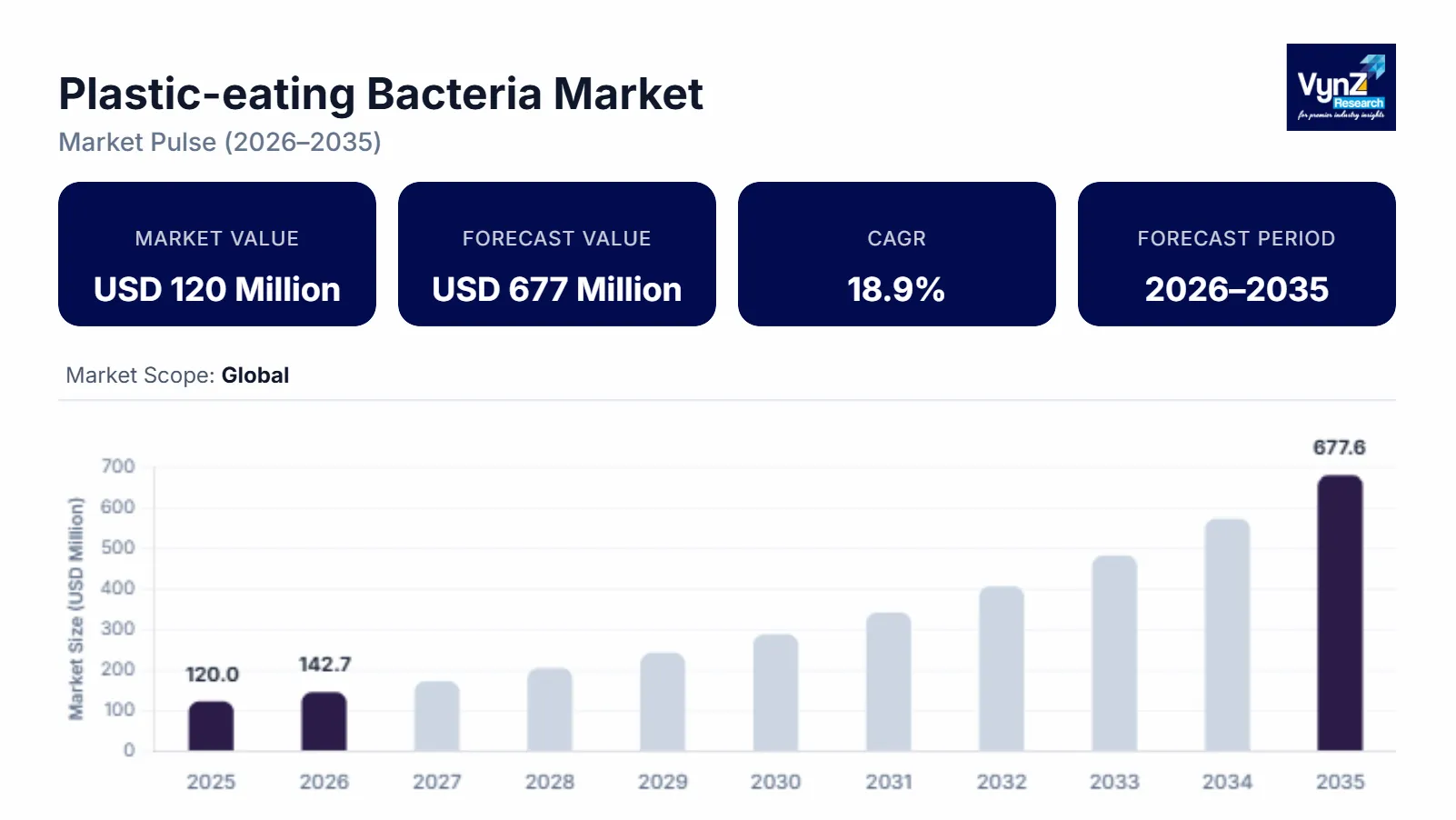
Market expansion results from three factors which include rising plastic waste production, increased public awareness about non-biodegradable waste disposal issues and the implementation of stricter waste management rules which people now follow along with their greater use of biological recycling methods. The market expansion in North America, Europe and Asia Pacific regions receives support from two forces which include rising interest in environmentally friendly waste processing solutions and continuing investments toward environmental protection programs. Environmental agencies together with international sustainability organizations have identified an urgent need to tackle plastic pollution through microbial degradation technology establishment and operational implementation.
Government initiatives which aim to decrease plastic waste while fostering circular economy principles, create a positive market effect across major world economies. Environmental protection programs together with policies that follow global sustainability objectives, promote plastic waste reduction through reuse and biological treatment methods, which help develop microbial degradation technologies. Public funding for waste management system development and research grants for biotechnology solutions create pathways to bring plastic-eating bacteria into the market. The international environmental framework support together with rising plastic disposal regulations, drives demand for the policy measures which apply to regions that require sustainability compliance and environmental protection standards.
Plastic-eating Bacteria Market Dynamics
Market Trends
The market experiences major changes because of new technological solutions which enable sustainable waste management through biological waste processing methods that environmentalists now prefer. The market trend which drives market development is people now using engineered microbial strains to degrade plastic because they want more sustainable and effective methods for reducing waste materials. The development of waste management systems through biotechnology processes occurs because organizations want to meet regulations and scientists make new discoveries about microbial organisms. Global environmental agencies report that companies now put more effort into implementing circular economy principles which leads them to develop scalable integrated solutions for biodegradation that establish new market competition standards.
Growth Drivers
Market growth occurs because plastic waste generation increases which creates ongoing demand for waste management and environmental remediation solutions. The waste treatment infrastructure development and environmental protection program investments create an extra drive for market growth. Environmental regulations which require organizations to adopt sustainable practices create a demand boost for biological plastic degradation solutions. The forecast period will see continued demand for biological plastic degrading solutions as both industries and municipalities focus their efforts on compliance and sustainability. Environmental agencies worldwide report that governments face increasing regulatory pressure which forces them to decrease plastic pollution while supporting the development of new biodegradation technologies.
Market Restraints / Challenges
The market has several obstacles which prevent its complete development despite showing potential for positive growth. Genetically modified organism regulations cause market penetration problems through their complicated standards which emerging economies with strict biosafety regulations must follow. Manufacturing companies and solution providers experience operational difficulties because they must deal with technological restrictions which affect large scale implementation. The market suffers from scalability issues and cost pressures because businesses need specialized research facilities and expert knowledge to operate during funding shortages and economic downturns. Environmental authorities and biosafety officials demand strict validation systems which will delay commercial product availability.
Market Opportunities
The market provides major growth potential through advanced waste recycling systems which currently experience increased demand because of growing international interest in sustainable waste management and circular economy systems. Microbial solution providers who offer scalable high-performance products will receive additional demand from municipal waste authorities and industrial users. The biotechnology sector offers major growth potential through its research and development investment which creates new paths for increasing operational efficiency and developing new medical applications. Synthetic biology and enzyme engineering development will boost material degradation efficiency while following sustainability standards through government environmental research programs and funding initiatives.
Global Plastic-eating Bacteria Market Report Coverage
|
Report Metric |
Details |
|
Historical Period |
2020 - 2024 |
|
Base Year Considered |
2025 |
|
Forecast Period |
2026 - 2035 |
|
Market Size in 2025 |
USD 0.12 Billion |
|
Revenue Forecast in 2035 |
USD 0.86 Billion |
|
Growth Rate |
18.9% |
|
Segments Covered in the Report |
Type, Polymer Type, Technology, End Use |
|
Report Scope |
Market Trends, Drivers, and Restraints; Revenue Estimation and Forecast; Segmentation Analysis; Companies’ Strategic Developments; Market Share Analysis of Key Players; Company Profiling |
|
Regions Covered in the Report |
North America, Europe, Asia Pacific, Rest of the World |
|
Key Companies |
BASF SE, Carbios, Danimer Scientific, DSM-Firmenich, Eastman Chemical Company, Evonik Industries AG, Genecis Bioindustries Inc., Kaneka Corporation, Novonesis, TotalEnergies Corbion |
|
Customization |
Available upon request |
Plastic-eating Bacteria Market Segmentation
By Type
Naturally occurring bacteria held the largest market share in 2025 which accounted for about 57% of the overall market revenue. Their dominance arises from their ability to meet regulatory demands with minimal effort while scientists have confirmed their effectiveness in environmental research. Environmental agencies supported by government funding continue to promote waste treatment solutions that use biologically derived materials which municipal and industrial sectors now adopt.
Genetically engineered bacteria are expected to register the fastest growth, with an estimated CAGR of 19.6% during the forecast period from 2026 to 2035. Synthetic biology developments together with enzyme engineering breakthroughs create better plastic degradation methods which expand their uses. The biotechnology industry is experiencing growth because companies invest in research while regulatory bodies create systems that support new ideas.
By Polymer Type
Polyethylene terephthalate held the top market position in 2025 which generated 43% of all segment revenue. Its dominance arises from its widespread global distribution which enables packaging and textile manufacturers to create more PET products and people now focus on PET waste management through biological recycling systems. Environmental agencies continue to highlight PET as a major contributor to plastic pollution, driving targeted microbial degradation efforts.
The polyurethane and polyethylene market segments will experience higher growth rates because they will achieve an estimated CAGR of 18.7% during the forecast period. The market progresses because industrial operations need to destroy difficult plastic materials and scientists conduct research to improve the microbial degradation capabilities of all types of polymers. Government funding for research programs is driving innovation in the development of multi polymer degradation methods.
By Technology
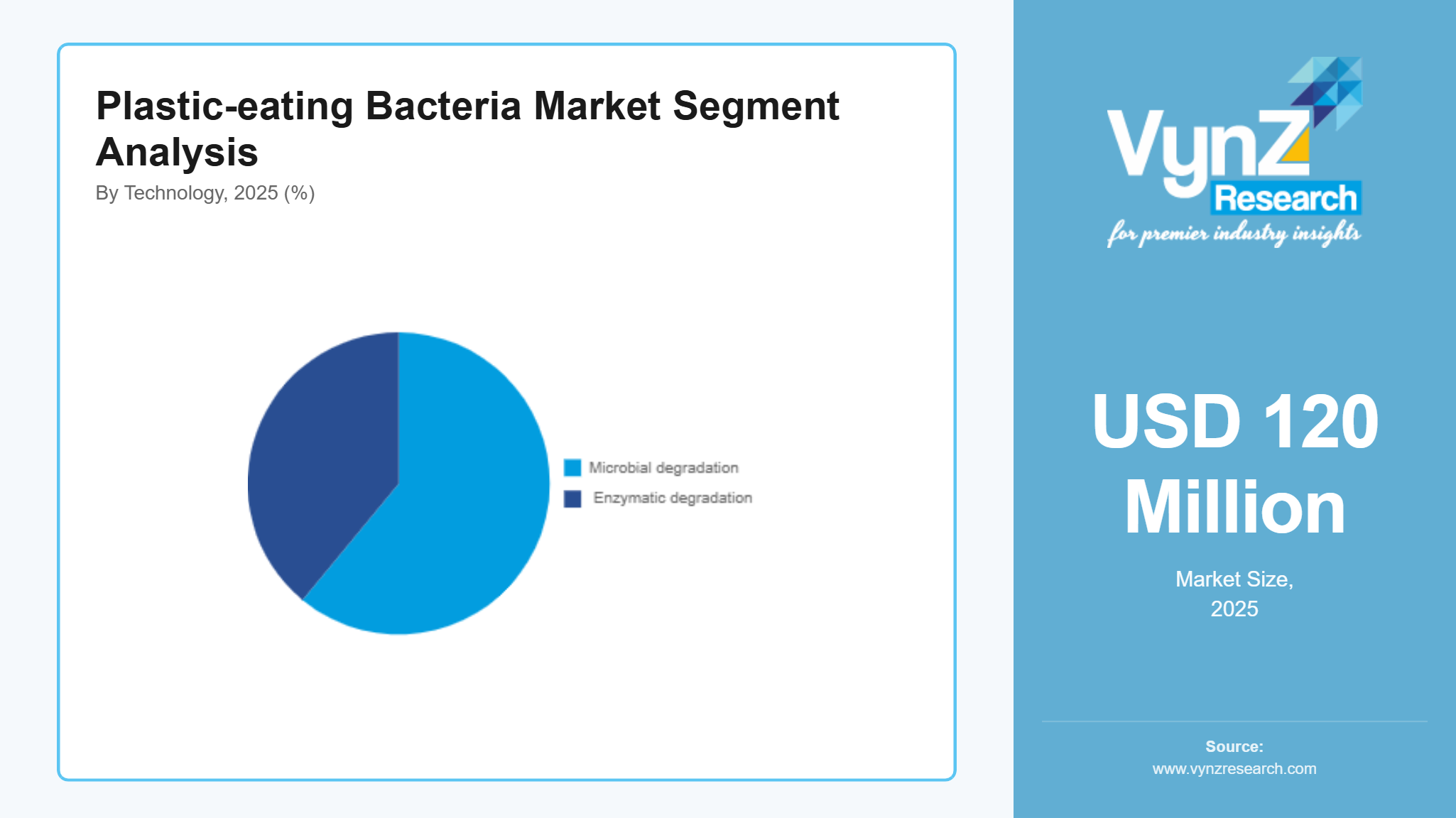
Microbial degradation held the largest market share in 2025, which accounted for 61% of total industry revenue. Its dominance arises from its ability to treat waste through direct application and its established use in environmental cleanup projects. Public environmental programs and waste management initiatives are promoting microbial solutions as cost effective and scalable alternatives to conventional recycling methods.
The enzymatic degradation market will expand at the fastest rate which will reach a CAGR of 19.1% between 2026 and 2035. The market expands because plastics can now be specifically targeted with improved processes that use enzymes to break down materials. Government funding for biotechnology research programs together with innovation initiatives will drive adoption of advanced recycling and industrial waste management systems.
By End Use
The waste management market segment generated the largest revenue in 2025 which accounted for 52% of total market earnings. Its dominance arises from the ongoing increase in global plastic waste production and the development of municipal waste processing facilities. The government promotes sustainable waste management and circular economy practices which residents of urban areas are now adopting.
The industrial segment is witnessing the fastest growth, which will achieve an estimated CAGR of 18.8% during the forecast period. The market expands because manufacturing and packaging companies increasingly want to use environmentally friendly waste disposal methods. Environmental compliance expenditures and ecofriendly technology adoption maintain market demand while environmental remediation activities enable companies to operate in polluted areas with high waste production.
Regional Insights
North America
The market in 2025 in North America reached about 29% of its total market share. The region experiences growth because of its strong regulatory framework, advanced waste management systems and ongoing environmental biotechnology funding. The cities of New York, San Francisco and Toronto show persistent growth in their implementation of biological recycling methods which they use to process both municipal and industrial waste. Environmental protection agencies report increasing plastic pollution problems so they push for the use of sustainable degradation technologies.
Europe
The European market achieved 26% market share in 2025. The region achieves growth through its strict environmental regulations and its sustainability targets and its policy framework which supports waste reduction and recycling initiatives. The industrial and municipal sectors of Germany, France and the Netherlands operate advanced biological waste treatment technologies at increasing levels. The environmental regulatory bodies report strong progress toward two goals which include reducing landfill dependency while promoting eco-friendly waste solutions.
Asia Pacific
The market in Asia Pacific reached 23% of total sales in 2025. The rapid urban growth and increasing plastic waste production and improved waste management systems in China, India and Japan drive market expansion. Beijing, Mumbai and Tokyo function as important centers for developing waste treatment technologies and applying environmental technology solutions. The regional environmental agencies report that governments are increasing their focus on implementing sustainable waste management systems.
Rest of the World
The market share of the rest of the world which includes Latin America, the Middle East and Africa reached 22% in 2025. The regions experience growth because people now understand plastic pollution better and waste management systems have started to improve their performance and environmental sustainability initiatives receive increasing funding. Emerging economies are beginning to adopt biological solutions, although their overall market penetration remains inferior to that of leading regions.
Competitive Landscape / Company Insights
The market shows intermediate competition because global and regional companies active in the market pursue product development and expansion into new markets. Companies are boosting their research and development spending to develop biotechnological innovations which will help them achieve better market results. The development of scalable and safe microbial solutions receives support from environmental authorities and biosafety organizations through their regulatory guidelines. The combination of government-funded research programs and sustainability initiatives creates commercial opportunities while partnerships with waste management agencies help businesses establish themselves in the market and drive their future growth.
Mini Profiles
BASF SE focuses on sustainable materials and enzyme-based solutions supporting plastic biodegradation, supported by strong global distribution networks and established brand recognition across industrial and environmental biotechnology applications.
Carbios operates in niche biotechnology segments, emphasizing advanced enzymatic plastic recycling technologies that enhance degradation efficiency and enable circular economy solutions for polymer waste management.
Danimer Scientific leverages biopolymer innovation and strategic partnerships to expand market presence, offering biodegradable material solutions aligned with increasing demand for sustainable plastic alternatives across packaging industries.
DSM-Firmenich focuses on bioscience and enzyme development for sustainable applications, supported by strong research capabilities and global presence in biotechnology and environmental solution markets.
Evonik Industries AG operates in specialized chemical and biotechnology segments, emphasizing performance-driven enzyme solutions and sustainable innovations for industrial and environmental applications.
Key Players
- BASF SE
- Carbios
- Danimer Scientific
- DSM-Firmenich
- Eastman Chemical Company
- Evonik Industries AG
- Genecis Bioindustries Inc.
- Kaneka Corporation
- Novonesis
- TotalEnergies Corbion
Recent Developments
In January 2026, Eastman Chemical Company expanded its sustainable materials portfolio by advancing enzymatic and molecular recycling initiatives targeting hard-to-recycle plastic waste. The development supports integration of biological and chemical recycling technologies to improve circularity.
In March 2025, Genecis Bioindustries Inc. progressed its microbial fermentation platform for converting plastic waste into biodegradable materials. The company strengthened collaborations with industrial partners to scale commercialization of biologically derived recycling solutions.
In April 2026, Kaneka Corporation enhanced production capacity for biodegradable polymers and bio-based materials aligned with global sustainability targets. The initiative supports increased adoption of eco-friendly alternatives across packaging and industrial applications.
In February 2026, Novonesis advanced its enzyme innovation programs focused on improving plastic degradation efficiency and industrial scalability. The company continues to invest in biotechnology research aligned with environmental sustainability and circular economy goals.
In May 2025, TotalEnergies Corbion expanded its global footprint in bioplastics by increasing production of PLA-based materials for sustainable packaging solutions. The development aligns with rising demand for biodegradable materials and regulatory pressure to reduce plastic waste.
Global Plastic-eating Bacteria Market Coverage
Type Insight and Forecast 2026 - 2035
- Naturally occurring bacteria
- Genetically engineered bacteria
Polymer Type Insight and Forecast 2026 - 2035
- Polyethylene terephthalate
- Polyethylene
- Polyurethane
- Others
Technology Insight and Forecast 2026 - 2035
- Microbial degradation
- Enzymatic degradation
End Use Insight and Forecast 2026 - 2035
- Waste management
- Industrial
- Environmental remediation
Region Insight and Forecast 2026 - 2035
- North America
- Europe
- Asia Pacific
- Rest of the World
Global Plastic-eating Bacteria Market by Region
- North America
- By Type
- By Polymer Type
- By Technology
- By End Use
- By Region
- By Country - U.S., Canada, Mexico
- Europe
- By Type
- By Polymer Type
- By Technology
- By End Use
- By Region
- By Country - Germany, U.K., France, Italy, Spain, Russia, Rest of Europe
- Asia-Pacific (APAC)
- By Type
- By Polymer Type
- By Technology
- By End Use
- By Region
- By Country - China, Japan, India, South Korea, Vietnam, Thailand, Malaysia, Rest of Asia-Pacific
- Rest of the World (RoW)
- By Type
- By Polymer Type
- By Technology
- By End Use
- By Region
- By Country - Brazil, Saudi Arabia, South Africa, U.A.E., Other Countries
Table of Contents for Plastic-eating Bacteria Market Report
1. Research Overview
1.1. The Report Offers
1.2. Market Coverage
1.2.1. By
Type
1.2.2. By
Polymer Type
1.2.3. By
Technology
1.2.4. By
End Use
1.2.5. By
Region
1.3. Research Phases
1.4. Limitations
1.5. Market Methodology
1.5.1. Data Sources
1.5.1.1.
Primary Research
1.5.1.2.
Secondary Research
1.5.2. Methodology
1.5.2.1.
Data Exploration
1.5.2.2.
Forecast Parameters
1.5.2.3.
Data Validation
1.5.2.4.
Assumptions
1.5.3. Study Period & Data Reporting Unit
2. Executive Summary
3. Industry Overview
3.1. Industry Dynamics
3.1.1. Market Growth Drivers
3.1.2. Market Restraints
3.1.3. Key Market Trends
3.1.4. Major Opportunities
3.2. Industry Ecosystem
3.2.1. Porter’s Five Forces Analysis
3.2.2. Recent Development Analysis
3.2.3. Value Chain Analysis
3.3. Competitive Insight
3.3.1. Competitive Position of Industry
Players
3.3.2. Market Attractive Analysis
3.3.3. Market Share Analysis
4. Global Market Estimate and Forecast
4.1. Global Market Overview
4.2. Global Market Estimate and Forecast to 2035
5. Market Segmentation Estimate and Forecast
5.1. By Type
5.1.1. Naturally occurring bacteria
5.1.1.1. Market Definition
5.1.1.2. Market Estimation and Forecast to 2035
5.1.2. Genetically engineered bacteria
5.1.2.1. Market Definition
5.1.2.2. Market Estimation and Forecast to 2035
5.2. By Polymer Type
5.2.1. Polyethylene terephthalate
5.2.1.1. Market Definition
5.2.1.2. Market Estimation and Forecast to 2035
5.2.2. Polyethylene
5.2.2.1. Market Definition
5.2.2.2. Market Estimation and Forecast to 2035
5.2.3. Polyurethane
5.2.3.1. Market Definition
5.2.3.2. Market Estimation and Forecast to 2035
5.2.4. Others
5.2.4.1. Market Definition
5.2.4.2. Market Estimation and Forecast to 2035
5.3. By Technology
5.3.1. Microbial degradation
5.3.1.1. Market Definition
5.3.1.2. Market Estimation and Forecast to 2035
5.3.2. Enzymatic degradation
5.3.2.1. Market Definition
5.3.2.2. Market Estimation and Forecast to 2035
5.4. By End Use
5.4.1. Waste management
5.4.1.1. Market Definition
5.4.1.2. Market Estimation and Forecast to 2035
5.4.2. Industrial
5.4.2.1. Market Definition
5.4.2.2. Market Estimation and Forecast to 2035
5.4.3. Environmental remediation
5.4.3.1. Market Definition
5.4.3.2. Market Estimation and Forecast to 2035
5.5. By Region
5.5.1. North America
5.5.1.1. Market Definition
5.5.1.2. Market Estimation and Forecast to 2035
5.5.2. Europe
5.5.2.1. Market Definition
5.5.2.2. Market Estimation and Forecast to 2035
5.5.3. Asia Pacific
5.5.3.1. Market Definition
5.5.3.2. Market Estimation and Forecast to 2035
5.5.4. Rest of the World
5.5.4.1. Market Definition
5.5.4.2. Market Estimation and Forecast to 2035
6. North America Market Estimate and Forecast
6.1. By
Type
6.2. By
Polymer Type
6.3. By
Technology
6.4. By
End Use
6.5. By
Region
6.5.1.
U.S. Market Estimate and Forecast
6.5.2.
Canada Market Estimate and Forecast
6.5.3.
Mexico Market Estimate and Forecast
7. Europe Market Estimate and Forecast
7.1. By
Type
7.2. By
Polymer Type
7.3. By
Technology
7.4. By
End Use
7.5. By
Region
7.5.1.
Germany Market Estimate and Forecast
7.5.2.
France Market Estimate and Forecast
7.5.3.
U.K. Market Estimate and Forecast
7.5.4.
Italy Market Estimate and Forecast
7.5.5.
Spain Market Estimate and Forecast
7.5.6.
Russia Market Estimate and Forecast
7.5.7.
Rest of Europe Market Estimate and Forecast
8. Asia-Pacific (APAC) Market Estimate and Forecast
8.1. By
Type
8.2. By
Polymer Type
8.3. By
Technology
8.4. By
End Use
8.5. By
Region
8.5.1.
China Market Estimate and Forecast
8.5.2.
Japan Market Estimate and Forecast
8.5.3.
India Market Estimate and Forecast
8.5.4.
South Korea Market Estimate and Forecast
8.5.5.
Rest of Asia-Pacific Market Estimate and Forecast
9. Rest of the World (RoW) Market Estimate and Forecast
9.1. By
Type
9.2. By
Polymer Type
9.3. By
Technology
9.4. By
End Use
9.5. By
Region
9.5.1.
Brazil Market Estimate and Forecast
9.5.2.
Saudi Arabia Market Estimate and Forecast
9.5.3.
South Africa Market Estimate and Forecast
9.5.4.
U.A.E. Market Estimate and Forecast
9.5.5.
Other Countries Market Estimate and Forecast
10. Company Profiles
10.1.
BASF SE
10.1.1.
Snapshot
10.1.2.
Overview
10.1.3.
Offerings
10.1.4.
Financial
Insight
10.1.5.
Recent
Developments
10.2.
Carbios
10.2.1.
Snapshot
10.2.2.
Overview
10.2.3.
Offerings
10.2.4.
Financial
Insight
10.2.5.
Recent
Developments
10.3.
Danimer Scientific
10.3.1.
Snapshot
10.3.2.
Overview
10.3.3.
Offerings
10.3.4.
Financial
Insight
10.3.5.
Recent
Developments
10.4.
DSM-Firmenich
10.4.1.
Snapshot
10.4.2.
Overview
10.4.3.
Offerings
10.4.4.
Financial
Insight
10.4.5.
Recent
Developments
10.5.
Eastman Chemical Company
10.5.1.
Snapshot
10.5.2.
Overview
10.5.3.
Offerings
10.5.4.
Financial
Insight
10.5.5.
Recent
Developments
10.6.
Evonik Industries AG
10.6.1.
Snapshot
10.6.2.
Overview
10.6.3.
Offerings
10.6.4.
Financial
Insight
10.6.5.
Recent
Developments
10.7.
Genecis Bioindustries Inc.
10.7.1.
Snapshot
10.7.2.
Overview
10.7.3.
Offerings
10.7.4.
Financial
Insight
10.7.5.
Recent
Developments
10.8.
Kaneka Corporation
10.8.1.
Snapshot
10.8.2.
Overview
10.8.3.
Offerings
10.8.4.
Financial
Insight
10.8.5.
Recent
Developments
10.9.
Novonesis
10.9.1.
Snapshot
10.9.2.
Overview
10.9.3.
Offerings
10.9.4.
Financial
Insight
10.9.5.
Recent
Developments
10.10.
TotalEnergies Corbion
10.10.1.
Snapshot
10.10.2.
Overview
10.10.3.
Offerings
10.10.4.
Financial
Insight
10.10.5.
Recent
Developments
11. Appendix
11.1. Exchange Rates
11.2. Abbreviations
Note: Financial insight and recent developments of different companies are subject to the availability of information in the secondary domain.
Frequently Asked Questions
Purchase Options
Latest Report
Research Methodology
- Desk Research / Pilot Interviews
- Build Market Size Model
- Research and Analysis
- Final Deliverable
Connect With Our Sales Team
- Toll-Free: +1-888-253-3960
- Phone: +91 9960 288 381
- Email: enquiry@vynzresearch.com
Plastic-eating Bacteria Market