
Renewable Energy-powered USVs Market Size & Share - Growth Forecast Report (2026-2035)
Industry Insight by Energy Source (Solar-Powered USVs, Wind-Powered USVs, Wave-Powered USVs, Hybrid Renewable Energy USVs), by Size (Small USVs, Medium USVs, Large USVs), by Application (Defense & Maritime Security, Oceanographic Research & Environmental Monitoring, Offshore Oil & Gas Operations, Renewable Energy Infrastructure Inspection, Hydrographic Surveying, Others), by Propulsion Type (Fully Renewable-Powered, Hybrid Propulsion)
| Status : Published | Published On : Apr, 2026 | Report Code : VREP3066 | Industry : Energy & Power | Available Format :

|
Page : 195 |
Renewable Energy-powered USVs Market Overview
The renewable energy-powered USVs market which was valued at approximately USD 1.1 billion in 2025 and is estimated to reach around USD 1.3 billion in 2026, is projected to reach close to USD 4.0 billion by 2035, expanding at a CAGR of about 13.4% during the forecast period from 2026 to 2035.
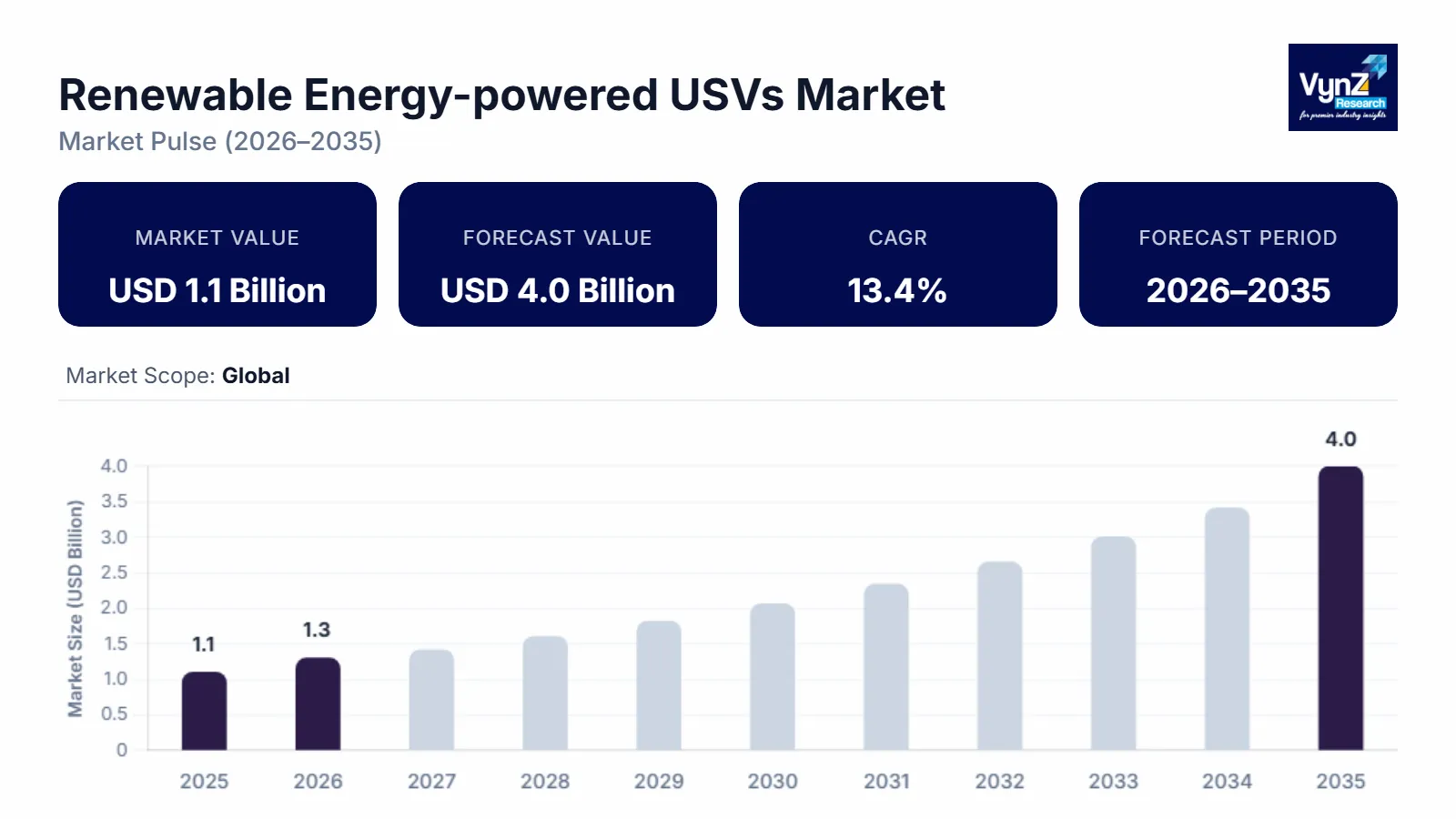
The renewable energy-powered (USVs) market is driven by the increasing emphasis on sustainability, operational efficiency, and long-endurance ocean missions. These USVs utilize renewable energy sources such as solar, wind, and wave power, enabling extended deployment durations with minimal human intervention and significantly reduced fuel dependency. The market is witnessing strong adoption across applications including oceanographic research, environmental monitoring, maritime security, offshore energy operations, and defense surveillance, where continuous data collection and low operating costs are critical. Technological advancements in autonomous navigation systems, energy storage, and hybrid propulsion solutions are further enhancing the reliability and efficiency of these platforms, making them viable alternatives to conventional vessels. The market is also supported by stringent environmental regulations and government initiatives promoting low-carbon maritime operations, particularly in the U.S., where sustainability goals and maritime security investments are accelerating adoption.
Renewable Energy-powered USVs Market Dynamics
Market Trends
Technological innovations in energy storage and power management systems are playing a critical role in advancing the capabilities of renewable energy-powered uncrewed surface vehicles (USVs). As these vessels rely on intermittent energy sources such as solar, wind, and wave power, efficient storage solutions particularly advanced lithium-ion batteries and emerging solid-state technologies are essential for ensuring continuous operation during periods of low energy generation. In parallel, intelligent power management systems are being developed to optimize energy consumption by dynamically allocating power across propulsion, sensors, communication systems, and onboard processing units. These systems often incorporate real-time monitoring, predictive analytics, and AI-based optimization to enhance energy efficiency and extend mission duration. The DOE invested over $18 million in multiple university-led projects focused on advancing marine energy technologies, including systems that improve energy generation, storage reliability, and performance optimization for ocean-based platforms. Additionally, hybrid energy architectures that combine multiple renewable sources with backup storage are becoming increasingly common, enabling USVs to operate reliably in diverse and challenging marine environments.
Growth Drivers
The growing deployment of renewable energy-powered uncrewed surface vehicles (USVs) in defense and maritime security applications is emerging as a significant growth driver for the market. Defense agencies and naval forces are increasingly adopting these platforms for intelligence, surveillance, reconnaissance (ISR), border patrol, mine countermeasures, and anti-submarine warfare due to their ability to operate autonomously for extended durations without the need for frequent refueling. Renewable-powered USVs, equipped with solar, wind, or wave energy systems, offer enhanced endurance and stealth capabilities, making them highly effective for persistent monitoring of strategic maritime zones. the U.S. Navy, which has allocated nearly $5 billion toward unmanned maritime programs, including around $2.1 billion for medium unmanned surface vessels (MUSVs). This reflects a clear strategic shift toward autonomous, energy-efficient platforms that can perform surveillance and reconnaissance missions with lower operational dependence on fuel and human intervention, thereby enhancing long-endurance maritime security capabilities. Additionally, their lower operational and maintenance costs compared to traditional manned vessels enable defense organizations to scale deployments more efficiently. Governments, particularly in the United States, are investing heavily in autonomous maritime technologies to strengthen national security and improve situational awareness across vast ocean territories.
Market Restraints / Challenges
The complex integration of hybrid energy and power management systems represents a significant challenge in the renewable energy-powered uncrewed surface vehicles (USVs) market. These vessels often rely on a combination of energy sources such as solar panels, wind turbines, wave energy converters, and battery storage, all of which must be seamlessly coordinated to ensure continuous and efficient operation. Managing multiple energy inputs with varying availability and output levels requires highly sophisticated control systems capable of real-time monitoring, energy forecasting, and dynamic power distribution. Any imbalance or inefficiency in this integration can lead to energy losses, reduced performance, or even system failures during critical missions. Additionally, designing compact and lightweight systems that can accommodate diverse energy components without compromising vessel stability or performance further increases complexity. The need for advanced software, sensors, and control algorithms also raises development costs and technical barriers.
Market Opportunities
Advancements in energy storage technologies are creating significant opportunities in the renewable energy-powered uncrewed surface vehicles (USVs) market by enabling ultra-long mission durations and enhancing operational reliability. Modern USVs increasingly rely on high-performance battery systems such as advanced lithium-ion and emerging solid-state batteries, which offer higher energy density, faster charging capabilities, and improved lifecycle performance. These innovations allow USVs to store surplus energy generated from renewable sources like solar, wind, and wave power, ensuring continuous operation even during periods of low energy availability. The EVs4ALL Battery Program by the U.S. Department of Energy is a $42 million initiative aimed at developing next-generation batteries that are longer-lasting, faster-charging, and more efficient. It funds 12 projects across universities and companies to improve battery performance, durability, and reliability, helping advance clean energy technologies and enabling longer operational durations for applications like autonomous maritime systems. In addition, the integration of smart energy management systems helps optimize power distribution across propulsion, sensors, and communication systems, minimizing energy wastage and extending mission timelines.
Global Renewable Energy-powered USVs Market Report Coverage
|
Report Metric |
Details |
|
Historical Period |
2020 - 2024 |
|
Base Year Considered |
2025 |
|
Forecast Period |
2026 - 2035 |
|
Market Size in 2025 |
USD 1.1 Billion |
|
Revenue Forecast in 2035 |
USD 4.0 Billion |
|
Growth Rate |
13.4% |
|
Segments Covered in the Report |
Energy Source, Size, Application, Propulsion Type |
|
Report Scope |
Market Trends, Drivers, and Restraints; Revenue Estimation and Forecast; Segmentation Analysis; Companies’ Strategic Developments; Market Share Analysis of Key Players; Company Profiling |
|
Regions Covered in the Report |
North America, Europe, Asia-Pacific, Rest of the World |
|
Key Companies |
Saildrone, Inc., Liquid Robotics, Inc., Ocean Aero, Inc., L3Harris Technologies, Inc., Elbit Systems Ltd., Kongsberg Gruppen ASA, Teledyne Technologies Incorporated, ASV Global, SeaRobotics Corporation, AutoNaut Ltd., Open Ocean Robotics, XOCEAN Ltd. |
|
Customization |
Available upon request |
Renewable Energy-powered USVs Market Segmentation
By Energy Source
The solar-powered USVs is the largest category with a market share of about 40% in 2025, primarily due to its technological maturity, cost-effectiveness, and ease of integration into existing USV platforms. Solar energy systems are widely adopted as they provide a reliable and continuous power source during daylight conditions, making them suitable for long-duration ocean monitoring and surveillance missions. Additionally, advancements in photovoltaic efficiency and declining solar panel costs have further strengthened their adoption across both defense and commercial applications.
The hybrid renewable energy is the fastest-growing category with a CAGR of 13.7% during the forecast period, as it combines multiple energy sources such as solar, wind, and wave power with advanced battery storage systems to overcome the limitations of individual energy sources. This hybrid approach enhances operational reliability and ensures continuous power availability even under fluctuating environmental conditions. Increasing demand for uninterrupted, long-endurance missions in defense, offshore, and research applications is driving the rapid adoption of hybrid systems. Additionally, ongoing innovations in energy management systems are making hybrid USVs more efficient and commercially viable.
By Size
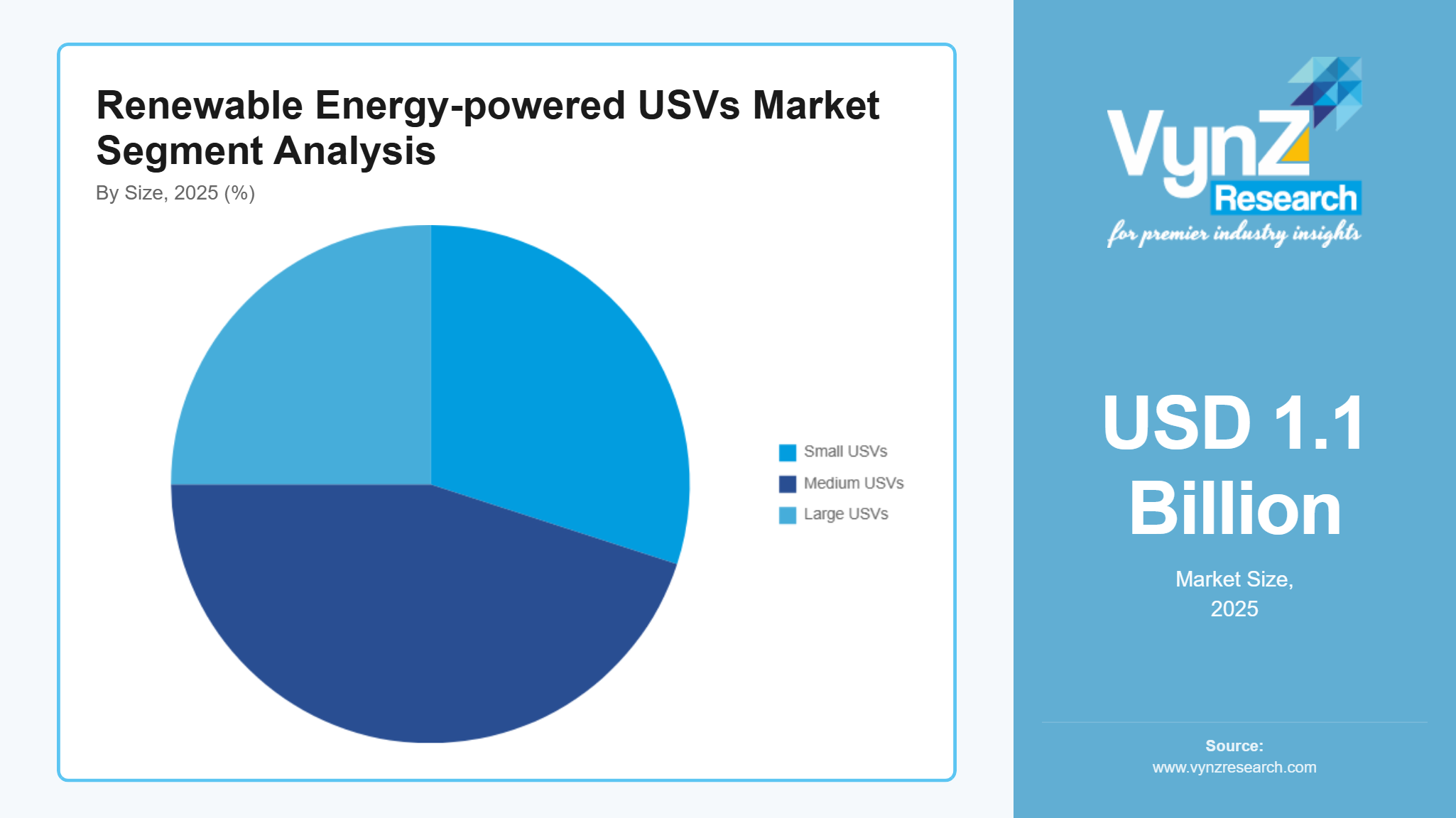
The medium USVs is the largest category with a market share of about 45% in 2025, owing to its optimal balance between payload capacity, operational range, and cost efficiency. Medium-sized USVs are widely used across defense, surveillance, and research applications as they can accommodate advanced sensors, communication systems, and energy modules without significantly increasing operational complexity. Their versatility and adaptability across multiple mission profiles make them the most preferred choice among end users, particularly in naval and environmental monitoring operations.
The large USVs is the fastest-growing category with a CAGR of 13.9% during the forecast period, due to increasing demand for high-endurance and high-capacity platforms capable of supporting complex and long-duration missions. These vessels are increasingly being adopted in defense and offshore industries where larger payloads, extended operational range, and enhanced stability are required. Government investments in autonomous naval fleets and technological advancements in energy storage systems are further accelerating the growth of this segment.
By Application
The defense & maritime security is the largest category with a market share of about 35% in 2025, driven by rising geopolitical tensions, increasing maritime threats, and the growing need for persistent surveillance and reconnaissance capabilities. Renewable energy-powered USVs offer extended operational endurance, reduced fuel dependency, and enhanced stealth capabilities, making them highly suitable for defense applications such as border patrol, intelligence gathering, and anti-submarine warfare.
The renewable energy infrastructure inspection is the fastest-growing category during the forecast period, as the global expansion of offshore wind farms and marine renewable energy installations is creating new demand for autonomous inspection and maintenance solutions. USVs provide a cost-effective and efficient alternative to manned vessels by enabling continuous monitoring, reducing operational risks, and minimizing downtime. The increasing focus on renewable energy development and asset optimization is driving rapid growth in this segment.
By Propulsion Type
The hybrid propulsion is the largest category with a market share of around 60% in 2025, and it is also the fastest-growing category during the forecast period, as it offers a balanced combination of renewable energy sources and battery backup, ensuring reliable and continuous operation. Hybrid systems effectively address the intermittency of renewable energy while enhancing overall efficiency and mission duration. Increasing demand for long-endurance and energy-resilient USVs across defense and commercial applications is driving the dominance and rapid growth of this segment.
Regional Insights
North America
North America held around 34% of the market share in the year 2025 according to current projections. The region experiences growth through its combination of advanced technological capabilities, substantial defense spending and its early adoption of autonomous maritime systems. The United States establishes its leading position through its extensive funding of unmanned naval systems and ocean monitoring equipment and eco-friendly maritime technologies.
Defense agencies and government entities are expanding their use of uncrewed surface vehicles USVs to conduct surveillance, reconnaissance and security missions in both coastal and offshore territories. The development of autonomous naval systems through multimillion-dollar funding programs which include Medium Unmanned Surface Vehicles MUSVs enhances innovation and commercialization. The combination of strict environmental rules and increasing efforts to cut maritime carbon emissions creates a favorable environment for USVs powered by renewable energy.
Asia-Pacific
The market share for Asia Pacific in 2025 reached approximately 23% making it the region with the fastest growth rate. Maritime security investments show a rising growth trend while countries like China, India, Japan and South Korea spend money on defense modernization and autonomous technologies.
The need for USVs arises from increasing demands for coastal surveillance, environmental monitoring and offshore resource management. Defense research programs backed by the government which include funding for autonomous surface and underwater systems boost regional economic development. The regional ecosystem for USVs powered by renewable energy develops stronger through domestic manufacturing growth and global technology partner relationships.
Europe
Europe held a market share of about 27% in 2025. The region experiences economic development because its sustainability policies, marine engineering capabilities and maritime decarbonization regulations create a supportive business environment. Norway, Germany and the United Kingdom lead the world in creating and using autonomous maritime systems which consume less energy.
USVs are becoming increasingly necessary for offshore wind farms because their inspection, monitoring and maintenance tasks require these vessels. The regional organizations which establish funding programs and innovation initiatives support the creation of vessels that produce low emissions while using renewable energy thus enhancing Europe’s position in international markets.
Rest of the World
The Rest of the World market which includes the Middle East, Africa and Latin America had a market share of about 16% for the year 2025. Maritime security improvements, offshore energy development and environmental monitoring initiatives drive regional growth in these areas.
The Middle Eastern countries focus their efforts on safeguarding vital offshore facilities while improving their coastal surveillance systems. Brazil and Mexico from Latin America invest money into offshore energy and marine research. The government programs which aim to enhance maritime domain awareness and illegal activity detection and sustainable ocean management practice create a favorable environment for renewable energy USV adoption in these developing regions.
Competitive Landscape / Company Insights
The renewable energy-powered USVs market is moderately fragmented in nature. This fragmentation is primarily due to the presence of a mix of established defense contractors, specialized marine technology firms, and emerging startups that are actively developing innovative USV platforms and energy systems. The market is still evolving, with companies focusing on niche capabilities such as solar-powered vessels, wave-powered systems, and hybrid energy integration. Additionally, rapid technological advancements, increasing government funding, and growing demand across defense, research, and commercial sectors are encouraging new entrants to participate, further increasing competition. However, the market also shows partial consolidation in defense-driven segments, where large organizations with strong funding, advanced R&D capabilities, and long-term government contracts dominate.
Mini Profiles
Saildrone, Inc. develops wind- and solar-powered USVs for long-endurance ocean data collection, maritime surveillance, and environmental monitoring using advanced sensors and autonomous navigation systems.
Liquid Robotics, Inc. designs wave- and solar-powered USVs, known for its Wave Glider platform, used in defense, ocean monitoring, and long-duration data missions.
Ocean Aero, Inc. specializes in hybrid autonomous surface and underwater vehicles powered by renewable energy, supporting defense and ocean research applications.
Ocius Technology Ltd. develops fully renewable-powered USVs using solar, wind, and wave energy, focusing on maritime surveillance and persistent ocean monitoring.
Open Ocean Robotics builds solar-powered autonomous USVs for zero-emission ocean monitoring, data collection, and offshore inspection applications.
Key Players
- Saildrone, Inc.
- Liquid Robotics, Inc.
- Ocean Aero, Inc.
- L3Harris Technologies, Inc.
- Elbit Systems Ltd.
- Kongsberg Gruppen ASA
- Teledyne Technologies Incorporated
- ASV Global
- SeaRobotics Corporation
- AutoNaut Ltd.
- Open Ocean Robotics
- XOCEAN Ltd.
Recent Developments
In April 2026, Saildrone Inc. expanded its fleet of long-endurance solar- and wind-powered USVs with enhanced AI-based navigation and real-time data analytics capabilities, strengthening its position in defense surveillance and climate monitoring applications.
In February 2026, Teledyne Technologies Incorporated introduced next-generation autonomous marine sensing systems integrated with renewable-powered USVs, improving deep-sea data collection, offshore inspection, and environmental monitoring efficiency.
In January 2026, Open Ocean Robotics advanced its solar-powered USV platform with upgraded energy storage and carbon monitoring sensors, supporting extended-duration missions for climate research and ocean sustainability programs.
In March 2025, Liquid Robotics Inc. launched its Open Oceans Partner Program to expand global deployment of wave-powered USVs, enabling collaboration with governments and research institutions for ocean monitoring, data collection, and maritime security.
Global Renewable Energy-powered USVs Market Coverage
Energy Source Insight and Forecast 2026 - 2035
- Solar-Powered USVs
- Wind-Powered USVs
- Wave-Powered USVs
- Hybrid Renewable Energy USVs
Size Insight and Forecast 2026 - 2035
- Small USVs
- Medium USVs
- Large USVs
Application Insight and Forecast 2026 - 2035
- Defense & Maritime Security
- Oceanographic Research & Environmental Monitoring
- Offshore Oil & Gas Operations
- Renewable Energy Infrastructure Inspection
- Hydrographic Surveying
- Others
Propulsion Type Insight and Forecast 2026 - 2035
- Fully Renewable-Powered
- Hybrid Propulsion
Global Renewable Energy-powered USVs Market by Region
- North America
- By Energy Source
- By Size
- By Application
- By Propulsion Type
- By Country - U.S., Canada, Mexico
- Europe
- By Energy Source
- By Size
- By Application
- By Propulsion Type
- By Country - Germany, U.K., France, Italy, Spain, Russia, Rest of Europe
- Asia-Pacific (APAC)
- By Energy Source
- By Size
- By Application
- By Propulsion Type
- By Country - China, Japan, India, South Korea, Vietnam, Thailand, Malaysia, Rest of Asia-Pacific
- Rest of the World (RoW)
- By Energy Source
- By Size
- By Application
- By Propulsion Type
- By Country - Brazil, Saudi Arabia, South Africa, U.A.E., Other Countries
Table of Contents for Renewable Energy-powered USVs Market Report
1. Research Overview
1.1. The Report Offers
1.2. Market Coverage
1.2.1. By
Energy Source
1.2.2. By
Size
1.2.3. By
Application
1.2.4. By
Propulsion Type
1.3. Research Phases
1.4. Limitations
1.5. Market Methodology
1.5.1. Data Sources
1.5.1.1.
Primary Research
1.5.1.2.
Secondary Research
1.5.2. Methodology
1.5.2.1.
Data Exploration
1.5.2.2.
Forecast Parameters
1.5.2.3.
Data Validation
1.5.2.4.
Assumptions
1.5.3. Study Period & Data Reporting Unit
2. Executive Summary
3. Industry Overview
3.1. Industry Dynamics
3.1.1. Market Growth Drivers
3.1.2. Market Restraints
3.1.3. Key Market Trends
3.1.4. Major Opportunities
3.2. Industry Ecosystem
3.2.1. Porter’s Five Forces Analysis
3.2.2. Recent Development Analysis
3.2.3. Value Chain Analysis
3.3. Competitive Insight
3.3.1. Competitive Position of Industry
Players
3.3.2. Market Attractive Analysis
3.3.3. Market Share Analysis
4. Global Market Estimate and Forecast
4.1. Global Market Overview
4.2. Global Market Estimate and Forecast to 2035
5. Market Segmentation Estimate and Forecast
5.1. By Energy Source
5.1.1. Solar-Powered USVs
5.1.1.1. Market Definition
5.1.1.2. Market Estimation and Forecast to 2035
5.1.2. Wind-Powered USVs
5.1.2.1. Market Definition
5.1.2.2. Market Estimation and Forecast to 2035
5.1.3. Wave-Powered USVs
5.1.3.1. Market Definition
5.1.3.2. Market Estimation and Forecast to 2035
5.1.4. Hybrid Renewable Energy USVs
5.1.4.1. Market Definition
5.1.4.2. Market Estimation and Forecast to 2035
5.2. By Size
5.2.1. Small USVs
5.2.1.1. Market Definition
5.2.1.2. Market Estimation and Forecast to 2035
5.2.2. Medium USVs
5.2.2.1. Market Definition
5.2.2.2. Market Estimation and Forecast to 2035
5.2.3. Large USVs
5.2.3.1. Market Definition
5.2.3.2. Market Estimation and Forecast to 2035
5.3. By Application
5.3.1. Defense & Maritime Security
5.3.1.1. Market Definition
5.3.1.2. Market Estimation and Forecast to 2035
5.3.2. Oceanographic Research & Environmental Monitoring
5.3.2.1. Market Definition
5.3.2.2. Market Estimation and Forecast to 2035
5.3.3. Offshore Oil & Gas Operations
5.3.3.1. Market Definition
5.3.3.2. Market Estimation and Forecast to 2035
5.3.4. Renewable Energy Infrastructure Inspection
5.3.4.1. Market Definition
5.3.4.2. Market Estimation and Forecast to 2035
5.3.5. Hydrographic Surveying
5.3.5.1. Market Definition
5.3.5.2. Market Estimation and Forecast to 2035
5.3.6. Others
5.3.6.1. Market Definition
5.3.6.2. Market Estimation and Forecast to 2035
5.4. By Propulsion Type
5.4.1. Fully Renewable-Powered
5.4.1.1. Market Definition
5.4.1.2. Market Estimation and Forecast to 2035
5.4.2. Hybrid Propulsion
5.4.2.1. Market Definition
5.4.2.2. Market Estimation and Forecast to 2035
6. North America Market Estimate and Forecast
6.1. By
Energy Source
6.2. By
Size
6.3. By
Application
6.4. By
Propulsion Type
6.4.1.
U.S. Market Estimate and Forecast
6.4.2.
Canada Market Estimate and Forecast
6.4.3.
Mexico Market Estimate and Forecast
7. Europe Market Estimate and Forecast
7.1. By
Energy Source
7.2. By
Size
7.3. By
Application
7.4. By
Propulsion Type
7.4.1.
Germany Market Estimate and Forecast
7.4.2.
France Market Estimate and Forecast
7.4.3.
U.K. Market Estimate and Forecast
7.4.4.
Italy Market Estimate and Forecast
7.4.5.
Spain Market Estimate and Forecast
7.4.6.
Russia Market Estimate and Forecast
7.4.7.
Rest of Europe Market Estimate and Forecast
8. Asia-Pacific (APAC) Market Estimate and Forecast
8.1. By
Energy Source
8.2. By
Size
8.3. By
Application
8.4. By
Propulsion Type
8.4.1.
China Market Estimate and Forecast
8.4.2.
Japan Market Estimate and Forecast
8.4.3.
India Market Estimate and Forecast
8.4.4.
South Korea Market Estimate and Forecast
8.4.5.
Rest of Asia-Pacific Market Estimate and Forecast
9. Rest of the World (RoW) Market Estimate and Forecast
9.1. By
Energy Source
9.2. By
Size
9.3. By
Application
9.4. By
Propulsion Type
9.4.1.
Brazil Market Estimate and Forecast
9.4.2.
Saudi Arabia Market Estimate and Forecast
9.4.3.
South Africa Market Estimate and Forecast
9.4.4.
U.A.E. Market Estimate and Forecast
9.4.5.
Other Countries Market Estimate and Forecast
10. Company Profiles
10.1.
Saildrone, Inc.
10.1.1.
Snapshot
10.1.2.
Overview
10.1.3.
Offerings
10.1.4.
Financial
Insight
10.1.5.
Recent
Developments
10.2.
Liquid Robotics, Inc.
10.2.1.
Snapshot
10.2.2.
Overview
10.2.3.
Offerings
10.2.4.
Financial
Insight
10.2.5.
Recent
Developments
10.3.
Ocean Aero, Inc.
10.3.1.
Snapshot
10.3.2.
Overview
10.3.3.
Offerings
10.3.4.
Financial
Insight
10.3.5.
Recent
Developments
10.4.
L3Harris Technologies, Inc.
10.4.1.
Snapshot
10.4.2.
Overview
10.4.3.
Offerings
10.4.4.
Financial
Insight
10.4.5.
Recent
Developments
10.5.
Elbit Systems Ltd.
10.5.1.
Snapshot
10.5.2.
Overview
10.5.3.
Offerings
10.5.4.
Financial
Insight
10.5.5.
Recent
Developments
10.6.
Kongsberg Gruppen ASA
10.6.1.
Snapshot
10.6.2.
Overview
10.6.3.
Offerings
10.6.4.
Financial
Insight
10.6.5.
Recent
Developments
10.7.
Teledyne Technologies Incorporated
10.7.1.
Snapshot
10.7.2.
Overview
10.7.3.
Offerings
10.7.4.
Financial
Insight
10.7.5.
Recent
Developments
10.8.
ASV Global
10.8.1.
Snapshot
10.8.2.
Overview
10.8.3.
Offerings
10.8.4.
Financial
Insight
10.8.5.
Recent
Developments
10.9.
SeaRobotics Corporation
10.9.1.
Snapshot
10.9.2.
Overview
10.9.3.
Offerings
10.9.4.
Financial
Insight
10.9.5.
Recent
Developments
10.10.
AutoNaut Ltd.
10.10.1.
Snapshot
10.10.2.
Overview
10.10.3.
Offerings
10.10.4.
Financial
Insight
10.10.5.
Recent
Developments
10.11.
Open Ocean Robotics
10.11.1.
Snapshot
10.11.2.
Overview
10.11.3.
Offerings
10.11.4.
Financial
Insight
10.11.5.
Recent
Developments
10.12.
XOCEAN Ltd.
10.12.1.
Snapshot
10.12.2.
Overview
10.12.3.
Offerings
10.12.4.
Financial
Insight
10.12.5.
Recent
Developments
11. Appendix
11.1. Exchange Rates
11.2. Abbreviations
Note: Financial insight and recent developments of different companies are subject to the availability of information in the secondary domain.
Frequently Asked Questions
Purchase Options
Latest Report
Research Methodology
- Desk Research / Pilot Interviews
- Build Market Size Model
- Research and Analysis
- Final Deliverable
Connect With Our Sales Team
- Toll-Free: +1-888-253-3960
- Phone: +91 9960 288 381
- Email: enquiry@vynzresearch.com
Renewable Energy-powered USVs Market