
Asia Pacific Sports Nutrition Market Size & Share | Growth Forecast Report (2026-2035)
Industry Insight by Product Type (Sports drinks, Sports supplements, Sports food, Meal replacement products, Weight loss products), by Formulation (Powder), by Consumer Group (Athletes, Bodybuilders, Recreational users, Lifestyle users), by Distribution Channel (Supermarkets and hypermarkets, Convenience stores, Specialty stores, Online retail stores,Others)
| Status : Published | Published On : Apr, 2026 | Report Code : VRFB11041 | Industry : Food & Beverage | Available Format :

|
Page : 135 |
Asia Pacific Sports Nutrition Market Overview
The Asia Pacific sports nutrition market which was valued at approximately USD 11.20 billion in 2025 and is estimated to rise further up to almost USD 12.45 billion by 2026, is projected to reach around USD 32.38 billion in 2035, expanding at a CAGR of about 11.2% during the forecast period from 2026 to 2035.
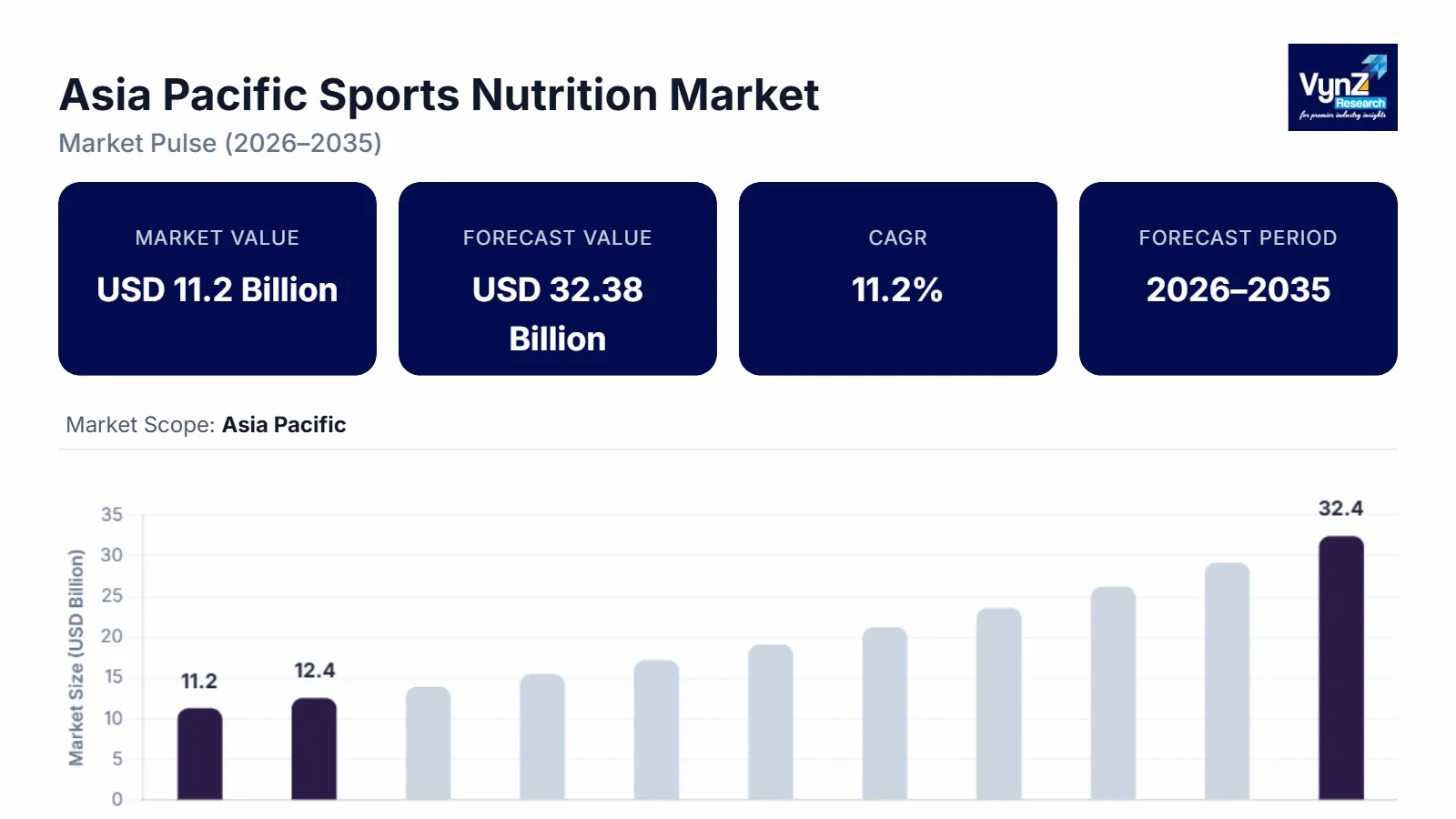
The market shows growth because urban residents become more health conscious, people engage in fitness and recreational sports at higher rates while middle class families increase their spending power and people begin using protein supplements and functional nutrition products. The market growth in China, India and Japan receives support from two main factors which include the rising demand for nutritional products that enhance performance and recovery among both professional athletes and general users along with the continuous funding of public health initiatives.
The World Health Organization has highlighted the growing burden of physical inactivity across Asia Pacific, encouraging governments to promote active lifestyles through national fitness programs and awareness campaigns which indirectly support demand for sports nutrition products. Government backed initiatives such as national fitness missions school level sports integration programs and expansion of public sports infrastructure are strengthening consumer engagement in physical activities. The main countries have established food safety standards and dietary supplement labeling requirements which regulatory bodies now apply to all products thus creating more product options for consumers who trust the safety of dietary supplements. The market continues to grow throughout the region because organized retail and e-commerce platforms now exist in more locations, which has created multiple opportunities for development.
Asia Pacific Sports Nutrition Market Dynamics
Market Trends
The market is experiencing significant changes as customers modify their purchasing habits, companies develop new product formulas and online sales channels extend their reach into essential markets. The market trend towards plant based clean label products and functional nutrition products demonstrates how consumers now prefer transparent labeling and natural products which support their long-term health needs. The food safety authorities together with public health agencies in the area provide regulatory guidance which results in standardized labeling systems and nutritional information requirements, thus enhancing product credibility and building consumer trust.
The e-commerce distribution channels show rapid growth as internet access and digital payment systems become more widespread. The online retail systems in China and India receive improvements from digital economy initiatives which the government supports, thus making sports nutrition products easier to obtain. The product development process results in market changes which lead companies to prioritize personalized nutrition and fortified products and ready-to-eat items as their new market strategy.
Growth Drivers
The market grows because more people join fitness, sports and active lifestyle activities which create ongoing demand from urban residents, young people and fitness enthusiasts. The World Health Organization public health frameworks show how physical activity reduces non communicable diseases, which motivates governments across the region to build fitness spaces, sports centers and conduct awareness programs. The market expansion accelerates because sports infrastructure developments increase investments in stadiums, training facilities and community fitness programs.
The rising health awareness among people and their adoption of preventive healthcare measures directly drives increased demand for health-related products. The demand for protein supplements, energy drinks and functional foods will stay strong throughout the forecasting period because consumers choose products which improve their performance, help them recover and support their general wellness. The government nutrition programs and food safety regulations in India, Japan and Australia help establish product standards and safety measures which lead to consumer trust and ongoing market growth.
Market Restraints / Challenges
The market exhibits strong growth potential but it faces multiple obstacles which will hinder its market growth. The product approval process and market entry for smaller manufacturers face obstacles because different countries maintain separate dietary supplement and functional food standards. Food safety authorities across the region impose strict guidelines on ingredient usage, health claims, and labeling requirements, which can increase compliance costs and delay product commercialization.
The need to import whey protein and specialty ingredients creates operational difficulties for both manufacturers and suppliers. Price fluctuations from global supply chain changes and currency value changes create cost challenges which disrupt pricing stability in markets that have sensitive pricing. International trade and food agencies report that supply disruptions together with import dependencies will restrict product scalability and delivery times which will hinder market performance during economic downturns.
Market Opportunities
The market provides strong potential for companies to grow their personalized nutrition and functional nutrition products because consumers now have better product knowledge and fitness trackers get more common while people want customized dietary solutions. Companies that provide cost-effective products with high performance capabilities and local market solutions will gain market share from urban residents, athletes and health-conscious individuals. The government programs which support nutrition education and healthy lifestyle promotion will enhance market access for businesses.
The premium product sector together with specialized products represents another key market opportunity because companies now invest more money into scientific research which leads to development of advanced supplements and nutritional products. The integration of digital health tools with wearable devices and data-based nutrition planning will enable businesses to improve customer interaction and achieve better sales conversion results. The World Health Organization and other organizations endorse public health guidelines about balanced diets and protein consumption, which will increase interest in advanced sports nutrition products that have clinical evidence in the region.
Asia Pacific Sports Nutrition Market Report Coverage
|
Report Metric |
Details |
|
Historical Period |
2020 - 2024 |
|
Base Year Considered |
2025 |
|
Forecast Period |
2026 - 2035 |
|
Market Size in 2025 |
USD 11.20 Billion |
|
Revenue Forecast in 2035 |
USD 32.38 Billion |
|
Growth Rate |
11.2% |
|
Segments Covered in the Report |
Product Type, Formulation, Consumer Group, Distribution Channel |
|
Report Scope |
Market Trends, Drivers, and Restraints; Revenue Estimation and Forecast; Segmentation Analysis; Companies’ Strategic Developments; Market Share Analysis of Key Players; Company Profiling |
|
Regions Covered in the Report |
China, India, Japan, Australia, Rest of Asia Pacific |
|
Key Companies |
Abbott Laboratories, Amway Corporation, Glanbia plc, GNC Holdings LLC, Herbalife Nutrition Ltd., MusclePharm Corporation, Nestlé S.A., PepsiCo, Inc., Post Holdings, Inc., The Coca-Cola Company |
|
Customization |
Available upon request |
Asia Pacific Sports Nutrition Market Segmentation
By Product Type
The market share of sports drinks reached its peak in 2025 when it generated about 40% of total revenue because athletes and fitness enthusiasts used the product frequently and it was widely available. The combination of government public health programs which promote hydration and active living and worldwide health organization guidance has resulted in an upward demand trend being observed in urban areas.
The sports supplements category is expected to experience the most rapid growth during the period between 2026 and 2035 with a projected compound annual growth rate of 11.9%. The growth of the market results from fitness consumers who want to achieve muscle recovery and performance enhancement through proper protein consumption. The upcoming gym memberships together with the development of training programs and the promotion of protein intake through new dietary guidelines are driving continuous growth in the segment for both China and India.
The market for meal replacement and weight management products is experiencing steady growth with a projected compound annual growth rate of 10.7% because more people want easy access to weight control products which provide nutritional value. The growth of metropolitan areas current expansion of product innovation and increasing adoption among working professionals and lifestyle users contribute to steady market growth.
By Formulation
Powder based products generated the highest revenue share in 2025 because they achieved 48% of total revenue through their ability to provide cost savings and extended shelf life and customizable dosage options. The segment experiences strong demand because bodybuilders and fitness enthusiasts purchase the product which becomes available through both offline and online retail channels.
Liquid formulations will experience the highest growth rate because they will achieve an estimated compound annual growth rate of 12.2% throughout the upcoming forecast period. The market growth occurs because urban consumers choose ready-to-consume products which provide convenient nutrition solutions for their active lifestyles. The government-supported food safety regulations together with improved packaging standards enhance the product quality which boosts customer trust in liquid nutrition formats.
Tablets and capsules show consistent market growth with their current compound annual growth rate of 10.4% which benefits from their user-friendly design and accurate dosage system and rising usage among office staff. The market segment experiences growth because people become more aware of the advantages of micronutrient supplements and preventive health measures.
By Consumer Group
The recreational and lifestyle user group generated the largest market revenue share in 2025 when it produced approximately 45% of total revenue because people became more health-conscious and urban areas started new fitness trends and more people engaged in non-professional sports activities. Public health recommendations which promote regular exercise together with balanced nutrition led to broader consumer adoption across the region.
The athlete and bodybuilder segments will experience the highest growth rate in the market because they will achieve an estimated compound annual growth rate of 11.6% between 2026 and 2035. The growth of competitive sports participation continues to rise because national sports development initiatives provide support to structured fitness programs and training infrastructure. The market for performance enhancement products and recovery products experiences strong growth in demand for these items.
The market research shows that personalized nutrition and targeted supplementation products will create an annual growth rate of 10.8% across different consumer groups. The public demand for fitness centers and sports academies creates ongoing market demand for both professional and casual sports users.
By Distribution Channel
Supermarkets and hypermarkets generated 37% of total revenue in 2025 because customers still prefer to see products in person before purchasing them because they want to verify product authenticity and check multiple brand options. The expansion of organized retailing builds momentum in this sector because government policies support the development of retail infrastructure.
The online retail market shows the fastest growth rate because it has an estimated compound annual growth rate of 12.6% throughout the upcoming forecast period. The market grows because more people use digital devices and logistics networks have become better and people want both convenient shopping options and price transparency. The digital economy initiatives which the government supports together with the better online payment systems permanent security make e-commerce business grow throughout the whole region.
Specialty stores show ongoing market growth because they achieve a compound annual growth rate of 10.3% which results from their expert consultants who deliver tailored product recommendations to customers who want personalized nutrition solutions. The capacity to reach customers through both offline expert contact points and digital platforms enables businesses to expand their market presence while driving growth in their particular market segments.
Regional Insights
China
In 2025 China held about 32% of the market because its urban areas grew, people earned more money and more people started to exercise and play sports. The market shows continuous expansion because major cities like Beijing, Shanghai and Guangzhou have strong demand for protein supplements and functional nutrition products. People in China have begun to use sports nutrition products more because government programs want to make people fit through exercise which matches World Health Organization guidelines for public health.
India
India held approximately 18% of the market in 2025 because people became more health conscious and more fitness centers opened and the middle-class population expanded. Sports supplements and functional foods see permanent demand from urban consumers and young people who live in cities such as Mumbai, Delhi and Bengaluru. The government wants people to develop healthier habits through national fitness and wellness programs together with nutritional awareness campaigns which follow WHO physical activity guidelines.
Japan
In 2025 Japan held 14% of the market because people showed high health awareness and the country had many aging residents who wanted functional and fortified nutrition products. The two main urban centers of Tokyo and Osaka show increasing sports nutrition consumption from both professional athletes and lifestyle users. Government health promotion policies and dietary guidelines which support balanced nutrition and protein consumption help maintain market demand.
Australia
In 2025 Australia held 11% of the market because its citizens practice sports activities and its fitness culture have become established and people want premium nutrition products. The people of Sydney and Melbourne have maintained a steady demand for sports supplements and beverages because they follow lifestyle trends and have high product knowledge. Government organizations and public health agencies work together to establish dietary guidelines which have made it easier for people to adopt sports nutrition products.
Rest of Asia Pacific
The Rest of Asia Pacific including South Korea, Indonesia, Thailand and Malaysia held an approximate 8% market share in 2025. The region experiences growth because its inhabitants keep moving to cities while their income levels rise and they start understanding fitness and nutrition better. The market develops because government health promotion programs which comply with global public health guidelines encourage people to exercise while they improve their eating habits.
The above-mentioned regions account for 83% of the total market while the remaining demand spreads out across smaller and emerging Asia Pacific markets which this analysis does not cover.
Competitive Landscape / Company Insights
The market shows a range of competitive intensity between global and regional companies who use product development, pricing methods and their expansion into new markets to compete against each other. Companies are increasing their research and development spending along with their brand development work and digital retail operations to build stronger market positions. The government-supported food safety regulations and nutritional labeling standards together with public health initiatives that follow World Health Organization guidelines for active lifestyles and balanced diets, create a framework for companies to enhance their product quality while reaching more customers throughout the region.
Mini Profiles
Abbott Laboratories focuses on nutritional supplements and performance products, supported by strong global distribution networks, established healthcare expertise, and consistent investment in research and development enhancing product credibility and consumer trust.
Glanbia plc operates in the performance and lifestyle nutrition segments, emphasizing product innovation, high quality protein formulations, and strong brand positioning across fitness and sports nutrition markets globally.
Herbalife Nutrition Ltd. leverages direct selling networks and digital engagement platforms to expand market presence, supported by personalized nutrition programs and strong distributor driven consumer outreach strategies.
Nestlé S.A. focuses on functional nutrition and wellness products, supported by extensive global supply chains, strong brand recognition, and continuous investment in research driven nutritional innovations.
PepsiCo, Inc. operates in mass and functional beverage segments, emphasizing performance drinks, wide retail distribution, and strong brand visibility across urban and emerging consumer markets.
Key Players
- Abbott Laboratories
- Amway Corporation
- Glanbia plc
- GNC Holdings LLC
- Herbalife Nutrition Ltd.
- MusclePharm
- Corporation
- Nestlé S.A.
- PepsiCo, Inc.
- Post Holdings, Inc.
- The Coca-Cola Company
Recent Developments
In January 2026, Herbalife continued its partnership as the official nutrition partner for the Tata Women’s Premier League, strengthening its presence in professional sports nutrition.
The initiative focuses on supporting athlete performance and recovery through science-based nutrition, reinforcing its positioning in the sports nutrition segment.
In January 2026, Amway highlighted the need for policy reforms including rationalization of customs duties on nutraceutical ingredients in India’s budget discussions.
The company emphasized recognition of dietary supplements as a core component of preventive healthcare, supporting long term market expansion and regulatory alignment.
In February 2026, GNC participated in the global Weight Management and Sports Nutrition Summit, focusing on evolving consumer demand and next generation nutrition solutions.
The company is aligning product strategies toward functional health categories including metabolic support and performance nutrition to capture emerging demand trends.
In March 2026, Post Holdings continued expanding its active nutrition portfolio through innovation in ready to consume protein products aligned with evolving consumer preferences.The company is focusing on convenience driven formats and diversified product offerings to strengthen its presence in the global sports nutrition market landscape.
In February 2026, MusclePharm increased focus on performance nutrition innovation aligned with growing global demand for protein based and functional supplements.
The company is strengthening its product portfolio and market positioning through enhanced formulations targeting athlete performance and recovery segments.
Asia Pacific Sports Nutrition Market Coverage
Product Type Insight and Forecast 2026 - 2035
- Sports drinks
- Sports supplements
- Sports food
- Meal replacement products
- Weight loss products
Formulation Insight and Forecast 2026 - 2035
- Powder
Asia Pacific Sports Nutrition Market by Region
- China
- By Product Type
- By Formulation
- Japan
- By Product Type
- By Formulation
- India
- By Product Type
- By Formulation
- South Korea
- By Product Type
- By Formulation
- Vietnam
- By Product Type
- By Formulation
- Thailand
- By Product Type
- By Formulation
- Malaysia
- By Product Type
- By Formulation
- Rest of Asia-Pacific
- By Product Type
- By Formulation
Table of Contents for Asia Pacific Sports Nutrition Market Report
1. Research Overview
1.1. The Report Offers
1.2. Market Coverage
1.2.1. By
Product Type
1.2.2. By
Formulation
1.3. Research Phases
1.4. Limitations
1.5. Market Methodology
1.5.1. Data Sources
1.5.1.1.
Primary Research
1.5.1.2.
Secondary Research
1.5.2. Methodology
1.5.2.1.
Data Exploration
1.5.2.2.
Forecast Parameters
1.5.2.3.
Data Validation
1.5.2.4.
Assumptions
1.5.3. Study Period & Data Reporting Unit
2. Executive Summary
3. Industry Overview
3.1. Industry Dynamics
3.1.1. Market Growth Drivers
3.1.2. Market Restraints
3.1.3. Key Market Trends
3.1.4. Major Opportunities
3.2. Industry Ecosystem
3.2.1. Porter’s Five Forces Analysis
3.2.2. Recent Development Analysis
3.2.3. Value Chain Analysis
3.3. Competitive Insight
3.3.1. Competitive Position of Industry
Players
3.3.2. Market Attractive Analysis
3.3.3. Market Share Analysis
4. Asia Market Estimate and Forecast
4.1. Asia Market Overview
4.2. Asia Market Estimate and Forecast to 2035
5. Market Segmentation Estimate and Forecast
5.1. By Product Type
5.1.1. Sports drinks
5.1.1.1. Market Definition
5.1.1.2. Market Estimation and Forecast to 2035
5.1.2. Sports supplements
5.1.2.1. Market Definition
5.1.2.2. Market Estimation and Forecast to 2035
5.1.3. Sports food
5.1.3.1. Market Definition
5.1.3.2. Market Estimation and Forecast to 2035
5.1.4. Meal replacement products
5.1.4.1. Market Definition
5.1.4.2. Market Estimation and Forecast to 2035
5.1.5. Weight loss products
5.1.5.1. Market Definition
5.1.5.2. Market Estimation and Forecast to 2035
5.2. By Formulation
5.2.1. Powder
5.2.1.1. Market Definition
5.2.1.2. Market Estimation and Forecast to 2035
6. China Market Estimate and Forecast
6.1. By
Product Type
6.2. By
Formulation
7. Japan Market Estimate and Forecast
7.1. By
Product Type
7.2. By
Formulation
8. India Market Estimate and Forecast
8.1. By
Product Type
8.2. By
Formulation
9. South Korea Market Estimate and Forecast
9.1. By
Product Type
9.2. By
Formulation
10. Vietnam Market Estimate and Forecast
10.1. By
Product Type
10.2. By
Formulation
11. Thailand Market Estimate and Forecast
11.1. By
Product Type
11.2. By
Formulation
12. Malaysia Market Estimate and Forecast
12.1. By
Product Type
12.2. By
Formulation
13. Rest of Asia-Pacific Market Estimate and Forecast
13.1. By
Product Type
13.2. By
Formulation
14. Company Profiles
14.1.
Abbott Laboratories
14.1.1.
Snapshot
14.1.2.
Overview
14.1.3.
Offerings
14.1.4.
Financial
Insight
14.1.5.
Recent
Developments
14.2.
Amway Corporation
14.2.1.
Snapshot
14.2.2.
Overview
14.2.3.
Offerings
14.2.4.
Financial
Insight
14.2.5.
Recent
Developments
14.3.
Glanbia plc
14.3.1.
Snapshot
14.3.2.
Overview
14.3.3.
Offerings
14.3.4.
Financial
Insight
14.3.5.
Recent
Developments
14.4.
GNC Holdings LLC
14.4.1.
Snapshot
14.4.2.
Overview
14.4.3.
Offerings
14.4.4.
Financial
Insight
14.4.5.
Recent
Developments
14.5.
Herbalife Nutrition Ltd.
14.5.1.
Snapshot
14.5.2.
Overview
14.5.3.
Offerings
14.5.4.
Financial
Insight
14.5.5.
Recent
Developments
14.6.
MusclePharm
14.6.1.
Snapshot
14.6.2.
Overview
14.6.3.
Offerings
14.6.4.
Financial
Insight
14.6.5.
Recent
Developments
14.7.
Corporation
14.7.1.
Snapshot
14.7.2.
Overview
14.7.3.
Offerings
14.7.4.
Financial
Insight
14.7.5.
Recent
Developments
14.8.
Nestlé S.A.
14.8.1.
Snapshot
14.8.2.
Overview
14.8.3.
Offerings
14.8.4.
Financial
Insight
14.8.5.
Recent
Developments
14.9.
PepsiCo, Inc.
14.9.1.
Snapshot
14.9.2.
Overview
14.9.3.
Offerings
14.9.4.
Financial
Insight
14.9.5.
Recent
Developments
14.10.
Post Holdings, Inc.
14.10.1.
Snapshot
14.10.2.
Overview
14.10.3.
Offerings
14.10.4.
Financial
Insight
14.10.5.
Recent
Developments
14.11.
The Coca-Cola Company
14.11.1.
Snapshot
14.11.2.
Overview
14.11.3.
Offerings
14.11.4.
Financial
Insight
14.11.5.
Recent
Developments
15. Appendix
15.1. Exchange Rates
15.2. Abbreviations
Note: Financial insight and recent developments of different companies are subject to the availability of information in the secondary domain.
Frequently Asked Questions
Purchase Options
Latest Report
Research Methodology
- Desk Research / Pilot Interviews
- Build Market Size Model
- Research and Analysis
- Final Deliverable
Connect With Our Sales Team
- Toll-Free: +1-888-253-3960
- Phone: +91 9960 288 381
- Email: enquiry@vynzresearch.com
Asia Pacific Sports Nutrition Market