
Avocado Market Size & Share Growth Forecast Report (2026-2035)
Industry Insight by Product Form (Fresh avocados, Processed avocado products, Guacamole and avocado pulp, Avocado oil and other derivatives), by Variety (Hass, Other commercial varieties), by Distribution Channel (Supermarkets and hypermarkets, Traditional retail and independent grocers, Online retail, Foodservice distribution, Other distribution channels), by End Use (Household consumption, Foodservice, Food processing, Other commercial uses)
| Status : Published | Published On : Nov, 2026 | Report Code : VRFB11053 | Industry : Food & Beverage | Available Format :

|
Page : 145 |
Avocado Market Overview
The global avocado market was valued at approximately USD 17.2 billion in 2025 and is estimated at USD 18.5 billion in 2026, with a projected value of USD 38.1 billion by 2035, reflecting a CAGR of 8.33% from 2026 to 2035.
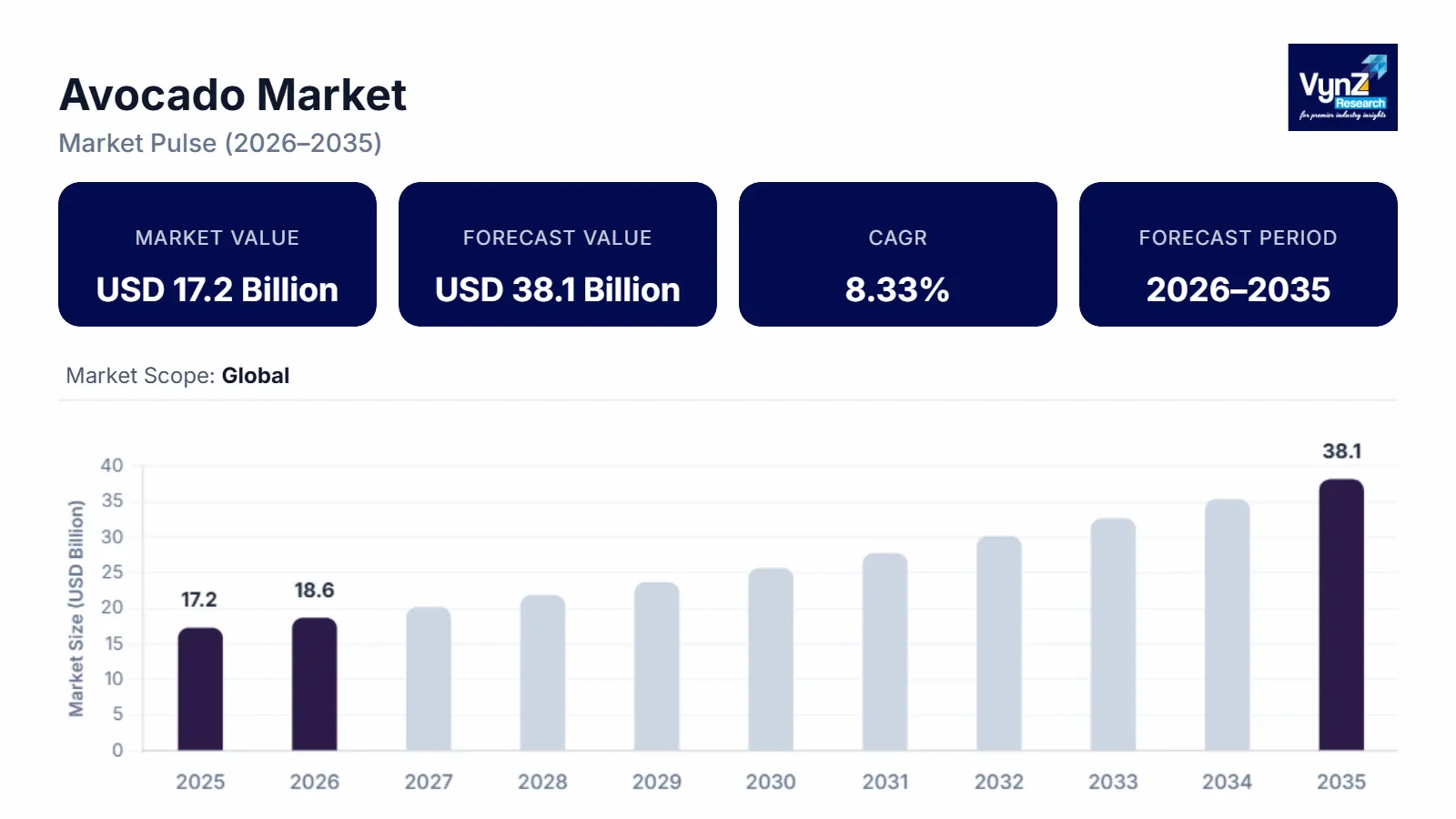
Demand is supported by consumer interest in nutrient-rich foods, expanding foodservice applications, and wider availability of fresh and ready-to-eat avocado products. Market growth is supported by demand for healthy foods, greater use of avocados in restaurants and prepared products, and improvements in cold-chain logistics. FAO production statistics and USDA trade reports show the importance of established producing countries and international supply routes. Investments in ripening, packing, traceability, and product processing are also helping suppliers serve retailers and foodservice businesses across North America, Europe, and Asia-Pacific.
Research Methodology
The VynZ Research team assessed the avocado market through secondary research covering industry reports, agricultural statistics, trade records, company disclosures, and government publications. The review considered production, consumption, import and export activity, distribution channels, processing applications, and regional demand. Sources included the Food and Agriculture Organization of the United Nations (FAO), the United States Department of Agriculture (USDA), and relevant company announcements. Market estimates for years not directly covered by published forecasts were calculated using the stated forecast CAGR. Segment-level shares and growth rates are report estimates rather than independently published official statistics.
Research Highlights
- Fresh avocados are estimated to account for 82% of market revenue in 2025, supported by household purchases and established retail and foodservice demand.
- Hass avocados are estimated to hold 78% of market revenue in 2025, driven by their established role in commercial cultivation and international trade.
- Household consumption is estimated to represent 57% of market revenue in 2025, supported by fresh-fruit purchases and use in everyday meals.
- Online avocado retail is estimated to register a CAGR of 10.2% from 2026 to 2035, driven by expanding online grocery access and home-delivery convenience.
- North America accounted for 35% of the global avocado market in 2025, supported by established consumption and strong supply links with Mexico.
Avocado Market Dynamics
Market Trends
The avocado market is shifting toward year-round availability, ripe-and-ready retail formats, and products that require less preparation. Retailers and foodservice operators are expanding their use of avocado in salads, sandwiches, bowls, spreads, and guacamole. Healthy-fat consumption and ready-to-eat products are important demand trends. These developments are encouraging suppliers to improve ripening control, packaging, and distribution reliability. Another emerging trend is greater emphasis on traceability, sustainable sourcing, and the use of avocado byproducts. Importers increasingly require reliable origin and phytosanitary documentation, while processors are exploring higher-value uses for skins, stones, pulp, and oil.
Growth Drivers
Demand for nutrient-rich foods is a major driver, as avocados are used in home cooking, restaurant menus, and prepared foods. Their versatility allows suppliers to serve several consumption occasions, from fresh fruit purchases to guacamole and spreads. USDA reporting on Mexico's avocado sector also indicates strong export demand, reinforcing the importance of consistent supply and international market access. The expansion of retail and foodservice distribution is another growth driver. Supermarkets, online grocery platforms, restaurants, and food processors depend on consistent grading, controlled ripening, and reliable deliveries. Investments in packing facilities and cold-chain systems help suppliers manage seasonal production differences and maintain quality over longer routes. The USDA's forecast for Mexico's 2025 production and exports supports the view that international trade remains an important component of market expansion.
Market Restraints / Challenges
Climate variability, water availability, and irregular rainfall can affect yields and fruit quality in key producing areas. Avocado production is concentrated in a limited number of major origins, so weather disruption or crop disease can influence export availability and prices. FAO production statistics show the significance of countries such as Mexico, Colombia, Peru, and Indonesia in the global supply base. Producers must balance expanding output with water management and long-term orchard productivity. Perishability and supply-chain costs also create challenges. Avocados require careful handling, temperature management, and ripening control to reduce spoilage and deliver fruit at the appropriate stage of maturity. Freight costs, labor availability, import requirements, and changes in wholesale prices can affect margins for growers, packers, and distributors. Smaller suppliers may find it harder to fund the infrastructure and traceability systems required by major retail customers.
Market Opportunities
Processed avocado products offer opportunities for suppliers to extend the market beyond fresh fruit. Guacamole, avocado pulp, spreads, sauces, and avocado oil can serve retail, foodservice, and food-manufacturing customers while creating uses for fruit that may not meet fresh-market appearance standards. Product formats designed for convenience and portion control may also encourage more frequent consumption.
Additional opportunities exist in emerging consumption markets and sustainable supply-chain solutions. Suppliers can invest in consumer education, ripening technology, improved packaging, and dependable year-round sourcing to address barriers to adoption. Traceability and byproduct utilization can help differentiate products and improve resource efficiency.
Global Avocado Market Report Coverage
|
Report Metric |
Details |
|
Historical Period |
2020 - 2024 |
|
Base Year Considered |
2025 |
|
Forecast Period |
2026 - 2035 |
|
Market Size in 2025 |
USD 17.2 Billion |
|
Revenue Forecast in 2035 |
USD 38.1 Billion |
|
Growth Rate |
8.33% |
|
Segments Covered in the Report |
Product Form, Variety, Distribution Channel, End Use |
|
Report Scope |
Market Trends, Drivers, and Restraints; Revenue Estimation and Forecast; Segmentation Analysis; Companies’ Strategic Developments; Market Share Analysis of Key Players; Company Profiling |
|
Regions Covered in the Report |
North America, Europe, Asia-Pacific, Rest of World |
|
Key Companies |
AgroFresh, Calavo Growers, Del Monte Fresh Produce, Fresh Del Monte Produce, Greenyard, Henry Avocado, Mission Produce, Nature's Pride, Oppy, Westfalia Fruit |
|
Customization |
Available upon request |
Avocado Market Segmentation
By Product Form
Fresh avocados are estimated to account for approximately 82% of market revenue in 2025, supported by household purchases, grocery retail, and foodservice demand for whole fruit. Fresh products benefit from established sourcing and distribution networks in major importing regions.
Processed avocado products are estimated to grow at a CAGR of 9.1% from 2026 to 2035, supported by demand for guacamole, pulp, spreads, sauces, and avocado oil.
By Variety
The Hass variety is estimated to represent approximately 78% of market revenue in 2025, reflecting its established commercial role in international trade and the availability of established growing, packing, and ripening networks. Its suitability for export supply chains and widespread retail recognition support demand in major importing markets.
Other varieties are estimated to register a CAGR of 8.8% from 2026 to 2035, supported by local consumer preferences, regional production conditions, and opportunities to serve markets where Hass is not the only commercially relevant type.
By Distribution Channel
Supermarkets and hypermarkets are estimated to account for 48.6% of market revenue in 2025, supported by broad consumer reach, established fresh-produce departments, and the availability of multiple pack sizes and ripeness options.
Online retail is estimated to record a CAGR of 10.2% from 2026 to 2035, driven by wider online grocery adoption, home delivery, and the ability to combine avocados with other fresh and prepared food products.
By End Use
Household consumption is estimated to represent approximately 57% of market revenue in 2025, supported by fresh fruit purchases and home preparation of salads, sandwiches, snacks, and meals.
Foodservice and industrial processing are estimated to grow at a CAGR of 9.4% from 2026 to 2035, as restaurants, quick-service outlets, and food manufacturers expand avocado use in prepared meals, guacamole, spreads, and sauces.
Regional Insights
North America
North America accounted for approximately 35% of the avocado market in 2025, supported by established household consumption, strong restaurant demand, and extensive retail distribution. The United States is a major import market, with Mexico serving as its leading supplier. Demand is supported by established ripening infrastructure, year-round sourcing, and the use of avocados in restaurant meals and prepared products. The region's future performance will depend on consumer demand, import prices, supply diversification, and the ability of suppliers to maintain quality during transport.
Europe
Europe is estimated to account for approximately 22% of market revenue in 2025, supported by household retail demand, foodservice use, and imports from Latin American and African producers. Spain also contributes through domestic cultivation, while the Netherlands acts as an important import and distribution hub. Traceability, food safety, and sustainability requirements are increasingly relevant to exporters supplying European markets. Retail availability, controlled ripening, and convenient product formats are expected to support further market expansion. Suppliers that can document origin, manage post-harvest quality, and meet changing import requirements may be better positioned to serve European retailers and foodservice operators.
Asia Pacific
Asia Pacific is estimated to represent approximately 19% of market revenue in 2025. Growth is supported by expanding retail distribution, greater awareness of avocado-based foods, and increasing access to imported produce in urban markets. Japan, China, India, and other regional markets offer opportunities for suppliers, although consumer familiarity and price sensitivity vary. Ripeness education, reliable cold-chain handling, and appropriately priced product formats may help strengthen demand. Regional growth will also depend on import access, freight economics, and competition from other fruit categories.
Rest of World
The remaining 24% of the global market in 2025 is attributed collectively to Latin America outside North America, the Middle East, and Africa. This group includes major producing and exporting countries such as Colombia, Peru, Indonesia, Kenya, and South Africa, alongside importing markets with developing consumption. FAO statistics identify Mexico, Colombia, Peru, and Indonesia among the leading avocado producers in 2024. Market performance across these areas varies according to domestic consumption, export infrastructure, water availability, and access to international buyers. Producer investment in packing, irrigation, traceability, and logistics can improve competitiveness, while growth in urban retail and foodservice can create additional demand.
Competitive Landscape / Company Insights
The avocado market is moderately competitive, with major suppliers differentiating themselves through multi-origin sourcing, packing and ripening infrastructure, retail relationships, and value-added products. Mission Produce's acquisition of Calavo Growers, completed in 2026, expanded its North American sourcing, distribution, and prepared-food capabilities. Westfalia Fruit has also pursued product and sustainability initiatives, including higher-value uses for avocado byproducts. These developments highlight the importance of supply-chain scale, product diversification, and customer-focused innovation.
Mini Profiles
AgroFresh provides post-harvest technologies and solutions that help fresh-produce businesses manage quality, extend shelf life, and reduce food loss across supply chains.
Del Rey Avocado participates in avocado sourcing, packing, and distribution, serving customers through fresh-produce supply networks and commercial relationships.
Greenyard is a global fresh, frozen, and prepared produce supplier serving retail and foodservice customers through an international sourcing and distribution network.
Henry Avocado supplies fresh avocados and supports retail and foodservice distribution through sourcing, packing, and quality-management operations.
Nature's Pride sources and distributes fresh produce internationally, focusing on product quality, ripeness management, and reliable supply to retail customers.
Key Players
- AgroFresh
- Calavo Growers
- Del Rey Avocado
- Fresh Del Monte Produce
- Greenyard
- Henry Avocado
- Mission Produce
- Nature's Pride
- West Pak Avocado
- Westfalia Fruit
Recent Developments
Mission Produce completed its acquisition of Calavo Growers in 2026, expanding its North American avocado platform and prepared-food capabilities. The transaction brought together sourcing, packing, distribution, and value-added product operations.
Fresh Del Monte announced a Colombian-based joint venture in 2025 to expand avocado sourcing for North American and European markets. The initiative is intended to broaden supply options and support customer demand across key destinations.
Calavo reported growth in its prepared-foods business in its 2025 financial results, supported by higher sales volumes and new customer programs. Its prepared segment includes guacamole and other avocado products for retail and foodservice customers.
West Pak introduced a new nutritional bag in 2025, using retail packaging to communicate avocado nutrition information to shoppers. The initiative combines consumer education with product presentation at the point of purchase.
Westfalia developed a process to extract natural dye from avocado stones in 2025, exploring higher-value uses for byproducts from avocado processing. The initiative supports its wider approach to resource utilization and reducing waste across the supply chain.
Global Avocado Market Coverage
Product Form Insight and Forecast 2026 - 2035
- Fresh avocados
- Processed avocado products
- Guacamole and avocado pulp
- Avocado oil and other derivatives
Variety Insight and Forecast 2026 - 2035
- Hass
- Other commercial varieties
Distribution Channel Insight and Forecast 2026 - 2035
- Supermarkets and hypermarkets
- Traditional retail and independent grocers
- Online retail
- Foodservice distribution
- Other distribution channels
End Use Insight and Forecast 2026 - 2035
- Household consumption
- Foodservice
- Food processing
- Other commercial uses
Global Avocado Market by Region
- North America
- By Product Form
- By Variety
- By Distribution Channel
- By End Use
- By Country - U.S., Canada, Mexico
- Europe
- By Product Form
- By Variety
- By Distribution Channel
- By End Use
- By Country - Germany, U.K., France, Italy, Spain, Russia, Rest of Europe
- Asia-Pacific (APAC)
- By Product Form
- By Variety
- By Distribution Channel
- By End Use
- By Country - China, Japan, India, South Korea, Vietnam, Thailand, Malaysia, Rest of Asia-Pacific
- Rest of the World (RoW)
- By Product Form
- By Variety
- By Distribution Channel
- By End Use
- By Country - Brazil, Saudi Arabia, South Africa, U.A.E., Other Countries
Table of Contents for Avocado Market Report
1. Research Overview
1.1. The Report Offers
1.2. Market Coverage
1.2.1. By
Product Form
1.2.2. By
Variety
1.2.3. By
Distribution Channel
1.2.4. By
End Use
1.3. Research Phases
1.4. Limitations
1.5. Market Methodology
1.5.1. Data Sources
1.5.1.1.
Primary Research
1.5.1.2.
Secondary Research
1.5.2. Methodology
1.5.2.1.
Data Exploration
1.5.2.2.
Forecast Parameters
1.5.2.3.
Data Validation
1.5.2.4.
Assumptions
1.5.3. Study Period & Data Reporting Unit
2. Executive Summary
3. Industry Overview
3.1. Industry Dynamics
3.1.1. Market Growth Drivers
3.1.2. Market Restraints
3.1.3. Key Market Trends
3.1.4. Major Opportunities
3.2. Industry Ecosystem
3.2.1. Porter’s Five Forces Analysis
3.2.2. Recent Development Analysis
3.2.3. Value Chain Analysis
3.3. Competitive Insight
3.3.1. Competitive Position of Industry
Players
3.3.2. Market Attractive Analysis
3.3.3. Market Share Analysis
4. Global Market Estimate and Forecast
4.1. Global Market Overview
4.2. Global Market Estimate and Forecast to 2035
5. Market Segmentation Estimate and Forecast
5.1. By Product Form
5.1.1. Fresh avocados
5.1.1.1. Market Definition
5.1.1.2. Market Estimation and Forecast to 2035
5.1.2. Processed avocado products
5.1.2.1. Market Definition
5.1.2.2. Market Estimation and Forecast to 2035
5.1.3. Guacamole and avocado pulp
5.1.3.1. Market Definition
5.1.3.2. Market Estimation and Forecast to 2035
5.1.4. Avocado oil and other derivatives
5.1.4.1. Market Definition
5.1.4.2. Market Estimation and Forecast to 2035
5.2. By Variety
5.2.1. Hass
5.2.1.1. Market Definition
5.2.1.2. Market Estimation and Forecast to 2035
5.2.2. Other commercial varieties
5.2.2.1. Market Definition
5.2.2.2. Market Estimation and Forecast to 2035
5.3. By Distribution Channel
5.3.1. Supermarkets and hypermarkets
5.3.1.1. Market Definition
5.3.1.2. Market Estimation and Forecast to 2035
5.3.2. Traditional retail and independent grocers
5.3.2.1. Market Definition
5.3.2.2. Market Estimation and Forecast to 2035
5.3.3. Online retail
5.3.3.1. Market Definition
5.3.3.2. Market Estimation and Forecast to 2035
5.3.4. Foodservice distribution
5.3.4.1. Market Definition
5.3.4.2. Market Estimation and Forecast to 2035
5.3.5. Other distribution channels
5.3.5.1. Market Definition
5.3.5.2. Market Estimation and Forecast to 2035
5.4. By End Use
5.4.1. Household consumption
5.4.1.1. Market Definition
5.4.1.2. Market Estimation and Forecast to 2035
5.4.2. Foodservice
5.4.2.1. Market Definition
5.4.2.2. Market Estimation and Forecast to 2035
5.4.3. Food processing
5.4.3.1. Market Definition
5.4.3.2. Market Estimation and Forecast to 2035
5.4.4. Other commercial uses
5.4.4.1. Market Definition
5.4.4.2. Market Estimation and Forecast to 2035
6. North America Market Estimate and Forecast
6.1. By
Product Form
6.2. By
Variety
6.3. By
Distribution Channel
6.4. By
End Use
6.4.1.
U.S. Market Estimate and Forecast
6.4.2.
Canada Market Estimate and Forecast
6.4.3.
Mexico Market Estimate and Forecast
7. Europe Market Estimate and Forecast
7.1. By
Product Form
7.2. By
Variety
7.3. By
Distribution Channel
7.4. By
End Use
7.4.1.
Germany Market Estimate and Forecast
7.4.2.
France Market Estimate and Forecast
7.4.3.
U.K. Market Estimate and Forecast
7.4.4.
Italy Market Estimate and Forecast
7.4.5.
Spain Market Estimate and Forecast
7.4.6.
Russia Market Estimate and Forecast
7.4.7.
Rest of Europe Market Estimate and Forecast
8. Asia-Pacific (APAC) Market Estimate and Forecast
8.1. By
Product Form
8.2. By
Variety
8.3. By
Distribution Channel
8.4. By
End Use
8.4.1.
China Market Estimate and Forecast
8.4.2.
Japan Market Estimate and Forecast
8.4.3.
India Market Estimate and Forecast
8.4.4.
South Korea Market Estimate and Forecast
8.4.5.
Rest of Asia-Pacific Market Estimate and Forecast
9. Rest of the World (RoW) Market Estimate and Forecast
9.1. By
Product Form
9.2. By
Variety
9.3. By
Distribution Channel
9.4. By
End Use
9.4.1.
Brazil Market Estimate and Forecast
9.4.2.
Saudi Arabia Market Estimate and Forecast
9.4.3.
South Africa Market Estimate and Forecast
9.4.4.
U.A.E. Market Estimate and Forecast
9.4.5.
Other Countries Market Estimate and Forecast
10. Company Profiles
10.1.
AgroFresh
10.1.1.
Snapshot
10.1.2.
Overview
10.1.3.
Offerings
10.1.4.
Financial
Insight
10.1.5.
Recent
Developments
10.2.
Calavo Growers
10.2.1.
Snapshot
10.2.2.
Overview
10.2.3.
Offerings
10.2.4.
Financial
Insight
10.2.5.
Recent
Developments
10.3.
Del Rey Avocado
10.3.1.
Snapshot
10.3.2.
Overview
10.3.3.
Offerings
10.3.4.
Financial
Insight
10.3.5.
Recent
Developments
10.4.
Fresh Del Monte Produce
10.4.1.
Snapshot
10.4.2.
Overview
10.4.3.
Offerings
10.4.4.
Financial
Insight
10.4.5.
Recent
Developments
10.5.
Greenyard
10.5.1.
Snapshot
10.5.2.
Overview
10.5.3.
Offerings
10.5.4.
Financial
Insight
10.5.5.
Recent
Developments
10.6.
Henry Avocado
10.6.1.
Snapshot
10.6.2.
Overview
10.6.3.
Offerings
10.6.4.
Financial
Insight
10.6.5.
Recent
Developments
10.7.
Mission Produce
10.7.1.
Snapshot
10.7.2.
Overview
10.7.3.
Offerings
10.7.4.
Financial
Insight
10.7.5.
Recent
Developments
10.8.
Nature's Pride
10.8.1.
Snapshot
10.8.2.
Overview
10.8.3.
Offerings
10.8.4.
Financial
Insight
10.8.5.
Recent
Developments
10.9.
West Pak Avocado
10.9.1.
Snapshot
10.9.2.
Overview
10.9.3.
Offerings
10.9.4.
Financial
Insight
10.9.5.
Recent
Developments
10.10.
Westfalia Fruit
10.10.1.
Snapshot
10.10.2.
Overview
10.10.3.
Offerings
10.10.4.
Financial
Insight
10.10.5.
Recent
Developments
11. Appendix
11.1. Exchange Rates
11.2. Abbreviations
Note: Financial insight and recent developments of different companies are subject to the availability of information in the secondary domain.
Frequently Asked Questions
Purchase Options
Latest Report
Research Methodology
- Desk Research / Pilot Interviews
- Build Market Size Model
- Research and Analysis
- Final Deliverable
Connect With Our Sales Team
- Toll-Free: +1-888-253-3960
- Phone: +91 9960 288 381
- Email: enquiry@vynzresearch.com
Avocado Market