
Pea Protein Market Size & Share Growth Forecast Report (2026-2035)
Industry Insight by Form (Concentrates, Isolates, Textured/Hydrolyzed), by Nature (Conventional, Organic), by Application (Animal Feed, Personal Care and Cosmetics, Food and Beverages, Supplements), by End Use (Food Manufacturers, Beverage Manufacturers, Sports and Dietary Nutrition Manufacturers, Animal Nutrition Manufacturers, Personal Care and Cosmetics Manufacturers)
| Status : Published | Published On : Sep, 2026 | Report Code : VRFB11050 | Industry : Food & Beverage | Available Format :

|
Page : 156 |
Pea Protein Market Overview
The Pea Protein Market size was estimated at about USD 1.34 billion in 2025 and is expected to reach around USD 1.48 billion in 2026, rising up to roughly USD 4.25 billion in 2035, growing at approximately 12.45% CAGR from 2026 to 2035.
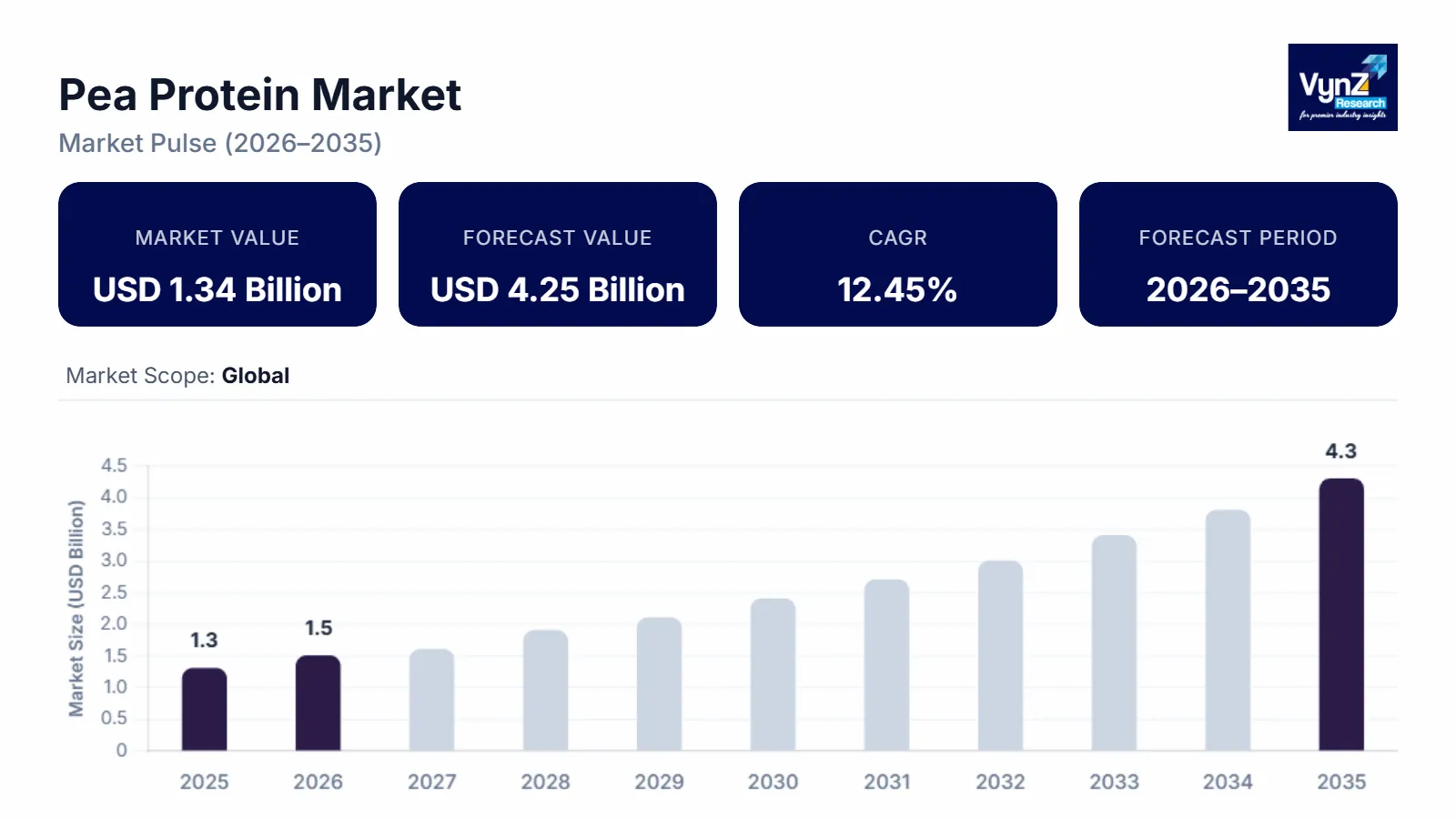
Market growth is determined by the rising demand for plant-based protein, protein enrichment and alternative food products, as well as the development of extraction, fractionation, flavor management, and texturization methods. The Food and Agriculture Organization deems pulses as key sources of nutrition and resilience, while the European Commission supports the protein crop production and processing areas under the Protein Action Plan. USDA and Agriculture and Agri Food Canada report consistent dry pea production and trade levels, which secure the raw materials for protein processors.
Research Methodology
VynZ Research uses secondary research, market structure analysis, company evaluation, application identification, and quantitative forecasting to estimate the market. The experts at VynZ Research assess the available market research reports, agricultural production data, regulatory documents, corporate publications, and product developments to determine the market value in 2025. The published figures are used as the basis for calculations rather than being copied directly, and the differences in market definitions, regional coverage, and time frames are taken into account.
Research Highlights
- Isolates accounted for approximately 52.27% of the market in 2025, supported by their high protein concentration and suitability for beverages, dairy alternatives and sports nutrition.
- Food and beverage applications represented approximately 62.48% in 2025, owing to extensive use in meat alternatives, dairy alternatives, bakery products and protein fortified foods.
- Conventional pea protein represented approximately 80.92% of demand in 2025, because of wider raw material availability and established processing infrastructure.
- Concentrates are estimated to register approximately 8.15% CAGR from 2026 to 2035, reflecting their comparatively lower processing requirements and growing use in cost sensitive formulations.
- North America accounted for approximately 40.02% in 2025, for established pea processing infrastructure and strong food and nutrition demand.
Pea Protein Market Dynamics
Market Trends
The pea protein industry is witnessing growing interest in cleaner taste, improved solubility, higher functionality and application specific ingredients. One of the key trends shaping the market is the development of refined isolates and textured ingredients capable of performing effectively in beverages, dairy alternatives and structured foods. Another emerging trend is the diversification of pea protein formats for mainstream food applications driven by advances in fractionation, extrusion and formulation. The European Commission is encouraging stronger plant protein value chains and increased domestic production of protein crops, which is creating a supportive environment for ingredient development and processing investment. These developments are encouraging suppliers to focus on functional differentiation rather than protein concentration.
Growth Drivers
The growth of the market is driven by growing demand for plant-based protein ingredients across food, beverage and nutrition applications. The Food and Agriculture Organization recognizes pulses as important sources of plant protein and nutrients as well as their role in sustainable agricultural systems. Increasing interest in protein enriched foods and alternative proteins is therefore driving wider use of pea-based ingredients in mainstream products including beverages, bakery products, snacks, meat alternatives and dairy alternatives. Additionally, growing investment in processing capacity is playing a key role in boosting adoption.
Market Restraints / Challenges
The market faces challenges around raw material availability, crop variability and processing economics. Yellow peas remain an important feedstock for commercial pea protein production, making processors sensitive to weather conditions, agricultural acreage and international trade patterns. Agriculture and Agri Food Canada continue to monitor substantial changes in pea production and trade, highlighting the importance of agricultural supply conditions to ingredient manufacturers. Fluctuations in crop availability can therefore impact procurement costs and production planning, especially for processors operating under long term supply arrangements. Furthermore, sensory characteristics and formulation performance are operational challenges for manufacturers.
Market Opportunities
The market offers significant opportunities in high functionality pea protein ingredients in beverages, dairy alternatives, sports nutrition and structured plant-based foods. Improved extraction and purification technologies can enhance protein solubility, flavor and texture, enabling manufacturers to utilize pea protein in applications where earlier formulations faced sensory limitations. The European Commission is encouraging expansion of European protein crop production and processing infrastructure, creating opportunities for suppliers capable of linking agricultural resources with higher value ingredient manufacturing. Another key opportunity lies in regional processing expansion and product diversification.
Global Pea Protein Market Report Coverage
|
Report Metric |
Details |
|
Historical Period |
2020 - 2024 |
|
Base Year Considered |
2025 |
|
Forecast Period |
2026 - 2035 |
|
Market Size in 2025 |
USD 1.34 Billion |
|
Revenue Forecast in 2035 |
USD 4.25 Billion |
|
Growth Rate |
12.45% |
|
Segments Covered in the Report |
Form, Nature, Application, End Use |
|
Report Scope |
Market Trends, Drivers, and Restraints; Revenue Estimation and Forecast; Segmentation Analysis; Companies’ Strategic Developments; Market Share Analysis of Key Players; Company Profiling |
|
Regions Covered in the Report |
North America, Europe, Asia Pacific, Rest of the World |
|
Key Companies |
ADM, Axiom Foods, Burcon NutraScience Corporation, Cargill, Cosucra, Ingredion, Louis Dreyfus Company, PURIS, Ripple Foods, Roquette |
|
Customization |
Available upon request |
Pea Protein Market Segmentation
By Form
Isolates accounted for approximately 52.27% of the market in 2025, supported by their high protein concentration, comparatively strong solubility and suitability for beverages, dairy alternatives and sports nutrition.
Concentrates are estimated to register approximately 8.15% CAGR from 2026 to 2035, reflecting broader adoption in cost sensitive food formulations and continued development of dry fractionation technologies.
By Nature
Conventional products accounted for approximately 80.92% of demand in 2025, due to broader availability, established processing capacity and extensive use across mainstream food and nutrition applications.
Organic pea protein is estimated to grow at approximately 10.48% CAGR from 2026 to 2035, supported by demand for certified ingredients, traceable sourcing and premium plant-based products.
By Application
Food and beverages accounted for approximately 62.48% of demand in 2025, owing to extensive use in bakery products, dairy alternatives, meat alternatives, snacks and protein fortified foods.
Food and beverage applications are estimated to grow at approximately 12.26% CAGR from 2026 to 2035, supported by continued product development across alternative dairy, plant-based meat, beverages and protein enriched foods.
By End Use
Food manufacturers accounted for approximately 54.80% of demand in 2025, reflecting the broad incorporation of pea protein into meat alternatives, dairy alternatives, bakery products, snacks and fortified foods.
Food manufacturers are estimated to expand at approximately 12.31% CAGR from 2026 to 2035, supported by continued product reformulation and growth in plant-based foods.
Regional Insights
North America
North America accounted for approximately 40.02% of the market in 2025, supported by established pea cultivation, processing infrastructure and demand from food, beverage and nutrition manufacturers. Mordor Intelligence identifies North America as the largest regional market, with the United States and Canada providing a mature processing ecosystem. The region also benefits from strong development of plant-based foods and sports nutrition products, while domestic ingredient manufacturers continue to expand product functionality and processing capacity.
Europe
Europe held nearly 24.60% of global demand in 2025, supported by growing interest in plant based foods, sustainable nutrition and domestic protein crop development. The region has a mature food processing industry and established demand for meat alternatives, dairy alternatives, nutritional products and clean label ingredients. The European Commission has identified greater domestic production of protein crops, improved processing infrastructure and stronger protein value chains as important priorities, providing a supportive framework for pea protein adoption.
Asia Pacific
Asia Pacific contributed for approximately 21.30% of the global market in 2025, with China, India, Japan, Australia and Southeast Asian economies contributing to expanding demand. Mordor Intelligence identifies Asia Pacific as the fastest growing major region, with urbanization, increasing nutrition awareness and greater consumption of functional foods supporting adoption. Plant based dairy alternatives, sports nutrition and protein fortified foods are creating additional application opportunities, while regional processors are increasingly developing local ingredient supply capabilities.
Rest of the World
The Rest of the World accounted for the remaining 14.08% of global demand in 2025, covering South America, the Middle East and Africa after the North American, European and Asia Pacific shares. The combined regional base remains smaller but offers opportunities through expanding processed food industries, sports nutrition, dietary products and alternative protein applications. The Food and Agriculture Organization identifies pulses as important for food security, nutrition and resilient agricultural systems, supporting the broader development of pulse-based ingredients in emerging markets.
Competitive Landscape / Company Insights
The pea protein market is moderately competitive, with global ingredient companies and specialized protein producers focusing on processing capacity, product functionality and application development. Companies are investing in cleaner taste, improved solubility, textured formats and regional sourcing to strengthen their market positions. Recent activity from Roquette, ADM, Burcon and Louis Dreyfus Company demonstrates continued investment in pea protein capacity and product development, while Cargill, Ingredion and Cosucra maintain established application portfolios across food, beverage and nutrition markets.
Mini Profiles
ADM focuses on pea protein ingredients for food and beverage formulations, supported by ingredient processing capabilities and application development resources.
Burcon NutraScience Corporation develops plant protein technologies, including Peazazz, with emphasis on taste, solubility and functional performance.
Cargill supplies pea protein ingredients for food, beverage, nutrition and alternative protein applications through its broader ingredient portfolio.
Ingredion develops plant protein solutions for food manufacturers, with pea protein used across plant based and protein fortified formulations.
Roquette maintains the NUTRALYS plant protein portfolio and continues to expand pea protein formats for food and nutrition applications.
Key Players
- ADM
- Axiom Foods
- Burcon NutraScience Corporation
- Cargill
- Cosucra
- Ingredion
- Louis Dreyfus Company
- PURIS
- Ripple Foods
- Roquette
Recent Developments
Cosucra continues to develop its PISANE pea protein portfolio for food and nutrition applications, including savory products and non-dairy formulations. The company's development focus remains on functionality, formulation performance and plant-based nutrition.
Louis Dreyfus Company has been developing pea protein isolate processing capacity in Saskatchewan to increase value added processing of Canadian peas. The facility is intended to strengthen regional supply of higher value pea ingredients.
Ripple Foods expanded its plant-based milk portfolio with an organic product using pea protein as its principal protein source. The product development demonstrates continued use of pea protein in mainstream dairy alternative beverages.
Global Pea Protein Market Coverage
Form Insight and Forecast 2026 - 2035
- Concentrates
- Isolates
- Textured/Hydrolyzed
Nature Insight and Forecast 2026 - 2035
- Conventional
- Organic
Application Insight and Forecast 2026 - 2035
- Animal Feed
- Personal Care and Cosmetics
- Food and Beverages
- Supplements
End Use Insight and Forecast 2026 - 2035
- Food Manufacturers
- Beverage Manufacturers
- Sports and Dietary Nutrition Manufacturers
- Animal Nutrition Manufacturers
- Personal Care and Cosmetics Manufacturers
Global Pea Protein Market by Region
- North America
- By Form
- By Nature
- By Application
- By End Use
- By Country - U.S., Canada, Mexico
- Europe
- By Form
- By Nature
- By Application
- By End Use
- By Country - Germany, U.K., France, Italy, Spain, Russia, Rest of Europe
- Asia-Pacific (APAC)
- By Form
- By Nature
- By Application
- By End Use
- By Country - China, Japan, India, South Korea, Vietnam, Thailand, Malaysia, Rest of Asia-Pacific
- Rest of the World (RoW)
- By Form
- By Nature
- By Application
- By End Use
- By Country - Brazil, Saudi Arabia, South Africa, U.A.E., Other Countries
Table of Contents for Pea Protein Market Report
1. Research Overview
1.1. The Report Offers
1.2. Market Coverage
1.2.1. By
Form
1.2.2. By
Nature
1.2.3. By
Application
1.2.4. By
End Use
1.3. Research Phases
1.4. Limitations
1.5. Market Methodology
1.5.1. Data Sources
1.5.1.1.
Primary Research
1.5.1.2.
Secondary Research
1.5.2. Methodology
1.5.2.1.
Data Exploration
1.5.2.2.
Forecast Parameters
1.5.2.3.
Data Validation
1.5.2.4.
Assumptions
1.5.3. Study Period & Data Reporting Unit
2. Executive Summary
3. Industry Overview
3.1. Industry Dynamics
3.1.1. Market Growth Drivers
3.1.2. Market Restraints
3.1.3. Key Market Trends
3.1.4. Major Opportunities
3.2. Industry Ecosystem
3.2.1. Porter’s Five Forces Analysis
3.2.2. Recent Development Analysis
3.2.3. Value Chain Analysis
3.3. Competitive Insight
3.3.1. Competitive Position of Industry
Players
3.3.2. Market Attractive Analysis
3.3.3. Market Share Analysis
4. Global Market Estimate and Forecast
4.1. Global Market Overview
4.2. Global Market Estimate and Forecast to 2035
5. Market Segmentation Estimate and Forecast
5.1. By Form
5.1.1. Concentrates
5.1.1.1. Market Definition
5.1.1.2. Market Estimation and Forecast to 2035
5.1.2. Isolates
5.1.2.1. Market Definition
5.1.2.2. Market Estimation and Forecast to 2035
5.1.3. Textured/Hydrolyzed
5.1.3.1. Market Definition
5.1.3.2. Market Estimation and Forecast to 2035
5.2. By Nature
5.2.1. Conventional
5.2.1.1. Market Definition
5.2.1.2. Market Estimation and Forecast to 2035
5.2.2. Organic
5.2.2.1. Market Definition
5.2.2.2. Market Estimation and Forecast to 2035
5.3. By Application
5.3.1. Animal Feed
5.3.1.1. Market Definition
5.3.1.2. Market Estimation and Forecast to 2035
5.3.2. Personal Care and Cosmetics
5.3.2.1. Market Definition
5.3.2.2. Market Estimation and Forecast to 2035
5.3.3. Food and Beverages
5.3.3.1. Market Definition
5.3.3.2. Market Estimation and Forecast to 2035
5.3.4. Supplements
5.3.4.1. Market Definition
5.3.4.2. Market Estimation and Forecast to 2035
5.4. By End Use
5.4.1. Food Manufacturers
5.4.1.1. Market Definition
5.4.1.2. Market Estimation and Forecast to 2035
5.4.2. Beverage Manufacturers
5.4.2.1. Market Definition
5.4.2.2. Market Estimation and Forecast to 2035
5.4.3. Sports and Dietary Nutrition Manufacturers
5.4.3.1. Market Definition
5.4.3.2. Market Estimation and Forecast to 2035
5.4.4. Animal Nutrition Manufacturers
5.4.4.1. Market Definition
5.4.4.2. Market Estimation and Forecast to 2035
5.4.5. Personal Care and Cosmetics Manufacturers
5.4.5.1. Market Definition
5.4.5.2. Market Estimation and Forecast to 2035
6. North America Market Estimate and Forecast
6.1. By
Form
6.2. By
Nature
6.3. By
Application
6.4. By
End Use
6.4.1.
U.S. Market Estimate and Forecast
6.4.2.
Canada Market Estimate and Forecast
6.4.3.
Mexico Market Estimate and Forecast
7. Europe Market Estimate and Forecast
7.1. By
Form
7.2. By
Nature
7.3. By
Application
7.4. By
End Use
7.4.1.
Germany Market Estimate and Forecast
7.4.2.
France Market Estimate and Forecast
7.4.3.
U.K. Market Estimate and Forecast
7.4.4.
Italy Market Estimate and Forecast
7.4.5.
Spain Market Estimate and Forecast
7.4.6.
Russia Market Estimate and Forecast
7.4.7.
Rest of Europe Market Estimate and Forecast
8. Asia-Pacific (APAC) Market Estimate and Forecast
8.1. By
Form
8.2. By
Nature
8.3. By
Application
8.4. By
End Use
8.4.1.
China Market Estimate and Forecast
8.4.2.
Japan Market Estimate and Forecast
8.4.3.
India Market Estimate and Forecast
8.4.4.
South Korea Market Estimate and Forecast
8.4.5.
Rest of Asia-Pacific Market Estimate and Forecast
9. Rest of the World (RoW) Market Estimate and Forecast
9.1. By
Form
9.2. By
Nature
9.3. By
Application
9.4. By
End Use
9.4.1.
Brazil Market Estimate and Forecast
9.4.2.
Saudi Arabia Market Estimate and Forecast
9.4.3.
South Africa Market Estimate and Forecast
9.4.4.
U.A.E. Market Estimate and Forecast
9.4.5.
Other Countries Market Estimate and Forecast
10. Company Profiles
10.1.
ADM
10.1.1.
Snapshot
10.1.2.
Overview
10.1.3.
Offerings
10.1.4.
Financial
Insight
10.1.5.
Recent
Developments
10.2.
Axiom Foods
10.2.1.
Snapshot
10.2.2.
Overview
10.2.3.
Offerings
10.2.4.
Financial
Insight
10.2.5.
Recent
Developments
10.3.
Burcon NutraScience Corporation
10.3.1.
Snapshot
10.3.2.
Overview
10.3.3.
Offerings
10.3.4.
Financial
Insight
10.3.5.
Recent
Developments
10.4.
Cargill
10.4.1.
Snapshot
10.4.2.
Overview
10.4.3.
Offerings
10.4.4.
Financial
Insight
10.4.5.
Recent
Developments
10.5.
Cosucra
10.5.1.
Snapshot
10.5.2.
Overview
10.5.3.
Offerings
10.5.4.
Financial
Insight
10.5.5.
Recent
Developments
10.6.
Ingredion
10.6.1.
Snapshot
10.6.2.
Overview
10.6.3.
Offerings
10.6.4.
Financial
Insight
10.6.5.
Recent
Developments
10.7.
Louis Dreyfus Company
10.7.1.
Snapshot
10.7.2.
Overview
10.7.3.
Offerings
10.7.4.
Financial
Insight
10.7.5.
Recent
Developments
10.8.
PURIS
10.8.1.
Snapshot
10.8.2.
Overview
10.8.3.
Offerings
10.8.4.
Financial
Insight
10.8.5.
Recent
Developments
10.9.
Ripple Foods
10.9.1.
Snapshot
10.9.2.
Overview
10.9.3.
Offerings
10.9.4.
Financial
Insight
10.9.5.
Recent
Developments
10.10.
Roquette
10.10.1.
Snapshot
10.10.2.
Overview
10.10.3.
Offerings
10.10.4.
Financial
Insight
10.10.5.
Recent
Developments
11. Appendix
11.1. Exchange Rates
11.2. Abbreviations
Note: Financial insight and recent developments of different companies are subject to the availability of information in the secondary domain.
Frequently Asked Questions
Purchase Options
Latest Report
Research Methodology
- Desk Research / Pilot Interviews
- Build Market Size Model
- Research and Analysis
- Final Deliverable
Connect With Our Sales Team
- Toll-Free: +1-888-253-3960
- Phone: +91 9960 288 381
- Email: enquiry@vynzresearch.com
Pea Protein Market