
Molecular Methods for Food Safety Testing Market Size & Share Growth Forecast Report (2026-2035)
Industry Insight by Technology (Polymerase Chain Reaction, Immunoassay, Biosensors, Microarray, Others), by Product (Instrument, Reagents and Consumables, Services), by Application (Pathogen Detection, Food Authenticity and Species Identification, GMO Testing, Other Applications), by End User (Food Manufacturers and Processors, Food Safety Testing Laboratories, Regulatory Authorities, Research Institutions and Academia)
| Status : Published | Published On : Oct, 2026 | Report Code : VRFB11051 | Industry : Food & Beverage | Available Format :

|
Page : 165 |
Molecular Methods for Food Safety Testing Market Overview
The global molecular methods for food safety testing market size was estimated at USD 2.32 billion in 2025 and is expected to reach around USD 2.53 billion in 2026, rising to approximately USD 5.50 billion in 2035, growing at approximately 9% CAGR from 2026 to 2035.
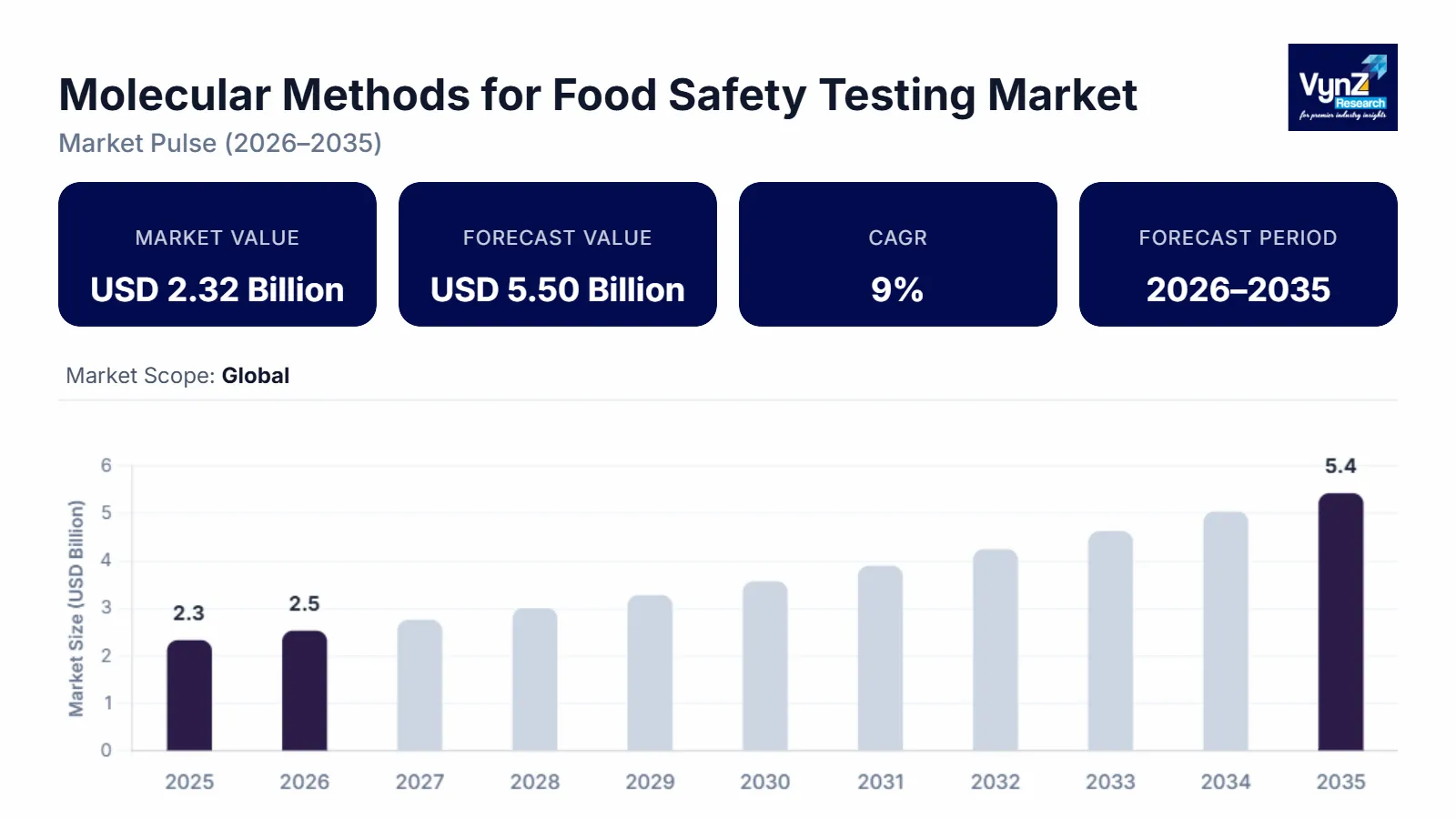
The report reflects the established importance of molecular pathogen detection, expanding laboratory testing requirements and continued adoption of rapid analytical technologies. WHO reports that contaminated food causes hundreds of millions of illnesses globally each year, while its food safety program continues to emphasize the need for stronger national food control systems and microbiological risk assessment.
Market growth is driven by rising foodborne disease surveillance, stricter food safety controls and the increasing demand for rapid pathogen detection, along with adoption of automated and data connected testing workflows. WHO identifies foodborne contamination as a major global public health concern, while FDA continues to strengthen laboratory accreditation and food testing oversight. USDA FSIS maintains validated microbiological testing procedures for regulated meat and poultry products, supporting continued demand for reliable analytical methods.
Research Methodology
VynZ Research employs a combination of secondary research, regulatory review, company analysis, technology assessment and market triangulation in order to evaluate the industry. VynZ Research team reviews public information from food safety authorities, scientific organizations, regulatory bodies, company disclosures and validated technical literature to establish the market structure, technology adoption and regional demand patterns. The assessment also considers laboratory capacity, pathogen surveillance, regulatory testing requirements, molecular assay adoption, food production trends and developments in rapid detection. FDA laboratory accreditation initiatives, USDA FSIS analytical methods, FSSAI laboratory infrastructure and international microbiological risk assessment activities offer relevant validation points for the market assessment.
Research Highlights
- PCR accounted for an estimated 39% of technology revenue in 2025, supported by high sensitivity, specificity and broad pathogen detection applications.
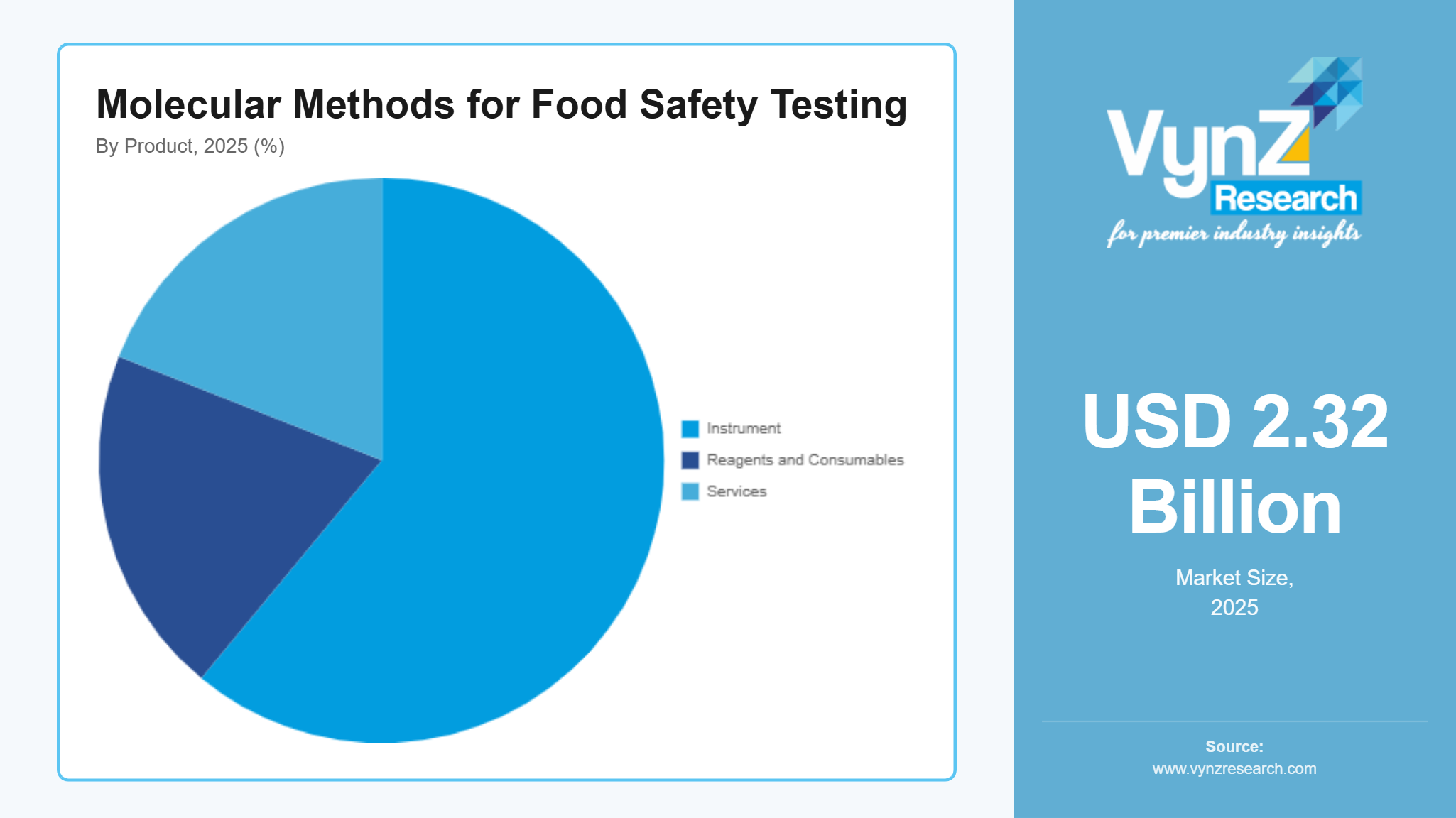
- Reagents and consumables represented approximately 61% of product revenue in 2025, reflecting recurring laboratory demand and routine testing requirements.
- Food manufacturers and processors generated an estimated 35% of end user demand in 2025,due to greater internal quality control and pathogen monitoring.
- Biosensors are projected to register approximately 10.1% CAGR from 2026 to 2035, because of demand for rapid and portable detection workflows.
- North America represented approximately 29% of global revenue in 2025, owing to established laboratory infrastructure, regulatory testing and rapid method adoption.
Molecular Methods for Food Safety Testing Market Dynamics
Market Trends
The food safety testing industry is witnessing a shift towards faster molecular workflows, automated interpretation and integrated laboratory data management. PCR remains widely used due to its ability to identify specific genetic targets with high analytical sensitivity, while isothermal amplification and biosensing technologies are gaining attention for applications that require shorter workflows. WHO and FAO have also increased their scientific interest in advanced analytical approaches, with a 2026 expert meeting specifically examining omics-based technologies in microbiological risk assessment. Another emerging trend is to integrate molecular testing with digital platforms, automated reporting and genomic characterization.
Growth Drivers
The growth of the market is largely supported by the continuing global burden of foodborne contamination and the need for faster identification of pathogens. WHO estimates that contaminated food causes around 866 million illnesses and 1.52 million deaths annually, while foodborne disease also results in significant productivity losses. These conditions increase the importance of rapid laboratory testing for organisms including Salmonella, Listeria and pathogenic Escherichia coli. Furthermore, regulatory strengthening is supporting the adoption of technology across commercial and government laboratories. The FDA established the Food Analysis Laboratory Accreditation program to strengthen laboratory accreditation for food testing, while the USDA FSIS continues to maintain validated microbiological analytical procedures.
Market Restraints / Challenges
Despite favorable growth prospects, the market faces challenges associated with instrument costs, assay validation and laboratory infrastructure requirements. Advanced molecular platforms can require specialized instruments, controlled workflows and trained personnel, creating a higher initial cost than simpler conventional testing approaches. Smaller laboratories and food producers may therefore rely on outsourced testing services where internal molecular capabilities are economically difficult to establish. Furthermore, regulatory validation and method standardization can slow the commercial adoption of new molecular technologies. AFNOR reported continued validation activity under EN ISO 16140-2 during 2025, which demonstrates the importance of analytical performance validation prior to the wider acceptance of alternative methods. Differences in regulatory requirements between countries can also increase documentation, validation and implementation costs for international suppliers.
Market Opportunities
The market presents significant opportunities in rapid, enrichment free and automated pathogen detection, particularly as food manufacturers seek shorter release cycles and faster responses to contamination risks. Another opportunity is in molecular characterization, genomic analysis and connected testing platforms. WHO and FAO continue to examine advanced molecular and omics-based technologies for microbiological risk assessment. These developments create opportunities for suppliers that combine molecular assays, software and analytical interpretation.
Global Molecular Methods for Food Safety Testing Market Report Coverage
|
Report Metric |
Details |
|
Historical Period |
2020 - 2024 |
|
Base Year Considered |
2025 |
|
Forecast Period |
2026 - 2035 |
|
Market Size in 2025 |
USD 2.32 Billion |
|
Revenue Forecast in 2035 |
USD 5.50 Billion |
|
Growth Rate |
9% |
|
Segments Covered in the Report |
Technology, Product, Application, End User |
|
Report Scope |
Market Trends, Drivers, and Restraints; Revenue Estimation and Forecast; Segmentation Analysis; Companies’ Strategic Developments; Market Share Analysis of Key Players; Company Profiling |
|
Regions Covered in the Report |
North America, Europe, Asia Pacific, Rest of the World |
|
Key Companies |
Agilent Technologies, bioMérieux, Bio-Rad Laboratories, Clear Labs, Eurofins Scientific, Hygiena, Neogen, QIAGEN, R-Biopharm, Thermo Fisher Scientific |
|
Customization |
Available upon request |
Molecular Methods for Food Safety Testing Market Segmentation
By Technology
PCR accounted for an estimated 39% share in 2025, supported by established laboratory workflows, high specificity and broad use for detecting foodborne pathogens. Its application across meat, poultry, dairy, seafood, processed foods and other matrices continues to sustain demand.
Biosensors are projected to record approximately 10.1% CAGR from 2026 to 2035, making them one of the fastest-expanding technology categories. Their growth is associated with demand for rapid screening, simplified workflows and potentially portable testing formats.
By Product
Reagents and consumables represented approximately 61% of revenue in 2025, supported by recurring requirements for assays, reaction materials, sample preparation products and related laboratory supplies.
Services are expected to expand at approximately 10% CAGR through 2035, supported by demand from food manufacturers that prefer specialist laboratories for complex or high-volume testing.
By Application
Pathogen detection accounted for an estimated 54% share in 2025, reflecting the central role of molecular methods in identifying organisms such as Salmonella, Listeria and pathogenic Escherichia coli.
Food authenticity and species identification are projected to grow at approximately 9.4% CAGR from 2026 to 2035, due to supply chain complexity, food fraud concerns and greater emphasis on traceability.
By End User
Food manufacturers and processors accounted for an estimated 35% share in 2025, because of internal quality control, environmental monitoring, batch release requirements and contamination prevention.
Food safety testing laboratories are expected to expand at approximately 9.8% CAGR from 2026 to 2035, supported by increasing outsourcing and accreditation requirements.
Regional Insights
North America
North America accounted for approximately 29% of the global market in 2025, due to established food testing infrastructure, strong regulatory oversight and high adoption of rapid analytical technologies. The United States remains a major demand centre because food manufacturers and laboratories operate within extensive testing requirements administered by agencies including FDA and USDA FSIS. USDA FSIS maintains microbiological laboratory guidance covering analytical procedures used in food safety testing, supporting continued demand for validated laboratory technologies.
Europe
Europe represented approximately 24% of global revenue in 2025, owing to mature food safety regulation, extensive laboratory networks and strong adoption of rapid microbiological methods. European testing activity is influenced by stringent controls surrounding pathogens, food authenticity and traceability, while Germany, France, the UK and other major food-producing economies maintain significant laboratory demand. Regional food testing analysis indicates PCR remains a major technology within European testing workflows.
Asia Pacific
Asia Pacific accounted for approximately 23% of the market in 2025, with growth driven by expanding food processing industries, increasing laboratory capacity and greater regulatory attention to foodborne hazards. China, Japan, India, South Korea and Australia represent important testing markets, while expanding processed food production is increasing the need for faster quality and safety verification. India provides a notable example of regulatory expansion, with FSSAI continuing to assess and approve rapid food testing kits and laboratory methods. Its 2025 records include approvals and recommendations involving bioMérieux, Neogen, R-Biopharm and other testing suppliers, demonstrating increasing availability of validated analytical solutions.
Rest of the World
The remaining 24% of the market is covered by Latin America, the Middle East and Africa, leaving the four regional sections at a combined 100%. Demand in these markets is supported by food export requirements, increasing laboratory modernization and greater attention to microbiological hazards. WHO's Global Strategy for Food Safety 2022–2030 emphasizes stronger national food control systems and improved food safety surveillance, creating a broader policy basis for laboratory modernization. Growth is also supported by the increasing use of molecular testing for export-oriented food production, where rapid and reliable pathogen detection can support compliance with destination market requirements.
Competitive Landscape / Company Insights
The market is moderately to highly competitive, with global diagnostics, life science and food testing companies competing through molecular assay development, instrument integration, validation and laboratory services. Companies are expanding rapid detection portfolios and strengthening digital testing capabilities to improve workflow efficiency. Recent validation activity by AFNOR includes methods from bioMérieux, Neogen, Bio-Rad and Thermo Fisher, while FSSAI approvals demonstrate continued international adoption of rapid food testing technologies.
Mini Profiles
Agilent Technologies focuses on analytical instruments and laboratory workflows, supporting food testing laboratories through technologies used for chemical, biological and molecular analysis across complex testing environments.
bioMérieux develops food safety diagnostics and molecular solutions, with GENE-UP platforms supporting rapid pathogen detection and characterization for food manufacturers and testing laboratories.
Clear Labs develops automated genomic food safety testing platforms, emphasizing high throughput pathogen detection, sequencing and data analysis for modern food production environments.
Eurofins Scientific provides broad food testing and laboratory services, combining analytical capabilities with extensive testing networks serving manufacturers, retailers and regulatory requirements.
Hygiena provides rapid molecular diagnostics, hygiene monitoring and food safety data solutions, with emphasis on faster product release, compliance and contamination risk management.
Key Players
- Agilent Technologies
- bioMérieux
- Bio-Rad Laboratories
- Clear Labs
- Eurofins Scientific
- Hygiena
- Neogen
- QIAGENR-Biopharm
- Thermo Fisher Scientific
Recent Developments
Neogen launched the MDA2 Quantitative Salmonella molecular detection assay for poultry applications in 2025, combining quantitative detection with rapid enrichment media. The company stated that the method is designed to improve sensitivity and support verification of food safety interventions.
bioMérieux expanded its GENE-UP TYPER platform with a real time PCR based Salmonella assay for food manufacturing environments in 2026. The solution is designed to support strain discrimination and faster root cause analysis following contamination events.
R-Biopharm expanded its molecular food analysis portfolio with real time PCR solutions covering pathogens and food matrices. Its 2025 product catalogue highlights molecular testing for meat, dairy, eggs, vegetables, fruits, beverages and prepared foods.
Bio-Rad Laboratories received NF VALIDATION approval for its EZ-Check Salmonella method in 2025. The validation strengthens the company's portfolio of alternative microbiological methods for food safety laboratories.
Thermo Fisher Scientific continued expanding validated molecular food testing applications, with its SureTect Listeria and Salmonella PCR assays included in AFNOR's 2025 validation activity. Such validation supports adoption in laboratories requiring standardized alternative methods.
Global Molecular Methods for Food Safety Testing Market Coverage
Technology Insight and Forecast 2026 - 2035
- Polymerase Chain Reaction
- Immunoassay
- Biosensors
- Microarray
- Others
Product Insight and Forecast 2026 - 2035
- Instrument
- Reagents and Consumables
- Services
Application Insight and Forecast 2026 - 2035
- Pathogen Detection
- Food Authenticity and Species Identification
- GMO Testing
- Other Applications
End User Insight and Forecast 2026 - 2035
- Food Manufacturers and Processors
- Food Safety Testing Laboratories
- Regulatory Authorities
- Research Institutions and Academia
Global Molecular Methods for Food Safety Testing Market by Region
- North America
- By Technology
- By Product
- By Application
- By End User
- By Country - U.S., Canada, Mexico
- Europe
- By Technology
- By Product
- By Application
- By End User
- By Country - Germany, U.K., France, Italy, Spain, Russia, Rest of Europe
- Asia-Pacific (APAC)
- By Technology
- By Product
- By Application
- By End User
- By Country - China, Japan, India, South Korea, Vietnam, Thailand, Malaysia, Rest of Asia-Pacific
- Rest of the World (RoW)
- By Technology
- By Product
- By Application
- By End User
- By Country - Brazil, Saudi Arabia, South Africa, U.A.E., Other Countries
Table of Contents for Molecular Methods for Food Safety Testing Market Report
1. Research Overview
1.1. The Report Offers
1.2. Market Coverage
1.2.1. By
Technology
1.2.2. By
Product
1.2.3. By
Application
1.2.4. By
End User
1.3. Research Phases
1.4. Limitations
1.5. Market Methodology
1.5.1. Data Sources
1.5.1.1.
Primary Research
1.5.1.2.
Secondary Research
1.5.2. Methodology
1.5.2.1.
Data Exploration
1.5.2.2.
Forecast Parameters
1.5.2.3.
Data Validation
1.5.2.4.
Assumptions
1.5.3. Study Period & Data Reporting Unit
2. Executive Summary
3. Industry Overview
3.1. Industry Dynamics
3.1.1. Market Growth Drivers
3.1.2. Market Restraints
3.1.3. Key Market Trends
3.1.4. Major Opportunities
3.2. Industry Ecosystem
3.2.1. Porter’s Five Forces Analysis
3.2.2. Recent Development Analysis
3.2.3. Value Chain Analysis
3.3. Competitive Insight
3.3.1. Competitive Position of Industry
Players
3.3.2. Market Attractive Analysis
3.3.3. Market Share Analysis
4. Global Market Estimate and Forecast
4.1. Global Market Overview
4.2. Global Market Estimate and Forecast to 2035
5. Market Segmentation Estimate and Forecast
5.1. By Technology
5.1.1. Polymerase Chain Reaction
5.1.1.1. Market Definition
5.1.1.2. Market Estimation and Forecast to 2035
5.1.2. Immunoassay
5.1.2.1. Market Definition
5.1.2.2. Market Estimation and Forecast to 2035
5.1.3. Biosensors
5.1.3.1. Market Definition
5.1.3.2. Market Estimation and Forecast to 2035
5.1.4. Microarray
5.1.4.1. Market Definition
5.1.4.2. Market Estimation and Forecast to 2035
5.1.5. Others
5.1.5.1. Market Definition
5.1.5.2. Market Estimation and Forecast to 2035
5.2. By Product
5.2.1. Instrument
5.2.1.1. Market Definition
5.2.1.2. Market Estimation and Forecast to 2035
5.2.2. Reagents and Consumables
5.2.2.1. Market Definition
5.2.2.2. Market Estimation and Forecast to 2035
5.2.3. Services
5.2.3.1. Market Definition
5.2.3.2. Market Estimation and Forecast to 2035
5.3. By Application
5.3.1. Pathogen Detection
5.3.1.1. Market Definition
5.3.1.2. Market Estimation and Forecast to 2035
5.3.2. Food Authenticity and Species Identification
5.3.2.1. Market Definition
5.3.2.2. Market Estimation and Forecast to 2035
5.3.3. GMO Testing
5.3.3.1. Market Definition
5.3.3.2. Market Estimation and Forecast to 2035
5.3.4. Other Applications
5.3.4.1. Market Definition
5.3.4.2. Market Estimation and Forecast to 2035
5.4. By End User
5.4.1. Food Manufacturers and Processors
5.4.1.1. Market Definition
5.4.1.2. Market Estimation and Forecast to 2035
5.4.2. Food Safety Testing Laboratories
5.4.2.1. Market Definition
5.4.2.2. Market Estimation and Forecast to 2035
5.4.3. Regulatory Authorities
5.4.3.1. Market Definition
5.4.3.2. Market Estimation and Forecast to 2035
5.4.4. Research Institutions and Academia
5.4.4.1. Market Definition
5.4.4.2. Market Estimation and Forecast to 2035
6. North America Market Estimate and Forecast
6.1. By
Technology
6.2. By
Product
6.3. By
Application
6.4. By
End User
6.4.1.
U.S. Market Estimate and Forecast
6.4.2.
Canada Market Estimate and Forecast
6.4.3.
Mexico Market Estimate and Forecast
7. Europe Market Estimate and Forecast
7.1. By
Technology
7.2. By
Product
7.3. By
Application
7.4. By
End User
7.4.1.
Germany Market Estimate and Forecast
7.4.2.
France Market Estimate and Forecast
7.4.3.
U.K. Market Estimate and Forecast
7.4.4.
Italy Market Estimate and Forecast
7.4.5.
Spain Market Estimate and Forecast
7.4.6.
Russia Market Estimate and Forecast
7.4.7.
Rest of Europe Market Estimate and Forecast
8. Asia-Pacific (APAC) Market Estimate and Forecast
8.1. By
Technology
8.2. By
Product
8.3. By
Application
8.4. By
End User
8.4.1.
China Market Estimate and Forecast
8.4.2.
Japan Market Estimate and Forecast
8.4.3.
India Market Estimate and Forecast
8.4.4.
South Korea Market Estimate and Forecast
8.4.5.
Rest of Asia-Pacific Market Estimate and Forecast
9. Rest of the World (RoW) Market Estimate and Forecast
9.1. By
Technology
9.2. By
Product
9.3. By
Application
9.4. By
End User
9.4.1.
Brazil Market Estimate and Forecast
9.4.2.
Saudi Arabia Market Estimate and Forecast
9.4.3.
South Africa Market Estimate and Forecast
9.4.4.
U.A.E. Market Estimate and Forecast
9.4.5.
Other Countries Market Estimate and Forecast
10. Company Profiles
10.1.
Agilent Technologies
10.1.1.
Snapshot
10.1.2.
Overview
10.1.3.
Offerings
10.1.4.
Financial
Insight
10.1.5.
Recent
Developments
10.2.
bioMérieux
10.2.1.
Snapshot
10.2.2.
Overview
10.2.3.
Offerings
10.2.4.
Financial
Insight
10.2.5.
Recent
Developments
10.3.
Bio-Rad Laboratories
10.3.1.
Snapshot
10.3.2.
Overview
10.3.3.
Offerings
10.3.4.
Financial
Insight
10.3.5.
Recent
Developments
10.4.
Clear Labs
10.4.1.
Snapshot
10.4.2.
Overview
10.4.3.
Offerings
10.4.4.
Financial
Insight
10.4.5.
Recent
Developments
10.5.
Eurofins Scientific
10.5.1.
Snapshot
10.5.2.
Overview
10.5.3.
Offerings
10.5.4.
Financial
Insight
10.5.5.
Recent
Developments
10.6.
Hygiena
10.6.1.
Snapshot
10.6.2.
Overview
10.6.3.
Offerings
10.6.4.
Financial
Insight
10.6.5.
Recent
Developments
10.7.
Neogen
10.7.1.
Snapshot
10.7.2.
Overview
10.7.3.
Offerings
10.7.4.
Financial
Insight
10.7.5.
Recent
Developments
10.8.
QIAGEN
10.8.1.
Snapshot
10.8.2.
Overview
10.8.3.
Offerings
10.8.4.
Financial
Insight
10.8.5.
Recent
Developments
10.9.
R-Biopharm
10.9.1.
Snapshot
10.9.2.
Overview
10.9.3.
Offerings
10.9.4.
Financial
Insight
10.9.5.
Recent
Developments
10.10.
Thermo Fisher Scientific
10.10.1.
Snapshot
10.10.2.
Overview
10.10.3.
Offerings
10.10.4.
Financial
Insight
10.10.5.
Recent
Developments
11. Appendix
11.1. Exchange Rates
11.2. Abbreviations
Note: Financial insight and recent developments of different companies are subject to the availability of information in the secondary domain.
Frequently Asked Questions
Purchase Options
Research Methodology
- Desk Research / Pilot Interviews
- Build Market Size Model
- Research and Analysis
- Final Deliverable
Connect With Our Sales Team
- Toll-Free: +1-888-253-3960
- Phone: +91 9960 288 381
- Email: enquiry@vynzresearch.com
Molecular Methods for Food Safety Testing Market